Marie Marshall

Author. Poet. Editor.

Category: fantasy

Dee and Boleyn

I have sought solace in reading psalms and in prayer, but nothing avails, except perhaps my dreams; and so I seek sleep, and hasten each day with pacing to and fro, as though I could not wait for the end. My mother called such behaviour wishing my life away, but would not laugh if she could see me here.

Each night I hurry to my bed, earlier and earlier, eager to enter a world of shadows and strange colours, and to find the answers to questions which perplex me, and any other whom I may ask, during the dubious hours of waking. Yet some nights are vague, and I may startle awake with a cock-crow or a bursting-in of sunlight, to remember nothing. Or again, I may lie upon my back all night, sleepless, and with my fists balled; the days that follow are drowsy and tedious, but the little sleeps between the visits of those who attend me are sans dreaming. I could read; I have many of my beloved books around me, but am without inclination these days, except for the psalms, with their illuminations – the blood of the whiplash fish, weathered green copper, gold-leaf. My constant prayer has been let me read the book of my dreams.

I recall the third night I was ever in this room. It seemed as though I was snatched from making out the shadows on the ceiling into another world. I was a child again, in a gown of green velvet, the hue of the under-side of leaves in high summer, and a gable-hood of the same. I was upon the London River, in a barge that slipped silently against the stream with the aid of neither sail nor oars; I was attended by silent servants in tabards that matched my gown. I enquired where we were bound for, and none would lift his head, save one who eyed me and looked away, and spoke in French.

Au Lac de la Mort, Maitresse.”

To the Lake of Death – and this puzzled me, for I knew of no such place on the Thames, but only of a hamlet that had grown around a stream filled with silver salmon, for that was the place where the barge glided to the shore, and where I stepped out onto the bank. And it seemed that at the moment my toes touched the land, I was in a great hall. Everything was tall – the people in it, the tables and the chairs, for I was an infant in this dream, to whom the walls of a chamber are as great as an oak or the flank of a galleon. And this hall was filled with books, shelved against every wall. Not one window was there here, but light was given by candles, some upon tables, some on the floor, some even upon a pile of books. Between the furred skirts of the gowns of the men who gathered in the hall, I could see only a little of the tables around which they clustered. From some, charts and scrolls spilled; upon others I saw browned skulls and thighbones, bottles of dark liquids, a still but evil-faced raven which winked at me, and other objects nameless and beyond description. As I walked by them, some of the men turned their heads to look at me, and I felt my face burn in their gaze; others conversed with each other in whispers and mutters, and two or three stretched their hands over some object and intoned in a language I did not recognise. One I saw exchange gold coins for a leather pouch that seemed to move, as though it contained a frog or a mouse.

At the far end of the room, upon a sort of dais, an old man sat, as though enthroned, and it was towards him that I walked. If I looked away for a moment he seemed, from the corner of my eye, to be a boy of twelve or thirteen; but always when I looked directly at him he was venerable, white-bearded.

There was an impatience in his face, as he leant forward and beckoned me, as though he had news of great import, or some secret to tell me. But in the moment that he drew breath to speak I awoke, and was here in my prison again.

“Where is a Joseph or a Daniel who will riddle me this?” I thought.

That was the first time I met the old mage in my dreams, for indeed he seemed to be a philosopher or magician of some sort; but since that night I have met him often, walked with him through the strangely silent streets of London or the garden of Hampton Court, where we stopped to look at the great clock. I swear I saw the hands whisk through the hours and the moon-phases faster than the wheels of Phaeton’s chariot. Sometimes in my dreams he was struck dumb, sometimes I; at other times he spoke to me only in a language I could not understand, and grew angry because I did not answer. At other times we conversed.

“Do you know me, Lady?” he asked once.

“Certainly,” I replied. “You are the old magus whom I meet here in my dreams.”

“But do you know my name, Madam?”

“No, I do not.”

“I shall write it for you,” he said, and stooped to trace it in the dust with his finger. At this I shuddered, for it seemed blasphemous to imitate a gesture of the Saviour thus – hoc autem dicebant tenantes eum, ut possent accusare eum, Iesus autem inclinans se deorsum, digito scribat in terra. Even more so did what the old man wrote upon the ground, for it was more a picture or a sign than a name. A circle, which could have been his face or the sun’s, with a single eye in the centre; crescent horns surmounted the face, and could have been the moon; from a stick-like body, two arms protruded, in mockery of our Lord upon the cross; the whole figure squatted upon the ground, it’s knees drawn up, and its legs bowed.

“This is all-in-all,” he said to me, and seemed to be pleased with what he said, and to ignore my look of horror.

Three nights ago I looked for him once more, but in my dream I stepped into my husband’s closet, seeking my book of psalms. My lord was there, and I spoke to him, simply saying his name once.

“Henry?”

I reached out my hand, but did not dare touch him. He seemed to hear me, and inclined his head, with a look of sudden irritation on his face. He said nothing, but continued what he had been doing when I entered – picking up books and leafing hastily through them as though searching for something.

Upon his table I saw my own book of psalms, and picked it up. But it was false – the cover of my book held pages of crabbed writing, little of which I could make out, except for the names of sundry angels. Then I came upon a page which had the symbol drawn by the mage in the dust, and I knew that this book was his. I put it down quickly, and my hand moved to another book, mutilated and coverless. That was mine, my poor little book of psalms in French, which I now opened to read, for solace. Quand je marche dans la vallée de l’ombre de la mort, Je ne crains aucun mal, car tu es avec moi… My eye was drawn from the holy words to the bright images upon the facing pages, which were unfamiliar, and bore such names as La Reine de Deniers, and La Reine d’Epées, as though the songs of King David had become a game, or a medium for scrying. I can recall no more of that dream.

Two nights ago I met the mage again, and he showed me the court of a great queen whom all feared and loved. She was enthroned, and clothed in a white gown on which pearls had been sewn with golden thread. She had my hair, and my eyes; but those eyes were full of loneliness past bearing.

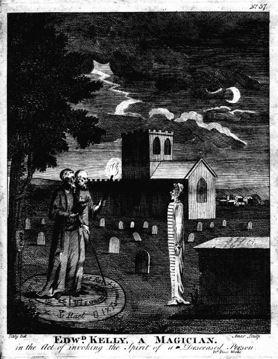
Last night I dreamed yet again. I felt myself drawn to a place where the mage stood, with another old man. They were huddled together, standing on a spot where strange devices had been scored upon the earth, as though the perimeter of the devices protected them from some evil or force beyond their control. I approached them as though through mist, or through the hall where I had first encountered the old man (though now it seemed plundered and ruined), all becoming clearer as I came close to them. At last I stood before them, a hand’s reach away, but outside their magic circle. The old man spoke to his companion.

“Strike with your staff upon the point of the heptogram, Master Kelley, and make it speak.”

At this, a look of annoyance passed the other’s face.

“I am known as Talbot now, and not by my old name. How many times do I have to say so before you remember!” He turned his eyes towards me, and drew himself up, rapping three times upon the ground with his stick.

“Speak, spirit,” he said. “Speak or be returned whence you came, and shut again in your arrow-chest. Speak, I command, in the name of an holy Power!”

“Whom do you command to speak?” I said. “I speak or do not speak at my own will, not yours. I say what is in my heart and mind, when it pleases me to open my lips. I am not bidden by anyone to speak or to stay silent, to come or to go.”

My old mage – I now thought of him as somehow mine – smiled a little, but the other became agitated, and struck again several times with his staff.

“I charge you to speak,” he barked. “Are you from Paradise or from eternal fire?”

“If you rap much harder on the ground,” said my mage. “You will find out first hand, as we shall fall through and into hell ourselves!”

“Paradise or flames?” I said. “A room in the Tower is not Paradise, though it is comfortable enough for a while; nor is it hell, for all its dreary solitude. Rather say it is purgatory, as it affords much opportunity for reflection and repentance!”

“Speak not in riddles!” cried the other. “But answer plainly, I charge you, by the angels!”

Patient now, my mage interjected, “Peace, Master Kelley; I know her, I know of her – she speaks what she thinks is true. She knows naught of heaven or hell, but lies where she lies, with her last memories, waiting for the graves to give forth their contents.”

“Master Dee, you may have traveled much, you may have been to Bohemia, and to Poland (where, I have heard, men have tails), but in these things you are ignorant. She is a spirit, and as such she has seen things you and I have not. And she is bound by the enchantment and invocation I have made, to tell us the truth. This fiddle-faddle she gives us is but her resisting my power, and it cannot last.”

“I know nothing of spirits,” I said. “Except that Saul was damned for causing one to be conjured up. I am none such. I am a queen, albeit one cast down. And Master Kelley or Talbot or whoever-you-may-be, you would be well advised to address me with more deference, and indeed to desist from your imagined conjuring.”

At this moment, my old mage turned eyes on me that held more pity and kindness than I had ever seen in him. There was such sorrow in his voice, when he spoke again.

“Master Talbot, it is clear to me that she is telling you the truth, though you cannot see it. Madam… Mistress… Your Majesty… “

His voice faltered, as though he had something difficult to say.

“Can you tell me where your favourite French headdress is at this moment?”

“Certainly, sir,” I replied. “I have it in my hand.”

“Madam, you have more than your headdress in your hand.”

At that moment, in my dream, I saw his meaning clearly –though I knew not with what eyes I saw that which I saw, for my own eyes looked up at me – and I screamed. My scream was choked by my awakening. Dreams are beyond fathoming, the pictures they paint are strange, their meaning is deep and often unholy…  and it is now today.

There is my gown, and my headdress; there also is my little book of psalms in French, undesecrated. I will wear my gown and my headdress today, and carry my psalms with me when I walk outside. I already have in mind what I will say:

Good Christian people, I am come hither to die, for according to the law, and by the law I am judged to die, and therefore I will speak nothing against it. I am come hither to accuse no man, nor to speak anything of that, whereof I am accused and condemned to die, but I pray God save the king and send him long to reign over you, for a gentler nor a more merciful prince was there never: and to me he was ever a good, a gentle and sovereign lord. And if any person will meddle of my cause, I require them to judge the best. And thus I take my leave of the world and of you all, and I heartily desire you all to pray for me. O Lord have mercy on me, to God I commend my soul.

But as I kneel, and before the swordsman scythes my head from my body, I shall think of my old magus. Then I shall breathe a short, Plantagenet prayer, and hope that my daughter, who has my eyes and my hair, will never be a queen, but will live her life a country lass, safe at home. For the burden of queenship is too heavy.
The Stag – a fable*

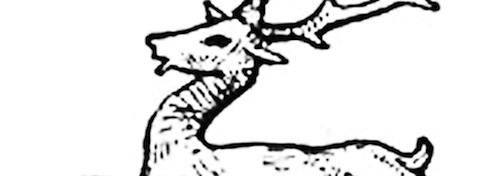
Deep in the heart of the realm of Angria there was a forest. In that forest lived a stag, perhaps the finest stag anyone had ever seen, his antlers spreading like the winter branches of an old beech tree, his flanks red as the ire of winter dawn. In a house just outside the forest there lived a hunter who had vowed to trap and kill the stag, to wear the antlers as his headdress and the russet hide as his cloak. But the stag was many years in age and full strength, wily, swift. He valued his freedom and would bound away while the hunter was still fitting a quarrel to his crossbow. Season upon season, year upon year, the hunter stalked the stag. Prey and predator knew every inch of the forest, every tree, every thicket, every faint sentier, every clearing, every pool, every shadow. At the beginning of one year the stag lifted his head to a new sound, the steady fall of an axe against a tree trunk. He thought little of it as such things are not the concern of deer, but nevertheless he moved through the forest to a place where the noise did not crowd as badly upon such things as did concern him. The sound continued throughout the year, but still the stag thought little of it. Then one day when he approached the edge of the forest he found that his kingdom was much smaller than he remembered, and his way out into the open fields beyond the forest was blocked. There was a high, wooden fence. The hunter had chopped down many trees to make it, and it was cammed in cruel, sharp points. The stag ran to the other side of the forest and found the way blocked there also. He ran along every path he knew and everywhere his was way barred by the fence. He plunged through thickets and briar patches through which he had never gone before, but the fence always thwarted and confounded him. Wherever he could get a run he tried to jump the fence but always, from outside, came the hunter’s mocking laugh or a warning bolt from the crossbow. At last the stag could endure this no more and risked everything on one last, desperate leap. The fence was higher than anything he had ever cleared before, but he gathered all his strength and courage, fixed his eye upon the blue sky above the cruel, sharpened points, and ran. He left the ground, he flew, he soared, wondering if this is what it felt like to be a bird. In mid-leap he could see the open farmland and the hills beyond. It was at that moment that the hunter, who had been waiting for him, loosed his quarrel. It went deep into the stag’s body, right to his heart, checked his leap, and brought him crashing down onto the sharp points. The stag’s eye was still fixed upon the sky and the far hills but now it saw nothing. When he saw what he had done, the hunter dropped his crossbow and his quiver and walked away. He was never seen again, and his house became a cold and empty ruin.
__________
* (c) from ‘Branwell’, a work-in-progress.

An excerpt from ‘The Chronicles of Anna Lund of Helsingfors, Vampire Hunter’

I can remember a cold evening, very cold, my toes numb in my boots, my fingers aching in my muff, so much so that I wanted to take them out and suck them to make them warm. I was huddled close to my father, his left arm was round my shoulder, and our feet crunched on the snow as the skirts of his coat flapped outwards at my thighs and legs. We were hurrying, and I felt that it was not so much because the winter snow was whipping at our faces, but because it was late. My father was in haste to get home, almost as though he was afraid. A few lights from windows and elsewhere threw patches of yellow glow on the snow, but though every flat surface was white and the wind was drifting it against walls, there were still shadows too dense for my half-shut eyes to see into, and pieces of black wall standing crazily upright like broken teeth or gravestones. Snowflakes clung to my eyelashes, and there was enough warmth in my face to melt some of them and make them run like tears. My legs propelled me almost to fast for me to stay upright, and had it not been for my father’s steadying arm, I believe I would have tripped over my numbed toes. My body and my breath were hot from effort, making my extremities feel even colder by contrast. If there was any sound apart from the crunch of our footfalls – which I seemed to feel rather than hear – it was lost in the wind that buffeted my ears. A winter night in Helsingfors can be cruel.

Then there was a moment when I came closest to falling; that was when my father suddenly stopped. Again I can’t be sure of sounds, but I think he gasped. He pulled me closer to him, pressing my face into his coat. It was rough and harsh against my skin, and I couldn’t breathe, so I slowly twisted my head so I could see out of the corner of my eye, between two of his long fingers as they barred across my face.

I thought I could make out that we were close to our home. If it had been bright daylight, I might have recognized the place where the street bent to the right, and to the left an alleyway led up narrow steps before making a right-angle and losing itself amongst the tenements and go-downs of the city. High on a wall a casement was flapping open in the wind, wrenching back against its own hinges. It was allowing a light to shine down upon the mouth of the alley and the steps. At the margin of the patch of light there seemed to be two vague shadows. One was like a crumpled shape on the ground, the other seemed to bend or loom over it; as the snowflakes dashed against my face, the two shadows seemed to merge into each other, separate, and merge again. Then suddenly, the lower shadow was alone, the looming shadow had disappeared; but instead there was a figure standing at the top of the steps, a man in dark clothes. The light from the casement shone directly onto his face – it was as though his face attracted it. To me it seemed as though his bright eyes were fixed upon me and only me, and he was looking at me, memorizing my half-hidden features. He was grinning, a nasty, fixed grin, and there was something about his teeth – I could not take my eyes away from his grin.

The wind blew my father’s coat across my face for a moment, and when it flapped back again the top of the steps was empty. The man had gone.

Once we reached our house, my father took me up to my bedroom and made me lie down for the night. I didn’t go to sleep immediately, and my father sat there beside my bed, his head bowed as though he was praying. When I did go to sleep – I seem to remember – my dreams took me back to the mouth of the alley. It was always deserted, not only free of snow but as though the steps had been swept by a broom. The casement was always tight shut and curtained. There always seemed to be the echo of running feet…

__________

‘Anna Lund’ is a casual, on-going project of mine. Something might come of it.

Of Sam, Miss Smith, and Justice!

When I was young I read a whimsical book by Beverley Nichols entitled The Tree That Sat Down. The story is set in a wood where four human characters – Judy and her grandmother Old Judy, and Sam and his grandfather Old Sam – run two rival shops. The Judys’ shop is set in the crook and hollow beneath an old willow tree, and there they sell all kinds of good and wholesome things to the talking animals of the wood. The Sams are newcomers and set up a rival shop in a ruined Model T Ford. Young Sam is a hoodlum and uses modern advertising techniques to sell worthless things to the animals, many of whom are nonetheless taken in. Sam recruits the help of Mr. Bruno, a bear who is basically decent but weak. In order to impress the woodland animals, Mr. Bruno has always pretended to come from ‘The Steppes of Russia’ and to be able to speak Russian, but Sam blackmails him, having recognized him from a visit to the circus from which Mr. Bruno had escaped. He becomes Sam’s bearspaw and bearsbody, doing nefarious errands for the young entrepreneur.

Into the wood comes a character who comes and goes through several of Beverley Nichols’ children’s books – the witch Miss Smith, with her attendant squad of toads. Though two or three centuries old, Miss Smith presents herself as a young lady of fashion. She is thoroughly evil, and Nichols describes this in a simple but succulent way:

“… all the evil things in the dark corners knew that she was passing… The snakes felt the poison tingling in their tails and made vows to sting something as soon as possible.  The ragged toadstools oozed with more of their deadly slime… In many dark caves, wicked old spiders, who had long given up hope of catching a fly, began to weave again with tattered pieces of web, muttering to themselves as they mended the knots…”

Sam accepts her help in his commercial war, but soon finds himself dominated by her. She suggests sending a poisoned gift, which she will make, to the Judys. Sam seems terrified at the implications of this, but mutely agrees, and Mr. Bruno is forced to deliver the deadly package. He sets off to do so, but at the last moment surrenders in tears to Constable Monkey and Mr. Justice Owl.

The animals put young Sam on trial for his life. Prosecuting counsel is the Judys’ best friend Mr. Tortoise. Mr. Justice Owl, despite his incompetence, conducts the trial, and Mr. Bruno, Miss Smith, and even the toads (“Swelpmesatan” they croak in chorus as they take the oath) give evidence against Sam. A storm is coming, the wind is rising; Judy looks at Sam cowering in the dock and feels nothing but pity for him. She shouts for mercy, but her cries are carried away in the wind. She looks up to the clouds and prays for some power to save Sam. The clouds roll back and she sees the stern face of the Clerk of the Weather – an angel who had once complained to God about the remorseless sunshine of heaven – who sends a tornado to blow Sam away to a new but hard life.

Mr. Tortoise transforms into a handsome prince – he had been turned into a tortoise until he had learned to better his ways – and marries Judy.

I can recall how incensed I was as a child by Sam’s trial. Certainly he was a wrong’un, a capitalist, and a racketeer, but how could it be fair? The judge was incompetent, the jury of animals was prejudiced against him after learning of the plot to kill Judy, and he had no defense counsel. Moreover he had been an almost-unwilling party to the plot, which had all been the suggestion of Miss Smith. She had made the poison. As far as I could tell Sam hadn’t even touched it, Miss Smith put it into the hands of Mr. Bruno, and now these two co-conspirators were giving evidence against him. I shouldn’t have had any sympathy for Sam, but my outrage was more practical than Judy’s pity. I imagined myself imposing my presence – a girl no older than Judy at the time – upon the court as counsel for the defense, showing how inadmissible the evidence was, how unreliable the witnesses were, how little a part Sam had actually had to play in the scheme, and dashing the prosecution’s case to pieces! How delicious it would have been to have had a battle of wits with Miss Smith as a hostile witness.

As I could not do that, I went through the book from the beginning, scoring out any bad thing that Sam did or said and writing in a virtuous alternative characterization. By the time I had finished the pages were thick with crossings out and were a palimpsest of redemptory fiction.

That was, I believe, the only time I had ever desecrated a book. I am rather glad I did, though, and if I ever get the time and inclination, I will search the second-hand book stalls and car-boot markets for Nichols’ other books that feature Miss Smith. It seems that she catalyses my creativity. I’ll put my pens well out of reach, though.

The Haunting of James Abbott McNeill Whistler

It is late on a rainy winter’s afternoon in the Hunterian art gallery in Glasgow. Little daylight finds its way into to the interconnecting rooms and the artificial light is yellow and diffuse, or seems so to the gallery-goer who is standing in front of a pair of paintings. They are behind one of the last few partitions at the back of the gallery, almost hidden from view unless one knows they are there or have happened on them in a spirit of exploration. The gallery-goer has to look slightly downwards to see them, as there are two other paintings above. These other paintings have only held her interest for a moment or two, but the lower pair seem to have transfixed her. She shifts her stance slightly as if to alter the angle of her gaze and lose some unwanted glare or reflection from the literal surfaces, and thrusts her hands in the pockets of her coat to quell an urge to reach out and feel the texture of the paint. She reads the laminated plaques at the side of each painting and confirms that they are by James Abbott McNeill Whistler and are part of the bequest of his sister-in-law Rosalind Phillip.

Whistler has never been her favourite painter – she prefers German Expressionism if anything – but at this moment she feels a compulsion to stand and let her emotional and intellectual reactions overlay each other, confuse her, vie for strength like two equidistant radio stations fighting for the capture effect. Arranging her thoughts like clothes on a washing-maiden to dry, the gallery-goer builds the following analysis.

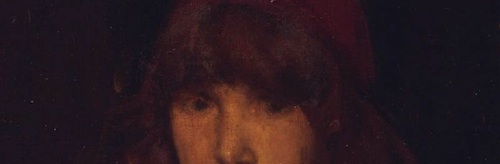
The composition of each painting is simply the figure of a seated girl from the waist up. She has long, full, auburn hair with an untidy fringe touching her eyebrows, and tresses which rest on her shoulders. She wears a purple beret or small cap on the top of her head, pushed back. She is dressed in shapeless, dark clothes, maybe brown, or black seen with a reddish sheen by a dim lantern or firelight. In one painting her body is angled slightly away from the artist and she has turned her head towards her left shoulder to look directly at him. Her hands rest on her lap but the delineation is imprecise, they are pale and doll-like, or like hands on a photograph from Belsen. In the other painting she is slightly more squarely-on, her hands are out of sight. At first it seems that her gaze is straight towards the painter again, but perhaps she is looking to his right and slightly down. The second painting seems to have been executed with a darker palette, but in both cases it looks like paint has been applied and then has been scraped thin. The texture of paint and canvas are one. The modeling is uncertain, the girl’s pale face seems to be the only source of light. The picture space has almost no depth, as though she is sitting directly in front of a dark wall with her back pressed against it. The tone in the first painting is stark in its contrast between light and dark even though the background colour is a warm brown; the white of the girl’s hands and face are almost shocking, and although her gaze engages the artist and the viewer there is a remoteness, we are at arm’s length from her. The second painting is darker overall, but the tone of the girl’s skin is softer, there is more colour to her cheeks. She seems to be closer to us, and although her gaze is slightly averted the whole effect is more intimate. In both cases her face dominates the picture, drawing the eye into an uncertain virtual space full of ‘as though… as though’.

The gallery-goer does not know how long she has stood looking at these paintings. She becomes aware that someone has come to stand at her left elbow, though she did notice this person arrive. The other person speaks to her, and in the exchange that follows tells her a story, or maybe more than one story.

*

Beautiful, isn’t she! You don’t think so? Well I’ll grant she isn’t conventionally pretty. Her nose is long, her mouth is canted slightly downwards to the left, her expression is mournful, her complexion seems pale and warmed only by external influence rather than by her own blush, and – look here – that could almost be a scar. No, I think it is more likely to be the violence of Whistler’s palette-knife as the mark is only there on one of the paintings. But her face holds you nonetheless. Am I right?

You are wondering why the title, why ‘Le Petit Cardinal’, why present the model as a male? There is something a little androgynous to her looks I agree, but it’s obviously because of that purple cap she is wearing. Whistler painted and drew her several times with that cap on her head. Her name is Lillie Pamington. Very little is known about her apart from her having been one of several street-girls who caught Whistler’s eye in London. One can imagine he was passing in a Hansom cab when suddenly saw her in her dark coat and purple cap, weaving her way in between the press of people on the pavement. He was captivated, just as you are, by that pale face in the gaslight, bobbing along like a jack-o-lantern amongst bushes, and he rapped the roof of the cab with his walking stick – Stop, cabbie, stop! – and jumped down onto the kerb.

Miss. I say there, Miss. Young lady with the purple cap! Picture her halting, looking over her shoulder to see who was calling. Maybe he gestured her to come. Maybe she placed one of those pale hands against her chest as if to ask Me? or as if she were trying to still a racing heartbeat, unsure in her mind whether she was to be the subject of a hue-and-cry as a thief. Picture him holding out a business card. Can you read? Come to this address then, I would like to paint your portrait. Did her face remain solemn and sullen or did she smile? Was she instantly trusting or did she rebuff him at first with a few choice words of cockney? We know that she did turn up at Whistler’s studio because we have the evidence right here in front of us, but for now picture her purple cap bobbing down the street, soon lost amongst the crowds. Oi guv’nor the cabbie would have called. You want this cab or not? I’m losin’ fares.

Imagine how, a day later, she arrived at his studio, that there was a knock at the door and that when he opened it Whistler was at first puzzled. Who could these two people? One would have been a child of about fourteen with a painted face and elaborately-curled hair, the other a woman, her hands resting lightly but proprietarily on the child’s shoulders. I made her look nice for you, sir – a proper little lady to ‘ave ‘er portrait painted. Whistler would have come to realisation, and would have been horrified. No, no, this wouldn’t do – where was the solemn waif with pale face and auburn tresses that had captivated him in the street? This was a sham, a travesty, a mockery of her beauty. Imagine how he controlled his emotions and explained to the woman, as her smile faded, that he wanted her daughter – was the woman actually the child’s mother? – just as he had first seen her, and turned them away from the door. How he would have fretted for the next few days, cancelling all the sittings he had scheduled in case the woman and child returned. Would they return? There had been no mention of payment. Should he patrol the street where he had first seen her, or would that risk his not being at the studio when the next knock came?

It might have been one evening ten days later that Whistler resolved that the next day he would stop waiting for Lillie Pamington to come, and would arrange other sittings again. Imagine a light step outside and the rap of a small fist upon his door. Imagine that he opened it and saw standing in the shadow… Lillie with the pale, solemn face, with the unruly waterfall of auburn hair, with the dark coat and purple cap. Standing alone, silent. Would he have let her in without a word, or would he have smiled and said, Delighted to see you, Miss Pamington – so glad you could come, please do step inside.

What was the obsession that drove him to paint and draw her over and over again, clothed and naked? We know that he was a womaniser, and that he sired many unacknowledged children by his mistresses. Did he see in Lillie some echo of Joanna Hiffernan, the lover whom he had lost to Gustave Courbet? We do not know, Whistler never told us and as for Lillie she suddenly disappeared from his life and became obscure once more.

But imagine this. Imagine Whistler, having used up all the obsession he could on painting her, throwing his paintbrush down one evening and taking her in his arms. A kiss for ‘Uncle James’, Lillie? A struggle would have happened – I’ll tell! I’ll tell! – and he would have silenced her, consigned her limp remains to secrecy and sworn to all inquirers that he had sent her home at the usual time. But the stress of keeping the secret as a matter between himself and his burdened conscience would have weighed upon Whistler, so much so that he might have spent hours gazing upon ‘Le Petit Cardinal’, at his study in ‘Grenat et Or’. One night he would have fallen asleep and awakened to see nothing but her pale and solemn face looking out from the portrait. It would have seemed that the face detached itself from the painting and approached, as though Lillie was walking towards him. Imagine that was the first of many such night-time visitations, and that eventually he could stand no more and, snatching up his palette-knife, slashed at the apparition. Imagine that in the daylight that eventually followed, the mark of the knife was to be seen on the painting. Imagine, perhaps, that years after Whistler’s death the skeleton of an unidentified girl was found in blitzed-out rubble somewhere in London.

No? You don’t like that story? Well then, imagine this alternative. Lillie came willingly to kiss ‘Uncle James’, and her kiss was sweet as pomegranate juice but sharp as broken glass, and that she came and went as she pleased at night until Whistler wasted away and died, his life entirely drained from him.

You’re right, of course. The official story is that he was ill, that he was broken-hearted after the death of his wife Beatrix, and I’m sure that is much more likely than either of these tales. How could they be true? But just look to your right, look at his last self-portrait. Gone is the confidence of the young man in the tilted, broad-brimmed hat, gone is the flash and dandyism. Originally he painted himself in a white coat, but something made him scrape off most of the paint and re-execute the work in black or dark brown. The stance and gestures are clearly in imitation of Velazquez; but the hands are indistinct as though fluttering and fretful, the right hand perhaps on the point of being raised to repel something, the left hand just holding his coat closed, a hesitative protection. His entire weight is on his back foot, as though he is leaning away from something. His expression – his eyes – he is looking down as if at the approach of someone a good deal shorter than himself, and he is staring with horror. What is he trying to tell us? What secret is he only just holding inside?

*

This is the point at which the gallery-goer realises that the other person has fallen silent and, moreover, that the gallery lights have all been shut off apart from the single, dimming lamp where she has been standing. The gallery is in complete silence, the only sounds are faint and come from outside. The most luminous object in her line of sight is the face of Lillie Pamington in the portrait.

The other person is still a presence at her elbow, just outside her peripheral vision.

Who are you? she asks. What are you?

I may not tell you, but I may show you, says the other. Come with me.

Bat, man, batman, batsman.

Crypto-anthropology is a word I thought I might have invented (like ‘polemophonic’ – pertinent to the sound of warfare, ‘polemophonics’ – the study of the sounds of warfare) but it seems not. A pity, considering my interest in the Moosh-Moosh. But then I didn’t invent ‘futilitarian’ or ‘eukelele’ either, although the latter is only a pre-existing, alternative spelling. Here is my butterfly mind flitting from flower to thoughtflower for the brief summer of its life, digressing from the off. Here’s what I mean to say:

Cities grow. Ours did. Track outwards from the centre and you will see where the margins were, how they advanced and were filled in, how they swallowed neighbouring villages and towns, how there are rural names for roads and faubourgs mixed in with the newer names that commemorate royalty, trees, Scottish islands. Between the city and me there is woodland and parkland, but in that woodland there is a golf course. Golf courses are things of the Scottish ‘edge’ as farmers diversify in hard times. Also there is a water tower for the nearest of the city’s housing schemes that lie on the other side of the wood. The parkland, once the estate of a conquering admiral, is now a pleasure park for the citizens, complete with zoo and funfair. Only on the edge could such things be.

Is my village itself still a village? Its dormitory status makes it almost a suburb, yet it has or had a number of edge-features – a caravan park, and at one time an indoor play-area for children with a ball-pool and such like. Oh flit, flitter, flutter, fritillary. Anyhow, here’s what I mean to say… no really…

Attached to our Millennium Hall are a bowling green and playing fields. There is fitba of course, but also a cricket pitch. Cricket is not unknown in Scotland, of course, and much further north in the land too, but it is nevertheless a curiosity to many, something you would have to turn your head to gawk at if you were passing on a bus. It isn’t entirely a haven for expatriate English and third-generation South Asian Scots either, but it is an edgy place where crypto-anthropology has recently taken a strange turn. I think so. I had to think so when someone told me that the cricket team had a member who was half-man and half-bat.

I remember thinking that they were making a play on the word ‘bat’, but no, they meant it literally. There is a man nominally on their playing strength who has the arms and wings of a bat. He goes by the name of Doug Millar. He can fly, though he hardly ever does, and only once has done so on the field of play. He was fielding at silly-point when a farmer’s son from Forfar let fly a square cut with his full strength. Doug dived out of the way to avoid harm – there was no way he could have stopped the ball, let alone caught it, without risk of injury – and in diving he spread his wings. He only flapped them once but that was enough to allow him to glide over the outfield towards the Third Man boundary where he banked sharply, caught a thermal, and soared. Thankfully the umpire was about to call a drinks break anyway and Doug wasn’t even off the field long enough to warrant substitution by Twelfth Man. He returned red-faced and apologetic for his lapse.

Doug is not of this world. He is a Thogrian, which many folk mistakenly write as ‘Thorgian’, a unique marooneer on our planet and a castadrift from the world of Goldilocks 4. The cricket club doesn’t shout about him, they’re cagey blokes. If he could handle the willow or the cork-and-leather a wee bit better, or if ever he flew from Fine Leg to take a catch at Gully, it might cause questions amongst the rules committee of the league in which our village team plays. But he’s a plodder with both ball and blade and an average though conscientious fielder, driven less by skill than by his love for the game.

I have always wanted to talk to him but have never succeeded. I heard that he was due to be at the last home game so I went there and hung about the pavilion, searching amongst the whited players on the field or waiting their innings on deck chairs. I couldn’t see him. Then someone told me he was in the scorers’ hut for that match and couldn’t be disturbed. And that’s when I caught sight of him, very briefly, walking back to the hut with a tray of teacups and a teapot, his wings folded across his back. For some reason he had affected a Mohawk haircut.

I am told that if he excels in any respect it is as a scorer. His entries in the score book are precise, instant, and accurate. He uses an ancient Parker fountain pen but never makes a blot, and indeed there is a little Gothic flourish every time he records a ‘W’ for wicket. I think that he’ll be in that hut whenever I make an appearance at the cricket pitch. I think I have missed my chance. The hut is sacrosanct.

You see… I want to tell him that I can fly too, even though I only have conventional arms. I can’t soar as he does, though I have tried it once or twice when leaping from the King’s Seat, beyond Abernyte. Each time I could feel the wind under my arms, but my descent was too rapid and I had to resort to flapping hard to maintain any height and to land safely. I want to share with him that sweet, intimate knowledge of the upper air and of seeing the land turn beneath me. I have to speak this truth to someone who will not say I have been dreaming.

‘A Woman on the Edge’ – workshop project of prose and poetry, part 3

The moosh-moosh

In the marginal lands between city and countryside there lives a type of rare hominid known as the ‘moosh-moosh’. The name appears to be of Romany origin and until recently these shy creatures would only reveal themselves to travelling folk. In fact so secretive and shy are they that most settled folk continue to deny their existence.

Their natural habitat is, or was according to anthropological speculation, the cave. However since intensive agriculture has decimated the wild places of Britain in the south, and deforestation and sheep-farming has done the same in the north, the moosh-moosh have moved into the new wilderness that humans have created, the wilderness that is neither urban nor rural but which is found on the margin between the two.

In build they resemble humans almost exactly, except for their apparent superior muscle tone. They are stocky but not fat. Their skin is pale but is hardly visible except on the face, the rest of their heads and bodies being covered in a light, reddish-brown fur. Their faces are large and broad but not un-handsome. Some observers believe them to be descended from the last remnants of the Neanderthalers, but this is mere speculation. They go naked but appear to be totally without any sense of shame. Deprived of their natural habitat, they have occupied such spaces as unwanted cargo containers. A small group was discovered living in an old Nissen hut on what was a WW2 airfield but upon which a new housing estate was encroaching, and it was this extended family that became the first moosh-moosh to encounter its homo sapiens cousins, or at least the settled and civilised branch of our species, with more regularity than before, gaining a certain controversial fame in academic circles and becoming a minor tourist attraction, especially for a few savvy if brash Americans.

Communicating with moosh-moosh is problematical. Folklore tells us that they and the Romany people once made themselves understood by a system of mutual hand-signs and by a few syllables of human speech, but if that folklore is based on truth it is a tenuous truth and the faculty has long-since evaporated. The interface between us and the moosh-moosh is akin to that between an adult and an autistic child, except that they will meet our eye with a steady gaze. There is no hint of comprehension in that gaze, with the exception that if you hurt one of them their expression hints at puzzlement and sadness. They seem to be asking silently “Why?” Violence is alien to them.

Their own speech sounds like a cross between the cooing of doves and a human whistle. It is quiet speech and they use it sparingly, spending long periods in communal silence. I have tried to imitate their sounds whenever I have been amongst the ‘Nissen Family’, as this particular group has come to be known, and whenever I have done so they have turned a softened gaze upon me as if to say that they appreciate my attempts. The only time I have ever seen a definite communication between moosh-moosh and homo sapiens was when I arrived at the same time as a knot of transatlantic tourists. The moosh-moosh were about to eat, which they do communally, and a female came behind us making insistent, shepherding gestures, urging us to sit down with them.

Moosh-moosh food is simple, consisting of a kind of cake made from the seeds of wild grasses sweetened with honey or with whatever berries are in season, or flavoured with hedgerow herbs. They share their food evenly between all who are present, even with homo sapiens, although the latter sometimes find it hard to digest. I am always conscious that they have scarcely enough to spare. In winter they are, if anything, less semi-visible than they are at other times of the year; it was thought that they hibernate – the Romany always said so – but in fact they spend most of this time when little sustenance is available huddled together for warmth in foraged straw and under salvaged tarpaulins.

Their groups and extended families are without hierarchy and are highly co-operative. If two or more discrete groups should meet there is no competition, but rather all direct themselves towards mutual benefit. Their delight is in each other, and it is a full and complete delight.

They make no art, no music, and of course no literature, but their appreciation of the natural world appears to be total. It is an appreciation apparently not born of awe or of anything mystical but rather seems to be one of immersion, joy, participation. It is a happy state free of the twin mental yokes of religion and science, a state which proves that mutuality rather than competition is the highest law of evolution.

The last time I sat down with the ‘Nissen Family’ of moosh-moosh I felt their hands gently resting on my shoulders and arms. Their gaze had softened and seemed to express some kind of sympathy. I realised that I had been crying. I tried to smile, and indeed their caresses were comforting, but this display of empathy, this acceptance of myself almost as one of them was so poignant that my tears continued. There was so much I wanted to say to them.

Oh, my dear Nissen Family, as dear to me as my own family! My dear, precious, innocent moosh-moosh! If only you knew my true nature and the nature of all of my brothers and sisters, the homo sapiens. If only you knew the depth and height of our jealousy, our insecurity, our vainglory. If only you knew how cruel we are. You, I know, are no children except inasmuch as you have preserved the innocence of childhood. You are no distant cousin, no Neanderthal throwback. You are of the same root and stock as we are, you are people, but you are people who took the decision long ago to follow the path of pure wisdom, to seek nothing but that which was good, nothing but what you actually needed. You are wise beyond our capacity to be wise. Yet in that wisdom you are as foolish as saints. What are fences and hedges to you? What are the divisions and boundaries that we set up in the face of nature to you? What are the frowns on the faces of farmers and householders to you when you forage their barley and their chives? What is our folly to you, the folly that points to something and says “Mine”?

If only I could convey this to you before it is too late, before you become nothing more than a dwindling number of anthropological or zoological specimens, a theme park, ‘Moosh-Moosh-Land’, an insignificant detail of history, a small entry in Wikipedia, a cuddly toy. If only you would realise this before we come for you, before we take you away, before we make you our playthings, before we study, catalogue, abuse, dissect, and destroy you, before we turn upon its head your evolutionary success and make a lie out of it. We are monsters, my dear family, monsters. We are ugly in our complexity, ogres, madmen!

You sit here in utter patience, lambs of the God you do not know, every one. Why do you not start up, why do you not run? Why do you not find all your tribes and families and hide in what remains of the forest? Why do you not go deep into our abandoned mines and conceal yourselves? Why do you not remove yourselves from our sight and memory before we remove you entirely from the world? Why do you sit so patiently, witnesses to all that is good, a light that will soon be put out? Are you somehow driven to prove to us what brutes we are?

We are your brothers and sisters but we are also your executioners. We hold your death warrant in our hands.