Marie Marshall

Author. Poet. Editor.

Category: fiction

A Tale from the Hill Country

Curl Up and Burn
short story by Samuel Snoek-Brown
http://eunoiareview.wordpress.com/2013/02/03/curl-up-and-burn/ 
review by Marie Marshall

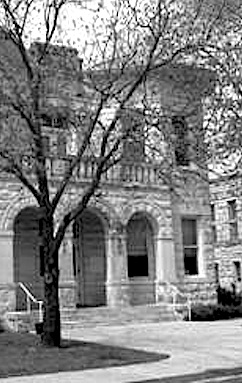
Kendall County Courthouse, Texas.

Kendall County Courthouse, Texas.

I would not normally review a short story, but this particular one by Sam Snoek-Brown is ten-thousand-or-so words long, and if the narrative were expanded it would start to knock on the door of novella. However, a short story it is, lean of excessive development and sharply focused. That leanness pulls us along and makes sure our attention is not diverted.

The subject matter is a ‘statutory rape’ case in Texas, its effects on the community and the persons involved, and its aftermath. The story’s style of presentation is one of reportage. It is written as if it is a magazine article. The narrator is as detached and non-judgmental as an investigative reporter, but his presence ‘interviewing’ and interacting with the personae of the story allows their character to be drawn out. The cut-and-paste nature of the narrative allows it to be episodic, which accentuates that drawing-out – for example, the meeting between the narrator and the convicted man’s father, the latter’s pickup blocking the road, a shotgun pointedly on display on the gun-rack, is loaded with tension and menace.

Another thing that this episodic treatment enables is a presentation of the ‘facts’ in a non-linear way. The fact that a man has been convicted of statutory rape and has served twelve years in a tough prison is made known very early in the story. The details of the case are revealed, but not necessarily in chronological sequence. Rather they are cut with historical detail, sections of modern supposed interviews with townsfolk, and with descriptions of the protagonist’s drives around his home town, where he and the crime of which he has been convicted are well-known, and of his obsession with building and maintaining a model of the town in which things he observes in everyday life modify the layout. Essentially there is no final resolution to the story, but we do realise that a story has been told. The protagonist’s final statement is terse, almost threatening in tone, but remains enigmatic.

Adding to the air of reportage is the research, including historical research, that the author has pasted into the story. The story is set in a real town in Texas – the author himself was brought up in Texas and can therefore be relied upon to give the setting an air of authenticity. Of course his storytelling style does take over from the journalistic style in places, notably in the descriptions of the protagonist’s run-in with his Nemesis, a local Deputy, and the title is a storyteller’s title, not a journalist’s.

I have a couple of niggles – no story is perfect, let’s face it. Firstly there is much made of a teenage girl’s ‘chatting on the internet’; I don’t know whether Texas was a long way ahead of us (I’m writing this from the point of view of a British reader), but in the early 1990s, when this was supposed to have taken place, chatrooms and emails were not as common as they now are, and most households, if they had a computer, were on a dial-up system for the internet, which took up phone time and therefore parents’ money. I could be out-of-touch, but this detail momentarily halted my ride through the story. Secondly, the girl in question is Chinese-American, and whilst her father has the English given name John, her full name appears to be wholly Cantonese. When a Chinese character appears in a work be a non-Chinese writer, I often wonder – maybe unfairly, I’ll grant you – whether her name has been plucked out of the air. I put the name of this character into an image search engine and came up with pictures of a male boxer. Like I said, these are only niggles, and could be my own reading quirks.

When it comes down to it, this is a compelling story, excellently written and insightful, moral but not moralistic. Sam Snoek-Brown is a tireless craftsman of the short story, and Curl Up and Burn shows that he has been working out.

‘On The Platform’ at Fearie Tales

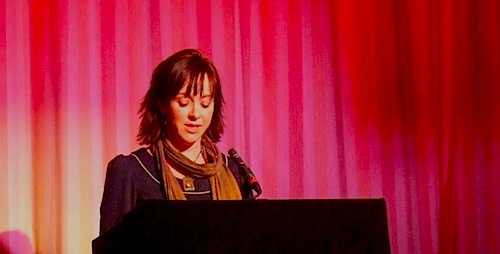
Helen Logan reading ‘On The Platform’, 1st Feb 2013. Image © Bookseeker Agency

Helen Logan reading ‘On The Platform’, 1st Feb 2013. Image © Bookseeker Agency

As previously reported, my short story On The Platform was one of the winners of this year’s ‘Fearie Tales’ competition at Pitlochry’s Winter Words Literary Festival. Winter Words kickstarts the literary year for Scotland, and features a list of writers and other people in the public eye. ‘Fearie Tales’ is its annual competition for stories of a ghostly, macabre, or supernatural nature, and this year actress Helen Logan gave my story a highly atmospheric reading…

… a young woman is waiting on a lonely station platform late at night… she meets a strange, dark man who starts to talk to her about supernatural matters… is one of them a ghost, and if so, which one?

The audience, which included broadcaster James Naughtie, was rapt throughout the reading and appreciative afterwards. Already I have ideas buzzing for my entry to the competition next year!

How Tam o’ Shanter came to be written – a tale for Burns Night

detail of Faed's Tam

Was it a year ago now, since last we piped in the great chieftain o’ the pudding race, that we raised an amber dram, that we all gave a hearty slainte mhath! There was one braw lad whose eyes were twinkling with glee and single malt, who rose and recited – without a prompt – the auld tale of Tam o’ Shanter, the skellum the blethering, blustering, drunken blellum. Aye, aye, and how we laughed, how we all chorused “Weel done, Cutty Sark!” And how we cheered on old Tam was he whipped Maggie his mare towards Doon Water and the Brig, held our breath at the last loup of Nannie the witch to grab the mare’s tale as Tam won to the key-stane o’ the brig, and yes, how we let it all out with a big gasp when he was hame and free. More, how we winked and smiled and nodded at each other when our impromptu Makar wagged his finger and said:

Noo, wha this tale o’ truth shall read.
Ilk man and mother’s son, take heed;
Whene’er to drink you are inclined,
Or cutty sarks run in your mind,
Think! Ye may buy joys o’er dear –
Remember Tam o’ Shanter’s mare.

Aye, aye, and we clapped and cheered of course, and shouted out, “More! More!” – and of course there is no more, for no one, least of all our national Bard, ever wrote The Further Adventures of Tam o’ Shanter. But of course the moment passed, and then someone got up and sang My Love Is Like A Red, Red Rose to which we all listened in silent transport, some of us with our eyes upturned in wistful sadness as we remembered the Joes and Jeannies of our youth. And at the end of the evening we all declared “A Man’s A Man For A’ That” as we shook each other by the hand.

That was a night, but then it always is, isn’t it.

Look, let me tell you something I heard. How Tam o’ Shanter came to be written. The tale may surprise you for many reasons. I heard the story from someone, and they heard it from someone in Ayr who heard it from someone in Mauchline who heard it from someone in Tarbolton. And that person from Tarbolton heard it from his grannie, and… well, you get the picture. Each one swears that it is a true story.

Firstly you must forget Alloway Kirk and the Brig o’ Doon. The story didn’t happen there. Imagine instead a man riding slowly along a country road, on his way to his farm at Mossgiel, his mare plodding hoof-after-hoof, he himself in a sober brown-study – aye, sober! No drunken blellum he, but a serious, sullen, frowning man, a young man who would have been handsome but for his scowl. He has come from a Lodge meeting in Mauchline where he had been passed over for advancement to one of the Craft’s arcane and worshipful positions, and passed over in favour of one more lately come to the brotherhood. However, remembering that concord should prevail amongst Brother Masons, he had transferred the resentment in his mind to other things. We may suppose his thoughts to have run somewhat along the following lines:

“Farming is a business for fools and dullards. Nothing good ever came out of a farm. Let my brother Gilbert work the farm to his heart’s content, let him whistle behind the plough, let him sow and harrow and reap and stack, let him break his back on the hard work – I have done my share of labouring since I was wee, and enough is enough! I am a poet, and I am a good one, and I should be kent as one; but no one will buy my verses. My curse on all publishers. How good it would be if there was some agency, natural or supernatural, by which poetry appeared in print on its merit alone, and did not depend on the whims and low tastes of publishers. Ah, and if I was mair kent then the lasses would look upon me and love me. Finding a love would be less of a trial and more of a sport.” And so on, and so on.

This resentment smoldered and kept hot in his mind, to the extent that he missed his way. He turned left before Tarbolton Kirk when he should have turned left at Tarbolton Kirk, but as the evening darkened he was well past the loanings to Hallrig and to Spittalside before he realized his mistake. He found himself approaching a meeting-of-ways that he did not recognize as the gloaming-light faded. He looked about him, and his frown did not improve. He was about to turn his mare round and ride back towards Tarbolton when the sound of some music reached his ears from across a field. He turned his head towards where he thought the sound came from, and for a while he could see nothing; but then there was a faint, greenish-yellow, bobbing light, as though a torchbearer was picking his way across a field. Then the light became two lights, the two became four, the four eight, and so they multiplied until it seemed as though a procession of torchbearers wound its way along the further edge of the field. All the while there was the wail of small-pipes playing a slow air in time to which the torchbearers marched.

Then their torches threw light upon some old walls and ruined towers, and upon a dour, square house of stone. The marchers passed in and out amongst the buildings, touching their torches to flambeaux in sconces, to braziers, and at last to a great bonfire, and against all this light the young man could see those walls now as squares of oblongs of shadows.

“Why this must be the old monastery ruins and castle of Fail,” he thought to himself. “But surely there have been no monks here since before the days of the Covenanters, and surely also no one has lived at the old castle – if you could call such a meager block a castle – for generations, not since the ill-reputed Laird died while old King James was still a bairn. That’s more than two centuries syne.”

Curiosity now overcame the young man’s former emotions. He looped the reins of his mare round the limb of a tree, climbed over a low stone fence, and made his way cautiously across the field towards the light and the music. The small-pipes were playing a jauntier tune now, and voices were joining in, not so much singing as chanting to the rhythm of the tune. He reached the outer wall of the monastery ruins and carefully peeked around them. What he saw made his jaw drop. His first thought was to take flight – aye and it would have been better for him if he had! There was only one word to describe the beings who had marched to that place by torchlight.

Witches!

I know, I know, that’s not a word we are supposed to use these days for fear of offending someone. Och there’s aye something to keep us from speaking the truth! Let me say then that these wights, these nighttime revelers, were as far away from the honest wiccans and pagans of today as it is possible to be. They were further still from the old storybook witches with their pointy hats and flying besoms. There is no better way to say what they were if not witches and warlocks, except perhaps that “the earth hath bubbles, as the water has, and these are of them.” So profound their evil, so eldritch their craft, so obscene their practices, so loathsome the object of their worship, so deep, so dark, so full of mortal danger…

As with all true evil, however, there was something fascinating and beguiling about them, a web of enchantment that even they wove without being conscious of it. The impulse to flee that had briefly come upon the young man died as quickly as it had appeared, and was replaced by a stronger curiosity than had first lured him to that spot. He stayed, he watched, enthralled even as disgust rose within him to battle with the thrall. The throng of this conventicle – it must have been a veritable synod of covens! – milled around a stone table, an altar dark-stained and cracked. Onto it they placed the burdens, offerings and sacrifices they had brought with them, or other foul objects wrenched from the freshly-breached tombs within those ruined walls. The young man made a ghastly catalogue of them in his mind:

A murders’s banes in gibbet-airns;
Twa span-lang, wee, unchristen’d bairns;
A thief, new-cutted frae a rape,
Wi’ his last gasp his gab did gape;
Five tomahawks, wi’ blude red-rusted;
Five scymitars, wi’ murder crusted;
A garter, which a babe had strangled;
A knife, a father’s throat had mangled…

… and so on, and so on, you know them all as well as I do, I have no doubt. When these had all been placed in a horrid tangle, the piper struck up another tune, a lively reel, and the company began to dance. The young man could just make out the piper sitting in an alcove, seven feet or more up a wall. He was a darker shadow in the dark, as though the light from the fires and torches could not reach him. Yet still the young man could tell that the piper’s fingers worked and worked at the chanter of his small-pipes, and the tune that came forth was lively, almost cheery, though there was mockery in its cheerfulness. As the witches and warlocks danced around the great table, the young man felt his own feet tapping to the tune. The reel gave way to a jig, rattling skirls and triplets rippled from the pipes, and the ghastly crowd flung themselves into their dancing, panting, sweating, shedding clothes as they whirled. Tongues lolled, eyes glazed with madness, spittle flew from their lips as the tune changed again to a wild slip-jig. One by one the witches and warlocks began to fall in exhausted stupors or trances until only a handful were left dancing, all hideous hags – except for one.

Louping higher than the rest, whirling and spinning with an uncanny vigour, her eyes bright, her face shining in ecstasy, was a young lass, stripped to her brief petticoat. The young man could not keep his eyes from her, nor his lascivious thoughts from her bare legs, or from what else might have been scarcely hidden.

“I ken her!” The sudden thought came to him. “Damn me but I ken her! That, unless I am mad, is the daughter of Brother McDowell from Mauchline. Aye, it is, it is. It’s young Nannie. Nannie whom I met at McDowell’s house on two, no, three occasions last year. Why, she must be no more than eighteen years old – and she’s here at a witch’s Sabbath?” Then he began to recall the looks that Nannie had given to him during those three visits. When he had looked at her directly she had lowered her eyes demurely, but once or twice he had caught her looking at him, just a swift, sideways glance. Now the awfulness of the scene began to lose its effect on him. Instead he looked at Nannie and saw not a witch cavorting round a horror-laden altar, but a wild thing, a beautiful thing, a filly or a young deer springing from crag to crag, an object of lust… no, of love!

All the remaining dancers except for Nannie dropped to the floor, and propelled by some new insanity the young man dashed out from behind the wall, louped into the middle of the blazing light, and seized Nannie by her hands. For a time which might have been an hour or a second, they danced and louped together in a frenzy, more a single being than two. Then –

“Weel done, Cutty-sark!” yelled the young man. “Weel done, Cutty-sark!”

Whatever spell had bound them momentarily was shattered by those words. The piping stopped. All was silence. Nannie crouched like a wild cat waiting to spring, her eyes no longer shining with the pleasure of the dance, but hard, dark, feral. All around him the exhausted witches and warlocks propped themselves on their elbows as though about to rise. Some eyes turned to the alcove where the piper sat. The young man stood, wishing he could cast a line around the seconds that had just past, haul them in, make it so they had never happened. In that moment of great peril, while all was yet still, he took hold of his chance, turned, and ran!

As he sped across the field it was only terror that made him turn his head to look behind. He caught glimpses. Witches and warlocks all in a guddle, tripping over each other in their haste, some grabbing knives and hatchets from the altar, some already running after him. At the head of the pursuit was Nannie, the hands that he had held in their dancing stretched before her like claws. No more tripping and stumbling now, they were all after him, Nannie in the van and the dark piper at the rear. The young man threw himself onto his mare’s back, whipped her and kicked her flanks with his heels, and she started away with less than a heartbeat to spare. Off she galloped, her hooves clattering on the road, the shrieking mob of witches and warlocks after her. Man, man could they run! Their devilish zeal, their anger at the disruption of their Sabbath giving them the strength and speed of a pack of hounds.

Wildly the young man rode towards Tarbolton, sometimes seeming to outdistance his pursuers, sometimes losing ground. At the outskirts of the little town, in a panic and instead of going straight on for the safety of the kirk, he slewed his mare sharply to the left and took the Mossgiel road. Och that was a mistake, as his pursuers simply louped over the hedges and fences and cut the corner. As he rode hard for the bridge over the Water of Fail they were almost upon him.

“Come on, Maggie, come on!” he yelled at his mare, and at last they won and barely passed over the key-stane o’ the brig!

Folk will tell you that neither witch nor warlock can pass over running water. It simply isn’t true. Witches and warlocks can pass over running water as well as you or I. Man and mare’s victory in this particular race was of no effect, for Nannie sprang and grabbed hold of the mare’s tail. The mare pulled up short, and the young man was thrown onto the hard ground, the wind knocked out of him. The next thing he knew was that he was surrounded by that horrid crew, and moreover Nannie was kneeling on his chest, her hands at his throat, her nails like talons digging into his flesh.

“Weel, weel, Rabbie ma doo,” she said, a grin twisting her beauty. “D’ye loo me?”

Oddly, even though he had never been so fearful for his life and for his immortal soul, the young man’s immediate thought was one of irritation. “Damn it,” he said to himself. “No one has called me by that diminutive since my late mother! Is this quine going to insult me before she kills me?”

Just at that moment the eldritch crowd parted, and the piper came and stood over him. The young man was expecting the Devil himself, and indeed that adversary might have seemed more comforting than the one who now looked down upon him. The fact that the piper was a lesser foe than Old McNiven, as we call the cloven-footed one, was not softened by the fact that he was as gruesome to look at. Let me say that he had the aspect of one who had lain a long time in his grave and who had been only lately and hastily disturbed. The young man looked at his grey skin stretched like old parchment over a wooden frame, at his eyeballs which were the colour of sour milk dribbled into ditchwater, at his lips which were eaten away to expose yellow-grey teeth, and he shuddered in total terror. The piper put his bony hands on his hips.

“Do I have the pleasure of addressing Master Robert Burns of Mossgiel, farmer?” he asked, his voice like rats’ claws on dead leaves, his breath stale and rank as the air of a disused charnel house.

“Aye sir, ye do,” answered the young man as bravely and politely as he could. “Do I have the honour of addressing Mister Walter Whiteford, late Laird of Fail?”

Very late,” said the piper, nodding.

“Would you be so kind as to entreat Miss McDowell here to leave go of me, or I fear I shall have no breath left to address you further.”

“Your having or not having breath is of purely academic interest,” said the piper, nevertheless motioning Nannie to get off the young man’s chest. “Tonight both your life and your immortal soul are forfeit, on account of the vanity and resentment I see in you, as well as for disrupting the business of our unholy Sabbath.”

“Wait, wait,” cried the young man, still prostrate on the ground. “Give me twenty years more life, only twenty, and I swear to you I shall turn this night into one of the best-kent legends. I shall write a poem that will make Nannie as weel-kent you are yourself, Laird of Fail. Give me another twenty years of life!”

The piper-laird laughed. “You are no Doctor Faustus to be asking such favours. I’ll give you seven for your effrontery!”

“Fifteen,” begged the young man. “Fifteen, for the love of God!”

“Twelve,” said the Laird of Fail. “For the love of Satan.”

“Done!” They spat on their palms, the trembling hand of the living shook the cold, desiccated hand of the dead, and there was a ghastly leer upon the face of the Warlock of Fail. The Laird looked around at his followers with something like a triumphant smirk on his face, and as they began to titter and to grab hold of Robert Burns’ arms and legs, the relief in the poet’s mind turned to fear and panic. “My God, my God,” he thought. “What have I done?”

The witches with a “One… two… THREE!” tossed him into the air, and he screamed!

The young man seemed to awake from a nightmare at that moment, for he found himself standing at Mossgiel in front of his own farm, holding the reins of Maggie the mare. Both were sweating. Both were shivering.

Well, he was as good as his word. It took some time but if he worked hard at nothing else he certainly put his soul into his poetry. He took his own folly out of the story, set it some miles away, and made the protagonist a drunkard, but apart from that the tale we know as Tam o’ Shanter became famous amongst all his famous poems. He had his treasure upon earth, and now he has statues and memorials, and pictures everywhere, and a special day set aside for us to celebrate him. But twelve years to the day after his mad ride from the old monastery and his bargain with the Laird of Fail, Robert Burns died. He was thirty-seven.

A reconstruction of the face of Robert Burns, from a skull cast made at the time of his death

A reconstruction of the face of Robert Burns, from a skull cast made at the time of his death

You want to know his fate? The fate of Scotland’s national bard is eternal fame, of course. The fate of Robert Burns the resentful brother, the philanderer, the father of illegitimate children, the falsifier of official records, the Freemason envious of those who should have been his brothers, good heavens the Excise Man? You want to know what happened to him? I can’t tell you. No, I won’t tell you. I shall however give you a hint. There was a tall, proud ship which bore the nickname by which he had called his young, unholy dancing partner. A few years ago – mark this well – it burned!

There’s a price to pay for everything, you see.

Sunset

sunset-ocean

In the days of the old British Empire, two colonial types were sitting on a Verandah somewhere in Malaya, sipping their pink gins and watching the day end.

The sun which during the afternoon had been a harsh and dazzling glare of white had consolidated to a disc of tangerine low in the sky. It rode on the horizon clouds, and its slanted rays turned the little breakers on the strand first to vanilla, then to lemon, then to copper. It kissed the far lip of the sea, sending a fan of reflections back across the miles of water. As that disc dulled to red and began to curtsey below the world’s edge, the sky faded from aquamarine to navy blue. Venus, in her peace and beauty, graced the sky by appearing at a wink, and, as if she were a herald, a million-million other stars were suddenly scattered onto the evening like diamonds onto an indigo velvet cape. Soon only a ribbon of red remained at the horizon. The sea’s lapping at the sand hushed to a repetitive whisper, the breeze captured the sudden scent of moon-seeking flowers, and the liquid notes of a bird’s call floated in from the plantation. Then the remains of sunlight evaporated with the last cloud, and a crescent moon was suspended away to the side of this heady panorama.

“Not bad, eh?” said one ex-pat to the other.

“There’s no need to rave about it like a ruddy poet, old man,” came the reply.

Review – ‘The Hobbit: An Unexpected Journey’

The Hobbit: An Unexpected Journey, 2012, dir. Peter Jackson, New Line / Wingnut / MGM.
Reviewed by Marie Marshall

Film poster presumed (c) MGM, reproduced under 'fair use'.

Film poster presumed (c) MGM, reproduced under ‘fair use’.

The Hobbit: An Unexpected Journey – or, as I have been calling it lately, Lord of the Rings: The Phantom Menace. Those of you familiar with prequels will appreciate what I’m driving at. There are problems with making prequels, and this film suffers from them all. Let me say straight away that it is nonetheless watchable. There are some good reasons for going to see it.

Good reason No.1 – you have a crush on Cate Blanchett or Hugo Weaver (and who could possibly blame you!).

Good reason No.2 – you are a Tolkie (Tolkeenie?) and a Middle-Earth completist, and I mean the kind of person who has even downloaded a hooky copy of the Air New Zealand in-flight safety video. In which case how could you miss this film!

Good reason No.3 – you are a fan of British and British-based actors in general, in which case this film is an absolute feast for you. You will sit there saying things like, “Hey – isn’t that Mitchell out of Being Human? Isn’t that the bloke who played Rebus?” Although if you can actually spot Benedict Cumberbatch and Barry Humphries you deserve a prize.

And that’s about it. On that last point, it does fare better than the Harry Potter canon in which the cream of British acting hammed their way to the bank, and who could blame them*. The acting quality is much better. Martin Freeman plays Bilbo Baggins almost exactly as he played Watson to Benedict Cumberbatch’s Sherlock Holmes, but he is believable as a young Ian Holm**. Sylvester McCoy is a thoroughly eccentric Radagast, and again fans will recall his equally eccentric tour of duty as the eponymous Dr Who, so it’s lovely to see him at his craft again.

However, The Hobbit: An Unexpected Journey does suffer all the ills of a prequel. There is no surprise, no delight in discovering the Shire, Rivendell, and the rest of Middle Earth. We are already familiar with it in the wonderful, broad sweep of the LOTR trilogy, with the musical tropes, and so they appear tired rather than fresh. There is no shock in seeing an orc or a troll for the first time, and in fact there is something tame about the trolls, which takes me on to the next problem.

The Hobbit, the novel on which this film is based, is very different in tone, in target readership, in almost every way from Lord of the Rings. It is very brief, shorter than any one of the three parts of Lord of the Rings, and written with young readers in mind. The three trolls that Bilbo encounters in the book are much less like the hulking, mindless monsters in the film trilogy, more bucolic, calling each other Tom, Bill, and Bert. The new film tries to bridge that gap, and damn near fails. The task is like binding two metal strips together, each of which expands with heat at a different rate, and holding them over a flame. This shows up very clearly in the scene with the trolls round their camp fire. They look sufficiently like the mindless trolls from the trilogy, but smaller, more like a trio of obese skinheads. This is a symptom of trying to marry very different books into a single experience – it doesn’t quite work.

The brevity of the book suggests to me that it could easily have been made into a single film, maybe even a stand-alone film. Stretching it out into two feature-length films is a mistake. As a result, and to provide extra action and spectacle, the film-makers have added elements which were not in the book. Unfortunately that complicates and obscures the plot. There is, for example, a back-story and sub-plot concerning Thorin and a one-handed, albino orc-warrior. It’s padding. Galadriel, Radagast, and Saruman do not appear in the book, but they do make appearances in the film. Sylvester McCoy’s cameo is, as I have said, eccentric, charmingly silly. Christopher Lee, on the other hand, plays Saruman entirely seated; he seems, as he is, much older than he did playing the same part supposedly many years into the future. The book glosses over the conflict between the shadowy ‘Necromancer’ (‘Sauron’ in Lord of the Rings) and implies that Gandalf’s order of wizards, including Radagast and Saruman we must assume, fought as one against this menace. However, the film-makers couldn’t resist giving us a disingenuously proleptic glimpse of ‘Saruman the Bad’. Again, padding, and I’m afraid the stuffing is falling out of it.

Another cameo appearance that simply doesn’t work: Elijah Wood, in real life, looks a good ten years older than he did when he first appeared as Frodo. Then he was cute, now no amount of soft focus can hide the fact that his face has matured. The result is that we are treated to seeing Frodo supposedly several years younger but obviously not. No, doesn’t work, bad padding again.

Maybe it is because I am more used to seeing Lord of the Rings in home DVD format, but I also felt that there was something lacking in the film quality, some lack of definition or clarity. It seems murkier than the trilogy. The film ends at a half-way point in the novel, leaving room for the next film to bridge the gap to Lord of the Rings. I do not know what elements of the story will be left out of No.2 (maybe the part played by Beorn the Skin-changer) nor what will be grafted in (presumably the conflict with the Necromancer and a resolution of Thorin’s feud with the pale orc), but I have my worries.

There are a few good moments of comedy in the film, however, mainly surrounding Thorin’s band of dwarves, who draw as much from Terry Pratchett as they do from Tolkien. I won’t spoil it for you, but watch out for the line, “That could have been worse.” Also it is available in 3D at the cinema, which is still a sufficiently new technology to be enjoyable, so it is worth seeing before you become jaded with the effect.

Overall I think it’s worth paying for a cinema ticket nevertheless (go for a cheap matinee), and worth buying the DVD after it has been out for a few months and the price has come down a little. You could iron to it. If I were to give the Lord of the Rings trilogy five stars, I would award this three. Not bad, Mr Jackson, but you could do much better.

__________

*There were some golden moments in the Harry Potter films too, though if you haven’t seen any of them, take my advice and only see the ones in which Jason Isaacs appears – he is the only cast member who doesn’t ham it up, and as a result he is utterly, chillingly convincing – and the one in which Hermione decks Draco Malfoy with a right hook. Shout ‘Expelliarmus’ all you like, that was the most magical moment in all that series of films.

**Except maybe to those of us old enough to remember the young Ian Holm.

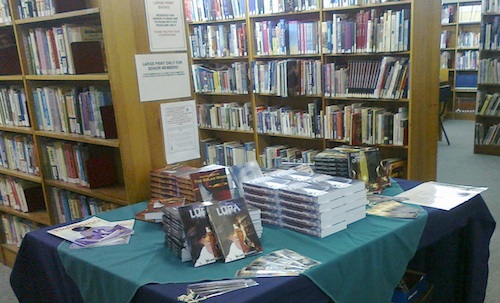
P’kaboo day at Glenstantia Library, Pretoria, SA.

(c) Lyz Russo

(c) Lyz Russo

The mini-launch in South Africa went off quite well. I was able to ‘join’ the proceedings by keyboard chat. The photo above shows the publicity table before the event began, with – yes! – Lupa on view there. My thanks go to Lyz Russo at P’kaboo for all the energy she has expended getting an event before Christmas. I’m told that there will be some more events in South Africa over the coming months, hopefully with Naked in the Sea and Mercury Silver featured also. Stay tuned.

If you happen to be in South Africa…

Lupa header temp

… on the 20th of December 2012, and you can get to Constantia Park Library, Pretoria, for 6pm, you will be able to attend a mini-launch of three books published by P’Kaboo Publishers. This will include my Lupa. Recommended – a book is always a good Christmas present, and a visit to a library is time well spent.

I mourn the passing of a blog today! Canadian poet Steve Myers – a totally unique voice – has left a farewell note on his now-empty blog. I am glad to see that he may still write, later, but sad to see that his future projects will not involve this medium, which even a technophobe such as myself acknowledges to be a remarkable tool for communication.

Good interviews are like Gold Dust…

… and when the chance comes I take it. A couple of months back I was interviewed for Gold Dust, the twice-yearly magazine of literature and the arts. The interview came out in their Winter 2012 issue. It has been overtaken by events a little, inasmuch as The Everywhen Angels is currently being considered by a UK publisher, and the new collection of poetry, I am not a fish, will be published early in 2013 (I know, I know, I keep telling you this).

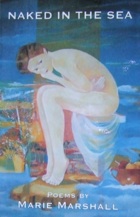
If you happen to want to order a copy of the original imprint of Naked in the Sea from your local Waterstones, they should be able to get it for you. Just give them the ISBN 978-0-9566041-0-1. It’s certainly on Waterstones’ on-line ordering system, and is still available direct from Masque Publishing. Meanwhile the second imprint, courtesy of P’Kaboo Publishing, is available as in Kindle format from Amazon UK, or Amazon USA, or as an eBook direct from P’Kaboo.

More news about Lupa when I have it.

Lewis Grassic Gibbon’s ‘Sunset Song’ – a neglected classic.

I was recently loaned a copy of Sunset Song to read. The novel is the first part of a trilogy, collectively known as A Scots Quair, written by Lewis Grassic Gibbon. That is a pen-name, by the way, used by James Leslie Mitchell, an author who grew up in what was then Kincardineshire or ‘The Mearns’ in rural North-east Scotland, purely for this trilogy – he used his given name for his other work, his pen-name being a version of his mother’s maiden name. I was loaned it because (said the loaner) I would enjoy its literary qualities, its blending of Scots and English, and the anarcho-communist politics of its author, although the book does not wear those politics prominently on its sleeve.*

After I had read the book I applied the words above – ‘a neglected classic’ – to it. Not because it is neglected generally but because I had neglected it. in Scotland it is revered, it has been voted Scotland’s favourite novel and is in print at a host of publishing houses, as you can see from the handful of covers pictured here. Inasmuch as it documents vividly, truthfully, yet not without sentiment, the passing of the peasant class in rural Scotland, it is almost a work of social history as well as a novel. As we come closer to the centenary of the Great War of 1914-18, the event which, more than any, destroyed that class, the novel deserves reappraisal.

It is not necessarily an easy novel to get into. The register in which it is written is peculiar. A modern reviewer recently castigated it as being ‘badly written’ because of its overuse of conjunctions ‘and’ and ‘but’, its long sentences, and its peculiar syntax, dismissing the novel out-of-hand as boring and dull. Suffice it to say it’s neither boring nor dull, but its prologue is surprising. Before a reader is more than two or three sentences into it, he or she may become aware that this apparent mish-mash of folk-tale and history has the register of the Scots equivalent of a griot, the West African storyteller and reciter of genealogies. Where the ramble through the history of the Mearns community comes up-to-date, the register becomes gossipy, as though the doings of the inhabitants are being discussed over the garden fence. This was a departure from the expectations of novel-writing and narrations, and such departures were typical of the modernist period of literature**.

The four main chapters are given titles corresponding to stages in the agricultural cycle – ploughing, harvesting, and so on. Although the story is narrated, the central consciousness is that of Chris Guthrie, whom we see grow from childhood to young-widowhood. There are departures from her thoughts into the thoughts of others, often by Gibbon’s use of the confidential ‘you’ which places the narrator in the Mearns community and draws the reader into it also, but always and at the beginning and end of the chapters, it is Chris’s eyes we see through. Chris is a strong character, an intelligent young woman who could have broken out of her environment on account of her aptitude at school, but who chooses not to do so. Her staying gives an opportunity for the book’s point of view to be one of clear vision. Her insistence on being known as ‘Chris’, never ‘Chrissie’, gives her a toehold of independence in a society in which women are sexually and domestically subservient.

This is no rose-tinted novel. Life in the Mearns is shown to be harsh and hard. Sex is seen as a sociological driver. People are shown with brutal honesty as being mean-spirited and unwilling to speak well of anyone if they have a breath left to speak ill. The reader can sense that this is not a part of their character that Gibbon admires, but he is prepared to address it head-on, to describe all the small-mindedness and spite of the village gossips, all the brutality of the men without holding back. The prominence of Chris’s viewpoint, however, gives the novel an empathic gynocentricity which had critics at the time wondering about the gender of the author. However, Gibbon admires the way that, when the occasion demands it, these folk form and function as a community without giving it a moment’s thought.

There is another object of admiration. Chris’s father, John Guthrie, is portrayed as Calvinistic, tyrranical, brutal, and a prisoner of his sexual needs. Yet when he dies and is being buried, and the reader is heaving a sigh of relief, this moving passage occurs:

Someone chaved at her hand then, it was the gravedigger, he was gentle and strangely kind, and she looked down and couldn’t see, for now she was crying, she hadn’t thought she would ever cry for her father, but she hadn’t known, she hadn’t known this thing that was happening to him! She found herself praying then, blind with tears in the rain, lowering the cord with the hand of the gravedigger over hers, the coffin dirling below the spears of the rain. Father, father, I didn’t know, Oh Father, I didn’t KNOW. She hadn’t known, she’d been dazed and daft with her planning, her days could never be aught without father; and she minded then, wildly, in a long, broken flash of remembrance, all of the fine things of him and his justice, and the fight unwearying he’d fought with the land and its masters to have them all clad and fed and respectable, he’d never rested working and chaving for them, only God had beaten him in the end. And she minded the long roads he’d tramped to the kirk with her when she was young, how he’d smiled at her and called her his lass in days before the world’s fight and the fight of his own flesh grew over-bitter, and poisoned his love to hate…

I should point out that direct speech is rare in the novel, and where it occurs it is shown by italics. Here indeed we have those long sentences, rushing on, broken by conjunctions, but in this case it adds to the incoherence of the sudden realization of grief as suppressed memories of her father’s honesty and tirelessness, and even of a forgotten moment of affection between them, burst upon her. The gravedigger, his hand over hers, serves as a reminder of the good in her father – he is a silent almost-surrogate for her father in this scene. Chris’s anguished cry is almost a liturgical response to Christ’s petition for forgiveness on the cross. It is indeed the crux of the novel, and Gibbon’s bringing us to realise that not a monster but merely a man is being buried. The passage borders on sentimentality, but it is not maudlin. It is not the man John Guthrie that Gibbon admires, it is the qualities which are picked out in him in this and other passages. Here he stands for all the men of the Mearns – he works tirelessly, is rigorously honest, is rigorously egalitarian.

The passage is also interesting for its use of Scots words and hints of Scots grammar. This is typical of the book as a whole, and is evidence of Gibbon’s deliberate linguistic enterprise. His intent was to write in a way accessible to readers whose first language was English, but to enrich that English not only with the cadences of Scots but with a certain amount of Scots lexicon too. He did this with deliberation, out of the love of both languages and in the knowledge that one was effectively dying while the other was developing and strengthening. It isn’t an easy marriage. Scots is exclusively a demotic language, and the Scots of the Mearns is a dialect of it; Scots never had an official status even within the borders of its own land, was never the second language even of the Gaelic-speaking Westerners. This makes it difficult (not impossible) to use outside its historical and geographical context. However, Gibbon does make successful use of a selection of Scots words, the meaning of which is, to varying degrees, decipherable from the context. Gibbon did not want to include a glossary with his novels, but some editions do have one, which is of assistance. Less comfortable and to my mind a flaw in Gibbon’s execution of his scheme is his adaptation of some words into a faux-English equivalent. These stick out like a sore thumb for their etymological ineptness. I cite the following. ‘Brave’ for the Scots ‘braw’, the former being of Latinate origin and the latter Nordic, both having divergent meanings***. ‘Childe’ for ‘chiel’ meaning a fellow. ‘Quean’ for ‘quine’ meaning a young woman. ‘Blither’ for ‘blether’ meaning to speak or to converse, the former being an English word with connotations of delirious raving. Heaven alone knows why he made those particular lexical choices.

Despite this, the novel remains the preeminent evocation of the passing of the crofting way of life in the rural North-East. The final scene – the dedication of a war memorial at an old stone circle – records the names of the young men who would not be coming back to farm their smallholdings, and laments that their place has been taken by business-oriented farmers with an eye on profit at the expense of community.

I am currently reading through the sequels, Cloud Howe set in a large village or small burgh, and Grey Granite set in an industrial, coastal town. They are good books in their own right, but perhaps not as satisfying as Sunset Song. There is a sense of unfinishedness about them. Gibbon died at the early age of thirty-three. He did not live to see the Spanish Civil War, the Second World War, the establishment of the post-war Labour government with its National Health Service and other socialist projects, the fall of Stalin, the Iron Curtain, and the Cold War. Sunset Song has a resolution and closure that the other novels of the trilogy seem to lack, because it marks the passing of an old world; the others do not mark the beginning of a new. Nevertheless the trilogy is a landmark of the twentieth-century ‘Scottish Renaissance’, and Sunset Song itself a minor masterpiece. I would recommend it for anyone interested in Scotland, or in the history and literature of this country.

__________

* I am grateful to my agent – he is studying for a university degree in English Literature, and I get the backwash of his learning!

** It has to be said of modernism that it is not a unified nor easily defined movement, and that the writings of, say, James Joyce, Katherine Mansfield, Gibbon, and Virginia Woolf, to give a mere handful of examples, differ from each other greatly. One could more easily speak of ‘modernisms’ rather than ‘modernism’.

*** Here in Dundee we pronounce it ‘brah’, which is pure Swedish!

A reader’s reaction to ‘Lupa’

Lupa is the story of two fearless fighters, two She-Wolves, perhaps the avatars of the same wandering spirit, whose destinies become aligned through the mirror of time and dream. The set of the two plots, none other than the Eternal City, casts its many shadows and symbols on both stories.

I came upon this book quite by accident, while perusing the poetry section of a blogging site. The author’s compelling poetry made me very curious about what her blog announced as her first novel and, indeed, I was not disappointed.

Marie Marshall’s sharp writing has a wolfish brutality to it that masterfully shape-shifts to raw emotion in Lupa‘s fighting scenes.

Unlike Hesse’s Harry Haller, the main characters not only accept but seek out the totemic wolf within.”