Marie Marshall

Author. Poet. Editor.

Category: fiction

My YA novel ‘The Everywhen Angels’ – more news

41aYN0pMq2L._SY344_BO1,204,203,200_My novel aimed at young adults and older children – The Everywhen Angels – is now available internationally atAmazon, in paperback and Kindle formats. Will you be the first to review it, I wonder? I’m looking for reviews for Amazon and Goodreads.

‘The Everywhen Angels’ reviewed.

angel eyes

The Everywhen Angels reviewed by Nikki Mason in the YA section at BestChickLit.com. Click here.

There is no such thing as ‘modern literature’

Robert Rauschenberg, untitled.

Robert Rauschenberg, untitled.

Imagine a world where Paul Klee’s ‘Senecio’ (that’s the painting a detail of which currently heads my web site – look above) doesn’t exist. Imagine a world with no Mark Rothko, or no Salvador Dali, no Jackson Pollock, Piet Mondrian, Marc Chagall, Wassily Kandinsky, Henri Matisse, or Robert Rauschenberg to look at. Imagine a world without Györgi Ligeti’s music, or Igor Stravinsky’s, or Steve Reich’s. Imagine there’s no jazz, no John Coltrane, no Miles Davis. Imagine a world where music had been halted before Debussy and Satie, and art before the impressionists. You don’t have to, that world exists.

It’s the world of literature.

Effectively, literature operates to an Edwardian, male pattern. It’s driven by the absolute imperative of plot resolution, the cart valiantly and obstinately pulling the horse along. I’m looking at the list of winners of the Man Booker Prize, all bloody fine books, and a quick scan of the last – say – ten reveals none without a plot that resolves, and thus none that hasn’t been written with the plot driving it along, arse-about-face. We can all probably name a handful of authors who broke out of the comfort zone of writing – James Joyce, Katherine Mansfield, Virginia Woolf, and of course dramatist Samuel Beckett who famously wrote a play in which ‘nothing happens, twice’ – but they’re long gone. Even Manuel Puig’s El beso de la mujer araña, an uncomfortably brilliantly novel in dialogue form, interrupted by long footnotes and official reports, is almost forty years old.

Mark Rothko, untitled.

Mark Rothko, untitled.

I see startled looks already. “Surely,” people are saying, “a novel must have a beginning, a middle, and an end? What is it otherwise? What is it if it doesn’t ‘tell a story’?” But look at the vibrant colours of a Mark Rothko painting, or the vigorous action of a Jackson Pollock, ask the question “What is this if it doesn’t show me anything visually recognizable?” Listen to the ‘Kyrie’ from Ligeti’s Requiem, or to Stravinsky’s The Rite of Spring, or to the jazz of Sun Ra, Charles Mingus, or Ornette Coleman, and say “What is this if it doesn’t have a tune?” You will instantly feel silly for having asked the question. Just because there is no recognizable image, no tune, doesn’t mean the work doesn’t engage your senses and your emotions, doesn’t mean that it has no aesthetic, doesn’t mean that it’s no longer painting or music.

So why not literature? Why has this particular art form stood resolutely still?

“Well feel free to experiment all you like, but you won’t sell any books!”

Is that it, then? Is literature not an art form at all, but rather nothing – nothing! – but a commercial product? Of course the argument about ‘canonical’ literature versus ‘popular’ literature is old, stale, and defunct. But seriously, when a rich patron can stage a new opera, or buy a single painting for a hundred thousand pounds, why can’t a rich patron buy a hundred thousand copies of a book to distribute to friends, family, the needy, anyone, or buy the manuscript to keep exclusively for his own?

I can’t be the first writer to ask this question. Why should literature effectively stand still? Why shouldn’t it change its face and figure and still engage us? Discuss.

__________

Images reproduced under ‘fair use’ terms.

Introducing Evangeline*

Detail from 'The Derby Day' by William Powell Frith

Detail from ‘The Derby Day’ by William Powell Frith

Imagine Epsom a huge tray of type rolling, popping, reversing at it is shaken, and there you have this field of hats and heads, toppers, skimmers, brimmers, bowlers, billycocks, and caps, all peppered with ladies’ bonnets, twirlers, birders, and fascinators as though someone had tossed cloured comfits into the jiggling type. The men of course are the blacks and greys of the inky letters, apart from a handful of jays and mandrakes. In all this steps Evangeline, as though she is treading from tussock to tussock in a wind-disturbed swamp or from boat to boat in a bobbing harbour, although her paces have all the precision of a prima ballerina’s. She only appears to be pushing through the press, which in fact parts, imperceptibly, for her. She sees all, sees the punters, tic-tac men, bookies, buzzers, down-and-outs, up-and-comings, lordings out on the slum like so many drunken second-sons. Evangeline’s back is straight, the face she shows to each person she slides by is what they want to see; she is their equal whether they expect a whore or a lady, oh my, oh my, she can counterfeit all, especially that which she genuinely is.

“I have the skin of a fish,” she thinks, says under her breath, an arcane choice of phrase by which she takes pride in her ability to sense the movement of the crowd and isolate the ripples and disturbifications that are just a little foreign to it. As now she does, finding the zig-zag of a dipper whom she knows, searching for his titfer amongst the thousand, spotting it with a smile. It’s Ganzy Gil Degarry, called ‘Old Cawhang’ by his pals for his Channel Island cant and patois, though more than half he puts on, having left Guernsey as a young’un, and indeed he’s not that old. She sees him making a mark, lifting his hat in apology to a man whose weskit he has just relieved of a deaner or two, a drackmer, or maybe of his best jerry, or maybe of a long-tailed note. Ganzy Gil’s quite the mobsman, quite the tooler.

“What’s this?” she thinks, says under her breath, as a new counter-eddy makes itself known, paralleling the pick-pocket. Her eyes rake the stylish tiles, settling on a couple of bowlers circulating on the periphery. Two Miltonians (she’ll be bound!), one whose gait she recognizes as he whom she calls ‘my grasshopper’, the other no doubt his sergeant. No doubt either that their courses spiral in towards the progress of Ganzy Gil, whom they have spotted at his business. So she herself cuts a curlicue process towards the thief, prettily, carefully, lifting the skirts of her coat. Despite the deliberate ease with which she penetrates the jostling press, she knows they will have him before she gets to them. From her pocket she slips a small bottle of gin, swigging from it to perfume her breath and to give her an excuse to stagger a little.

Ganzy Gil’s skillful monkey-fingers are about to harvest a pocket-book from a portly cove when the sergeant’s hand rests lightly but obviously on his shoulder. He halts, looking for a way out, but is confronted by the grasshopper who stands before him like Dover cliffs. And so Ganzy Gil is voided of his energy – inevitability has seen to that – and his swagger sags. Inevitability, however, suffers a little reverse, when Evangeline takes a small, tipsy stumble backwards, and the heel of her shoe presses down hard on the grasshopper’s foot. He yells in pain, his colleague is distracted for long enough for the pick-pocket to swing away from under his grasp and dodge into the crowd. The sergeant springs to pursue, but Evangeline staggers in front of him and is knocked to the ground.

“Here! What’s your game?” she cries, not in the least winded. “Stop him! Stop him someone! That brute attacked me!”

A dozen or more bodies bar the sergeant’s way, and if Evangeline had been on her feet more quickly, she would seen a cheeky, over-the-shoulder grin from Degarry serving as his a la perchoine to the peelers. As it is, Evangeline is returned to her feet firmly by the grasshopper, whose grip lingers on her slender arm, strongly enough to be a restraint, gently enough to leave no trace of a bruise. “Blind me and bless me,” she thinks, “but he’s done this before, held a woman suspect immobile.”

“Miss, I think you are well aware that I am an Inspector of the Metropolitan Police,” he says, loudly enough so that the eagerly watching crowd does not turn nasty and instead knows him for the jack he is. “Furthermore I think you were well aware that my colleague whom you impeded so excellently is a sergeant of the same force. I also think you know the criminal whom we had arrested and who escaped thanks to your intervention. To put it simply, Miss, you’re nibbed.”

“Sir,” says Evangeline, brushing mud off her coat with her free hand, “you think a deal to much. And since you are a policeman you will know that your thoughts to not amount to evidence. Are we to miss the races because of your thoughts?”

“I see you are not as tipsy as you first appeared,” says the grasshopper. “That goes a little way towards being evidence. It is at least a suspicion in my mind, and as such is enough to oblige you to come with me and be questioned.”

“Then allow me a little dignity,” says Evangeline. “Allow me to take your arm as fits a lady. Your bulldog can walk behind and make sure I don’t cut and run.”

So Evangeline and ‘her’ jack swap their who-holds-whom, at her insistence and without his resistance. Together, and with the sergeant stalking behind like a zealous duenna, they walk through the once-again parting press as lady and escort. When a gaze meets hers she smiles, slightly inclining her head, and the gazer can’t help but touch the brim of his hat respectfully.

________

*My previous post was a teaser about ‘Agent Delta’, a fragment of an unwritten novel. Here is one which introduces ‘Evangeline’ – Victorian orphan, sometime mountebank but with true psychic talent, well-born friend of criminals and prostitutes, and destined to be a ‘Woman Searcher’ with the Metropolitan Police – and her ‘Grasshopper’, an unnamed Police Inspector, loosely based on the real-life Jack Whicher (though what an officer of ‘the Met’ is doing at a racecourse in Surrey is in itself a mystery).

I am fascinated by the thought of ‘lost slang’. I know that things I recall from my own lifetime have come and gone, leaving gaps in social history. Nothing appears on the mighty internet about them. They might never have been. For that reason, along with London’s Victorian argot that I have researched, my intention has always been to drop expressions into the mouths of my characters for which there is absolutely no evidence.

One other thing I ought to mention is an additional way that these fragments have been constructed to ‘tease’. All the original text fragments of both my ‘Agent Delta’ and ‘Evangeline’ works-in-progress are written in the first person, the protagonist narrating; however the two pieces I have composed and posted here are written in the third person, though focalized on the protagonist. I like to play. This is all helping me get back into the discipline of writing…

Introducing Agent Delta*

gills

Agent Delta lifted the crime scene tapes and stepped into the cordoned-off area, turning up the collar of his dark grey suit to an insistent, cold wind. Somehow the large, sliding doors of the disused warehouse were funneling it, as though it had been whistled up for the occasion. Something was rattling or slapping arrythmically, irritatingly, against an iron rail. Odd pieces of litter were bouncing and tumbling through the space, looking for a way out at the other side; most trapped themselves against the far wall and fluttered, reminding Delta of the death-twitches of a Great Hawkmoon Moth.

Death. That’s why the tall, gaunt, lank-haired man with the grey suit and black turtle-neck was there. “There’s been a death,” they had told him. “The ‘locals’ don’t know what to make of it. Go and sort it out.” And indeed, in the middle of the empty, wind-bothered space there was a corpse. Crouching by it was a figure in a disposable, white oversuit. Standing a few feet away was a second figure; as Delta walked towards them the second figure turned and strode quickly to intercept him. Delta looked him up and down – the beige mac flying open in the draught looked expensive, as did the tailored suit, darker than Delta’s own, and the brogue shoes. “Too well-off for a policeman,” Delta thought, and then he spotted the distinctive cufflinks of the Holy Tabernacle of Continuing Pentecost. That bunch set great store by appearance.

“And you are?”

The man’s fragment of a sentence was curt to the point of incivility, but Delta was used to this kind of thing on the rare occasions that he turned up at crime scenes like this. His coming was seldom announced, and this one probably hadn’t been. He reached into the inside pocket of his jacket, pulled out a slim wallet, and flipped it open. The man made a show of stopping beyond arm’s reach and craning his neck to look. There was a badge on one side and Agent Delta’s photo ID on the other. The words Chthonic Intelligence Agency were in bold red type below the photo.

The man’s attitude didn’t exactly change. Delta couldn’t shake off the feeling that his presence was resented, as the man’s eyes flicked up from the credentials to Delta’s face and back again.

“I’m Detective Inspector Ellis. Come this way, Agent Delta.” The policeman walked off towards the corpse and the figure in the white oversuit. He stepped quickly to draw ahead of Delta, as though maintaining his authority over the scene.

“I don’t often get to meet people from your Agency,” he said, over his shoulder, and then to the figure in white: “Doctor Phillip, this is Agent Delta from the Chthonic Intelligence Agency. Doctor Phillip is a Home Office pathologist, Agent Delta.”

Doctor Phillip stood up, pulling back the hood of the oversuit to reveal hair as blonde as Delta’s own but tousled. She was almost as tall as the agent, certainly as slender, and her gaze was direct. In that gaze Delta read more than resentment at his presence, he read something that was almost a direct challenge to his very existence. “She’s a scientist and therefore a rationalist,” he thought. “Maybe even a Dawkinist. Many scientists are. She’s already resentful that the policeman she’s working with is religious. I’m the last straw – a wizard.”

“Unfortunate set of initials your outfit has,” she said. No other greeting. “Could lead to a certain amount of confusion.”

“I hadn’t heard that initials were copyrighted,” said Delta. “What do you think we have here?”

“The body of a man in his mid-thirties. Appears to have been dead for about four hours.”

“His clothes are wet,” D I Ellis put in, “and there seems to be water on the ground beneath him.”

Agent Delta looked up. At this point the roof seemed intact and sound. It was unlikely that rain could have got in from above, and if it had blown from somewhere else there would have been other patches of wetness. He looked at the pathologist, and for a moment imagined them in bed together, imagined that resentment and challenge directed into something else, and he felt the corners of his mouth turn upwards into half a smile. Then he remembered his wife, alone in the old manor house that had been in his family for generations, her mind alienated by – what? – a lifetime in magic, his neglect, their son’s sullen rebellion, a dozen things. He remembered the narrowness of the bed in his London flat, where he stayed seven days or more out of every ten. He remembered the handful of meaningless sexual encounters that had fizzled out almost as soon as they had begun. The half a smile ceased to be.

“What else do we have?” he asked the pathologist.

“Nothing to smile about,” she replied. He wouldn’t bother to put her straight about what had made him smile. “There is no immediately visible cause of death. There is a strange contortion to the limbs and to the facial muscles. A small amount of froth at the mouth and nose might suggest drowning. I say ‘might’. If so then he didn’t die here. There’s something anomalous – what appear to be five or six slits on the side of his neck. And there’s this…”

She crouched down again and pointed to the dead man’s left wrist. His left arm was crooked up awkwardly, the fingers of his left hand were clawed. Something was protruding from the sleeve of his jacket. Doctor Phillip must have taken it for a stick from wherever the dead man might have drowned, because she was reaching to take hold of it and pull it out.

“No!” Delta said sharply. He recognized the butt of a wand when he saw it. he had one similar up the left sleeve of his own jacket. What they had here was a dead wizard. That’s why someone had called him in. He bent over and looked at the ‘slits’ in the corpse’s neck. They looked like small shark gills, a sure sign that the dead wizard had enchanted himself to survive under water for a time. So how would he have drowned? Where was the nearest water? The Birmingham canal system? Hardly. Delta took out his thaumatometer. To the pathologist and the policeman it would have looked like a mobile phone, but the ‘camera lens’ was the knot-hole of an alive oak from Arkham Forest, and what looked like a winking, red LED was a scale from a Sri Lankan salamander. He passed the meter over the corpse. The winking light did not change colour – a totally negative reaction. Despite the gills and the wand, everything about the corpse, everything on or near it, had been totally drained of magic, and that was dangerous. The whole place was thaumaturgically unstable, the equivalent of a magical black hole.

“Step away, Doctor Phillip,” said Delta. “In fact I’d like you and Detective Inspector Ellis to leave the scene right now.”

“What? No! Are you serious? I’m here as Home Office pathologist. I don’t leave, and I’m officially taking charge of the corpse for a post mortem examination…”

“No, you’re not,” Delta interrupted. “In fact you are leaving. I can have you removed if necessary. This area is now off-limits to the police, the Home Office, and in fact to anyone outside the Chthonic Intelligence Agency. I do have the authority to do this, Doctor. Please do not oblige me to exercise it to its full extent.”

Doctor Phillip was furious but speechless as the Detective Inspector led her away. Delta looked down at the corpse. Sure this was a mystery, but his mind strayed back to the piece of paper in his pocket. It was a talking note from the Head of the Agency. He already knew it was a summons, he just didn’t know why…

__________

*Agent Delta© and the Chthonic Intelligence Agency© are part of a world I have thrown together in a handful of experimental writings, maybe towards a novel, maybe towards a few short stories, maybe towards nothing at all. I’m introducing Agent Delta to you in the fragment above for one reason only – not because I intend the mystery of a drowned wizard with shark gills, miles away from water, to go anywhere, but because this is a neat way of illustrating the process of how I write.

Most stories appear to be linear. In fact they are not. Writers start with the resolution in mind – in effect they begin with the end – and it is the resolution, not the linear steps, that drives the story. In the 20c a handful of great modernists like James Joyce and Virginia Woolf challenged this process. However it persists. Whilst most of the fiction I write has a resolution of some sort, that’s not the way I approach writing. I like to start with an idea, a character, an episode, a piece of dialogue, a feeling, a style of writing, or with something evocative of place and/or time, and simply throw words at it. From that process a plot line with something resembling a resolution may suggest itself and the work move towards completion. That’s how I wrote Lupa and The Everywhen Angels. Or the process might not lead to a completed work at all, and I may be left with notes, fragments, and so on. This started unintentionally, but it is now simply and deliberately how I work. What I would say about that unfinished residue is this: when we unearth a preliminary sketch by Picasso or Leonardo da Vinci we regard it as a work of art in its own right, but we do not accord the same respect to sketches by composers, authors, poets, or creators in other artistic fields. I’m not the Leonardo of fiction writing, I’ll grant you, but on behalf of my fellow writers I would like to claim that artistic ground for our unfinished works. If you like, I’m forming the ‘Edwin Drood Society’.

Over the next few posts I might introduce you to a few more characters or scenes from my sketchbook.

I met the real ‘Agent Delta’, by the way, when I taught for one term at his school, and again when studying as a ‘mature student’ for my ThauM in ‘the History of Magic’ at the Miskatonic Institute of Sorcery and Thaumaturgy. My presence at both places of learning was controversial at the time, as I was the first non-magical person at either. The young ‘Delta’ was an arrogant and unpromising pupil, but I saw something in him that was only realised in maturity. When we met again at Miskatonic the arrogance had mellowed. We have been in touch ever since, and he has kept me informed about his adventures in the Agency. At least, as far as he is allowed to tell…

A couple of nice things people said about me in 2013

“… an intellectual and creative juggernaut, with a rare combination of self-awareness and self-actualization…”

“… the Queen of Wow…”

(Just saying)

M.

How Millie’s cover art came to be…

© Millie Ho

© Millie Ho

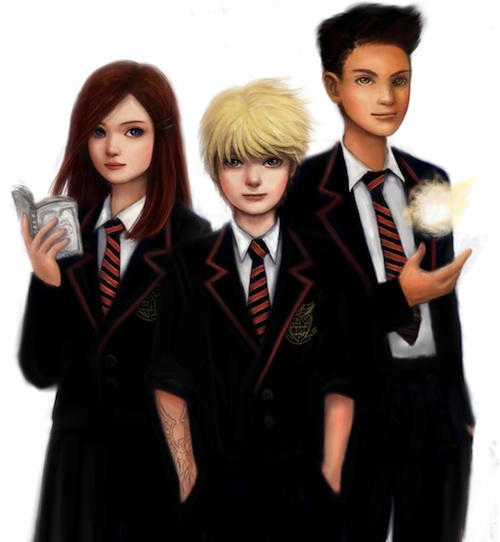
Over on Millie Ho‘s site she shares a few insights into the process of creating the cover illustration for The Everywhen Angels. Please do visit and show your appreciation.

‘The Everywhen Angels’ is now published!

My second novel, The Everywhen Angels, is now published!

Image © Millie Ho

Image © Millie Ho

It has taken some time for me to realise this particular ambition, but at last my second novel – my first specifically written for younger readers – is now published. It’s available in eBook format direct from the publisher at present, but as soon as it becomes available elsewhere I’ll let you all know. The timing is pretty good, as you can buy it to top up someone’s electronic stocking this Christmas.

A few years ago I was having a lively discussion with a bunch of on-line friends who were all devoted fans of a certain Scottish author and her growing series of books about a boy-wizard. I have to confess that I was being less than charitable, and the argument was getting circular (They’re not well-written – That’s because they’re for kids – But you’re reading them and you’re adults – That’s because they’re great! – But they’re not well-written…). Eventually they told me that as I styled myself an author, I should either write a fantasy set in a school and make it at least as good as one of my compatriot’s novels, or I should shut up. Well you know me, I don’t shut up that easily, so I buckled down and wrote the book. It was tried out on the thirteen-year-old daughter of a friend; the deal was that the daughter would do her homework and tidy her room, and the mum would read one chapter aloud to her every evening. Well, never has homework been so assiduously completed and never has a room been tidier. I realised I had a hit on my hands. The next task would be to convince a publisher.

The manuscript did the rounds. Head of Zeus showed interest in it but eventually declined it, at which point it was snapped up by P’kaboo, who had already published my first novel Lupa. Although P’kaboo is a comparatively small publisher, the feeling one gets from having a novel published commercially – twice! – is very pleasant. I’m not knocking successful self-publishing – that’s now an established thing with its own degree of satisfaction – but to be taken on by a publisher because they have faith in your writing does feel very special indeed. As regular readers here will know, the cover illustration was provided by Millie Ho. I’m hoping that this will mark the first of several collaborations with Millie, who is very gifted at putting ideas into images.

So what next for The Everywhen Angels? Well, of course we – P’kaboo and I – are hoping for sales. And of course I’m looking forward to reviews and to readers’ comments, from which I will quote here.

THUMBNAIL_IMAGESome more publication news came my way today. The Milk of Female Kindness is subtitled ‘An Anthology of Honest Motherhood’. Edited and published by Kasia James, it is a collection of prose and poetry on the subject of motherhood. The title is a quotation from Woolf’s Orlando. I’m pleased to say that I provided three poems for the anthology and also contributed a little ‘editorial consultancy’ work towards it. I have therefore had the opportunity to read through it already, and I have to say it is an exceptional collection. Some of the writers are known to me, most are not, and all have views on motherhood which do not necessarily reflect the image at first conjured up by the word. It is available on Createspace and I recommend it highly.

i-am-not-a-fish-cover-extractAlso today I was paying a visit to the excellent blog of San Snoek-Brown, and I found his list of recommended books for the coming holiday season. Sam has amassed a big haul of books by writers he knows, one way or another, and whose work he seems only too happy to draw to readers’ attention. My poetry collection from earlier this year, I am not a fish, is included in his list. Thank you, Sam!

It is no heavy obligation for me to reciprocate. As regular readers here will know, I’ve been raving about Sam’s fiction ever since I first came across it. So please accept my recommendation of his chapbook of short fiction Boxcutters, available from Sunnyoutside.

BoxCutters

Loss (flash fiction)

Because this started out as an idea for a poem, and is prose-poetry rather than straight fiction, I’ve posted it on my poetry blog.

How Millie draws a Fresh Cat

© Millie Ho

© Millie Ho

I really want to share this with you, just so that you can see Millie Ho’s hands at work. Millie (how could you forget?) is the artist who has provided a cover illustration for The Everywhen Angels. She claims all kinds of artistic influences, but at the end of the ol’ cliche day what she produces is all her own work. The ‘cat’ in this video is – kind of – the Fresh Prince of Bel Air of the cat world. I especially love his copter cap – I haven’t seen a cat in one of those since Hanna and Barbera’s Mr Jinks wore one. And yes, those are fish.