Marie Marshall

Author. Poet. Editor.

Category: poem

‘A Woman on the Edge’ – Railway poetry

Railway footbridge, Perth.

My careful paces, three to the second, carry me
across the worn, regular plates of the footbridge; a slight give,
spring, a dull noise that dies, and if I pause to look
over the rail into the slack, dark backwater,
the black-to-silver flash of heron-bait fry
flickers against the turvy tree and the negative sky.

I know that by the hedges at the far side of the bridge,
where an old gate leans, black flies will be haze-hanging,
trailing their lazy legs in the air, and that I might be taken
by the sudden ambiguity of a butterfly, resting
on a stoical stone, all red-gold-in-shadow.

Yet to come, but first a one-boy riot of slapping trainers
in a terrified sprint to win the far side before a train comes,
oh the clangour of drowned bells his feet make; be quick, be quick!
Who knows what cracks may open and
what worlds may be tumbled into if the monster should arrive;
would the boy be left senseless, eyes a-distance,
or a wicked, smiling changeling, or a pair of empty shoes?
Is there such magic, such old, unwritten wizardry in the everyday places?
I have no idea, but he has me running fit-to-win as well!

The view from a train

Travelling by rail gives me views I am not supposed to have. Human activity and urban sensibility demand that I approach by road, on foot or by car, and see the face that places want to project – the front of a house, the shop façade, the planned vista. The railway, on the other hand, ignores convention and ducks around the side and back, and for all that impoliteness it barges through in a straight line or at best in a gentle and graceful curve as though ignoring the things it passes. But surely things were built this way? Surely the railway was here before the majority of the landmarks of the townscape?  Maybe. Nevertheless even the Georgian villas present the reverse of their wooden fences to me, the obverse being a quiet component of a garden. It is not the train that sees things at all, it doesn’t care a jot for the intrusion, its progress is a linear dance to the tune of its diesel motor and the rhythms of the track. It is I who am the voyeur, keeking at the dirty underwear of the town. The town doesn’t care. It was built this way, showing its bent and ugly back to the travelers, showing us contempt. “I shall show hoi polloi my arse! Folk of quality roll up to my front door by carriage, knock, present a gilt-edged card. Only the ragged are shuttled behind me. If they demand respect, let them come by foot and see my porticos, my pediments, my railings of wrought iron.”

Not that we notice, of course. Newspaper, book, and now laptop, iPod, iPhone, iPad, tablet, gamer… only the indolent (me) technophobe (me) lexophobe (me) looks out of the window,

and

sometimes the town shuts with a bang. Someone has built a new housing estate that just out into the countryside. Its edge is as sharp as a kitchen-knife, and the green field full of sheep with dirty wool and patches of reddle leaps up at me immediately the instant I pass in the train. Whose idea was this insanity? Who decreed that there should be no debatable area but instead of that an ugly, stark interface?

There is a pick-up-sticks of broken doors,
poles, planks, grey and shadowed in angularity;
my head turns in direct proportion
to the speed of the train, and the sight is lost…

unless of course… the weather turns against us…

… rain making scars
across the face of a window.

In summer the rose bay willow herb is dense. Or is it loosestrife? The former I think. Someone I knew called it railway weed, or parson’s prick because it pops up everywhere – episcopalis vulgaris erectens or some such. I wrote a story once about being asked by an elderly Japanese couple what the tall, pink weeds at the side of the track were, and how I watched them mouth each word carefully. Rose. Bay. Willow. Herb. I can’t find it now. This tall, waving plant is the hair on the back of the town’s neck. It blushes and is beautiful from a distance, ugly close-to. It sighs and bows to the train’s bow-wave. It has its own eyes and watches back, pink-lidded and dusty with sleep. Left to its own devices it would colonise no further. It seems not to need to. It seems to know the limit of its domain. No flower defines the edge more than rose bay willow herb.

‘A Woman on the Edge’ – workshop project of prose and poetry, part 2

image (c) James Allan

Caravan Storage 

There is a lane behind my house. It runs straight,
all along the backs of our gardens, a hedge to one side
of dense beech and hawthorn, garden fences to the other.
Today there is a litter of pace-egg shells; kids,
despairing of a slope, have hurled their treasures
at the high, thick, brown wood, and they have fallen
amongst a rash of tiny mauve flowers. The flowers dare me,
taunt me as a ‘nature-poet’, challenge me to name them,
and I can’t; the flowers win, and nod slightly to themselves.
I am no Janus. I confess I look outwards from the town,
never inwards; I can be found pent by the first barbed wire
when it is winter, clutching numbly with my fingers,
beside the prayer-flagging shreds of polythene,
gibbeted rags riven from their scavenged corpses,
making the only music above the wind in my ears,
harsh, a relentless clatter like the tearing of paper.
Now, spring, I strain to mark the place where dunnock,
finch, and wren give way to jay and woodpecker,
and that corsair southerner the magpie – curse her! –
where lawnmower is drowned in a sea of new leaf-rustle.
And yet at the end of the lane I am always surprised
by acres of caravans, so I turn right, looking to lose myself
in the wood, where one is always north of the road,
west of the golf course, south of the water tower,
east of the houses and one field of grass-keep,
and where in autumn I come across lost golf balls
as often as fly agaric. Today, perverse, I turn left
instead of right and wander where the phalanx of caravans sits,
silent, almost terminally silent; I expect a dog to bark
or a man to shout, but it is as though life is waiting,
as dormant as each caravan, as flat as the pale sheet of their sides,
the sky, the clouds, angled towards me in each window,
blind girls’ eyes, colours that can see no colours.
Behind me, diagonally across a field, it is playtime
at the school, the yard sharp and joyful with children –
here amongst these sleepers the kids’ cries are yips
and yaps that vie with the conversation of sparrows.
At the end of the very last row I could push through
a thin screen of trees to contemplate the brown furrows,
but why not, for once, sit with my back to a post
or perch on a metal step to look back? Find a vantage, Marie,
from which to gaze at this oblong promontory,
the imposition of order certainly, but left
to weather the seasons, tarmac pebbling at the edges,
grass high, dandelions asserting themselves,
crows wheeling awkwardly above, panels of pea green,
aquamarine, sunburst yellow baking to fade
in the Scottish sun. Along with caws from the tattered,
fragmented flight, the sound of the breeze
whipping a loose washing line, the clink of a tool
on an engine block, a hint of raucous diesel
from the mini-coach headquarters. The sight of roofs,
grey, grey, and pale pantile-red, slipping away to my right;
the insect-crawl of a tractor along the plumbline road.
I could sit here until night, when the dark is drilled
by streetlights, stars, and the red beacon atop the TV mast,
by the wing-tips of an old Fokker 50 in steady climb;
I could wait for owls; I could come back in autumn
and spy bats out of the corner of my eye, after days
spent brambling, the corners of my mouth hurting,
pie-hungry, my fingers bloodied and pricking;
I could mark the turns and twists of the year not so much
by the cold or by the rain but by the depth of the furrows,
the voices of the sheep, the ins and outs of the caravans,
the headlights on the tractors, the saltired contrails
on the blue flag of a Scottish sky. I could take root,
become a laminate print of myself, still as a Madonna,
and lean one-quarter-starwards as the caravan windows do.
I could become part of the debate that is this corner of my county.
Listen – is that the distant whip and pock of golf club against ball,
or a thrush anviling a snail? Is that a Romany terrier barking
or the cut-short cry of a gull, a child, the creak of a wind-driven hinge?
Eventually, of course, I will simply leave, go home;
but on the way I will pass a couple who have been
hand-in-handing it along the lane and, as always,
I will notice the young woman’s hair, conclude that it is
a cross between Baltic amber and that drift of old beech leaves
piled against the padlocked door of the shed I have never seen opened,
and I will rush to box myself in my house to write poems
to the Icon of the Angel with Golden Locks, striving
obsessively for the perfection that is never there in the world,
but without which we could not write, or paint, or sing.
The things which go on at this edge will go on without me,
as ignorant of me as I will be of them, because that is in our natures,
tenacious, just like cuckoo-spit on reed-grasses, oil patches on concrete,
the green of dock-stain on nettled thumbs; unlike my words
which stick in the mind less than the letters on an old, flattened can,
the painted number on that shed door, the half-buried
number plate of the old Vauxhall, and which, if read aloud,
are somehow less musical than the rattle of gravel under
slow van-wheels, the drone of a motor in low gear.
This box – home – is the inside of my head; out there
amongst the ranks and rows of trailer-homes is dreaming,
dream-time, another place entirely, conflicted with
the coming and going of images, unsafe, ambiguous,
flirting with the bizarre rather than fighting the familiar,
as though each was mildly irritated by the other
but neither could ignore the attraction, opposite poles
pulled together, magnetic lines compressed, penetrating,
alloyed, brazed at the edges, bitumen spilled onto grass,
grass spearing asphalt, weight and counter-weight,
blade and counter-blade, kiss and counter-kiss.
If there is a centre of the world, a true axis,
then the world will spin on an imaginary line
between two such places. The centre of everything
must be just that – the centre of everything, the bisection,
even the meeting of dreams and reality. And yet…

texting, tweeting, and the Poet Laureate

People who are familiar with my old (and defunct) literary blog will remember that occasionally I used to ‘go off on one’ on a literary subject. I’m doing that again today, simply because something got up my nose.

I am most critical of myself first of all, then of other writers, especially those who speak fluent rubbish but have an audience because of their position. The Poet Laureate Carol Ann Duffy, for whom I have a certain amount of respect as a poet, ought to guard her tongue or she will be seen as ridiculous. Recently she has, laudably, launched a competition in which secondary school students are encouraged to produce poetry anthologies. So far so good, a bloody brilliant idea! However she should know better than to try to ice the cake by attempting to sound ‘cool’. Here’s Carol Ann ‘getting down with the kids’:

The poem is a form of texting … it’s the original text. It’s a perfecting of a feeling in language – it’s a way of saying more with less, just as texting is. We’ve got to realise that the Facebook generation is the future – and, oddly enough, poetry is the perfect form for them. It’s a kind of time capsule – it allows feelings and ideas to travel big distances in a very condensed form… The poem is the literary form of the 21st century. It’s able to connect young people in a deep way to language … it’s language as play… I think it’s most obvious in music. If you look at rapping, for example, a band like Arctic Monkeys uses lyrics in a poetic way. And using words in an inventive way is at the heart of youth culture in every way.

This is straight out of Patronise 101, it is how people of older generations always talk down to youngsters. I remember it from my school days and it embarrasses me to hear someone of my own generation still doing it. “The Facebook generation” for heaven’s sake, as if there is no one over the age of fifteen on social media. That old chestnut of “Rock lyrics are poetry” has been debated since the early days of Bob Dylan, and it has been done to death. Carol Ann does no service to herself by rehashing it. Then she stumbles into another obvious pitfall – ignorance of her subject – by relating rap to the Arctic Monkeys, who are definitely not rap. All of this is before we even get to the notion of text equaling poetry. Here’s how a friend of mine expressed his opinion to me of Carol Ann’s statement:

Look, poetry can be written on a post-it-note, jotted on the back of a beer mat, blogged, emailed, extemporised in a chat room, and – yes – texted. But so can a shopping list, a dirty joke, or a phone number. To be poetry it has to be… well… poetry.

Preaching to the choir, pal… preaching to the choir! I have used the language of texting and chat rooms in my own fiction, I have had a poem published the title of which is set out like an html command – that was probably a world first but so what? I don’t say this to prove how clever I am, it’s just that the language is there, and there to be observed and used. If you google the word ‘haiku’ and ‘tweet’ or ‘twitter’ you will get pages of hits detailing 17-syllable, 140-character haiku. This doesn’t mean that texting or tweeting is poetry but simply that it can be used for poetry. We can say with Karlheinz Stockhausen (yes, I can be pretentious with the best of ‘em) “New means change the method, new methods change the experience, new experience changes man”, but texts and tweets are not so much new means as new media. The means – language – remains basically the same except for a few specialised abbreviations and the natural, morphing flow of argot.

I want to remind my readers of two things. They are seemingly contradictory but nevertheless they illustrate two solid pillars of the house of poetry. Firstly ‘success’ in the world of poetry still means getting your poetry into print – not blogging it, not texting it, not tweeting it, no matter how many ‘followers’ you get. If my word is not enough then consider what is going to happen with the winning anthology from the competition that Carol Ann Duffy is promoting. Secondly, on the other hand, there is the artistic satisfaction of creating poetry, and that does not depend on getting into print. Probably the most wonderful poet I know, Lane A Smith, is virtually unknown outside a couple of collective web sites. To the best of my knowledge she has only ever had two poems published in magazines (Bard issue 80, Awen issue 69, and they were submitted by someone else on her behalf), yet when I read her poetry it is as though the beat generation lives on but on the warm, worn boards of a front stoop overlooking a Georgia beach, and in childhood memories of hot summers, dust, and women who were much taller and wiser than the little girl whose older head reverberates to the memories. However if you google ‘Lane A Smith poet’ you will be lucky to get a single hit. Nevertheless I consider her to be a ‘success’ in a way few of us can ever be.

I’ll close with a poem of my own from my 2008 collection 58 degrees North. It is dedicated to Lane:


Day after midnight
we packed them in
trading word for world
line for lines
vice for verse
     incredible
      streaking daylight in rods
like frozen trails of hard liquor
after body-shots
trading cheap dresses
with each other
like in-jokes
(we laughed)

people talked of perfection
and greatness
but they didn’t get it

the whole point
was
the cheap dresses

those gaudy
booze-soaked
shreds of poetry


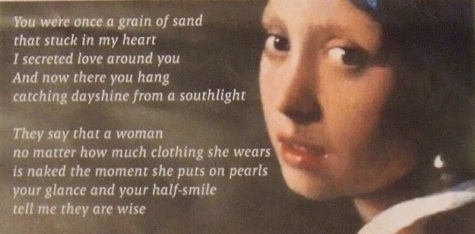
Pearl 5

(c) Winter Words Festival

Calle dei Morti

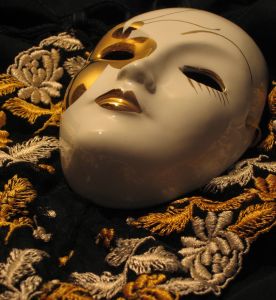
There is one more reveler in the masquerade,
one more domino and high-crowned tricorn,
if you can count the carnival-goers heartbeat by heartbeat;
we whisper of the one who measures by silent paces
the Calle dei Morti, those few, narrow metres
from the bridge un, , tre, along this little ravine
quatro, zsinque, sie, to the Calle Cornier and back.
Here things are sombre, quiet, moonless, barely touched,
a shaft for rare stars to mock from unshuttered windows,
neglected washing to become shreds of clouds, shrouds
shaken by forgotten hands, numb, damnable breezes,
after-breath of words spoken by a lonely bell from San Stae,
by the lick of water on worn, greened brickwork,
by the lumber of wood and bump of boats moored carelessly,
by the late, late, oar-stroked clock-rhythm of a bisonno;
and still the swirl of a cloak, the relentless slow-march
sete, oto, nóve, as though carrying the world upon his shoulders,
or the dead of a thousand years in a single, child-size coffin,
steadying himself by placing sole after sole on the flagstones,
pausing only when there is laughter in the Campo San Cassiano,
fading from sight, melding with the dark of an old doorway
when homeward, hesitant shoe-taps skitter – faster,
faster at some middle-moment without knowing why.
At times of mute shadow, of the hollowed, callous city,
calling by slight hands, by sleight-handed, gloved gestures,
by finger-counts in missed seconds, shapes, echoes, half-echoes,
this nook runs from nowhere to somewhere else,
and the steps continue diéxe, ondexe, dódexe, to the end
and then, as though there is neither left nor right in the world,
back again, again, again, footfall after dark footfall.