Marie Marshall

Author. Poet. Editor.

Category: poetry

Some of my old poems turned up…

product_thumbnail… in May Prism 2014, a collection of contemporary international poetry, a quarterly (or thereabouts) paperback edited and self-published by Australian poet Ron Wiseman. [Find it here, and my poems from p.157 onwards.] This was half-a-surprise to me, as I hadn’t visited the poets’ virtual hideaway that Ron and I frequent(ed) for a while until recently, so I was out-of-the-loop and didn’t even know he was engaged in this little publishing venture. As a result, the poems he selected (knowing that I would have given him permission anyway if I had been around) are all fairly old. Some of them have been published before, in Tower Journal for example, and many of them are formal, or show me tinkering with Celtic-mystic-medieval themes. The feature even quotes me as saying “I am best known as a neo-formalist poet…” Good grief! It’s a long while since I said that, and it is no longer strictly accurate, but never mind. I did cut my teeth on formal poetry, figuring that it was a good discipline to learn in order to give my writing in general some technical power.

May Prism is full of poetry by a whole range of poets from around the world, so I can thoroughly recommend it. Here is one of my poems from the selection of seven that Ron published. I have spared you the iambic pentameter – this one is written free.

Someone said you loved me

There are no ties to life; rather it’s like a hangnail
when it catches in my sweater – one tug and it’s free,
free to fall, free to take its end.

Few things make me catch my step, slow me,
have me gripping at the burning minutes as they are consumed,
very few things save, perhaps, you.

Gossip I can let tumble and roll among the leaves and papers –
except when someone said your eyes followed me
as I wandered through the room.

Now I will test the truth of this by walking slowly, as though on a wire,
savouring each second, seeing if my bare neck flames
in your gaze
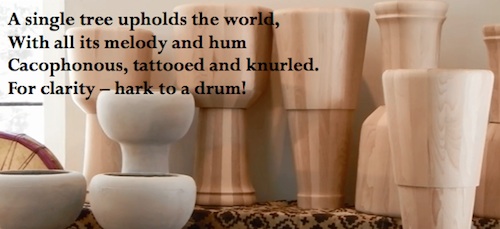
Membranes of Marrakesh

words © Marie Marshall image © Membranes of Marrakesh

words © Marie Marshall
image © Membranes of Marrakesh

I often say that the strangest place I have ever ‘published’ a poem has to be the time one was etched into an African drum, which is now at the New Orleans Museum of Art. The poem was called ‘Djembe’; I wrote it several years ago, and that’s it above. The image I have used to accompany it shows the raw, waiting bodywork of drums made in the same workshop as ‘mine’ was. If you click on the image you will be taken to a fundraising site for the workshop’s new project. They hope to give away 100 drums at the Burning Man festival in Nevada this year. Have a read through their promotion and watch the video. If you can help this celebration of giving please do, even if it is only with good vibes and good wishes. Thank you.

By the way, if you happen to be in Nevada between August 25th and September 1st this year, then go and experience the Burning Man. If you visit the Membranes’ stall in the Souk, then the patter with which they address you may well have been written by… me! Find out how the young Berber woman, Yasmine, got the better of a mighty desert djinn!

M.

Dance the Carmagnole!

Traditional (anon.), tr. Marie Marshall

Young Missus Veto said to me
She’d slit the throat of all Paree.
Young Missus Veto said to me
She’d slit the throat of all Paree.
But see the plan she laid
Spoilt by our cannonade!

Let’s dance the Carmagnole
– hear ‘em roar, hear ‘em roar!
All dance the Carmagnole

– hear how loud the cannons roar!

Old Mister Veto said to me a-Sansculottes-1793-jacob 2
He’d give his realm fidelity.
Old Mister Veto said to me
He’d give his realm fidelity.
But this he failed to do,
We’ll give no quarter too!

Let’s dance the Carmagnole
– hear ‘em roar, hear ‘em roar!
All dance the Carmagnole
– hear how loud the cannons roar!

Antoinette said “Let it pass
The common crowd falls on its arse.”
Antoinette said “Let it pass
The common crowd falls on its arse.”
But in the market-place
She fell flat on her face!

Let’s dance the Carmagnole
– hear ‘em roar, hear ‘em roar!
All dance the Carmagnole
– hear how loud the cannons roar!

Louis the King thought he had won
But we’re the champions, every one.
Louis the King thought he had won
But we’re the champions, every one.
Cry-baby Louis – weep
From your palace to the keep!

Let’s dance the Carmagnole
– hear ‘em roar, hear ‘em roar!
All dance the Carmagnole
– hear how loud the cannons roar!  

When Antoinette was shown her cell
She began to weep as well.
When Antoinette was shown her cell
She began to weep as well.
She fainted and fell down,
All because she’d lost her crown!

Let’s dance the Carmagnole
– hear ‘em roar, hear ‘em roar!
All dance the Carmagnole
– hear how loud the cannons roar!

The bloody Switzers* made a vow
They’d gun down our comrades now.
The bloody Switzers made a vow
They’d gun down our comrades now.
But look at how they prance,
Our bullets make ‘em dance!

Let’s dance the Carmagnole
– hear ‘em roar, hear ‘em roar!
All dance the Carmagnole

– hear how loud the cannons roar!

sans-culottesComrades, forever we’ll unite
No matter who comes here to fight.
Comrades, forever we’ll unite
No matter who comes here to fight.
Attack us if they dare,
We’ll give ‘em such a scare!

Let’s dance the Carmagnole
– hear ‘em roar, hear ‘em roar!
All dance the Carmagnole

– hear how loud the cannons roar!

Comrades, remember their renown,
The Sans-Culottes from our town.
Comrades, remember their renown,
The Sans-Culottes from our town.
We’ll raise a glass and sing,
The bells of freedom ring!

Let’s dance the Carmagnole
– hear ‘em roar, hear ‘em roar!
All dance the Carmagnole

– hear how loud the cannons roar!

__________

* ‘Switzers’ here refers to Swiss mercenaries in the pay of the King of France.

There are several variants of this song. The words have been translated very freely and are possibly more ‘jokey’ than the original. As with all the better-known songs of the French Revolutionary period, this is actually a very rousing piece of music. If you would like to sing along, you will find the tune here.

Throwaway art and poetry

spacewalkbanner

If you have not already done so, please check out, or even follow, my New Orleans collaboration for Mardi Gras 2015. Thanks.

M.

Take a ten-count for the Blog Tour

Ten count

Click the pic for more information.

#amwriting

From My Cold, Undead Hand reached an exciting stage today, as I received the manuscript back from its first professional edit. Progress continues on the sequel, KWIREBOY vs VAMPIRE. In other news, I have just finished two short stories – ‘The Warlock’s Hat’ and ‘Gravity’ – as entries for the William Soutar Writing Prize. They have two entirely different settings, Dundee and South Africa, and are written in two entirely different styles. Let’s see how they fare. And I have written to the Ivan Franko National University of L’viv in the Ukraine, asking if I may have access to more of Vera Rich’s neglected translations. Watch this space.

‘Photography on wings’

Final Flyer

Photography on wings is the title of an exhibition, to be staged in Nottingham from 7th June to 31st July, of the photographs of Harminder Nagi. The photographs, all of winged creatures, will be accompanied by poetry by twenty international poets including myself. The exhibition is an extension of the book Continents Connect: poetry on wings which was published in 2012. If you’re anywhere near Nottingham between the dates mentioned above, please do make a point of going along to visit the exhibition. For those of you who can’t make it, here’s the poem I wrote for the book; it’s called ‘Eros and Psyche’, and I wrote it as though for Emily Dickinson.

I have your beauty safe in a box, ever since
I scotched my shoulder with a half-nocked arrow.
Sometimes I let it out to sit amongst the flowers
and drink; it settles until I shade it from the sun.

Things like this are made to delight us, I muse.
The cynic at my side shakes his head, quotes
a priori laws, says that the world is not about us.

The heart seeks pleasure first, I tell him firmly,
and I fall so deep in love with the phrase that
I etch it on my next arrow, drive that one deep
into the ambushed back of a poet, to her surprise.

The Phoenix rising is ‘a groundbreaking anthology’!

WLT header

The Phoenix Rising from the Ashes, Editor-in-Chief Richard Vallance (Deputy Editor, me), recently received an accolade from World Literature Today, the prestigious and internationally respected literary periodical published by the University of Oklahoma. The anthology was included in its ‘Nota Benes’ page for summer 2014, which contains editorial recommendations for books to read over the season. You can see their comments in the context of their selection here. Their assessment was as follows:

‘A groundbreaking anthology of poetry presented in six languages, The Phoenix Rising from the Ashes accomplishes a perfect revival of the sonnet. Divided into themes but without a formal table of contents, this artistically rendered collection provides readers with a sense of both choice and surprise. The 315 sonnets on display counter the popularly held notion that the sonnet is outmoded.’

Angélique Jamail at DFW Writers’ Conference

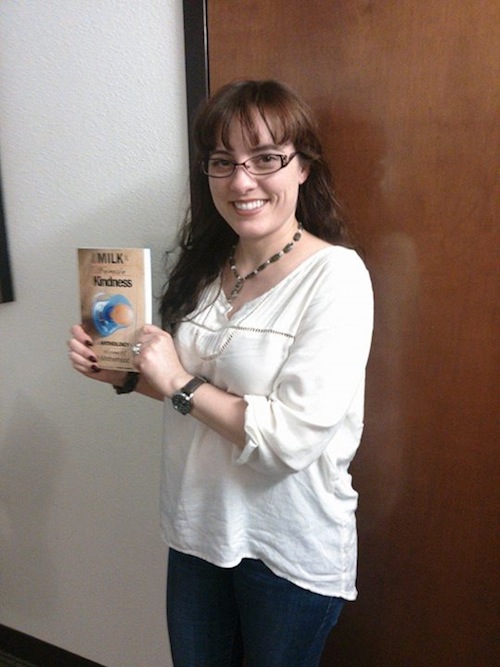
Below is a picture of Angélique Jamail at the recent DFW Writers’ Conference in Hurst, Texas, with a copy of The Milk of Female Kindness. The anthology, to which I contributed both poetry and some consulting editorship, was launched in Australia earlier this year. It is the ‘baby’ of Kasia James, and contains some wonderful pieces of writing about motherhood by a number of women from around the world. My own poems in the anthology are not available anywhere else, by the way.

image by Sarah Warburton

image by Sarah Warburton

Taxonomy Domine

dogcat1

It’s funny how my own mind works, never mind anyone else’s. When I was invited to read Michel Foucault’s The Order of Things, basically a study of how our assumptions about the way we think do not depend on a continuous, recognisable rationalism, and that all periods of history have possessed certain underlying epistemological assumptions that determined what was acceptable as, for example, scientific discourse, I didn’t know how many harmonic strings would be plucked in my own mind.

In the Preface to the book, Foucault cites a piece by Jorge Luis Borges in which Borges pretends to have found in ‘a certain Chinese encyclopaedia’ a classification of animals into the following categories:

a) belonging to the Emperor, b) embalmed, c) tame, d) sucking pigs, e) sirens, f) fabulous, g) stray dogs, h) included in the present classification, i) frenzied, j) innumerable, k) drawn with a very fine camelhair brush, l) et cetera, m) having just broken the water pitcher, n) that from a long way off look like flies.

This taxonomy is, of course, fictitious and there is no such encyclopaedia – totally in keeping for Borges’s love of literary hoaxes, and his ‘magic realism’ – and Foucault knows it is. However that doesn’t stop critics of post-modern thinkers – critics such as Keith Windschuttle – from accusing them of ‘murdering our past’, on the basis that a few lazy post-modern thinkers don’t realise Borges was joking. Hmm… aye, right.

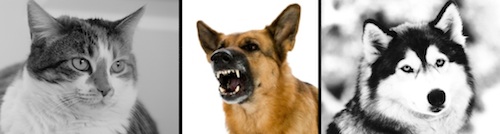
Anyhow, it got me thinking about how we decide to list things. Does the way we define an animal, for example – by phylum, class, order, family, genus, species – have any objective basis, or is it a product of human perception? No-brainer? Well that’s the point! Take the images at the head of this piece. How would you split them up, if you were asked to group together two that were most alike? This isn’t a trick question, there isn’t a right or wrong answer. Maybe before you read the all the foregoing you were already sorting them in your mind. It could have been by biological family (two dogs, one cat), but it could equally have been by mood (two placid, one angry), by direction (two looking right, one left), or by the chromatic value of the images (two monochrome, one coloured). There might be other influencing factors, such as the pre-existing order of the images along the conventional left-to-right reading path, so would there be any difference in your sorting process if I changed the order?

dogcat2

How about size?

dogcat3

Or if I inverted one of the images?

dogcat4

Perhaps if you now went back to the first set of images you would split them up differently. Like I said, there are no right or wrong answers here.

Why do I mention all this? Well it’s because, as a poet and author, I like to play around with meaning, beating the use to which we put words into a new shape which, even though it might be battered by my hammer, makes a reader sit up and take interest. I like to play with perception and challenge what we think we see. Some people like to see science as the final frontier, but for me it’s human consciousness, our perception, and the shifting ground on which it stands. Yes, there is an objective reality out there – let’s face it, we have to move beyond solipsism to be able to survive – but it ain’t necessarily what we think it is. Maybe not, anyhow.