Marie Marshall

Author. Poet. Editor.

Category: Review

100 free ebook copies of ‘Lupa’!

Lupa

That’s an offer you can’t refuse. For a limited time, and in a limited amount, my novel Lupa will be available as a free ebook, along with Lyz Russo’s futuristic adventure The Mystery of the Solar Wind, Douglas Pearce’s weirdly witty Almost Dead in Suburbia, and Leslie Hyla Winton Noble’s Tabika for younger readers. There are no strings, but you are invited to take part in round two of the P’kaboo Facebook Share Contest. Step one of round two is reading the book of your choice (all four, if you wish!) and writing a review. Read all about this on Lyz Russo’s blog, or just go direct to P’kaboo’s online bookshop and download any of the books from there.

Demons and Angels

A few days ago I asked you this question: What well-known character in children’s fiction is known in Chinese as Fú Dìmó? I had many interesting answers either as comments or tweets, some of which are contained in the montage below – including the correct character, which nobody guessed. Have a look at the montage, and see if you can spot the correct character. I’ll reveal the answer below.

Who is Fu Dimo?

I’m guessing that you had no trouble identifying each of the characters in the montage. Each answer was imaginative, even if Fu Manchu and the cast of Crouching Tiger, Hidden Dragon stretched the idea of ‘children’s fiction’ a little far. Whoever guessed Harry Potter probably got the closest, but still ‘no cigar’.

The correct answer is… Lord Voldemort from the Harry Potter canon. You could have spotted the phonetic similarity between ‘Voldemort’ and ‘Fú Dìmó’. It might have been easier to spot if the translators had gone with their first idea, and had used a character ‘Fo’ instead of ‘Fu’. However ‘Fo’ can have associations with Buddha, and that might not have seemed appropriate for such a villainous character as Voldemort. It has been pointed out that the etymology of the name ‘Voldemort’ suggests ‘wish of death’. This fact reminds me of the difficulty of translating literary texts (I have done a little translating, mainly between French and English, and I briefly worked with the late Vera Rich, proof-reading an unfinished translation from Belarusian to English). JKR’s translators went for a phonetic rendering with an appropriately sinister meaning, rather than taking a meaning from the etymology of the original.

Anyhow, thank you to everyone who played the game with me.

That takes care of today’s demon. Now what about tomorrow’s angels? Just a quick update on The Everywhen Angels, my soon-to-be-published novel.  We have completed the major editing stage and are now looking at the first full draft, with our eyes open for any missed typos and new glitches. I received this comment from the publisher’s editor, himself no mean novelist: “… the book is something special. The characterisation is convincing. The narrative is entertaining and gripping, but at the same time shows a wealth of knowledge and research and introduces challenging food for thought on abstract matters…” That is quite something for a YA book. We’re still waiting for cover art, but hopefully the book will be out well before Christmas and in time for the publisher’s schools promotion.

More news as I get it.

We’d like to know a little bit about you for our files…

bestchicklit

Nikki Mason at BestChickLit.com followed up her review of Lupa by conducting an interview with me. Read it here.

Reviews, vampires, and storybook witches…

"Yes, my name is Miss Smith. No I will NOT 'take a letter'!"

“Yes, my name is Miss Smith. No I will NOT ‘take a letter’!”

BestChickLitLogoBlast! I could do with a reliable secretary. It’s a funny old day. I feel as though I’ve only just sat down at the computer – in fact I logged on at about 5am and it’s nearly lunchtime. Thank heavens its a bank holiday! There has been a welter of tweets and emails, and a shed-load of stuff for me to deal with. The most pleasant was finding a review of my novel Lupa at BestChickLit, courtesy of Nikki Mason. It’s always gratifying to get exposure of this kind.

Another task today is dealing with my publisher’s editor, as we chip away at the imperfections in my second novel The Everywhen Angels, which is due for publication soon. We’re approaching the galley proof stage, and I can’t wait to see what the house artist will have dreamed up for the book jacket.

Meanwhile, what I am supposed to be doing is getting on with is my third novel, the vampire story. But it’s strange where research can take you when you’re doing something like this. I’ve been sidetracked by a chance reference in my research material (posh term for the rubbish I was scrabbling through on line) to one of my favourite anti-heroines of children’s literature, Miss Smith, ‘the wickedest witch in the world’. Before my pagan friends begin to complain about ‘negative stereotypes’ let me say two things: firstly, she’s fictional, and secondly she is far from stereotypical. Ever heard of a witch keeping toads in a fridge? Live toads? She sails blithely through four of Beverley Nichols’ novels, written between 1945 and 1971 on a tide of delicious malice, dressed like a Vogue model. Actually, delicious malice is just what I am looking for right now; an image has popped into my mind of a vampire bound to a dentist’s chair with ropes woven from fibres extracted from garlic plants, while someone forcibly removes its canines. And what about the next scene where its ‘Sire’ replaces them with a stainless steel pair? The thick plottens!

‘Naked in the Sea’

nitsbanner

Image (c) Marcello Minnia

I’m very grateful to Angélique Jamail for publishing this review of my 2010 poetry collection Naked in the Sea.

Art: a statement of priorities

Theodore Metochites

It occurred to me a long time ago that there are only two important factors in art – our expectations and the artist’s intentions – all else is subordinate. The extent to which one governs the other has been fluid over history. It is worth remembering that Théophile Gautier’s expression of autotelicism, “L’art pour l’art”, was a manifestation of a 19c movement, and therefore is less than two hundred years old. It is a blink of an eye in the history of art. However, it was an important movement, because it liberated the artist, more than any previous shift of influence, from the demands of patronage.

When we look at the 14c depiction of the Paleologue Emperor Theodore Metochites on the wall of the Church of St. Saviour in Chora, we are not looking at the work of an inept artist, simply because the stylized mosaic is not realistic to our eyes. Here the artist has created exactly what his Imperial patron asked for, and the priorities of the work radiate to us. The Emperor, his orientalism expressed in his turban and brocade robe, his power expressed in his senatorial beard, kneels before an austere Christ. In the potentate’s hands is a building, rendered model-sized – it is the Church that he had restored, and in which he was to end his days as a monk – which he offers to Christ. In his turn, Christ looks out at us, two fingers half-raised as if about to bless. We are meant to see piety, to appreciate holiness, and to feel awe. These are the semiotics of this type of Byzantine art.

face 09aThe fact that the image is already eight hundred years old reinforces the knowledge that it comes from a culture which had a sense of eternity. By contrast, an image hastily rendered in dripping spray-paint is ephemeral. The grotesque graffito of a face on a wall in Dundee was never meant to last – it leers at us for a while and is gone. I think even the wall has gone now. It comes from a culture which acknowledges and appreciates the throw-away. A very brief scan of both works of art suggests that if we took both artists we could train each of them in the use of perspective etc. and produce two adepts of photo-neo-realism. But why should we? What business is it of ours to demand that either should subscribe to our idea of what art ‘is’?

In 1907 when Pablo Picasso was midway through a birds-eye view of a group of prostitutes lounging on a bed, he was suddenly seized with the notion of incorporating a distorted version of an African mask into the picture, and two of his Demoiselles D’Avignon have markedly less realistic faces than the others. Modernist engagement with ‘the primitive’ was an exciting development in Western art. The fact that une demoisellethey got African culture(s) badly wrong, failing to see the sophistication of its art, is almost irrelevant to the dynamism of the movement. We do get it wrong when we look at things from outside our culture; by and large that can’t be helped.

Thus when we see a work of art that is eight ninths vandalism of public property, it is very likely we simply get it wrong. After all, the culture from which it comes is arcane to us, with our bourgeois standards of behaviour and taste, and our own semiotics. It could be instantaneous, yes, almost mindless. It could be a deliberate negation of the whole concept of ‘public property’ and therefore some kind of political manifesto. It could be a personal expression of angst, pain, or terror It could be part of an intricate sub-culture which we do not recognize and whose semiotics are beyond us. We may one day learn face 17awhat is going on, we may not. However, thanks to Gautier and his contemporaries, we are no longer able to impose our tastes and our expectations, beyond saying whether we like something.

Or are we? An aspect of post-modernism seems to throw the ball back into the court of the onlooker, the reader, the consumer of art. In 1968 Roland Barthes published an essay entitled ‘The Death of the Author’. Rather than restore supremacy to the tastes and patronage of a privileged class, however, Barthes’ emphasis was on the interpretation by those before whom art comes as part of the continuing creative process. Therefore the modernists’ hash of ‘primitive’ Africanism could benefit from a reprieve; moreover, our own appreciation for something splashed on a wall gives it wings – perhaps – beyond its artist’s hoped-for flight. I would say we are nevertheless no longer able to damn something as ‘not being art’, or to scorn it because of the demographic from which it springs or because we find it hard to fathom or unpleasant. Art has long since become something with fewer imposed limits, if it has any at all.

Marking a century of haiku

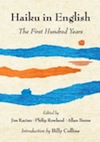
516Ba8RUQfL._SY300_Haiku in English: The First Hundred Years
Jim Kacian, Philip Rowland, Allan Burns (editors)
2013, New York, W W Norton & Company, pp.439
ISBN 978-0-393-23947-8
Hardcover $23.95US

Reviewed by Marie Marshall

As an anthologist I know when something ought to be done, and this had to be done. The centenary of Ezra Pound’s

The apparition of these faces in the crowd;
Petals on a wet, black bough.

in the infancy of imagism was impossible to miss. This book does not commemorate a birthday, however – it’s not just for this year, 2013. It stands as a record, and ought to stand as a book of reference.

The last time I reviewed a collection of haiku I made plain my objection to much time and energy being spent on writing about this word-form. I haven’t changed my opinion, but I will say that an editors’ foreword can’t be escaped in a book of this length. There simply has to be an explanation of what the editors had been trying to do. Their exercise was one of importance, marking a numerical milestone in the writing of haiku in English, their stated purpose not necessarily to present to us the ‘best’ haiku in our own language (stating that could be seen as cannily preempting criticism of their selection) but perhaps haiku which illustrated best its stages of development over the past hundred years.

That is what we are supposed to spot as we read. The stages are not flagged-up for us. Thus when I read, say, Ezra Pound’s orientalist

The petals fall in the fountain,
the orange-coloured rose-leaves,
Their ochre clings to the stone.

and the final poem of the book, Rebecca Lilly’s

Snow at dawn…
dead singers in their prime
on the radio

I am supposed to see a word-form which has changed, developed, moved. As it turns out, with these two examples I don’t. I see what I will have expected to see throughout the book – a continuum. Every newcomer to haiku has certain ‘rules’ drummed into him/her, notably the syllable-count, the reference to nature or season, the cutting point at the end of the second line, the need to omit definite and indefinite articles, and so on. That last ‘rule’, by the way, is one of the silliest and most stultifying, and one which (I am glad to say) most good writers of haiku ignore totally. Each of the poems above use an observation of nature to point to a season, each expresses the transient moment, neither dispenses with articles and therefore each flows naturally. This is precisely what I mean by ‘continuum’; I believe that the first and last poets to appear in this collection would have understood precisely what each other was trying to do.

By the way, neither poem adheres to a strict syllable count. Billy Collins in his guest introduction to the anthology makes the point that ‘a “syllable” does not have the same meaning or weight in Japanese as it does in English’. True, but the next time I read this I swear I’ll scream. It is the prime example of a ‘non-rule’ to counter balance all the ‘rules’.

Back on track. Would I be right to conclude that if I pick someone from the middle of the period, I will find the same recognizable ‘continuum’? Here are two from Jack Kerouac:

In my medicine cabinet
the winter fly
Has died of old age

The bottoms of my shoes
are clean
From walking in the rain

Yes. No. maybe. They’re brilliant anyway. But then someone else jumps in and kicks me in the head. Larry Gates:

Gateshaiku

This is where people sit bolt upright in their chairs and say, “But… but… this isn’t haiku!’ It appears between two other poems which quite clearly do fit comfortably in the continuum, but it sticks out like a mustard-plaster on a coal-scuttle. However, in the couple of seconds your eye first takes in this piece, you see the moment that the poet has captured. You think you see the exclamation ‘Great Snakes!’; you hear the ‘SSSSSSS’ of the snake’s hiss; you experience the aphasic ‘GGGGGGG’ of shock, the ‘RRRRRR’ of anger; you do see the word ‘SNAKE’ in there, and also, if you’re paying attention, the word ‘RAKE’. The poet in his garden is surprised by a snake and lashes out with the first thing that comes to hand. The first and last poet in the collection might have scratched their heads, but I think they’d have got it!

There are more than two hundred and twenty poets represented in this anthology. They are presented in order, that order being by the date of publication of their first identifiable haiku. Given the editors’ aim of showing the development of the form, this was a logical decision. Included are poets I know well – David Cobb*, Alexis Rotella, and Johannes S H Bjerg, for example. Also, if you are attracted by ‘names’, you will find Langston Hughes, e e cummings, Allen Ginsberg, Seamus Heaney, Paul Muldoon, and Billy Collins. I spotted Dag Hammarskjöld in there too, which surprised me – in my ignorance I only knew him as a statesman. In the collection are pieces that both reinforce and challenge our perceptions of what haiku is; in the continuum, bright and jagged shapes sometimes swim to the surface.

Pages 321 to 392 of the book are taken up with a dissertation by Jim Kacian, ‘An Overview of Haiku in English’. I really wish it wasn’t necessary, given my prejudice, but I guess it is. There is not a single volume of collected works or wisdom in the libraries of the world that another editor, myself included, would not have done differently. That goes as much for Haiku in English: The First Hundred Years as much as it does for The Faber Book of Beasts or The Oxford Dictionary of Quotations. We others have to let it go. The book under review here is absolutely essential, whether I’m comfortable with it or not, and my comfort is irrelevant. If you are at all interested in haiku, then it needs to be on your bookshelf and in easy reach.

Let me leave you with one of the most poignant pieces. It’s by Frank K Robinson, and it marks a point where the form is used to draw the mind from a simple natural observation to a dynamic and terrible time in 20c history:

anzio beach…
another wave gathers
and breaks

rated ★★★★☆

__________

*David Cobb, possibly the most renowned haijin in the UK, was kind enough to contribute to the first ever issue of ‘my’ e-zine the zen space.

Review of ‘A New Resonance 8’

resonance8

A New Resonance 8
Jim Kacian & Dee Evetts (editors)
2013, Winchester VA, Red Moon Press, pp.175
ISBN 978-1-946848 -22-5
$17US

Reviewed by Marie Marshall *

It’s a personal prejudice of mine that as little should be written as possible about haiku, and the same goes for writing about people who write it. You’ll forgive me, therefore, if I deal with the presentation of this anthology before I touch on the contents.

This latest in the New Resonance series is actually beautiful to look at, its covers using the reds and purples of an Emil Nolde painting, setting off yellow lettering – ‘Resonance’ being prominent. In place of a rear-cover blurb are the words

Seventeen poets
whose names you will hear often
in the coming years

and it doesn’t take a genius to spot the arrangement of syllables. Inside, the distraction starts. The business of a book – the title page and publication details – can’t be avoided. The busy-ness of a blank flyleaf, a foreword, a further title page, a list of contributors, an editorial review of the first haijin, and the publication details of her haiku – all before the first poem – arguably can. For the ninth in the series, I would like to see the editor consider what may or may not be superfluous. The first poem is ‘about’ beginning; ironically it’s on page 9. It’s a simple, enigmatic monostich

spring rain backwards until the beginning

and it is the intriguing (proper) start of the book. The nature referent is almost intrusive, interrupting an apparent grammatical flow, making the initial word ‘spring’ wonderfully ambiguous. ‘Time is not to be relied on’ runs the editorial commentary, and the poem ‘invite[s] us to read [it] over and over’. Does it? Should it? Would the shade of Basho gnash his teeth at the thought of our oohs and ahs as we fixate on the eternal plop of a frog into an eternal pool? Whatever – Melissa Allen’s one-liner is a great way to open the show. The rest of her selections are full of strength, surprising, compulsive stuff; the book leads with an ace.

Then comes another moment of superfluity. The next poet – each poet – is introduced not only by an editorial comment and publication details, but by a repeated list of all the poets, with the featured poet’s name in bold. Arguably it’s like two bars’ rest in music with the conductor still waving his baton, but please expect that at least fifty-one of your one hundred and seventy-five pages will not contain haiku. You’re looking at a stack of sandwiches, so expect a lot of bread.

But the filling!

The featured poets include many I know, such as Johannes S H Bjerg, Aubrie Cox, and Christina Nguyen, and many I don’t know. Again I’m uncomfortable writing too much about their creations. I can say that much of the poetry in A New Resonance 8 shows that there’s a happy coincidence in the Japanese words mono no aware and the English word ‘aware’. I’m going to extract a couple that stand out for me, and leave the rest for you to come across when you read the book for yourself. First Lucas Strensland’s

sleepless night
where else does she have
owl tattoos

and secondly John Hawk’s monostich

how should I put this broken window

yet another lovely monkeying-around with grammar and ambiguity. Perhaps the weakest poem is David Caruso’s

holy war
death
by ancient literature

– I feel like saying yes, you’ve made your point, but should you be even making a ‘point’ with haiku? Let me say anyhow that if that’s the weakest poem in the book – and it’s not that bad! – that says a lot for the quality of the book as a whole. After a while I even got used to the intrusive ‘bread’ pages. It’s a book to approach in may ways. I like to pick it up, flip open a random page (flip over a couple more if I land on the bread!) and read what I find there. If I occasionally land on the same poem, then that’s a serendipitous plop in the pool. This book is full of high quality modern haiku, stuff of a much higher standard than you’d even find in most specialist magazines.

Rated ★★★★☆

__________

* I’m grateful to Johannes S H Bjerg for the review copy. I would have done a shorter review for the zen space, but for the fact that the next issue is in the hands of a guest editor.