“We could, I suppose, form a detective agency of our own,” said Mrs. Norton to me, under circumstances I’ll come to eventually, I promise you.
And at the time I felt that maybe we could. I certainly regarded myself as somewhat qualified, having absorbed, by what I believe Dr. Watson would classify as ‘osmosis’, a fair amount from my famous tenant. More, in fact, than you would imagine. I have spent several years navigating both his order and his chaos, distinguishing the one from the other, and recognising the tracks and traces of one within the other. I know what is secreted where, and where to find reference to things. I know how he files newspaper clippings, and what his system of annotation means. It is amazing what can be gleaned during simple housekeeping activities. I am not merely the adjunct whom he calls his busy, biblical ‘Martha’, to be yelled for from the top of the stair when he wants a Scottish breakfast or his Dewar flask filled with coffee in the depth of the night. I am not ‘Mrs. Turner’, as he once absently called me. I am Elspeth Hudson – née Turnbull, and Effie to my friends – I am a widow, I am a woman used to standing on my own two feet, I am educated, I am a Scot, and 221b Baker Street, London NW, is my address, not his. He rents rooms here. if he omits ‘care of’ on his calling card, then he does so by his own presumption and without my permission. In fact everything he does in this house, and by sally from it, everything he says from here, is done and said on sufferance. The same applies to Dr. Watson, though he is much more affable and polite. Superficially, that is. If I am to be honest, both of them have a typical bachelor’s disregard for women. They don’t mean to have, it’s simply the way menfolk are bred up, and again to be honest I don’t hold it against them.
 Let me give you a wee example of my qualification, just picked from the air as it may be. Last week there was a chapping at my door, and I answered it to a man asking, as they all do, to see Mr. Sherlock Holmes. I admitted him and conducted him upstairs. As I left him there with my famous tenant, I heard the usual rigmarole.
“I perceive that you a married man in sudden and unexpectedly straitened circumstances, and that you arrived here from Birmingham this morning by the ten-fifteen express.”
“Good Lord, Mr. Holmes! How can you possibly know that?”
“By simple observation and logical deduction. You see…” etcetera, etcetera.
All well and good, of course. Mr. Holmes was entirely correct in his deductions – I did not need to hover at the top of the stair to hear his reasoning – as I had come to much the same conclusion himself. The sudden and straitened circumstances were indicated by his wearing a jacket that was fashionable for men two summers previously, but which had had one button replaced that was not quite a match. I recognised the thrift of the button jar! His being married was obvious by the careful and regular way in which the replacement button had been sewn on, not with the cobbled-together stitching a man on his own would have used, nor with the delicacy and loving touch of a sweetheart, but with the honest practicality of a longer-time companion. There was nothing about him generally to suggest that he was a ‘mother’s boy’, and the touch was definitely companionable I’d say; and if you add to that the fact that he was past conventional courting days by a good five years or more, it was a fair shot that he was married. The deduction about his origin and arrival was as easy as pie; were his voice not enough, he had an early morning edition of a Birmingham newspaper sticking out of his jacket pocket, and there was only one train that could have borne him here at this time. I could have primed Mr. Holmes also, if I had cared to the following. That our visitor possibly had a sweet tooth, by the smell of peppermints on his breath and by the click-clack a couple of them made in the left-hand pooch of his overcoat as I hung it up; or more likely that he had been drinking, if the uneven weight of something, probably a flask, on the right hand side of his coat was anything to go by. That he had walked here via Manchester Square Gardens, by the evidence of an autumnal leaf, attached to one of his dickersons, from a tree that grew in that location, alone of all the neighbouring gardens. That this route to our – I mean my – front door meant that either he had little sense of direction, or more probably that he was distracted by the matter that had brought him here, and had mistaken the the direct route from the railway station. That his distraction might be confirmed by the obvious lack of attention he paid whilst crossing the road, as witnessed to by a distinct whiff of the leavings of a dray-horse on the same dickerson that bore the leaf. That he had either sustained an injury to one leg, or that the right was a little shorter than the left, which I gathered from the rhythm of his footfalls as he climbed the stairs behind me. I could even have hazarded that he was right-handed. How? By the fact that if he reached more often for his flask than he did for a sweetie, then the flask would be in the pooch reachable by his better hand. However, I didn’t add that to a prominent catalogue of his personals, as most people are right-handed, and that fact was not necessarily significant. Worth handing to the clerk of memory for filing, but that is all.
Women, you see, notice such things. it’s not a skill we have to learn. Maybe ‘osmosis’ is just so much bunkum. Or maybe Mr. Holmes learned from me, and not the other way round. Now that would be something notable!
Anyhow, this wasn’t what I wanted to tell you. I wanted to tell you what happened the last time Mary Watson – Mary Morstan as was – came to 221b Baker Street. I was in my pantry dealing with the items just delivered by the grocer’s boy, when I heard a ring at the doorbell. No doubt Dr. Watson, acting as Mr. Holmes’s amanuensis, would have called it an urgent ring. He has a way of transferring things, of personifying the thing acted upon as though it was the person acting upon it – you’ll have seen that, no doubt, in his published accounts of the menfolk’s adventures. It was a ring, I’ll say that much. I was, I admit, surprised to find Mary, Dr. Watson’s wife, standing there.
 “Good morning, Mrs. Hudson,” she said, looking past me. “Is Mr. Holmes here? May I see him?”
“Good morning, Mrs. Watson,” I replied. “No, he’s not here just now.”
“Oh dear. Will he be back soon?”
“I’m afraid I’m not expecting him today. In fact I have no idea when he might return. He’s away on an investigation. You missed him by less than a day, by the way – he left last night. Did your husband not tell you?”
“No,” she said with a sigh, “John’s away too. He’s at a medical conference in Dublin. He never mentioned Mr. Holmes before he left.”
It is as I said. Both our menfolk, tenant and husband, have retained in their characters the best and the worst of bachelorhood, the worst being a slight disregard towards women. Well, I had Mrs. Watson into my own parlour – I did not presume to take her up to Mr. Holmes’s, and in any case mine is comfier, there are no hard angles, there is less clutter, there is no odour of stale tobacco, there is a gently-ticking clock that gives comfort with a soft chime at each hour, and my kettle and cups are nearby. It is an environment where it was easy for us, despite our twenty years’ difference in ages, to drop our titles and become Effie and Mary to each other. To each other, I stress, and not to you, however – for the remainder of this tale I shall write ‘Mrs. Watson’. There we sat over two cups of my strong tea and broached the Dundee cake I had baked the previous day, while she told me why she had come.
Please forgive me if I don’t dress it up in ribbons. Here it is in a nutshell:
She has a friend – no need to name her – who had recently lost her husband. Distraught by her bereavement, she had looked for solace in spiritualism, as so many people do. It was something for which Mrs. Watson herself had no time, and no more do I, and yet it was a trait, an interest, a belief that her good friend had always had, and which she therefore tolerated it out of affection. Mrs. Watson took some encouragement in the fact that her friend’s quest was leading nowhere, and that she might be able to find her own inward strength to come to terms with her bereavement, or at least to lean on a good friend rather than on mountebanks and strangers. However, just when her friend seemed to be on the point of giving up her visits to mediums and clairvoyants, she reported that she had found a new one.
 “When I saw her,” said Mrs. Watson, “there was a gleam in her eye and a flush on her cheek. She was excited, overly so. There was something of the enthusiast in her manner. I became worried once more.”
“What can you tell me about this new medium?” I asked.
“Well, he goes by the name of Kuldip Singh Naga. Apart from his Indian name, bearing, and voice, there is nothing particularly strange about him. Nothing flamboyant, nothing melodramatic. He does not seem to be a showman of any kind.”
“You have met him?”
“Once. On the street. I was on my way round to see my friend, and I came across them. I gathered they had either met by chance, or he had been to her house and was now taking his leave. When I came up, she introduced him as ‘Swami Kuldip Singh’. I proffered my hand, and he seemed a little reluctant to take it at first. But when he did, he bowed slightly, and said he was delighted to make my acquaintance. He was dressed in a simple, dark grey suit that buttoned to his neck, and a turban. He had a servant with him who bowed too.”
“What else can you tell me about him?” I asked.
“Nothing much beyond what my friend told me. His consultations take place in a hired room near Sloane Square. The room is modestly furnished, there are no suggestive decorations or appurtenances, no crystal ball or other fetish. His method is simply to spend a few minutes talking to her – sometimes with his hand laid upon hers – relaying to her messages that he says are from her husband.”
“What is it that makes him convincing where the others are not?”
“Merely the depth and breadth of his knowledge about her late husband,” said Mrs. Watson, and hesitated.
“What is it that you are not telling me?” I asked.
“Well, two things. Firstly that a few weeks before his death, there was a suspicion that their house was broken into… no, nothing was stolen, in fact everything about the house seemed to have been left neat and tidy, neater than usual, especially in her husband’s study. His books and private papers. I suspect that whoever broke in could well have been garnering information about him, the kind of detail that the Swami gave back to her in his consultations.”
“And the second thing?”
“The second thing is this. He is no Indian. He is no Sikh. Oh, you know my background – my father was Indian Army – so I ought to know. His disguise is good, but not good enough. I took a look at him when he shook my hand, and I am certain he is not genuine. His servant, on the other hand, is genuine – a Punjabi Musalman, I’d say.”
“And of course,” I said, “what is really the point here, is this. Let’s say he is a fraud, and let’s say also it was he or his servant who broke into the house and carefully perused all those papers and so on. The question remains as to how they knew that your friend’s husband was about to die? Unless…”
She nodded vigorously. “Unless it was they who killed him!”
“How did he die?”
“A heart attack. But as John tells me, indeed as he knows from his cases with Mr. Holmes, it is easier to fake a cause of death than is popularly supposed; and as regards heart attacks, the foxglove is a common weed… Oh Effie, since that thought occurred to be I have never seen an obituary in the paper without wondering if ‘died peacefully in his sleep’ hides something else.”
“I could go up to Mr. Holmes’s room,” I said, “and look though his clippings in the hope that there might be some relevant obituaries; but I doubt if that will be of any practical use. Look, it seems to me that we already have the facts of the case, and there is no mystery to solve. The man is a fake, a murderer, and a mountebank. He breaks into houses, finds out information about the occupant, murders him in some clandestine way that does not have any apparent connection to the breaking-in, and then extracts money from his widow – yes?”
Mrs. Watson nodded.
Well, the upshot was that with both Mr. Holmes and Dr. Watson away, we decided to do some investigating of our own, and in fact to pay a visit on the Swami. Our premise was to be that, on her friend’s recommendation, Mary was to introduce me as a widowed acquaintance – which was true enough – wishing to hear from her departed husband. Our aim was simply to amass as much information as we could, maybe proof at the very least of his assumed identity. So the same afternoon saw us outside his hired room in Chelsea.
 We knocked, the servant answered the door and stood there making no sign at all.
“We’re here to see Swami Kuldip Singh Naga,” said Mrs. Watson.
He did not let us in, but called over his shoulder, “Prabhu… loka ithe hana.”
“One moment,” came a soft voice from inside the room, and a few seconds later the Swami himself appeared, pulling his grey jacket on. “May I help you, ladies?”
Mrs. Watson reminded him that they had met briefly, once, and told him the story that we had agreed on, but still neither man stood aside to let us in. I had the impression that they were occupied and did not really wish to be disturbed.
“Could my friend Mrs. Hudson not consult you?” she asked.
“I regret not,” said the Swami, “I am not taking on any further clients. Please do excuse me.”
We turned to go, genuinely disappointed.
“Wait!” he said, and stepped outside, pulling the door to after him, looking hard into both our faces, and then suddenly seizing my hand.
“Forgive my presumption,” he said, looking directly at me. “There is nothing I can do for you. Your husband is at rest, and therefore beyond my reach. Only such souls who have not yet penetrated the final veil and have yet to rest are open to me. I’m truly sorry.”
We travelled back to Baker Street by cab. Once or twice I was convinced that we were being followed by another cab, and I wondered if the Swami or his servant was trailing us, but Baker Street itself was full of passing traffic, no cabs stopped nearby or even slowed down. In my parlour, Mrs. Watson and I held counsel. Although I’m no expert on the customs and costume of India, I agreed with her that the Swami must surely be a fake.
“Apart from anything else,” she said, “his servant was far too familiar with him, and spoke to him in rather simplistic Punjabi, as though to one who is not a native-speaker. I wonder who he is really?”
“I think I can find out,” I said, and went upstairs to Mr. Holmes’s lair. I found a sheet of paper and fed it into his Remington, typing the following:
My dear Lestrade.
Could you, with some dispatch, find out the name and any other details of the lessee of rooms on the third floor at 34 ___ Street, SW. Please reply to Baker Street.
SH
Chuckling at my own effrontery and hoping that the inspector would not suspect anything, I put it in an envelope addressed to Scotland Yard, and committed it to the evening collection at the nearest pillar box. Having done so I made up a bed for Mrs. Watson in one of my spare rooms, and prepared us some supper. Inspector Lestrade’s reply came by second post the following day. The body of it ran thus:
The name on the rental agreement for the rooms in SW appeared to be Eduard Sinkiewicz. However, the landlord shows the rent as having been paid up to yesterday and the room now vacant. Forwarding address not known, but effects were removed to a private repository under railway arches in ___ Street, Whitechapel. Is there anything in this for us? Let me know.
The way that Dr. Watson represents the Inspector in his published accounts usually has him lagging several steps behind Mr. Holmes, or arresting the wrong man, or following the irrelevant or misinterpreted evidence. In fact I have always found him to be a very shrewd and intelligent man, and the newspapers regularly print summaries of his cases – ones with which Mr. Holmes has no connection – which show great efficiency. He does allow Mr. Holmes to rattle him sometimes, and has to endure my tenant’s condescension to someone not quite at his level – that lets him down a little. But I have a great deal of regard for him, and this note, I think, shows why!
Mrs. Watson and I held counsel again, as to whether simply to hand everything we knew over to the Inspector, or to keep on with our own investigation. Our conclusion was that we did not have sufficient evidence yet, our certainty about the murder and deception being the extent of what we had. However, Whitechapel had an unsavoury reputation and was not the sort of place two women like us could easily visit. We were at a loss for a while how to move things forward. Then I recalled that Mr. Holmes occasionally used disguises during his investigations…
Well – nutshell time again – as gloaming turned to murk, and evening to night, we found ourselves walking briskly through the neighbourhood in question, dressed in the uniform of the Salvation Army. I know, I know, but it was the best idea I could come up with. We maintained as much of an upright and confident air as we could, and moved about entirely without molestation. I silently congratulated Salvationism for having built up such trust, and hoped that our escapade would not mar things for them in any way.
Nevertheless, once again I had the feeling we were being followed. It was only a feeling, there was no evidence to suggest it was anything more than that, but it unsettled me a little. So by the time we arrived at the railway arches, I have to say I was a wee bit jittery. We identified the private repository by the serial number painted on the door, and in what little light there was saw that it stood unlocked and ajar.
“It may well be that we are too late,” said Mrs. Watson.
“It may well be,” I said, “but there is only one way to find out.”
My grandmother used to say that the only way to overcome the jitters is to square your shoulders, think of Scotland, and step forward. That was advice I tried very hard to follow as I slipped between door and jamb, and into the total darkness of the repository. I have no idea how Mrs. Watson steeled herself, but she was close behind me.
“Did you bring a candle? Some matches?” she asked.
“Not I,” I answered. “What was that noise?”
“I’m not sure, but it sounded like a door shutting and a bolt sliding to.”
“How right you are! The earth hath bubbles as the water has, and these are of them!” said a soft voice, and at that moment a lantern was uncovered, allowing a yellowish light to shine up into the bearded face of the Swami. I looked over my shoulder, past Mrs. Watson’s anxious face, and I could make out that the Swami’s servant stood between us and the door. I emulated my grandmother once again.
“Kuldip Singh Naga,” I said, as confidently as I could. “Or should I say Mr. Eduard Sinkiewicz?”
“Very true, how clever of you,” said the now-exposed Swami. “I must say your having tracked us here so quickly, before we could make our way to the Cuxhaven steamer, fills me with admiration. As does your penetration of my disguise. I have carried this ad hoc identity through India, you realise, once as an agent of the Tsar of Russia, then as a freelance; from there I made my way across the near-East, and Europe, living by my wits. Now, thanks to your meddling, I am obliged to make my way back again…”
“Wits?” cried Mrs. Watson, stepping forward. “You’re a mountebank, a murderer, and a thief!”
“And you are Mrs. Mary Watson, wife of Dr. John Watson, partner in the investigations of Mr. Sherlock Holmes, to whom you…” he turned to me, “are housekeeper, Mrs. Elspeth Hudson. What! – you think I didn’t know who you were? Finding that out was easy. Finding things out is all part of my enterprise, as you well know.”
“How would it be if we allowed you to leave for the steamer?” I asked. I could feel Mrs. Watson begin to object, but she stifled her objection in response to an urgent touch from my hand.”
“Allowed me. Hmm…” Sinkiewicz seemed to consider that.
“You could, as a gesture, let us have the sum you took from Mrs. Watson’s friend,” I ventured. He shook his head.
“On balance, I think it would be unwise to leave any loose threads here. I’m sorry,” he said. Then he turned towards his servant and barked an order. “Nasir – jaladi, mara!”
The servant pulled a dirk from his belt, but before he could move towards us the repository door gave way with a loud crash, swinging inward and knocking the him off his feet. A figure, coated and muffled burst in. Finding his feet again, the Punjabi made to throw his dirk, but the newcomer was faster, pulling something from a coat pocket – a revolver! – and there was a simultaneous flash and bang. The lantern was covered again, and I felt someone push past me and rush into the night. By the time the lantern was found and uncovered, Sinkiewicz was gone. But the Punjabi servant lay dead on the ground.
Mrs. Watson and I looked at the newcomer, now unwinding a muffler, to reveal a smiling face that was familiar to me.
“Good grief!” I exclaimed, “Mrs. Norton!”
“Good evening Mrs. Hudson,” said our dea ex machina, throwing her revolver down next to the dead Punjabi. “It’s good to see you again. Your companion and I have never met, but I know her to be the wife of Dr. Watson.”
“It seems my night to be recognised,” said Mrs. Watson.
I apologised to her, and introduced the newcomer. “This is Mrs. Irene Norton, better known to the world as Irene Adler, the famous contralto. Mr. Holmes has crossed swords with her in the past, when her career was intriguer, thief, and blackmailer, but he has some grudging admiration for her, regarding her as more sinned against than sinning. I have to say I never shared that view. Nonetheless I can’t remember ever being so glad to see one of Mr. Holmes’s adversaries. How on earth do you come to be here?”
“Oh, I… um… happened to be in the area of Baker Street, having just arrived in town from Cambridge, where I had been visiting some old friends. I happened to see you two in animated mode, and was instantly fascinated. I wanted to find out what had captured your attention – I sensed a possible adventure! – so I followed you. You’re lucky, though, because I was about to give up, but then I saw you two respectable ladies break into a Salvation Army Citadel. That kept me after you.”
“I knew it! I have had the distinct feeling we were being followed since out visit to Chelsea.”
“Now we should leave,” said the adventuress. “I sent an urchin for the police, and they should be on their way.”
“What about your gun?”
“Believe me, it will do more good lying there than not,” she said.
The police were indeed on their way, but they paid no attention to two Salvationists in the street, supporting an apparently drunken woman between them, while she sang about her “werry pretty garding”.
It was back at Baker Street, next morning, where she said “We could, I suppose, form a detective agency of our own. It really is not half as difficult as Dr. Watson’s published accounts – which I read avidly – make out. Far from creating mysteries, most criminals leave tracks that would disgrace an elephant.”
“What would Mr. Norton have to say about this?” I asked, but she ignored that question.
“We could call ourselves Watson, Hudson, and Norton,” said Mrs. Watson. I felt that was a little prosaic.
“That sounds like a firm of Writers-to-the-Signet,” I said.
“The Weird Sisters, then,” said my friend, laughing, reprising the fake Swami’s Shakespearean reference.
“Three Bubbles of Earth,” said Mrs. Norton merrily.
At that moment my doorbell rang, and I went to see who might be calling. It was a boy with a telegram. It was from my tenant.
ARRIVING NOON. COFFEE ESSENTIAL.
Oh these bachelors! I read it aloud to my guests. Mrs. Norton looked at my parlour clock.
“I should be going,” she said. “This idea of investigating things as a trio is an attractive one. Should you ever need me for such an adventure, put an advertisement in the personal column of the times. To ‘I.N.’ – some reference to Macbeth – and I’ll contact you.”
With that, she was muffled and gone. Mrs. Watson departed not long after her, and I was left on my own to prepare for Mr. Holmes’s return.
A day later everything was back to normal. Mr. Holmes was in his armchair reading his paper. Dr. Watson, returned from Dublin, had called to see him (before going home to his wife!). I was clearing away the breakfast dishes, when my famous tenant spoke.
 “Watson, I see that Lestrade has been busy,” he said. It appears that two nights ago an alarm was raised in Whitechapel, and a dead Hindoo… hmm… from his description in the paper I would say rather a Punjabi Musalman… was found shot dead under some railway arches in Whitechapel, the murder weapon lying beside him. The murderer had made his escape. Later what appeared to be another Hindoo… there they go again… was apprehended about to board the steamer for Cuxhaven. He was first arrested on suspicion of having murdered the other fellow, but Inspector Lestrade of Scotland Yard was able to establish that he was none other than Eduard Sinkiewicz, a Pole, a former Russian spy, and a suspect in the murder of six gentlemen and the swindling of their widows, in the guise of a spiritual medium. Most of the ill-arrived gains were recovered from Whitechapel. Hmm… no residue of that case for us. But ah! What’s this?”
He sprang to his feet.
“The theft has been reported of an original manuscript of Edmund Spenser’s The Faerie Queene, from Pembroke College, Cambridge. Police in that University city fear that a ransom will be demanded for this national treasure. Watson! There is no time to lose. When is the next train to Cambridge?”
“But… but…” said Dr. Watson, no doubt wondering how to explain his absence to his wife.
“Cambridge,” I said to myself as I went down the stair. “Cambridge. Oh dear.”
I thought perhaps I had better put an advertisement in the Times without delay. One of the three bubbles had some explaining to do…
__________
This might not be the last you hear of the three lady detectives.
M.

 The Sun came to the Earth and had a child with her. That child was a field of wheat, and it grew from its mother towards its father, becoming more and more golden.
 missed. So the Sun and the Earth called upon their friends the Four Winds, and together they made seasons to nourish all that was left of the wheat-child. And eventually that single stalk of wheat became a great Tree.
 Keats and Chapman
 were having a friendly game of quoits one day. They were neck-and-neck on points, each being as good as the other at the sport. Chapman, desperate to pull ahead, flung his penultimate quoit to the furthest peg, and ringed it perfectly. He drew back to let fly his last missile, when Keats stopped him.
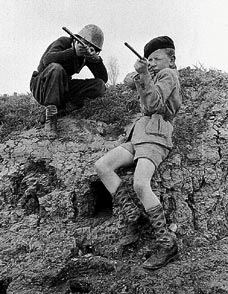 The boys put down their Commando comics, in which the heroes were square-jawed and wore their helmets at a jaunty angle, and the enemies’ eyes were always in shadow, and determined to play war in the woods. One or two were lucky enough to have their dads’ old berets, a helmet, or a toy gun, the others grabbed dry sticks of the right size, with which to extemporise a weapon. They picked sides and fanned out into the trees.



 Marie Marshall