Marie Marshall

Author. Poet. Editor.

Category: story

Juggernaut!

From my longest short-story, The Last-but-one-Samurai:

“I believe that there is a barbarian land, where they have an annual festival in which they propel a large, heavy statue of one of their gods down a hillside. It is left to chance or fate where it careers. It strikes a rock, and either bounces aside down a new, destructive path, or dislodges the rock, which then tumbles with it in a terrifying avalanche. Onlookers marvel, and wonder when it is going to stop dead. Eventually it strikes a more solid obstacle, and its tumbling is arrested – the onlookers breathe again – but no! It teeters for a moment, as if making up its mind whether to settle back, and then plunges onwards, causing more and more destruction. What I am trying to say is that my story has been like this, and whatever I thought, as I lay my gear down amongst that of the forty-six, there was more insanity to come. The statue of the god was about to tip over again, and carry me down with it!”

Of sequels, threequels, and w.h.y.

w.h.y. banner

Just when I thought I had enough balls in the air, someone throws me another one. Instead of dropping them all, running, and hiding, I catch it and add it to the juggling act. Okay, last time I reported in, I was doing the final edit of From My Cold, Undead Hand, progressing the sequel KWIREBOY vs VAMPIRE, finishing two short stories – ‘Gravity’ and ‘The Warlock’s Hat’ – for a competition, and contacting a Ukrainian university about Vera Rich’s translations of Ivan Franko’s poetry.

Well, it all seemed manageable. I now have the finalised manuscript of From My Cold, Undead Hand here. It will ready for publication as soon as we have cover artwork and layout. I return to KWIREBOY vs VAMPIRE as often as I can. The short stories have had their final edit, which involved opening up the sealed envelope I was about to mail them in. I have been looking at Vera Rich’s translation of ‘Death of Cain’, comparing it to an earlier translation by the Rev Perceval Cundy, wondering why she rendered ‘город’ as ‘city’ and not ‘garden’ in the context of the poem, and surprising myself at my own cheek at questioning an expert! So, all balls describing a neat arc in the air above my head. Then I found another ball in my pocket – the threequel to From My Cold, Undead Hand (working title KLONE vs OVERLORD) – and added it to the juggled bunch, rather shakily at first, then it too joined the arc. Equilibrium.

Then blow me down! An idea casually tossed to me by a fellow writer exploded in my head, and suddenly I have a plan for a sequel to The Everywhen Angels. With the working title of Among the Grove of Stones (which readers will recognise as a line from an extempore poem in the first book), it will tell the story of Connor Shaw, King Shaw’s nephew, and of how Ashe Sobiecki went missing, of what had been happening to the tulpas of dead Angels as they tried to pass through one last, forbidden door at the moment of death, and of why Angela and the other Unified Angels feel disturbances in the flow that even they can’t control. All of a sudden my control on all the juggled balls is becoming unsteady. I’m hoping I can prioritise and get everything in some semblance of equilibrium again by autumn, and then maybe I will be able to concentrate on finishing one of these jobs at a time.

I think I’m addicted to writing. My hits keep getting bigger.

#amwriting

From My Cold, Undead Hand reached an exciting stage today, as I received the manuscript back from its first professional edit. Progress continues on the sequel, KWIREBOY vs VAMPIRE. In other news, I have just finished two short stories – ‘The Warlock’s Hat’ and ‘Gravity’ – as entries for the William Soutar Writing Prize. They have two entirely different settings, Dundee and South Africa, and are written in two entirely different styles. Let’s see how they fare. And I have written to the Ivan Franko National University of L’viv in the Ukraine, asking if I may have access to more of Vera Rich’s neglected translations. Watch this space.

Robin Hood and the Bishop of Hereford

Robin Hood and the Bishop of Hereford

Robin Hood and the Bishop of Hereford,

A story for May Day *


It happened that on the first day of May the Lord Bishop of Hereford was riding through the Great Greenwood that once covered most of England, on his way from the Abbey of St Hilda in Whitby to his own city of Hereford. Against the advice of the Abbot of Whitby, he was riding alone, for the Bishop was a man of great stature and courage and feared no man. “Besides,” he had said to the abbot, “who would waylay a man of the Church?”

As the Lord Bishop rode through the forest, looking around at the fresh, spring leaves on the oaks, the ashes, and the bonny rowans, and listening to the chaffinches giving their celebratory spring call and the jays laughing at them from deep in the trees, he too was filled with joy, and broke into a chant, in the manner of St Gregory.

Te Deum laudamus,” he sang, in his great baritone. “Te Dominum confitemur…” and the birds seemed to increase their trilling and laughing in friendly rivalry with him. Here, where the forest was at its deepest and greenest, and the track wound in between the oak boles, he felt was a place of goodness, where no harm could come to anyone, and if anywhere was a remnant of the blessed Garden of Eden, then this corner of England was it.

“Hold!” cried a voice, of a sudden. The Bishop broke off his song, looked down, and saw that he was surrounded by men in Lincoln Green, one of whom – a bold, smiling villain in a feathered cap – held fast his palfrey’s bridle. All brandished stout longbows with arrows nocked, some of which were pointed at him.

“Who are you men who roughly and rudely interrupt my praises to the Almighty, prevent my travel, and disturb this blessed Spring day?” cried the Bishop. “And especially, who art thou, grinning in thy beard? Yes, thou, the knave with the pheasant’s tail in his bonnet, who hast laid hands on my horse.”

This man, who appeared to be the leader of the troop, let go of the bridle, showed the palm of his hand to be clear of it.

“Upon your parole, then, my Lord Bishop,” he said. Then, sweeping his cap from his head, he bowed low and made a respectful leg to the prelate. “I am known in these parts as Robin Hood, and these honest churls, on whose behalf I beg your pardon for the interruption to your journey, are my friends and fellow Foresters. We collect the toll from travellers who pass this way.”

“Never let it be said that I refused to render unto Caesar that which is Caesar’s,” said the Bishop. “How much is the toll?”

“Half of all you carry,” said Robin, “and an hour or so of your time to dine with us.”

The Bishop’s eyes opened wide. “I am a humble priest!” he protested, “but even half of what I carry is too much to ask, surely?”

“Your fine garments, your riding-horse, the ring on your finger, and the heavy pouch at your belt would all say that you are far from humble, My Lord Bishop. Besides, it is much less of an impost than some of my men here have had to pay, having lost all they ever possessed.”

Now the Bishop, large and fearless though he was and capable of standing a round of buffets with any man, was kindly at heart. He had heard of how the outlaws of Sherwood, once they had sufficient to keep themselves fed, would distribute the bulk of their pelf to the poor, and he himself was cognizant of the virtue of St Martin. He recalled the story of how the saint, while still a soldier and a worldly man, had freely cut his paenula in two and given half to a shivering beggar who – as it was revealed to him in a dream – was Christ in disguise. Well, the man with the feathered cap was no Christ, any more than the others of the green-clad band were Apostles, so the Bishop was of a mind to have some sport with them.

“I doubt me, Sirrah, that thou art truly Robin Hood,” he said. “And if thou art not, what is to prevent another band of robbers stopping me a mile hence with their own claim to be the Merry Men of Sherwood, then another band a mile further, then another and another, each taking half, until I am left with a groat, half a cassock, half a cloak, and one shoe? I hear that Robin Hood and his followers are great archers. Lend me for one minute one of your longbows – let it be the worst you have – and I shall loose an arrow, shooting it as far as I can. If you can shoot further, and thou, Feathered-Cap Esquire, furthest, then I shall acknowledge that I am indeed in the presence of Robin Hood and his men, and I shall pay the forest-toll.”

With these words the Bishop leapt down from his horse and took hold of the bow of Much the Miller’s son, nocked an arrow to it, drew it, and let fly. The arrow’s flight was long, and it landed in a field beyond the trees. The Bishop handed the bow back to Much, who nocked a second arrow, drew back the bowstring, and with a grunt of effort shot it into the same field, but a little further than the Bishop’s. The Bishop clapped his hands.

“Excellent bowmanship for such a young lad!” he exclaimed, and then pointed at Will Scatlock. “Now this fellow!”

Will drew back his bowstring and shot an arrow into the next field, to the Bishop’s delight. Each of the band had his turn, each shooting further and further, until it was the turn of the tall, powerful John Little. With his mighty arms he drew back his bow and loosed an arrow that went two fields further than the last man’s.

“Thou giant!” cried the Bishop, even though he was of a height with John Little. “I’ll wager no one can best that!”

Robin Hood stepped forward. He was no match for his great lieutenant in height and strength, but his skill was such that he knew well how to make the most of a longbow. He took his bow, nocked an arrow, drew, elevated the bow with exactness and, having waited for the wind to die a little, let fly. The arrow went a prodigious distance and landed one field further than John Little’s. The Bishop clapped and cheered, and then bowed to Robin, addressing him politely.

“You are indeed Robin Hood!” he said. “That I freely acknowledge.”

“Then pay the toll, my Lord Bishop,” said Robin. “That was the wager.” But the Bishop mounted his horse again and raised an eyebrow in a pretence of haughtiness.

“Who is to stop me? All your arrows are spent!”

Robin saw that the Bishop had bettered him, and he threw back his head and laughed. Then he bowed again.

“Well won, Well won! The freedom of the forest track is yours. Pass onwards free of toll, for you have taught us all a lesson today, and that is worth more than any toll.”

But the Bishop did not spur his horse. “I am determined to be magnanimous in victory,” he said. “These lands hereabouts are mine, and the field where the lad’s arrow landed I shall give to him, and it shall be known as ‘Miller’s Field’. The next, where Scatlock’s arrow landed, shall be his and shall be called ‘Will Scatlock’s Field’. And there shall be ‘John Little’s Field’, and ‘Robin’s Field’, and a field for all of you.” And this offer was a true one, because the Bishop was not only a priest but also a great holder of land in his own right, being of the line of one of the Conqueror’s barons.

“Alas,” said Robin, shaking his head, “ this cannot be, for we are outlaws and forbidden to hold land.”

“Some say, however, that you are heir to the Manor of Locksley.”

“Aye, and others that I am the son of the Earl of Huntingdon, and others still that I am a Knight of the Cross of St John. But the law is the law, and we are outside it,” said Robin.

The Bishop dismounted again and clasped Robin’s hand.

“Then your lineage,” he said, smiling, “matters nothing to me. We shall halve the contents of my purse. Now, I believe there was some mention of dining – dare I expect venison?”

Thus the Bishop of Hereford came to feast in Sherwood, and a merry May Day was had by all. The Bishop counted over half of the coins in his purse, as he had promised, and made sure he had at least his fair share of venison. He conversed in Latin with the good Friar Tuck, in French with Demoiselle Marianne who was Norman, and even in Arabic and Greek with ibn Hassan, Robin’s hostage-become-friend. At the end of the feast he went on his way with many a wave and a Pax Vobiscum.

From that day, in all the diocese of Hereford, no church from the Cathedral itself to the lowliest chapel would refuse sanctuary to any man dressed in Lincoln Green; and every May Day was a holiday amongst the outlaws, and in their feasting they never forgot to toast the Bishop of Hereford, the only man ever to get the better of bold Robin Hood.

__________

* In most of the Robin Hood folk-tales, the Bishop of Hereford is portrayed as an enemy of Robin and the outlaws. In this particular tale, which is based on a story I heard from a teacher when I was a little girl, the Bishop is a good character. This tale is retold just for fun, without any pretended literary merit – whoever heard of a folk tale having literary merit, for heaven’s sake!


‘Le Phénix renaissant de ses cendres’ – critique par Thierry Guinhut.

‘At Jenners, Edinburgh’ (detail) © Paul Thompson

‘At Jenners, Edinburgh’ (detail) © Paul Thompson

For my Francophone readers, here is a review of the sonnet anthology The Phoenix Rising from the Ashes, of which I was Deputy Editor. The review is by Thierry Guinhut, a well-regarded reviewer in France. The image above is detailed from one which contributes to the visual layout of the anthology. Thierry’s review is glowing; most reviews have been good so far, with the exception of one ‘critic’ who seems to imagine some kind of Corsican vendetta exists between him and the Editor-in-Chief. The anthology is one of the many published items you can find under the ‘Works‘ tab on this web site.

Baal, Yamm, and Anath

Embedded in The Everywhen Angels is this tale, handed down from ancient Canaan; it is told by a Romany patriarch to a gorjo boy, as his wife paints a henna tattoo on the boy’s arm.
__________

BaalFar away in the land of Canaan, many years ago, beyond the city of Ugarit, where they sang psalms to the creator El long before the Children of Israel came and stole not only their land but their psalms too, there stood a mountain. The mountain’s name was Zaphon, and it was the home of the great god Baal, son of Dagon, called ‘Lord of Thunder’, ‘Almighty’, ‘Rider of the Clouds’, ‘Lord over the Earth’. Some folk called Baal by the name of Hadad. Baal was never still – he could never rest – and thunder could be heard daily from Mount Zaphon, and flashes of lightning played around its summit.

From the summit of Mount Zaphon, where he ceaselessly paced to and fro, Baal could see the Mediterranean ocean, home of the god Yamm. Baal became angry. His kingdom now felt small, because he could see its boundaries. And in his anger he called out to Yamm, insulting him continually in his loud voice, hurling thunderbolts and making great winds, so that Yamm’s kingdom was constantly in turmoil, tossing this way and that in the storms and winds that Baal sent.

“Come out and fight me, Yamm, you coward!” shouted Baal, in a voice that echoed in a peal of thunder so loud it was heard beyond the southern border of Canaan. “Stop skulking in your slimy kingdom. Show yourself!”

And at last Yamm came up from the sea, his dark face rising like a tidal wave, and he set his great, green foot upon the shore, upon Baal’s kingdom. And he shouted back to Baal in a voice like the crashing of breakers against the cliffs.

“Here I stand, you blustering bully! Are you nothing but noise? I challenge you! Who’s the coward now?”

Baal saw that Yamm was indeed mighty, a great enemy, strong and fearsome. Baal himself was no coward, but he was very cunning, and so he went to Kothar, the blacksmith god, skilled in making any object a god could need. He asked Kothar to make him mighty weapons with which to fight Yamm. Kothar took all the metal that lay under the ground between Mount Zaphon in the West, and the Indus river in the East, and he worked it into a great, bronze sword. And he scooped up a huge piece of the Earth and made it into a stout shield; and the hole it left became the Sea of Galilee.

Armed with the sword and shield, Baal charged at Yamm. The battle between these two gods lasted twelve whole years, during which time there were such thunderstorms and tides as had never been seen in the Mediterranean*. Baal pushed at Yamm with his shield, and battered at him with his sword; and with every push of the shield and stroke of the sword there was a huge peal of thunder and flash of lightning. Yamm whipped Baal with waterspouts and showers of stinging rain and hail.

In the city of Ugarit, and throughout Canaan, the poor people cowered in their houses, only coming out when the two rival gods paused between rounds.

Eventually Yamm began to gain the upper hand, and roared with delight, beating Baal further and further back inland. One lash with a mighty waterspout was enough to send Baal’s shield spinning from his hand, to land on its edge in the sea, where it became the island of Cyprus.

By this time even the gods themselves had come to watch the battle, betting upon the outcome. The sun goddess, Shapash, was the only one to bet on Baal, and secretly warmed and dried him with her rays. Baal, who as you know was cunning, devised a plan to escape defeat. He waited until the sun goddess’s kindly gaze was on him and then angled his mighty, bronze sword so that it reflected the sunlight right into Yamm’s eyes. Yamm was dazzled and blinded, and Baal started to belabour him with the flat of his sword, raining blow after blow down upon the sea god, until he was beaten, and the sea became calm and still.

Now Baal had a wife who was also his sister. Do not ask me how this can be, but such things were possible with the gods of Canaan. Not only was Anath his sister and his wife, but she was forever a virgin. She was greatly loved by all the gods, and she took Baal by the hand and led him to see El, the creator, to whom all psalms were sung. There she told him that the reason Baal paced to and fro on Mount Zaphon was that he had no house to live in. If El would give permission for Baal to have a house built, then all Canaan would be a place of peace. El readily gave his permission.

Anath asked Kothar for help, calling to him sweetly, using the pet name she had for him. “O Hasis the Skilful, Hasis the Wise, make a house for my brother-husband Baal and me, in which we can live peacefully.”

Kothar built a house for Baal on top of Mount Zaphon, and Baal was pleased. For a while all Canaan was at peace, the sun shone, and the gods dozed. Even Yamm forgot his quarrel with Baal, and visited him in his house. At such times the summit of Mount Zaphon was wreathed in mist.

One day Baal invited all the gods to a great feast. Yamm was there, and El the creator as the guest of honour. Shapash and Kothar sat together, and even Yutpan the deceitful had a place. The only god not to be invited was Mot, the god of death. When he heard about the feast, he strode up Mount Zaphon in a rage, and pounded so hard on the door of Baal’s house that the food and drink was shaken off the tables.

Mot burst into the house and cursed and ranted at Baal for the insult of not inviting him. Baal was so enraged at this that he forgot he was supposed to be living a peaceful life. He sprang to his feet, seized the sword that he had used to defeat Yamm, and rushed at Mot.

Their duel was a terrible sight. Even the mighty gods fled from Mount Zaphon, as Baal and Mot reduced the lovely house to rubble in their raging. But even the mighty Baal could not defeat Death, and Mot eventually swallowed up Baal, and spat him out on the mountain top, dead and cold.

While the gods debated amongst themselves who could take Baal’s place, Anath mourned for him. Not only did she mourn as a sister and a wife, but also as a mother and a daughter would, for she was all things to Baal. She wandered through Canaan looking for Baal’s body, and when she found it, she buried it and wept over his grave. But her tears, at first cool and sorrowful, turned to drops of fire, and became a rage such as creation had never seen. She turned and ran and ran until she came to Mot, flinging herself upon him in a murderous frenzy. Struggle as he might, Mot found he was no match for Anath, because as she had mourned Baal as a sister, a wife, a mother, and a daughter, she had become four goddesses in one. In her wrath she killed Mot, ground his body to powder, and scattered it over land and sea.

Then she took the place of Baal on top of Mount Zaphon, where she ruled for many years, no longer as Anath the gentle and beloved of the gods, but as the goddess of slaughter, whom some called Ashtoreth, with a hideous aspect.

Many lives of men and women passed. One night El, the creator, dreamed a dream, in which Baal and Mot were alive and stood before him. What El dreams always comes to pass, and so when he awoke, there before him stood Baal and Mot, restored to life. He charged them solemnly each to keep to his own kingdom, and not to fight any more. They bowed low to him and gave him their promise.

When Anath saw Baal coming again to Mount Zaphon, her heart was softened, and her face became beautiful once more. She painted herself with a dye made from her sacred plant, which she called Mehendi, making  the beautiful patterns on her face and limbs, which brides do to this very day in India, and in Mesopotamia, and in all parts of Arabia.

And Baal and Anath lived in peace and happiness ever after. Some say that when the One God came they faded away. Others say they still live on top of Mount Zaphon, but now as an old man and an old woman, and have retired from being gods.

But one thing I know is this: Anath’s sacred plant, Mehendi, which we call Henna, still grows.
__________

* Yes, I know, I know!

Something ghostly from Shetland…

Da Trow i' da Waa

… is coming to Pitlochry on 22nd February, in the shape of my short story Da Trow i’ da Waa. It will be rounding off the prizewinning stories of this year’s ‘Fearie Tales’ competition at the Winter Words literary festival – the first of Scotland’s literary season – at the Pitlochry Festival Theatre. ‘Trow’ is a word which has survived from Shetland’s Nordic past into its modern tongue (which is maybe less than a language, maybe more than a dialect, not unlike Lowland Scots), and it is roughly equivalent to the Scandinavian ‘troll’. My story is all about what happens to an author with writer’s block, who takes a cottage on the remote island of Yell, in Scotland’s most northerly archipelago.

The story will be read to an audience by Scottish actor Helen Logan. Just checking out the events for the rest of the Festival week, you could say I was on the same bill as Sir Chris Bonington, Mike McCartney, Sally Magnusson, and Neil Oliver! Here you can watch a short video about the festival and the venue.

Comic books, cultural catastrophes, and juggled balls.

All images shown under ‘fair use’ provisions.
__________

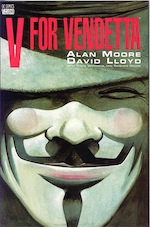
V for vendettaI own only one graphic novel, Alan Moore’s V For Vendetta. Of course I do – why wouldn’t I own a book in which an anarchist superhero goes mano a mano with a fascist government in Britain? I notice that Alan Moore distanced himself from the film version, exciting though that was (and it starred the wonderful Hugo Weaving!), saying that it had been ‘turned into a Bush-era parable by people too timid to set a political satire in their own country’. Having read the script, he said,

It’s a thwarted and frustrated and largely impotent American liberal fantasy of someone with American liberal values standing up against a state run by neoconservatives – which is not what the comic V for Vendetta was about. It was about fascism, it was about anarchy, it was about England.

If this does nothing else, it points up the difficulty in adapting a work of art in one medium for another. Perhaps the greatest irony about both the graphic novel and the film of V For Vendetta, is that whilst the Guy Fawkes mask of the protagonist has become instantly recognized worldwide as a symbol of radical protest, it must be making a pretty good profit for someone.

I own three DVDs that are adaptations of graphic novels or comics (if you don’t count assorted Batman flicks in the back of the drawer). These are 300, based on Frank Miller’s and Lynn Varley’s fictionalization of the Battle of Thermopylae, and Kick Ass and Kick Ass 2, based on the comics of Mark Millar and John Romita Jr.

Kick AssKick Ass is fun. It came in for a lot of abuse on account of the bad language, less for the violence – with the exception of one teenager, no bad guy is left alive by the end of the film. Its killing-spree violence is in the tradition of Peckinpah and Tarantino, subverting the bloodless wrong-righting of The Lone Ranger and Batman. I think people missed the point that it is highly satirical of the superhero genre, and simply spares no effort to de-bunk its ‘zap’ and ‘pow’ fisticuffs. It is, as the cover of the comic book says ‘Sickening violence, just the way you like it’, signaling that it does not take itself seriously and shouldn’t be taken too seriously by readers and movie-goers. The satire of the film is taken further by the character Big Daddy (Nicolas Cage) adopting the phrasing of Adam West, one of the film’s Batman references along with the parting Jack Nicholson quote from Chris D’Amico (Christopher Mintz-Plasse) “Wait till they get a load of me”, and Hit-Girl’s (Chloë Grace Moretz) “Just contact the mayor’s office. He’s got this giant light he shines in the sky. It’s in the shape of a giant cock” (the bird! the bird! Omnia munda mundis!).

Alan Moore is, I guess, entitled to take pot shots at the genre from his position as an insider. If anyone knows the genre he does. In his latest diatribe, possibly his public farewell, he not only curses the modern craze for superheroes, but also tackles such issues as the depiction of rape, and the right of an author to use characters of a different race, class, or gender from his or her own. Specifically on superheroes he says:

To my mind, this embracing of what were unambiguously children’s characters at their mid-20th century inception seems to indicate a retreat from the admittedly overwhelming complexities of modern existence. It looks to me very much like a significant section of the public, having given up on attempting to understand the reality they are actually living in, have instead reasoned that they might at least be able to comprehend the sprawling, meaningless, but at-least-still-finite ‘universes’ presented by DC or Marvel Comics. I would also observe that it is, potentially, culturally catastrophic to have the ephemera of a previous century squatting possessively on the cultural stage and refusing to allow this surely unprecedented era to develop a culture of its own, relevant and sufficient to its times.

Angels Amazon coverHaving fallen almost by accident into writing for young adults, I find myself skirting superhero territory. The teenagers in my novel The Everywhen Angels have powers that they don’t quite understand, and the protagonist in my recently-completed teen-vampire novella, From My Cold, Undead Hand, is a girl who has been trained to hunt and destroy vampires. Consciously or unconsciously, however, I seem to have made these characters break a mould, or break out of a strait-jacket. Unlike traditional heroes, they don’t necessarily win, they don’t necessarily triumph over a force bigger than they are, their tales do not have a clear resolution where all is explained in a neat and tidy way. Good does not necessarily triumph over evil, and where it does it may well be by accident rather than design. Why?

I guess it is because so many action adventures in any medium, where makers justify their violence in terms of the triumph of good over evil, are little more than morality plays and wish-fulfillment fantasies. If I’m to get readers close to the characters, and the characters close to the danger, everyone is going to have to realise that kids don’t get to be kings and queens of Narnia, and they do get to screw up. I mention all this because one of the balls I’m currently juggling is scripting From My Cold, Undead Hand for adaptation into a graphic novel. It isn’t all that easy. As I was writing it I never had anything in my mind apart from painting pictures with text. In order to script it, I have to take a huge step back, almost throw out the entire manuscript, and re-tell the story a totally different way. I have to imagine how it might look on the page. Take the following note I have made about the initial image:

Exceptionally, this should be a full-page picture, opening on the right-hand page. Chevonne is striding towards us, sword strapped to her back, carbon-pistol in her hand. Her face is rather grim and determined. The angle is fairly low – we’re slightly looking up at her. She’s striding between the stacks of a library. Text in a rectangular box, or maybe two, says something like: ‘The time is a little way into the future. This is Chevonne Kustnetsov – by day a student at PS#401, New York, by night a vampire hunter. Here she is, pursuing a vampire through the University Club Library, tracking it down to destroy it…’ Perhaps change that to 1st person speech, as the text novel is in 1st. Maybe not. We can take that final decision later.

Compare that with the opening paragraph of the novella:

There’s an art to this. When a vamp de-korps I only have a split second to guess where it’s going to re-korp. This one’s tricky, clever, powerful. As I just beaded my carbon-gat at it, it blew into a thousand-thousand little bits in front of me. Thought it could fool me, but that de-korp happened too quick to be the result of my bullet.

In that opening there is no detail of who the character is, where she is, or when the story is set. Such detail is revealed within the text when it needs to be – her school, for example, is not referred to until the second chapter, and the time in which the story is set is implied by things such as the technology depicted. You can easily see that this is a total departure for me. It’s quite a challenge and I think I’ll have to put other projects on hold while I tackle it. But you know me – I’m liable to pick up and put down my writing projects in a rather haphazard way. Wish me luck.

Introducing Evangeline*

Detail from 'The Derby Day' by William Powell Frith

Detail from ‘The Derby Day’ by William Powell Frith

Imagine Epsom a huge tray of type rolling, popping, reversing at it is shaken, and there you have this field of hats and heads, toppers, skimmers, brimmers, bowlers, billycocks, and caps, all peppered with ladies’ bonnets, twirlers, birders, and fascinators as though someone had tossed cloured comfits into the jiggling type. The men of course are the blacks and greys of the inky letters, apart from a handful of jays and mandrakes. In all this steps Evangeline, as though she is treading from tussock to tussock in a wind-disturbed swamp or from boat to boat in a bobbing harbour, although her paces have all the precision of a prima ballerina’s. She only appears to be pushing through the press, which in fact parts, imperceptibly, for her. She sees all, sees the punters, tic-tac men, bookies, buzzers, down-and-outs, up-and-comings, lordings out on the slum like so many drunken second-sons. Evangeline’s back is straight, the face she shows to each person she slides by is what they want to see; she is their equal whether they expect a whore or a lady, oh my, oh my, she can counterfeit all, especially that which she genuinely is.

“I have the skin of a fish,” she thinks, says under her breath, an arcane choice of phrase by which she takes pride in her ability to sense the movement of the crowd and isolate the ripples and disturbifications that are just a little foreign to it. As now she does, finding the zig-zag of a dipper whom she knows, searching for his titfer amongst the thousand, spotting it with a smile. It’s Ganzy Gil Degarry, called ‘Old Cawhang’ by his pals for his Channel Island cant and patois, though more than half he puts on, having left Guernsey as a young’un, and indeed he’s not that old. She sees him making a mark, lifting his hat in apology to a man whose weskit he has just relieved of a deaner or two, a drackmer, or maybe of his best jerry, or maybe of a long-tailed note. Ganzy Gil’s quite the mobsman, quite the tooler.

“What’s this?” she thinks, says under her breath, as a new counter-eddy makes itself known, paralleling the pick-pocket. Her eyes rake the stylish tiles, settling on a couple of bowlers circulating on the periphery. Two Miltonians (she’ll be bound!), one whose gait she recognizes as he whom she calls ‘my grasshopper’, the other no doubt his sergeant. No doubt either that their courses spiral in towards the progress of Ganzy Gil, whom they have spotted at his business. So she herself cuts a curlicue process towards the thief, prettily, carefully, lifting the skirts of her coat. Despite the deliberate ease with which she penetrates the jostling press, she knows they will have him before she gets to them. From her pocket she slips a small bottle of gin, swigging from it to perfume her breath and to give her an excuse to stagger a little.

Ganzy Gil’s skillful monkey-fingers are about to harvest a pocket-book from a portly cove when the sergeant’s hand rests lightly but obviously on his shoulder. He halts, looking for a way out, but is confronted by the grasshopper who stands before him like Dover cliffs. And so Ganzy Gil is voided of his energy – inevitability has seen to that – and his swagger sags. Inevitability, however, suffers a little reverse, when Evangeline takes a small, tipsy stumble backwards, and the heel of her shoe presses down hard on the grasshopper’s foot. He yells in pain, his colleague is distracted for long enough for the pick-pocket to swing away from under his grasp and dodge into the crowd. The sergeant springs to pursue, but Evangeline staggers in front of him and is knocked to the ground.

“Here! What’s your game?” she cries, not in the least winded. “Stop him! Stop him someone! That brute attacked me!”

A dozen or more bodies bar the sergeant’s way, and if Evangeline had been on her feet more quickly, she would seen a cheeky, over-the-shoulder grin from Degarry serving as his a la perchoine to the peelers. As it is, Evangeline is returned to her feet firmly by the grasshopper, whose grip lingers on her slender arm, strongly enough to be a restraint, gently enough to leave no trace of a bruise. “Blind me and bless me,” she thinks, “but he’s done this before, held a woman suspect immobile.”

“Miss, I think you are well aware that I am an Inspector of the Metropolitan Police,” he says, loudly enough so that the eagerly watching crowd does not turn nasty and instead knows him for the jack he is. “Furthermore I think you were well aware that my colleague whom you impeded so excellently is a sergeant of the same force. I also think you know the criminal whom we had arrested and who escaped thanks to your intervention. To put it simply, Miss, you’re nibbed.”

“Sir,” says Evangeline, brushing mud off her coat with her free hand, “you think a deal to much. And since you are a policeman you will know that your thoughts to not amount to evidence. Are we to miss the races because of your thoughts?”

“I see you are not as tipsy as you first appeared,” says the grasshopper. “That goes a little way towards being evidence. It is at least a suspicion in my mind, and as such is enough to oblige you to come with me and be questioned.”

“Then allow me a little dignity,” says Evangeline. “Allow me to take your arm as fits a lady. Your bulldog can walk behind and make sure I don’t cut and run.”

So Evangeline and ‘her’ jack swap their who-holds-whom, at her insistence and without his resistance. Together, and with the sergeant stalking behind like a zealous duenna, they walk through the once-again parting press as lady and escort. When a gaze meets hers she smiles, slightly inclining her head, and the gazer can’t help but touch the brim of his hat respectfully.

________

*My previous post was a teaser about ‘Agent Delta’, a fragment of an unwritten novel. Here is one which introduces ‘Evangeline’ – Victorian orphan, sometime mountebank but with true psychic talent, well-born friend of criminals and prostitutes, and destined to be a ‘Woman Searcher’ with the Metropolitan Police – and her ‘Grasshopper’, an unnamed Police Inspector, loosely based on the real-life Jack Whicher (though what an officer of ‘the Met’ is doing at a racecourse in Surrey is in itself a mystery).

I am fascinated by the thought of ‘lost slang’. I know that things I recall from my own lifetime have come and gone, leaving gaps in social history. Nothing appears on the mighty internet about them. They might never have been. For that reason, along with London’s Victorian argot that I have researched, my intention has always been to drop expressions into the mouths of my characters for which there is absolutely no evidence.

One other thing I ought to mention is an additional way that these fragments have been constructed to ‘tease’. All the original text fragments of both my ‘Agent Delta’ and ‘Evangeline’ works-in-progress are written in the first person, the protagonist narrating; however the two pieces I have composed and posted here are written in the third person, though focalized on the protagonist. I like to play. This is all helping me get back into the discipline of writing…

Introducing Agent Delta*

gills

Agent Delta lifted the crime scene tapes and stepped into the cordoned-off area, turning up the collar of his dark grey suit to an insistent, cold wind. Somehow the large, sliding doors of the disused warehouse were funneling it, as though it had been whistled up for the occasion. Something was rattling or slapping arrythmically, irritatingly, against an iron rail. Odd pieces of litter were bouncing and tumbling through the space, looking for a way out at the other side; most trapped themselves against the far wall and fluttered, reminding Delta of the death-twitches of a Great Hawkmoon Moth.

Death. That’s why the tall, gaunt, lank-haired man with the grey suit and black turtle-neck was there. “There’s been a death,” they had told him. “The ‘locals’ don’t know what to make of it. Go and sort it out.” And indeed, in the middle of the empty, wind-bothered space there was a corpse. Crouching by it was a figure in a disposable, white oversuit. Standing a few feet away was a second figure; as Delta walked towards them the second figure turned and strode quickly to intercept him. Delta looked him up and down – the beige mac flying open in the draught looked expensive, as did the tailored suit, darker than Delta’s own, and the brogue shoes. “Too well-off for a policeman,” Delta thought, and then he spotted the distinctive cufflinks of the Holy Tabernacle of Continuing Pentecost. That bunch set great store by appearance.

“And you are?”

The man’s fragment of a sentence was curt to the point of incivility, but Delta was used to this kind of thing on the rare occasions that he turned up at crime scenes like this. His coming was seldom announced, and this one probably hadn’t been. He reached into the inside pocket of his jacket, pulled out a slim wallet, and flipped it open. The man made a show of stopping beyond arm’s reach and craning his neck to look. There was a badge on one side and Agent Delta’s photo ID on the other. The words Chthonic Intelligence Agency were in bold red type below the photo.

The man’s attitude didn’t exactly change. Delta couldn’t shake off the feeling that his presence was resented, as the man’s eyes flicked up from the credentials to Delta’s face and back again.

“I’m Detective Inspector Ellis. Come this way, Agent Delta.” The policeman walked off towards the corpse and the figure in the white oversuit. He stepped quickly to draw ahead of Delta, as though maintaining his authority over the scene.

“I don’t often get to meet people from your Agency,” he said, over his shoulder, and then to the figure in white: “Doctor Phillip, this is Agent Delta from the Chthonic Intelligence Agency. Doctor Phillip is a Home Office pathologist, Agent Delta.”

Doctor Phillip stood up, pulling back the hood of the oversuit to reveal hair as blonde as Delta’s own but tousled. She was almost as tall as the agent, certainly as slender, and her gaze was direct. In that gaze Delta read more than resentment at his presence, he read something that was almost a direct challenge to his very existence. “She’s a scientist and therefore a rationalist,” he thought. “Maybe even a Dawkinist. Many scientists are. She’s already resentful that the policeman she’s working with is religious. I’m the last straw – a wizard.”

“Unfortunate set of initials your outfit has,” she said. No other greeting. “Could lead to a certain amount of confusion.”

“I hadn’t heard that initials were copyrighted,” said Delta. “What do you think we have here?”

“The body of a man in his mid-thirties. Appears to have been dead for about four hours.”

“His clothes are wet,” D I Ellis put in, “and there seems to be water on the ground beneath him.”

Agent Delta looked up. At this point the roof seemed intact and sound. It was unlikely that rain could have got in from above, and if it had blown from somewhere else there would have been other patches of wetness. He looked at the pathologist, and for a moment imagined them in bed together, imagined that resentment and challenge directed into something else, and he felt the corners of his mouth turn upwards into half a smile. Then he remembered his wife, alone in the old manor house that had been in his family for generations, her mind alienated by – what? – a lifetime in magic, his neglect, their son’s sullen rebellion, a dozen things. He remembered the narrowness of the bed in his London flat, where he stayed seven days or more out of every ten. He remembered the handful of meaningless sexual encounters that had fizzled out almost as soon as they had begun. The half a smile ceased to be.

“What else do we have?” he asked the pathologist.

“Nothing to smile about,” she replied. He wouldn’t bother to put her straight about what had made him smile. “There is no immediately visible cause of death. There is a strange contortion to the limbs and to the facial muscles. A small amount of froth at the mouth and nose might suggest drowning. I say ‘might’. If so then he didn’t die here. There’s something anomalous – what appear to be five or six slits on the side of his neck. And there’s this…”

She crouched down again and pointed to the dead man’s left wrist. His left arm was crooked up awkwardly, the fingers of his left hand were clawed. Something was protruding from the sleeve of his jacket. Doctor Phillip must have taken it for a stick from wherever the dead man might have drowned, because she was reaching to take hold of it and pull it out.

“No!” Delta said sharply. He recognized the butt of a wand when he saw it. he had one similar up the left sleeve of his own jacket. What they had here was a dead wizard. That’s why someone had called him in. He bent over and looked at the ‘slits’ in the corpse’s neck. They looked like small shark gills, a sure sign that the dead wizard had enchanted himself to survive under water for a time. So how would he have drowned? Where was the nearest water? The Birmingham canal system? Hardly. Delta took out his thaumatometer. To the pathologist and the policeman it would have looked like a mobile phone, but the ‘camera lens’ was the knot-hole of an alive oak from Arkham Forest, and what looked like a winking, red LED was a scale from a Sri Lankan salamander. He passed the meter over the corpse. The winking light did not change colour – a totally negative reaction. Despite the gills and the wand, everything about the corpse, everything on or near it, had been totally drained of magic, and that was dangerous. The whole place was thaumaturgically unstable, the equivalent of a magical black hole.

“Step away, Doctor Phillip,” said Delta. “In fact I’d like you and Detective Inspector Ellis to leave the scene right now.”

“What? No! Are you serious? I’m here as Home Office pathologist. I don’t leave, and I’m officially taking charge of the corpse for a post mortem examination…”

“No, you’re not,” Delta interrupted. “In fact you are leaving. I can have you removed if necessary. This area is now off-limits to the police, the Home Office, and in fact to anyone outside the Chthonic Intelligence Agency. I do have the authority to do this, Doctor. Please do not oblige me to exercise it to its full extent.”

Doctor Phillip was furious but speechless as the Detective Inspector led her away. Delta looked down at the corpse. Sure this was a mystery, but his mind strayed back to the piece of paper in his pocket. It was a talking note from the Head of the Agency. He already knew it was a summons, he just didn’t know why…

__________

*Agent Delta© and the Chthonic Intelligence Agency© are part of a world I have thrown together in a handful of experimental writings, maybe towards a novel, maybe towards a few short stories, maybe towards nothing at all. I’m introducing Agent Delta to you in the fragment above for one reason only – not because I intend the mystery of a drowned wizard with shark gills, miles away from water, to go anywhere, but because this is a neat way of illustrating the process of how I write.

Most stories appear to be linear. In fact they are not. Writers start with the resolution in mind – in effect they begin with the end – and it is the resolution, not the linear steps, that drives the story. In the 20c a handful of great modernists like James Joyce and Virginia Woolf challenged this process. However it persists. Whilst most of the fiction I write has a resolution of some sort, that’s not the way I approach writing. I like to start with an idea, a character, an episode, a piece of dialogue, a feeling, a style of writing, or with something evocative of place and/or time, and simply throw words at it. From that process a plot line with something resembling a resolution may suggest itself and the work move towards completion. That’s how I wrote Lupa and The Everywhen Angels. Or the process might not lead to a completed work at all, and I may be left with notes, fragments, and so on. This started unintentionally, but it is now simply and deliberately how I work. What I would say about that unfinished residue is this: when we unearth a preliminary sketch by Picasso or Leonardo da Vinci we regard it as a work of art in its own right, but we do not accord the same respect to sketches by composers, authors, poets, or creators in other artistic fields. I’m not the Leonardo of fiction writing, I’ll grant you, but on behalf of my fellow writers I would like to claim that artistic ground for our unfinished works. If you like, I’m forming the ‘Edwin Drood Society’.

Over the next few posts I might introduce you to a few more characters or scenes from my sketchbook.

I met the real ‘Agent Delta’, by the way, when I taught for one term at his school, and again when studying as a ‘mature student’ for my ThauM in ‘the History of Magic’ at the Miskatonic Institute of Sorcery and Thaumaturgy. My presence at both places of learning was controversial at the time, as I was the first non-magical person at either. The young ‘Delta’ was an arrogant and unpromising pupil, but I saw something in him that was only realised in maturity. When we met again at Miskatonic the arrogance had mellowed. We have been in touch ever since, and he has kept me informed about his adventures in the Agency. At least, as far as he is allowed to tell…