Loss (flash fiction)
Because this started out as an idea for a poem, and is prose-poetry rather than straight fiction, I’ve posted it on my poetry blog.

Because this started out as an idea for a poem, and is prose-poetry rather than straight fiction, I’ve posted it on my poetry blog.
People often ask me how I started writing. The answer is I started writing because I found I could. I entered a competition where participants had to complete a short story started by Joanne Harris. It doesn’t matter now how successful or unsuccessful my entry was; what does matter is that a quirk in my mind was turned towards writing, and I am glad of that. I thought you would like to read the story, partly © Joanne Harris, partly © me, to see the way my mind suddenly started to work back then.

In a quiet little corner of the Botanical Gardens, between a stand of old trees and a thick holly hedge, there is a small green metal bench. Almost invisible against the greenery, few people use it, for it catches no sun and offers only a partial view of the lawns. A plaque in the centre reads: In Memory of Josephine Morgan Clarke, 1912-1989. I should know – I put it there – and yet I hardly knew her, hardly noticed her, except for that one rainy Spring day when our paths crossed and we almost became friends.
I was twenty-five, pregnant and on the brink of divorce. Five years earlier, life had seemed an endless passage of open doors; now I could hear them clanging shut, one by one; marriage; job; dreams. My one pleasure was the Botanical Gardens; its mossy paths; its tangled walkways, its quiet avenues of oaks and lindens. It became my refuge, and when David was at work (which was almost all the time) I walked there, enjoying the scent of cut grass and the play of light through the tree branches. It was surprisingly quiet; I noticed few other visitors, and was glad of it. There was one exception, however; an elderly lady in a dark coat who always sat on the same bench under the trees, sketching. In rainy weather, she brought an umbrella: on sunny days, a hat. That was Josephine Clarke; and twenty-five years later, with one daughter married and the other still at school, I have never forgotten her, or the story she told me of her first and only love.
It had been a bad morning. David had left on a quarrel (again), drinking his coffee without a word before leaving for the office in the rain. I was tired and lumpish in my pregnancy clothes; the kitchen needed cleaning; there was nothing on TV and everything in the world seemed to have gone yellow around the edges, like the pages of a newspaper that has been read and re-read until there’s nothing new left inside. By midday I’d had enough; the rain had stopped, and I set off for the Gardens; but I’d hardly gone in through the big wrought-iron gate when it began again – great billowing sheets of it – so that I ran for the shelter of the nearest tree, under which Mrs Clarke was already sitting.
We sat on the bench side-by-side, she calmly busy with her sketchbook, I watching the tiresome rain with the slight embarrassment that enforced proximity to a stranger often brings. I could not help but glance at the sketchbook – furtively, like reading someone else’s newspaper on the Tube – and I saw that the page was covered with studies of trees. One tree, in fact, as I looked more closely; our tree – a beech – its young leaves shivering in the rain. She had drawn it in soft, chalky green pencil, and her hand was sure and delicate, managing to convey the texture of the bark as well as the strength of the tall, straight trunk and the movement of the leaves. She caught me looking, and I apologised.
“That’s all right, dear,” said Mrs Clarke. “You take a look, if you’d like to.” And she handed me the book.
Politely, I took it. I didn’t really want to; I wanted to be alone; I wanted the rain to stop; I didn’t want a conversation with an old lady about her drawings. And yet they were wonderful drawings – even I could see that, and I’m no expert – graceful, textured, economical. She had devoted one page to leaves; one to bark; one to the tender cleft where branch meets trunk and the grain of the bark coarsens before smoothing out again as the limb performs its graceful arabesque into the leaf canopy. There were winter branches; summer foliage; shoots and roots and windshaken leaves. There must have been fifty pages of studies; all beautiful, and all, I saw, of the same tree.
I looked up to see her watching me. She had very bright eyes, bright and brown and curious; and there was a curious smile on her small, vivid face as she took back her sketchbook and said: “Piece of work, isn’t he?”
It took me some moments to understand that she was referring to the tree.
“I’ve always had a soft spot for the beeches,” continued Mrs Clarke, “ever since I was a little girl. Not all trees are so friendly; and some of them – the oaks and the cedars especially – can be quite antagonistic to human beings. It’s not really their fault; after all, if you’d been persecuted for as long as they have, I imagine you’d be entitled to feel some racial hostility, wouldn’t you?” And she smiled at me, poor old dear, and I looked nervously at the rain and wondered whether I should risk making a dash for the bus shelter. But she seemed quite harmless, so I smiled back and nodded, hoping that was enough.
“That’s why I don’t like this kind of thing,” said Mrs Clarke, indicating the bench on which we were sitting. “This wooden bench under this living tree – all our history of chopping and burning. My husband was a carpenter. He never did understand about trees. To him, it was all about product – floorboards and furniture. They don’t feel, he used to say. I mean, how could anyone live with stupidity like that?”
She laughed and ran her fingertips tenderly along the edge of her sketchbook. “Of course I was young; in those days a girl left home; got married; had children; it was expected. If you didn’t, there was something wrong with you. And that’s how I found myself up the duff at twenty-two, married – to Stan Clarke, of all people – and living in a two-up, two-down off the Station Road and wondering; is this it? Is this all?”
That was when I should have left. To hell with politeness; to hell with the rain. But she was telling my story as well as her own, and I could feel the echo down the lonely passages of my heart. I nodded without knowing it, and her bright brown eyes flicked to mine with sympathy and unexpected humour.
“Well, we all find our little comforts where we can,” she said, shrugging. “Stan didn’t know it, and what you don’t know doesn’t hurt, right? But Stanley never had much of an imagination. Besides, you’d never have thought it to look at me. I kept house; I worked hard; I raised my boy – and nobody guessed about my fella next door, and the hours we spent together.”
She looked at me again, and her vivid face broke into a smile of a thousand wrinkles. “Oh yes, I had my fella,” she said. “And he was everything a man should be. Tall; silent; certain; strong. Sexy – and how! Sometimes when he was naked I could hardly bear to look at him, he was so beautiful. The only thing was – he wasn’t a man at all.”
Mrs Clarke sighed, and ran her hands once more across the pages of her sketchbook. “By rights,” she went on, “he wasn’t even a he. Trees have no gender – not in English, anyway – but they do have identity. Oaks are masculine, with their deep roots and resentful natures. Birches are flighty and feminine; so are hawthorns and cherry trees. But my fella was a beech, a copper beech; red-headed in autumn, veering to the most astonishing shades of purple-green in spring. His skin was pale and smooth; his limbs a dancer’s; his body straight and slim and powerful. Dull weather made him sombre, but in sunlight he shone like a Tiffany lampshade, all harlequin bronze and sun-dappled rose, and if you stood underneath his branches you could hear the ocean in the leaves. He stood at the bottom of our little bit of garden, so that he was the last thing I saw when I went to bed, and the first thing I saw when I got up in the morning; and on some days I swear the only reason I got up at all was the knowledge that he’d be there waiting for me, outlined and strutting against the peacock sky.
Year by year, I learned his ways. Trees live slowly, and long. A year of mine was only a day to him; and I taught myself to be patient, to converse over months rather than minutes, years rather than days. I’d always been good at drawing – although Stan always said it was a waste of time – and now I drew the beech (or The Beech, as he had become to me) again and again, winter into summer and back again, with a lover’s devotion to detail. Gradually I became obsessed – with his form; his intoxicating beauty; the long and complex language of leaf and shoot. In summer he spoke to me with his branches; in winter I whispered my secrets to his sleeping roots.
You know, trees are the most restful and contemplative of living things. We ourselves were never meant to live at this frantic speed; scurrying about in endless pursuit of the next thing, and the next; running like laboratory rats down a series of mazes towards the inevitable; snapping up our bitter treats as we go. The trees are different. Among trees I find that my breathing slows; I am conscious of my heart beating; of the world around me moving in harmony; of oceans that I have never seen; never will see. The Beech was never anxious; never in a rage, never too busy to watch or listen. Others might be petty; deceitful; cruel, unfair – but not The Beech.
The Beech was always there, always himself. And as the years passed and I began to depend more and more on the calm serenity his presence gave me, I became increasingly repelled by the sweaty pink lab rats with their nasty ways, and I was drawn, slowly and inevitably, to the trees.
Even so, it took me a long time to understand the intensity of those feelings. In those days it was hard enough to admit to loving a black man – or worse still, a woman – but this aberration of mine – there wasn’t even anything about it in the Bible, which suggested to me that perhaps I was unique in my perversity, and that even Deuteronomy had overlooked the possibility of non-mammalian, inter-species romance.
And so for more than ten years I pretended to myself that it wasn’t love. But as time passed my obsession grew; I spent most of my time outdoors, sketching; my boy Daniel took his first steps in the shadow of The Beech; and on warm summer nights I would creep outside, barefoot and in my nightdress, while upstairs Stan snored fit to wake the dead, and I would put my arms around the hard, living body of my beloved and hold him close beneath the cavorting stars.
It wasn’t always easy, keeping it secret. Stan wasn’t what you’d call imaginative, but he was suspicious, and he must have sensed some kind of deception. He had never really liked my drawing, and now he seemed almost resentful of my little hobby, as if he saw something in my studies of trees that made him uncomfortable. The years had not improved Stan. He had been a shy young man in the days of our courtship; not bright; and awkward in the manner of one who has always been happiest working with his hands. Now he was sour – old before his time. It was only in his workshop that he really came to life. He was an excellent craftsman, and he was generous with his work, but my years alongside The Beech had given me a different perspective on carpentry, and I accepted Stan’s offerings – fruitwood bowls, coffee- tables, little cabinets, all highly polished and beautifully-made – with concealed impatience and growing distaste.
And now, worse still, he was talking about moving house; of getting a nice little semi, he said, with a garden, not just a big old tree and a patch of lawn. We could afford it; there’d be space for Dan to play; and though I shook my head and refused to discuss it, it was then that the first brochures began to appear around the house, silently, like spring crocuses, promising en-suite bathrooms and inglenook fireplaces and integral garages and gas fired central heating. I had to admit, it sounded quite nice. But to leave The Beech was unthinkable. I had become dependent on him. I knew him; and I had come to believe that he knew me, needed and cared for me in a way as yet unknown among his proud and ancient kind.
Perhaps it was my anxiety that gave me away. Perhaps I under-estimated Stan, who had always been so practical, and who always snored so loudly as I crept out into the garden. All I know is that one night when I returned, exhilarated by the dark and the stars and the wind in the branches, my hair wild and my feet scuffed with green moss, he was waiting.
“You’ve got a fella, haven’t you?”
I made no attempt to deny it; in fact, it was almost a relief to admit it to myself. To those of our generation, divorce was a shameful thing; an admission of failure. There would be a court case; Stanley would fight; Daniel would be dragged into the mess and all our friends would take Stanley’s side and speculate vainly on the identity of my mysterious lover. And yet I faced it; accepted it; and in my heart a bird was singing so hard that it was all I could do not to burst out laughing.
“You have, haven’t you?” Stan’s face looked like a rotten apple; his eyes shone through with pinhead intensity.
“Who is it?”
I kept laughing. And then I stopped. We stood looking at each other, there in our front room, and I couldn’t find anything to say. My eyes wandered over to the table, where I had left my sketchbooks, and Stan’s gaze followed mine; then we looked at each other again, and I fancied I could see more in Stan’s eyes at that moment than I would have thought possible in such an unimaginative man. There was a sort of realisation, without understanding. There was anger, and there was pain.
I was terrified. I thought he might hit me. Then I thought he might do something to my sketchbooks. But at last he turned and went back upstairs, coming down a few minutes later in his working clothes. At the foot of the stairs he pulled his boots on, took the key to his lock-up workshop from the stand by the door, and went out of the house without saying a word or looking at me.
There was nothing for me to do, I felt, but to go back into the garden, and put my head against the trunk of The Beech.
People tell me that there was a terrible squall that night, and I am sure that the wind did get up awfully. But that can’t account for the way The Beech behaved to me. He seemed even angrier than Stan, now that our secret was out, and there was nothing slow about how he showed it. His trunk swayed, as he lashed his branches by my face, making me flinch. A falling branch glanced off my shoulder; a hail of leaves whipped my face. “Go!” he was saying to me. “Go! Go!”
Feelings of rejection and betrayal battled inside me with the sudden realisation that I had put The Beech in danger. I dashed back into the house, pulled on coat and shoes, and then I was out of the front door – leaving Daniel alone upstairs – running down towards Stan’s workshop. To Stan, a tree was nothing more than raw material, and the workshop held tools for dealing with that raw material. I knew what he wanted to do, but God knows what I could have done to stop him.
When I got to the workshop, Stan was sitting at a workbench. He was gripping the handle of a saw tightly in his right hand, but he was just sitting there, not moving. When I got closer to him, I could see that his eyes were glassy, and there was spittle running down his chin.”
Mrs Clarke sighed, and looked at me.
“That was his first stroke – the first of three. It put paid to his business, and to his dreams of a new house in the suburbs. It put paid to his power of speech, and suddenly I lived in an almost silent world, as The Beech no longer spoke to me either. We had to move after all, but into a downstairs flat at the other end of the borough. Stan couldn’t manage stairs, and in those days you looked after a sick husband, no question. He lived through the war, right into the mid fifties. I’m on my own now – Dan’s in Australia. I still draw. From memory……”
It had stopped raining, and I stood up, conscious that she had run out of steam.
“That’s quite a story,” I said. “Look, I’ll come back soon. I’ll see you again. But please excuse me, there’s something I must……..”
Not finishing sentences was catching! I looked back at her, as I hurried off towards the gate of the Botanic gardens. She smiled briefly, and then turned back to her sketchbook, and to her pictures – the pictures of our tree!
I walked home too fast for a pregnant woman. I hurried past the supermarket which stood, as I recalled, where the old lock-ups had been. I turned left into Station Road, and by the time I got to Mafeking Avenue, a street of refurbished terrace-houses, I was breathing hard. At number thirty-eight – my house – I fumbled in my pockets for the key, and opened the front door impatiently. I walked straight through the front room, through the dining room, through the nineteen-seventies’ extension, and out into the York-stone-paved back yard, with its terracotta pots and planters. I went straight down to the semicircle of earth at the far end, stopped, and looked up at The Beech. It had seemed familiar in Mrs Clarke’s drawings, but now I knew it beyond doubt. It was older, but it was the same tree.
I stretched out my hand gently, and laid it on the trunk – and began to understand! I turned, and rested my back against it, tilting my head round so that my cheek was against it too. I raised one hand to caress it, heard a sighing from the branches, and felt a few drops of rain, shaken from the leaves onto my face.
That’s where I was when my contractions started.
Twenty-five years have passed, during which time I have patiently learned the lesson which she did not: a secret has to be kept. The patience which I have learned from The Beech has spread outward into the rest of my life. The doors which had been clanging shut before, began to ease themselves gently open. My whole existence has seemed calmer, slower, more fruitful. My marriage went on, and produced a second daughter; oh sure, David left eventually, but men do that anyhow. I always meant to go and confide in Mrs Clarke, but I never saw her in the Botanic Gardens again, and eventually I found her in the municipal cemetery. The seat was a gesture to her, nothing more.
My life with The Beech has not been one of conversation, but of communion; not sex, but the meeting and merging of our essences. Oh there is passion, but it does not rage out of control. I sit with my back to him, to all intents simply a woman resting against a tree at the bottom of her garden, and I learn how to see and to feel with his slow consciousness, as it overtakes mine.
Soon – as a tree understands soon – my younger daughter Alice may well leave for college, or get married herself. But I shall never be alone. I shall be here, patiently waiting for answers. Do I carry a seed inside me? When I am dead and buried, will a new tree spring from the ground, and will its new thoughts be mine, or yours, or his own? This is the destiny of the dryad.
__________
© Joanne Harris/BBC/Marie Marshall
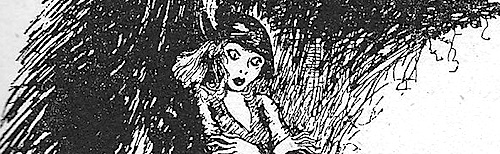
“Yes, my name is Miss Smith. No I will NOT ‘take a letter’!”
 Blast! I could do with a reliable secretary. It’s a funny old day. I feel as though I’ve only just sat down at the computer – in fact I logged on at about 5am and it’s nearly lunchtime. Thank heavens its a bank holiday! There has been a welter of tweets and emails, and a shed-load of stuff for me to deal with. The most pleasant was finding a review of my novel Lupa at BestChickLit, courtesy of Nikki Mason. It’s always gratifying to get exposure of this kind.
Another task today is dealing with my publisher’s editor, as we chip away at the imperfections in my second novel The Everywhen Angels, which is due for publication soon. We’re approaching the galley proof stage, and I can’t wait to see what the house artist will have dreamed up for the book jacket.
Meanwhile, what I am supposed to be doing is getting on with is my third novel, the vampire story. But it’s strange where research can take you when you’re doing something like this. I’ve been sidetracked by a chance reference in my research material (posh term for the rubbish I was scrabbling through on line) to one of my favourite anti-heroines of children’s literature, Miss Smith, ‘the wickedest witch in the world’. Before my pagan friends begin to complain about ‘negative stereotypes’ let me say two things: firstly, she’s fictional, and secondly she is far from stereotypical. Ever heard of a witch keeping toads in a fridge? Live toads? She sails blithely through four of Beverley Nichols’ novels, written between 1945 and 1971 on a tide of delicious malice, dressed like a Vogue model. Actually, delicious malice is just what I am looking for right now; an image has popped into my mind of a vampire bound to a dentist’s chair with ropes woven from fibres extracted from garlic plants, while someone forcibly removes its canines. And what about the next scene where its ‘Sire’ replaces them with a stainless steel pair? The thick plottens!

If you scroll down through this blog section of my web site, clicking on the older posts as you go (a worthwhile exercise, by the way, as there is some interesting reading there), you’ll come across occasional news updates of whatever my ‘latest project’ happens to be. So what happens to them? Where are the finished products? In most cases they simply aren’t. Finished, I mean. Many of them are little better than ‘good ideas’. Other things get in the way – editorial work, judging a competition, work, food, sleep, and so on. Mainly they run out of steam, or I run out of commitment, and I know that is a personal flaw – ‘successful authors’ don’t have this flaw, if you believe their soundbites. But I feel every project was worth starting, just to see if it would work, just to see if it would carry me along.
Anyhow, now that my second novel, The Everywhen Angels, is about to be published, I have been wondering why it has been so hard to complete a third. And then I was asked “Can you write a teen-vampire novel for us?” That’s as near as damn-it a commission! My instant answer was “Yes. No. Maybe.”
To tackle this I would need to re-think my daily schedule. I have been lazy when it comes to writing. I don’t do what good writers are ‘supposed’ to do, which is to spend a fixed time each day writing. I would have to re-commit to that. I would have to shelve the two novels-in-progress that I have. That wouldn’t be shelving much, I have to confess, because they are in the doldrums anyway; but as I shelved one to write the other and now would be shelving both, well that wouldn’t do much for my confidence in finishing the third. I would have to start turning down requests for my editorial expertise; I wouldn’t be able to start any other projects, I would simply have to focus on this. Then the teen-vampire genre has been flogged as near to death as the undead can be, and is lying there waiting for a stake to be driven through its heart. Stephenie Meyer has seen to that. Is there anything left to say? Is there an unused plot? Is there an unexplored twist, an unusual angle? You can see why I said “Yes. No. Maybe.”
However, it just so happens that I have a pottle of notes, fragments, poems, and short stories about a vampire hunter. Could something be reconstructed from these shards? Let’s see if I can bang a stake in without hitting my thumb, or anyone else’s…

Little one, many folk tell the tale of the three blind men who, unaware of each other, came upon the same elephant.
The first blind man, putting out his hands to feel his way, touched the elephant’s mighty trunk, feeling it flex and move, as though it had a life independent. He took it for a great snake.
“Surely,” he thought, “This is the greatest, most magnificent snake ever!”
The second blind man bumped into one of the elephant’s legs and, putting out his arms to try and encompass it, was certain that he had found the bole of a tall tree.
“Surely,” he thought, “There is no tree in all the world like this!”
The third blind man felt the elephant’s tail brush his face, and when he caught it in his hand, he was convinced that it was part of a gigantic vine.
“Surely,” he thought, “A man could live in the shade of this vine and want for nothing.”
Now folk who tell this tale, little one, usually stop at that point, and say it proves that in matters of faith and belief, all men perceive a little bit of the truth, never all of it. But they are not wise, little one, for the tale does not stop there. It goes on…
The first blind man became devoted to his notion of a snake, and began to worship it, singing and chanting.
“O divine Serpent… O divine Serpent…”
The second blind man became devoted to his notion of a tree, and began also to worship it, singing and chanting.
“O ineffable Tree… O ineffable Tree…”
The third blind man became devoted to his notion of a vine, and began also to worship it, singing and chanting.
“O miraculous Vine… O miraculous Vine…”
Then they heard each other, and became angry.
“What fools these other two fellows are,” thought the first blind man. “This is neither a tree nor a vine, but the Holy Serpent!”
“What fools these other two fellows are,” thought the second blind man. “This is neither a snake nor a vine, but the Heavenly Tree!”
“What fools these other two fellows are,” thought the third blind man. “This is neither a snake nor a tree, but the… er… Divine… Vine!”
So they all began to sing and chant more loudly, in order to drown out each other’s voices; and soon there was cacophony.
“… ineffable Tree… divine Serpent… miraculous Vine…”
Then their anger blazed into fury, and they began to shout and scream at each other.
“Heretics!”
“Blasphemers!”
“Infidels!”
Now you are aware, little one, being the wisest of children yourself, that elephants are very patient animals. But even the patience of the most forbearing tusker wears very thin, when such a hullabaloo happens around his feet. For this elephant was perfectly certain in his own mind that he was neither snake, nor tree, nor vine, but an elephant. And indeed he was. Elephant through and through. Elephant right to the core of his being. He knew well enough that each of the blind men did not have some of the truth, part of the truth, or even a little bit of the truth. All three were totally, completely, utterly… wrong!
Eventually he could stand no more. He shook his trunk free of the first blind man’s hands, and trumpeted loudly in his ear.
“Ow!” said the first blind man, his head ringing. “No snake ever did that!”
Next the elephant lifted his leg, and trod on the toes of the second blind man.
“Ow!” yelled the second blind man. “No tree ever moved!”
Next the elephant – I’m afraid – evacuated on the third blind man, who was impudently tugging his tail.
“Ugh!” said the third blind man. “Those are neither grapes nor oranges!”
In that moment, when the elephant manifested himself to them, little one, all three were enlightened, and knew the true nature of what they had worshipped separately.
Little one, foolish though these blind men were, eventually they were enlightened. Not so, I fear, those story-tellers who stop short, and do not themselves wait for the elephant to manifest itself. You see, because our god or our gods are known to be greater than we are, it is often assumed that they are wider and more complicated than we can conceive.
But they might just be simpler, more straightforward.
Like an elephant, little one.
Now be patient. You might dream of an elephant.
Go to sleep.

Ratty had been emailing me faster than I could reply, not that I’m all that savvy with electronic communications. Actually I spend most of my time down my hole engrossed in World of Warcraft, deep in the wizard-world of Azeroth – I’m a Night Elf from Outland – currently operating at the fourth level of Cataclysm and on the run from Hakkar the Soulflayer… not relevant, not relevant… but on the other hand not much need for emails either.
Ratty’s emails, they went along these lines… hang on, let me open one up and cut-and-paste it for you, here we go…
“Hey Mole, I’m due to fly out to Cyprus today and go on board the Wildwood Warrior. We’re going to sail for the Gaza strip in a couple of days time with a cargo of humanitarian aid to see if we can get past the blockade. There is still nothing, Moley, absolutely nothing half so much worth doing as simply messing about in boats! LOL. Follow me on twitter @riverbankratty.”
That was last week. I can’t look at his tweets, I fear for the dear fellow. The world out there is a big place and a dangerous place. ‘Messing about in boats’ is one thing, messing about in big boats in a sea full of bigger boats bristling with guns is another thing altogether. Oh well, at least he can swim, and he always was an adrenalin-junkie, Pan knows! Like I said, I get my adrenalin rush from virtual wargaming.
Talking of which I bumped into Badger the other day coming out of the Red Lion. Bumped literally. He had his head down and his nose in his Mac Book Air, which was open. As we collided he let it slip and it would have shattered into a thousand very expensive pieces on the cobbles of the pub courtyard if I hadn’t fielded it like Alastair Cook taking a slip catch. Of course I couldn’t help noticing what was on his screen – World of Warcraft! It was an irritated ol’ Badger who snatched the lappie out of my hands.
“Hey Badgie,” I said. “Didn’t realise you were into ‘the Craft’.”
“You make it sound like the confounded Freemasons,” he said with a frown. “Yes I do the odd bit of gaming.”
“Well maybe we have crossed swords at some stage,” I said. “I’m Dalforstin the Night-Elf. Who are you?”
He mumbled something I didn’t catch.
“What was that?”
“I said I’m Kolkhatana, Warrior Princess of the Dwarves. Satisfied?” he snapped, and stalked off in moderately high dudgeon. I was silent – gobsmacked actually – as his hunched figure hurried away. He was cutting quickly round the hedge at the end of the lane when a sudden thought struck me.
“Kolkhatana? Hey, didn’t we…” I called. But he had gone. And it didn’t bear thinking about.
I decided it was time to drop in on Toad Hall. Things had been quiet there for some time. I did know that the upkeep was rather steepish these days and that Toad, bless his silly heart, had been threatening to give it to the National Trust and move into the gamekeeper’s cottage. Presumably that would mean that the gamekeeper would have to move out – Toad wouldn’t have thought of that, of course. Anyhow, I ambled along what had once been a leafy lane… well it was still a leafy lane for most of its length but the here at the village end of it there was a tightly-packed knot of new houses – Toadfields. His Toadfulness had sold a patch of the old estate off to a developer in order to settle a tax bill. So anyhow, like I said, there I was ambling along the lane which led eventually to Toad Hall, when I realised I wasn’t on my own. Stoats and Weasels, rucks of ‘em, were popping out of the trees and hurrying excitedly down the lane. I could see the increasing crowd three hundred yards away funnelling through the lodge-gates and on to Toad’s gravelled driveway*.
Momentarily I paused. I wondered whether it was another invasion such as the one we four – me, Ratty, Badgie, and Toady – had fought off back in the day. But these stoats and weasels seemed in good spirits, not belligerent, as though setting off to have a good time. They were all relatively young ‘uns too.
I accosted a ferret in a cap and shades (incongruous those, because the sun was about to set) and asked him what was afoot.
“Hey bruv,” he said. “It’s ‘im, innit. It’s da beats, bruv, da beats. It’s totally sick, sick as aids, bruv!”
I resisted the temptation to say “No hablo Chav” and let him go on his way. Still I stood and wondered what in Pan’s name my ol’ pal Bufo Bufo was up to this time. We’d been through the camp site, the theme park, the WW2 vehicle museum, the health spa… none of those had attracted a surge of young mustelidae like this and, crucially, none of them had made any money either. I straggled behind the crowd as evening fell.
Toad hall was in darkness, but by the light of the hundreds of glo-sticks the stoats and weasels were carrying, and the luminescent screens of hundreds more iPhones, I could make out some sort of bulky structure in front of it – a stage? A dais?
Suddenly a siren sounded and a great cheer went up from the crowd. Then the cheering itself was drowned by a deafening swell of electronic music at (I guess) one-hundred-and-thirty beats per second – the unmistakeable sound of Euro-Trance. Then fireworks exploded, lasers and strobe lights flashed, the stage was lit up by spotlights and there… there… there behind what could only be a set of decks bristling with controls, screens, sequencer keyboards, all the gubbins of Electro… there in a brilliant white T-shirt, cycling shades, and headphones was Toad! Toad grinning from ear to ear. Toad punching the air in time to the music, while the stoats and weasels danced and bounced and punched the air in response.
“TOADMEISTER! TOADMEISTER!” they yelled in unison.
You could have knocked me down with a wet piece of hedge-sorrel. But as I became swept up in the euphoria, began to bounce, began to dance, began to punch the air, I realised that at last, at last, Toad had got what he had always wanted.
Acclamation!
__________
* I would be grateful to know, by the way, why Americans park on a driveway and drive on a parkway.

It almost seems strange to be saying this, but there was life, and lifestyle, before Fifty Shades of Grey, and it made its way into literature. Sacher-Masoch’s Venus in Furs was published over 140 years ago. For some time before I became a ‘legit’ (what does that even mean?) author and poet I wrote about love, sex, domination, and the areas where they did and did not overlap. I wrote the vignette below in a deliberately-mannered and sentimental style, to reflect the formality that often exists within Dominant/submissive relationships; the era in which it is set is not mentioned, but it could belong to any time…
__________
“I have made her as comfortable as I can.” These had been the doctor’s parting words to Greta. Now Greta sat by Leonora’s bedside as the late afternoon sun struck aslant at the covers, through half-closed curtains. The room was almost silent. Outside, absurdly cheerful birds were twittering, oblivious to the sadness inside, where the only sound was the quiet rasping of Leonora’s breath.
“I do not have long,” said Leonora, very quietly. “I know this, Mistress.”
Greta reached out and took her hand, surprised by the strength of the grip she felt. Looking at Leonora’s face, her eyes met the dying woman’s, and held, and locked. She was surprised how bright they were, how much love and happiness they seemed to contain at this time. Leonora was smiling. Greta forced herself to smile in return, though she felt her heart was breaking.
“You will be fine, darling. Very soon you will be well and strong, and you will leave that bed. We’ll take our walks together again, and do all the things we love doing. And just call me Greta for now – there is no need for formality.” To herself she thought, “Why do we always say these absurd things to those whom we love, while life is slipping away? We know they are dying, they know they are dying, and yet we toss bright phrases about as if they are suffering from nothing worse than a slight migraine. Can we not bear the truth, even though we all know it?” She refocused on the sweet, submissive woman in the bed – the loving one who was slipping away from her – and fought hard to keep her composure. It did not break.
At the admonishment to drop her Mistress’s formal title, Leonora shook her head weakly, but with some vehemence. “Please, Mistress, I beg you not to deprive me of that – not now, please. I could not bear it, Mistress.”
There was something bold, almost forward in this petition. Greta’s thoughts rolled back through the decades to the time that Leonora had first come to her. By mutual consent Greta had offered her protection and command, and Leonora had offered herself. Her enthusiasm for being a submissive woman to Greta’s need to dominate had been tempered with a little hesitancy at first, but often the enthusiasm had got the better of her, and she had blundered into many a transgression, for which Greta had not been slow to chastise her pet. Now Greta sat, looking down at Leonora, wondering if she had been domineering rather than dominating, cruel rather than magnificent. But all she could see in Leonora’s eyes was love and devotion. If her slave had ever felt hard-done-by, she did not show it now. She showed only the faithful adoration that Greta had become so used to over the years. Leonora’s willingness to be led down any path of experience had surprised Greta, but to Leonora it had simply been a duty she had been resigned to – no, not resigned, one to which she had come singing with joy. Step by step her Mistress’s will had become second nature to her, as vital as food and drink, and as air, and she had learned to obey almost unbidden, knowing and anticipating Greta’s wishes, reading her needs, and submitting herself to them.
Now it was to end. That perfection of love was to wink out in an instant, a bare moment which seemed to be racing upon the two women as they faced each other now. Greta struggled to find the words she needed to say. In her mind, after all this time, were doubts about the life they had chosen. She asked herself, “What great things might Leonora have done, if she had been free?” And in an unspoken, inner dialogue she seemed to hear Leonora talking back to her, telling her how she had blossomed as a singer, as and artist, as a whole person, in Greta’s service, and how wonderful it had all been.
“Dear Leonora,” said Greta finally. “If I have never succeeded in telling you how grateful I am for your lifelong gift of yourself, please let the action I am about to take be an explanation. Darling, all those years ago you gave yourself to me unreservedly. Today, all debts are cancelled, all pledges redeemed. I give you the only gift I can – yourself. You are free.”
As Greta spoke, Leonora tugged urgently at her hand, in a way that she would hitherto not have dared.
“…And my parting gift is to return yours to you. I wish to die belonging to you, Mistress. It is all I have ever wanted – to serve you all the days of my life, right until my death. I am your slave for life, for my whole life.”
The grip on Greta’s hand was a little weaker now. The tugging seemed to have sapped Leonora of much of her strength.
“Very well, little one,” said Greta, using a term of endearment she had not used to Leonora in a long time. “It is my pleasure to grant your wish. I remain your Mistress to the end, and you my slave. But know this…”
Greta bent low, kissed her slave on the forehead, and the lips, feeling as she did so the barely-perceptible breath on her cheek.
“…in Paradise there is no slavery. In Paradise you will stand by my side as my eternal wife, and only as that. Even you cannot go against a law made in heaven. Be peaceful, my darling little one, be peaceful…” Greta’s commanding voice fell away, and she simply sat, holding Leonora’s hand, looking at the silent devotion and love in her eyes.
She sat and looked into those eyes until all the devotion and love had finally faded away, along with all other light and lustre, and all that was left was the eyes. Leonora’s breath had stilled to nothing, she was free, and her hand lay gently in that of her earthly Mistress.
That was the moment – when she was finally alone – that Greta surrendered her life-long dignity. She bowed her frame over her dead love and, as the birds sang with incessant merriness outside, she wept.
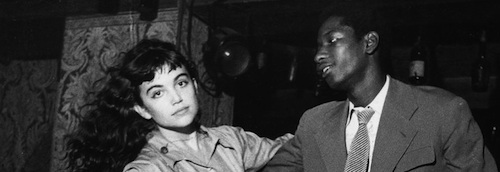
Detail from a photo by Robert Doisneau
Raconter des salades
(à Robert Doisneau)
Je vois la juive jeune
et son nègre adorant
danser comme
deux fruits-de-nuit
Tous les deux bourgeonnent
en plein été
autour de Saint Germain
– faut que je sourie!
Jive talking
(for Robert Doisneau)
I see the Jewish girl
and her adoring black guy
dance like
two nighttime fruits
Both are coming into bud
in high summer
around St Germain
– gotta smile!
Ebooks Etc is the name of a bookshop with branches in Pretoria and Centurion in South Africa. If you drop in you’ll find Lupa stocked on their shelves. Discerning folk, these Southern Hemisphere types, if you ask me.
M.

I hate strange cities. I avoid travelling unless I have to for work, and even then I wriggle out if it if I can. I pretend I’m nowhere at all, hurrying back from my appointments to hide away in my hotel room and flick through the television channels, settling on the least dreadful show. Sometimes I do get sick of this, and resolve to go out, leaving a mental trail of elastic thread back to my hotel, like an umbilical cord that attenuates and attenuates as I go. Long before it snaps, I let it reel me in, and I retrace my steps exactly no matter what temptation tugs me sideways.
Occasionally what seems to me like a wild spirit of adventure makes me disobey and kick against my agoraphobia. These are no big deal – I might go ten paces down a side street, or into a late-opening store for a few minutes, until the frisson of defiance is threatened again by a panic attack coming on and the feeling that I’m going to be sick. I know, I know! To you for whom it’s no adventure at all to roam the phoney souks and bazaars of the world’s far-flung towns, it must be laughable to hear someone so timid in her home country. But to tell the truth, beyond my own patria chica of a few streets and byways, everything is alien to me. Maybe I understand other women – who knows? – but beyond that everything animal, vegetable, or mineral, all that is natural or artificial, seems kind of inert and soulless to me. I guess that is why I’ve always been on my own. Sometimes I’ve provoked interest in other people, but it has always been short-lived when they don’t find that vital point of contact with me. I watch it happening. I can see it, but I can’t do anything about it.
What magic was around that one day, during that last professional mini-exile a few months ago? Normally there’s a voice in my head nagging me to forget the evening sunshine and go back to my hotel, but on this occasion something cemented me to the spot, by the door of a small bar. Easily answered. The magic was in the siren voice of a tenor saxophone, that’s what.
Precisely, I caught a snatch of a run of notes, repeated, repeated again and toyed with. Over the hum of conversation and the clink of glasses beyond the dark, open doorway, this simple playfulness, all within a single chord, I heard as suddenly thrown aside by the saxophonist, caught briefly by the right hand of the pianist, before the latter began to comp and the sax took up the melody of a standard. “Why, that’s…” I began to say out loud, and took a step towards the door.
I can’t say I actually remember walking into the bar. It was dark, half full, mercifully free of smoke – that I do remember. I must have ordered an apple cider with ice. I must have paid for it. I must have found my way to a small, unoccupied table, because that’s what I do recall. The table’s surface was slightly tacky against my bare elbows, the chair hard and almost uncomfortable, the cider was sweet on my lips and sharp on my taste-buds, the ice painful to my teeth, the jazz quartet…
Say what you like, black and white musicians come to jazz from totally different directions. Never mind what pressures homogenize them, there are still times when the racial mix of a band is as strange as a dog in a dress. The most liberal person – and people of my generation always are consciously and conscientiously liberal – listens out for tell-tale jarrings, slight… I don’t know what… I’m not a musician. Really. But I listen; music is lodged in my idiotikos and it’s something I escape into, burrowing down into melody and rhythm, resting there hearing and feeling things which may or may not be in it. So there I was, my umbilical cord somehow detached or forgotten for the evening, my lips sipping zinging apple from a glass, my elbows sticking to a table, my ears taking in sound which my mind was trying to filter unwanted ambient noise out of, my eyes making a composition from the oblong backdrop of the small stage on which were three black men and one white woman.
One man was at the piano – a grand, wedged tight into stage right, my left – and I could see him, head and shoulders only, looking down and sometimes flicking his gaze upwards to check out the saxophonist, as though looking re-established or reinforced a mental link. Another man was at the drums, taking in the rest of down-stage, loose, relaxed, smiling, chopping a syncopated be-bop as loose as himself with sticks or brushes, a swinging dynamo behind the flow of the music. A third, intense, brooding, brow lined with concentration, eyes shut, head nodding on the off-beat, hunched himself over the double-bass. All three were dark-suited, the drummer’s and bass-player’s neckties were loose, and I felt with them because I too, in my own way, was making a little gesture of non-conformity, defiance, simply by being here and conspiring with them to make or to hear music. I was engaged. They were not background noise. They were not wallpaper. Not to me.
In front of the three men was the saxophonist. Between numbers there was very little chat between her and the others, or amongst them generally, and no patter at all to the audience. Could we have been called an audience? Hardly anyone else apart from me was engaged; there was always a pitter-pattering of applause, like a brief rain-shower, at the end of each number, and maybe a couple of other people applauded solos along with me. The band hardly breathed between numbers, hardly waited for the brief applause to die down, seeming to regard it as a minor distraction along with the conversation, and the cross-currents of tinkling glass and the cash drawer opening and closing. Captained tenuously by the saxophonist, they cruised through standards and easy-winners, giving them an edge, a swing. I heard Cole Porter, I heard Gershwin, and then even Lennon and McCartney, Bricusse and Newley, Lionel Bart. Applause was a little louder the more people recognised a tune.
They had just eased their way through “Have You Met Miss Jones”, and the saxophonist put down her tenor and picked up a soprano for the first time since I’d come in. The sling her tenor had hung from was now lying loosely between her breasts, emphasising them slightly, making a sharp V, bisected by the fly-front of her white shirt. The shirt itself was picked up by one of the few spotlights almost randomly lighting the small stage. The shoulders inside the shirt were broad but spare; the arms, though I couldn’t see them, gave the impression of muscle tone, the wrists were slender, the fingers long. I caught myself thinking with a lot of “the”, sub-consciously de-personalising her, trying to ignore the fact that she was attractive. And she was. I saw a sister, about ten years my junior, and simultaneously an object of desire, an equal. Beneath my involvement with the music was an admiration for the roundness of her hips, which her formal slacks emphasised. She was tall, her hair short, feathered, spiky, and black. Her face was pale, slender, and seemed to hang from high cheekbones. Her playing… her playing was instinctive, intelligent, understanding, restrained enough for this time and place where experimentation was neither needed nor wanted, but still probing, flirting with a kind of effrontery.
Now, with the soprano to her lips, she led the combo effortlessly into “Every Time I Say Goodbye”. I recognised it immediately, right in the first bar, and I heard in it a distinct echo of John Coltrane’s Paris concert. It was no carbon copy, but the way she handled the melody said, “I’ve heard it, I know it, I understand it, and here’s my reply, my ‘take’”. She took the melody, and her improvisation made it fly like the loops, swoops, and sudden turns of a lapwing’s flight, and culminated her solo with a series of skylark trills, making my mind come up with all these silly bird-images – but wow! My applause for the solo, and at the end of the number, was louder than before, and she glanced over. Then she had a longer-than-usual word with the pianist, who nodded and mouthed something to the bass-player who nodded too.
As the saxophonist put down the soprano, and re-attached the tenor to its sling, the bass was already sounding out a few preliminary notes, making his instrument enter into a conversation of sorts with the piano. Then he picked up a familiar riff, and my heart jumped. It was Miles Davis’ “So What?” – the sextet version. It was like he was asking a question over and over, and the piano and sax started to answer with a flip comeback, “So… what? So… what?” Then suddenly they were off; the drummer swung on the hiss-cymbal, set the high-hat chapping the off-beat, clipping rim-shots across the swing; the bass player making large steps, four-square up and down the neck of the big fiddle; the pianist, watchful, comping. And oh that woman on the sax!
She didn’t exactly ignore the audience, didn’t turn her back on us, but she did turn sideways and drop her head, holding her horn close. Without imitating a muted trumpet, she was suddenly introspective, centring the music on herself, and I heard and understood the tribute to, the imitation of… no, the emulation of… Miles Davis’s initial solo. She took me with her. Her playing wasn’t Davis’ total self-absorbance – not to me, anyhow – but rather it left a way in, a window through which she showed the inner workings of her mind. Again it said, “I heard this, I understood, now here is what I have to say.” The fact that she took a trumpet part and moulded it to suit her tenor sax made me take notice of what she had to say.
Suddenly she abandoned the introspection, turned to face us full on, and relaxed out of her hunch. With eyes wide open she began to paint with brash, primary colours, launching into a second full-length solo. This was a tribute to Julian Adderley, Miles’ second soloist. It was loud, straight-ahead, bluesy, confident, adult yet playful. It was a joy, and I found my foot tapping and my head nodding as I listened.
As that second solo seemed to be coming to an end, I made to clap. But she took a breath, and turned the music round again. Her blowing became more concrete, more like sound for its own sake. She took runs and chords and tested them, searched them, used them to search other ideas and feelings. The music was less bluesy, hanging less and less upon the driving swing of her rhythm section, cutting more and more across it, probing, looking for something that was always beyond the reach of her fingertips. No, I was wrong about that, because I am sure she was holding back. But again, her playing said to me, “I have heard John Coltrane!” I held my breath and listened. No one plays like Coltrane did, but she played like someone who had known him and loved him and understood him. She played like someone on the same pilgrimage. And just when I thought she could pull out nothing more, she started to overblow, to make sounds that were fuzzy with harmonics and overtones as she made the reed in the tenor’s mouthpiece protest. The bass-player was still hunched and intense, but the pianist and drummer were playing freely and without inhibition, the former hitting loud chords, the latter syncopating wristy blows on the crash-cymbal and grinning broadly as he did so. The whole began to compete with conversations, and people bent towards their companions and put their hands alongside their mouths, looking over in annoyance. The music was beginning to be too risky for the environment.
But that was ok, because as suddenly as it had all happened the triple-solo of the sax faded, the music regained subtlety and composure, and the pianist took a short, tinkling solo.
As the sax-player took a step back and a breath, I couldn’t hold back a whoop as I applauded her solo. And I gave the whole piece a standing ovation at the end. The band stood too, to take a brief and final bow. It was the end of their set. The sax-player looked briefly in my direction, winked, cocked an index finger, and mouthed something which might have been “Thanks”.
The world was suddenly very empty simply because the stage was empty. I struggled to bring back the sensation of listening to that triple solo, but although I felt as though I could sing every note of it in my mind, its immediacy was gone. I felt like asking, “Did the earth move for you?” but there was no one to ask. The ambient noise of the bar was total now, even though it was no louder than before. There was nothing to draw my attention from it. As my teeth clattered against my glass, the conversations around me engulfed me without becoming any clearer in themselves. I was drowning, and realised that it was death to breathe. I recognised this panic and wondered if I shut my eyes and counted to ten, would I be transported back to my hotel room.
I have no idea what would have happened next if someone had not slipped into the seat opposite mine, and pushed across another iced apple cider.
“Hey!” said the saxophonist, smiling.
She was wearing jeans and a sweater now, and she had bought me a drink. I felt somehow that was the wrong way round.
“That was… I mean… hi, hello… that was just so amazing.”
“Thank you. I noticed you liked it. Not many people who come in here could care less about the jazz. I’ll get my ass kicked by the owner – he likes me to stick to standards. But I saw you dug the Cole Porter, so I asked the guys if they would mind playing something for you. They were ok about it.”
“You played it for me?”
“Uh huh.”
“Wow… I don’t think anyone has ever played anything for me before. But thanks. I mean it really was great. You got into something there – I could hear something of Davis, and Cannonball, and Coltrane of course, but it was all you at the same time. You were creating, not just being a copycat.”
She grinned again. “That’s nice of you to say, and it’s great to get someone in here who’s really into jazz. You know Sonny Rollins said – If Charlie Parker had been a gunslinger, there’d be a lot of dead copycats!”
“You’re too cool to shoot,” I said, and then thought to myself, “God, how lame!” But she was still smiling. There was a couple of bars rest. I sipped the drink she’d bought me and thought of what to say next.
“How long have you been?” I said. “I mean… into jazz?”
“My dad brought me up on Duke Ellington. Then I heard stuff like Brubek and the MJQ, and then I got into Trane, and Ornette, and Sonny, and Roland Kirk, and Pharaoh, and listened to everything I could on a jazz station. I took up sax in junior high, but there’s only so much you can do in a school band. I went for about four years in my late teens deliberately not listening to any jazz at all, so that I would play stuff that was all my own. Then I started listening again, and realised I could hear what was really going on. Trane and Sonny had been talking to me before, but now it was like I spoke the same language. Maybe with an accent, but I could talk back to them.”
“And now you’re fronting a quartet of your own.”
“Yeah, kinda. They’re some guys I know. Been playing on and off with them for about a year now. It works.”
“It certainly does. You read each other, you’re on the same wavelength. I don’t know what else to say.” I really didn’t. My isolation makes me gauche. I converse mostly with myself, and find little to say to anyone else. I was drowning again, but I wouldn’t reach out for her, I wouldn’t let her pull me out of the water. There was a pause, and I looked away as I felt her eyes searching my face.
“You look flushed – are you ok?” she said.
“I guess… maybe I’d better…”
“Look, give me a minute to get my jacket and I’ll meet you outside.” She got up before I could answer, and I was alone at the table again. Then, seemingly without any period of transience or mode of transit, I was back in front of the doorway, outside. It had gone dark, and a breeze played with a Styrofoam cup in the gutter, making it skitter. God knows how long I’d been in the bar, now I felt the umbilical tug; I knew which way to walk to get to my hotel – it was only five minutes away at most – but everywhere seemed different, and the breeze made me feel chilly.
Then there she was, coming out of the doorway pulling on a leather jacket.
“Hey!” she said again.
“Your horn?” I asked.
“The guys took it for me,” she said, and then stood there smiling, while I treated her to another silence.
“Look… “ I said. “I would really like to see you some more. I mean I don’t live around here, but we could… Do you want some coffee? I have a coffee-maker in my hotel room? Oh my God – sorry – that sounds so crass!”
But she was still smiling, and it was open, unaffected by my crassness.
“Hmm, coffee,” she mused.
The she leant forward, and that embouchure that had kissed Davis and Adderley and Coltrane kissed me!
“Cool!” she said.
And it was. Very. As was the whole of the rest of that summer.
__________
‘Cool’ © 2007-2013 Marie Marshall
 Marie Marshall