Marie Marshall

Author. Poet. Editor.

Category: story

Murder at Manderley

poirot

I’ve often wondered what might have happened if Rebecca had been written by Agatha Christie instead of Daphne Du Maurier. Maybe it would have ended like this…

__________ 

“Mesdames, Messieurs,” said the dapper little Belgian. “Thank you all for coming here at my invitation. I apologise for incommoding you. I would have preferred to have assembled you at Monsieur de Winter’s home at Manderley, but unfortunately the recent conflagration has prevented that. I hope that you have made yourself as comfortable as one may be here in the room where the inquest into Madame de Winter’s death was held.”

Poirot moved a few paces to his right, stopped, and turned to face the company. Every eye was on him. The company, seated or standing, looked at him expectantly; he, in his turn looked at them.

“We are here to reveal the late Madame de Winter’s murderer,” he said. At that there were gasps and cries of “What?” Colonel Julyan rose to his feet.

“I say, look here, Moosior Poirot,” he objected. “Rebecca de Winter’s death was suicide. The facts bear that out. The finding of the inquest was unequivocal and the evidence was conclusive. The lady took her own life. Do you now dispute that?”

“Mon cher Colonel, I do not for one moment dispute either the facts or the evidence,” said the detective mildly. “I merely dispute the interpretation put upon them. If you and the ladies and gentlemen here will hear me out with patience, then I, Poirot, will reveal to you what actually happened on the day Madame de Winter died, and why.”

The room fell silent again, and Poirot continued. “There can be no doubt that the late Madame de Winter did not die by her own hand, that she in fact was murdered. Furthermore, Mesdames et Messieurs, there is no doubt that the person by whose hand she did died is, at this very moment, here in this room!”

Again there were gasps, glances were shot from one person to the next, and a babble of questions were directed at Poirot. He held up a manicured hand.

“S’il vous plait, s’il vous plait. Poirot will reveal all to you, I promise that in a very short time all mystery will be cleared away, everything that can be made known to you, shall be made known. But first, I have asked Chief Inspector Japp of Scotland Yard to be with us…” Poirot raised his voice slightly as he mentioned the Chief Inspector’s name, and that very person entered the room making his way to  the Belgian’s side. “… in case his presence should be needed. Now then, Mesdames et Messieurs, to the matter of the crime about which Poirot has been exercising the little grey cells. There is more than one of you who had reason to resent the late Rebecca de Winter, and perhaps that resentment might have – how do you say? – boiled over into a rage of homicide. For example you… Monsieur Favell.”

“Damn you, you detestable little frog,” snapped Jack Favell, grinding out his cigarette. “I’ve good mind to throttle you where you stand! I loved Rebecca.”

“Where Poirot stands, he stands!” said the Belgian, ignoring both Favell’s insult and its inaccuracy. “You show sufficient anger to be capable of murder perhaps. Indeed you did love the lady, but how often do we see love and jealousy go hand in hand? For certainment she had other lovers – a crime passionelle would not have been impossible. However I believe that you lack the courage. Your way is to creep around, not to confront – your surreptitious visit to Manderley to see Madame Danvers when Monsieur de Winter was absent shows as much. Non, you are not the murderer. Shall we see who else might have a motive. Perhaps Monsieur Crawley, the estate manager.”

Frank Crawley raised his eyebrows in surprise.

“You, Monsieur Crawley, are the devoted friend and faithful employee of Monsieur de Winter. You have worked for him for many years, taking care of the estate for which you yourself have much love. And yet – Poirot is correct, is he not? – Madame Rebecca once made the romantic overture to you. You could not stand the thought that one day the estate that you loved would come into her hands, the hands of a woman who would deceive her husband, your friend.”

“By George, you’re right!” said Frank Crawley. “She did, just the once. I was shocked, I can tell you, and for a good while I had my doubts about the kind of woman she was. But if she was unfaithful to Mr de Winter she managed to conceal it well enough from me, and I thought it had been an isolated… mistake.”

“Oh, but isolated it was not,” said Poirot. “Again am I not correct, Major Lacey?”

Major Lacey turned red, looked down, and mumbled something.

“Good grief, Giles!” exclaimed Beatrice Lacey.

“But again, there is not enough there to light a spark from which murder can burst into flame,” said Poirot. “Leaving aside the late Madame de Winter’s flirtings, there is at least one person present to whom she was deliberately and viciously cruel – le pauvre Monsieur Ben.”

Ben, standing at the back of the room, his battered hat clutched in his hand, realised that he was being spoken about. There has panic in his eyes.

“I didn’t do nothing,” he said, piteously. “Don’t send me to the asylum… I don’t want to go to the asylum…”

Poirot’s look was kindly. “Have no fear, Monsieur Ben,” he said, gently. “No one will ever send you to that dreadful place which you fear so much. As you say, you did nothing. You do not have the necessary skill to pilot a boat, to sink it, to return to the shore, and to cause to disappear all the evidence of this. Non, Monsieur Ben, the one person who ever threatened you with that dreadful place is gone, never to return.”

“She’s gone, that one,” said Ben.

“I shall make sure Ben is provided for, sir,” interjected Frank Crawley. Poirot made a short bow towards him, and continued.

“Who else is there who had motive or opportunity? Frith, the butler, standing there in our presence? Non, I can reveal that the butler did not do it. In fact, the finding of the inquest, it was almost correct. It is possible to say that the late Madame de Winter did indeed kill herself. Rather than suffer the wreck of her youthfulness and beauty, rather than die in pain from the fatal disease from which, we now know, she was suffering, she walked up to and stared into the face of her death, at the hands of you… Monsieur de Winter.”

“I knew it!” cried Jack Favell, jumping to his feet as Chief Inspector Japp moved swiftly to intercept him and push him back down into his chair. “Max, you swine! It was you all along.”

Maxim de Winter rose from his chair, and his young, rather dowdy second wife rose with him. He stood, his eyes steady on Poirot’s. “Go on,” he said, and Poirot, returning his steady gaze, did so.

“On the day in question you confronted your late wife in the boathouse cottage. There she taunted you about her infidelities – about which you already knew – but this time perhaps her taunts were insupportable, perhaps she said she would break her word, her promise of silence, and ruin your reputation and your family name. All the anger and resentment that you had held inside, at that moment it became too much to bear. You took up a gun and you shot her through the heart. After that you carried the body to the boat, piloted it out into the bay, spiked the hull, opened the sea-cocks, and rowed back to shore in the dinghy. You made sure that there was no evidence of the shooting in the boathouse. When a drowned woman was found later, you took the opportunity to identify her as your wife, even though you knew she was not – that was no mistake. No one would have known, had it not been for the shipwreck and for the discovery by the diver of your late wife’s boat. There, is Poirot not correct?”

“Say nothing, Maxim,” said Mrs de Winter, her voice quiet but firm.

Japp stepped forward. “Maximilian de Winter, I’m arresting you…” Poirot’s hand was on his arm, and the puzzled policeman stopped in mid-sentence.

“Not possible, mon cher Japp,” he said. “If indeed Monsieur de Winter remains silent, makes no confession, there is not one shred of material evidence against him. The bullet which killed his late wife passed through her body without leaving any mark upon her skeleton, and although the exercise of Poirot’s little grey cells is, as ever, impeccable, I must admit that without Monsieur de Winter’s confession there is no case. Even the accessory after the fact, the second Madame de Winter cannot be touched by the law. Oh yes, Madame, you have known for some time. Your fainting fit at the inquest, just at the moment when your husband’s testimony was beginning to appear shaky, it was most convenient. But it did not deceive Poirot! Enfin, you were about to leave for Southampton, if you go now you will still be in time to catch your steamer. Do not stand there – go! Go before Poirot changes his mind and gives you into the hands of the good Chief Inspector!”

Maxim de Winter seemed about to say something, but his little wife had caught his sleeve, her eyes as hard as steel. Without another word they both left the room.

“Look here, Poirot, this won’t do!” said Chief Inspector Japp, rounding on him. “You had a murderer and an accessory right here and you let them off scot free!”

“Scot free, mon cher Japp? Mais non. I have condemned them to a life sentence. Maxim de Winter is deprived of the house he loved, and the childlike qualities of his second wife, which so endeared her to him, have gone for ever. Their life together will be a prison of conjugal ennui. But resume your seats Mesdames et Messieurs, because there is another crime to consider – the burning down of Manderley.”

“Surely that was an accident, a fault with an electric lamp or something, wasn’t it?” asked Colonel Julyan.

“Non, mon Colonel, it was most certainly an act of arson.”

“Oh, I’ll put my hand up to that one,” said Jack Favell, taking a cigarette from its case and tapping it on the lid. “I always was a little careless with a cigarette lighter.”

Poirot turned to him and gave a weak smile. “Non, Monsieur Favell, it was not you. You could not have returned from the visit to Doctor Baker, when Madame Rebecca’s illness became known, in time to set the house ablaze before the de Winters returned. Impossible for a man to drive that fast and to take the correct route when he is – how do you say? – so well acquainted with a hip flask. But on this occasion you make perhaps an uncharacteristically generous gesture, one of protection, because you have guessed what Poirot has guessed, and you seek to protect someone of whom you are fond, someone who has always been on your side, someone whom no doubt you telephoned after the meeting with Doctor Baker. Madame Danvers, I must address my next remarks to you.”

The housekeeper sat rigid on her chair, her hands gripping the arms, an expression of utter hatred in her eyes as she looked at Poirot.

“You had disappeared, Madame, and we would not have found you had you not tried to sell some of the late Madame de Winter’s jewellery.”

“She gave me those, before she died. Keepsakes, presents,” said the housekeeper, through clenched teeth. “They were mine to do with as I pleased.”

“Perhaps, perhaps,” said the little Belgian. “The ownership of the jewels is of no importance. For a time, you were under suspicion for the murder, but your devotion to the lady was too great for that crime. The arson, however, is another matter. The fire began and had its greatest intensity in the east wing, in the bedroom of the second Madame de Winter, whose presence you resented, and whom you once tried to persuade to commit suicide. This was a crime of hate, an attempt to blot out all trace of the woman who had usurped the place of the one to whom you were so devoted. Again, is Poirot not correct?”

“Evangeline Danvers, I am arresting you… oh for heaven’s sake, Poirot, what now?”

Poirot had gently interposed himself between the policeman and the housekeeper, shaking his head. “Once more, mon cher Japp, unless Madame Danvers cares to confess, there is no material evidence. Well, Madame, do you wish to – please pardon the expression – make the clean breast of it?”

Getting to her feet, Mrs Danvers merely said, “Rot in hell – all of you!”, turned, and left the room.

“Wait for me, Danny,” called Jack Favell, following her.

“Poirot, I must say this is a bad show all round,” said Chief Inspector Japp with not a little irritation. “You got me down here with assurance of murder and arson, and now I have to go back to the Yard empty handed. If you’ll excuse me, ladies and gentlemen, I have a train to catch.”

“I give you this assurance, mon cher Japp,” said Poirot with a smile. “None of the people who committed a crime have escaped. At the very least they will wake up each night from dreams of the wreck of their lives, and of the burned shell of the great house of Manderley!”

“Moosior Poirot,” said Colonel Julyan, when everyone else had gone. “What will you do now. I for one would like to hear more about some of the cases which you have solved – professional interest, you know, as a magistrate. Can I persuade you to stay in Kerrith for a while longer? The local food they serve at the inn has a first class reputation.”

Poirot politely declined. “Alas, mon Colonel, I believe I ought to take also the London train, and make my peace with the good Chief Inspector. But I thank you for the kind invitation. Another time, perhaps, when you next visit London.”

Bowing and handing the Colonel his card, Poirot left. As he made for the station he sighed with relief. He thought, “I shall escape from this Cornwall – ses brouillards, ses orages, ses naufrages! – and most especially from the prospect of having to endure its cuisine. Oh those gastronomically detestable – how do they call them? – pasties!”
My short stories

writing

I have reorganised things on this site ever so slightly, and now all the short stories I have posted here can be accessed from a single tag. You can find them here – the first ten are displayed, and you’ll find a link to others at the bottom of the page. Enjoy!

M

A Tale from the Hill Country

Curl Up and Burn
short story by Samuel Snoek-Brown
http://eunoiareview.wordpress.com/2013/02/03/curl-up-and-burn/ 
review by Marie Marshall

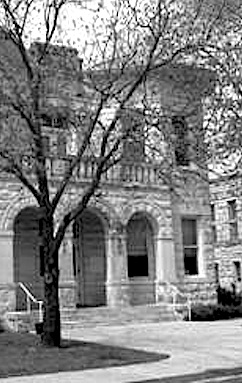
Kendall County Courthouse, Texas.

Kendall County Courthouse, Texas.

I would not normally review a short story, but this particular one by Sam Snoek-Brown is ten-thousand-or-so words long, and if the narrative were expanded it would start to knock on the door of novella. However, a short story it is, lean of excessive development and sharply focused. That leanness pulls us along and makes sure our attention is not diverted.

The subject matter is a ‘statutory rape’ case in Texas, its effects on the community and the persons involved, and its aftermath. The story’s style of presentation is one of reportage. It is written as if it is a magazine article. The narrator is as detached and non-judgmental as an investigative reporter, but his presence ‘interviewing’ and interacting with the personae of the story allows their character to be drawn out. The cut-and-paste nature of the narrative allows it to be episodic, which accentuates that drawing-out – for example, the meeting between the narrator and the convicted man’s father, the latter’s pickup blocking the road, a shotgun pointedly on display on the gun-rack, is loaded with tension and menace.

Another thing that this episodic treatment enables is a presentation of the ‘facts’ in a non-linear way. The fact that a man has been convicted of statutory rape and has served twelve years in a tough prison is made known very early in the story. The details of the case are revealed, but not necessarily in chronological sequence. Rather they are cut with historical detail, sections of modern supposed interviews with townsfolk, and with descriptions of the protagonist’s drives around his home town, where he and the crime of which he has been convicted are well-known, and of his obsession with building and maintaining a model of the town in which things he observes in everyday life modify the layout. Essentially there is no final resolution to the story, but we do realise that a story has been told. The protagonist’s final statement is terse, almost threatening in tone, but remains enigmatic.

Adding to the air of reportage is the research, including historical research, that the author has pasted into the story. The story is set in a real town in Texas – the author himself was brought up in Texas and can therefore be relied upon to give the setting an air of authenticity. Of course his storytelling style does take over from the journalistic style in places, notably in the descriptions of the protagonist’s run-in with his Nemesis, a local Deputy, and the title is a storyteller’s title, not a journalist’s.

I have a couple of niggles – no story is perfect, let’s face it. Firstly there is much made of a teenage girl’s ‘chatting on the internet’; I don’t know whether Texas was a long way ahead of us (I’m writing this from the point of view of a British reader), but in the early 1990s, when this was supposed to have taken place, chatrooms and emails were not as common as they now are, and most households, if they had a computer, were on a dial-up system for the internet, which took up phone time and therefore parents’ money. I could be out-of-touch, but this detail momentarily halted my ride through the story. Secondly, the girl in question is Chinese-American, and whilst her father has the English given name John, her full name appears to be wholly Cantonese. When a Chinese character appears in a work be a non-Chinese writer, I often wonder – maybe unfairly, I’ll grant you – whether her name has been plucked out of the air. I put the name of this character into an image search engine and came up with pictures of a male boxer. Like I said, these are only niggles, and could be my own reading quirks.

When it comes down to it, this is a compelling story, excellently written and insightful, moral but not moralistic. Sam Snoek-Brown is a tireless craftsman of the short story, and Curl Up and Burn shows that he has been working out.

‘On The Platform’ at Fearie Tales

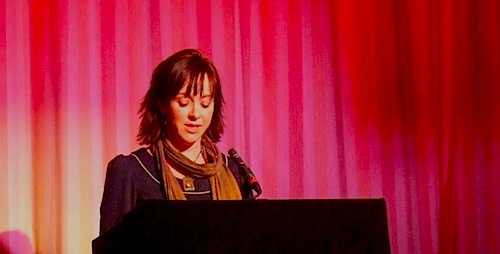
Helen Logan reading ‘On The Platform’, 1st Feb 2013. Image © Bookseeker Agency

Helen Logan reading ‘On The Platform’, 1st Feb 2013. Image © Bookseeker Agency

As previously reported, my short story On The Platform was one of the winners of this year’s ‘Fearie Tales’ competition at Pitlochry’s Winter Words Literary Festival. Winter Words kickstarts the literary year for Scotland, and features a list of writers and other people in the public eye. ‘Fearie Tales’ is its annual competition for stories of a ghostly, macabre, or supernatural nature, and this year actress Helen Logan gave my story a highly atmospheric reading…

… a young woman is waiting on a lonely station platform late at night… she meets a strange, dark man who starts to talk to her about supernatural matters… is one of them a ghost, and if so, which one?

The audience, which included broadcaster James Naughtie, was rapt throughout the reading and appreciative afterwards. Already I have ideas buzzing for my entry to the competition next year!

News from ‘Winter Words’

© Bookseeker Agency

© Bookseeker Agency

Deep winter in the Highlands of Scotland, with a foot of snow gradually starting to thaw as our changeable weather takes another swing. In the town of Pitlochry, at their famous Festival Theatre, the annual Winter Words literary festival is under way. I have just heard that my poem ‘Beatrice the rat tells Mr. Coelacanth about the Wisecrack city elves’ (from my soon-to-be-published collection I am not a fish) was premiered at their ‘Poetry Please’ event. Also I am once again amongst the winners of their ‘Fearie Tales’ competition for tales of the supernatural, and my ghost story ‘On the Platform’ will be read out during the final weekend of the festival. There are plenty of other interesting events at the festival too. Can you make it?

Sunset

sunset-ocean

In the days of the old British Empire, two colonial types were sitting on a Verandah somewhere in Malaya, sipping their pink gins and watching the day end.

The sun which during the afternoon had been a harsh and dazzling glare of white had consolidated to a disc of tangerine low in the sky. It rode on the horizon clouds, and its slanted rays turned the little breakers on the strand first to vanilla, then to lemon, then to copper. It kissed the far lip of the sea, sending a fan of reflections back across the miles of water. As that disc dulled to red and began to curtsey below the world’s edge, the sky faded from aquamarine to navy blue. Venus, in her peace and beauty, graced the sky by appearing at a wink, and, as if she were a herald, a million-million other stars were suddenly scattered onto the evening like diamonds onto an indigo velvet cape. Soon only a ribbon of red remained at the horizon. The sea’s lapping at the sand hushed to a repetitive whisper, the breeze captured the sudden scent of moon-seeking flowers, and the liquid notes of a bird’s call floated in from the plantation. Then the remains of sunlight evaporated with the last cloud, and a crescent moon was suspended away to the side of this heady panorama.

“Not bad, eh?” said one ex-pat to the other.

“There’s no need to rave about it like a ruddy poet, old man,” came the reply.

P’kaboo day at Glenstantia Library, Pretoria, SA.

(c) Lyz Russo

(c) Lyz Russo

The mini-launch in South Africa went off quite well. I was able to ‘join’ the proceedings by keyboard chat. The photo above shows the publicity table before the event began, with – yes! – Lupa on view there. My thanks go to Lyz Russo at P’kaboo for all the energy she has expended getting an event before Christmas. I’m told that there will be some more events in South Africa over the coming months, hopefully with Naked in the Sea and Mercury Silver featured also. Stay tuned.

A reader’s reaction to ‘Lupa’

Lupa is the story of two fearless fighters, two She-Wolves, perhaps the avatars of the same wandering spirit, whose destinies become aligned through the mirror of time and dream. The set of the two plots, none other than the Eternal City, casts its many shadows and symbols on both stories.

I came upon this book quite by accident, while perusing the poetry section of a blogging site. The author’s compelling poetry made me very curious about what her blog announced as her first novel and, indeed, I was not disappointed.

Marie Marshall’s sharp writing has a wolfish brutality to it that masterfully shape-shifts to raw emotion in Lupa‘s fighting scenes.

Unlike Hesse’s Harry Haller, the main characters not only accept but seek out the totemic wolf within.”

Dee and Boleyn

I have sought solace in reading psalms and in prayer, but nothing avails, except perhaps my dreams; and so I seek sleep, and hasten each day with pacing to and fro, as though I could not wait for the end. My mother called such behaviour wishing my life away, but would not laugh if she could see me here.

Each night I hurry to my bed, earlier and earlier, eager to enter a world of shadows and strange colours, and to find the answers to questions which perplex me, and any other whom I may ask, during the dubious hours of waking. Yet some nights are vague, and I may startle awake with a cock-crow or a bursting-in of sunlight, to remember nothing. Or again, I may lie upon my back all night, sleepless, and with my fists balled; the days that follow are drowsy and tedious, but the little sleeps between the visits of those who attend me are sans dreaming. I could read; I have many of my beloved books around me, but am without inclination these days, except for the psalms, with their illuminations – the blood of the whiplash fish, weathered green copper, gold-leaf. My constant prayer has been let me read the book of my dreams.

I recall the third night I was ever in this room. It seemed as though I was snatched from making out the shadows on the ceiling into another world. I was a child again, in a gown of green velvet, the hue of the under-side of leaves in high summer, and a gable-hood of the same. I was upon the London River, in a barge that slipped silently against the stream with the aid of neither sail nor oars; I was attended by silent servants in tabards that matched my gown. I enquired where we were bound for, and none would lift his head, save one who eyed me and looked away, and spoke in French.

Au Lac de la Mort, Maitresse.”

To the Lake of Death – and this puzzled me, for I knew of no such place on the Thames, but only of a hamlet that had grown around a stream filled with silver salmon, for that was the place where the barge glided to the shore, and where I stepped out onto the bank. And it seemed that at the moment my toes touched the land, I was in a great hall. Everything was tall – the people in it, the tables and the chairs, for I was an infant in this dream, to whom the walls of a chamber are as great as an oak or the flank of a galleon. And this hall was filled with books, shelved against every wall. Not one window was there here, but light was given by candles, some upon tables, some on the floor, some even upon a pile of books. Between the furred skirts of the gowns of the men who gathered in the hall, I could see only a little of the tables around which they clustered. From some, charts and scrolls spilled; upon others I saw browned skulls and thighbones, bottles of dark liquids, a still but evil-faced raven which winked at me, and other objects nameless and beyond description. As I walked by them, some of the men turned their heads to look at me, and I felt my face burn in their gaze; others conversed with each other in whispers and mutters, and two or three stretched their hands over some object and intoned in a language I did not recognise. One I saw exchange gold coins for a leather pouch that seemed to move, as though it contained a frog or a mouse.

At the far end of the room, upon a sort of dais, an old man sat, as though enthroned, and it was towards him that I walked. If I looked away for a moment he seemed, from the corner of my eye, to be a boy of twelve or thirteen; but always when I looked directly at him he was venerable, white-bearded.

There was an impatience in his face, as he leant forward and beckoned me, as though he had news of great import, or some secret to tell me. But in the moment that he drew breath to speak I awoke, and was here in my prison again.

“Where is a Joseph or a Daniel who will riddle me this?” I thought.

That was the first time I met the old mage in my dreams, for indeed he seemed to be a philosopher or magician of some sort; but since that night I have met him often, walked with him through the strangely silent streets of London or the garden of Hampton Court, where we stopped to look at the great clock. I swear I saw the hands whisk through the hours and the moon-phases faster than the wheels of Phaeton’s chariot. Sometimes in my dreams he was struck dumb, sometimes I; at other times he spoke to me only in a language I could not understand, and grew angry because I did not answer. At other times we conversed.

“Do you know me, Lady?” he asked once.

“Certainly,” I replied. “You are the old magus whom I meet here in my dreams.”

“But do you know my name, Madam?”

“No, I do not.”

“I shall write it for you,” he said, and stooped to trace it in the dust with his finger. At this I shuddered, for it seemed blasphemous to imitate a gesture of the Saviour thus – hoc autem dicebant tenantes eum, ut possent accusare eum, Iesus autem inclinans se deorsum, digito scribat in terra. Even more so did what the old man wrote upon the ground, for it was more a picture or a sign than a name. A circle, which could have been his face or the sun’s, with a single eye in the centre; crescent horns surmounted the face, and could have been the moon; from a stick-like body, two arms protruded, in mockery of our Lord upon the cross; the whole figure squatted upon the ground, it’s knees drawn up, and its legs bowed.

“This is all-in-all,” he said to me, and seemed to be pleased with what he said, and to ignore my look of horror.

Three nights ago I looked for him once more, but in my dream I stepped into my husband’s closet, seeking my book of psalms. My lord was there, and I spoke to him, simply saying his name once.

“Henry?”

I reached out my hand, but did not dare touch him. He seemed to hear me, and inclined his head, with a look of sudden irritation on his face. He said nothing, but continued what he had been doing when I entered – picking up books and leafing hastily through them as though searching for something.

Upon his table I saw my own book of psalms, and picked it up. But it was false – the cover of my book held pages of crabbed writing, little of which I could make out, except for the names of sundry angels. Then I came upon a page which had the symbol drawn by the mage in the dust, and I knew that this book was his. I put it down quickly, and my hand moved to another book, mutilated and coverless. That was mine, my poor little book of psalms in French, which I now opened to read, for solace. Quand je marche dans la vallée de l’ombre de la mort, Je ne crains aucun mal, car tu es avec moi… My eye was drawn from the holy words to the bright images upon the facing pages, which were unfamiliar, and bore such names as La Reine de Deniers, and La Reine d’Epées, as though the songs of King David had become a game, or a medium for scrying. I can recall no more of that dream.

Two nights ago I met the mage again, and he showed me the court of a great queen whom all feared and loved. She was enthroned, and clothed in a white gown on which pearls had been sewn with golden thread. She had my hair, and my eyes; but those eyes were full of loneliness past bearing.

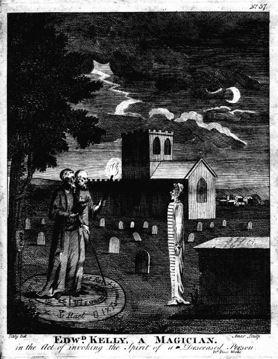
Last night I dreamed yet again. I felt myself drawn to a place where the mage stood, with another old man. They were huddled together, standing on a spot where strange devices had been scored upon the earth, as though the perimeter of the devices protected them from some evil or force beyond their control. I approached them as though through mist, or through the hall where I had first encountered the old man (though now it seemed plundered and ruined), all becoming clearer as I came close to them. At last I stood before them, a hand’s reach away, but outside their magic circle. The old man spoke to his companion.

“Strike with your staff upon the point of the heptogram, Master Kelley, and make it speak.”

At this, a look of annoyance passed the other’s face.

“I am known as Talbot now, and not by my old name. How many times do I have to say so before you remember!” He turned his eyes towards me, and drew himself up, rapping three times upon the ground with his stick.

“Speak, spirit,” he said. “Speak or be returned whence you came, and shut again in your arrow-chest. Speak, I command, in the name of an holy Power!”

“Whom do you command to speak?” I said. “I speak or do not speak at my own will, not yours. I say what is in my heart and mind, when it pleases me to open my lips. I am not bidden by anyone to speak or to stay silent, to come or to go.”

My old mage – I now thought of him as somehow mine – smiled a little, but the other became agitated, and struck again several times with his staff.

“I charge you to speak,” he barked. “Are you from Paradise or from eternal fire?”

“If you rap much harder on the ground,” said my mage. “You will find out first hand, as we shall fall through and into hell ourselves!”

“Paradise or flames?” I said. “A room in the Tower is not Paradise, though it is comfortable enough for a while; nor is it hell, for all its dreary solitude. Rather say it is purgatory, as it affords much opportunity for reflection and repentance!”

“Speak not in riddles!” cried the other. “But answer plainly, I charge you, by the angels!”

Patient now, my mage interjected, “Peace, Master Kelley; I know her, I know of her – she speaks what she thinks is true. She knows naught of heaven or hell, but lies where she lies, with her last memories, waiting for the graves to give forth their contents.”

“Master Dee, you may have traveled much, you may have been to Bohemia, and to Poland (where, I have heard, men have tails), but in these things you are ignorant. She is a spirit, and as such she has seen things you and I have not. And she is bound by the enchantment and invocation I have made, to tell us the truth. This fiddle-faddle she gives us is but her resisting my power, and it cannot last.”

“I know nothing of spirits,” I said. “Except that Saul was damned for causing one to be conjured up. I am none such. I am a queen, albeit one cast down. And Master Kelley or Talbot or whoever-you-may-be, you would be well advised to address me with more deference, and indeed to desist from your imagined conjuring.”

At this moment, my old mage turned eyes on me that held more pity and kindness than I had ever seen in him. There was such sorrow in his voice, when he spoke again.

“Master Talbot, it is clear to me that she is telling you the truth, though you cannot see it. Madam… Mistress… Your Majesty… “

His voice faltered, as though he had something difficult to say.

“Can you tell me where your favourite French headdress is at this moment?”

“Certainly, sir,” I replied. “I have it in my hand.”

“Madam, you have more than your headdress in your hand.”

At that moment, in my dream, I saw his meaning clearly –though I knew not with what eyes I saw that which I saw, for my own eyes looked up at me – and I screamed. My scream was choked by my awakening. Dreams are beyond fathoming, the pictures they paint are strange, their meaning is deep and often unholy…  and it is now today.

There is my gown, and my headdress; there also is my little book of psalms in French, undesecrated. I will wear my gown and my headdress today, and carry my psalms with me when I walk outside. I already have in mind what I will say:

Good Christian people, I am come hither to die, for according to the law, and by the law I am judged to die, and therefore I will speak nothing against it. I am come hither to accuse no man, nor to speak anything of that, whereof I am accused and condemned to die, but I pray God save the king and send him long to reign over you, for a gentler nor a more merciful prince was there never: and to me he was ever a good, a gentle and sovereign lord. And if any person will meddle of my cause, I require them to judge the best. And thus I take my leave of the world and of you all, and I heartily desire you all to pray for me. O Lord have mercy on me, to God I commend my soul.

But as I kneel, and before the swordsman scythes my head from my body, I shall think of my old magus. Then I shall breathe a short, Plantagenet prayer, and hope that my daughter, who has my eyes and my hair, will never be a queen, but will live her life a country lass, safe at home. For the burden of queenship is too heavy.

One Day in High Park, Toronto


Flash fiction – One Day in High Park, Toronto.

I was sitting on a bench, reading – hardly noticed the man, hand-in-hand with a boy. Both were dressed in black pants and white shirts, and the man had a black hat of woven straw. “Old Order Mennonite – what are they doing in town?” I mused momentarily.

They had been talking quietly, but suddenly the man raised his voice, still gentle in tone.

“No, Karl, that’s not true. You’re lying to me. I can’t allow that. You’ll have to take your punishment.”

“Yes, Dad.”

“Shall we get it over with now, rather than later?”

“Yes Dad.” The boy reached and rolled up the legs of his pants as far as they would go. The man bent down behind him and slapped him on the back of each calf, then slapped him again.

“Hey! Hey!” A guy in t-shirt and jeans, came from behind where I was sitting, vaulted over the end of my bench, and barged the man away from the boy.

“Pick on someone your own damn size!” he said, swinging a punch which caught the man on the right cheek. Down he went, and sat on the ground, hat awry, face bleeding. The t-shirt guy stood over him, fists balled.

After about fifteen seconds he got up, dusted himself off, straightened his hat, and looked at the t-shirt guy. He said nothing, but seemed to angle his left cheek a little, as though inviting another punch. Then he turned to the boy.

“Punishment over, Karl.” He said. The boy rolled his pants legs down, and came over to hold his father’s hand. “Shall we get some ice-cream?”

The boy grinned. “Yes please, Dad.”

They walked away, and the t-shirt guy stood, hands on hips. “Well… I… should… fuck… a… pig!”

I said nothing – I had a good book.