Marie Marshall

Author. Poet. Editor.

Category: story

On the centenary of Brian O’Nolan
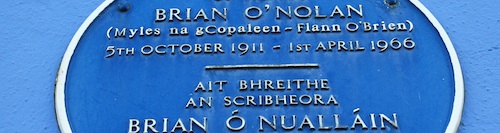
It is the centenary, give-or-take, of the birth of the Irish scriever Brian O’Nolan, famous nowadays for comic-fantastic novels such as ‘At Swim-Two-Birds’, ‘The Third Policeman’, and ‘An Béal Bocht’ (the latter written in his native Irish). He wrote under many names, the best known of which is Flann O’Brien, and for years under the cognomen of Myles na gCopaleen (Myles of the little horse) he wrote the humorous column ‘Cruiskeen Lawn’ in the Irish Times. What follows is a small selection of my tributes to him, originally published, shall we say, elsewhere; a small number of my contributions to the canon of adventures of those two pals – yer man Keats and yer man Chapman.

_______________

Keats and Chapman were once obliged to make a journey across the city by public transport. They boarded a bus and it set off. The vehicle was quite ancient and close to obsolescence, and its progress was erratic. This was made worse by the fact that it was a very windy day, and every time the bus passed a side-street or a gap in the buildings, it was struck by violent side-winds and caused to lurch terribly, as if about to capsize. Also the window-catches were defective, the windows would not close, and great draughts of air made it impossible for Chapman to continue to hold his copy of The Thunderer before himself to read. Chapman, being able to stand no more, paradoxically stood. He seized the conductor and began to make loud protestations about the fitness-for-purpose of the bus. The conductor took him on, arguing strongly that no one but Chapman was complaining. The exchanges between them became (in best cliché fashion) heated, and Chapman was within moments of being put off at the next stop. Keats, however, rose and put a placatory hand on the shoulder of each one of them.

“Gentlemen,” he said. “De gusty bus non disputandum est.”

_______________________

Keats and Chapman were at home, each at peace reading a newspaper. Chapman looked up from the cartoon page, and remarked on the genius of the American artist Charles M Schultz in the way that he made the little bird Woodstock talk to his pal Snoopy in a series of minuscule, vertical penstrokes.

“Talk is cheep,” observed Keats.

________________________

Keats was trying to listen to the Test Match on the radio one day, but was disturbed by Chapman, who was roaming from room to room in their shared apartment, overturning stuff, opening drawers, and cursing loudly. It became too much to bear when Chapman burst into the lounge where Keats was sitting and started to ransack the place. Keats sighed, switched off the radio, and asked Chapman what the divvil he thought he was playing at.

Chapman said, “I’ve been looking for my copy of Homer. It’s nowhere to be found. A mystery! In my opinion it’s been stolen!”

“I’ll look into it,” said Keats.

_______________________

Keats was a gracious man, and would never turn down an invitation to this meeting or that soiree or the other book-signing. Chapman wondered at his goodwill as much as at his stamina. One day Keats received a polite letter from a literary society based in a small town in the West of Ireland.

“I know these people well,” said Chapman to him. “I’ve given a talk there once, as have many of my friends – and yours I think.”

“I don’t know them,” said Keats. “What like are they?”

“They’re decent folk,” replied Chapman. “And they’ll be delighted to see you. But there’s one thing I ought to warn you about. There is one surname that is so common in that area that almost everyone bears it. They consider themselves to be a clan as much as a town. It seems that anyone who isn’t a Murphy there is an O’Murphy or as MacMurphy; even the local Punjabi shopkeeper named his eldest “Murphy” in their honour. What you have to watch out for is this: they have heard every possible joke about the name, every bon mot about potatoes, every quip about one chap called Murphy two hundred years ago who must have travelled round on a bike and, as Dryden put it, scattered his Maker’s image through the land. Say what you want, but just don’t mention that name!”

“I’ll mind that,” said Keats.

The pair travelled to the West of Ireland, to the little town, and were put up in the temperance hotel where the literary society were to hold the reception in his honour. Came the evening and they went down to the function suite where they were greeted with applause. Chapman, who was of course already known to them, introduced Keats as they circulated, and many a hand was shaken.

The formalities of the evening went ahead. Keats of course gave a reading of some of his own poetry, which was received with a reverent hush and a standing ovation at the end of it all. The rest of the evening was taken up by several items, which included:

“A tale or two of Finn MacCool” presented by the society’s shanachee Mr Eamon Murphy,

A solo upon the uilleann pipes by Mr James Murphy,

A recitation “On the visit to us of Mr John Keats” by the society’s Bard Mr Brian Murphy,

A song by Miss Kathleen Murphy, accompanied on the piano by her sister Miss Niamh Murphy,

A slide-show on the delights of Murphyville, Georgia USA, presented by Mr Hiram J Murphy III,

A blessing upon the gathering given by Father Liam Murphy,

A vote of thanks to Keats and to everyone involved proposed by the society’s Hon Sec Mr Brendan Murphy, and seconded by the society’s Hon Treas Mrs Deridre Murphy, and

A closing address given by the society’s Chairman Mr Arthur Wellesly Murphy.

That was not, however, the end of proceedings, as there was one final item on the agenda – the presentation to Keats of a cut-glass Waterford decanter, specially engraved to mark the occasion, paid for out of society funds. This was handed to Keats, with the thanks of all present, by the society’s President-for-Life Mr Aloysius Murphy.

Keats appeared overwhelmed, lost for words, and responded in his poor French.

“Murphy beaucoup!”

Chapman tore at his beard.

‘A Woman on the Edge’ – workshop project of prose and poetry, part 3

The moosh-moosh

In the marginal lands between city and countryside there lives a type of rare hominid known as the ‘moosh-moosh’. The name appears to be of Romany origin and until recently these shy creatures would only reveal themselves to travelling folk. In fact so secretive and shy are they that most settled folk continue to deny their existence.

Their natural habitat is, or was according to anthropological speculation, the cave. However since intensive agriculture has decimated the wild places of Britain in the south, and deforestation and sheep-farming has done the same in the north, the moosh-moosh have moved into the new wilderness that humans have created, the wilderness that is neither urban nor rural but which is found on the margin between the two.

In build they resemble humans almost exactly, except for their apparent superior muscle tone. They are stocky but not fat. Their skin is pale but is hardly visible except on the face, the rest of their heads and bodies being covered in a light, reddish-brown fur. Their faces are large and broad but not un-handsome. Some observers believe them to be descended from the last remnants of the Neanderthalers, but this is mere speculation. They go naked but appear to be totally without any sense of shame. Deprived of their natural habitat, they have occupied such spaces as unwanted cargo containers. A small group was discovered living in an old Nissen hut on what was a WW2 airfield but upon which a new housing estate was encroaching, and it was this extended family that became the first moosh-moosh to encounter its homo sapiens cousins, or at least the settled and civilised branch of our species, with more regularity than before, gaining a certain controversial fame in academic circles and becoming a minor tourist attraction, especially for a few savvy if brash Americans.

Communicating with moosh-moosh is problematical. Folklore tells us that they and the Romany people once made themselves understood by a system of mutual hand-signs and by a few syllables of human speech, but if that folklore is based on truth it is a tenuous truth and the faculty has long-since evaporated. The interface between us and the moosh-moosh is akin to that between an adult and an autistic child, except that they will meet our eye with a steady gaze. There is no hint of comprehension in that gaze, with the exception that if you hurt one of them their expression hints at puzzlement and sadness. They seem to be asking silently “Why?” Violence is alien to them.

Their own speech sounds like a cross between the cooing of doves and a human whistle. It is quiet speech and they use it sparingly, spending long periods in communal silence. I have tried to imitate their sounds whenever I have been amongst the ‘Nissen Family’, as this particular group has come to be known, and whenever I have done so they have turned a softened gaze upon me as if to say that they appreciate my attempts. The only time I have ever seen a definite communication between moosh-moosh and homo sapiens was when I arrived at the same time as a knot of transatlantic tourists. The moosh-moosh were about to eat, which they do communally, and a female came behind us making insistent, shepherding gestures, urging us to sit down with them.

Moosh-moosh food is simple, consisting of a kind of cake made from the seeds of wild grasses sweetened with honey or with whatever berries are in season, or flavoured with hedgerow herbs. They share their food evenly between all who are present, even with homo sapiens, although the latter sometimes find it hard to digest. I am always conscious that they have scarcely enough to spare. In winter they are, if anything, less semi-visible than they are at other times of the year; it was thought that they hibernate – the Romany always said so – but in fact they spend most of this time when little sustenance is available huddled together for warmth in foraged straw and under salvaged tarpaulins.

Their groups and extended families are without hierarchy and are highly co-operative. If two or more discrete groups should meet there is no competition, but rather all direct themselves towards mutual benefit. Their delight is in each other, and it is a full and complete delight.

They make no art, no music, and of course no literature, but their appreciation of the natural world appears to be total. It is an appreciation apparently not born of awe or of anything mystical but rather seems to be one of immersion, joy, participation. It is a happy state free of the twin mental yokes of religion and science, a state which proves that mutuality rather than competition is the highest law of evolution.

The last time I sat down with the ‘Nissen Family’ of moosh-moosh I felt their hands gently resting on my shoulders and arms. Their gaze had softened and seemed to express some kind of sympathy. I realised that I had been crying. I tried to smile, and indeed their caresses were comforting, but this display of empathy, this acceptance of myself almost as one of them was so poignant that my tears continued. There was so much I wanted to say to them.

Oh, my dear Nissen Family, as dear to me as my own family! My dear, precious, innocent moosh-moosh! If only you knew my true nature and the nature of all of my brothers and sisters, the homo sapiens. If only you knew the depth and height of our jealousy, our insecurity, our vainglory. If only you knew how cruel we are. You, I know, are no children except inasmuch as you have preserved the innocence of childhood. You are no distant cousin, no Neanderthal throwback. You are of the same root and stock as we are, you are people, but you are people who took the decision long ago to follow the path of pure wisdom, to seek nothing but that which was good, nothing but what you actually needed. You are wise beyond our capacity to be wise. Yet in that wisdom you are as foolish as saints. What are fences and hedges to you? What are the divisions and boundaries that we set up in the face of nature to you? What are the frowns on the faces of farmers and householders to you when you forage their barley and their chives? What is our folly to you, the folly that points to something and says “Mine”?

If only I could convey this to you before it is too late, before you become nothing more than a dwindling number of anthropological or zoological specimens, a theme park, ‘Moosh-Moosh-Land’, an insignificant detail of history, a small entry in Wikipedia, a cuddly toy. If only you would realise this before we come for you, before we take you away, before we make you our playthings, before we study, catalogue, abuse, dissect, and destroy you, before we turn upon its head your evolutionary success and make a lie out of it. We are monsters, my dear family, monsters. We are ugly in our complexity, ogres, madmen!

You sit here in utter patience, lambs of the God you do not know, every one. Why do you not start up, why do you not run? Why do you not find all your tribes and families and hide in what remains of the forest? Why do you not go deep into our abandoned mines and conceal yourselves? Why do you not remove yourselves from our sight and memory before we remove you entirely from the world? Why do you sit so patiently, witnesses to all that is good, a light that will soon be put out? Are you somehow driven to prove to us what brutes we are?

We are your brothers and sisters but we are also your executioners. We hold your death warrant in our hands.