Marie Marshall

Author. Poet. Editor.

Category: writing

Editing

fish

I am not a fish is now on the last stages of editing, and I should know the publication date soon. Meanwhile a short passage has been reinserted in a key scene in Lupa; its absence doesn’t spoil the book (if you have a copy already), but I’m relieved to restore an emotional dimension to the scene in question. Editing and revision of a written work are not necessarily closed processes…

Time, the holographic universe, and Schrodinger’s Tiger

Schrodinger's Tiger

“I’m not a scientist and I’m not a mathematician,” a friend said to me. “I’m a philosopher. So when my daughter – she was of primary school age at the time – asked me what there was before time, I told her this: ‘Time is simply a measurement of the rate of change; for when there was no such thing as time, you have to imagine a state of things which is absolutely static, nothing moves, nothing changes, nothing can be understood to exist.’ That satisfied her for the time being – at least it made her silent on the subject.”

He went on. “Scientists are talking about the universe existing as information, and that that information is contained, stored, located at the event of a black hole. Thus the information is in two-dimensional form. However, the universe as it is perceived is three-dimensional. A three-dimensional object generated from two-dimensional information is holographic, therefore the possibility exists that the universe is a gigantic hologram. That being so, it could be a simulation. But of what, and initiated by whom? However, I see a flaw in that, and it’s a big one. If the event of a black hole is two-dimensional, then it has no depth whatsoever, it is simply where two different states – call them zones if you like – meet. If it has no depth, if it is simply where two discrete things meet, how can it be said to exist? If it does not exist, how can it hold information, how can it hold anything? If it holds something, it must exist. If it exists discretely, it can’t simply be where two zones abut. It has to have depth, no matter how small that depth is. If it has depth it is three-dimensional, not two-dimensional. Therefore the universe is not holographic.”

It seems to me that ever since the great Voltaire lampooned and overturned the optimistic principle of a priori in favour of the rational a posteriori, science has been trying to bump things back the way they were before. Well, maybe not precisely ever since, but at least since Einstein told us that the laws of the universe were the same at any point in space or time. That must mean that they existed, in all their complexity, an infinitesimal moment after the big bang, and that they have governed everything that has happened since. The scientists who propose that we are a holographic simulation – and who will probably be able to point out the flaw in my pointing out the flaw in their thinking – must also propose that the parameters of the simulation have governed, a priori, everything that has happened, is happening, or will happen.

As I sit here in my lifeboat in the middle of the Pacific Ocean, I am looking at the forward section, covered by a tarpaulin. Under the tarpaulin there is a tiger. The tiger may or may not be alive, or may be simultaneously alive, under the Copenhagen interpretation rather than the tarpaulin. Or it might simultaneously be under the tarpaulin and the Copenhagen interpretation…

If I, or the tiger, ever get out of this situation, then there’s a novel in this. Maybe even a blockbuster film. Knowing my luck someone will have already beaten me to it by the time I reach land.

The ‘female spirit’ of ‘Lupa’…

CBW

I enjoy it when people ask me for interviews – I like ’em long range, by which I mean they email me a list of questions and I sit down and write considered answers. I recently had the pleasure of fielding some questions from my fellow-writer C B Wentworth, about my novel Lupa. You can find the interview here.

My short stories

writing

I have reorganised things on this site ever so slightly, and now all the short stories I have posted here can be accessed from a single tag. You can find them here – the first ten are displayed, and you’ll find a link to others at the bottom of the page. Enjoy!

M

More news of the Phoenix

© Describe Adonis Press

© Describe Adonis Press

At the suggestion of the Editor-in-Chief, Richard Vallance, and with the agreement of the others on the editorial team, I will be credited as ‘Deputy Editor’ when the anthology is eventually published. I am honoured.

A reminder about the Aval-Ballan Poetry Competition

(c) Lesley Haycock

(c) Lesley Haycock

Just a reminder for all writers of poetry that this competition is still very much live, and that there is room for your entry. Click the painting above to go to the competition web site.

M

‘Powm!’

Ginsberg Orlovsky

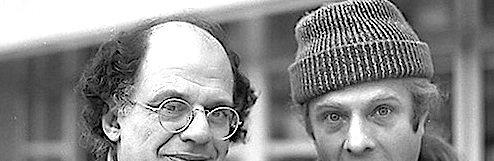
A ‘powm’ – with or without exclamation mark – is a poem that punches above its weight. Not every day you get to read a new word.

M.

A Tale from the Hill Country

Curl Up and Burn
short story by Samuel Snoek-Brown
http://eunoiareview.wordpress.com/2013/02/03/curl-up-and-burn/ 
review by Marie Marshall
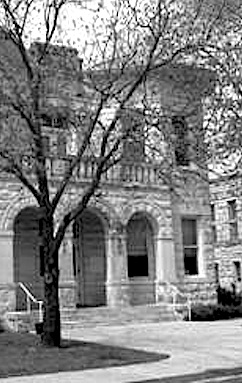
Kendall County Courthouse, Texas.

Kendall County Courthouse, Texas.

I would not normally review a short story, but this particular one by Sam Snoek-Brown is ten-thousand-or-so words long, and if the narrative were expanded it would start to knock on the door of novella. However, a short story it is, lean of excessive development and sharply focused. That leanness pulls us along and makes sure our attention is not diverted.

The subject matter is a ‘statutory rape’ case in Texas, its effects on the community and the persons involved, and its aftermath. The story’s style of presentation is one of reportage. It is written as if it is a magazine article. The narrator is as detached and non-judgmental as an investigative reporter, but his presence ‘interviewing’ and interacting with the personae of the story allows their character to be drawn out. The cut-and-paste nature of the narrative allows it to be episodic, which accentuates that drawing-out – for example, the meeting between the narrator and the convicted man’s father, the latter’s pickup blocking the road, a shotgun pointedly on display on the gun-rack, is loaded with tension and menace.

Another thing that this episodic treatment enables is a presentation of the ‘facts’ in a non-linear way. The fact that a man has been convicted of statutory rape and has served twelve years in a tough prison is made known very early in the story. The details of the case are revealed, but not necessarily in chronological sequence. Rather they are cut with historical detail, sections of modern supposed interviews with townsfolk, and with descriptions of the protagonist’s drives around his home town, where he and the crime of which he has been convicted are well-known, and of his obsession with building and maintaining a model of the town in which things he observes in everyday life modify the layout. Essentially there is no final resolution to the story, but we do realise that a story has been told. The protagonist’s final statement is terse, almost threatening in tone, but remains enigmatic.

Adding to the air of reportage is the research, including historical research, that the author has pasted into the story. The story is set in a real town in Texas – the author himself was brought up in Texas and can therefore be relied upon to give the setting an air of authenticity. Of course his storytelling style does take over from the journalistic style in places, notably in the descriptions of the protagonist’s run-in with his Nemesis, a local Deputy, and the title is a storyteller’s title, not a journalist’s.

I have a couple of niggles – no story is perfect, let’s face it. Firstly there is much made of a teenage girl’s ‘chatting on the internet’; I don’t know whether Texas was a long way ahead of us (I’m writing this from the point of view of a British reader), but in the early 1990s, when this was supposed to have taken place, chatrooms and emails were not as common as they now are, and most households, if they had a computer, were on a dial-up system for the internet, which took up phone time and therefore parents’ money. I could be out-of-touch, but this detail momentarily halted my ride through the story. Secondly, the girl in question is Chinese-American, and whilst her father has the English given name John, her full name appears to be wholly Cantonese. When a Chinese character appears in a work be a non-Chinese writer, I often wonder – maybe unfairly, I’ll grant you – whether her name has been plucked out of the air. I put the name of this character into an image search engine and came up with pictures of a male boxer. Like I said, these are only niggles, and could be my own reading quirks.

When it comes down to it, this is a compelling story, excellently written and insightful, moral but not moralistic. Sam Snoek-Brown is a tireless craftsman of the short story, and Curl Up and Burn shows that he has been working out.


‘On The Platform’ at Fearie Tales

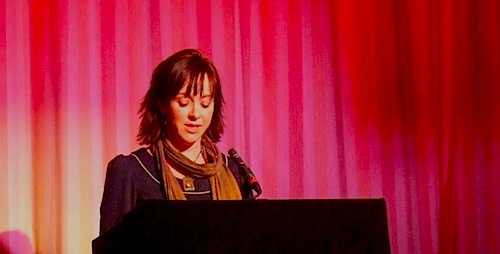
Helen Logan reading ‘On The Platform’, 1st Feb 2013. Image © Bookseeker Agency

Helen Logan reading ‘On The Platform’, 1st Feb 2013. Image © Bookseeker Agency

As previously reported, my short story On The Platform was one of the winners of this year’s ‘Fearie Tales’ competition at Pitlochry’s Winter Words Literary Festival. Winter Words kickstarts the literary year for Scotland, and features a list of writers and other people in the public eye. ‘Fearie Tales’ is its annual competition for stories of a ghostly, macabre, or supernatural nature, and this year actress Helen Logan gave my story a highly atmospheric reading…

… a young woman is waiting on a lonely station platform late at night… she meets a strange, dark man who starts to talk to her about supernatural matters… is one of them a ghost, and if so, which one?

The audience, which included broadcaster James Naughtie, was rapt throughout the reading and appreciative afterwards. Already I have ideas buzzing for my entry to the competition next year!

Tantalising glimpses…

… of some of the illustrations…

glimpse 1

… contained in the sonnet anthology…

glimpse 2

The Phoenix Rising from the Ashes

glimpse 3

… due to be published later this year.

I have a number of sonnets in the anthology, and have been working as part of the editorial team since this project was started by Describe Adonis Press, Canada. You may be curious as to how someone could with fairness both edit and contribute; the answer is that poems by members of the editorial team were subject to the same anonymous selection process as poems by other contributors. The result will be a fine anthology, I believe, containing poetry by some of the new century’s most interesting practitioners in the form. The web page for the anthology is here, and will be up-dated with publication news as and when it is available.

Readers who know my recent work will know that I seldom write formal poetry these days. However, I generally ignore the ‘Chinese walls’ between the various modes, school, whatevers of poetry. That’s just my way…