Marie Marshall

Author. Poet. Editor.

Review of ‘Finis’ by Angélique Jamail

Finis cover 200Finis
Angélique Jamail
Amazon Kindle format
review by Marie Marshall

The best fantasies are the ones which have one foot in reality, in a world or society in which there is enough recognizable for a reader to be drawn in without having to have anything explained. A writer’s skill in doing so is necessary for the metaphor – the unreal, the less-than-recognisable that nonetheless stands for something in our own world – to take hold and be convincing, and Angélique Jamail’s skill is apparent from the very beginning of Finis.

We instantly enter a familiar world where work is tedious, landlords are mean, family is disapproving, neighbourhoods are patrolled by gangs, and where to be different is to be in danger. But in his corner office, the boss is a monster, quite literally a monster capable of goring any secretary who misses a staff meeting. In an environment where to be recognised as fully human one also has to be fully animal, one wonders just how bizarre the Minotaur of legend must have been if ‘Somewhere in Crete a maze is missing its pet’! Similar in feel to the way Philip Pullman’s characters develop a companion ‘dæmon’ as they mature, humans in Jamail’s story take on important aspects of members of the animal kingdom, until they are a fusion of the two. People who never develop this full nature are referred to as ‘plain’.

Elsa, Jamail’s protagonist is a ‘Plain One’, enduring reactions from her colleagues and superiors that range from pity, through discrimination, to bullying, and meeting little better from her immediate family. Even her cat wants to claw and bite her, and in fact is the only one who (spoiler alert! from now on they come thick and fast) actually understands her true nature from the beginning. Jamail’s portrayal of her nagging, unsympathetic father is convincing…

When Elsa doesn’t muster the same enthusiasm as the rest of the family, her father asks what her problem is.

   “Dad, you know I can’t swim – “

   “No, you won’t swim,” he grouses. “There’s a difference.”

This is technically true. Elsa chooses not to submerge herself in vats of acid too.

as is her mother’s fretful ‘Why doesn’t she ever go out? Why doesn’t she ever bring friends over at the holidays? Is she ever going to get married?’ The only member of Elsa’s family with whom she has any affinity is her cousin Gerard – “We both like seashells and hot chocolate”.

A tantalising ichthyological theme runs through the story like a bright thread – an aquarium, tuna sandwiches, references to water everywhere, even the punning title of the story and the last word on the page – loading the narrative with proleptic irony at every turn. Suddenly a clue comes, a newspaper story about the possible appearance of a Phoenix. Perhaps this is how Elsa will develop, with a rebirth in fire, and perhaps this explains her fear of water. But this is partly a red herring (!), although for Elsa it does suggest that maybe her own rebirth means surrendering to the very element that she fears. Eventually she becomes – what? A fish? A mermaid? Her transformation is left less than clear, but for her it is satisfying, it is an ending and a beginning. The conclusion is open-ended, and it almost leaves the reader with a feeling of unease. The problems of plain-ness have not gone away in Elsa’s world simply because she has escaped it, and the point of story has suddenly become her comfortable conformity.

Any niggles I have with the execution of this story are minor. For example, the process of change is referred to as ‘blossoming’, which to my mind is floral rather than faunal, and therefore less than appropriate. Overall it is a lesson in how to write from a point of ‘otherness’. It is short, but just the right length to carry readers and keep attention along a fairly simple narrative. Very worth reading, if my spoilers haven’t given the game away.

Read the first chapter of ‘From My Cold, Undead Hand’!

FMCUH cover final 500

Click on the illustration above to be taken to the publisher’s page for From My Cold, Undead Hand. Once you’re there, click on the cover illustration there and you can read the whole of the first chapter as a preview to the novel!

Download my free ‘From My Cold, Undead Hand’ wallpapers

FMCUH eyes

Make the most of your desktop with these cool, noir wallpapers, and help me celebrate the publication of my first teen-vampire novella. There is a lot of empty space so that your icons don’t appear as ‘clutter’. Choose glacier white or nightwalker black – just click on a thumbnail below and a full-size image will open…

The artwork is © Millie Ho; permission is not granted for use other than as a desktop wallpaper.

FMCUH white wallpaper     FMCUH black wallpaper

Pre-order ‘From My Cold, Undead Hand’!

News just in!

FMCUH pre-order

‘From My Cold, Undead Hand’ – Publication date!

twitterbanner 2 blog

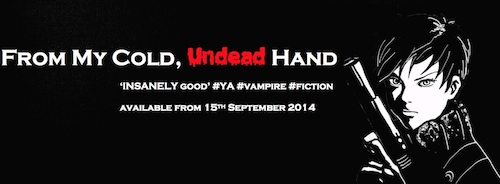
I’m pleased to announce that From My Cold, Undead Hand, the first of a planned trilogy of teen-vampire novels, will be published in e-book form on 15th September! Don’t go looking for it just yet, as the plan also involves some free extras for pre-orders and/or early purchases – more news about that when I have it. I will also keep you informed as and when it becomes available at Amazon or elsewhere.

There are some preview opinions of From My Cold, Undead Hand here. If you’re on Twitter, you can keep up with the news by following @ColdUndeadHand.

Our Sister, ‘Anon’.

virginia_woolf

… it is unthinkable that any woman in Shakespeare’s day should have had Shakespeare’s genius. For genius like Shakespeare’s is not born among labouring, uneducated, servile people. It was not born among the Saxons and the Britons. It is not born today among the working classes… Yet genius of a sort must have existed among women as it must have existed among the working classes. Now and again an Emily Brontë or a Robert Burns blazes out and proves its presence. But certainly it never got itself on to paper. When, however, one reads of a witch being ducked, of a woman possessed by devils, of a wise woman selling herbs, or even of a very remarkable man who had a mother, then I think we are on the track of a lost novelist, a suppressed poet, of some mute and inglorious Jane Austen, some Emily Brontë who dashed her brains out on the moor or mopped and mowed about the highways crazed with the torture that her gift had put her to. Indeed, I would venture to guess that Anon, who wrote so many poems without signing them, was often a woman…

Virginia Woolf, A Room of One’s Own, 1929.

One thing we must never do, it occurs to me, is to dwell in the wise woman selling herbs or in the witch being ducked. It may be that women writers had to flounder, to experiment, to fail, to try again and fail better, because we had no literary tradition behind us, and that what was behind us was in any case overwhelmingly male. To dwell on that and in that situation is to hamper our creativity. As Virginia Woolf says later in A Room of One’s Own, ‘the whole of the mind must lie open’. By dwelling in the wise woman and the witch I mean becoming shackled to the idea of ourselves as feminist writers. The end of feminism in literature is that there should be no more feminism, just literature. The expansion of this avenue of thought into a broader vista runs thus: that liberation cannot be piecemeal, and if women have claimed a place in literature that does not stop the world of literature being a world of privilege. The unprivileged exist. While they exist we, exercising our ‘freedom’, are in fact not free; we are as bound by chains as they are, and they must be liberated before we can consider ourselves truly liberated, before we can enjoy with significant comfort our place in the literary world. Moreover we can never think of their liberation as anything within our gift, nor our tradition as something they must build on. We may invite them to stand where we stand but we must not assume that they will want to stand there. They may be standing somewhere else already. They will flounder, experiment, fail, try again and fail better; they will attach an ‘ism’ to what they are doing and, one day, detach it again. The sum of my argument is that liberation is total and inclusive. It exists in a world we can’t see and won’t recognise when it’s here. Expect some turbulence on the way.

Some of my old poems turned up…

product_thumbnail… in May Prism 2014, a collection of contemporary international poetry, a quarterly (or thereabouts) paperback edited and self-published by Australian poet Ron Wiseman. [Find it here, and my poems from p.157 onwards.] This was half-a-surprise to me, as I hadn’t visited the poets’ virtual hideaway that Ron and I frequent(ed) for a while until recently, so I was out-of-the-loop and didn’t even know he was engaged in this little publishing venture. As a result, the poems he selected (knowing that I would have given him permission anyway if I had been around) are all fairly old. Some of them have been published before, in Tower Journal for example, and many of them are formal, or show me tinkering with Celtic-mystic-medieval themes. The feature even quotes me as saying “I am best known as a neo-formalist poet…” Good grief! It’s a long while since I said that, and it is no longer strictly accurate, but never mind. I did cut my teeth on formal poetry, figuring that it was a good discipline to learn in order to give my writing in general some technical power.
May Prism is full of poetry by a whole range of poets from around the world, so I can thoroughly recommend it. Here is one of my poems from the selection of seven that Ron published. I have spared you the iambic pentameter – this one is written free.

Someone said you loved me

There are no ties to life; rather it’s like a hangnail
when it catches in my sweater – one tug and it’s free,
free to fall, free to take its end.

Few things make me catch my step, slow me,
have me gripping at the burning minutes as they are consumed,
very few things save, perhaps, you.

Gossip I can let tumble and roll among the leaves and papers –
except when someone said your eyes followed me
as I wandered through the room.

Now I will test the truth of this by walking slowly, as though on a wire,
savouring each second, seeing if my bare neck flames
in your gaze

Membranes of Marrakesh

words © Marie Marshall image © Membranes of Marrakesh

words © Marie Marshall
image © Membranes of Marrakesh

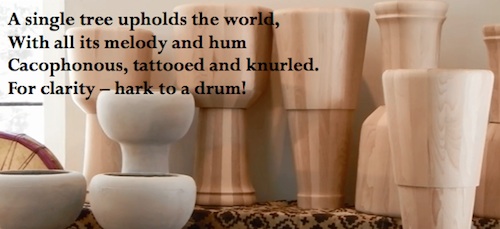
I often say that the strangest place I have ever ‘published’ a poem has to be the time one was etched into an African drum, which is now at the New Orleans Museum of Art. The poem was called ‘Djembe’; I wrote it several years ago, and that’s it above. The image I have used to accompany it shows the raw, waiting bodywork of drums made in the same workshop as ‘mine’ was. If you click on the image you will be taken to a fundraising site for the workshop’s new project. They hope to give away 100 drums at the Burning Man festival in Nevada this year. Have a read through their promotion and watch the video. If you can help this celebration of giving please do, even if it is only with good vibes and good wishes. Thank you.

By the way, if you happen to be in Nevada between August 25th and September 1st this year, then go and experience the Burning Man. If you visit the Membranes’ stall in the Souk, then the patter with which they address you may well have been written by… me! Find out how the young Berber woman, Yasmine, got the better of a mighty desert djinn!

M.

Dance the Carmagnole!

Traditional (anon.), tr. Marie Marshall

Young Missus Veto said to me
She’d slit the throat of all Paree.
Young Missus Veto said to me
She’d slit the throat of all Paree.
But see the plan she laid
Spoilt by our cannonade!

Let’s dance the Carmagnole
– hear ‘em roar, hear ‘em roar!
All dance the Carmagnole

– hear how loud the cannons roar!

Old Mister Veto said to me a-Sansculottes-1793-jacob 2
He’d give his realm fidelity.
Old Mister Veto said to me
He’d give his realm fidelity.
But this he failed to do,
We’ll give no quarter too!

Let’s dance the Carmagnole
– hear ‘em roar, hear ‘em roar!
All dance the Carmagnole
– hear how loud the cannons roar!

Antoinette said “Let it pass
The common crowd falls on its arse.”
Antoinette said “Let it pass
The common crowd falls on its arse.”
But in the market-place
She fell flat on her face!

Let’s dance the Carmagnole
– hear ‘em roar, hear ‘em roar!
All dance the Carmagnole
– hear how loud the cannons roar!

Louis the King thought he had won
But we’re the champions, every one.
Louis the King thought he had won
But we’re the champions, every one.
Cry-baby Louis – weep
From your palace to the keep!

Let’s dance the Carmagnole
– hear ‘em roar, hear ‘em roar!
All dance the Carmagnole
– hear how loud the cannons roar!  

When Antoinette was shown her cell
She began to weep as well.
When Antoinette was shown her cell
She began to weep as well.
She fainted and fell down,
All because she’d lost her crown!

Let’s dance the Carmagnole
– hear ‘em roar, hear ‘em roar!
All dance the Carmagnole
– hear how loud the cannons roar!

The bloody Switzers* made a vow
They’d gun down our comrades now.
The bloody Switzers made a vow
They’d gun down our comrades now.
But look at how they prance,
Our bullets make ‘em dance!

Let’s dance the Carmagnole
– hear ‘em roar, hear ‘em roar!
All dance the Carmagnole

– hear how loud the cannons roar!

sans-culottesComrades, forever we’ll unite
No matter who comes here to fight.
Comrades, forever we’ll unite
No matter who comes here to fight.
Attack us if they dare,
We’ll give ‘em such a scare!

Let’s dance the Carmagnole
– hear ‘em roar, hear ‘em roar!
All dance the Carmagnole

– hear how loud the cannons roar!

Comrades, remember their renown,
The Sans-Culottes from our town.
Comrades, remember their renown,
The Sans-Culottes from our town.
We’ll raise a glass and sing,
The bells of freedom ring!

Let’s dance the Carmagnole
– hear ‘em roar, hear ‘em roar!
All dance the Carmagnole

– hear how loud the cannons roar!

__________

* ‘Switzers’ here refers to Swiss mercenaries in the pay of the King of France.

There are several variants of this song. The words have been translated very freely and are possibly more ‘jokey’ than the original. As with all the better-known songs of the French Revolutionary period, this is actually a very rousing piece of music. If you would like to sing along, you will find the tune here.

SORROWBACON!

f-in-school

“SORROWBACON is a webcomic about a cat, a badger, and a sentient custard,” says Millie Ho. Who am I to disagree? It started out as doodles which are now “raw and bloody and more lo-fi than a Brooklyn alleyway” and “exposed and vulnerable to whoever happens to stumble upon them.”

Millie has been hinting at its existence for some time, dropping clues about its nascence on her blog. Her latest post announces its launch and it can be found right here. It appears to be executed entirely in ball-point and highlighter, reveling in that everyday, almost banal, technical simplicity. I’m not going to say much about it except that it’s different and makes me want to do wild, fangirly dances.