Marie Marshall

Author. Poet. Editor.

‘Dryad’ (with Joanne Harris)

People often ask me how I started writing. The answer is I started writing because I found I could. I entered a competition where participants had to complete a short story started by Joanne Harris. It doesn’t matter now how successful or unsuccessful my entry was; what does matter is that a quirk in my mind was turned towards writing, and I am glad of that. I thought you would like to read the story, partly © Joanne Harris, partly © me, to see the way my mind suddenly started to work back then.

Dryad

In a quiet little corner of the Botanical Gardens, between a stand of old trees and a thick holly hedge, there is a small green metal bench. Almost invisible against the greenery, few people use it, for it catches no sun and offers only a partial view of the lawns. A plaque  in the centre reads: In Memory of Josephine Morgan Clarke, 1912-1989. I should know – I put it there – and yet I hardly knew her, hardly noticed her, except for that one rainy Spring day when our paths crossed and we almost became friends.

I was twenty-five, pregnant and on the brink of divorce. Five years earlier, life had seemed an endless passage of open doors; now I could hear them clanging shut, one by one; marriage; job; dreams. My one pleasure was the Botanical Gardens; its mossy paths; its tangled walkways, its quiet avenues of oaks and lindens. It became my refuge, and when David was at work (which was almost all the time) I walked there, enjoying the scent of cut grass and the play of light through the tree branches. It was surprisingly quiet; I noticed few other visitors, and was glad of it. There was one exception, however; an elderly lady in a dark coat who always sat on the same bench under the trees, sketching. In rainy weather, she brought an umbrella: on sunny days, a hat. That was Josephine Clarke; and twenty-five years later, with one daughter married and the other still at school, I have never forgotten her, or the story she told me of her first and only love.

It had been a bad morning. David had left on a quarrel (again), drinking his coffee without a word before leaving for the office in the rain. I was tired and lumpish in my pregnancy clothes; the kitchen needed cleaning; there was nothing on TV and everything in the world seemed to have gone yellow around the edges, like the pages of a newspaper that has been read and re-read until there’s nothing new left inside. By midday I’d had enough; the rain had stopped, and I set off for the Gardens; but I’d hardly gone in through the big wrought-iron gate when it began again – great billowing sheets of it – so that I ran for the shelter of the nearest tree, under which Mrs Clarke was already sitting.

We sat on the bench side-by-side, she calmly busy with her sketchbook, I watching the tiresome rain with the slight embarrassment that enforced proximity to a stranger often brings. I could not help but glance at the sketchbook – furtively, like reading someone else’s newspaper on the Tube – and I saw that the page was covered with studies of trees. One tree, in fact, as I looked more closely; our tree – a beech – its young leaves shivering in the rain. She had drawn it in soft, chalky green pencil, and her hand was sure and delicate, managing to convey the texture of the bark as well as the strength of the tall, straight trunk and the movement of the leaves. She caught me looking, and I apologised.

“That’s all right, dear,” said Mrs Clarke. “You take a look, if you’d like to.” And she handed me the book.

Politely, I took it. I didn’t really want to; I wanted to be alone; I wanted the rain to stop; I didn’t want a conversation with an old lady about her drawings. And yet they were wonderful drawings – even I could see that, and I’m no expert – graceful, textured, economical. She had devoted one page to leaves; one to bark; one to the tender cleft where branch meets trunk and the grain of the bark coarsens before smoothing out again as the limb performs its graceful arabesque into the leaf canopy. There were winter branches; summer foliage; shoots and roots and windshaken leaves. There must have been fifty pages of studies; all beautiful, and all, I saw, of the same tree.

I looked up to see her watching me. She had very bright eyes, bright and brown and curious; and there was a curious smile on her small, vivid face as she took back her sketchbook and said: “Piece of work, isn’t he?”

It took me some moments to understand that she was referring to the tree.

“I’ve always had a soft spot for the beeches,” continued Mrs Clarke, “ever since I was a little girl. Not all trees are so friendly; and some of them – the oaks and the cedars especially – can be quite antagonistic to human beings. It’s not really their fault; after all, if you’d been persecuted for as long as they have, I imagine you’d be entitled to feel some racial hostility, wouldn’t you?” And she smiled at me, poor old dear, and I looked nervously at the rain and wondered whether I should risk making a dash for the bus shelter. But she seemed quite harmless, so I smiled back and nodded, hoping that was enough.

“That’s why I don’t like this kind of thing,” said Mrs Clarke, indicating the bench on which we were sitting. “This wooden bench under this living tree – all our history of chopping and burning. My husband was a carpenter. He never did understand about trees. To him, it was all about product – floorboards and furniture. They don’t feel, he used to say. I mean, how could anyone live with stupidity like that?”

She laughed and ran her fingertips tenderly along the edge of her sketchbook. “Of course I was young; in those days a girl left home; got married; had children; it was expected. If you didn’t, there was something wrong with you. And that’s how I found myself up the duff at twenty-two, married – to Stan Clarke, of all people – and living in a two-up, two-down off the Station Road and wondering; is this it? Is this all?”

That was when I should have left. To hell with politeness; to hell with the rain. But she was telling my story as well as her own, and I could feel the echo down the lonely passages of my heart. I nodded without knowing it, and her bright brown eyes flicked to mine with sympathy and unexpected humour.

“Well, we all find our little comforts where we can,” she said, shrugging. “Stan didn’t know it, and what you don’t know doesn’t hurt, right? But Stanley never had much of an imagination. Besides, you’d never have thought it to look at me. I kept house; I worked hard; I raised my boy – and nobody guessed about my fella next door, and the hours we spent together.”

She looked at me again, and her vivid face broke into a smile of a thousand wrinkles. “Oh yes, I had my fella,” she said. “And he was everything a man should be. Tall; silent; certain; strong. Sexy – and how! Sometimes when he was naked I could hardly bear to look at him, he was so beautiful. The only thing was – he wasn’t a man at all.”

Mrs Clarke sighed, and ran her hands once more across the pages of her sketchbook. “By rights,” she went on, “he wasn’t even a he. Trees have no gender – not in English, anyway – but they do have identity. Oaks are masculine, with their deep roots and resentful natures. Birches are flighty and feminine; so are hawthorns and cherry trees. But my fella was a beech, a copper beech; red-headed in autumn, veering to the most astonishing shades of purple-green in spring. His skin was pale and smooth; his limbs a dancer’s; his body straight and slim and powerful. Dull weather made him sombre, but in sunlight he shone like a Tiffany lampshade, all harlequin bronze and sun-dappled rose, and if you stood underneath his branches you could hear the ocean in the leaves. He stood at the bottom of our little bit of garden, so that he was the last thing I saw when I went to bed, and the first thing I saw when I got up in the morning; and on some days I swear the only reason I got up at all was the knowledge that he’d be there waiting for me, outlined and strutting against the peacock sky.

Year by year, I learned his ways. Trees live slowly, and long. A year of mine was only a day to him; and I taught myself to be patient, to converse over months rather than minutes, years rather than days. I’d always been good at drawing – although Stan always said it was a waste of time – and now I drew the beech (or The Beech, as he had become to me) again and again, winter into summer and back again, with a lover’s devotion to detail. Gradually I became obsessed – with his form; his intoxicating beauty; the long and complex language of leaf and shoot. In summer he spoke to me with his branches; in winter I whispered my secrets to his sleeping roots.

You know, trees are the most restful and contemplative of living things. We ourselves were never meant to live at this frantic speed; scurrying about in endless pursuit of the next thing, and the next; running like laboratory rats down a series of mazes towards the inevitable; snapping up our bitter treats as we go. The trees are different. Among trees I find that my breathing slows; I am conscious of my heart beating; of the world around me moving in harmony; of oceans that I have never seen; never will see. The Beech was never anxious; never in a rage, never too busy to watch or listen. Others might be petty; deceitful; cruel, unfair – but not The Beech.

The Beech was always there, always himself. And as the years passed and I began to depend more and more on the calm serenity his presence gave me, I became increasingly repelled by the sweaty pink lab rats with their nasty ways, and I was drawn, slowly and inevitably, to the trees.

Even so, it took me a long time to understand the intensity of those feelings. In those days it was hard enough to admit to loving a black man – or worse still, a woman – but this aberration of mine – there wasn’t even anything about it in the Bible, which suggested to me that perhaps I was unique in my perversity, and that even Deuteronomy had overlooked the possibility of non-mammalian, inter-species romance.

And so for more than ten years I pretended to myself that it wasn’t love. But as time passed my obsession grew; I spent most of my time outdoors, sketching; my boy Daniel took his first steps in the shadow of The Beech; and on warm summer nights I would creep outside, barefoot and in my nightdress, while upstairs Stan snored fit to wake the dead, and I would put my arms around the hard, living body of my beloved and hold him close beneath the cavorting stars.

It wasn’t always easy, keeping it secret. Stan wasn’t what you’d call imaginative, but he was suspicious, and he must have sensed some kind of deception. He had never really liked my drawing, and now he seemed almost resentful of my little hobby, as if he saw something in my studies of trees that made him uncomfortable. The years had not improved Stan. He had been a shy young man in the days of our courtship; not bright; and awkward in the manner of one who has always been happiest working with his hands. Now he was sour – old before his time. It was only in his workshop that he really came to life. He was an excellent craftsman, and he was generous with his work, but my years alongside The Beech had given me a different perspective on carpentry, and I accepted Stan’s offerings – fruitwood bowls, coffee- tables, little cabinets, all highly polished and beautifully-made – with concealed impatience and growing distaste.

And now, worse still, he was talking about moving house; of getting a nice little semi, he said, with a garden, not just a big old tree and a patch of lawn. We could afford it; there’d be space for Dan to play; and though I shook my head and refused to discuss it, it was then that the first brochures began to appear around the house, silently, like spring crocuses, promising en-suite bathrooms and inglenook fireplaces and integral garages and gas fired central heating. I had to admit, it sounded quite nice. But to leave The Beech was unthinkable. I had become dependent on him. I knew him; and I had come to believe that he knew me, needed and cared for me in a way as yet unknown among his proud and ancient kind.

Perhaps it was my anxiety that gave me away. Perhaps I under-estimated Stan, who had always been so practical, and who always snored so loudly as I crept out into the garden. All I know is that one night when I returned, exhilarated by the dark and the stars and the wind in the branches, my hair wild and my feet scuffed with green moss, he was waiting.

“You’ve got a fella, haven’t you?”

I made no attempt to deny it; in fact, it was almost a relief to admit it to myself. To those of our generation, divorce was a shameful thing; an admission of failure. There would be a court case; Stanley would fight; Daniel would be dragged into the mess and all our friends would take Stanley’s side and speculate vainly on the identity of my mysterious lover. And yet I faced it; accepted it; and in my heart a bird was singing so hard that it was all I could do not to burst out laughing.

“You have, haven’t you?” Stan’s face looked like a rotten apple; his eyes shone through with pinhead intensity.

“Who is it?”

I kept laughing. And then I stopped. We stood looking at each other, there in our front room, and I couldn’t find anything to say. My eyes wandered over to the table, where I had left my sketchbooks, and Stan’s gaze followed mine; then we looked at each other again, and I fancied I could see more in Stan’s eyes at that moment than I would have thought possible in such an unimaginative man. There was a sort of realisation, without understanding. There was anger, and there was pain.

I was terrified. I thought he might hit me. Then I thought he might do something to my sketchbooks. But at last he turned and went back upstairs, coming down a few minutes later in his working clothes. At the foot of the stairs he pulled his boots on, took the key to his lock-up workshop from the stand by the door, and went out of the house without saying a word or looking at me.

There was nothing for me to do, I felt, but to go back into the garden, and put my head against the trunk of The Beech.

People tell me that there was a terrible squall that night, and I am sure that the wind did get up awfully. But that can’t account for the way The Beech behaved to me. He seemed even angrier than Stan, now that our secret was out, and there was nothing slow about how he showed it. His trunk swayed, as he lashed his branches by my face, making me flinch. A falling branch glanced off my shoulder; a hail of leaves whipped my face. “Go!” he was saying to me. “Go! Go!”

Feelings of rejection and betrayal battled inside me with the sudden realisation that I had put The Beech in danger. I dashed back into the house, pulled on coat and shoes, and then I was out of the front door – leaving Daniel alone upstairs – running down towards Stan’s workshop. To Stan, a tree was nothing more than raw material, and the workshop held tools for dealing with that raw material. I knew what he wanted to do, but God knows what I could have done to stop him.

When I got to the workshop, Stan was sitting at a workbench. He was gripping the handle of a saw tightly in his right hand, but he was just sitting there, not moving. When I got closer to him, I could see that his eyes were glassy, and there was spittle running down his chin.”

Mrs Clarke sighed, and looked at me.

“That was his first stroke – the first of three. It put paid to his business, and to his dreams of a new house in the suburbs. It put paid to his power of speech, and suddenly I lived in an almost silent world, as The Beech no longer spoke to me either. We had to move after all, but into a downstairs flat at the other end of the borough. Stan couldn’t manage stairs, and in those days you looked after a sick husband, no question. He lived through the war, right into the mid fifties. I’m on my own now – Dan’s in Australia. I still draw. From memory……”

It had stopped raining, and I stood up, conscious that she had run out of steam.

“That’s quite a story,” I said. “Look, I’ll come back soon. I’ll see you again. But please excuse me, there’s something I must……..”

Not finishing sentences was catching! I looked back at her, as I hurried off towards the gate of the Botanic gardens. She smiled briefly, and then turned back to her sketchbook, and to her pictures – the pictures of our tree!

I walked home too fast for a pregnant woman. I hurried past the supermarket which stood, as I recalled, where the old lock-ups had been. I turned left into Station Road, and by the time I got to Mafeking Avenue, a street of refurbished terrace-houses, I was breathing hard. At number thirty-eight – my house – I fumbled in my pockets for the key, and opened the front door impatiently. I walked straight through the front room, through the dining room, through the nineteen-seventies’ extension, and out into the York-stone-paved back yard, with its terracotta pots and planters. I went straight down to the semicircle of earth at the far end, stopped, and looked up at The Beech. It had seemed familiar in Mrs Clarke’s drawings, but now I knew it beyond doubt. It was older, but it was the same tree.

I stretched out my hand gently, and laid it on the trunk – and began to understand! I turned, and rested my back against it, tilting my head round so that my cheek was against it too. I raised one hand to caress it, heard a sighing from the branches, and felt a few drops of rain, shaken from the leaves onto my face.

That’s where I was when my contractions started.

Twenty-five years have passed, during which time I have patiently learned the lesson which she did not: a secret has to be kept. The patience which I have learned from The Beech has spread outward into the rest of my life. The doors which had been clanging shut before, began to ease themselves gently open. My whole existence has seemed calmer, slower, more fruitful. My marriage went on, and produced a second daughter; oh sure, David left eventually, but men do that anyhow. I always meant to go and confide in Mrs Clarke, but I never saw her in the Botanic Gardens again, and eventually I found her in the municipal cemetery. The seat was a gesture to her, nothing more.

My life with The Beech has not been one of conversation, but of communion; not sex, but the meeting and merging of our essences. Oh there is passion, but it does not rage out of control. I sit with my back to him, to all intents simply a woman resting against a tree at the bottom of her garden, and I learn how to see and to feel with his slow consciousness, as it overtakes mine.

Soon – as a tree understands soon – my younger daughter Alice may well leave for college, or get married herself. But I shall never be alone. I shall be here, patiently waiting for answers. Do I carry a seed inside me? When I am dead and buried, will a new tree spring from the ground, and will its new thoughts be mine, or yours, or his own? This is the destiny of the dryad.

__________

© Joanne Harris/BBC/Marie Marshall
The Vampires are coming! The Vampires are coming!

VampireE3

I have finished the first rough draft of my teen vampire novella. It’s a trashy blast of steam-goth that ricochets from action-episode to action-episode. it’s unashamedly derivative, paying intertextual teeth-service to the whole vampire genre. Basically, there are only two plots in teen-vamp fiction: plot one is the vampire-as-misunderstood-teenager going steady with the girl from school (think Stephenie Meyer); plot two is the fearless, teenage vampire-killer (think Joss Whedon’s Buffy). Mine is plot two, with a little of the misunderstood teenager thrown in for good luck. I don’t pretend it’s going to be great literature (OMG, I’m channeling JKR!), but I do hope it’s going to be fun. I think its greatest asset is its total implausibility. I wrote it more quickly than I have ever written anything of comparable size.

The next stage is some preliminary proof-reading, and for that I will be roping in a friend or two. After that, it’s going to be sent to the publisher who asked me if I could write a teen vamp story.

I wonder if I will want to get back to serious fiction. I still have notes for at least one novel, along with some trial chapters. It had been giving me a great deal of trouble, and so I was really glad of the light relief of charging head on at this trashy novella. Let’s see if I’m back in the proverbial groove. If not, never mind – faithful readers will be glad to know that my second novel, The Everywhen Angels, is due for publication before Christmas, and hopefully will be available for your stocking via Amazon. Stay tuned.

Visiting Vettriano

fig.1

Getting to Glasgow is always a bit of a struggle for me, but today I made the effort. The reason was the offer of a trip to see the retrospective exhibition of paintings by Jack Vettriano at the Kelvingrove Museum.

fig2 - detail from a self portrait

fig2 – detail from a self portrait

There is a problem with writing honestly about Vettriano’s painting, and that is that the pro- lobby has got its retaliation in first. Any criticism of the painter’s style, content, or expertise is instantly greeted with accusations of snobbery. One must not attack ‘The People’s Painter’, or so it appears, as to do so is to betray oneself as insufferably bourgeoise. However, Vettriano suffers from an obvious flaw of the self-taught – a lack of technical power*. Getting up close to original Vettriano paintings, close enough to reach out and touch, in the basement of the Kelvingrove, has to be worth £5, though, just to see what all the fuss is about and to check out the source for the million-million images on mugs, postcards, and tea-towels.

Many of his most famous paintings are on display, including The Billy Boys, The Singing Butler, and the zinging Bluebird at Bonneville, loaned from the collections in which they are hoarded. The whole exhibition must be worth an arm and a leg. That’s a problem; standing there feels like I just paid a fiver to glorify marketing, not to appreciate art. But then in 1988 Vettriano sold his first two canvases accepted for the Royal Scottish Academy’s annual show on the first day, and hasn’t looked back since. Inevitably, in the prevailing private-market-driven culture of art, the question is asked – how many of his paintings now sell because they are appreciated and how many because they are a sound investment? Somebody must like them, reproductions are as common as chips and disappear off the shelves rapidly.

fig.3 - detail from a self-portrait

fig.3 – detail from a self-portrait

Let me deal with what I do like and do appreciate in his work, first of all, and then go on to say what I honestly think lets it down. I shall use paintings that are on display at the Kelvingrove, wherever possible.

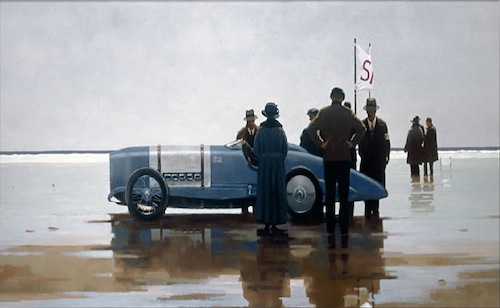
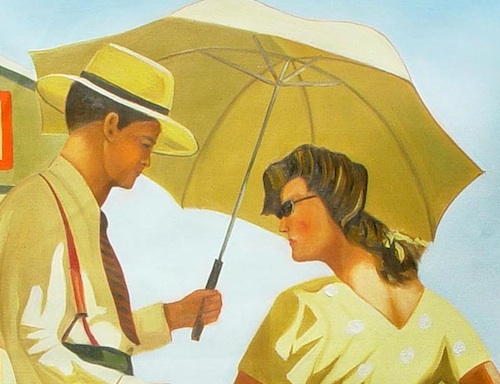
Probably my favourite Vettriano painting, leaving aside his self-portraits, is the one of Malcolm Campbell’s ‘Bluebird’ on Pendine Sands in 1924 (fig.1). It is highly stylized, as many of his paintings are, and has his low horizon, distant breakers, and wet beach tropes, along with figures back-lit by watery sunlight. It displays his wonderful knack for painting reflections on surfaces, in this case the wet beach. I love the fragmentation of the reflections. Another Vettriano trope is the frozen attitudes of the figures, each one looking as though it has been caught at an individual moment. The whole painting is like a pause in conversation, with the only sounds being Bluebird’s engine ticking over, and the ‘start’ banner snapping in the breeze. I enjoy looking at it, it has a definite ‘feel’.

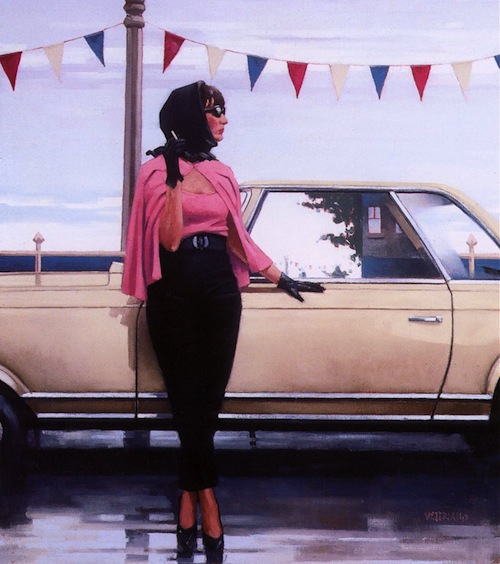
A similar capturing of reflection can be seen in the picture of the woman in slacks and a headscarf, leaning against a car (fig.4).

fig.4

fig.4

The whole picture is very stylized of course, but apart from the familiar device of the fragmented reflections on the wet ground, there is the clearer view of a building and trees in the car window, and a more indistinct, angled reflection in the misted rear quarter-light (or are we supposed to be looking through it? It’s debatable, and sometimes Vettriano does pull our leg and trick our eye). There is also a subtle difference in surfaces on the car, where an imperfection in the bodywork appears, just below the door handle. Things like this convince me that Vettriano can paint.

fig.5 - detail from a self portrait

fig.5 – detail from a self portrait

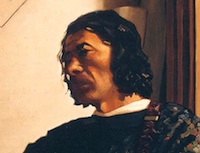
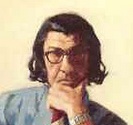
He’s weak on faces, about which weakness more later. The one face he does seem to have the measure of is his own; it is almost the only one that he tackles from straight on, that is not obscured by a fedora or something. I can look at his self portraits and feel engaged with the person depicted there. I would happily hang one on my wall. I like the one where he is shown absorbed by a book (fig.2). Behind him on the wall is an empty frame; it seems to imply that the artist-subject’s face, on which we might pretend to read his character, is as important to appreciation of the painting as is the whole, larger composition. At the same time it reminds the onlooker that the painting’s subject is an artist.

The more full-length self-portrait below (fig.6) shows him posed almost like one of his 1940s-kitsch male figures. However, there is more relaxation, less striking of an attitude. Once again the subject is caught in a suspended moment. This painting also shows Vettriano’s knack with light. He often paints light from a window in this way, sometimes filtering it through thin curtains, and more often than not he nails it.

self-portrait 4

fig.6 – self portrait

I mentioned that he is weak on faces. I believe this to be demonstrated by his hiding them. Very few faces in his paintings are shown anything more than sideways on. Many that are, are shaded by a hat, or suggested rather than depicted. Meanwhile other details in the same painting – the fold and hang of clothes, for example – may be sharp and well-executed. He has made a virtue of this, seeming to suggest that his subjects are anonymous, mysterious rather than open, menacing, furtive, sometimes ashamed of themselves or of the decadent world they inhabit – the bars, the dives, the back rooms, the cheap hotels. On some occasions a painting is embarrassingly bad. In The Direct Approach (fig.7), the young woman’s head, neck, and right shoulder are anatomically impossible.

fig.7 - detail from 'The Direct Approach'

fig.7 – detail from ‘The Direct Approach’

I look at some faces – hands as well – in a Vettriano painting and think that I’ve seen better in the end-of-term display at the local high school. It seems to be a matter of hit-and-miss; stepping from one painting to the next in this exhibition can often be a matter of stepping from a good one to an awful one, and there are too many that leave me shaking my head to convince me that Jack Vettriano is all he’s cracked up to be. His obsession with creating a kind of soft-porn, 1940s, high kitsch with mobster overtones has been flogged to death. He has painted himself into a corner as a one-trick pony; no matter that it is a highly successful, highly commercial trick (and good luck to him on that score, as he can ignore my opinion all the way to the bank), a whole room full of them soon starts to grate. I often wish that his application to study fine art at Edinburgh University had not been turned down, that he had gone there and acquired some of the technical power he lacks. His painting doesn’t seem to have been going anywhere, and I have the feeling that it ought to have done. He is very talented, and ironically had he been less so he would have been lauded as a primitive. The trouble is that he has too much technique for that, but not enough to rise above the mugs and postcards.

I wish he would. If I could paint as badly as he does (if you see what I mean) I would want to paint better.

__________
* I am all too aware that I am expressing this opinion as a self-taught author and poet; ours seems to be the only formal genre, however, where the necessity of ‘learning’ the art is considered irrelevant by most critics.

Artworks reproduced are acknowledged to be the painter’s copyright, but are displayed in this essay for illustration purposes and as examples for legitimate criticism and comment.

Angels, Mothers, Vampires, and Others.

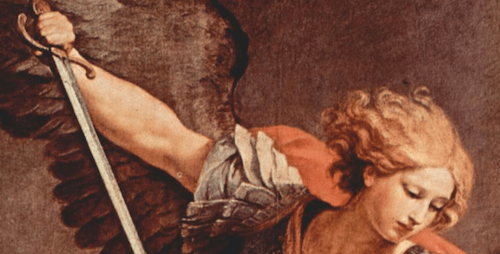
Michael

This morning I finished my final read-through of The Everywhen Angels, my forthcoming novel, and gave a small list of unresolved typographical issues to my publisher. I think that’s the job done. I’m still awaiting the cover artwork, but that’s for the ‘house’ artist.

Having done that, I turned my attention to The Milk of Female Kindness, an anthology of prose, artwork, and poetry on the subject of motherhood. Contributors are drawn from as far afield as Australia, North America, and Britain. The Australian editor is Kasia James, and I am privileged to be doing a little editorial consultancy for her. The contents are marvelous – poetry ranges from Alison Bartlett’s ‘Reasons to Breastfeed’ to my own ‘The Maclaren’, about someone who can’t breastfeed – and I would especially recommend Maureen Bowden’s short story ‘Hiding the Knives’. I don’t have any information as to when the book will appear, but I’ll let you know as soon as I do.

I have also heard that the international anthology of modern sonnets The Phoenix Rising from its Ashes, for which I am Deputy Editor, is now ready to go to print. Publication is a little behind schedule, but it has a bit of a struggle to get this far. Being a deputy means you don’t get final say. I have often thought that it would have looked a lot different had I been at the helm, but it wasn’t my baby, and so all the recognizable facial features will be those of its very loving father, Editor-in-Chief Richard Vallance. Richard has sunk considerable energy and personal resources into this collection, and deserves to see it thrive. Again, more news as I get it.

Having work edited – the most chastening part of publication for an author – is damn good schooling for doing editorial work oneself. It sharpens up one’s initial presentation, for a start. Shortly, I hope, I shall be in a position to hand over the first draft of my teen-vampire novel. I’m winging it. I didn’t want to write a romance, where another Bella falls for another Edward*, so I launched straight into an action scene without even pausing to dream up a plot. I figured that my protagonist would suggest to me how the story would go and so she did! Imagine a tomboyish, even ‘boi-ish’, version of Buffy in a New York setting, a generation into the future, when energy resources are running thin and vampires are finding their way into positions of influence in the world. Imagine her reading a book about a nineteenth-century vampire hunter and finding connections. Imagine that despite her heroism she makes fatal mistakes. Imagine vampires with whom any person-to-person understanding is next-to-impossible (hence no cheesy romance). Imagine, most of all, the feeling that as a teenager one is marginalized and kept in the dark. That’s the way the novel is shaping up at present. The question of teenage alienation and lack of understanding is not a new theme for me. I deal with it a lot in The Everywhen Angels, for example. In my teen-vampire novel it is going to be dealt with a little more simply and superficially, amongst the episodic, crash-bang plot. I have to say it feels a little as though I’m writing a pot-boiler, but we’ll see how it comes out…

It’s a while until the next Showcase at the zen space is due out. Nevertheless I’m currently thinking about it. My aim this time will be to feature, strictly, writers whose work has not yet been seen in a Showcase. This means I will have to start sending out invitations and calling for contributions soon. I’m taking a little rest from writing poetry myself, but will be back at it shortly, I’m sure.

Finally, have you picked up your free ebook copy of my novel Lupa? If not, go here to do so – and also think about writing a review for me.

__________
*That’s a Twilight reference, for those of you who don’t instantly get it.

Vampire moments

Wompeer

Today I’m remembering two of my favourite vampire moments. The first has to be from the movie The Fearless Vampire Killers. Veteran British actor Alfie Bass, playing a Jewish innkeeper, has been turned into a vampire. He invades a maiden’s bedroom at night, she screams, and holds up a crucifix. “Oy, oy!” grins Alfie, “Did you pick the wrong vampire!” The old jokes are the best. FVK has to be my favourite vampire movie ever, if only for the irony of the title – the hunters seem to spend the whole film in a state of abject terror, and never kill a single vampire.

Bela Lugosi as Dracula

Bela Lugosi as Dracula

Another moment comes from a TV show from the 1960s, Michael Bentine’s It’s a Square World. In the sketch I recall, another veteran british actor, Clive Dunn, arrives in Transylvania on a cultural mission to bring cricket to the peasants in the Carpathians. At a village inn he finds a group of terrified peasants, led by Michael Bentine, cowering in a corner in fear of the local nobleman, a notorious vampire. Dunn brings out his cricketing gear, but the language barrier produces a hilarious result, as Bentine, in a cod Eastern-European language, mimes to his fellow peasants how to cosh a vampire with the cricket bat, and drive stumps through its heart. Enter the vampire, probably played by John Bluthal dressed a la Lugosi, and the peasants flee. Not realising what this newcomer is, Dunn promises to turn him into “a first class bat”, and off they go together, Dunn folded ominously in the vampire’s cloak.

I mention all this because my teen-vampire novel-in-progress has now passed thirty thousand words. I can’t help thinking that just writing it is the easy part…

From Shogunate Japan to the Bayous with Sam Snoek-Brown

sam

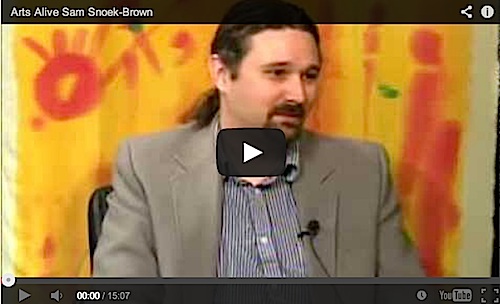
If you have fifteen minutes to spare, I recommend watching this video clip of Sam Snoek-Brown, a writer for whom I have enormous respect. In this televised interview he talks about such things as how he teaches his creative writing students all about getting rejected by publishers. But the main topic of the interview is his forthcoming novel Hagridden, and the influence of classic Samurai movies on his writing. The novel is set at the time of the American Civil War, but its action happens well away from the battlefields, cities, and plantations of North and South.

I’ve been here before

angels

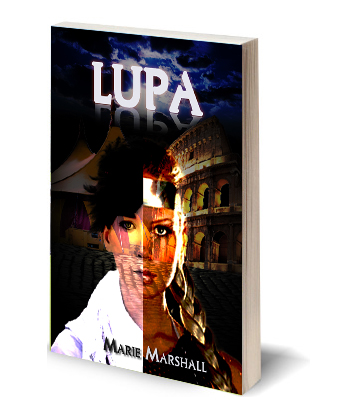
It seems like only days ago that I was proof-reading the final draft of Lupa. There were three of us on the task, and we still let a glaring typo go through into the first print run. Now I’m at the same stage with The Everywhen Angels, and I’m a little jumpy about making the same mistake. I always blame typos on my legendary North Korean keyboard, but no one really believes me. The other thing that has me on the edge of my seat is the prospect of seeing the cover illustration. I have passed my own ‘vision’ to the house illustrator, but who knows what he will come up with. Reactions to his cover for Lupa were very good – not without exception, but you can’t please everyone.

Meanwhile my new teen-vampire-themed novel is progressing slowly, after an initial burst, but it definitely is progressing, and probably more quickly than anything I have ever written. A bit.

I would like to remind you that if you would like a free e-book copy of Lupa you can still get one – but hurry! You’re also invited to send in a review, with the possibility that you could win an autographed copy of the novel. You will see from the on-line review form that it doesn’t have to be a long review, but the text box on the form does expand to allow you to ‘wax lyrical’.

100 free ebook copies of ‘Lupa’!

Lupa

That’s an offer you can’t refuse. For a limited time, and in a limited amount, my novel Lupa will be available as a free ebook, along with Lyz Russo’s futuristic adventure The Mystery of the Solar Wind, Douglas Pearce’s weirdly witty Almost Dead in Suburbia, and Leslie Hyla Winton Noble’s Tabika for younger readers. There are no strings, but you are invited to take part in round two of the P’kaboo Facebook Share Contest. Step one of round two is reading the book of your choice (all four, if you wish!) and writing a review. Read all about this on Lyz Russo’s blog, or just go direct to P’kaboo’s online bookshop and download any of the books from there.

And the Winner Is:

gipsika's avatarthe red ant

Blank bookcover with clipping path

Lupa by Marie Marshall

is the first of our Facebook Share contestants to move into the “Free Downloads Zone”.

The “Zone” will open on the 1st of October, so stay tuned…  A limited number of copies is going to become available for free download, from the P’kaboo website.

There is something immensely satisfying in being the first in something.  Well done, Marie!

Please boost the other books, too:

Visit this page and share books to move more into the “Zone”.


LupaTabika 1Almost Dead in SuburbiaMercury SilverBaa Baa Black BeltSolar Wind 1Solar Wind 2


Thank you for participating!

And now gipsika will steal away and prepare for her daughter’s 16th birthday, and a corporate gig she’s playing in Joburg next week.

View original post

Demons and Angels

A few days ago I asked you this question: What well-known character in children’s fiction is known in Chinese as Fú Dìmó? I had many interesting answers either as comments or tweets, some of which are contained in the montage below – including the correct character, which nobody guessed. Have a look at the montage, and see if you can spot the correct character. I’ll reveal the answer below.

Who is Fu Dimo?

I’m guessing that you had no trouble identifying each of the characters in the montage. Each answer was imaginative, even if Fu Manchu and the cast of Crouching Tiger, Hidden Dragon stretched the idea of ‘children’s fiction’ a little far. Whoever guessed Harry Potter probably got the closest, but still ‘no cigar’.

The correct answer is… Lord Voldemort from the Harry Potter canon. You could have spotted the phonetic similarity between ‘Voldemort’ and ‘Fú Dìmó’. It might have been easier to spot if the translators had gone with their first idea, and had used a character ‘Fo’ instead of ‘Fu’. However ‘Fo’ can have associations with Buddha, and that might not have seemed appropriate for such a villainous character as Voldemort. It has been pointed out that the etymology of the name ‘Voldemort’ suggests ‘wish of death’. This fact reminds me of the difficulty of translating literary texts (I have done a little translating, mainly between French and English, and I briefly worked with the late Vera Rich, proof-reading an unfinished translation from Belarusian to English). JKR’s translators went for a phonetic rendering with an appropriately sinister meaning, rather than taking a meaning from the etymology of the original.

Anyhow, thank you to everyone who played the game with me.

That takes care of today’s demon. Now what about tomorrow’s angels? Just a quick update on The Everywhen Angels, my soon-to-be-published novel.  We have completed the major editing stage and are now looking at the first full draft, with our eyes open for any missed typos and new glitches. I received this comment from the publisher’s editor, himself no mean novelist: “… the book is something special. The characterisation is convincing. The narrative is entertaining and gripping, but at the same time shows a wealth of knowledge and research and introduces challenging food for thought on abstract matters…” That is quite something for a YA book. We’re still waiting for cover art, but hopefully the book will be out well before Christmas and in time for the publisher’s schools promotion.

More news as I get it.