Marie Marshall

Author. Poet. Editor.

Tower Journal, Winter 2011-12

Poet and editor Mary Ann Sullivan has done me the honour of featuring eleven of my poems, alongside those of US Laureate (2008-2010) Kay Ryan and former Laureate Daniel Hoffmann, in the current issue of The Tower Journal. My featured poems are all from my 2011 output and include all four of the poems inspired by Veronica Franco (or perhaps five, as Calle dei Morte might be narrated by her or a ‘scene’ in her psyche – I wasn’t sure when I wrote it and I think I’ll leave it arcane). Mary Ann has been very complimentary about my poems and I was very pleased to be invited into an issue of Tower.

Winter 2012 showcase at ‘the zen space’

Happy New Year!

The Winter 2012 showcase at the zen space has now been published. It was hard but rewarding work sifting through the haiku and short-burst poetry, but I think the result is pleasing. Please do feel free to visit.

image (c) Marie Taylor

‘A Woman on the Edge’ – workshop project of prose and poetry: Omega.

One day nature will declare my work-in-progress a canon, and there will be an omega stamped, sealed, upon my work. It will be as final as a horseshoe-print on my skull, a line drawn underneath the last word on the last page. The moment before that line is drawn and the Omega is spoken I know that I will be praying to write just one more line, one more metaphor. Perhaps it would have been as apt a metaphor as – life imitating art – was drawn by those foresters who lately cut down some trees in a piece of Perthshire woodland. No doubt in an act of supposed ‘management’ they culled those on which, a couple of months previously, hand-written poems of mine had been pinned, but more than management it seemed like retribution exacted by the landowners for their having participated in an act of revolution. Cruel landowner! Cruel foresters! The trees were innocent bystanders, or at most unwitting insurrectionists!

Still, it made me think.

It knocked clean out of my head my project of hidden poetry, buried under the earth and leaf-mold of the forest floor. In its place was panic at the thought that a day would come when I produced no new poetry, not simply poetry that would remain unseen. How awful a glimpse of mortality!

I shall seed amongst old books some scraps and notes, lines in my hand on the backs of old envelopes, hints of manuscripts completed but undiscovered, so that there will always be speculation as to whether any ‘canon’ is complete, whether there are poems out there new to the reader’s eye. I shall redecorate my house, writing in felt marker upon a wall before I apply paste and paper, so that – perhaps – when they blue-plaque the building with a reverent Marie Marshall, author and poet, lived here it may be treasure-trove. I shall give my man-of-law a box and specify that it is never to be opened.

Such you may consider to be sleight of hand, deception, half-lies, total falsehoods, and finite even if secretly so. I shall bequeath to other poets a phrase each, an idea, some few words, a sentence, a rhythm, a rhyme – something. Along with each bequest will be a plea for them to run with it, weave it in-and-out of the pommiers of their poetic orchard or of the bollards and signposts of their city streets, to mortar it as a reclaimed brick into their own wall. I will release my works to the world and say: If you have a mind to poetry, then lift these, re-mould them, extract text from them, expand the images and metaphors, or simplify them, encapsulate them in seventeen syllables, do anything you wish… but please be sure to acknowledge them!

Perhaps there is an Edgeland between life and death, and this is why we believe in ghosts; perhaps my own dreams – the ones where I can fly, rather as one treads water – are intimations of this state seen through a crack in time and space. If this is so, I might be watching as it all unfolds. I might be the goose that walks over the grave of the reluctant poet – the one who doesn’t pitch in – and makes him shiver. You have been warned.

‘A Woman on the Edge’ – workshop project of prose and poetry, part 6

Templeton Woods

Held in an irregular trapezoid between Dundee and one of its dormitory villages, bordered by a broken road, by the ordered twists and turns and straight-forwards of a golf course, by the rat-run to Coupar Angus, and crowned by a water-tower, is the wood where I walk. I prefer to pick days when I won’t meet anybody, so that in this patch, this scratch of trees on the map, this soledad, I can run and walk alone. I can lose myself, pretend I am in the depths of the antic Caledonian Forest; so I come midweek, maybe in the rain, deliberately to feel the breath knife my lungs and my heartbeat rise to meet it. I feel safe here, there is no denying. Sometimes I feel as though I could pull a blanket of fallen leaves over me and sleep, never to be found, although sometimes felt. I have run here in the dark, bobbing my torch to the fall of my trainers, veering crazily off the path and crashing into branches, and only the cold has held pace with me. I have deliberately stood here waiting for evening to overtake day, for the last sky-metal to turn edge-on to me and withdraw, for the blue-to-black sheath to take its blade, so that I could look up between the trees to see stars, shooting stars, tricks of the light that never came. All this so close to civilisation.

On the 20th of March 1979, eighteen-year-old Carol Lannen was witnessed getting into a man’s car in Dundee. Some time later her naked body lay here in Templeton Woods; she had been strangled, her clothes were never found but her handbag was discovered miles away in Aberdeenshire. A little short of a year later a shy young woman by the name of Elizabeth McCabe went missing. Rabbit hunters found what they thought was a discarded shop-window dummy lying very close to where Carol Lennan’s body had been found. Neither murder has ever been solved, each remains a cause célèbre, and a torment to those who knew and loved each victim.

And yet I still come here, willing myself to be lost, to be alone. Day after day I cross the trail of other walkers, I find litter, hear a dog barking. Woods like this one right here on the edge of things are debatable places. They ought to be wild yet so much of them is touched daily – we come for solitude, for exercise, maybe for sex, for thought, for stars. Twice, as recorded, to leave the aftershock of pain and terror. Oh God, there are edges and then there are edges.

The Haunting of James Abbott McNeill Whistler

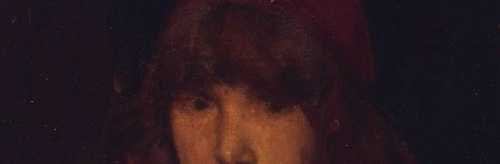
It is late on a rainy winter’s afternoon in the Hunterian art gallery in Glasgow. Little daylight finds its way into to the interconnecting rooms and the artificial light is yellow and diffuse, or seems so to the gallery-goer who is standing in front of a pair of paintings. They are behind one of the last few partitions at the back of the gallery, almost hidden from view unless one knows they are there or have happened on them in a spirit of exploration. The gallery-goer has to look slightly downwards to see them, as there are two other paintings above. These other paintings have only held her interest for a moment or two, but the lower pair seem to have transfixed her. She shifts her stance slightly as if to alter the angle of her gaze and lose some unwanted glare or reflection from the literal surfaces, and thrusts her hands in the pockets of her coat to quell an urge to reach out and feel the texture of the paint. She reads the laminated plaques at the side of each painting and confirms that they are by James Abbott McNeill Whistler and are part of the bequest of his sister-in-law Rosalind Phillip.

Whistler has never been her favourite painter – she prefers German Expressionism if anything – but at this moment she feels a compulsion to stand and let her emotional and intellectual reactions overlay each other, confuse her, vie for strength like two equidistant radio stations fighting for the capture effect. Arranging her thoughts like clothes on a washing-maiden to dry, the gallery-goer builds the following analysis.

The composition of each painting is simply the figure of a seated girl from the waist up. She has long, full, auburn hair with an untidy fringe touching her eyebrows, and tresses which rest on her shoulders. She wears a purple beret or small cap on the top of her head, pushed back. She is dressed in shapeless, dark clothes, maybe brown, or black seen with a reddish sheen by a dim lantern or firelight. In one painting her body is angled slightly away from the artist and she has turned her head towards her left shoulder to look directly at him. Her hands rest on her lap but the delineation is imprecise, they are pale and doll-like, or like hands on a photograph from Belsen. In the other painting she is slightly more squarely-on, her hands are out of sight. At first it seems that her gaze is straight towards the painter again, but perhaps she is looking to his right and slightly down. The second painting seems to have been executed with a darker palette, but in both cases it looks like paint has been applied and then has been scraped thin. The texture of paint and canvas are one. The modeling is uncertain, the girl’s pale face seems to be the only source of light. The picture space has almost no depth, as though she is sitting directly in front of a dark wall with her back pressed against it. The tone in the first painting is stark in its contrast between light and dark even though the background colour is a warm brown; the white of the girl’s hands and face are almost shocking, and although her gaze engages the artist and the viewer there is a remoteness, we are at arm’s length from her. The second painting is darker overall, but the tone of the girl’s skin is softer, there is more colour to her cheeks. She seems to be closer to us, and although her gaze is slightly averted the whole effect is more intimate. In both cases her face dominates the picture, drawing the eye into an uncertain virtual space full of ‘as though… as though’.

The gallery-goer does not know how long she has stood looking at these paintings. She becomes aware that someone has come to stand at her left elbow, though she did notice this person arrive. The other person speaks to her, and in the exchange that follows tells her a story, or maybe more than one story.

*

Beautiful, isn’t she! You don’t think so? Well I’ll grant she isn’t conventionally pretty. Her nose is long, her mouth is canted slightly downwards to the left, her expression is mournful, her complexion seems pale and warmed only by external influence rather than by her own blush, and – look here – that could almost be a scar. No, I think it is more likely to be the violence of Whistler’s palette-knife as the mark is only there on one of the paintings. But her face holds you nonetheless. Am I right?

You are wondering why the title, why ‘Le Petit Cardinal’, why present the model as a male? There is something a little androgynous to her looks I agree, but it’s obviously because of that purple cap she is wearing. Whistler painted and drew her several times with that cap on her head. Her name is Lillie Pamington. Very little is known about her apart from her having been one of several street-girls who caught Whistler’s eye in London. One can imagine he was passing in a Hansom cab when suddenly saw her in her dark coat and purple cap, weaving her way in between the press of people on the pavement. He was captivated, just as you are, by that pale face in the gaslight, bobbing along like a jack-o-lantern amongst bushes, and he rapped the roof of the cab with his walking stick – Stop, cabbie, stop! – and jumped down onto the kerb.

Miss. I say there, Miss. Young lady with the purple cap! Picture her halting, looking over her shoulder to see who was calling. Maybe he gestured her to come. Maybe she placed one of those pale hands against her chest as if to ask Me? or as if she were trying to still a racing heartbeat, unsure in her mind whether she was to be the subject of a hue-and-cry as a thief. Picture him holding out a business card. Can you read? Come to this address then, I would like to paint your portrait. Did her face remain solemn and sullen or did she smile? Was she instantly trusting or did she rebuff him at first with a few choice words of cockney? We know that she did turn up at Whistler’s studio because we have the evidence right here in front of us, but for now picture her purple cap bobbing down the street, soon lost amongst the crowds. Oi guv’nor the cabbie would have called. You want this cab or not? I’m losin’ fares.

Imagine how, a day later, she arrived at his studio, that there was a knock at the door and that when he opened it Whistler was at first puzzled. Who could these two people? One would have been a child of about fourteen with a painted face and elaborately-curled hair, the other a woman, her hands resting lightly but proprietarily on the child’s shoulders. I made her look nice for you, sir – a proper little lady to ‘ave ‘er portrait painted. Whistler would have come to realisation, and would have been horrified. No, no, this wouldn’t do – where was the solemn waif with pale face and auburn tresses that had captivated him in the street? This was a sham, a travesty, a mockery of her beauty. Imagine how he controlled his emotions and explained to the woman, as her smile faded, that he wanted her daughter – was the woman actually the child’s mother? – just as he had first seen her, and turned them away from the door. How he would have fretted for the next few days, cancelling all the sittings he had scheduled in case the woman and child returned. Would they return? There had been no mention of payment. Should he patrol the street where he had first seen her, or would that risk his not being at the studio when the next knock came?

It might have been one evening ten days later that Whistler resolved that the next day he would stop waiting for Lillie Pamington to come, and would arrange other sittings again. Imagine a light step outside and the rap of a small fist upon his door. Imagine that he opened it and saw standing in the shadow… Lillie with the pale, solemn face, with the unruly waterfall of auburn hair, with the dark coat and purple cap. Standing alone, silent. Would he have let her in without a word, or would he have smiled and said, Delighted to see you, Miss Pamington – so glad you could come, please do step inside.

What was the obsession that drove him to paint and draw her over and over again, clothed and naked? We know that he was a womaniser, and that he sired many unacknowledged children by his mistresses. Did he see in Lillie some echo of Joanna Hiffernan, the lover whom he had lost to Gustave Courbet? We do not know, Whistler never told us and as for Lillie she suddenly disappeared from his life and became obscure once more.

But imagine this. Imagine Whistler, having used up all the obsession he could on painting her, throwing his paintbrush down one evening and taking her in his arms. A kiss for ‘Uncle James’, Lillie? A struggle would have happened – I’ll tell! I’ll tell! – and he would have silenced her, consigned her limp remains to secrecy and sworn to all inquirers that he had sent her home at the usual time. But the stress of keeping the secret as a matter between himself and his burdened conscience would have weighed upon Whistler, so much so that he might have spent hours gazing upon ‘Le Petit Cardinal’, at his study in ‘Grenat et Or’. One night he would have fallen asleep and awakened to see nothing but her pale and solemn face looking out from the portrait. It would have seemed that the face detached itself from the painting and approached, as though Lillie was walking towards him. Imagine that was the first of many such night-time visitations, and that eventually he could stand no more and, snatching up his palette-knife, slashed at the apparition. Imagine that in the daylight that eventually followed, the mark of the knife was to be seen on the painting. Imagine, perhaps, that years after Whistler’s death the skeleton of an unidentified girl was found in blitzed-out rubble somewhere in London.

No? You don’t like that story? Well then, imagine this alternative. Lillie came willingly to kiss ‘Uncle James’, and her kiss was sweet as pomegranate juice but sharp as broken glass, and that she came and went as she pleased at night until Whistler wasted away and died, his life entirely drained from him.

You’re right, of course. The official story is that he was ill, that he was broken-hearted after the death of his wife Beatrix, and I’m sure that is much more likely than either of these tales. How could they be true? But just look to your right, look at his last self-portrait. Gone is the confidence of the young man in the tilted, broad-brimmed hat, gone is the flash and dandyism. Originally he painted himself in a white coat, but something made him scrape off most of the paint and re-execute the work in black or dark brown. The stance and gestures are clearly in imitation of Velazquez; but the hands are indistinct as though fluttering and fretful, the right hand perhaps on the point of being raised to repel something, the left hand just holding his coat closed, a hesitative protection. His entire weight is on his back foot, as though he is leaning away from something. His expression – his eyes – he is looking down as if at the approach of someone a good deal shorter than himself, and he is staring with horror. What is he trying to tell us? What secret is he only just holding inside?

*

This is the point at which the gallery-goer realises that the other person has fallen silent and, moreover, that the gallery lights have all been shut off apart from the single, dimming lamp where she has been standing. The gallery is in complete silence, the only sounds are faint and come from outside. The most luminous object in her line of sight is the face of Lillie Pamington in the portrait.

The other person is still a presence at her elbow, just outside her peripheral vision.

Who are you? she asks. What are you?

I may not tell you, but I may show you, says the other. Come with me.

The Bruce Dawe Prize…

Dr Bruce Dawe AO

I begin by defining my terms. I’m not talking about the Australia-wide prize for poetry, because I’m not an Australian, but I am talking about a ‘Bruce Dawe Prize’. Bower Bird Press is a small publishing concern, the brainchild of Australian poet Ronald Wiseman. It’s main publishing project is the series of international anthologies under the umbrella title On Viewless Wings. The patron of this project is Dr Bruce Dawe AO, arguably Australia’s best loved and most influential living poet. He gives his time freely to judging a ‘long list’ of several hundred poems from each anthology and awarding a virtual laurel wreath to the best. The results are published in each following anthology under the heading ‘The Bruce Dawe Prizes’. My personal news is that the Champion’s laurel for 2011 has gone to my Sequence of Six Love Sonnets. Dr Dawe had this to say about them:

These sonnets range across the experience of love: the place of first meeting; the sense of kissing as a veritable feast; the artistry of love’s web-spinning; the ebb and flow of emotions; its life-giving alchemy; and the sense of love (at times) being a merry dance. [Marie] has dealt with each of these aspects with sophisticated, experiential skill.

Vera Rich

Dr Dawe is the second fellow-poet with an international reputation to appreciate my poetry. The other was the late Vera Rich, who was the world’s foremost translator of poetry from Slavic languages into English. She was never uncritical – in fact she was often highly critical – but she honoured me with a request to proof-read her most recent works prior to publication. This collaboration between us was, sadly, cut short by her sudden death.

Moving on, I recommend the latest issue of Decanto magazine, and not solely because it features one of my own poems, Le Baute (‘The Masks’). Decanto is always full of wonderful poems.

The batsman of the Somme

I have a mad desire to catch
the pomegranate that I see
mid-arcing in the winter air
or with a willow bat despatch
it high above the English lea
to drop beyond the boundary there

But I am deep inside my trench
and in the time it takes a breath
though that may ape eternity
the pomegranate’s fatal wrench
will bear me past the bourn of death
no Ceres waits for spring and me

__________

A friend reminded me of the above poem which I wrote in 2007. It is, of course, a poem about the First World War and about ninety years too late, but I felt it was worth sharing with my readers. New friends will perhaps not realise that I write – or used to write – much that rhymed and scanned. I do not believe in the Chinese walls that are erected to separate poetry from poetry.

Publication news

I have received two complimentary copies of magazines today, each of which features poetry of mine. The first is issue 60 of Smoke, a magazine produced in Liverpool by the Windows Project, Liver House, 96 Bold Street, Liverpool L1 4HY. They have published my poem I hate all flowers, which is a lithopoema I wrote in 2010. [By the way, for those of you who are not familiar with the city of Liverpool, although the city’s prefix is pronounced as in the bodily organ, such places as ‘Liver House’ are pronounced ‘lie-vur’ – just saying.]

The second magazine is issue 37 of THE SHOp, a magazine published in Ireland, which features a 2011 poem of mine simply entitled End. Editorial address of THE SHOp is Skeagh, Schull, Co. Cork, Ireland. [Another ‘by the way’: I believe the word ‘skeagh’ is Irish for a thorn bush, and ‘Schull’ derives from the word ‘scoil’ meaning a school, the latter being very similar in Scottish Gaelic. Correct me if I’m wrong…]

Travelling with Bukowski, parts 1 and 2*

1

Brevity: like a footprint in the mud – no matter
how pure those sky-tears that fall from the grey
clouds, in the footprint they turn to soup; the tread
of the worn boot becomes featureless, and
by morning it’s nothing.

I turned up, a dust cloud out of the Mohave;
he and I kinda floated
down the Los Angeles River,
washing up on the far bank,
staring at the ceiling
of a cheap hotel room
and passing a smoke from hand to hand.

I had been on a quest – or so it seemed –
for the Holy Grail; but I had come instead with a bottle
of Burgundy filched from the back seat of a red Corvette.
He complained that it wasn’t whiskey, but drank
the lion’s share anyway. Alcohol went down his throat
like rainwater down a drain.

Love: maybe. The call of a freight-train sounded
like a violin playing in the key of somewhere-else,
and oh how those boxcars rattled. In the dark his cheek,
his curls, were cherubic; but when morning fisted the sky
the time and season when phantoms and night-haunts
are laid
– he was hollow-cheeked, hollow-eyed,
hollow-souled, and suddenly gone.

That is why – like you care – memory and bewilderment
are one to me, just like truth and beauty, and our momentary
flicker of a hitch-hike only led this far.


2

Everything I tell you is a lie

Says you, says the poet in the torn coat, hanging limp as night-fog while the wind frets at the cracked window, blowing blue like jazz from a New York loft.

I remember the spikes and penny-hangers of London, friend, but your eyes are on the Latinas, shuffling into the church next door, rosaries, crucifixes, charms and amulets against sin, red-cheeked confessions, turning the pages of their week and on to another chapter, bless me father. The bell pulses, the rope old and brittle against the priest’s calluses, the prayers are spoken. But you…

Why does it amuse you so much, out here in the Valley, away from those Angelenos, kneeling beside me, spreading my hair on the pillow? You have no camera, no palette and easel, simply a notebook and the butt of a pencil; but I feel like a whore, paid to lie with a bastard Jesus at my breast while you paint me as a Madonna.

That wind, blowing soft and crazy like Ornette Coleman, lifts the torn curtain; the half-crescent moon, a whey-faced voyeur, winks an eye at the depth of my shame. You say it was karma that we met; I say close the window, pull the curtains together, shut out the moonlight, as I gaze at the swinging lightbulb and the motion makes me feel sick…

Oh you lying poet! No white sails on a golden sea, no elusive, leaping gazelles, just the truth of dust and hurt; and your words still paint me – your shiftless, dirty Madonna, always haunted by you, by our travels, by the two plastic spoons in the jar of cold beans, nuestro sacramento, by our upside-down world.

Now, at nights, those bald, bare words of yours are what I lay against my cheek as I try to sleep, betrayed, an old gypsy of the long, flat roads, my life peeled from me the way a thumbnail peels the skin from a mandarin orange, fleeced, the droplets of my blood tart and citric. I listen to the damnable high-hat-and-snare of a cicada, and I laugh. Bitter, my friend… bitter.


__________

* This poem won the Del Warren Livingston Memorial Prize for Free Verse in 2009. I don’t generally put my poems up for awards and I regard things like this as incidental, but it seems silly not to mention it.

The image of Charles Bukowski used in this post was retrieved from http://helvira3.blogspot.com where the user states that it is assumed to be in the public domain.

Shakespeare-shmakespeare

Two Noble Dudes

So I bust my ass with a script, and the man writes back “Don’t send me no more films where the guy writes with a feather!” So I figure – what the hell – I’ll do him a Western instead, ‘coz it’s been eighteen years since Unforgiven. I had this idea where two gunslingers get in a fist-fight over who’s gonna marry the big cheese rancher’s daughter, and the sheriff breaks up the fight, tells one to get outta town, and throws the other one’s ass in jail. Then he busts out and the other guy comes back, and they shoot it out, and one guy beats the other to the draw but falls off his horse, then they’re gonna lynch the first guy but the rancher’s daughter begs for his life… and… and… But anyhow, the studio sends me this co-writer (some bald limey with a beard), and he says like bring it up to date. So okay, I say, how about we do “Two Bloods in the Hood”, ghetto-style, y’know, urban stuff with gangsta rap, and he says “Blacksploitation’s so seventies, Fletch!” (only with this English accent) “We need the final duel to be a car chase… explosions… kung fu on the top of a burning building… and the girl needs to kick arse too.” (Yeah, he actually said “arse”!) And he goes on, “Willis and Schwarzenegger are too old, so get me the guy out of 24 and someone out of Stargate Atlantis.” But the studio calls and says they’re going with something by Dryden and Davenant, and I say to the limey, “Take it from me, it’s gonna be another piece of crap like Propsero’s Books.” I mean, gimme a break!

Love’s Labour Won, or Rosencrantz and the Stapler

 O thou, the very stuff of draftsmen’s dreams,
Whose sheaves by naughty Zephyr scatterëd
Abroad in autumn, are unruly reams,
Come hither to my bare and virgin bed.
What ghosts of lovers past come fluttering,
As I thy bends of wire do contemplate
By midnight candle, pale and guttering,
And, moth-like, beat their wings against my pate?
I love thee! Ah, thy handle firm and true
That nestles in my eager, cuppëd hand!
Thy spring, that all my force cannot subdue,
Which, when I bid ‘Contract!’ doth then expand!
Ah, Rosencrantz! Thy stapler is the sun,
Love’s labour now secured by staple-gun!