Marie Marshall

Author. Poet. Editor.

haiku on silk

Today I received a note from David Cobb. David was a founder member, past secretary, and past president of the British Haiku Society. He is a renowned poet, haijin, editor of many books including Haiku (British Museum Press), and is probably the UK’s most respected authority on haiku. The note was to tell me that British-resident Japanese haijin and artist Yoshiko Torii had translated one of my haiku into Japanese. The note ran:

The person who was supervising the ‘Silks and Haiku’ exhibition at the St Pancras Crypt Gallery had the rather sweet idea of translating your haiku into Japanese and making a haiga* of it. I can’t vouch for the accuracy of her translation, but I hope it will please you… The two scarves, on one of which your haiku appears, are now in the BHS possession and will be displayed at the upcoming AGM Day in Conway Hall, London…

I have to say that this was both unexpected and gratifying. It adds another language to the list of those into which pieces of mine have been translated (the list already includes Russian, Welsh, and Gaelic), and another location and medium to the list of those in which pieces of mine have been displayed (that list already includes the walls of a cafe in Wales and an art gallery on the isle of Mull, and etched into an African drum at the New Orleans Museum of Art).

__________

* Haiga is a form of expression which combines the use of words and calligraphy which go to make up haiku with visual art. Often the drawing would be done with the same brush and ink as was used for the words, and even if the drawing seemed obviously unrelated to the words the two would form a single work of art. I’m aware that this definition is an oversimplification but so many words are spent in discussing these simple forms – many more words and effort than are spent in executing them.  M.

‘A Woman on the Edge’ – workshop project of prose and poetry

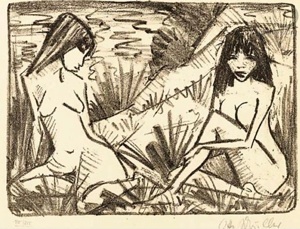
Otto Mueller, Mädchen am Ufer

I know why I’m alive, why I want to be! Life is a blind headsman with a dull axe who tries to kill you many times, and though there are so many things ringing in my head, their peals and counter-peals, their changes and counter-changes, their plain bob majors, until my mind is a hellish jangle of wedding-Saturdays and a choir of imps telling me why I should not be, why I should die. However, if I can find a hill and punish myself up its grey, green sides, not stopping even if my own breath stabs me deep to the heart, pressing my aching feet on to a drumbeat only I can hear, and if I can reach the top or sometimes if I turn my head and am taken mid-pace by a burst of horizon through the trees, I say – I live here! I live here! That’s why I live. Anyone who can look down from a hill to a city, or look up from a town to a hill, may wonder what lies between.

I do. I lie between.

I have lain and lied between ever since I was small; I still lie between England and Scotland (with a scarlet splash of France, daring, incongruous, bof, zut!) somehow, yes I do, but when I was little and the hot summer came when stag beetles crissed and crossed the concrete flags and penny-piece raindrops hammered making great nail-head shapes and sounds, lapping and overlapping until the whole pavement was brown and shining, then, then, those were the days when I could walk and walk. I could walk and walk way beyond the cricket club, way up along Corkscrew Hill, past woods which hinted at Old England, past playing fields which were the flat, green temples to William Webb Ellis, past another copse through which I could see new houses (I pretended they were the angles of a castle), past a park and a convent, and down a lane which went on for ever to the downs. And I could turn and come back!

In those days the margin was harder, clearer; but still you could get on a Green Line bus or take the tube to the end of the line and at that terminus you could find the start of a footpath. That footpath would make a few angles around the back of shops and lock-ups, a straight alongside a playing field, and then maybe meander alongside a stream, pass a copse, skirt meadows sweet with the breath of cows, to a place where the soughing of leaves and grasses and the trickling of water obliterated the mechanical sounds of humanity. It was always a place of questions for me – I mean banal questions like should I wear a skirt and sandals to go there or jeans and hiking boots, or should I take sandwiches, stuff like that. My fictional character Ashe Sobiecki knew this:

“There’s a place where you notice our suburb begin to thin out. It’s a bit further now, because I think the car-park for the new garden centre reaches there. It’s not exactly the countryside, not yet, but it’s like the town isn’t holding on to its place any more, it’s beginning to lose its grip. There are buildings that aren’t quite farms, but might have a few sheep and ponies. There are stands of trees which aren’t quite woods, and there are tracks which aren’t quite lanes. You mustn’t be surprised to see ducks turning a flood-puddle into a pond as if by magic, or rabbits here and there; and once, one cold day when there was still snow on the ground, I saw a stoat in its winter ermine. I have even seen a sparrowhawk take a pigeon. When I was younger, I always liked to think that this area had a magic to it, because it was where something became something else. I used to notice things, I had my own little landmarks which told me whereabouts on a scale I had in my head, between town and country, the exact spot was. When we did percentages in school I used them in the scale. I graded the places by smell too. There’s a place where it smells of sheep droppings, and that’s about eighty percent countryside, and another where I can smell some sort of lubricating oil, and that’s seventy-five percent town. And sounds too. You never quite lose the noise of the traffic in the background, but it’s definitely louder the closer you get to the main road – well it would be – and in the opposite direction there’s the place where you can sometimes hear curlews in spring. That is so cool, that sound. Well, I like it round there. It’s not just the landscape, not just the smells and sounds, and the birds and stuff like that. It’s a feeling I get. I have always had it. It’s being right on the edge of something. I know it is only the countryside it is on the edge of, but it’s the edge that counts. It’s like one of those graphs that go along in a kind of gradual slope and then shoot up suddenly. It’s like that only upside down, so that the slope wants to pull you. I like being right where the pull is strong. It feels dangerous. But it’s a dangerous idea, not a real danger, if you see what I mean.”

Yes yes, Ashe, I felt that way too! I felt that if I kept walking up Layhams Road and into the Downs I was somehow walking on an overlay which had been placed upon history, and that if I pushed hard enough something miraculous and perilous would happen. Or I would keep walking until I reached Biggin Hill, one or the other.

This now is the twenty-first century, and places on this edge have changed again since I walked through them as a youngster. To Paul Farley and Michael Symmons Roberts, authors of Edgelands*, this fluid, shifting, abandoned and re-occupied, marginal zone is the place of power stations, scrap yards, water treatment plants, container depots, incongruously just-out-of-town shopping centres. Yet still they have a glamour that is hard to put your finger on. A new housing estate can grow up just where you remember a deserted holiday camp having been once. A farm, a seaside park, a railway station can decay and disappear as completely as a Highland Clearance village; a mead full of cowslips can become a wedge between a factory and a bypass, and then can be transformed into a car-breakers’ yard, and then bulldozed into annihilation, flattened, grasses and wild flowers re-establishing themselves. It is as though we watch a tide, or the breathing of a great animal.

__________

* Michael Symmons Roberts & Paul Farley, 2011, Edgelands, London, Jonathan Cape.

texting, tweeting, and the Poet Laureate

People who are familiar with my old (and defunct) literary blog will remember that occasionally I used to ‘go off on one’ on a literary subject. I’m doing that again today, simply because something got up my nose.

I am most critical of myself first of all, then of other writers, especially those who speak fluent rubbish but have an audience because of their position. The Poet Laureate Carol Ann Duffy, for whom I have a certain amount of respect as a poet, ought to guard her tongue or she will be seen as ridiculous. Recently she has, laudably, launched a competition in which secondary school students are encouraged to produce poetry anthologies. So far so good, a bloody brilliant idea! However she should know better than to try to ice the cake by attempting to sound ‘cool’. Here’s Carol Ann ‘getting down with the kids’:

The poem is a form of texting … it’s the original text. It’s a perfecting of a feeling in language – it’s a way of saying more with less, just as texting is. We’ve got to realise that the Facebook generation is the future – and, oddly enough, poetry is the perfect form for them. It’s a kind of time capsule – it allows feelings and ideas to travel big distances in a very condensed form… The poem is the literary form of the 21st century. It’s able to connect young people in a deep way to language … it’s language as play… I think it’s most obvious in music. If you look at rapping, for example, a band like Arctic Monkeys uses lyrics in a poetic way. And using words in an inventive way is at the heart of youth culture in every way.

This is straight out of Patronise 101, it is how people of older generations always talk down to youngsters. I remember it from my school days and it embarrasses me to hear someone of my own generation still doing it. “The Facebook generation” for heaven’s sake, as if there is no one over the age of fifteen on social media. That old chestnut of “Rock lyrics are poetry” has been debated since the early days of Bob Dylan, and it has been done to death. Carol Ann does no service to herself by rehashing it. Then she stumbles into another obvious pitfall – ignorance of her subject – by relating rap to the Arctic Monkeys, who are definitely not rap. All of this is before we even get to the notion of text equaling poetry. Here’s how a friend of mine expressed his opinion to me of Carol Ann’s statement:

Look, poetry can be written on a post-it-note, jotted on the back of a beer mat, blogged, emailed, extemporised in a chat room, and – yes – texted. But so can a shopping list, a dirty joke, or a phone number. To be poetry it has to be… well… poetry.

Preaching to the choir, pal… preaching to the choir! I have used the language of texting and chat rooms in my own fiction, I have had a poem published the title of which is set out like an html command – that was probably a world first but so what? I don’t say this to prove how clever I am, it’s just that the language is there, and there to be observed and used. If you google the word ‘haiku’ and ‘tweet’ or ‘twitter’ you will get pages of hits detailing 17-syllable, 140-character haiku. This doesn’t mean that texting or tweeting is poetry but simply that it can be used for poetry. We can say with Karlheinz Stockhausen (yes, I can be pretentious with the best of ‘em) “New means change the method, new methods change the experience, new experience changes man”, but texts and tweets are not so much new means as new media. The means – language – remains basically the same except for a few specialised abbreviations and the natural, morphing flow of argot.

I want to remind my readers of two things. They are seemingly contradictory but nevertheless they illustrate two solid pillars of the house of poetry. Firstly ‘success’ in the world of poetry still means getting your poetry into print – not blogging it, not texting it, not tweeting it, no matter how many ‘followers’ you get. If my word is not enough then consider what is going to happen with the winning anthology from the competition that Carol Ann Duffy is promoting. Secondly, on the other hand, there is the artistic satisfaction of creating poetry, and that does not depend on getting into print. Probably the most wonderful poet I know, Lane A Smith, is virtually unknown outside a couple of collective web sites. To the best of my knowledge she has only ever had two poems published in magazines (Bard issue 80, Awen issue 69, and they were submitted by someone else on her behalf), yet when I read her poetry it is as though the beat generation lives on but on the warm, worn boards of a front stoop overlooking a Georgia beach, and in childhood memories of hot summers, dust, and women who were much taller and wiser than the little girl whose older head reverberates to the memories. However if you google ‘Lane A Smith poet’ you will be lucky to get a single hit. Nevertheless I consider her to be a ‘success’ in a way few of us can ever be.

I’ll close with a poem of my own from my 2008 collection 58 degrees North. It is dedicated to Lane:


Day after midnight
we packed them in
trading word for world
line for lines
vice for verse
     incredible
      streaking daylight in rods
like frozen trails of hard liquor
after body-shots
trading cheap dresses
with each other
like in-jokes
(we laughed)

people talked of perfection
and greatness
but they didn’t get it

the whole point
was
the cheap dresses

those gaudy
booze-soaked
shreds of poetry


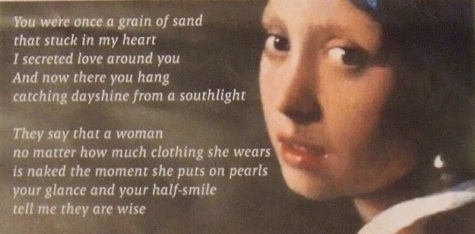
Pearl 5

(c) Winter Words Festival

Welcome to the new web site

Welcome to my new web site and literary blog. I am in the process of winding down my old site and archiving the material there. Once that is done I may reproduce some of the best of it here, but principally this site will carry my literary news, thoughts, and the occasional piece of creativity for you…

It’s a calm, grey day here in Scotland. The leaves are hanging loosely by the trees’ flanks, the birds all seem to be in hiding, and the traffic is low-level white noise. The clock’s hands are relentless and the working day calls…

Was it always this way, or was there once an excuse for indolence? Who froze forever the auld pletties o’ Dundee?


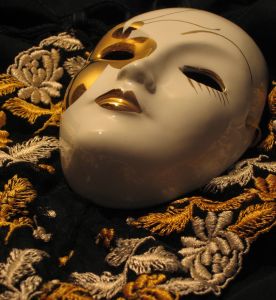
Calle dei Morti

There is one more reveler in the masquerade,
one more domino and high-crowned tricorn,
if you can count the carnival-goers heartbeat by heartbeat;
we whisper of the one who measures by silent paces
the Calle dei Morti, those few, narrow metres
from the bridge un, , tre, along this little ravine
quatro, zsinque, sie, to the Calle Cornier and back.
Here things are sombre, quiet, moonless, barely touched,
a shaft for rare stars to mock from unshuttered windows,
neglected washing to become shreds of clouds, shrouds
shaken by forgotten hands, numb, damnable breezes,
after-breath of words spoken by a lonely bell from San Stae,
by the lick of water on worn, greened brickwork,
by the lumber of wood and bump of boats moored carelessly,
by the late, late, oar-stroked clock-rhythm of a bisonno;
and still the swirl of a cloak, the relentless slow-march
sete, oto, nóve, as though carrying the world upon his shoulders,
or the dead of a thousand years in a single, child-size coffin,
steadying himself by placing sole after sole on the flagstones,
pausing only when there is laughter in the Campo San Cassiano,
fading from sight, melding with the dark of an old doorway
when homeward, hesitant shoe-taps skitter – faster,
faster at some middle-moment without knowing why.
At times of mute shadow, of the hollowed, callous city,
calling by slight hands, by sleight-handed, gloved gestures,
by finger-counts in missed seconds, shapes, echoes, half-echoes,
this nook runs from nowhere to somewhere else,
and the steps continue diéxe, ondexe, dódexe, to the end
and then, as though there is neither left nor right in the world,
back again, again, again, footfall after dark footfall.