Marie Marshall

Author. Poet. Editor.

Tag: fantasy

So, what next?

author clip art

… I hear you ask. What’s next after crashing into the world of teenagers and vampires? Well, you know me of old, how I proudly state what my current or next project is, and then you hear no more about it. The fact is that writing a teen-vampire novella at breakneck speed has knocked me back on my heels. It was such fun! I’m left wondering whether fun increases in indirect proportion to literary merit, but frankly I scarcely care. Last night as I lay awake I suddenly had the premise for a sequel. I wonder. Maybe not yet. Anyhow, finishing the first draft of a book does not mean the end of working on it. The novella is currently with a couple of readers who are proofing through it with a specific task in mind. Then it will go off to my publishers (who asked for it in the first place) to see if it will do. That’s when the really hard work starts, as it is scrutinised in minute detail by the in-house editor. That’s a process I have just been through with The Everywhen Angels – tedious, but necessary.

Which brings me on to the task(s) which will be engaging my attention next. Hopefully The Everywhen Angels will be out before Christmas. There will be the job of bringing it to the public’s attention. A similar job will be needed for The Phoenix Rising from its Ashes – that’s the major, new anthology of 21c sonnets, of which I am Deputy Editor. Also on the desk is completing a macabre story for this year’s Winter Words literary festival; this task involves getting to grips with the dialect of the Shetland Isles, a very specific branch of Scots, in which a major character speaks throughout, and which pervades the story.

I think that takes us up to Hogmanay. So what then. Well, I still have another novel on the desk, one for which I have done a lot of research but which is proving difficult to write convincingly. The main problem with it is that I have decided to use the third person (as an ‘omniscient’ narrator) rather than the first, and this is a major departure for me as regards longer fiction. My usual mode is first person, because I like to get under the skin of my protagonist and draw the readership close to her/him. Writing in the third and yet being able to carry readers with me is no easy option, but I won’t let it defeat me. I’ll get there some time. However, competing with that novel-in-progress, are other ideas. Will the sequel to my teen-vampire novel seduce me? Will I write a totally different novel, the seed of which is in my mind, about a cynical wizard-detective? Or will I go off at a tangent to all of these? Already I’m considering proposing a collaboration with an artist on a project to produce a graphic novel – such a tempting idea for me, but maybe not for the artist. So who knows. I’ll make you no promises, and meanwhile you can be sure my mind is bubbling.

M.

The Vampires are coming! The Vampires are coming!

VampireE3

I have finished the first rough draft of my teen vampire novella. It’s a trashy blast of steam-goth that ricochets from action-episode to action-episode. it’s unashamedly derivative, paying intertextual teeth-service to the whole vampire genre. Basically, there are only two plots in teen-vamp fiction: plot one is the vampire-as-misunderstood-teenager going steady with the girl from school (think Stephenie Meyer); plot two is the fearless, teenage vampire-killer (think Joss Whedon’s Buffy). Mine is plot two, with a little of the misunderstood teenager thrown in for good luck. I don’t pretend it’s going to be great literature (OMG, I’m channeling JKR!), but I do hope it’s going to be fun. I think its greatest asset is its total implausibility. I wrote it more quickly than I have ever written anything of comparable size.

The next stage is some preliminary proof-reading, and for that I will be roping in a friend or two. After that, it’s going to be sent to the publisher who asked me if I could write a teen vamp story.

I wonder if I will want to get back to serious fiction. I still have notes for at least one novel, along with some trial chapters. It had been giving me a great deal of trouble, and so I was really glad of the light relief of charging head on at this trashy novella. Let’s see if I’m back in the proverbial groove. If not, never mind – faithful readers will be glad to know that my second novel, The Everywhen Angels, is due for publication before Christmas, and hopefully will be available for your stocking via Amazon. Stay tuned.

100 free ebook copies of ‘Lupa’!

Lupa

That’s an offer you can’t refuse. For a limited time, and in a limited amount, my novel Lupa will be available as a free ebook, along with Lyz Russo’s futuristic adventure The Mystery of the Solar Wind, Douglas Pearce’s weirdly witty Almost Dead in Suburbia, and Leslie Hyla Winton Noble’s Tabika for younger readers. There are no strings, but you are invited to take part in round two of the P’kaboo Facebook Share Contest. Step one of round two is reading the book of your choice (all four, if you wish!) and writing a review. Read all about this on Lyz Russo’s blog, or just go direct to P’kaboo’s online bookshop and download any of the books from there.

伏地魔

Beijing

Now, you can find the answer to this puzzle via a search engine, but it’s much more fun to guess. This piece of information comes to me via my agent, who is not so much a mine of information but a whole information fracking operation.

What well-known character in children’s fiction is known in Chinese as Fú Dìmó? The characters literally mean ‘crouching’, ‘earth’, and ‘devil’, and the whole name could be translated as ‘demon crouching on the ground’. By the way, the picture above isn’t going to help you one bit!

After you have had your guess, feel free to put it below as a comment. But if you do look it up with a search engine, don’t enter that answer in the comment box – you’ll spoil the fun for everyone else!

I’ll post the right answer in due course.

“Can you write a teen-vampire novel for us?”

03

If you scroll down through this blog section of my web site, clicking on the older posts as you go (a worthwhile exercise, by the way, as there is some interesting reading there), you’ll come across occasional news updates of whatever my ‘latest project’ happens to be. So what happens to them? Where are the finished products? In most cases they simply aren’t. Finished, I mean. Many of them are little better than ‘good ideas’. Other things get in the way – editorial work, judging a competition, work, food, sleep, and so on. Mainly they run out of steam, or I run out of commitment, and I know that is a personal flaw – ‘successful authors’ don’t have this flaw, if you believe their soundbites. But I feel every project was worth starting, just to see if it would work, just to see if it would carry me along.

Anyhow, now that my second novel, The Everywhen Angels, is about to be published, I have been wondering why it has been so hard to complete a third. And then I was asked “Can you write a teen-vampire novel for us?” That’s as near as damn-it a commission! My instant answer was “Yes. No. Maybe.”

To tackle this I would need to re-think my daily schedule. I have been lazy when it comes to writing. I don’t do what good writers are ‘supposed’ to do, which is to spend a fixed time each day writing. I would have to re-commit to that. I would have to shelve the two novels-in-progress that I have. That wouldn’t be shelving much, I have to confess, because they are in the doldrums anyway; but as I shelved one to write the other and now would be shelving both, well that wouldn’t do much for my confidence in finishing the third. I would have to start turning down requests for my editorial expertise; I wouldn’t be able to start any other projects, I would simply have to focus on this. Then the teen-vampire genre has been flogged as near to death as the undead can be, and is lying there waiting for a stake to be driven through its heart. Stephenie Meyer has seen to that. Is there anything left to say? Is there an unused plot? Is there an unexplored twist, an unusual angle? You can see why I said “Yes. No. Maybe.”

However, it just so happens that I have a pottle of notes, fragments, poems, and short stories about a vampire hunter. Could something be reconstructed from these shards? Let’s see if I can bang a stake in without hitting my thumb, or anyone else’s…

‘My life as a coble’, and other things

poetry life & times2

Poetry Life & Times has published a poem of mine, ‘My life as a coble’. You can read it here. A coble, by the way, is a clinker-built boat common to the east coast of the UK, particularly Yorkshire; its construction is thought to come down directly from the techniques used to build Viking longships.

Meanwhile, P’kaboo Publishers have taken on my second novel, The Everywhen Angels. More news later, including some possible promotional events.

Before Fifty Shades: ‘The Dying Slave’.

Before Fifty Shades

It almost seems strange to be saying this, but there was life, and lifestyle, before Fifty Shades of Grey, and it made its way into literature. Sacher-Masoch’s Venus in Furs was published over 140 years ago. For some time before I became a ‘legit’ (what does that even mean?) author and poet I wrote about love, sex, domination, and the areas where they did and did not overlap. I wrote the vignette below in a deliberately-mannered and sentimental style, to reflect the formality that often exists within Dominant/submissive relationships; the era in which it is set is not mentioned, but it could belong to any time…

__________

“I have made her as comfortable as I can.” These had been the doctor’s parting words to Greta. Now Greta sat by Leonora’s bedside as the late afternoon sun struck aslant at the covers, through half-closed curtains. The room was almost silent. Outside, absurdly cheerful birds were twittering, oblivious to the sadness inside, where the only sound was the quiet rasping of Leonora’s breath.

“I do not have long,” said Leonora, very quietly. “I know this, Mistress.”

Greta reached out and took her hand, surprised by the strength of the grip she felt. Looking at Leonora’s face, her eyes met the dying woman’s, and held, and locked. She was surprised how bright they were, how much love and happiness they seemed to contain at this time. Leonora was smiling. Greta forced herself to smile in return, though she felt her heart was breaking.

“You will be fine, darling. Very soon you will be well and strong, and you will leave that bed. We’ll take our walks together again, and do all the things we love doing. And just call me Greta for now – there is no need for formality.” To herself she thought, “Why do we always say these absurd things to those whom we love, while life is slipping away? We know they are dying, they know they are dying, and yet we toss bright phrases about as if they are suffering from nothing worse than a slight migraine. Can we not bear the truth, even though we all know it?” She refocused on the sweet, submissive woman in the bed – the loving one who was slipping away from her – and fought hard to keep her composure. It did not break.

At the admonishment to drop her Mistress’s formal title, Leonora shook her head weakly, but with some vehemence. “Please, Mistress, I beg you not to deprive me of that – not now, please. I could not bear it, Mistress.”

There was something bold, almost forward in this petition. Greta’s thoughts rolled back through the decades to the time that Leonora had first come to her. By mutual consent Greta had offered her protection and command, and Leonora had offered herself. Her enthusiasm for being a submissive woman to Greta’s need to dominate had been tempered with a little hesitancy at first, but often the enthusiasm had got the better of her, and she had blundered into many a transgression, for which Greta had not been slow to chastise her pet. Now Greta sat, looking down at Leonora, wondering if she had been domineering rather than dominating, cruel rather than magnificent. But all she could see in Leonora’s eyes was love and devotion. If her slave had ever felt hard-done-by, she did not show it now. She showed only the faithful adoration that Greta had become so used to over the years. Leonora’s willingness to be led down any path of experience had surprised Greta, but to Leonora it had simply been a duty she had been resigned to – no, not resigned, one to which she had come singing with joy. Step by step her Mistress’s will had become second nature to her, as vital as food and drink, and as air, and she had learned to obey almost unbidden, knowing and anticipating Greta’s wishes, reading her needs, and submitting herself to them.

Now it was to end. That perfection of love was to wink out in an instant, a bare moment which seemed to be racing upon the two women as they faced each other now. Greta struggled to find the words she needed to say. In her mind, after all this time, were doubts about the life they had chosen. She asked herself, “What great things might Leonora have done, if she had been free?” And in an unspoken, inner dialogue she seemed to hear Leonora talking back to her, telling her how she had blossomed as a singer, as and artist, as a whole person, in Greta’s service, and how wonderful it had all been.

“Dear Leonora,” said Greta finally. “If I have never succeeded in telling you how grateful I am for your lifelong gift of yourself, please let the action I am about to take be an explanation. Darling, all those years ago you gave yourself to me unreservedly. Today, all debts are cancelled, all pledges redeemed. I give you the only gift I can – yourself. You are free.”

As Greta spoke, Leonora tugged urgently at her hand, in a way that she would hitherto not have dared.

“…And my parting gift is to return yours to you. I wish to die belonging to you, Mistress. It is all I have ever wanted – to serve you all the days of my life, right until my death. I am your slave for life, for my whole life.”

The grip on Greta’s hand was a little weaker now. The tugging seemed to have sapped Leonora of much of her strength.

“Very well, little one,” said Greta, using a term of endearment she had not used to Leonora in a long time. “It is my pleasure to grant your wish. I remain your Mistress to the end, and you my slave. But know this…”

Greta bent low, kissed her slave on the forehead, and the lips, feeling as she did so the barely-perceptible breath on her cheek.

“…in Paradise there is no slavery. In Paradise you will stand by my side as my eternal wife, and only as that. Even you cannot go against a law made in heaven. Be peaceful, my darling little one, be peaceful…” Greta’s commanding voice fell away, and she simply sat, holding Leonora’s hand, looking at the silent devotion and love in her eyes.

She sat and looked into those eyes until all the devotion and love had finally faded away, along with all other light and lustre, and all that was left was the eyes. Leonora’s breath had stilled to nothing, she was free, and her hand lay gently in that of her earthly Mistress.

That was the moment – when she was finally alone – that Greta surrendered her life-long dignity. She bowed her frame over her dead love and, as the birds sang with incessant merriness outside, she wept.

Dee and Boleyn

I have sought solace in reading psalms and in prayer, but nothing avails, except perhaps my dreams; and so I seek sleep, and hasten each day with pacing to and fro, as though I could not wait for the end. My mother called such behaviour wishing my life away, but would not laugh if she could see me here.

Each night I hurry to my bed, earlier and earlier, eager to enter a world of shadows and strange colours, and to find the answers to questions which perplex me, and any other whom I may ask, during the dubious hours of waking. Yet some nights are vague, and I may startle awake with a cock-crow or a bursting-in of sunlight, to remember nothing. Or again, I may lie upon my back all night, sleepless, and with my fists balled; the days that follow are drowsy and tedious, but the little sleeps between the visits of those who attend me are sans dreaming. I could read; I have many of my beloved books around me, but am without inclination these days, except for the psalms, with their illuminations – the blood of the whiplash fish, weathered green copper, gold-leaf. My constant prayer has been let me read the book of my dreams.

I recall the third night I was ever in this room. It seemed as though I was snatched from making out the shadows on the ceiling into another world. I was a child again, in a gown of green velvet, the hue of the under-side of leaves in high summer, and a gable-hood of the same. I was upon the London River, in a barge that slipped silently against the stream with the aid of neither sail nor oars; I was attended by silent servants in tabards that matched my gown. I enquired where we were bound for, and none would lift his head, save one who eyed me and looked away, and spoke in French.

Au Lac de la Mort, Maitresse.”

To the Lake of Death – and this puzzled me, for I knew of no such place on the Thames, but only of a hamlet that had grown around a stream filled with silver salmon, for that was the place where the barge glided to the shore, and where I stepped out onto the bank. And it seemed that at the moment my toes touched the land, I was in a great hall. Everything was tall – the people in it, the tables and the chairs, for I was an infant in this dream, to whom the walls of a chamber are as great as an oak or the flank of a galleon. And this hall was filled with books, shelved against every wall. Not one window was there here, but light was given by candles, some upon tables, some on the floor, some even upon a pile of books. Between the furred skirts of the gowns of the men who gathered in the hall, I could see only a little of the tables around which they clustered. From some, charts and scrolls spilled; upon others I saw browned skulls and thighbones, bottles of dark liquids, a still but evil-faced raven which winked at me, and other objects nameless and beyond description. As I walked by them, some of the men turned their heads to look at me, and I felt my face burn in their gaze; others conversed with each other in whispers and mutters, and two or three stretched their hands over some object and intoned in a language I did not recognise. One I saw exchange gold coins for a leather pouch that seemed to move, as though it contained a frog or a mouse.

At the far end of the room, upon a sort of dais, an old man sat, as though enthroned, and it was towards him that I walked. If I looked away for a moment he seemed, from the corner of my eye, to be a boy of twelve or thirteen; but always when I looked directly at him he was venerable, white-bearded.

There was an impatience in his face, as he leant forward and beckoned me, as though he had news of great import, or some secret to tell me. But in the moment that he drew breath to speak I awoke, and was here in my prison again.

“Where is a Joseph or a Daniel who will riddle me this?” I thought.

That was the first time I met the old mage in my dreams, for indeed he seemed to be a philosopher or magician of some sort; but since that night I have met him often, walked with him through the strangely silent streets of London or the garden of Hampton Court, where we stopped to look at the great clock. I swear I saw the hands whisk through the hours and the moon-phases faster than the wheels of Phaeton’s chariot. Sometimes in my dreams he was struck dumb, sometimes I; at other times he spoke to me only in a language I could not understand, and grew angry because I did not answer. At other times we conversed.

“Do you know me, Lady?” he asked once.

“Certainly,” I replied. “You are the old magus whom I meet here in my dreams.”

“But do you know my name, Madam?”

“No, I do not.”

“I shall write it for you,” he said, and stooped to trace it in the dust with his finger. At this I shuddered, for it seemed blasphemous to imitate a gesture of the Saviour thus – hoc autem dicebant tenantes eum, ut possent accusare eum, Iesus autem inclinans se deorsum, digito scribat in terra. Even more so did what the old man wrote upon the ground, for it was more a picture or a sign than a name. A circle, which could have been his face or the sun’s, with a single eye in the centre; crescent horns surmounted the face, and could have been the moon; from a stick-like body, two arms protruded, in mockery of our Lord upon the cross; the whole figure squatted upon the ground, it’s knees drawn up, and its legs bowed.

“This is all-in-all,” he said to me, and seemed to be pleased with what he said, and to ignore my look of horror.

Three nights ago I looked for him once more, but in my dream I stepped into my husband’s closet, seeking my book of psalms. My lord was there, and I spoke to him, simply saying his name once.

“Henry?”

I reached out my hand, but did not dare touch him. He seemed to hear me, and inclined his head, with a look of sudden irritation on his face. He said nothing, but continued what he had been doing when I entered – picking up books and leafing hastily through them as though searching for something.

Upon his table I saw my own book of psalms, and picked it up. But it was false – the cover of my book held pages of crabbed writing, little of which I could make out, except for the names of sundry angels. Then I came upon a page which had the symbol drawn by the mage in the dust, and I knew that this book was his. I put it down quickly, and my hand moved to another book, mutilated and coverless. That was mine, my poor little book of psalms in French, which I now opened to read, for solace. Quand je marche dans la vallée de l’ombre de la mort, Je ne crains aucun mal, car tu es avec moi… My eye was drawn from the holy words to the bright images upon the facing pages, which were unfamiliar, and bore such names as La Reine de Deniers, and La Reine d’Epées, as though the songs of King David had become a game, or a medium for scrying. I can recall no more of that dream.

Two nights ago I met the mage again, and he showed me the court of a great queen whom all feared and loved. She was enthroned, and clothed in a white gown on which pearls had been sewn with golden thread. She had my hair, and my eyes; but those eyes were full of loneliness past bearing.

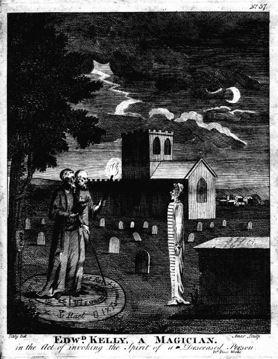
Last night I dreamed yet again. I felt myself drawn to a place where the mage stood, with another old man. They were huddled together, standing on a spot where strange devices had been scored upon the earth, as though the perimeter of the devices protected them from some evil or force beyond their control. I approached them as though through mist, or through the hall where I had first encountered the old man (though now it seemed plundered and ruined), all becoming clearer as I came close to them. At last I stood before them, a hand’s reach away, but outside their magic circle. The old man spoke to his companion.

“Strike with your staff upon the point of the heptogram, Master Kelley, and make it speak.”

At this, a look of annoyance passed the other’s face.

“I am known as Talbot now, and not by my old name. How many times do I have to say so before you remember!” He turned his eyes towards me, and drew himself up, rapping three times upon the ground with his stick.

“Speak, spirit,” he said. “Speak or be returned whence you came, and shut again in your arrow-chest. Speak, I command, in the name of an holy Power!”

“Whom do you command to speak?” I said. “I speak or do not speak at my own will, not yours. I say what is in my heart and mind, when it pleases me to open my lips. I am not bidden by anyone to speak or to stay silent, to come or to go.”

My old mage – I now thought of him as somehow mine – smiled a little, but the other became agitated, and struck again several times with his staff.

“I charge you to speak,” he barked. “Are you from Paradise or from eternal fire?”

“If you rap much harder on the ground,” said my mage. “You will find out first hand, as we shall fall through and into hell ourselves!”

“Paradise or flames?” I said. “A room in the Tower is not Paradise, though it is comfortable enough for a while; nor is it hell, for all its dreary solitude. Rather say it is purgatory, as it affords much opportunity for reflection and repentance!”

“Speak not in riddles!” cried the other. “But answer plainly, I charge you, by the angels!”

Patient now, my mage interjected, “Peace, Master Kelley; I know her, I know of her – she speaks what she thinks is true. She knows naught of heaven or hell, but lies where she lies, with her last memories, waiting for the graves to give forth their contents.”

“Master Dee, you may have traveled much, you may have been to Bohemia, and to Poland (where, I have heard, men have tails), but in these things you are ignorant. She is a spirit, and as such she has seen things you and I have not. And she is bound by the enchantment and invocation I have made, to tell us the truth. This fiddle-faddle she gives us is but her resisting my power, and it cannot last.”

“I know nothing of spirits,” I said. “Except that Saul was damned for causing one to be conjured up. I am none such. I am a queen, albeit one cast down. And Master Kelley or Talbot or whoever-you-may-be, you would be well advised to address me with more deference, and indeed to desist from your imagined conjuring.”

At this moment, my old mage turned eyes on me that held more pity and kindness than I had ever seen in him. There was such sorrow in his voice, when he spoke again.

“Master Talbot, it is clear to me that she is telling you the truth, though you cannot see it. Madam… Mistress… Your Majesty… “

His voice faltered, as though he had something difficult to say.

“Can you tell me where your favourite French headdress is at this moment?”

“Certainly, sir,” I replied. “I have it in my hand.”

“Madam, you have more than your headdress in your hand.”

At that moment, in my dream, I saw his meaning clearly –though I knew not with what eyes I saw that which I saw, for my own eyes looked up at me – and I screamed. My scream was choked by my awakening. Dreams are beyond fathoming, the pictures they paint are strange, their meaning is deep and often unholy…  and it is now today.

There is my gown, and my headdress; there also is my little book of psalms in French, undesecrated. I will wear my gown and my headdress today, and carry my psalms with me when I walk outside. I already have in mind what I will say:

Good Christian people, I am come hither to die, for according to the law, and by the law I am judged to die, and therefore I will speak nothing against it. I am come hither to accuse no man, nor to speak anything of that, whereof I am accused and condemned to die, but I pray God save the king and send him long to reign over you, for a gentler nor a more merciful prince was there never: and to me he was ever a good, a gentle and sovereign lord. And if any person will meddle of my cause, I require them to judge the best. And thus I take my leave of the world and of you all, and I heartily desire you all to pray for me. O Lord have mercy on me, to God I commend my soul.

But as I kneel, and before the swordsman scythes my head from my body, I shall think of my old magus. Then I shall breathe a short, Plantagenet prayer, and hope that my daughter, who has my eyes and my hair, will never be a queen, but will live her life a country lass, safe at home. For the burden of queenship is too heavy.

The Stag – a fable*

Deep in the heart of the realm of Angria there was a forest. In that forest lived a stag, perhaps the finest stag anyone had ever seen, his antlers spreading like the winter branches of an old beech tree, his flanks red as the ire of winter dawn. In a house just outside the forest there lived a hunter who had vowed to trap and kill the stag, to wear the antlers as his headdress and the russet hide as his cloak. But the stag was many years in age and full strength, wily, swift. He valued his freedom and would bound away while the hunter was still fitting a quarrel to his crossbow. Season upon season, year upon year, the hunter stalked the stag. Prey and predator knew every inch of the forest, every tree, every thicket, every faint sentier, every clearing, every pool, every shadow. At the beginning of one year the stag lifted his head to a new sound, the steady fall of an axe against a tree trunk. He thought little of it as such things are not the concern of deer, but nevertheless he moved through the forest to a place where the noise did not crowd as badly upon such things as did concern him. The sound continued throughout the year, but still the stag thought little of it. Then one day when he approached the edge of the forest he found that his kingdom was much smaller than he remembered, and his way out into the open fields beyond the forest was blocked. There was a high, wooden fence. The hunter had chopped down many trees to make it, and it was cammed in cruel, sharp points. The stag ran to the other side of the forest and found the way blocked there also. He ran along every path he knew and everywhere his was way barred by the fence. He plunged through thickets and briar patches through which he had never gone before, but the fence always thwarted and confounded him. Wherever he could get a run he tried to jump the fence but always, from outside, came the hunter’s mocking laugh or a warning bolt from the crossbow. At last the stag could endure this no more and risked everything on one last, desperate leap. The fence was higher than anything he had ever cleared before, but he gathered all his strength and courage, fixed his eye upon the blue sky above the cruel, sharpened points, and ran. He left the ground, he flew, he soared, wondering if this is what it felt like to be a bird. In mid-leap he could see the open farmland and the hills beyond. It was at that moment that the hunter, who had been waiting for him, loosed his quarrel. It went deep into the stag’s body, right to his heart, checked his leap, and brought him crashing down onto the sharp points. The stag’s eye was still fixed upon the sky and the far hills but now it saw nothing. When he saw what he had done, the hunter dropped his crossbow and his quiver and walked away. He was never seen again, and his house became a cold and empty ruin.
__________
* (c) from ‘Branwell’, a work-in-progress.

An excerpt from ‘The Chronicles of Anna Lund of Helsingfors, Vampire Hunter’

I can remember a cold evening, very cold, my toes numb in my boots, my fingers aching in my muff, so much so that I wanted to take them out and suck them to make them warm. I was huddled close to my father, his left arm was round my shoulder, and our feet crunched on the snow as the skirts of his coat flapped outwards at my thighs and legs. We were hurrying, and I felt that it was not so much because the winter snow was whipping at our faces, but because it was late. My father was in haste to get home, almost as though he was afraid. A few lights from windows and elsewhere threw patches of yellow glow on the snow, but though every flat surface was white and the wind was drifting it against walls, there were still shadows too dense for my half-shut eyes to see into, and pieces of black wall standing crazily upright like broken teeth or gravestones. Snowflakes clung to my eyelashes, and there was enough warmth in my face to melt some of them and make them run like tears. My legs propelled me almost to fast for me to stay upright, and had it not been for my father’s steadying arm, I believe I would have tripped over my numbed toes. My body and my breath were hot from effort, making my extremities feel even colder by contrast. If there was any sound apart from the crunch of our footfalls – which I seemed to feel rather than hear – it was lost in the wind that buffeted my ears. A winter night in Helsingfors can be cruel.

Then there was a moment when I came closest to falling; that was when my father suddenly stopped. Again I can’t be sure of sounds, but I think he gasped. He pulled me closer to him, pressing my face into his coat. It was rough and harsh against my skin, and I couldn’t breathe, so I slowly twisted my head so I could see out of the corner of my eye, between two of his long fingers as they barred across my face.

I thought I could make out that we were close to our home. If it had been bright daylight, I might have recognized the place where the street bent to the right, and to the left an alleyway led up narrow steps before making a right-angle and losing itself amongst the tenements and go-downs of the city. High on a wall a casement was flapping open in the wind, wrenching back against its own hinges. It was allowing a light to shine down upon the mouth of the alley and the steps. At the margin of the patch of light there seemed to be two vague shadows. One was like a crumpled shape on the ground, the other seemed to bend or loom over it; as the snowflakes dashed against my face, the two shadows seemed to merge into each other, separate, and merge again. Then suddenly, the lower shadow was alone, the looming shadow had disappeared; but instead there was a figure standing at the top of the steps, a man in dark clothes. The light from the casement shone directly onto his face – it was as though his face attracted it. To me it seemed as though his bright eyes were fixed upon me and only me, and he was looking at me, memorizing my half-hidden features. He was grinning, a nasty, fixed grin, and there was something about his teeth – I could not take my eyes away from his grin.

The wind blew my father’s coat across my face for a moment, and when it flapped back again the top of the steps was empty. The man had gone.

Once we reached our house, my father took me up to my bedroom and made me lie down for the night. I didn’t go to sleep immediately, and my father sat there beside my bed, his head bowed as though he was praying. When I did go to sleep – I seem to remember – my dreams took me back to the mouth of the alley. It was always deserted, not only free of snow but as though the steps had been swept by a broom. The casement was always tight shut and curtained. There always seemed to be the echo of running feet…

__________

‘Anna Lund’ is a casual, on-going project of mine. Something might come of it.