Marie Marshall

Author. Poet. Editor.

Tag: humour

Sunset

sunset-ocean

In the days of the old British Empire, two colonial types were sitting on a Verandah somewhere in Malaya, sipping their pink gins and watching the day end.

The sun which during the afternoon had been a harsh and dazzling glare of white had consolidated to a disc of tangerine low in the sky. It rode on the horizon clouds, and its slanted rays turned the little breakers on the strand first to vanilla, then to lemon, then to copper. It kissed the far lip of the sea, sending a fan of reflections back across the miles of water. As that disc dulled to red and began to curtsey below the world’s edge, the sky faded from aquamarine to navy blue. Venus, in her peace and beauty, graced the sky by appearing at a wink, and, as if she were a herald, a million-million other stars were suddenly scattered onto the evening like diamonds onto an indigo velvet cape. Soon only a ribbon of red remained at the horizon. The sea’s lapping at the sand hushed to a repetitive whisper, the breeze captured the sudden scent of moon-seeking flowers, and the liquid notes of a bird’s call floated in from the plantation. Then the remains of sunlight evaporated with the last cloud, and a crescent moon was suspended away to the side of this heady panorama.

“Not bad, eh?” said one ex-pat to the other.

“There’s no need to rave about it like a ruddy poet, old man,” came the reply.

cartocom

Bang goes my next career move, then.

Playing solitaire till dawn with a deck of fifty-one

queen

I used to play patience (solitaire) a lot, with real cards, back in the day when it wasn’t a standard feature of Windows. Back in the day when there were no PCs, for heaven’s sake – aye, when a jug of ale cost a ha’penny, and they used to hang you for stealing a loaf of bread, and the wheel was thought to be a thing of magic!

I used to notice that people had slightly different “rules” for how the game was played. When a stack became empty, I would wait for a king to come up and place that in the empty space. A friend of mine would fill the empty space with the exposed cards of the nearest stack. Either way had its advantages and disadvantages; one might wait a longer time to turn up a king, but a lower card had less scope for adding cards below it. Another friend of mine would deal cards hand-to-hand, so that the order of the three selected cards was reversed, I would just take three of the top of the deck so that the order stayed the same; yet another friend would take the last cards at the bottom of the deck, whether they were three, two, or one, whereas if I had two or one left I would place them at the top of the deck, so that the cards would rotate by threes. Again, each of these differences had its disadvantage and its advantage, by swings and roundabouts.

I was playing one day (in the common room at school), using my spare-cards-to-the-top-of-the-deck method, and a friend was watching me idly. Suddenly she said –

“You can’t do that. That’s cheating!”

I pointed out that it was one of the many variants of the game. She said –

“Yeah… but… well… you can’t do that. That’s cheating!”

Funny thing, people’s perceptions. I found this “You-can’t-do-that-that’s-cheating” attitude turned up time and time again. I’ll give you another example. I once had a red queen at the top of an exposed stack, there were no hidden cards underneath her, so if she moved there would have been an empty space left. On another stack there was a black king. To save time I picked up the black king and simply slipped him underneath the queen, so he was now at the top of the stack where the queen was. I lifted my hand to make the next move, when…

“You can’t do that. That’s cheating!”

“I beg your pardon?”

“What you just did. You can’t do that. That’s cheating!”

I explained to the observer that I had seen that the queen would have gone on the king, and that the king would then have gone into the empty space, so I had simply saved time by slipping the king where he was going to go anyway.

“Yeah… but… well… you can’t do that. That’s cheating!”

So I said. “Tell you what – how about I put the cards back as they were? Now I put the red queen onto the black king, like this, Okay? Now I put the black king in this space here. How about that?”

“Yeah, that’s okay. You can do that. But that other way that you did it – you can’t do that. That’s cheating!”

I am sure she is now a mother, or a high-ranking executive in a company.

All I know is that my current games are governed not by a friend looking over my shoulder, telling me what I can and can’t put where, but by an algorithm. I can still choose whether to move a card, or to wait for a more favourable one to turn up, so I still have some choice in the matter. And the algorithm will allow me to undo a move. I am still waiting for someone to look over my shoulder and say, “You can’t do that. That’s cheating!” – I’ll tell them to address their remarks to Microsoft.

It stops here!

President Harry S Truman looked around the Oval Office. His eye took in the rich, red drapes, the deep carpet in the same shade, the mahogany of the furniture. He glanced over each shoulder – right, left – to take in the Stars-and-Stripes and his own Presidential standard, and reflected that the room was still very much to the taste of Roosevelt his predecessor. How could it not be? FDR was such a dominating personality. He asked himself whether he had the courage (or the energy, or the time…) to redecorate.

Perhaps at this moment he doubted himself a little, but Truman was indeed a man of character. He looked down at his desk. Yes, here was the new Truman Presidency, ordered, workmanlike, symmetrical – that’s how he would be. A place for his pen, a place for his presidential blotter, a place for everything, yes everything was in order, so why was he frowning?

“Something is missing,” he thought.

His frown deepened when he caught sight of something he had been trying to avoid looking at. A tarpaulin had been laid on the carpet, and on that was the carcass of a freshly-killed white-tailed deer, a fine male with a single bullet hole. It was a gift from an eager, young White House aide who had heard that the President liked hunting. In that the aide had miscalculated – Truman shot grouse, not deer.

The President got up and walked round to the front of his desk. The carcass would not go away of its own accord, it had to be dealt with, a decision had to be made and it was the Commander-in-Chief who had to make it. No one else would make it for him.

“What the hell use would there be in a President who knew how to skin a damn deer?” he asked aloud. The walls of the Oval Office echoed his rhetorical question. He looked down at the white-tailed buck, then to the empty space on his desk. His frown melted. An idea formed in his mind and he made a decision. He lifted the Presidential phone and spoke to his secretary Matthew Connelly.

“Matt,” he said. “Get me the Presidential Butcher. And while you’re at it, get me the Presidential Carpenter and the Presidential Signwriter too…”

Shakespeare-shmakespeare

Two Noble Dudes

So I bust my ass with a script, and the man writes back “Don’t send me no more films where the guy writes with a feather!” So I figure – what the hell – I’ll do him a Western instead, ‘coz it’s been eighteen years since Unforgiven. I had this idea where two gunslingers get in a fist-fight over who’s gonna marry the big cheese rancher’s daughter, and the sheriff breaks up the fight, tells one to get outta town, and throws the other one’s ass in jail. Then he busts out and the other guy comes back, and they shoot it out, and one guy beats the other to the draw but falls off his horse, then they’re gonna lynch the first guy but the rancher’s daughter begs for his life… and… and… But anyhow, the studio sends me this co-writer (some bald limey with a beard), and he says like bring it up to date. So okay, I say, how about we do “Two Bloods in the Hood”, ghetto-style, y’know, urban stuff with gangsta rap, and he says “Blacksploitation’s so seventies, Fletch!” (only with this English accent) “We need the final duel to be a car chase… explosions… kung fu on the top of a burning building… and the girl needs to kick arse too.” (Yeah, he actually said “arse”!) And he goes on, “Willis and Schwarzenegger are too old, so get me the guy out of 24 and someone out of Stargate Atlantis.” But the studio calls and says they’re going with something by Dryden and Davenant, and I say to the limey, “Take it from me, it’s gonna be another piece of crap like Propsero’s Books.” I mean, gimme a break!

Love’s Labour Won, or Rosencrantz and the Stapler

 O thou, the very stuff of draftsmen’s dreams,
Whose sheaves by naughty Zephyr scatterëd
Abroad in autumn, are unruly reams,
Come hither to my bare and virgin bed.
What ghosts of lovers past come fluttering,
As I thy bends of wire do contemplate
By midnight candle, pale and guttering,
And, moth-like, beat their wings against my pate?
I love thee! Ah, thy handle firm and true
That nestles in my eager, cuppëd hand!
Thy spring, that all my force cannot subdue,
Which, when I bid ‘Contract!’ doth then expand!
Ah, Rosencrantz! Thy stapler is the sun,
Love’s labour now secured by staple-gun!

Bat, man, batman, batsman.

Crypto-anthropology is a word I thought I might have invented (like ‘polemophonic’ – pertinent to the sound of warfare, ‘polemophonics’ – the study of the sounds of warfare) but it seems not. A pity, considering my interest in the Moosh-Moosh. But then I didn’t invent ‘futilitarian’ or ‘eukelele’ either, although the latter is only a pre-existing, alternative spelling. Here is my butterfly mind flitting from flower to thoughtflower for the brief summer of its life, digressing from the off. Here’s what I mean to say:

Cities grow. Ours did. Track outwards from the centre and you will see where the margins were, how they advanced and were filled in, how they swallowed neighbouring villages and towns, how there are rural names for roads and faubourgs mixed in with the newer names that commemorate royalty, trees, Scottish islands. Between the city and me there is woodland and parkland, but in that woodland there is a golf course. Golf courses are things of the Scottish ‘edge’ as farmers diversify in hard times. Also there is a water tower for the nearest of the city’s housing schemes that lie on the other side of the wood. The parkland, once the estate of a conquering admiral, is now a pleasure park for the citizens, complete with zoo and funfair. Only on the edge could such things be.

Is my village itself still a village? Its dormitory status makes it almost a suburb, yet it has or had a number of edge-features – a caravan park, and at one time an indoor play-area for children with a ball-pool and such like. Oh flit, flitter, flutter, fritillary. Anyhow, here’s what I mean to say… no really…

Attached to our Millennium Hall are a bowling green and playing fields. There is fitba of course, but also a cricket pitch. Cricket is not unknown in Scotland, of course, and much further north in the land too, but it is nevertheless a curiosity to many, something you would have to turn your head to gawk at if you were passing on a bus. It isn’t entirely a haven for expatriate English and third-generation South Asian Scots either, but it is an edgy place where crypto-anthropology has recently taken a strange turn. I think so. I had to think so when someone told me that the cricket team had a member who was half-man and half-bat.

I remember thinking that they were making a play on the word ‘bat’, but no, they meant it literally. There is a man nominally on their playing strength who has the arms and wings of a bat. He goes by the name of Doug Millar. He can fly, though he hardly ever does, and only once has done so on the field of play. He was fielding at silly-point when a farmer’s son from Forfar let fly a square cut with his full strength. Doug dived out of the way to avoid harm – there was no way he could have stopped the ball, let alone caught it, without risk of injury – and in diving he spread his wings. He only flapped them once but that was enough to allow him to glide over the outfield towards the Third Man boundary where he banked sharply, caught a thermal, and soared. Thankfully the umpire was about to call a drinks break anyway and Doug wasn’t even off the field long enough to warrant substitution by Twelfth Man. He returned red-faced and apologetic for his lapse.

Doug is not of this world. He is a Thogrian, which many folk mistakenly write as ‘Thorgian’, a unique marooneer on our planet and a castadrift from the world of Goldilocks 4. The cricket club doesn’t shout about him, they’re cagey blokes. If he could handle the willow or the cork-and-leather a wee bit better, or if ever he flew from Fine Leg to take a catch at Gully, it might cause questions amongst the rules committee of the league in which our village team plays. But he’s a plodder with both ball and blade and an average though conscientious fielder, driven less by skill than by his love for the game.

I have always wanted to talk to him but have never succeeded. I heard that he was due to be at the last home game so I went there and hung about the pavilion, searching amongst the whited players on the field or waiting their innings on deck chairs. I couldn’t see him. Then someone told me he was in the scorers’ hut for that match and couldn’t be disturbed. And that’s when I caught sight of him, very briefly, walking back to the hut with a tray of teacups and a teapot, his wings folded across his back. For some reason he had affected a Mohawk haircut.

I am told that if he excels in any respect it is as a scorer. His entries in the score book are precise, instant, and accurate. He uses an ancient Parker fountain pen but never makes a blot, and indeed there is a little Gothic flourish every time he records a ‘W’ for wicket. I think that he’ll be in that hut whenever I make an appearance at the cricket pitch. I think I have missed my chance. The hut is sacrosanct.

You see… I want to tell him that I can fly too, even though I only have conventional arms. I can’t soar as he does, though I have tried it once or twice when leaping from the King’s Seat, beyond Abernyte. Each time I could feel the wind under my arms, but my descent was too rapid and I had to resort to flapping hard to maintain any height and to land safely. I want to share with him that sweet, intimate knowledge of the upper air and of seeing the land turn beneath me. I have to speak this truth to someone who will not say I have been dreaming.

Thirty years before, behind, and either side of the mast*

Ha! ‘Tis many a long year since I strode the deck of a tall ship. Well I remember how I bound my breasts and put on boys’ clothing, signed articles as a deck-hand on a cat-boat. I worked my way up by hard tack and little sleep, on luggers, cutters, coasters, trawlers, whalers, schooners, and square-riggers (in fact everything that showed a sail, apart from scows and dhows), till at last I became a deck-hand on the good ship Fancy out of Liverpool. Thirty years before the mast!

The Fancy? She was a floating purgatory, I can tell you. The captain was a bully, the mate was a bully, the bosun was a bully, and the ship’s salt-beef was a little too al dente for my taste too. But that bully captain – Dan Thirkell was his name – could drive her to make eleven knots, and that close-hauled! For all that the life on board her was hard, she was the trimmest tops’l schooner you could ever wish to see. Holystoned from keel to topmast she was.

Many’s the long voyage she saw, and many’s the time we beat around the Horn, Valparaiso-bound, half-seas-over. Aye, and many’s the good shipmate was washed overboard and never will be found until the sea shall give up its dead. Scurvy and yellowjack we endured, lateen-rigged pirate sloops we outsailed, monsoon and hurricano we withstood; sometimes Dan Thirkell would drive her until scarcely a piece of sailcloth remained aloft, while the mate and the bosun drove us fo’c’sle hands just as hard! (‘Twas thus on the very worst voyage; we saw St Elmo’s Fire on the topmast, mermaids off the port beam, and the mate shot an albatross. As all good sailors do know, ‘tis bad joss to bring golf clubs on board a ship!) But she was a fine sight with new canvas and new rigging, sailing goose-winged with a following trade wind.

But all things pass, shipmates. I mind the time that meself and me old mucker Bill Bracey from Boston (Lincs) were on the foredeck. We were a-skylarkin’, a-spinnin’ yarns, a-tellin’ tall tales, and a-spittin’ over the t’gallant rail the way that old salts do, when up comes Bigton Bill Buchan the bully bosun.

“Lay aft!” says he.

“Watch below, bosun,” says I. “Watch below until eight bells.”

“Damn ‘ee for a sea-lawyer!” says he, and starts a-lambastin’ me with his Malacca knout.

Later, in the fo’c’sle the ship’s cook (who was the nearest we had to a chirurgeon or a sawbones, being handy at jointing) tended to my wounds, stripping the shirt from my back and the breeks from my shanks to rub on tar-oil and goose-grease. Well that was the dismasting of me, because all of the hands could now see how I was rigged fore and aft!

“Why, Markie boy, you be a-sailin’ under false colours!” exclaimed Bristol Bob Bannerman, the sailmaker and ship’s carpenter. “For I see you be a judy!”

I was taken before the captain, and I expected the worst. To my surprise he was most civil when he saw what quarter the wind blew from. He cleared the mate out of his cabin and gave it over to me, gave me crinolines and petticoats to put on, even allowed me to wash. The rest of the voyage passed in pleasantness. I would stroll the deck, my parasol in my gloved hand, listening to the sea shanties and the orders from below to aloft borne on the wind, and they would seem exotic to me, sounds from another world. The crew would knuckle their foreheads as I passed and call me “Ma’am”; and the captain would stroll along half a pace behind me, hands clasped behind his broad back, head bowed, brows knitted, always as though about to speak of something.

Only later did it occur to me to wonder why he kept such an extensive female wardrobe aboard. I did notice that the dresses were a size or two large for me.

Y’know… even now, when the wind is set fair from the sou’ sou’ west, I have a longing to go to sea again. But this old peg leg of mine does warp so in the wet, and breaks my rolling gait.

Sorry – all this nautical reminiscing comes about by a circuitous route. An old Cheyenne woman knocked at the flap of my teepee this morning asking whether I still had the frying pan I borrowed from her village lo these many years. While Consuela (my Tejana maid) was rummaging in one of the yet-to-be-emptied tea-chests downstairs, she found my old pea-jacket and brought it to me.

Ah that old pea-jacket… still smelling of the salt wind and the spray… that old pea-jacket. I found something in the starboard pocket. It was a pea.

______________

* This story originally appeared in a series of humorous writings on an earlier blog

On the centenary of Brian O’Nolan

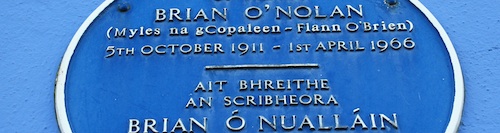
It is the centenary, give-or-take, of the birth of the Irish scriever Brian O’Nolan, famous nowadays for comic-fantastic novels such as ‘At Swim-Two-Birds’, ‘The Third Policeman’, and ‘An Béal Bocht’ (the latter written in his native Irish). He wrote under many names, the best known of which is Flann O’Brien, and for years under the cognomen of Myles na gCopaleen (Myles of the little horse) he wrote the humorous column ‘Cruiskeen Lawn’ in the Irish Times. What follows is a small selection of my tributes to him, originally published, shall we say, elsewhere; a small number of my contributions to the canon of adventures of those two pals – yer man Keats and yer man Chapman.

_______________

Keats and Chapman were once obliged to make a journey across the city by public transport. They boarded a bus and it set off. The vehicle was quite ancient and close to obsolescence, and its progress was erratic. This was made worse by the fact that it was a very windy day, and every time the bus passed a side-street or a gap in the buildings, it was struck by violent side-winds and caused to lurch terribly, as if about to capsize. Also the window-catches were defective, the windows would not close, and great draughts of air made it impossible for Chapman to continue to hold his copy of The Thunderer before himself to read. Chapman, being able to stand no more, paradoxically stood. He seized the conductor and began to make loud protestations about the fitness-for-purpose of the bus. The conductor took him on, arguing strongly that no one but Chapman was complaining. The exchanges between them became (in best cliché fashion) heated, and Chapman was within moments of being put off at the next stop. Keats, however, rose and put a placatory hand on the shoulder of each one of them.

“Gentlemen,” he said. “De gusty bus non disputandum est.”

_______________________

Keats and Chapman were at home, each at peace reading a newspaper. Chapman looked up from the cartoon page, and remarked on the genius of the American artist Charles M Schultz in the way that he made the little bird Woodstock talk to his pal Snoopy in a series of minuscule, vertical penstrokes.

“Talk is cheep,” observed Keats.

________________________

Keats was trying to listen to the Test Match on the radio one day, but was disturbed by Chapman, who was roaming from room to room in their shared apartment, overturning stuff, opening drawers, and cursing loudly. It became too much to bear when Chapman burst into the lounge where Keats was sitting and started to ransack the place. Keats sighed, switched off the radio, and asked Chapman what the divvil he thought he was playing at.

Chapman said, “I’ve been looking for my copy of Homer. It’s nowhere to be found. A mystery! In my opinion it’s been stolen!”

“I’ll look into it,” said Keats.

_______________________

Keats was a gracious man, and would never turn down an invitation to this meeting or that soiree or the other book-signing. Chapman wondered at his goodwill as much as at his stamina. One day Keats received a polite letter from a literary society based in a small town in the West of Ireland.

“I know these people well,” said Chapman to him. “I’ve given a talk there once, as have many of my friends – and yours I think.”

“I don’t know them,” said Keats. “What like are they?”

“They’re decent folk,” replied Chapman. “And they’ll be delighted to see you. But there’s one thing I ought to warn you about. There is one surname that is so common in that area that almost everyone bears it. They consider themselves to be a clan as much as a town. It seems that anyone who isn’t a Murphy there is an O’Murphy or as MacMurphy; even the local Punjabi shopkeeper named his eldest “Murphy” in their honour. What you have to watch out for is this: they have heard every possible joke about the name, every bon mot about potatoes, every quip about one chap called Murphy two hundred years ago who must have travelled round on a bike and, as Dryden put it, scattered his Maker’s image through the land. Say what you want, but just don’t mention that name!”

“I’ll mind that,” said Keats.

The pair travelled to the West of Ireland, to the little town, and were put up in the temperance hotel where the literary society were to hold the reception in his honour. Came the evening and they went down to the function suite where they were greeted with applause. Chapman, who was of course already known to them, introduced Keats as they circulated, and many a hand was shaken.

The formalities of the evening went ahead. Keats of course gave a reading of some of his own poetry, which was received with a reverent hush and a standing ovation at the end of it all. The rest of the evening was taken up by several items, which included:

“A tale or two of Finn MacCool” presented by the society’s shanachee Mr Eamon Murphy,

A solo upon the uilleann pipes by Mr James Murphy,

A recitation “On the visit to us of Mr John Keats” by the society’s Bard Mr Brian Murphy,

A song by Miss Kathleen Murphy, accompanied on the piano by her sister Miss Niamh Murphy,

A slide-show on the delights of Murphyville, Georgia USA, presented by Mr Hiram J Murphy III,

A blessing upon the gathering given by Father Liam Murphy,

A vote of thanks to Keats and to everyone involved proposed by the society’s Hon Sec Mr Brendan Murphy, and seconded by the society’s Hon Treas Mrs Deridre Murphy, and

A closing address given by the society’s Chairman Mr Arthur Wellesly Murphy.

That was not, however, the end of proceedings, as there was one final item on the agenda – the presentation to Keats of a cut-glass Waterford decanter, specially engraved to mark the occasion, paid for out of society funds. This was handed to Keats, with the thanks of all present, by the society’s President-for-Life Mr Aloysius Murphy.

Keats appeared overwhelmed, lost for words, and responded in his poor French.

“Murphy beaucoup!”

Chapman tore at his beard.