Agent Delta lifted the crime scene tapes and stepped into the cordoned-off area, turning up the collar of his dark grey suit to an insistent, cold wind. Somehow the large, sliding doors of the disused warehouse were funneling it, as though it had been whistled up for the occasion. Something was rattling or slapping arrythmically, irritatingly, against an iron rail. Odd pieces of litter were bouncing and tumbling through the space, looking for a way out at the other side; most trapped themselves against the far wall and fluttered, reminding Delta of the death-twitches of a Great Hawkmoon Moth.
Death. That’s why the tall, gaunt, lank-haired man with the grey suit and black turtle-neck was there. “There’s been a death,” they had told him. “The ‘locals’ don’t know what to make of it. Go and sort it out.” And indeed, in the middle of the empty, wind-bothered space there was a corpse. Crouching by it was a figure in a disposable, white oversuit. Standing a few feet away was a second figure; as Delta walked towards them the second figure turned and strode quickly to intercept him. Delta looked him up and down – the beige mac flying open in the draught looked expensive, as did the tailored suit, darker than Delta’s own, and the brogue shoes. “Too well-off for a policeman,” Delta thought, and then he spotted the distinctive cufflinks of the Holy Tabernacle of Continuing Pentecost. That bunch set great store by appearance.
“And you are?”
The man’s fragment of a sentence was curt to the point of incivility, but Delta was used to this kind of thing on the rare occasions that he turned up at crime scenes like this. His coming was seldom announced, and this one probably hadn’t been. He reached into the inside pocket of his jacket, pulled out a slim wallet, and flipped it open. The man made a show of stopping beyond arm’s reach and craning his neck to look. There was a badge on one side and Agent Delta’s photo ID on the other. The words Chthonic Intelligence Agency were in bold red type below the photo.
The man’s attitude didn’t exactly change. Delta couldn’t shake off the feeling that his presence was resented, as the man’s eyes flicked up from the credentials to Delta’s face and back again.
“I’m Detective Inspector Ellis. Come this way, Agent Delta.” The policeman walked off towards the corpse and the figure in the white oversuit. He stepped quickly to draw ahead of Delta, as though maintaining his authority over the scene.
“I don’t often get to meet people from your Agency,” he said, over his shoulder, and then to the figure in white: “Doctor Phillip, this is Agent Delta from the Chthonic Intelligence Agency. Doctor Phillip is a Home Office pathologist, Agent Delta.”
Doctor Phillip stood up, pulling back the hood of the oversuit to reveal hair as blonde as Delta’s own but tousled. She was almost as tall as the agent, certainly as slender, and her gaze was direct. In that gaze Delta read more than resentment at his presence, he read something that was almost a direct challenge to his very existence. “She’s a scientist and therefore a rationalist,” he thought. “Maybe even a Dawkinist. Many scientists are. She’s already resentful that the policeman she’s working with is religious. I’m the last straw – a wizard.”
“Unfortunate set of initials your outfit has,” she said. No other greeting. “Could lead to a certain amount of confusion.”
“I hadn’t heard that initials were copyrighted,” said Delta. “What do you think we have here?”
“The body of a man in his mid-thirties. Appears to have been dead for about four hours.”
“His clothes are wet,” D I Ellis put in, “and there seems to be water on the ground beneath him.”
Agent Delta looked up. At this point the roof seemed intact and sound. It was unlikely that rain could have got in from above, and if it had blown from somewhere else there would have been other patches of wetness. He looked at the pathologist, and for a moment imagined them in bed together, imagined that resentment and challenge directed into something else, and he felt the corners of his mouth turn upwards into half a smile. Then he remembered his wife, alone in the old manor house that had been in his family for generations, her mind alienated by – what? – a lifetime in magic, his neglect, their son’s sullen rebellion, a dozen things. He remembered the narrowness of the bed in his London flat, where he stayed seven days or more out of every ten. He remembered the handful of meaningless sexual encounters that had fizzled out almost as soon as they had begun. The half a smile ceased to be.
“What else do we have?” he asked the pathologist.
“Nothing to smile about,” she replied. He wouldn’t bother to put her straight about what had made him smile. “There is no immediately visible cause of death. There is a strange contortion to the limbs and to the facial muscles. A small amount of froth at the mouth and nose might suggest drowning. I say ‘might’. If so then he didn’t die here. There’s something anomalous – what appear to be five or six slits on the side of his neck. And there’s this…”
She crouched down again and pointed to the dead man’s left wrist. His left arm was crooked up awkwardly, the fingers of his left hand were clawed. Something was protruding from the sleeve of his jacket. Doctor Phillip must have taken it for a stick from wherever the dead man might have drowned, because she was reaching to take hold of it and pull it out.
“No!” Delta said sharply. He recognized the butt of a wand when he saw it. he had one similar up the left sleeve of his own jacket. What they had here was a dead wizard. That’s why someone had called him in. He bent over and looked at the ‘slits’ in the corpse’s neck. They looked like small shark gills, a sure sign that the dead wizard had enchanted himself to survive under water for a time. So how would he have drowned? Where was the nearest water? The Birmingham canal system? Hardly. Delta took out his thaumatometer. To the pathologist and the policeman it would have looked like a mobile phone, but the ‘camera lens’ was the knot-hole of an alive oak from Arkham Forest, and what looked like a winking, red LED was a scale from a Sri Lankan salamander. He passed the meter over the corpse. The winking light did not change colour – a totally negative reaction. Despite the gills and the wand, everything about the corpse, everything on or near it, had been totally drained of magic, and that was dangerous. The whole place was thaumaturgically unstable, the equivalent of a magical black hole.
“Step away, Doctor Phillip,” said Delta. “In fact I’d like you and Detective Inspector Ellis to leave the scene right now.”
“What? No! Are you serious? I’m here as Home Office pathologist. I don’t leave, and I’m officially taking charge of the corpse for a post mortem examination…”
“No, you’re not,” Delta interrupted. “In fact you are leaving. I can have you removed if necessary. This area is now off-limits to the police, the Home Office, and in fact to anyone outside the Chthonic Intelligence Agency. I do have the authority to do this, Doctor. Please do not oblige me to exercise it to its full extent.”
Doctor Phillip was furious but speechless as the Detective Inspector led her away. Delta looked down at the corpse. Sure this was a mystery, but his mind strayed back to the piece of paper in his pocket. It was a talking note from the Head of the Agency. He already knew it was a summons, he just didn’t know why…
__________
*Agent Delta© and the Chthonic Intelligence Agency© are part of a world I have thrown together in a handful of experimental writings, maybe towards a novel, maybe towards a few short stories, maybe towards nothing at all. I’m introducing Agent Delta to you in the fragment above for one reason only – not because I intend the mystery of a drowned wizard with shark gills, miles away from water, to go anywhere, but because this is a neat way of illustrating the process of how I write.
Most stories appear to be linear. In fact they are not. Writers start with the resolution in mind – in effect they begin with the end – and it is the resolution, not the linear steps, that drives the story. In the 20c a handful of great modernists like James Joyce and Virginia Woolf challenged this process. However it persists. Whilst most of the fiction I write has a resolution of some sort, that’s not the way I approach writing. I like to start with an idea, a character, an episode, a piece of dialogue, a feeling, a style of writing, or with something evocative of place and/or time, and simply throw words at it. From that process a plot line with something resembling a resolution may suggest itself and the work move towards completion. That’s how I wrote Lupa and The Everywhen Angels. Or the process might not lead to a completed work at all, and I may be left with notes, fragments, and so on. This started unintentionally, but it is now simply and deliberately how I work. What I would say about that unfinished residue is this: when we unearth a preliminary sketch by Picasso or Leonardo da Vinci we regard it as a work of art in its own right, but we do not accord the same respect to sketches by composers, authors, poets, or creators in other artistic fields. I’m not the Leonardo of fiction writing, I’ll grant you, but on behalf of my fellow writers I would like to claim that artistic ground for our unfinished works. If you like, I’m forming the ‘Edwin Drood Society’.
Over the next few posts I might introduce you to a few more characters or scenes from my sketchbook.
I met the real ‘Agent Delta’, by the way, when I taught for one term at his school, and again when studying as a ‘mature student’ for my ThauM in ‘the History of Magic’ at the Miskatonic Institute of Sorcery and Thaumaturgy. My presence at both places of learning was controversial at the time, as I was the first non-magical person at either. The young ‘Delta’ was an arrogant and unpromising pupil, but I saw something in him that was only realised in maturity. When we met again at Miskatonic the arrogance had mellowed. We have been in touch ever since, and he has kept me informed about his adventures in the Agency. At least, as far as he is allowed to tell…




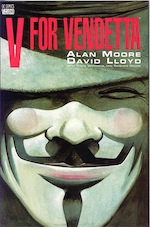 I own only one graphic novel, Alan Moore’s V For Vendetta. Of course I do – why wouldn’t I own a book in which an anarchist superhero goes mano a mano with a fascist government in Britain? I notice that Alan Moore distanced himself from the film version, exciting though that was (and it starred the wonderful Hugo Weaving!), saying that it had been ‘turned into a Bush-era parable by people too timid to set a political satire in their own country’. Having read the script, he said,
 Kick Ass is fun. It came in for a lot of abuse on account of the bad language, less for the violence – with the exception of one teenager, no bad guy is left alive by the end of the film. Its killing-spree violence is in the tradition of Peckinpah and Tarantino, subverting the bloodless wrong-righting of The Lone Ranger and Batman. I think people missed the point that it is highly satirical of the superhero genre, and simply spares no effort to de-bunk its ‘zap’ and ‘pow’ fisticuffs. It is, as the cover of the comic book says ‘Sickening violence, just the way you like it’, signaling that it does not take itself seriously and shouldn’t be taken too seriously by readers and movie-goers. The satire of the film is taken further by the character Big Daddy (Nicolas Cage) adopting the phrasing of
  Having fallen almost by accident into writing for young adults, I find myself skirting superhero territory. The teenagers in my novel The Everywhen Angels have powers that they don’t quite understand, and the protagonist in my recently-completed teen-vampire novella, From My Cold, Undead Hand, is a girl who has been trained to hunt and destroy vampires. Consciously or unconsciously, however, I seem to have made these characters break a mould, or break out of a strait-jacket. Unlike traditional heroes, they don’t necessarily win, they don’t necessarily triumph over a force bigger than they are, their tales do not have a clear resolution where all is explained in a neat and tidy way. Good does not necessarily triumph over evil, and where it does it may well be by accident rather than design. Why?





 Marie Marshall