Marie Marshall

Author. Poet. Editor.

Tag: prose

Playing solitaire till dawn with a deck of fifty-one

queen

I used to play patience (solitaire) a lot, with real cards, back in the day when it wasn’t a standard feature of Windows. Back in the day when there were no PCs, for heaven’s sake – aye, when a jug of ale cost a ha’penny, and they used to hang you for stealing a loaf of bread, and the wheel was thought to be a thing of magic!

I used to notice that people had slightly different “rules” for how the game was played. When a stack became empty, I would wait for a king to come up and place that in the empty space. A friend of mine would fill the empty space with the exposed cards of the nearest stack. Either way had its advantages and disadvantages; one might wait a longer time to turn up a king, but a lower card had less scope for adding cards below it. Another friend of mine would deal cards hand-to-hand, so that the order of the three selected cards was reversed, I would just take three of the top of the deck so that the order stayed the same; yet another friend would take the last cards at the bottom of the deck, whether they were three, two, or one, whereas if I had two or one left I would place them at the top of the deck, so that the cards would rotate by threes. Again, each of these differences had its disadvantage and its advantage, by swings and roundabouts.

I was playing one day (in the common room at school), using my spare-cards-to-the-top-of-the-deck method, and a friend was watching me idly. Suddenly she said –

“You can’t do that. That’s cheating!”

I pointed out that it was one of the many variants of the game. She said –

“Yeah… but… well… you can’t do that. That’s cheating!”

Funny thing, people’s perceptions. I found this “You-can’t-do-that-that’s-cheating” attitude turned up time and time again. I’ll give you another example. I once had a red queen at the top of an exposed stack, there were no hidden cards underneath her, so if she moved there would have been an empty space left. On another stack there was a black king. To save time I picked up the black king and simply slipped him underneath the queen, so he was now at the top of the stack where the queen was. I lifted my hand to make the next move, when…

“You can’t do that. That’s cheating!”

“I beg your pardon?”

“What you just did. You can’t do that. That’s cheating!”

I explained to the observer that I had seen that the queen would have gone on the king, and that the king would then have gone into the empty space, so I had simply saved time by slipping the king where he was going to go anyway.

“Yeah… but… well… you can’t do that. That’s cheating!”

So I said. “Tell you what – how about I put the cards back as they were? Now I put the red queen onto the black king, like this, Okay? Now I put the black king in this space here. How about that?”

“Yeah, that’s okay. You can do that. But that other way that you did it – you can’t do that. That’s cheating!”

I am sure she is now a mother, or a high-ranking executive in a company.

All I know is that my current games are governed not by a friend looking over my shoulder, telling me what I can and can’t put where, but by an algorithm. I can still choose whether to move a card, or to wait for a more favourable one to turn up, so I still have some choice in the matter. And the algorithm will allow me to undo a move. I am still waiting for someone to look over my shoulder and say, “You can’t do that. That’s cheating!” – I’ll tell them to address their remarks to Microsoft.

‘Panthera tigris altaica’

Tigris

‘Panthera tigris altaica’ is the title of a poem I wrote in 2008. It has recently been published in Rubies in the Darkness, the poetry magazine of the Red Lantern Retreat. Rubies in the Darkness describes itself as the ‘… prime specialist poetry journal of Spiritual Romanticism Worldwide’, and is one of these wonderful shoestring, small-press products that punches above its weight. It was a surprise arrival by post today.

At the same time I also received a signed copy of Peter Butler’s collection of haibun entitled A Piece of Shrapnel. Many thanks, Peter.

M.

Lewis Grassic Gibbon’s ‘Sunset Song’ – a neglected classic.

I was recently loaned a copy of Sunset Song to read. The novel is the first part of a trilogy, collectively known as A Scots Quair, written by Lewis Grassic Gibbon. That is a pen-name, by the way, used by James Leslie Mitchell, an author who grew up in what was then Kincardineshire or ‘The Mearns’ in rural North-east Scotland, purely for this trilogy – he used his given name for his other work, his pen-name being a version of his mother’s maiden name. I was loaned it because (said the loaner) I would enjoy its literary qualities, its blending of Scots and English, and the anarcho-communist politics of its author, although the book does not wear those politics prominently on its sleeve.*

After I had read the book I applied the words above – ‘a neglected classic’ – to it. Not because it is neglected generally but because I had neglected it. in Scotland it is revered, it has been voted Scotland’s favourite novel and is in print at a host of publishing houses, as you can see from the handful of covers pictured here. Inasmuch as it documents vividly, truthfully, yet not without sentiment, the passing of the peasant class in rural Scotland, it is almost a work of social history as well as a novel. As we come closer to the centenary of the Great War of 1914-18, the event which, more than any, destroyed that class, the novel deserves reappraisal.

It is not necessarily an easy novel to get into. The register in which it is written is peculiar. A modern reviewer recently castigated it as being ‘badly written’ because of its overuse of conjunctions ‘and’ and ‘but’, its long sentences, and its peculiar syntax, dismissing the novel out-of-hand as boring and dull. Suffice it to say it’s neither boring nor dull, but its prologue is surprising. Before a reader is more than two or three sentences into it, he or she may become aware that this apparent mish-mash of folk-tale and history has the register of the Scots equivalent of a griot, the West African storyteller and reciter of genealogies. Where the ramble through the history of the Mearns community comes up-to-date, the register becomes gossipy, as though the doings of the inhabitants are being discussed over the garden fence. This was a departure from the expectations of novel-writing and narrations, and such departures were typical of the modernist period of literature**.

The four main chapters are given titles corresponding to stages in the agricultural cycle – ploughing, harvesting, and so on. Although the story is narrated, the central consciousness is that of Chris Guthrie, whom we see grow from childhood to young-widowhood. There are departures from her thoughts into the thoughts of others, often by Gibbon’s use of the confidential ‘you’ which places the narrator in the Mearns community and draws the reader into it also, but always and at the beginning and end of the chapters, it is Chris’s eyes we see through. Chris is a strong character, an intelligent young woman who could have broken out of her environment on account of her aptitude at school, but who chooses not to do so. Her staying gives an opportunity for the book’s point of view to be one of clear vision. Her insistence on being known as ‘Chris’, never ‘Chrissie’, gives her a toehold of independence in a society in which women are sexually and domestically subservient.

This is no rose-tinted novel. Life in the Mearns is shown to be harsh and hard. Sex is seen as a sociological driver. People are shown with brutal honesty as being mean-spirited and unwilling to speak well of anyone if they have a breath left to speak ill. The reader can sense that this is not a part of their character that Gibbon admires, but he is prepared to address it head-on, to describe all the small-mindedness and spite of the village gossips, all the brutality of the men without holding back. The prominence of Chris’s viewpoint, however, gives the novel an empathic gynocentricity which had critics at the time wondering about the gender of the author. However, Gibbon admires the way that, when the occasion demands it, these folk form and function as a community without giving it a moment’s thought.

There is another object of admiration. Chris’s father, John Guthrie, is portrayed as Calvinistic, tyrranical, brutal, and a prisoner of his sexual needs. Yet when he dies and is being buried, and the reader is heaving a sigh of relief, this moving passage occurs:

Someone chaved at her hand then, it was the gravedigger, he was gentle and strangely kind, and she looked down and couldn’t see, for now she was crying, she hadn’t thought she would ever cry for her father, but she hadn’t known, she hadn’t known this thing that was happening to him! She found herself praying then, blind with tears in the rain, lowering the cord with the hand of the gravedigger over hers, the coffin dirling below the spears of the rain. Father, father, I didn’t know, Oh Father, I didn’t KNOW. She hadn’t known, she’d been dazed and daft with her planning, her days could never be aught without father; and she minded then, wildly, in a long, broken flash of remembrance, all of the fine things of him and his justice, and the fight unwearying he’d fought with the land and its masters to have them all clad and fed and respectable, he’d never rested working and chaving for them, only God had beaten him in the end. And she minded the long roads he’d tramped to the kirk with her when she was young, how he’d smiled at her and called her his lass in days before the world’s fight and the fight of his own flesh grew over-bitter, and poisoned his love to hate…

I should point out that direct speech is rare in the novel, and where it occurs it is shown by italics. Here indeed we have those long sentences, rushing on, broken by conjunctions, but in this case it adds to the incoherence of the sudden realization of grief as suppressed memories of her father’s honesty and tirelessness, and even of a forgotten moment of affection between them, burst upon her. The gravedigger, his hand over hers, serves as a reminder of the good in her father – he is a silent almost-surrogate for her father in this scene. Chris’s anguished cry is almost a liturgical response to Christ’s petition for forgiveness on the cross. It is indeed the crux of the novel, and Gibbon’s bringing us to realise that not a monster but merely a man is being buried. The passage borders on sentimentality, but it is not maudlin. It is not the man John Guthrie that Gibbon admires, it is the qualities which are picked out in him in this and other passages. Here he stands for all the men of the Mearns – he works tirelessly, is rigorously honest, is rigorously egalitarian.

The passage is also interesting for its use of Scots words and hints of Scots grammar. This is typical of the book as a whole, and is evidence of Gibbon’s deliberate linguistic enterprise. His intent was to write in a way accessible to readers whose first language was English, but to enrich that English not only with the cadences of Scots but with a certain amount of Scots lexicon too. He did this with deliberation, out of the love of both languages and in the knowledge that one was effectively dying while the other was developing and strengthening. It isn’t an easy marriage. Scots is exclusively a demotic language, and the Scots of the Mearns is a dialect of it; Scots never had an official status even within the borders of its own land, was never the second language even of the Gaelic-speaking Westerners. This makes it difficult (not impossible) to use outside its historical and geographical context. However, Gibbon does make successful use of a selection of Scots words, the meaning of which is, to varying degrees, decipherable from the context. Gibbon did not want to include a glossary with his novels, but some editions do have one, which is of assistance. Less comfortable and to my mind a flaw in Gibbon’s execution of his scheme is his adaptation of some words into a faux-English equivalent. These stick out like a sore thumb for their etymological ineptness. I cite the following. ‘Brave’ for the Scots ‘braw’, the former being of Latinate origin and the latter Nordic, both having divergent meanings***. ‘Childe’ for ‘chiel’ meaning a fellow. ‘Quean’ for ‘quine’ meaning a young woman. ‘Blither’ for ‘blether’ meaning to speak or to converse, the former being an English word with connotations of delirious raving. Heaven alone knows why he made those particular lexical choices.

Despite this, the novel remains the preeminent evocation of the passing of the crofting way of life in the rural North-East. The final scene – the dedication of a war memorial at an old stone circle – records the names of the young men who would not be coming back to farm their smallholdings, and laments that their place has been taken by business-oriented farmers with an eye on profit at the expense of community.

I am currently reading through the sequels, Cloud Howe set in a large village or small burgh, and Grey Granite set in an industrial, coastal town. They are good books in their own right, but perhaps not as satisfying as Sunset Song. There is a sense of unfinishedness about them. Gibbon died at the early age of thirty-three. He did not live to see the Spanish Civil War, the Second World War, the establishment of the post-war Labour government with its National Health Service and other socialist projects, the fall of Stalin, the Iron Curtain, and the Cold War. Sunset Song has a resolution and closure that the other novels of the trilogy seem to lack, because it marks the passing of an old world; the others do not mark the beginning of a new. Nevertheless the trilogy is a landmark of the twentieth-century ‘Scottish Renaissance’, and Sunset Song itself a minor masterpiece. I would recommend it for anyone interested in Scotland, or in the history and literature of this country.

__________

* I am grateful to my agent – he is studying for a university degree in English Literature, and I get the backwash of his learning!

** It has to be said of modernism that it is not a unified nor easily defined movement, and that the writings of, say, James Joyce, Katherine Mansfield, Gibbon, and Virginia Woolf, to give a mere handful of examples, differ from each other greatly. One could more easily speak of ‘modernisms’ rather than ‘modernism’.

*** Here in Dundee we pronounce it ‘brah’, which is pure Swedish!

Visiting Angélique

Relaxing, letting the novel take care of itself for a few days…

You might take some time to visit (as I did) the web site of writer Angélique Jamail, if for no other reason that to have your breath taken away by a smile and a frank stare as captured by the lens of Lauren Volness. I love black-and-white photography, I love its textures, I love its air of verité, and I love the way it makes me digress from the matter in hand.

I also love web sites that are clean but at the same time fill and delight the eye. There is something about dark red papyrus font on faded yellow, there is something about the empty, brown sidebars, there is something about the fussy, intrusive design of leaves that says ‘some is plenty’. The internal detail is personal and informal, yet to the point. It can sometimes be intriguing – “What’s the tab which says ‘RRFP’?” I asked myself. Apparently it has something to do with black and white, and a single accent of red, and if you want to know more, then visit. You will want to hear her poetry…

Gypsies, ‘… a loosely plot-driven collection of poems about jumping off from traditional toeholds and clinging to the air around you until you find a new niche.’

Barefoot on Marble, ‘orphan poetry, mermaid lit., and the poet’s impressions as more eras end.  These are lizards and prophets crawling up your house; these are lovers better left unmet; these are moments of great undoing; these are phoenixes, too.’

… and you will ache because none of it is there. But hurry, there is still time to buy a book!

There is a link to her blog, ‘Sappho’s Torque’, which is a different kettle of tuna altogether. It’s a blog, an honest-to-God blog, an it-does-exactly-what-it-says-on-the-tin blog, and that’s why I like it so much.

Have you ever come across poetry that you wish you had written, simply because it sits a camera on the sideboard of life, runs to the other side of the room, stands there, and grins? Have you ever come across poetry which, far from making you wish you had written it, makes you vividly almost painfully aware that you could not ever have had the precise experience of life to have written it? The following poem is one of the latter.

Recipe for My Daughter
Copyright © 2011 by Angélique Jamail

When the pita dough does not rise, throw it away,
remembering that yeast and flour are cheap,
and start over again on a day without rain.

When you become seven years old, you will be given
a new pair of tiny scissors, with which you will snip
the leaves from ten bunches of parsley, taking care

to keep the stems from the great silver bowl,
while your mother chops the tomatoes and onions.
When you manage this despite the nauseating

abundance of parsley, you will be allowed
to mix in the bourghoul. When you hollow out
the yellow squash, measure the tender rind so

your fingernail does not puncture the tiny gourd.
When you roll the grapeleaves, count twenty
per guest, and remember a pinky’s length of lamb
and rice is plenty. When you boil them

in the enormous pot, lay a dinner plate
on top so that the roiling does not unroll
your tightly wound creations.

When you learn to make bat’lawa, be careful
to paint the melted butter across every thin sheet
of filo separately. When you grind the pistachios,

try not to scrape your knuckles on the glass
each time you crank the lever around.

When the bread finally rises, you will sit upon
a wooden chair in front of the lower oven and announce
its brief inflation as if every puffed-up loaf were
the messiah. When it comes out of the upper oven,

flat again with a pocket, spread butter and grape jelly
on it and eat it so hot. When you are an adult,
you will remember this smell as joy.

When you have become good enough,
you will not have to measure anything ever again.

When you grind the lamb for kibbe, reserve some
to sautée with pine nuts for the hashwe, and run the rest
through the grinder twice more with onions and
bourghoul. When you have a craving for kibbe niya,

make it yourself and eat it the same day home from
the butcher, and bless the dish before you pour the olive oil,
because raw meat is not a thing to trust to just anyone.

When your son brings home an American girlfriend, admonish
his brothers for slopping it out in galoptious mounds
at her first dinner with the family.

When your daughter-in-law first opens her home to you,
bring her a great silver bowl, a new embroidered cloth,
a carton of sea salt, and a bulbous

witch doll to hang over her sink. When you take
the lemony, warm spinach pies to school for lunch,
you will not have to share them with the other children,

and one day you will appreciate having had them all to yourself.

A reader’s reaction to ‘Lupa’

Lupa is the story of two fearless fighters, two She-Wolves, perhaps the avatars of the same wandering spirit, whose destinies become aligned through the mirror of time and dream. The set of the two plots, none other than the Eternal City, casts its many shadows and symbols on both stories.

I came upon this book quite by accident, while perusing the poetry section of a blogging site. The author’s compelling poetry made me very curious about what her blog announced as her first novel and, indeed, I was not disappointed.

Marie Marshall’s sharp writing has a wolfish brutality to it that masterfully shape-shifts to raw emotion in Lupa‘s fighting scenes.

Unlike Hesse’s Harry Haller, the main characters not only accept but seek out the totemic wolf within.”

Dee and Boleyn

I have sought solace in reading psalms and in prayer, but nothing avails, except perhaps my dreams; and so I seek sleep, and hasten each day with pacing to and fro, as though I could not wait for the end. My mother called such behaviour wishing my life away, but would not laugh if she could see me here.

Each night I hurry to my bed, earlier and earlier, eager to enter a world of shadows and strange colours, and to find the answers to questions which perplex me, and any other whom I may ask, during the dubious hours of waking. Yet some nights are vague, and I may startle awake with a cock-crow or a bursting-in of sunlight, to remember nothing. Or again, I may lie upon my back all night, sleepless, and with my fists balled; the days that follow are drowsy and tedious, but the little sleeps between the visits of those who attend me are sans dreaming. I could read; I have many of my beloved books around me, but am without inclination these days, except for the psalms, with their illuminations – the blood of the whiplash fish, weathered green copper, gold-leaf. My constant prayer has been let me read the book of my dreams.

I recall the third night I was ever in this room. It seemed as though I was snatched from making out the shadows on the ceiling into another world. I was a child again, in a gown of green velvet, the hue of the under-side of leaves in high summer, and a gable-hood of the same. I was upon the London River, in a barge that slipped silently against the stream with the aid of neither sail nor oars; I was attended by silent servants in tabards that matched my gown. I enquired where we were bound for, and none would lift his head, save one who eyed me and looked away, and spoke in French.

Au Lac de la Mort, Maitresse.”

To the Lake of Death – and this puzzled me, for I knew of no such place on the Thames, but only of a hamlet that had grown around a stream filled with silver salmon, for that was the place where the barge glided to the shore, and where I stepped out onto the bank. And it seemed that at the moment my toes touched the land, I was in a great hall. Everything was tall – the people in it, the tables and the chairs, for I was an infant in this dream, to whom the walls of a chamber are as great as an oak or the flank of a galleon. And this hall was filled with books, shelved against every wall. Not one window was there here, but light was given by candles, some upon tables, some on the floor, some even upon a pile of books. Between the furred skirts of the gowns of the men who gathered in the hall, I could see only a little of the tables around which they clustered. From some, charts and scrolls spilled; upon others I saw browned skulls and thighbones, bottles of dark liquids, a still but evil-faced raven which winked at me, and other objects nameless and beyond description. As I walked by them, some of the men turned their heads to look at me, and I felt my face burn in their gaze; others conversed with each other in whispers and mutters, and two or three stretched their hands over some object and intoned in a language I did not recognise. One I saw exchange gold coins for a leather pouch that seemed to move, as though it contained a frog or a mouse.

At the far end of the room, upon a sort of dais, an old man sat, as though enthroned, and it was towards him that I walked. If I looked away for a moment he seemed, from the corner of my eye, to be a boy of twelve or thirteen; but always when I looked directly at him he was venerable, white-bearded.

There was an impatience in his face, as he leant forward and beckoned me, as though he had news of great import, or some secret to tell me. But in the moment that he drew breath to speak I awoke, and was here in my prison again.

“Where is a Joseph or a Daniel who will riddle me this?” I thought.

That was the first time I met the old mage in my dreams, for indeed he seemed to be a philosopher or magician of some sort; but since that night I have met him often, walked with him through the strangely silent streets of London or the garden of Hampton Court, where we stopped to look at the great clock. I swear I saw the hands whisk through the hours and the moon-phases faster than the wheels of Phaeton’s chariot. Sometimes in my dreams he was struck dumb, sometimes I; at other times he spoke to me only in a language I could not understand, and grew angry because I did not answer. At other times we conversed.

“Do you know me, Lady?” he asked once.

“Certainly,” I replied. “You are the old magus whom I meet here in my dreams.”

“But do you know my name, Madam?”

“No, I do not.”

“I shall write it for you,” he said, and stooped to trace it in the dust with his finger. At this I shuddered, for it seemed blasphemous to imitate a gesture of the Saviour thus – hoc autem dicebant tenantes eum, ut possent accusare eum, Iesus autem inclinans se deorsum, digito scribat in terra. Even more so did what the old man wrote upon the ground, for it was more a picture or a sign than a name. A circle, which could have been his face or the sun’s, with a single eye in the centre; crescent horns surmounted the face, and could have been the moon; from a stick-like body, two arms protruded, in mockery of our Lord upon the cross; the whole figure squatted upon the ground, it’s knees drawn up, and its legs bowed.

“This is all-in-all,” he said to me, and seemed to be pleased with what he said, and to ignore my look of horror.

Three nights ago I looked for him once more, but in my dream I stepped into my husband’s closet, seeking my book of psalms. My lord was there, and I spoke to him, simply saying his name once.

“Henry?”

I reached out my hand, but did not dare touch him. He seemed to hear me, and inclined his head, with a look of sudden irritation on his face. He said nothing, but continued what he had been doing when I entered – picking up books and leafing hastily through them as though searching for something.

Upon his table I saw my own book of psalms, and picked it up. But it was false – the cover of my book held pages of crabbed writing, little of which I could make out, except for the names of sundry angels. Then I came upon a page which had the symbol drawn by the mage in the dust, and I knew that this book was his. I put it down quickly, and my hand moved to another book, mutilated and coverless. That was mine, my poor little book of psalms in French, which I now opened to read, for solace. Quand je marche dans la vallée de l’ombre de la mort, Je ne crains aucun mal, car tu es avec moi… My eye was drawn from the holy words to the bright images upon the facing pages, which were unfamiliar, and bore such names as La Reine de Deniers, and La Reine d’Epées, as though the songs of King David had become a game, or a medium for scrying. I can recall no more of that dream.

Two nights ago I met the mage again, and he showed me the court of a great queen whom all feared and loved. She was enthroned, and clothed in a white gown on which pearls had been sewn with golden thread. She had my hair, and my eyes; but those eyes were full of loneliness past bearing.

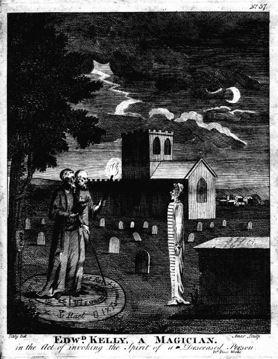
Last night I dreamed yet again. I felt myself drawn to a place where the mage stood, with another old man. They were huddled together, standing on a spot where strange devices had been scored upon the earth, as though the perimeter of the devices protected them from some evil or force beyond their control. I approached them as though through mist, or through the hall where I had first encountered the old man (though now it seemed plundered and ruined), all becoming clearer as I came close to them. At last I stood before them, a hand’s reach away, but outside their magic circle. The old man spoke to his companion.

“Strike with your staff upon the point of the heptogram, Master Kelley, and make it speak.”

At this, a look of annoyance passed the other’s face.

“I am known as Talbot now, and not by my old name. How many times do I have to say so before you remember!” He turned his eyes towards me, and drew himself up, rapping three times upon the ground with his stick.

“Speak, spirit,” he said. “Speak or be returned whence you came, and shut again in your arrow-chest. Speak, I command, in the name of an holy Power!”

“Whom do you command to speak?” I said. “I speak or do not speak at my own will, not yours. I say what is in my heart and mind, when it pleases me to open my lips. I am not bidden by anyone to speak or to stay silent, to come or to go.”

My old mage – I now thought of him as somehow mine – smiled a little, but the other became agitated, and struck again several times with his staff.

“I charge you to speak,” he barked. “Are you from Paradise or from eternal fire?”

“If you rap much harder on the ground,” said my mage. “You will find out first hand, as we shall fall through and into hell ourselves!”

“Paradise or flames?” I said. “A room in the Tower is not Paradise, though it is comfortable enough for a while; nor is it hell, for all its dreary solitude. Rather say it is purgatory, as it affords much opportunity for reflection and repentance!”

“Speak not in riddles!” cried the other. “But answer plainly, I charge you, by the angels!”

Patient now, my mage interjected, “Peace, Master Kelley; I know her, I know of her – she speaks what she thinks is true. She knows naught of heaven or hell, but lies where she lies, with her last memories, waiting for the graves to give forth their contents.”

“Master Dee, you may have traveled much, you may have been to Bohemia, and to Poland (where, I have heard, men have tails), but in these things you are ignorant. She is a spirit, and as such she has seen things you and I have not. And she is bound by the enchantment and invocation I have made, to tell us the truth. This fiddle-faddle she gives us is but her resisting my power, and it cannot last.”

“I know nothing of spirits,” I said. “Except that Saul was damned for causing one to be conjured up. I am none such. I am a queen, albeit one cast down. And Master Kelley or Talbot or whoever-you-may-be, you would be well advised to address me with more deference, and indeed to desist from your imagined conjuring.”

At this moment, my old mage turned eyes on me that held more pity and kindness than I had ever seen in him. There was such sorrow in his voice, when he spoke again.

“Master Talbot, it is clear to me that she is telling you the truth, though you cannot see it. Madam… Mistress… Your Majesty… “

His voice faltered, as though he had something difficult to say.

“Can you tell me where your favourite French headdress is at this moment?”

“Certainly, sir,” I replied. “I have it in my hand.”

“Madam, you have more than your headdress in your hand.”

At that moment, in my dream, I saw his meaning clearly –though I knew not with what eyes I saw that which I saw, for my own eyes looked up at me – and I screamed. My scream was choked by my awakening. Dreams are beyond fathoming, the pictures they paint are strange, their meaning is deep and often unholy…  and it is now today.

There is my gown, and my headdress; there also is my little book of psalms in French, undesecrated. I will wear my gown and my headdress today, and carry my psalms with me when I walk outside. I already have in mind what I will say:

Good Christian people, I am come hither to die, for according to the law, and by the law I am judged to die, and therefore I will speak nothing against it. I am come hither to accuse no man, nor to speak anything of that, whereof I am accused and condemned to die, but I pray God save the king and send him long to reign over you, for a gentler nor a more merciful prince was there never: and to me he was ever a good, a gentle and sovereign lord. And if any person will meddle of my cause, I require them to judge the best. And thus I take my leave of the world and of you all, and I heartily desire you all to pray for me. O Lord have mercy on me, to God I commend my soul.

But as I kneel, and before the swordsman scythes my head from my body, I shall think of my old magus. Then I shall breathe a short, Plantagenet prayer, and hope that my daughter, who has my eyes and my hair, will never be a queen, but will live her life a country lass, safe at home. For the burden of queenship is too heavy.

One Day in High Park, Toronto


Flash fiction – One Day in High Park, Toronto.

I was sitting on a bench, reading – hardly noticed the man, hand-in-hand with a boy. Both were dressed in black pants and white shirts, and the man had a black hat of woven straw. “Old Order Mennonite – what are they doing in town?” I mused momentarily.

They had been talking quietly, but suddenly the man raised his voice, still gentle in tone.

“No, Karl, that’s not true. You’re lying to me. I can’t allow that. You’ll have to take your punishment.”

“Yes, Dad.”

“Shall we get it over with now, rather than later?”

“Yes Dad.” The boy reached and rolled up the legs of his pants as far as they would go. The man bent down behind him and slapped him on the back of each calf, then slapped him again.

“Hey! Hey!” A guy in t-shirt and jeans, came from behind where I was sitting, vaulted over the end of my bench, and barged the man away from the boy.

“Pick on someone your own damn size!” he said, swinging a punch which caught the man on the right cheek. Down he went, and sat on the ground, hat awry, face bleeding. The t-shirt guy stood over him, fists balled.

After about fifteen seconds he got up, dusted himself off, straightened his hat, and looked at the t-shirt guy. He said nothing, but seemed to angle his left cheek a little, as though inviting another punch. Then he turned to the boy.

“Punishment over, Karl.” He said. The boy rolled his pants legs down, and came over to hold his father’s hand. “Shall we get some ice-cream?”

The boy grinned. “Yes please, Dad.”

They walked away, and the t-shirt guy stood, hands on hips. “Well… I… should… fuck… a… pig!”

I said nothing – I had a good book.

Words as ‘irreclaimable vagabonds’

On an old website of mine I had the following passage from an essay by Virginia Woolf. It is an extract from a talk she gave on BBC radio on 29th April 1937. Nothing remains of the talk except for this unique recording of her voice and the transcript below. I wasn’t the first person to do this and I won’t be the last. I’m not reproducing this because I accept VW’s argument, but simply because it is wonderful to read the words and hear the voice of such a writer…

…Words, English words, are full of echoes, of memories, of associations. They have been out and about, on people’s lips, in their houses, in the streets, in the fields, for so many centuries. And that is one of the chief difficulties in writing them today – that they are stored with other meanings, with other memories, and they have contracted so many famous marriages in the past. The splendid word “incarnadine,” for example – who can use that without remembering “multitudinous seas”? In the old days, of course, when English was a new language, writers could invent new words and use them. Nowadays it is easy enough to invent new words – they spring to the lips whenever we see a new sight or feel a new sensation – but we cannot use them because the English language is old. You cannot use a brand new word in an old language because of the very obvious yet always mysterious fact that a word is not a single and separate entity, but part of other words. Indeed it is not a word until it is part of a sentence. Words belong to each other, although, of course, only a great poet knows that the word “incarnadine” belongs to “multitudinous seas.” To combine new words with old words is fatal to the constitution of the sentence. In order to use new words properly you would have to invent a whole new language; and that, though no doubt we shall come to it, is not at the moment our business. Our business is to see what we can do with the old English language as it is. How can we combine the old words in new orders so that they survive, so that they create beauty, so that they tell the truth? That is the question.

And the person who could answer that question would deserve whatever crown of glory the world has to offer. Think what it would mean if you could teach, or if you could learn the art of writing. Why, every book, every newspaper you’d pick up, would tell the truth, or would create beauty. But there is, it would appear, some obstacle in the way, some hindrance to the teaching of words. For though at this moment at least a hundred professors are lecturing on the literature of the past, at least a thousand critics are reviewing the literature of the present, and hundreds upon hundreds of young men and women are passing examinations in English literature with the utmost credit, still – do we write better, do we read better than we read and wrote four hundred years ago when we were un-lectured, un-criticized, untaught? Is our modern Georgian literature a patch on the Elizabethan? Well, where are we to lay the blame? Not on our professors; not on our reviewers; not on our writers; but on words. It is words that are to blame. They are the wildest, freest, most irresponsible, most un-teachable of all things. Of course, you can catch them and sort them and place them in alphabetical order in dictionaries. But words do not live in dictionaries; they live in the mind. If you want proof of this, consider how often in moments of emotion when we most need words we find none. Yet there is the dictionary; there at our disposal are some half-a-million words all in alphabetical order. But can we use them? No, because words do not live in dictionaries, they live in the mind. Look once more at the dictionary. There beyond a doubt lie plays more splendid than Antony and Cleopatra; poems lovelier than the Ode to a Nightingale; novels beside which Pride and Prejudice or David Copperfield are the crude bunglings of amateurs. It is only a question of finding the right words and putting them in the right order. But we cannot do it because they do not live in dictionaries; they live in the mind. And how do they live in the mind? Variously and strangely, much as human beings live, ranging hither and thither, falling in love, and mating together. It is true that they are much less bound by ceremony and convention than we are. Royal words mate with commoners. English words marry French words, German words, Indian words, Negro words, if they have a fancy. Indeed, the less we enquire into the past of our dear Mother English the better it will be for that lady’s reputation. For she has gone a-roving, a-roving fair maid.

Thus to lay down any laws for such irreclaimable vagabonds is worse than useless. A few trifling rules of grammar and spelling is all the constraint we can put on them. All we can say about them, as we peer at them over the edge of that deep, dark and only fitfully illuminated cavern in which they live – the mind – all we can say about them is that they seem to like people to think before they use them, and to feel before they use them, but to think and feel not about them, but about something different. They are highly sensitive, easily made self-conscious. They do not like to have their purity or their impurity discussed. If you start a Society for Pure English, they will show their resentment by starting another for impure English – hence the unnatural violence of much modern speech; it is a protest against the puritans. They are highly democratic, too; they believe that one word is as good as another; uneducated words are as good as educated words, uncultivated words as good as cultivated words, there are no ranks or titles in their society. Nor do they like being lifted out on the point of a pen and examined separately. They hang together, in sentences, paragraphs, sometimes for whole pages at a time. They hate being useful; they hate making money; they hate being lectured about in public. In short, they hate anything that stamps them with one meaning or confines them to one attitude, for it is their nature to change.

Perhaps that is their most striking peculiarity – their need of change. It is because the truth they try to catch is many-sided, and they convey it by being many-sided, flashing first this way, then that. Thus they mean one thing to one person, another thing to another person; they are unintelligible to one generation, plain as a pikestaff to the next. And it is because of this complexity, this power to mean different things to different people, that they survive. Perhaps then one reason why we have no great poet, novelist or critic writing today is that we refuse to allow words their liberty. We pin them down to one meaning, their useful meaning, the meaning which makes us catch the train, the meaning which makes us pass the examination…

“No matter how famous I become…”

“No matter how famous I become I will never ask for nor accept, from any publisher or magazine editor, more than the standard fee for any piece accepted. If that means accepting no payment for a particular piece then I’ll accept no payment, and that’s all there is to it!”

I had been in conversation and the subject of a famous poet came up, one who had been asked by a magazine of which I was part of the editorial team if we could reproduce one of her already-published poems. Yes, said her agent, and named a substantial fee. Having recounted this in the conversation I made the declaration above. I said that no poet is greater than her audience, and that everyone has the right to beautiful, radiant things (to quote Emma Goldman).

“Put that on your web site,” came the reply to my declaration. “Look at it again in ten years’ time, and see if you have stuck by your principles!”

Well, there it is. Of course in ten years’ time we won’t have web-sites, we’ll be manifesting ourselves in holographic displays, triggered by our audience’s thought-waves. Or some such…

*

You may be asking what has happened to the many writing projects I have talked about over the past couple of years. Well, most of them have been shelved for one reason or another. Admitting this may make me seem like a writer who can’t stay the course. Well that’s a possibility, I suppose, but on the other hand this year I have completed a new collection of themed poems for submission, by invitation from a particular publisher. The shelved projects may remain shelved, or they may re-emerge later, as they are or reworked. I don’t know.

Meanwhile I’m about to add another project to the list. As a radical departure for me I am hoping to adapt another novelist’s book as a radio drama. That may end up on the shelf as well, but I’m willing to have a go. I shall let you know in due course.

Thoughts on ‘Ozymandias’ by Percy Bysshe Shelley

I have been in conversation with a friend – I could say I met a traveller from an antique land – about Percy Bysshe Shelley’s famous poem ‘Ozymandias’. I shall let you share a small handful of my thoughts from that conversation. First of all let me transcribe the poem for you to read:

I met a traveller from an antique land
Who said: “Two vast and trunkless legs of stone
Stand in the desert. Near them on the sand,
Half sunk, a shattered visage lies, whose frown
And wrinkled lip and sneer of cold command
Tell that its sculptor well those passions read
Which yet survive, stamped on these lifeless things,
The hand that mocked them and the heart that fed.
And on the pedestal these words appear:
`My name is Ozymandias, King of Kings:
Look on my works, ye mighty, and despair!’
Nothing beside remains. Round the decay
Of that colossal wreck, boundless and bare,
The lone and level sands stretch far away”.

This is probably Shelley’s best known and best loved poem. It is often said to be Shelley in sobriety; the ecstatic artist has been quieted, the revolutionary parlayed into the observer of history, the poet distanced from his subject. I believe otherwise. I see Shelley deeply engaged in this poem.

Shelley is often seen as a poet with a multiple and fragmented identity which emerges in the various personae of the ‘speakers’ of his poems, as well as being imposed on him from outside – the Victorian image of the ethereal versifier, for example, as fostered by his widow, is one such imposition. There is Shelley the inflammatory radical, doling out measured insults to the head of state, ‘an old, mad, blind, despised, and dying king’. There is Shelley the outraged father, spitting barely concealed bile at the Lord Chancellor. There is Shelley the Romantic observer of the Sublime, the inaccessible ‘secret Strength of things’ at Mont Blanc. There is Shelley the grasper for ultimate inspiration in ‘Ode to the West Wind’, begging ‘Be thou, Spirit fierce, my spirit! be thou me, impetuous one!’

To me this is not a random kaleidoscope, not a tumult, not a product of an unstable psyche. To be sure Shelley’s poetry develops through his career, changes, but it remains true, artistically resolute throughout. He is simply not a one-trick pony. He is clever and accomplished technically – hell, who these days could successfully write a wild, ecstatic poem and do it in five cantos of terza rima sonnet form, and make it good?* Like any of us, his mood can change, he can sit and look at things from a different perspective, he can step outside his own thoughts and emotions and observe them as much as he can experience them in the moment.

In ‘Ozymandias’ there appear to be four distinct voices. People normally identify three. Firstly there is the author/speaker; this voice is most often attributed to Shelley himself, and the fact that he only allows the speaker one line is held up as evidence of detachment. Secondly there is the traveller from the antique land, whose taking-over of the narration of the poem is considered to be further indication of objectivity, of Shelley’s status as an observer of history rather than a participant. This voice is contained in quotation marks, deliberately, and again this is taken to indicated distancing. Thirdly there is the voice of Ozymandias – Pharaoh Rameses II – whose inscription raises him above kings, commanding all who consider themselves to be powerful to look on his works and despair. The fourth voice is the Greek historian Diodorus Siculus, the supposed inscription being Shelley’s rendering of a phrase in Diodorus’s historical book on ancient Egypt. Two things should be noted here, firstly that Diodorus used other sources for his own historical works, and secondly that imagination played a part in classical history, with the result that what famous figures ‘said’ is often what the historian felt they ought to have said.

‘Ozymandias’ is taken to be a work of political satire, in particular a retrospective gaze at the rise and fall of Napoleon Bonaparte. Ancient Rome took the best part of two millennia to go from the expulsion of the Tarquins to the fall of Constantinople; France realised its equivalent during the adulthood of a single man, Napoleon. The poem is considered a warning to those who would carve out temporal power for themselves, to the effect that such power will not outlive them. it will fall as surely as the statue of Rameses II fell, worn away by the sands of the desert and by time.

But as I said, I believe that to be a superficial reading, and that Shelley is deeply engaged emotionally and intellectually in this poem. It is a self-referential and introspective work. The second voice, the traveller, is no one external to Shelley. He has given his pen to an inner voice of his own, which will pass judgment on him. I see this because many of Shelley’s familiar themes are actually expressed in this poem. The Sublime is there. Some of it is found in artifice rather than nature, but the words ‘vast’ and ‘colossal’** are there and note a sense of awe that is unmistakable even in a ‘wreck’. The Sublime in nature is in the ‘boundless’ desert, as awesome in its silence and ‘secret strength’ as is Mont Blanc, as relentless and powerful as the West Wind. Imagination is there – imagination of Diodorus on the one hand, and that of Shelley on the other. The face of the statue of Rameses is impassive, yet Shelley imagines a ‘frown’ and a ‘sneer of cold command’. Striving for greatness is there, as Napoleon the revolutionary turned emperor strove, as Shelley the revolutionary turned poet strove when he yearned to be made one with the West Wind, to be, in his artistic power, the Spring to the West Wind’s Winter. Politics certainly is there, even if direct and inflammatory agitprop is not.

But subtly Shelley’s inner voice of judgment mocks, as the hand that framed the statue ‘mocked’***. Ruefully Shelley must acknowledge that he, like all the Romantics, could not quite achieve the quasi-divine power of expression that he wished to. The Sublime desert, the expression of the unattainable, stretches far away.

Because this is all expressed in a short, tightly-wrought sonnet, it is missed by many readers. Scroll back and read it again, think of Shelley’s inner voice, still and small, gently charging him with trying to steal fire from heaven, think of Shelley himself as Ozymandias the failed worker of mighty works, think of him also as the sculptor whose stonework is now brought as low as the king’s power, and think on. When the poem has worked on you, play the arguments out in your own mind…

__________

*I hear some resolute modernists counter ‘Who would want to?’

**From the Colossus at Rhodes, one of the ancient Wonders of the World.

***In the context of the poem, the word has the likely meaning of sculpting, rather as we would use the term ‘mock-up’ today, and not necessarily the meaning of scorn, though that is an implication too, a double-meaning…