Marie Marshall

Author. Poet. Editor.

Tag: review

100 free ebook copies of ‘Lupa’!

Lupa

That’s an offer you can’t refuse. For a limited time, and in a limited amount, my novel Lupa will be available as a free ebook, along with Lyz Russo’s futuristic adventure The Mystery of the Solar Wind, Douglas Pearce’s weirdly witty Almost Dead in Suburbia, and Leslie Hyla Winton Noble’s Tabika for younger readers. There are no strings, but you are invited to take part in round two of the P’kaboo Facebook Share Contest. Step one of round two is reading the book of your choice (all four, if you wish!) and writing a review. Read all about this on Lyz Russo’s blog, or just go direct to P’kaboo’s online bookshop and download any of the books from there.

Demons and Angels

A few days ago I asked you this question: What well-known character in children’s fiction is known in Chinese as Fú Dìmó? I had many interesting answers either as comments or tweets, some of which are contained in the montage below – including the correct character, which nobody guessed. Have a look at the montage, and see if you can spot the correct character. I’ll reveal the answer below.

Who is Fu Dimo?

I’m guessing that you had no trouble identifying each of the characters in the montage. Each answer was imaginative, even if Fu Manchu and the cast of Crouching Tiger, Hidden Dragon stretched the idea of ‘children’s fiction’ a little far. Whoever guessed Harry Potter probably got the closest, but still ‘no cigar’.

The correct answer is… Lord Voldemort from the Harry Potter canon. You could have spotted the phonetic similarity between ‘Voldemort’ and ‘Fú Dìmó’. It might have been easier to spot if the translators had gone with their first idea, and had used a character ‘Fo’ instead of ‘Fu’. However ‘Fo’ can have associations with Buddha, and that might not have seemed appropriate for such a villainous character as Voldemort. It has been pointed out that the etymology of the name ‘Voldemort’ suggests ‘wish of death’. This fact reminds me of the difficulty of translating literary texts (I have done a little translating, mainly between French and English, and I briefly worked with the late Vera Rich, proof-reading an unfinished translation from Belarusian to English). JKR’s translators went for a phonetic rendering with an appropriately sinister meaning, rather than taking a meaning from the etymology of the original.

Anyhow, thank you to everyone who played the game with me.

That takes care of today’s demon. Now what about tomorrow’s angels? Just a quick update on The Everywhen Angels, my soon-to-be-published novel.  We have completed the major editing stage and are now looking at the first full draft, with our eyes open for any missed typos and new glitches. I received this comment from the publisher’s editor, himself no mean novelist: “… the book is something special. The characterisation is convincing. The narrative is entertaining and gripping, but at the same time shows a wealth of knowledge and research and introduces challenging food for thought on abstract matters…” That is quite something for a YA book. We’re still waiting for cover art, but hopefully the book will be out well before Christmas and in time for the publisher’s schools promotion.

More news as I get it.

Reviews, vampires, and storybook witches…

"Yes, my name is Miss Smith. No I will NOT 'take a letter'!"

“Yes, my name is Miss Smith. No I will NOT ‘take a letter’!”

BestChickLitLogoBlast! I could do with a reliable secretary. It’s a funny old day. I feel as though I’ve only just sat down at the computer – in fact I logged on at about 5am and it’s nearly lunchtime. Thank heavens its a bank holiday! There has been a welter of tweets and emails, and a shed-load of stuff for me to deal with. The most pleasant was finding a review of my novel Lupa at BestChickLit, courtesy of Nikki Mason. It’s always gratifying to get exposure of this kind.

Another task today is dealing with my publisher’s editor, as we chip away at the imperfections in my second novel The Everywhen Angels, which is due for publication soon. We’re approaching the galley proof stage, and I can’t wait to see what the house artist will have dreamed up for the book jacket.

Meanwhile, what I am supposed to be doing is getting on with is my third novel, the vampire story. But it’s strange where research can take you when you’re doing something like this. I’ve been sidetracked by a chance reference in my research material (posh term for the rubbish I was scrabbling through on line) to one of my favourite anti-heroines of children’s literature, Miss Smith, ‘the wickedest witch in the world’. Before my pagan friends begin to complain about ‘negative stereotypes’ let me say two things: firstly, she’s fictional, and secondly she is far from stereotypical. Ever heard of a witch keeping toads in a fridge? Live toads? She sails blithely through four of Beverley Nichols’ novels, written between 1945 and 1971 on a tide of delicious malice, dressed like a Vogue model. Actually, delicious malice is just what I am looking for right now; an image has popped into my mind of a vampire bound to a dentist’s chair with ropes woven from fibres extracted from garlic plants, while someone forcibly removes its canines. And what about the next scene where its ‘Sire’ replaces them with a stainless steel pair? The thick plottens!

‘Naked in the Sea’

nitsbanner

Image (c) Marcello Minnia

I’m very grateful to Angélique Jamail for publishing this review of my 2010 poetry collection Naked in the Sea.

Marking a century of haiku

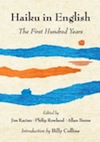
516Ba8RUQfL._SY300_Haiku in English: The First Hundred Years
Jim Kacian, Philip Rowland, Allan Burns (editors)
2013, New York, W W Norton & Company, pp.439
ISBN 978-0-393-23947-8
Hardcover $23.95US

Reviewed by Marie Marshall

As an anthologist I know when something ought to be done, and this had to be done. The centenary of Ezra Pound’s

The apparition of these faces in the crowd;
Petals on a wet, black bough.

in the infancy of imagism was impossible to miss. This book does not commemorate a birthday, however – it’s not just for this year, 2013. It stands as a record, and ought to stand as a book of reference.

The last time I reviewed a collection of haiku I made plain my objection to much time and energy being spent on writing about this word-form. I haven’t changed my opinion, but I will say that an editors’ foreword can’t be escaped in a book of this length. There simply has to be an explanation of what the editors had been trying to do. Their exercise was one of importance, marking a numerical milestone in the writing of haiku in English, their stated purpose not necessarily to present to us the ‘best’ haiku in our own language (stating that could be seen as cannily preempting criticism of their selection) but perhaps haiku which illustrated best its stages of development over the past hundred years.

That is what we are supposed to spot as we read. The stages are not flagged-up for us. Thus when I read, say, Ezra Pound’s orientalist

The petals fall in the fountain,
the orange-coloured rose-leaves,
Their ochre clings to the stone.

and the final poem of the book, Rebecca Lilly’s

Snow at dawn…
dead singers in their prime
on the radio

I am supposed to see a word-form which has changed, developed, moved. As it turns out, with these two examples I don’t. I see what I will have expected to see throughout the book – a continuum. Every newcomer to haiku has certain ‘rules’ drummed into him/her, notably the syllable-count, the reference to nature or season, the cutting point at the end of the second line, the need to omit definite and indefinite articles, and so on. That last ‘rule’, by the way, is one of the silliest and most stultifying, and one which (I am glad to say) most good writers of haiku ignore totally. Each of the poems above use an observation of nature to point to a season, each expresses the transient moment, neither dispenses with articles and therefore each flows naturally. This is precisely what I mean by ‘continuum’; I believe that the first and last poets to appear in this collection would have understood precisely what each other was trying to do.

By the way, neither poem adheres to a strict syllable count. Billy Collins in his guest introduction to the anthology makes the point that ‘a “syllable” does not have the same meaning or weight in Japanese as it does in English’. True, but the next time I read this I swear I’ll scream. It is the prime example of a ‘non-rule’ to counter balance all the ‘rules’.

Back on track. Would I be right to conclude that if I pick someone from the middle of the period, I will find the same recognizable ‘continuum’? Here are two from Jack Kerouac:

In my medicine cabinet
the winter fly
Has died of old age

The bottoms of my shoes
are clean
From walking in the rain

Yes. No. maybe. They’re brilliant anyway. But then someone else jumps in and kicks me in the head. Larry Gates:

Gateshaiku

This is where people sit bolt upright in their chairs and say, “But… but… this isn’t haiku!’ It appears between two other poems which quite clearly do fit comfortably in the continuum, but it sticks out like a mustard-plaster on a coal-scuttle. However, in the couple of seconds your eye first takes in this piece, you see the moment that the poet has captured. You think you see the exclamation ‘Great Snakes!’; you hear the ‘SSSSSSS’ of the snake’s hiss; you experience the aphasic ‘GGGGGGG’ of shock, the ‘RRRRRR’ of anger; you do see the word ‘SNAKE’ in there, and also, if you’re paying attention, the word ‘RAKE’. The poet in his garden is surprised by a snake and lashes out with the first thing that comes to hand. The first and last poet in the collection might have scratched their heads, but I think they’d have got it!

There are more than two hundred and twenty poets represented in this anthology. They are presented in order, that order being by the date of publication of their first identifiable haiku. Given the editors’ aim of showing the development of the form, this was a logical decision. Included are poets I know well – David Cobb*, Alexis Rotella, and Johannes S H Bjerg, for example. Also, if you are attracted by ‘names’, you will find Langston Hughes, e e cummings, Allen Ginsberg, Seamus Heaney, Paul Muldoon, and Billy Collins. I spotted Dag Hammarskjöld in there too, which surprised me – in my ignorance I only knew him as a statesman. In the collection are pieces that both reinforce and challenge our perceptions of what haiku is; in the continuum, bright and jagged shapes sometimes swim to the surface.

Pages 321 to 392 of the book are taken up with a dissertation by Jim Kacian, ‘An Overview of Haiku in English’. I really wish it wasn’t necessary, given my prejudice, but I guess it is. There is not a single volume of collected works or wisdom in the libraries of the world that another editor, myself included, would not have done differently. That goes as much for Haiku in English: The First Hundred Years as much as it does for The Faber Book of Beasts or The Oxford Dictionary of Quotations. We others have to let it go. The book under review here is absolutely essential, whether I’m comfortable with it or not, and my comfort is irrelevant. If you are at all interested in haiku, then it needs to be on your bookshelf and in easy reach.
Let me leave you with one of the most poignant pieces. It’s by Frank K Robinson, and it marks a point where the form is used to draw the mind from a simple natural observation to a dynamic and terrible time in 20c history:

anzio beach…
another wave gathers
and breaks

rated ★★★★☆

__________

*David Cobb, possibly the most renowned haijin in the UK, was kind enough to contribute to the first ever issue of ‘my’ e-zine the zen space.

Review of ‘A New Resonance 8’

resonance8

A New Resonance 8
Jim Kacian & Dee Evetts (editors)
2013, Winchester VA, Red Moon Press, pp.175
ISBN 978-1-946848 -22-5
$17US

Reviewed by Marie Marshall *

It’s a personal prejudice of mine that as little should be written as possible about haiku, and the same goes for writing about people who write it. You’ll forgive me, therefore, if I deal with the presentation of this anthology before I touch on the contents.

This latest in the New Resonance series is actually beautiful to look at, its covers using the reds and purples of an Emil Nolde painting, setting off yellow lettering – ‘Resonance’ being prominent. In place of a rear-cover blurb are the words

Seventeen poets
whose names you will hear often
in the coming years

and it doesn’t take a genius to spot the arrangement of syllables. Inside, the distraction starts. The business of a book – the title page and publication details – can’t be avoided. The busy-ness of a blank flyleaf, a foreword, a further title page, a list of contributors, an editorial review of the first haijin, and the publication details of her haiku – all before the first poem – arguably can. For the ninth in the series, I would like to see the editor consider what may or may not be superfluous. The first poem is ‘about’ beginning; ironically it’s on page 9. It’s a simple, enigmatic monostich

spring rain backwards until the beginning

and it is the intriguing (proper) start of the book. The nature referent is almost intrusive, interrupting an apparent grammatical flow, making the initial word ‘spring’ wonderfully ambiguous. ‘Time is not to be relied on’ runs the editorial commentary, and the poem ‘invite[s] us to read [it] over and over’. Does it? Should it? Would the shade of Basho gnash his teeth at the thought of our oohs and ahs as we fixate on the eternal plop of a frog into an eternal pool? Whatever – Melissa Allen’s one-liner is a great way to open the show. The rest of her selections are full of strength, surprising, compulsive stuff; the book leads with an ace.

Then comes another moment of superfluity. The next poet – each poet – is introduced not only by an editorial comment and publication details, but by a repeated list of all the poets, with the featured poet’s name in bold. Arguably it’s like two bars’ rest in music with the conductor still waving his baton, but please expect that at least fifty-one of your one hundred and seventy-five pages will not contain haiku. You’re looking at a stack of sandwiches, so expect a lot of bread.

But the filling!

The featured poets include many I know, such as Johannes S H Bjerg, Aubrie Cox, and Christina Nguyen, and many I don’t know. Again I’m uncomfortable writing too much about their creations. I can say that much of the poetry in A New Resonance 8 shows that there’s a happy coincidence in the Japanese words mono no aware and the English word ‘aware’. I’m going to extract a couple that stand out for me, and leave the rest for you to come across when you read the book for yourself. First Lucas Strensland’s

sleepless night
where else does she have
owl tattoos

and secondly John Hawk’s monostich

how should I put this broken window

yet another lovely monkeying-around with grammar and ambiguity. Perhaps the weakest poem is David Caruso’s

holy war
death
by ancient literature

– I feel like saying yes, you’ve made your point, but should you be even making a ‘point’ with haiku? Let me say anyhow that if that’s the weakest poem in the book – and it’s not that bad! – that says a lot for the quality of the book as a whole. After a while I even got used to the intrusive ‘bread’ pages. It’s a book to approach in may ways. I like to pick it up, flip open a random page (flip over a couple more if I land on the bread!) and read what I find there. If I occasionally land on the same poem, then that’s a serendipitous plop in the pool. This book is full of high quality modern haiku, stuff of a much higher standard than you’d even find in most specialist magazines.

Rated ★★★★☆

__________

* I’m grateful to Johannes S H Bjerg for the review copy. I would have done a shorter review for the zen space, but for the fact that the next issue is in the hands of a guest editor.

A Tale from the Hill Country

Curl Up and Burn
short story by Samuel Snoek-Brown
http://eunoiareview.wordpress.com/2013/02/03/curl-up-and-burn/ 
review by Marie Marshall

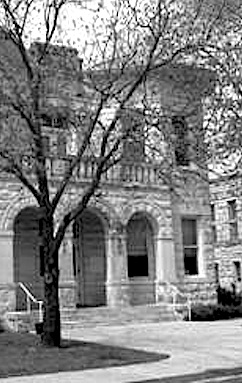
Kendall County Courthouse, Texas.

Kendall County Courthouse, Texas.

I would not normally review a short story, but this particular one by Sam Snoek-Brown is ten-thousand-or-so words long, and if the narrative were expanded it would start to knock on the door of novella. However, a short story it is, lean of excessive development and sharply focused. That leanness pulls us along and makes sure our attention is not diverted.

The subject matter is a ‘statutory rape’ case in Texas, its effects on the community and the persons involved, and its aftermath. The story’s style of presentation is one of reportage. It is written as if it is a magazine article. The narrator is as detached and non-judgmental as an investigative reporter, but his presence ‘interviewing’ and interacting with the personae of the story allows their character to be drawn out. The cut-and-paste nature of the narrative allows it to be episodic, which accentuates that drawing-out – for example, the meeting between the narrator and the convicted man’s father, the latter’s pickup blocking the road, a shotgun pointedly on display on the gun-rack, is loaded with tension and menace.

Another thing that this episodic treatment enables is a presentation of the ‘facts’ in a non-linear way. The fact that a man has been convicted of statutory rape and has served twelve years in a tough prison is made known very early in the story. The details of the case are revealed, but not necessarily in chronological sequence. Rather they are cut with historical detail, sections of modern supposed interviews with townsfolk, and with descriptions of the protagonist’s drives around his home town, where he and the crime of which he has been convicted are well-known, and of his obsession with building and maintaining a model of the town in which things he observes in everyday life modify the layout. Essentially there is no final resolution to the story, but we do realise that a story has been told. The protagonist’s final statement is terse, almost threatening in tone, but remains enigmatic.

Adding to the air of reportage is the research, including historical research, that the author has pasted into the story. The story is set in a real town in Texas – the author himself was brought up in Texas and can therefore be relied upon to give the setting an air of authenticity. Of course his storytelling style does take over from the journalistic style in places, notably in the descriptions of the protagonist’s run-in with his Nemesis, a local Deputy, and the title is a storyteller’s title, not a journalist’s.

I have a couple of niggles – no story is perfect, let’s face it. Firstly there is much made of a teenage girl’s ‘chatting on the internet’; I don’t know whether Texas was a long way ahead of us (I’m writing this from the point of view of a British reader), but in the early 1990s, when this was supposed to have taken place, chatrooms and emails were not as common as they now are, and most households, if they had a computer, were on a dial-up system for the internet, which took up phone time and therefore parents’ money. I could be out-of-touch, but this detail momentarily halted my ride through the story. Secondly, the girl in question is Chinese-American, and whilst her father has the English given name John, her full name appears to be wholly Cantonese. When a Chinese character appears in a work be a non-Chinese writer, I often wonder – maybe unfairly, I’ll grant you – whether her name has been plucked out of the air. I put the name of this character into an image search engine and came up with pictures of a male boxer. Like I said, these are only niggles, and could be my own reading quirks.

When it comes down to it, this is a compelling story, excellently written and insightful, moral but not moralistic. Sam Snoek-Brown is a tireless craftsman of the short story, and Curl Up and Burn shows that he has been working out.

Review – ‘The Hobbit: An Unexpected Journey’

The Hobbit: An Unexpected Journey, 2012, dir. Peter Jackson, New Line / Wingnut / MGM.
Reviewed by Marie Marshall

Film poster presumed (c) MGM, reproduced under 'fair use'.

Film poster presumed (c) MGM, reproduced under ‘fair use’.

The Hobbit: An Unexpected Journey – or, as I have been calling it lately, Lord of the Rings: The Phantom Menace. Those of you familiar with prequels will appreciate what I’m driving at. There are problems with making prequels, and this film suffers from them all. Let me say straight away that it is nonetheless watchable. There are some good reasons for going to see it.

Good reason No.1 – you have a crush on Cate Blanchett or Hugo Weaver (and who could possibly blame you!).

Good reason No.2 – you are a Tolkie (Tolkeenie?) and a Middle-Earth completist, and I mean the kind of person who has even downloaded a hooky copy of the Air New Zealand in-flight safety video. In which case how could you miss this film!

Good reason No.3 – you are a fan of British and British-based actors in general, in which case this film is an absolute feast for you. You will sit there saying things like, “Hey – isn’t that Mitchell out of Being Human? Isn’t that the bloke who played Rebus?” Although if you can actually spot Benedict Cumberbatch and Barry Humphries you deserve a prize.

And that’s about it. On that last point, it does fare better than the Harry Potter canon in which the cream of British acting hammed their way to the bank, and who could blame them*. The acting quality is much better. Martin Freeman plays Bilbo Baggins almost exactly as he played Watson to Benedict Cumberbatch’s Sherlock Holmes, but he is believable as a young Ian Holm**. Sylvester McCoy is a thoroughly eccentric Radagast, and again fans will recall his equally eccentric tour of duty as the eponymous Dr Who, so it’s lovely to see him at his craft again.

However, The Hobbit: An Unexpected Journey does suffer all the ills of a prequel. There is no surprise, no delight in discovering the Shire, Rivendell, and the rest of Middle Earth. We are already familiar with it in the wonderful, broad sweep of the LOTR trilogy, with the musical tropes, and so they appear tired rather than fresh. There is no shock in seeing an orc or a troll for the first time, and in fact there is something tame about the trolls, which takes me on to the next problem.

The Hobbit, the novel on which this film is based, is very different in tone, in target readership, in almost every way from Lord of the Rings. It is very brief, shorter than any one of the three parts of Lord of the Rings, and written with young readers in mind. The three trolls that Bilbo encounters in the book are much less like the hulking, mindless monsters in the film trilogy, more bucolic, calling each other Tom, Bill, and Bert. The new film tries to bridge that gap, and damn near fails. The task is like binding two metal strips together, each of which expands with heat at a different rate, and holding them over a flame. This shows up very clearly in the scene with the trolls round their camp fire. They look sufficiently like the mindless trolls from the trilogy, but smaller, more like a trio of obese skinheads. This is a symptom of trying to marry very different books into a single experience – it doesn’t quite work.

The brevity of the book suggests to me that it could easily have been made into a single film, maybe even a stand-alone film. Stretching it out into two feature-length films is a mistake. As a result, and to provide extra action and spectacle, the film-makers have added elements which were not in the book. Unfortunately that complicates and obscures the plot. There is, for example, a back-story and sub-plot concerning Thorin and a one-handed, albino orc-warrior. It’s padding. Galadriel, Radagast, and Saruman do not appear in the book, but they do make appearances in the film. Sylvester McCoy’s cameo is, as I have said, eccentric, charmingly silly. Christopher Lee, on the other hand, plays Saruman entirely seated; he seems, as he is, much older than he did playing the same part supposedly many years into the future. The book glosses over the conflict between the shadowy ‘Necromancer’ (‘Sauron’ in Lord of the Rings) and implies that Gandalf’s order of wizards, including Radagast and Saruman we must assume, fought as one against this menace. However, the film-makers couldn’t resist giving us a disingenuously proleptic glimpse of ‘Saruman the Bad’. Again, padding, and I’m afraid the stuffing is falling out of it.

Another cameo appearance that simply doesn’t work: Elijah Wood, in real life, looks a good ten years older than he did when he first appeared as Frodo. Then he was cute, now no amount of soft focus can hide the fact that his face has matured. The result is that we are treated to seeing Frodo supposedly several years younger but obviously not. No, doesn’t work, bad padding again.

Maybe it is because I am more used to seeing Lord of the Rings in home DVD format, but I also felt that there was something lacking in the film quality, some lack of definition or clarity. It seems murkier than the trilogy. The film ends at a half-way point in the novel, leaving room for the next film to bridge the gap to Lord of the Rings. I do not know what elements of the story will be left out of No.2 (maybe the part played by Beorn the Skin-changer) nor what will be grafted in (presumably the conflict with the Necromancer and a resolution of Thorin’s feud with the pale orc), but I have my worries.

There are a few good moments of comedy in the film, however, mainly surrounding Thorin’s band of dwarves, who draw as much from Terry Pratchett as they do from Tolkien. I won’t spoil it for you, but watch out for the line, “That could have been worse.” Also it is available in 3D at the cinema, which is still a sufficiently new technology to be enjoyable, so it is worth seeing before you become jaded with the effect.

Overall I think it’s worth paying for a cinema ticket nevertheless (go for a cheap matinee), and worth buying the DVD after it has been out for a few months and the price has come down a little. You could iron to it. If I were to give the Lord of the Rings trilogy five stars, I would award this three. Not bad, Mr Jackson, but you could do much better.

__________

*There were some golden moments in the Harry Potter films too, though if you haven’t seen any of them, take my advice and only see the ones in which Jason Isaacs appears – he is the only cast member who doesn’t ham it up, and as a result he is utterly, chillingly convincing – and the one in which Hermione decks Draco Malfoy with a right hook. Shout ‘Expelliarmus’ all you like, that was the most magical moment in all that series of films.

**Except maybe to those of us old enough to remember the young Ian Holm.

Lewis Grassic Gibbon’s ‘Sunset Song’ – a neglected classic.

I was recently loaned a copy of Sunset Song to read. The novel is the first part of a trilogy, collectively known as A Scots Quair, written by Lewis Grassic Gibbon. That is a pen-name, by the way, used by James Leslie Mitchell, an author who grew up in what was then Kincardineshire or ‘The Mearns’ in rural North-east Scotland, purely for this trilogy – he used his given name for his other work, his pen-name being a version of his mother’s maiden name. I was loaned it because (said the loaner) I would enjoy its literary qualities, its blending of Scots and English, and the anarcho-communist politics of its author, although the book does not wear those politics prominently on its sleeve.*

After I had read the book I applied the words above – ‘a neglected classic’ – to it. Not because it is neglected generally but because I had neglected it. in Scotland it is revered, it has been voted Scotland’s favourite novel and is in print at a host of publishing houses, as you can see from the handful of covers pictured here. Inasmuch as it documents vividly, truthfully, yet not without sentiment, the passing of the peasant class in rural Scotland, it is almost a work of social history as well as a novel. As we come closer to the centenary of the Great War of 1914-18, the event which, more than any, destroyed that class, the novel deserves reappraisal.

It is not necessarily an easy novel to get into. The register in which it is written is peculiar. A modern reviewer recently castigated it as being ‘badly written’ because of its overuse of conjunctions ‘and’ and ‘but’, its long sentences, and its peculiar syntax, dismissing the novel out-of-hand as boring and dull. Suffice it to say it’s neither boring nor dull, but its prologue is surprising. Before a reader is more than two or three sentences into it, he or she may become aware that this apparent mish-mash of folk-tale and history has the register of the Scots equivalent of a griot, the West African storyteller and reciter of genealogies. Where the ramble through the history of the Mearns community comes up-to-date, the register becomes gossipy, as though the doings of the inhabitants are being discussed over the garden fence. This was a departure from the expectations of novel-writing and narrations, and such departures were typical of the modernist period of literature**.

The four main chapters are given titles corresponding to stages in the agricultural cycle – ploughing, harvesting, and so on. Although the story is narrated, the central consciousness is that of Chris Guthrie, whom we see grow from childhood to young-widowhood. There are departures from her thoughts into the thoughts of others, often by Gibbon’s use of the confidential ‘you’ which places the narrator in the Mearns community and draws the reader into it also, but always and at the beginning and end of the chapters, it is Chris’s eyes we see through. Chris is a strong character, an intelligent young woman who could have broken out of her environment on account of her aptitude at school, but who chooses not to do so. Her staying gives an opportunity for the book’s point of view to be one of clear vision. Her insistence on being known as ‘Chris’, never ‘Chrissie’, gives her a toehold of independence in a society in which women are sexually and domestically subservient.

This is no rose-tinted novel. Life in the Mearns is shown to be harsh and hard. Sex is seen as a sociological driver. People are shown with brutal honesty as being mean-spirited and unwilling to speak well of anyone if they have a breath left to speak ill. The reader can sense that this is not a part of their character that Gibbon admires, but he is prepared to address it head-on, to describe all the small-mindedness and spite of the village gossips, all the brutality of the men without holding back. The prominence of Chris’s viewpoint, however, gives the novel an empathic gynocentricity which had critics at the time wondering about the gender of the author. However, Gibbon admires the way that, when the occasion demands it, these folk form and function as a community without giving it a moment’s thought.

There is another object of admiration. Chris’s father, John Guthrie, is portrayed as Calvinistic, tyrranical, brutal, and a prisoner of his sexual needs. Yet when he dies and is being buried, and the reader is heaving a sigh of relief, this moving passage occurs:

Someone chaved at her hand then, it was the gravedigger, he was gentle and strangely kind, and she looked down and couldn’t see, for now she was crying, she hadn’t thought she would ever cry for her father, but she hadn’t known, she hadn’t known this thing that was happening to him! She found herself praying then, blind with tears in the rain, lowering the cord with the hand of the gravedigger over hers, the coffin dirling below the spears of the rain. Father, father, I didn’t know, Oh Father, I didn’t KNOW. She hadn’t known, she’d been dazed and daft with her planning, her days could never be aught without father; and she minded then, wildly, in a long, broken flash of remembrance, all of the fine things of him and his justice, and the fight unwearying he’d fought with the land and its masters to have them all clad and fed and respectable, he’d never rested working and chaving for them, only God had beaten him in the end. And she minded the long roads he’d tramped to the kirk with her when she was young, how he’d smiled at her and called her his lass in days before the world’s fight and the fight of his own flesh grew over-bitter, and poisoned his love to hate…

I should point out that direct speech is rare in the novel, and where it occurs it is shown by italics. Here indeed we have those long sentences, rushing on, broken by conjunctions, but in this case it adds to the incoherence of the sudden realization of grief as suppressed memories of her father’s honesty and tirelessness, and even of a forgotten moment of affection between them, burst upon her. The gravedigger, his hand over hers, serves as a reminder of the good in her father – he is a silent almost-surrogate for her father in this scene. Chris’s anguished cry is almost a liturgical response to Christ’s petition for forgiveness on the cross. It is indeed the crux of the novel, and Gibbon’s bringing us to realise that not a monster but merely a man is being buried. The passage borders on sentimentality, but it is not maudlin. It is not the man John Guthrie that Gibbon admires, it is the qualities which are picked out in him in this and other passages. Here he stands for all the men of the Mearns – he works tirelessly, is rigorously honest, is rigorously egalitarian.

The passage is also interesting for its use of Scots words and hints of Scots grammar. This is typical of the book as a whole, and is evidence of Gibbon’s deliberate linguistic enterprise. His intent was to write in a way accessible to readers whose first language was English, but to enrich that English not only with the cadences of Scots but with a certain amount of Scots lexicon too. He did this with deliberation, out of the love of both languages and in the knowledge that one was effectively dying while the other was developing and strengthening. It isn’t an easy marriage. Scots is exclusively a demotic language, and the Scots of the Mearns is a dialect of it; Scots never had an official status even within the borders of its own land, was never the second language even of the Gaelic-speaking Westerners. This makes it difficult (not impossible) to use outside its historical and geographical context. However, Gibbon does make successful use of a selection of Scots words, the meaning of which is, to varying degrees, decipherable from the context. Gibbon did not want to include a glossary with his novels, but some editions do have one, which is of assistance. Less comfortable and to my mind a flaw in Gibbon’s execution of his scheme is his adaptation of some words into a faux-English equivalent. These stick out like a sore thumb for their etymological ineptness. I cite the following. ‘Brave’ for the Scots ‘braw’, the former being of Latinate origin and the latter Nordic, both having divergent meanings***. ‘Childe’ for ‘chiel’ meaning a fellow. ‘Quean’ for ‘quine’ meaning a young woman. ‘Blither’ for ‘blether’ meaning to speak or to converse, the former being an English word with connotations of delirious raving. Heaven alone knows why he made those particular lexical choices.

Despite this, the novel remains the preeminent evocation of the passing of the crofting way of life in the rural North-East. The final scene – the dedication of a war memorial at an old stone circle – records the names of the young men who would not be coming back to farm their smallholdings, and laments that their place has been taken by business-oriented farmers with an eye on profit at the expense of community.

I am currently reading through the sequels, Cloud Howe set in a large village or small burgh, and Grey Granite set in an industrial, coastal town. They are good books in their own right, but perhaps not as satisfying as Sunset Song. There is a sense of unfinishedness about them. Gibbon died at the early age of thirty-three. He did not live to see the Spanish Civil War, the Second World War, the establishment of the post-war Labour government with its National Health Service and other socialist projects, the fall of Stalin, the Iron Curtain, and the Cold War. Sunset Song has a resolution and closure that the other novels of the trilogy seem to lack, because it marks the passing of an old world; the others do not mark the beginning of a new. Nevertheless the trilogy is a landmark of the twentieth-century ‘Scottish Renaissance’, and Sunset Song itself a minor masterpiece. I would recommend it for anyone interested in Scotland, or in the history and literature of this country.

__________

* I am grateful to my agent – he is studying for a university degree in English Literature, and I get the backwash of his learning!

** It has to be said of modernism that it is not a unified nor easily defined movement, and that the writings of, say, James Joyce, Katherine Mansfield, Gibbon, and Virginia Woolf, to give a mere handful of examples, differ from each other greatly. One could more easily speak of ‘modernisms’ rather than ‘modernism’.

*** Here in Dundee we pronounce it ‘brah’, which is pure Swedish!

An Interview with Samuel Snoek-Brown

The difficulty with interviewing writer and teacher-of-writing Samuel Snoek-Brown is that his web site is so comprehensive that there is little left to ask. I’m reduced to quizzing him about the names of his cats. Sam is prolific, a non-stop writer, a daily blogger, a man of high, caffeine-driven energy. Amongst other things, aside from his writing, teaching, and speaking commitments, he is Production Editor of the amazing Jersey Devil Press, a small publishing outfit in the USA.

I caught up with Sam, by email, in between cups of coffee, and this is the result…

I guess you would say ‘Yes’ to this question without hesitation, but is it really possible to ‘teach writing’? Can you really take someone with – let’s be kind – no more than a modest talent, and, by instruction, make a successful writer out of them or at least someone who feels fulfilled in writing?

To the first part, yes, absolutely. But to the second part? That’s harder. I don’t think I can ‘make’ a successful writer out of anyone any more than I could ‘make’ any student successful in any field. I don’t view my role as teacher as a “maker” of students. I’m an usher; I collaborate in a student’s learning. There was a terrific article in Poets & Writers a couple of issues ago, in which Gregory Spatz tries not just to answer this question but to reframe it: he argues that the answer to the question is an obvious yes, and what we really ought to be asking is what happens when we do teach it. It’s a great article – people should track it down and read it.

But then there’s the last line of your question: can I help a student become ‘someone who feels fulfilled in writing?’ And yes, that I think I can do. And it’s not just about coddling or gladhanding writers. It’s about recognizing what they do well even if they don’t see it themselves, and then showing how to replicate that. That’s not easy to do – you have to make yourself into their sort of writer in order to know how to guide them in their writing – but I know it’s doable. When I was teaching in Wisconsin, I had a student who was an agriculture major in the most hard-core sense: the guy wore a uniform of heavy work boots and Carhartt jacket and John Deere cap; he proudly declared that his only reason for being in college in the first place was to learn how to take over his family farm from his father. He had no use for writing other than the credit it fulfilled in his degree. When I assigned the class to write about communities, he wrote about the farm, basic but beautifully pastoral essays about shovelling shit and harvesting beans. His essays weren’t perfect, but he worked hard and earned a solid B. And then he moved on, getting into the more important courses on agribusiness. But two years after he took my class, he surprised me in the hall outside my office. I smiled and shook his hand, thinking it was a passing hello, but he stopped me: he’d been looking for me. “I just wanted to tell you how much your class meant to me,” he said. “I ain’t gonna be a writer, but I never thought I could write. I’ve got some papers now in my other classes, and you gave me the confidence to write them. I’m doing okay – I even like my writing – and I wanted to thank you for that.”

In your opinion, what is the purpose of literature? How would you define ‘literature’ to start with? Does it have any obvious limits?

I used to be pretty snobby about the distinction between ‘literary’ and ‘non-literary’ fiction. In some respects, I still am: I just cannot give the same artistic weight to, say, Stephenie Meyer as I would to, say, Bram Stoker. But I’ve come to recognize ‘literary’ is just a genre tag, and that all fiction is literature.

So what is the purpose of any literature? I think it’s to entertain and to provoke – thought, emotion, or, ideally, both – to varying degrees. Some literature – what I like to call ‘airplane fiction’ – is almost purely entertaining and is designed to provoke the least possible amount of critical thought. Other literature is so intellectually demanding that it becomes exhausting and has almost no entertainment value at all. Both serve a purpose, but I think the ideal is a nice balance of the two.

Two of my favourite novels ever, Cormac McCarthy’s Blood Meridian and Ernest Hemingway’s For Whom the Bell Tolls, are richly complex works of literary fiction, full of demanding prose and opportunities for complicated critical investigation. Yet both are also essentially machoistic action novels full of sex and violence. And, for my money, that makes them two of the best novels ever written.

When you read, whether it is prose or poetry, what are you looking for? What qualities in others’ writings make you say, ‘Ah, yes!’?

I’m a big language guy. I love a good story or a clever conceit, but the work that makes me want to hug a book (and I literally do that – I press books right up against my heart) are the ones that use language beautifully. The cadences, the syntax, the images, the words…. The sentences of Cormac McCarthy or Barry Hannah or Alice Munro or Jac Jemc. The lines and images in Beth Ann Fennelly or Mark Doty or Czezlaw Milosz. The words. The words.

Beyond that, I want honesty. By which I mean beautiful ugliness, horrible love, brutal awe. I’m the kind of guy who thinks McCarthy’s The Road – in which the main character declares that “there is no God and we are his prophets” – is actually an uplifting novel. I’m the kind of guy who think Beth Ann Fennelly’s most beautiful poem is the one in which she describes breach-birthing her first child without drugs, how every capillary in her neck burst and her “asshole turned inside out like a rosebud.” One of my favourite love stories is Sarah Rose Etter’s Husband Feeding in which the wife lets herself be eaten alive by her spouse because it’s the only way to show how much she loves him.

What was your first published work? How did that first success feel?

I published a few things in my middle school magazine, the ink still purple from the mimeograph machine, the cardstock covers stapled on in the library. I fully expected classmates to throng me in the hallways and beg for my autograph, offer to buy my copies even though they were free to everyone. I was going to be the next Stephen King.

None of that happened, of course.

My first published story outside of school lit mags was ‘Coffee, Black,’ in Amarillo Bay. I knew and respected the editors, and I was over the damned moon. I shared that story everywhere. But by then, I knew enough not to expect fame a fortune. So it slightly less soul-crushing when fame and fortune kept ignoring me.

Recently you mentioned, amongst other anecdotes from your youth, a time when you were working as an office cleaner. By accident you came across a compartment in a wall, which contained some papers, money, and a lock-box for a hand-gun. You didn’t mention this to anyone – until recently of course – but did it occur to you to use this as the starting place for a piece of fiction? Has any other incident in your life been such a starting place?

At that point in my life, I was reading a lot of my dad’s old action novels, the Mac Bolan series, the Phoenix Force series, really campy ‘guy novels’ with lots of firearms and fists. This sort of thing – the panel in the wall, the cash and the handgun, the tiger head mounted on the wall – was straight out of one of those books, so if I had used it in a story, that’s what I would have done with it. But despite what I was reading, I was more interested in writing horror when I was a teenager, and I didn’t know what to do with that kind of incident.

But I’ve used a lot of incidents from my life in stories. Some of the events (I won’t say which) in my restaurant story ‘No Milk Would Come’ are based on my time cooking for a living. Some of the events in ‘A Few May Remember’ come from two different jobs I had working with senior citizens. The youth camp events in ‘Summerplace’ are practically autobiographical. The ending of ‘It Was the Only Way’ actually happened to me in Mexico.

I might have asked the above question also about coffee, but as it happens you have published ‘Coffee, Black’ back in 2001. How did your addiction start, and does it fuel your writing in any other way?

I grew up with coffee. My parents got addicted in college, and as soon as I was old reach the pot on the kitchen counter, I was making them coffee in the morning. But I didn’t take up coffee myself until I was in college. I was working at the restaurant, actually, exhausted from a full day of college classes and writing for the school newspaper and the long commute to the restaurant. I’d started popping caffeine pills, but one day I ran out, and the only caffeine we had at the restaurant was espresso. I brewed a double shot, slammed it back, and BAM – I was hooked. Fortunately, I had two English professors, one who hosted a monthly coffeehouse series where I read at the open mic and the other who was my mentor and a connoisseur of coffee, who helped nurture my addiction. (Thanks, Kathleen Hudson and David Breeden!)

Coffee absolutely fuels my writing. Some of it is pavlovian: I’ve just gotten so used to drinking coffee while writing that the flavor, even the aroma is enough to get the juices flowing. But a lot of it is scientific: caffeine stimulates creative centers in the brain. There’s a reason why artists and writers and musicians and philosophers all hung out together in the coffeehouses of Ottoman Istanbul and Enlightenment-era Europe. And still do, today.

I see that one of your principles is ‘Listen to comments on your writing. Do not react to negative criticism with anger or resentment.’ I have to ask – even when they’re plain, damn wrong?

Yes, absolutely. I believe in listening, and I believe and letting go of anger and resentment. But listening to comments doesn’t mean you have to obey or even accept the bad comments. And striving to avoid reacting with anger and resentment doesn’t mean you’re not allowed to feel anger and resentment – just that you should strive not to spread that anger or cling to resentment. Those are stifling emotions. If you hang onto those emotions – or, worse, if you get caught up in reacting from a position of those emotions – you’re only preventing yourself from getting back to work.

What drew you to an interest in religious motifs in literature? 

I got turned on by religion in college. I went to a church-affiliated college where I had the good fortune to study with a few really excellent professors in philosophy, religion, and mythology, and I was very interested very early in putting those fields together. When two of my professors – the campus minister and my myth-obsessed English professor – team-taught a course in religious motifs in literature, I leapt at the class. It remains one of the coolest classes I ever took.

My continued interest in the field of study stems from how I relate to religion and literature: I don’t really see the two as mutually exclusive. In fact, I think some of the best religious experiences necessarily come through the form of narrative or poetry, and some of the best written art is at least quasi-religious in tone. The earliest religious scripture was poetry and song, and then people began stringing those poems and songs together into narrative theater. The ancient stories we today call myths were narratives of religious experiences or stories we needed to understand our world. The Judaic-Christian-Islamic account of how God created the earth is given us in story, complete with dialogue (God speaks; Adam names things). And when I look at a story like, say, The Road or Beloved or Frankenstein, I see the echoes of religious narrative or images imprinted on those stories. That’s not the only thing I see – religious is just one tint of lenses through which I look at a text – but I can’t ignore it, either.

Do you think there will ever come a time when you will retire from writing?

God, I hope not. Sometimes I play those games with people – what superpower would you have? What would you do with three wishes? – and someone will ask which of my five senses I would least want to lose. And I don’t know, really, but somewhere in the discussion I try to imagine my life without touch or sight, and I immediately start making a list of people I could ask to write for me while I dictate, like Milton to his daughters. That’s how essential writing feels to my sense of self. I take breaks from writing all the time, but I don’t think I could ever quit for good. I wouldn’t know how.

As well as being an active writer, you are an avid reader. I have marooned you on a desert island with the Bible and the works of Shakespeare; you have room for one other book, what would it be? 

Shantideva’s The Bodhisattva Way of Life. Either that or Padmasambhava’s Enlightenment on Hearing in the Intermediate State. But if I could replace the Bible with one or both of those religious texts, and you required me to choose a work of fiction or poetry? I might say Alan Moore’s Watchmen. Not because it’s my favorite book or the best book ever printed, but because it’s the one I already reread once a year, every year.

I’m now going to ask you for a list of whos and whys. Who were the most fascinating literary and non-literary persons you have ever met, and what did you get from these encounters? Whom would you like the opportunity to meet, and why? Whom do you wish you could have met from the past, and why? 

I worked with a guy in the restaurant, a waiter named Sean Hutchinson. That dude was amazing. He once gave me a gift of a bird feather, a stone, and a Hopi sun drawing, just because. He left tiny gold buddhas as tips in diners. He dyed his hair a different color every month just so he wouldn’t get used to looking a certain way. He collected medieval tapestries. He worked at the restaurant only until he had enough money to move to Colorado, and then he worked at a ski lodge for a while, until he’d made enough money to move on to the next place, and the next. He was utterly unpredictable. I loved that about him.

I once met Frank McCourt. It was the year before his death. We were at a conference of the Association of Writers and Writing Programs, where McCourt and poet laureate Billy Collins had given back-to-back speeches. Afterward, they sat down at the same table to sign copies of their books. Everyone wanted autographs from both writers, but the conference organizers insisted on separate lines to keep things organized, and the lines were absurdly long, so people in one line weren’t going to have time to return to the end of the other line. After about thirty minutes, McCourt left the table and started walking back through the lines, shaking hands and signing books as he went, just so he could work his way up his own line and start coming back down the Billy Collins line. He had a smile for everyone, he listened to everyone, he told a different personal story to everyone. He personalized every autograph. I had him sign a copy of Teacher Man for my mother, who is a retired elementary school teacher. He told me to thank her for being a teacher – to thank her from him. He was an awesome human being, and I cried the day he died.

I would love some day to meet His Holiness the 14th Dalai Lama. Or the 15th Dalai Lama, if the 14th dies before I get a chance to meet him. In the past, I would love to have met Abraham Lincoln. I would love to have met the Prophet Mohammed, or to have been in the crowd while Jesus walked by, or to have attended even one teaching from Shakyamuni Buddha, or to have heard Socrates.

Is blogging really worth the trouble? 

Sometimes, no. It took me a long while to realize that and let it go when I get too busy to keep up with it. I love blogging, for what are probably pretty narcissistic reasons – I have something to say and everyone needs to read it! – but I’ve figured out that life is more important, and I’m not a slave to the blog the way I used to be. Still, one of the reasons I write is to participate in the larger discussion of the world, and I’ve come to see blogging as worthy part of that conversation, however little value my tiny voice might actually have.

What is on your ‘bucket list’? Not just as regards writing and reading, but other aspects of life.

I don’t know that I have a bucket list. Not in the literal sense that I have a list of stuff I want to do before I die. I could finish my list next week and then live to be 100. What would I do with the rest of that time? Or I could die in the next hour. If I haven’t done everything on my list, is that just an invitation to linger after death, wallowing in regrets and missed opportunities? This is just me being a Buddhist, but I think my time would be better served paying attention to this moment, not what I should be doing or haven’t done yet. Not that I actually do that – I’m constantly obsessing over things I haven’t done yet – but at least it’s stuff I didn’t do this week, or this year, and not this lifetime.

That said, I do have a list of places I’d love to visit, which is as close to a “bucket” list as I might get. Egypt, Japan, and India are on my personal short-list, but we’ve already decided our next overseas trip will be either to Germany or to England. I’d also love to take my wife to Turkey, and she’s long wanted to take me to San Miguel de Allende in Mexico. And we’d both love to return to Scotland, to Prince Edward Island in Canada, and to Thailand, three of our favorite places to visit. I guess you could say my whole ‘bucket list’, if I had one, is all travel.

Do you have any regrets about anything?

A friend of mine recently wrote a long blog post about how the whole ‘no regrets’ attitude is a lie. Of course we feel regrets. And then she launched into a litany of things she wishes hadn’t happened or that she’d done differently.

I don’t know that I buy that. There are plenty of things I wish I’d done differently or that had or hadn’t happened to me, but only in the most casual of ways. I’m a Buddhist, and I take the concept of karma pretty seriously, so I understand that whatever has happened to me, for better or worse, is mostly just karma arising. It’s stuff I’m burning through because of things set in motion in previous lives or in the lives of others. I constantly struggle to make better decisions in my life and to be more aware of how my life intersects with the lives of others, but what has already happened has happened, and I wouldn’t be at this point in my life otherwise. That’s not just Buddhism, that’s quantum science (though, more and more, it’s getting hard to tell the difference).

So do I have regrets in the sense that I actively wish things were different and that, given the magical opportunity, I’d change things in my past? Not really. I feel like I’d be pretty foolish to do so.

What the heck possessed you to call your cats ‘Ibsen’ and ‘Brontë’?

Actually, it was the other way around: they’re our cats because they already were Ibsen and Brontë. We adopted them from our local humane society when we lived in Texas, and we were first drawn to them because, of the cats listed on the society’s webpage, they were the only two with literary names. When we went to the shelter to fill out the adoption paperwork, we discovered they were siblings, and we knew we’d made the right decision, so we left their names as they are.

I like the literary name idea, so I keep threatening my wife that the next cat we adopt will be either Cormac, for a boy, or Austen, for a girl. So far she’s vetoed my choices, but we’re a two-cat family for now anyway, so it’s a moot issue. Our Ibsen and Brontë are plenty!

Thank you.