Marie Marshall

Author. Poet. Editor.

Tag: Short story

The wheat-child

wheat-childThe Sun came to the Earth and had a child with her. That child was a field of wheat, and it grew from its mother towards its father, becoming more and more golden.

The wheat-child learned from its mother and father how to mind its manners and show respect to its betters. So when that fierce knight, Sir North Wind, moved through the field in his shining steel armour, the wheat-child bowed to him as he passed. And when Lady South Wind came with her warm kisses, the wheat-child bowed to her. And when Boyar East Wind strode in from the Steppes, singing mournful songs, the wheat-child bowed to him. And when Widow West Wind let her tears fall on him, the wheat-child bowed to her.

But one night, while the Earth slept and the Sun was away on business on the other side of the world, the cruel landlord Squire Frost patrolled the fields, and because such as he walk silently, the wheat-child did not bow to him. Squire Frost was angry at the wheat-child for not showing respect, so he called on all his labourers, the Hailstones, to come with their scythes and sickles and reaping hooks to lay waste to the field and kill the wheat-child.

In the morning, when the Earth awoke and the Sun returned home, they saw the wheat-child lying on the ground, and their sadness was great. The Earth made to quake and to throw up mountains, and the Sun made to cover everything with fire, but suddenly they saw, in a corner of the field, one solitary stalk of wheat that Squire Frost’s cruelty had treemissed. So the Sun and the Earth called upon their friends the Four Winds, and together they made seasons to nourish all that was left of the wheat-child. And eventually that single stalk of wheat became a great Tree.

The great Tree grew straight and tall, and lived longer than any child of Sun and Earth ever had, even longer than Empress Slow of the Galapagos, whom the Tree could remember as a tiny tortoise when he was already as tall as a hill. The longer the Tree lived the more the Sun and the Earth whispered a secret to him, and that secret is that trees need not bow to anyone.

What’s that, little one? Yes, I expect the great Tree is living still. Unless some one has cut him down. Now go to sleep – even the Sun and the Earth have to do that, so why shouldn’t you!

Peace, War, Honour, and Death

Peace, War, Honour, and Death – a fable

Honour 1It happened that War saw a beautiful woman, whose name was Peace. Desiring her, he took her away to live with him. But Peace was never happy, and when he asked her why, she answered that it was because she was cold, for though War is hot he can never pass his warmth on to anyone.

One day a knight, whose name was Honour, rode by.

“This man serves me,” thought War, and called out to the knight, “Sir Knight, take off your cloak and give it to my lady Peace!”

The knight stopped, took off his cloak, and unsheathed his sword. Having cut his cloak in two, he put one half of it around Peace’s shoulders to warm her, the other half round his own, and rode away. From that moment, to his name was added Martinus Martianus, Warlike, and the word Generous was written on the cloak about his shoulders, for it takes an act of generosity to give warmth to anyone.

Soon the knight found himself in a battle, as all of his kind do. There he met with impartial Death, as one day do we all, good and bad. Death caught the knight with his scythe and he fell. The knight’s halved cloak was not enough to soak up his blood, which flowed like a stream. The stream became a great river of clear water, known as Generosity, and it flowed through the desert known as Indifference…

You ask me why? It is because, little one, all things are held in the Great Balance, and it must be so. Time for you to go to sleep, for sleeping and wakefulness are held in the Great Balance too…

The Lost Manuscript of Aë

Ae

The Lost Manuscript of Aë – a fable

There was once a very rich man who had in his castle an incomparable collection of beautiful things. He loved them, and would spend hours in his galleries and libraries, and amongst his showcases. There were paintings before which he would stand, lost in the world that they depicted or suggested, whether the painting was an intricate interior, a landscape, or a mere splash of primary colour. There were ancient musical instruments which, when he plucked, struck, or blew them, released into the room tones that had never been heard for centuries – he had a lyre, for example, that was said to have been carried to hell and back by a minstrel looking for his lover. There were statues so beautiful that the urge to kiss their lips was almost irresistible – one of them was so beguiling that the sculptor had fallen in love with it himself, and gone mad when his love remained unrequited. There were books of poetry, philosophy, and fable that transported the reader between all the realms of Fun and Profundity. There were weapons that the heroes of the world had wielded in defence of the weak and in pursuit of the wicked – there was a bow said to have been strung by a demiurge and drawn by a demigod. There were machines that were marvels of ancient and modern invention – each one had changed the world when they had been introduced. There were jewels, royal regalia from the past, emerald rings that burned brighter than forest sunlight, jade necklets that seemed warm to the touch as though the emperor who had worn them had only just taken them off – the, scepters, orbs, diadems, and touchstones of the most enlightened princes and the most terrible tyrants.

There was just one thing he lacked, something which he coveted and desired beyond all else. He had heard of the vanished civilisation of Aë, which some men say flourished thousands of years ago and others say is legend. He had been told how their last artefact – a manuscript that contained everything that gave joy and wisdom – had come down through the ages, or indeed had never existed. Rumour had reached him that this manuscript, which had been lost, was now found, and was circulating amongst men, or was so in someone’s drunken dream.

If it existed, he had to have it. He called his most trusted employee to him, and charged him with the task of tracking down and obtaining the manuscript. His man set out and, to cut a long story short, found the lost manuscript of Aë. It is not recorded how he found it – some say he won it on the turn of a card, others that he seized it in a brawl with an inebriated sailor, others still that he found it hidden in a cave, and others still that he paid a Romany woman half his patron’s fortune for it. No matter how he came by it, he went out a boy and came back a man. And he gave the manuscript to his rich patron.

The rich man unrolled the manuscript. It was old, it was beautiful, it was in Aëan. The rich man looked around at his people – his servants, his employees, his acolytes, his friends whom he had gathered together to see his new possession, others who had simply come on the off chance – did anyone read Aëan? No, certainly not amongst them. But someone did know of a scholar of antiquities who was adept at old languages and undecipherable glyphs, and so he was sent for.

The scholar, with the rich man always in attendance, worked for months at the manuscript. Piece by piece he began to make sense of it, and piece by piece he told the rich man what it said. Yes, there was joy in it. Yes, there was wisdom in it. The rich man was glad. But eventually, when the scholar had translated some three-fifths of it, he sadly came to the conclusion that the manuscript, though old, was not Aëan. It was a fake.

The rich man was devastated. He was not angry with his employee, who had done his best, but he did send him out to see if he could find the real one. In fact he found two, both of which were also fakes. The rich man never did possess the lost manuscript of Aë, and one day he gave his entire collection to the nation, which dispersed it amongst its many museums. One spin-off, however, was a general interest in all things Aëan, a fashion for Aëan gew-gaws and imaginary robes and adornments, market stalls full of scrolls and parchments with supposed Aëan glyphs all over them.

Is there a moral to this story?

A moral? Yes, never underestimate the power of bathos in fiction.

Ah.

A victory

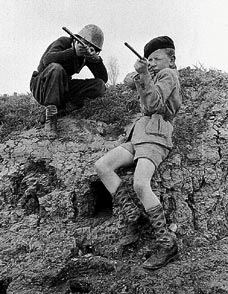
boys-playing-war-gamesThe boys put down their Commando comics, in which the heroes were square-jawed and wore their helmets at a jaunty angle, and the enemies’ eyes were always in shadow, and determined to play war in the woods. One or two were lucky enough to have their dads’ old berets, a helmet, or a toy gun, the others grabbed dry sticks of the right size, with which to extemporise a weapon. They picked sides and fanned out into the trees.

One of them – the youngest – struck out on his own. He could hear the others. Sometimes a twig would snap as a boy stalked through the bushes. At other times there were yells, whoops, or the staccato cry of “Er-er-er-er-er!” in imitation of a machine gun.

After about fifteen minutes alone, the young boy began to climb up a bare-topped knoll, dodging from tree to tree, imagining that he was storming a stronghold under heavy fire. When he reached the top he brandished his stick and began to cheer loudly. After a couple of minutes his cheering attracted the other boys, who began to climb up towards him, wearing puzzled frowns.

“Why are you cheering?” one of them asked.

“I’ve won! I’ve got to the top of the hill.”

“That’s not what the game’s about,” said another boy.

“Yes it is,” said the youngster. The others shook their heads at this, decided to re-start the game, and they all trooped back to the outskirts of the coppice. Fanning out again, they disappeared into the trees. Their occasional yells, imagined military commands, and mimicked gunfire could be heard, muted by the trees, saplings, and undergrowth. Once more the youngest boy made for the knoll and climbed, ducking and dodging the imaginary hail of bullets, taking the enemy’s machine-gun nest for the second time that afternoon. Once again at the top he waved his stick and cheered. Once again his racket attracted the other boys.

“I’ve won!” he proclaimed loudly.

“Look, we told you – that’s not what this game’s about,” said the biggest boy there, coming up to him.

“Yes it is.”

“No it bloody isn’t,” said the biggest boy, punching him hard on the shoulder to make his point.

The boys all trooped back to the edge of the wood and, starting their game again, filed between the trees in improvised patrols. Doggedly, the youngest boy made his way directly to the knoll. This time when he arrived there he found several of the other boys already on the top, and more climbing up to join them.

“It isn’t about getting to the top of this hill,” said the biggest boy, “and anyway this time we beat you up here!”

The boys couldn’t understand why their young playmate gave a broad smile at that. Shrugging, they made their way back to the edge of the wood. Instead of beginning the game again, they decided to go home. The afternoon sun was getting lower, and they didn’t much feel like another skirmish. Let the imaginary enemy hold the wood. They threw their sticks away, the owner of the Commando comics retrieved his dog-eared property from the hedge, and they set off into the nearby streets that the woodland fringed. At each junction some went left, some went right, until the biggest boy and his brother were left walking not quite along with the youngest but in the same direction. The biggest boy tugged at his brother’s sleeve, held him back, and jerked his thumb towards the youngest boy.

“Why’s he still bloody smiling?” he muttered, and his bother shook his head.

The youngster marched home down the middle of the street, shoulders back, as though he was about to be invested with a medal. He alone had kept his stick, and it was now tucked under his arm, like a Field Marshal’s baton.

Three Bubbles of Earth: A 221b Baker Street story

“We could, I suppose, form a detective agency of our own,” said Mrs. Norton to me, under circumstances I’ll come to eventually, I promise you.

And at the time I felt that maybe we could. I certainly regarded myself as somewhat qualified, having absorbed, by what I believe Dr. Watson would classify as ‘osmosis’, a fair amount from my famous tenant. More, in fact, than you would imagine. I have spent several years navigating both his order and his chaos, distinguishing the one from the other, and recognising the tracks and traces of one within the other. I know what is secreted where, and where to find reference to things. I know how he files newspaper clippings, and what his system of annotation means. It is amazing what can be gleaned during simple housekeeping activities. I am not merely the adjunct whom he calls his busy, biblical ‘Martha’, to be yelled for from the top of the stair when he wants a Scottish breakfast or his Dewar flask filled with coffee in the depth of the night. I am not ‘Mrs. Turner’, as he once absently called me. I am Elspeth Hudson – née Turnbull, and Effie to my friends – I am a widow, I am a woman used to standing on my own two feet, I am educated, I am a Scot, and 221b Baker Street, London NW, is my address, not his. He rents rooms here. if he omits ‘care of’ on his calling card, then he does so by his own presumption and without my permission. In fact everything he does in this house, and by sally from it, everything he says from here, is done and said on sufferance. The same applies to Dr. Watson, though he is much more affable and polite. Superficially, that is. If I am to be honest, both of them have a typical bachelor’s disregard for women. They don’t mean to have, it’s simply the way menfolk are bred up, and again to be honest I don’t hold it against them.

221b 5Let me give you a wee example of my qualification, just picked from the air as it may be. Last week there was a chapping at my door, and I answered it to a man asking, as they all do, to see Mr. Sherlock Holmes. I admitted him and conducted him upstairs. As I left him there with my famous tenant, I heard the usual rigmarole.

“I perceive that you a married man in sudden and unexpectedly straitened circumstances, and that you arrived here from Birmingham this morning by the ten-fifteen express.”

“Good Lord, Mr. Holmes! How can you possibly know that?”

“By simple observation and logical deduction. You see…” etcetera, etcetera.

All well and good, of course. Mr. Holmes was entirely correct in his deductions – I did not need to hover at the top of the stair to hear his reasoning – as I had come to much the same conclusion himself. The sudden and straitened circumstances were indicated by his wearing a jacket that was fashionable for men two summers previously, but which had had one button replaced that was not quite a match. I recognised the thrift of the button jar! His being married was obvious by the careful and regular way in which the replacement button had been sewn on, not with the cobbled-together stitching a man on his own would have used, nor with the delicacy and loving touch of a sweetheart, but with the honest practicality of a longer-time companion. There was nothing about him generally to suggest that he was a ‘mother’s boy’, and the touch was definitely companionable I’d say; and if you add to that the fact that he was past conventional courting days by a good five years or more, it was a fair shot that he was married. The deduction about his origin and arrival was as easy as pie; were his voice not enough, he had an early morning edition of a Birmingham newspaper sticking out of his jacket pocket, and there was only one train that could have borne him here at this time. I could have primed Mr. Holmes also, if I had cared to the following. That our visitor possibly had a sweet tooth, by the smell of peppermints on his breath and by the click-clack a couple of them made in the left-hand pooch of his overcoat as I hung it up; or more likely that he had been drinking, if the uneven weight of something, probably a flask, on the right hand side of his coat was anything to go by. That he had walked here via Manchester Square Gardens, by the evidence of an autumnal leaf, attached to one of his dickersons, from a tree that grew in that location, alone of all the neighbouring gardens. That this route to our – I mean my – front door meant that either he had little sense of direction, or more probably that he was distracted by the matter that had brought him here, and had mistaken the the direct route from the railway station. That his distraction might be confirmed by the obvious lack of attention he paid whilst crossing the road, as witnessed to by a distinct whiff of the leavings of a dray-horse on the same dickerson that bore the leaf. That he had either sustained an injury to one leg, or that the right was a little shorter than the left, which I gathered from the rhythm of his footfalls as he climbed the stairs behind me. I could even have hazarded that he was right-handed. How? By the fact that if he reached more often for his flask than he did for a sweetie, then the flask would be in the pooch reachable by his better hand. However, I didn’t add that to a prominent catalogue of his personals, as most people are right-handed, and that fact was not necessarily significant. Worth handing to the clerk of memory for filing, but that is all.

Women, you see, notice such things. it’s not a skill we have to learn. Maybe ‘osmosis’ is just so much bunkum. Or maybe Mr. Holmes learned from me, and not the other way round. Now that would be something notable!

Anyhow, this wasn’t what I wanted to tell you. I wanted to tell you what happened the last time Mary Watson – Mary Morstan as was – came to 221b Baker Street. I was in my pantry dealing with the items just delivered by the grocer’s boy, when I heard a ring at the doorbell. No doubt Dr. Watson, acting as Mr. Holmes’s amanuensis, would have called it an urgent ring. He has a way of transferring things, of personifying the thing acted upon as though it was the person acting upon it – you’ll have seen that, no doubt, in his published accounts of the menfolk’s adventures. It was a ring, I’ll say that much. I was, I admit, surprised to find Mary, Dr. Watson’s wife, standing there.

221b 1“Good morning, Mrs. Hudson,” she said, looking past me. “Is Mr. Holmes here? May I see him?”

“Good morning, Mrs. Watson,” I replied. “No, he’s not here just now.”

“Oh dear. Will he be back soon?”

“I’m afraid I’m not expecting him today. In fact I have no idea when he might return. He’s away on an investigation. You missed him by less than a day, by the way – he left last night. Did your husband not tell you?”

“No,” she said with a sigh, “John’s away too. He’s at a medical conference in Dublin. He never mentioned Mr. Holmes before he left.”

It is as I said. Both our menfolk, tenant and husband, have retained in their characters the best and the worst of bachelorhood, the worst being a slight disregard towards women. Well, I had Mrs. Watson into my own parlour – I did not presume to take her up to Mr. Holmes’s, and in any case mine is comfier, there are no hard angles, there is less clutter, there is no odour of stale tobacco, there is a gently-ticking clock that gives comfort with a soft chime at each hour, and my kettle and cups are nearby. It is an environment where it was easy for us, despite our twenty years’ difference in ages, to drop our titles and become Effie and Mary to each other. To each other, I stress, and not to you, however – for the remainder of this tale I shall write ‘Mrs. Watson’. There we sat over two cups of my strong tea and broached the Dundee cake I had baked the previous day, while she told me why she had come.

Please forgive me if I don’t dress it up in ribbons. Here it is in a nutshell:

She has a friend – no need to name her – who had recently lost her husband. Distraught by her bereavement, she had looked for solace in spiritualism, as so many people do. It was something for which Mrs. Watson herself had no time, and no more do I, and yet it was a trait, an interest, a belief that her good friend had always had, and which she therefore tolerated it out of affection. Mrs. Watson took some encouragement in the fact that her friend’s quest was leading nowhere, and that she might be able to find her own inward strength to come to terms with her bereavement, or at least to lean on a good friend rather than on mountebanks and strangers. However, just when her friend seemed to be on the point of giving up her visits to mediums and clairvoyants, she reported that she had found a new one.

221b 3“When I saw her,” said Mrs. Watson, “there was a gleam in her eye and a flush on her cheek. She was excited, overly so. There was something of the enthusiast in her manner. I became worried once more.”

“What can you tell me about this new medium?” I asked.

“Well, he goes by the name of Kuldip Singh Naga. Apart from his Indian name, bearing, and voice, there is nothing particularly strange about him. Nothing flamboyant, nothing melodramatic. He does not seem to be a showman of any kind.”

“You have met him?”

“Once. On the street. I was on my way round to see my friend, and I came across them. I gathered they had either met by chance, or he had been to her house and was now taking his leave. When I came up, she introduced him as ‘Swami Kuldip Singh’. I proffered my hand, and he seemed a little reluctant to take it at first. But when he did, he bowed slightly, and said he was delighted to make my acquaintance. He was dressed in a simple, dark grey suit that buttoned to his neck, and a turban. He had a servant with him who bowed too.”

“What else can you tell me about him?” I asked.

“Nothing much beyond what my friend told me. His consultations take place in a hired room near Sloane Square. The room is modestly furnished, there are no suggestive decorations or appurtenances, no crystal ball or other fetish. His method is simply to spend a few minutes talking to her – sometimes with his hand laid upon hers – relaying to her messages that he says are from her husband.”

“What is it that makes him convincing where the others are not?”

“Merely the depth and breadth of his knowledge about her late husband,” said Mrs. Watson, and hesitated.

“What is it that you are not telling me?” I asked.

“Well, two things. Firstly that a few weeks before his death, there was a suspicion that their house was broken into… no, nothing was stolen, in fact everything about the house seemed to have been left neat and tidy, neater than usual, especially in her husband’s study. His books and private papers. I suspect that whoever broke in could well have been garnering information about him, the kind of detail that the Swami gave back to her in his consultations.”

“And the second thing?”

“The second thing is this. He is no Indian. He is no Sikh. Oh, you know my background – my father was Indian Army – so I ought to know. His disguise is good, but not good enough. I took a look at him when he shook my hand, and I am certain he is not genuine. His servant, on the other hand, is genuine – a Punjabi Musalman, I’d say.”

“And of course,” I said, “what is really the point here, is this. Let’s say he is a fraud, and let’s say also it was he or his servant who broke into the house and carefully perused all those papers and so on. The question remains as to how they knew that your friend’s husband was about to die? Unless…”

She nodded vigorously. “Unless it was they who killed him!”

“How did he die?”

“A heart attack. But as John tells me, indeed as he knows from his cases with Mr. Holmes, it is easier to fake a cause of death than is popularly supposed; and as regards heart attacks, the foxglove is a common weed… Oh Effie, since that thought occurred to be I have never seen an obituary in the paper without wondering if ‘died peacefully in his sleep’ hides something else.”

“I could go up to Mr. Holmes’s room,” I said, “and look though his clippings in the hope that there might be some relevant obituaries; but I doubt if that will be of any practical use. Look, it seems to me that we already have the facts of the case, and there is no mystery to solve. The man is a fake, a murderer, and a mountebank. He breaks into houses, finds out information about the occupant, murders him in some clandestine way that does not have any apparent connection to the breaking-in, and then extracts money from his widow – yes?”

Mrs. Watson nodded.

Well, the upshot was that with both Mr. Holmes and Dr. Watson away, we decided to do some investigating of our own, and in fact to pay a visit on the Swami. Our premise was to be that, on her friend’s recommendation, Mary was to introduce me as a widowed acquaintance – which was true enough – wishing to hear from her departed husband. Our aim was simply to amass as much information as we could, maybe proof at the very least of his assumed identity. So the same afternoon saw us outside his hired room in Chelsea.

221b 4We knocked, the servant answered the door and stood there making no sign at all.

“We’re here to see Swami Kuldip Singh Naga,” said Mrs. Watson.

He did not let us in, but called over his shoulder, “Prabhu… loka ithe hana.”

“One moment,” came a soft voice from inside the room, and a few seconds later the Swami himself appeared, pulling his grey jacket on. “May I help you, ladies?”

Mrs. Watson reminded him that they had met briefly, once, and told him the story that we had agreed on, but still neither man stood aside to let us in. I had the impression that they were occupied and did not really wish to be disturbed.

“Could my friend Mrs. Hudson not consult you?” she asked.

“I regret not,” said the Swami, “I am not taking on any further clients. Please do excuse me.”

We turned to go, genuinely disappointed.

“Wait!” he said, and stepped outside, pulling the door to after him, looking hard into both our faces, and then suddenly seizing my hand.

“Forgive my presumption,” he said, looking directly at me. “There is nothing I can do for you. Your husband is at rest, and therefore beyond my reach. Only such souls who have not yet penetrated the final veil and have yet to rest are open to me. I’m truly sorry.”

We travelled back to Baker Street by cab. Once or twice I was convinced that we were being followed by another cab, and I wondered if the Swami or his servant was trailing us, but Baker Street itself was full of passing traffic, no cabs stopped nearby or even slowed down. In my parlour, Mrs. Watson and I held counsel. Although I’m no expert on the customs and costume of India, I agreed with her that the Swami must surely be a fake.

“Apart from anything else,” she said, “his servant was far too familiar with him, and spoke to him in rather simplistic Punjabi, as though to one who is not a native-speaker. I wonder who he is really?”

“I think I can find out,” I said, and went upstairs to Mr. Holmes’s lair. I found a sheet of paper and fed it into his Remington, typing the following:

My dear Lestrade.
Could you, with some dispatch, find out the name and any other details of the lessee of rooms on the third floor at 34 ___ Street, SW. Please reply to Baker Street.
SH

Chuckling at my own effrontery and hoping that the inspector would not suspect anything, I put it in an envelope addressed to Scotland Yard, and committed it to the evening collection at the nearest pillar box. Having done so I made up a bed for Mrs. Watson in one of my spare rooms, and prepared us some supper. Inspector Lestrade’s reply came by second post the following day. The body of it ran thus:

The name on the rental agreement for the rooms in SW appeared to be Eduard Sinkiewicz. However, the landlord shows the rent as having been paid up to yesterday and the room now vacant. Forwarding address not known, but effects were removed to a private repository under railway arches in ___ Street, Whitechapel. Is there anything in this for us? Let me know.

The way that Dr. Watson represents the Inspector in his published accounts usually has him lagging several steps behind Mr. Holmes, or arresting the wrong man, or following the irrelevant or misinterpreted evidence. In fact I have always found him to be a very shrewd and intelligent man, and the newspapers regularly print summaries of his cases – ones with which Mr. Holmes has no connection – which show great efficiency. He does allow Mr. Holmes to rattle him sometimes, and has to endure my tenant’s condescension to someone not quite at his level – that lets him down a little. But I have a great deal of regard for him, and this note, I think, shows why!

Mrs. Watson and I held counsel again, as to whether simply to hand everything we knew over to the Inspector, or to keep on with our own investigation. Our conclusion was that we did not have sufficient evidence yet, our certainty about the murder and deception being the extent of what we had. However, Whitechapel had an unsavoury reputation and was not the sort of place two women like us could easily visit. We were at a loss for a while how to move things forward. Then I recalled that Mr. Holmes occasionally used disguises during his investigations…

Well – nutshell time again – as gloaming turned to murk, and evening to night, we found ourselves walking briskly through the neighbourhood in question, dressed in the uniform of the Salvation Army. I know, I know, but it was the best idea I could come up with. We maintained as much of an upright and confident air as we could, and moved about entirely without molestation. I silently congratulated Salvationism for having built up such trust, and hoped that our escapade would not mar things for them in any way.

Nevertheless, once again I had the feeling we were being followed. It was only a feeling, there was no evidence to suggest it was anything more than that, but it unsettled me a little. So by the time we arrived at the railway arches, I have to say I was a wee bit jittery. We identified the private repository by the serial number painted on the door, and in what little light there was saw that it stood unlocked and ajar.

“It may well be that we are too late,” said Mrs. Watson.

“It may well be,” I said, “but there is only one way to find out.”

My grandmother used to say that the only way to overcome the jitters is to square your shoulders, think of Scotland, and step forward. That was advice I tried very hard to follow as I slipped between door and jamb, and into the total darkness of the repository. I have no idea how Mrs. Watson steeled herself, but she was close behind me.

“Did you bring a candle? Some matches?” she asked.

“Not I,” I answered. “What was that noise?”

“I’m not sure, but it sounded like a door shutting and a bolt sliding to.”

“How right you are! The earth hath bubbles as the water has, and these are of them!” said a soft voice, and at that moment a lantern was uncovered, allowing a yellowish light to shine up into the bearded face of the Swami. I looked over my shoulder, past Mrs. Watson’s anxious face, and I could make out that the Swami’s servant stood between us and the door. I emulated my grandmother once again.

“Kuldip Singh Naga,” I said, as confidently as I could. “Or should I say Mr. Eduard Sinkiewicz?”

“Very true, how clever of you,” said the now-exposed Swami. “I must say your having tracked us here so quickly, before we could make our way to the Cuxhaven steamer, fills me with admiration. As does your penetration of my disguise. I have carried this ad hoc identity through India, you realise, once as an agent of the Tsar of Russia, then as a freelance; from there I made my way across the near-East, and Europe, living by my wits. Now, thanks to your meddling, I am obliged to make my way back again…”

“Wits?” cried Mrs. Watson, stepping forward. “You’re a mountebank, a murderer, and a thief!”

“And you are Mrs. Mary Watson, wife of Dr. John Watson, partner in the investigations of Mr. Sherlock Holmes, to whom you…” he turned to me, “are housekeeper, Mrs. Elspeth Hudson. What! – you think I didn’t know who you were? Finding that out was easy. Finding things out is all part of my enterprise, as you well know.”

“How would it be if we allowed you to leave for the steamer?” I asked. I could feel Mrs. Watson begin to object, but she stifled her objection in response to an urgent touch from my hand.”

Allowed me. Hmm…” Sinkiewicz seemed to consider that.

“You could, as a gesture, let us have the sum you took from Mrs. Watson’s friend,” I ventured. He shook his head.

“On balance, I think it would be unwise to leave any loose threads here. I’m sorry,” he said. Then he turned towards his servant and barked an order. “Nasir – jaladi, mara!

The servant pulled a dirk from his belt, but before he could move towards us the repository door gave way with a loud crash, swinging inward and knocking the him off his feet. A figure, coated and muffled burst in. Finding his feet again, the Punjabi made to throw his dirk, but the newcomer was faster, pulling something from a coat pocket – a revolver! – and there was a simultaneous flash and bang. The lantern was covered again, and I felt someone push past me and rush into the night. By the time the lantern was found and uncovered, Sinkiewicz was gone. But the Punjabi servant lay dead on the ground.

Mrs. Watson and I looked at the newcomer, now unwinding a muffler, to reveal a smiling face that was familiar to me.

“Good grief!” I exclaimed, “Mrs. Norton!”

“Good evening Mrs. Hudson,” said our dea ex machina, throwing her revolver down next to the dead Punjabi. “It’s good to see you again. Your companion and I have never met, but I know her to be the wife of Dr. Watson.”

“It seems my night to be recognised,” said Mrs. Watson.

I apologised to her, and introduced the newcomer. “This is Mrs. Irene Norton, better known to the world as Irene Adler, the famous contralto. Mr. Holmes has crossed swords with her in the past, when her career was intriguer, thief, and blackmailer, but he has some grudging admiration for her, regarding her as more sinned against than sinning. I have to say I never shared that view. Nonetheless I can’t remember ever being so glad to see one of Mr. Holmes’s adversaries. How on earth do you come to be here?”

“Oh, I… um… happened to be in the area of Baker Street, having just arrived in town from Cambridge, where I had been visiting some old friends. I happened to see you two in animated mode, and was instantly fascinated. I wanted to find out what had captured your attention – I sensed a possible adventure! – so I followed you. You’re lucky, though, because I was about to give up, but then I saw you two respectable ladies break into a Salvation Army Citadel. That kept me after you.”

“I knew it! I have had the distinct feeling we were being followed since out visit to Chelsea.”

“Now we should leave,” said the adventuress. “I sent an urchin for the police, and they should be on their way.”

“What about your gun?”

“Believe me, it will do more good lying there than not,” she said.

The police were indeed on their way, but they paid no attention to two Salvationists in the street, supporting an apparently drunken woman between them, while she sang about her “werry pretty garding”.

It was back at Baker Street, next morning, where she said “We could, I suppose, form a detective agency of our own. It really is not half as difficult as Dr. Watson’s published accounts – which I read avidly – make out. Far from creating mysteries, most criminals leave tracks that would disgrace an elephant.”

“What would Mr. Norton have to say about this?” I asked, but she ignored that question.

“We could call ourselves Watson, Hudson, and Norton,” said Mrs. Watson. I felt that was a little prosaic.

“That sounds like a firm of Writers-to-the-Signet,” I said.

“The Weird Sisters, then,” said my friend, laughing, reprising the fake Swami’s Shakespearean reference.

“Three Bubbles of Earth,” said Mrs. Norton merrily.

At that moment my doorbell rang, and I went to see who might be calling. It was a boy with a telegram. It was from my tenant.

ARRIVING NOON. COFFEE ESSENTIAL.

Oh these bachelors! I read it aloud to my guests. Mrs. Norton looked at my parlour clock.

“I should be going,” she said. “This idea of investigating things as a trio is an attractive one. Should you ever need me for such an adventure, put an advertisement in the personal column of the times. To ‘I.N.’ – some reference to Macbeth – and I’ll contact you.”

With that, she was muffled and gone. Mrs. Watson departed not long after her, and I was left on my own to prepare for Mr. Holmes’s return.

A day later everything was back to normal. Mr. Holmes was in his armchair reading his paper. Dr. Watson, returned from Dublin, had called to see him (before going home to his wife!). I was clearing away the breakfast dishes, when my famous tenant spoke.

221b 6“Watson, I see that Lestrade has been busy,” he said. It appears that two nights ago an alarm was raised in Whitechapel, and a dead Hindoo… hmm… from his description in the paper I would say rather a Punjabi Musalman… was found shot dead under some railway arches in Whitechapel, the murder weapon lying beside him. The murderer had made his escape. Later what appeared to be another Hindoo… there they go again… was apprehended about to board the steamer for Cuxhaven. He was first arrested on suspicion of having murdered the other fellow, but Inspector Lestrade of Scotland Yard was able to establish that he was none other than Eduard Sinkiewicz, a Pole, a former Russian spy, and a suspect in the murder of six gentlemen and the swindling of their widows, in the guise of a spiritual medium. Most of the ill-arrived gains were recovered from Whitechapel. Hmm… no residue of that case for us. But ah! What’s this?”

He sprang to his feet.

“The theft has been reported of an original manuscript of Edmund Spenser’s The Faerie Queene, from Pembroke College, Cambridge. Police in that University city fear that a ransom will be demanded for this national treasure. Watson! There is no time to lose. When is the next train to Cambridge?”

“But… but…” said Dr. Watson, no doubt wondering how to explain his absence to his wife.

“Cambridge,” I said to myself as I went down the stair. “Cambridge. Oh dear.”

I thought perhaps I had better put an advertisement in the Times without delay. One of the three bubbles had some explaining to do…

__________
This might not be the last you hear of the three lady detectives.

M.

Claire Pellucida – a Fable

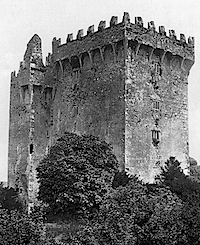
castleOnce there was a town. In the middle of the town stood a castle, and in the middle of the castle stood a high tower, and at the highest point of the tower was the chamber of a princess. Her name was Claire Pellucida, and the people of the town loved her, because she was pretty, and her eyes shone. They found her wise, because they would come to her and ask her what she could see from the window of her chamber, and she would tell them the most wonderful things. And the town itself was called Pellucida, in honour of its wise and pretty princess.

One day the people of the town assembled in the courtyard of the castle, and called up to the princess. “Princess Claire Pellucida, tell us what you can see to the north.”

The princess looked to the north, and said, “Far away I see mountains, with summits and pinnacles as sharp as needles. There are trees growing there, that are of solid silver, and on them hang fruits and berries that are pearls and hard diamonds. There is a river of clear crystal, like ice, that flows with such slowness. And in amongst the silver trees I see the glint of the eyes of ermines and foxes; and above the trees, on snowy wings, fly white birds like eagles, with silver beaks.”

The townspeople were amazed, and very happy that they had such a wise princess, who could see so far and tell them such wonderful things. But visitors from the north laughed at them.

“You Pellucidians are fools,” they said. “There are no such mountains to the north of here, no such trees, nor birds, nor animals, nor a crystal river!”

But the people of the town believed their princess, and one day, when Claire Pellucida had grown into a beautiful young woman, they assembled in the courtyard of the castle and called up to the princess. “Princess Claire Pellucida, tell us what you can see to the east.”

The princess looked to the east, and said, “Far away I see a forest, standing stark against the rising sun. The trees are an army of gigantic soldiers in a livery of black and dark green, and they roar in the wind, brandishing their long spears angrily, because they cannot march upon us.”

The townspeople were amazed, and very happy that they had such a wise princess, who could see so far and tell them such wonderful things. But visitors from the east laughed at them.

“You Pellucidians are fools,” they said. “There is no such forest of roaring giants to the east of here.”

But the people of the town believed their princess, and one day, when Claire Pellucida had grown into a handsome matron, they assembled in the courtyard of the castle and called up to the princess, “Princess Claire Pellucida, tell us what you can see to the south.

The princess looked to the south, and said, “Far away I see a land where the sands ripple as the sea does, and the mountains are like children’s bricks, stacked chequered – white limestone, red sandstone, pink granite. And the trees wave in the breeze, like many-fingered hands, and amongst them step lithe girls and boys in linen robes, gathering the amber fruits that hang on them.”

The townspeople were amazed, and very happy that they had such a wise princess, who could see so far and tell them such wonderful things. But visitors from the south laughed at them.

“You Pellucidians are fools,” they said. “There are no such mountains like children’s bricks to the south of here. Nor are there such waving trees with amber fruit.”

But the people of the town believed their princess, and one day, when Claire Pellucida had grown into a stately old woman, they assembled in the courtyard of the castle and called up to the princess. “Princess Claire Pellucida, tell us what you can see to the west.”

The princess looked to the west, and said, “Far away I see a peaceful sea of liquid silver, where the sun shines like copper. There is an island on that silver sea, and a great city on that island, with tall towers of yellow-veined marble, on which the copper sunlight glints, and shines, and dances. And upon that silver sea sail great golden dhows.”

The townspeople were amazed, and very happy that they had such a wise princess, who could see so far and tell them such wonderful things. But visitors from the west laughed at them.

“You Pellucidians are fools,” they said. “There is no such silver sea to the west of here. Nor is there such and island city, nor golden dhows.”

But the people of the town still believed their princess, as they had always done.

The night after she had looked to the west, and told the people of the town what she had seen there, Princess Claire Pellucida was wakened by a great glow outside the window of her chamber. She rose from her bed, and looked out of her window, to the west. There was the silver sea, the copper sunset, the island with its city of yellow-veined marble; and more marvellously, a silver river was running from the silver sea right to her castle. And on that silver river was a great, golden dhow. And on that great, golden dhow stood tall mariners and fine ladies, all dressed in saffron cloaks sewn with golden-thread. There were circlets on their heads of interwoven white gold and yellow gold, and torques of copper round their necks and wrists, and rings of gold upon their fingers. And they saluted and bowed, and called out to the princess.

“Princess Claire Pellucida, come down and sail with us to the island in the silver sea; for the island city with its towers of yellow-veined marble, has need of a queen to rule it.”

So Princess Claire Pellucida came down from her chamber in the highest point of the tower, in the centre of the castle; and she sailed away with the tall mariners and fine ladies, to the sunset, to the silver sea, to the island city with its towers of yellow-veined marble. And there she ruled as their Queen for ever.

But that is not the end of things.

The next morning, the people of the town of Pellucida gathered in the courtyard of the castle, and called up to their princess. But she did not answer. One brave townsman entered the castle, and climbed the tower, and from the window of the chamber at its highest point, he called sadly for five of his friends to join him.

In the chamber, the six men stood, and looked down at the bed, on which lay Princess Claire Pellucida. She lay smiling and peaceful, as though she slept, and in her face the six men could see the fleeting prettiness that had been there when she was a girl, the beauty that had been there when she was a grown woman, the loving gentleness that had been there when she was a matron, and still, still the stately splendour of their dear princess in old age lingered also. But they knew that she was not sleeping. She had left them, and was dead.

But even that is not the end of things.

The six men carried her, with great sadness and reverence, down to the townspeople, and they all processed solemnly out of the town, and laid the body of the princess – as was their custom – a mile away, in the great, open wilderness that surrounded the town for mile upon mile, for the wild beasts and the birds to devour.

But even that is not the end of things.

The townspeople continued to tell stories to their children, of all the wonderful things that the princess had seen from her chamber in the castle tower, and of all the things she had told them. The children believe the stories, and worshipped the tower where the princess had lived. They told the same stories to their own children. These children did not believe them, but still they told the same stories to the next generation. The children of that next generation believed nothing at all, except what travellers from the north, from the east, from the south, and from the west told them.

And who knows if that is the end of things!

golden 2

__________

I’m thinking of putting together a collection of my short stories – most of which you have not seen here on the web site, and presenting them for publication. What do you think? If you would like to read through the short stories that I have published so far on this web site, please click here.

M

Robin Hood and the Bishop of Hereford

Robin Hood and the Bishop of Hereford

Robin Hood and the Bishop of Hereford,

A story for May Day *


It happened that on the first day of May the Lord Bishop of Hereford was riding through the Great Greenwood that once covered most of England, on his way from the Abbey of St Hilda in Whitby to his own city of Hereford. Against the advice of the Abbot of Whitby, he was riding alone, for the Bishop was a man of great stature and courage and feared no man. “Besides,” he had said to the abbot, “who would waylay a man of the Church?”

As the Lord Bishop rode through the forest, looking around at the fresh, spring leaves on the oaks, the ashes, and the bonny rowans, and listening to the chaffinches giving their celebratory spring call and the jays laughing at them from deep in the trees, he too was filled with joy, and broke into a chant, in the manner of St Gregory.

Te Deum laudamus,” he sang, in his great baritone. “Te Dominum confitemur…” and the birds seemed to increase their trilling and laughing in friendly rivalry with him. Here, where the forest was at its deepest and greenest, and the track wound in between the oak boles, he felt was a place of goodness, where no harm could come to anyone, and if anywhere was a remnant of the blessed Garden of Eden, then this corner of England was it.

“Hold!” cried a voice, of a sudden. The Bishop broke off his song, looked down, and saw that he was surrounded by men in Lincoln Green, one of whom – a bold, smiling villain in a feathered cap – held fast his palfrey’s bridle. All brandished stout longbows with arrows nocked, some of which were pointed at him.

“Who are you men who roughly and rudely interrupt my praises to the Almighty, prevent my travel, and disturb this blessed Spring day?” cried the Bishop. “And especially, who art thou, grinning in thy beard? Yes, thou, the knave with the pheasant’s tail in his bonnet, who hast laid hands on my horse.”

This man, who appeared to be the leader of the troop, let go of the bridle, showed the palm of his hand to be clear of it.

“Upon your parole, then, my Lord Bishop,” he said. Then, sweeping his cap from his head, he bowed low and made a respectful leg to the prelate. “I am known in these parts as Robin Hood, and these honest churls, on whose behalf I beg your pardon for the interruption to your journey, are my friends and fellow Foresters. We collect the toll from travellers who pass this way.”

“Never let it be said that I refused to render unto Caesar that which is Caesar’s,” said the Bishop. “How much is the toll?”

“Half of all you carry,” said Robin, “and an hour or so of your time to dine with us.”

The Bishop’s eyes opened wide. “I am a humble priest!” he protested, “but even half of what I carry is too much to ask, surely?”

“Your fine garments, your riding-horse, the ring on your finger, and the heavy pouch at your belt would all say that you are far from humble, My Lord Bishop. Besides, it is much less of an impost than some of my men here have had to pay, having lost all they ever possessed.”

Now the Bishop, large and fearless though he was and capable of standing a round of buffets with any man, was kindly at heart. He had heard of how the outlaws of Sherwood, once they had sufficient to keep themselves fed, would distribute the bulk of their pelf to the poor, and he himself was cognizant of the virtue of St Martin. He recalled the story of how the saint, while still a soldier and a worldly man, had freely cut his paenula in two and given half to a shivering beggar who – as it was revealed to him in a dream – was Christ in disguise. Well, the man with the feathered cap was no Christ, any more than the others of the green-clad band were Apostles, so the Bishop was of a mind to have some sport with them.

“I doubt me, Sirrah, that thou art truly Robin Hood,” he said. “And if thou art not, what is to prevent another band of robbers stopping me a mile hence with their own claim to be the Merry Men of Sherwood, then another band a mile further, then another and another, each taking half, until I am left with a groat, half a cassock, half a cloak, and one shoe? I hear that Robin Hood and his followers are great archers. Lend me for one minute one of your longbows – let it be the worst you have – and I shall loose an arrow, shooting it as far as I can. If you can shoot further, and thou, Feathered-Cap Esquire, furthest, then I shall acknowledge that I am indeed in the presence of Robin Hood and his men, and I shall pay the forest-toll.”

With these words the Bishop leapt down from his horse and took hold of the bow of Much the Miller’s son, nocked an arrow to it, drew it, and let fly. The arrow’s flight was long, and it landed in a field beyond the trees. The Bishop handed the bow back to Much, who nocked a second arrow, drew back the bowstring, and with a grunt of effort shot it into the same field, but a little further than the Bishop’s. The Bishop clapped his hands.

“Excellent bowmanship for such a young lad!” he exclaimed, and then pointed at Will Scatlock. “Now this fellow!”

Will drew back his bowstring and shot an arrow into the next field, to the Bishop’s delight. Each of the band had his turn, each shooting further and further, until it was the turn of the tall, powerful John Little. With his mighty arms he drew back his bow and loosed an arrow that went two fields further than the last man’s.

“Thou giant!” cried the Bishop, even though he was of a height with John Little. “I’ll wager no one can best that!”

Robin Hood stepped forward. He was no match for his great lieutenant in height and strength, but his skill was such that he knew well how to make the most of a longbow. He took his bow, nocked an arrow, drew, elevated the bow with exactness and, having waited for the wind to die a little, let fly. The arrow went a prodigious distance and landed one field further than John Little’s. The Bishop clapped and cheered, and then bowed to Robin, addressing him politely.

“You are indeed Robin Hood!” he said. “That I freely acknowledge.”

“Then pay the toll, my Lord Bishop,” said Robin. “That was the wager.” But the Bishop mounted his horse again and raised an eyebrow in a pretence of haughtiness.

“Who is to stop me? All your arrows are spent!”

Robin saw that the Bishop had bettered him, and he threw back his head and laughed. Then he bowed again.

“Well won, Well won! The freedom of the forest track is yours. Pass onwards free of toll, for you have taught us all a lesson today, and that is worth more than any toll.”

But the Bishop did not spur his horse. “I am determined to be magnanimous in victory,” he said. “These lands hereabouts are mine, and the field where the lad’s arrow landed I shall give to him, and it shall be known as ‘Miller’s Field’. The next, where Scatlock’s arrow landed, shall be his and shall be called ‘Will Scatlock’s Field’. And there shall be ‘John Little’s Field’, and ‘Robin’s Field’, and a field for all of you.” And this offer was a true one, because the Bishop was not only a priest but also a great holder of land in his own right, being of the line of one of the Conqueror’s barons.

“Alas,” said Robin, shaking his head, “ this cannot be, for we are outlaws and forbidden to hold land.”

“Some say, however, that you are heir to the Manor of Locksley.”

“Aye, and others that I am the son of the Earl of Huntingdon, and others still that I am a Knight of the Cross of St John. But the law is the law, and we are outside it,” said Robin.

The Bishop dismounted again and clasped Robin’s hand.

“Then your lineage,” he said, smiling, “matters nothing to me. We shall halve the contents of my purse. Now, I believe there was some mention of dining – dare I expect venison?”

Thus the Bishop of Hereford came to feast in Sherwood, and a merry May Day was had by all. The Bishop counted over half of the coins in his purse, as he had promised, and made sure he had at least his fair share of venison. He conversed in Latin with the good Friar Tuck, in French with Demoiselle Marianne who was Norman, and even in Arabic and Greek with ibn Hassan, Robin’s hostage-become-friend. At the end of the feast he went on his way with many a wave and a Pax Vobiscum.

From that day, in all the diocese of Hereford, no church from the Cathedral itself to the lowliest chapel would refuse sanctuary to any man dressed in Lincoln Green; and every May Day was a holiday amongst the outlaws, and in their feasting they never forgot to toast the Bishop of Hereford, the only man ever to get the better of bold Robin Hood.

__________

* In most of the Robin Hood folk-tales, the Bishop of Hereford is portrayed as an enemy of Robin and the outlaws. In this particular tale, which is based on a story I heard from a teacher when I was a little girl, the Bishop is a good character. This tale is retold just for fun, without any pretended literary merit – whoever heard of a folk tale having literary merit, for heaven’s sake!

Baal, Yamm, and Anath

Embedded in The Everywhen Angels is this tale, handed down from ancient Canaan; it is told by a Romany patriarch to a gorjo boy, as his wife paints a henna tattoo on the boy’s arm.
__________

BaalFar away in the land of Canaan, many years ago, beyond the city of Ugarit, where they sang psalms to the creator El long before the Children of Israel came and stole not only their land but their psalms too, there stood a mountain. The mountain’s name was Zaphon, and it was the home of the great god Baal, son of Dagon, called ‘Lord of Thunder’, ‘Almighty’, ‘Rider of the Clouds’, ‘Lord over the Earth’. Some folk called Baal by the name of Hadad. Baal was never still – he could never rest – and thunder could be heard daily from Mount Zaphon, and flashes of lightning played around its summit.

From the summit of Mount Zaphon, where he ceaselessly paced to and fro, Baal could see the Mediterranean ocean, home of the god Yamm. Baal became angry. His kingdom now felt small, because he could see its boundaries. And in his anger he called out to Yamm, insulting him continually in his loud voice, hurling thunderbolts and making great winds, so that Yamm’s kingdom was constantly in turmoil, tossing this way and that in the storms and winds that Baal sent.

“Come out and fight me, Yamm, you coward!” shouted Baal, in a voice that echoed in a peal of thunder so loud it was heard beyond the southern border of Canaan. “Stop skulking in your slimy kingdom. Show yourself!”

And at last Yamm came up from the sea, his dark face rising like a tidal wave, and he set his great, green foot upon the shore, upon Baal’s kingdom. And he shouted back to Baal in a voice like the crashing of breakers against the cliffs.

“Here I stand, you blustering bully! Are you nothing but noise? I challenge you! Who’s the coward now?”

Baal saw that Yamm was indeed mighty, a great enemy, strong and fearsome. Baal himself was no coward, but he was very cunning, and so he went to Kothar, the blacksmith god, skilled in making any object a god could need. He asked Kothar to make him mighty weapons with which to fight Yamm. Kothar took all the metal that lay under the ground between Mount Zaphon in the West, and the Indus river in the East, and he worked it into a great, bronze sword. And he scooped up a huge piece of the Earth and made it into a stout shield; and the hole it left became the Sea of Galilee.

Armed with the sword and shield, Baal charged at Yamm. The battle between these two gods lasted twelve whole years, during which time there were such thunderstorms and tides as had never been seen in the Mediterranean*. Baal pushed at Yamm with his shield, and battered at him with his sword; and with every push of the shield and stroke of the sword there was a huge peal of thunder and flash of lightning. Yamm whipped Baal with waterspouts and showers of stinging rain and hail.

In the city of Ugarit, and throughout Canaan, the poor people cowered in their houses, only coming out when the two rival gods paused between rounds.

Eventually Yamm began to gain the upper hand, and roared with delight, beating Baal further and further back inland. One lash with a mighty waterspout was enough to send Baal’s shield spinning from his hand, to land on its edge in the sea, where it became the island of Cyprus.

By this time even the gods themselves had come to watch the battle, betting upon the outcome. The sun goddess, Shapash, was the only one to bet on Baal, and secretly warmed and dried him with her rays. Baal, who as you know was cunning, devised a plan to escape defeat. He waited until the sun goddess’s kindly gaze was on him and then angled his mighty, bronze sword so that it reflected the sunlight right into Yamm’s eyes. Yamm was dazzled and blinded, and Baal started to belabour him with the flat of his sword, raining blow after blow down upon the sea god, until he was beaten, and the sea became calm and still.

Now Baal had a wife who was also his sister. Do not ask me how this can be, but such things were possible with the gods of Canaan. Not only was Anath his sister and his wife, but she was forever a virgin. She was greatly loved by all the gods, and she took Baal by the hand and led him to see El, the creator, to whom all psalms were sung. There she told him that the reason Baal paced to and fro on Mount Zaphon was that he had no house to live in. If El would give permission for Baal to have a house built, then all Canaan would be a place of peace. El readily gave his permission.

Anath asked Kothar for help, calling to him sweetly, using the pet name she had for him. “O Hasis the Skilful, Hasis the Wise, make a house for my brother-husband Baal and me, in which we can live peacefully.”

Kothar built a house for Baal on top of Mount Zaphon, and Baal was pleased. For a while all Canaan was at peace, the sun shone, and the gods dozed. Even Yamm forgot his quarrel with Baal, and visited him in his house. At such times the summit of Mount Zaphon was wreathed in mist.

One day Baal invited all the gods to a great feast. Yamm was there, and El the creator as the guest of honour. Shapash and Kothar sat together, and even Yutpan the deceitful had a place. The only god not to be invited was Mot, the god of death. When he heard about the feast, he strode up Mount Zaphon in a rage, and pounded so hard on the door of Baal’s house that the food and drink was shaken off the tables.

Mot burst into the house and cursed and ranted at Baal for the insult of not inviting him. Baal was so enraged at this that he forgot he was supposed to be living a peaceful life. He sprang to his feet, seized the sword that he had used to defeat Yamm, and rushed at Mot.

Their duel was a terrible sight. Even the mighty gods fled from Mount Zaphon, as Baal and Mot reduced the lovely house to rubble in their raging. But even the mighty Baal could not defeat Death, and Mot eventually swallowed up Baal, and spat him out on the mountain top, dead and cold.

While the gods debated amongst themselves who could take Baal’s place, Anath mourned for him. Not only did she mourn as a sister and a wife, but also as a mother and a daughter would, for she was all things to Baal. She wandered through Canaan looking for Baal’s body, and when she found it, she buried it and wept over his grave. But her tears, at first cool and sorrowful, turned to drops of fire, and became a rage such as creation had never seen. She turned and ran and ran until she came to Mot, flinging herself upon him in a murderous frenzy. Struggle as he might, Mot found he was no match for Anath, because as she had mourned Baal as a sister, a wife, a mother, and a daughter, she had become four goddesses in one. In her wrath she killed Mot, ground his body to powder, and scattered it over land and sea.

Then she took the place of Baal on top of Mount Zaphon, where she ruled for many years, no longer as Anath the gentle and beloved of the gods, but as the goddess of slaughter, whom some called Ashtoreth, with a hideous aspect.

Many lives of men and women passed. One night El, the creator, dreamed a dream, in which Baal and Mot were alive and stood before him. What El dreams always comes to pass, and so when he awoke, there before him stood Baal and Mot, restored to life. He charged them solemnly each to keep to his own kingdom, and not to fight any more. They bowed low to him and gave him their promise.

When Anath saw Baal coming again to Mount Zaphon, her heart was softened, and her face became beautiful once more. She painted herself with a dye made from her sacred plant, which she called Mehendi, making  the beautiful patterns on her face and limbs, which brides do to this very day in India, and in Mesopotamia, and in all parts of Arabia.

And Baal and Anath lived in peace and happiness ever after. Some say that when the One God came they faded away. Others say they still live on top of Mount Zaphon, but now as an old man and an old woman, and have retired from being gods.

But one thing I know is this: Anath’s sacred plant, Mehendi, which we call Henna, still grows.
__________

* Yes, I know, I know!

Loss (flash fiction)

Because this started out as an idea for a poem, and is prose-poetry rather than straight fiction, I’ve posted it on my poetry blog.

‘Dryad’ (with Joanne Harris)

People often ask me how I started writing. The answer is I started writing because I found I could. I entered a competition where participants had to complete a short story started by Joanne Harris. It doesn’t matter now how successful or unsuccessful my entry was; what does matter is that a quirk in my mind was turned towards writing, and I am glad of that. I thought you would like to read the story, partly © Joanne Harris, partly © me, to see the way my mind suddenly started to work back then.

Dryad

In a quiet little corner of the Botanical Gardens, between a stand of old trees and a thick holly hedge, there is a small green metal bench. Almost invisible against the greenery, few people use it, for it catches no sun and offers only a partial view of the lawns. A plaque  in the centre reads: In Memory of Josephine Morgan Clarke, 1912-1989. I should know – I put it there – and yet I hardly knew her, hardly noticed her, except for that one rainy Spring day when our paths crossed and we almost became friends.

I was twenty-five, pregnant and on the brink of divorce. Five years earlier, life had seemed an endless passage of open doors; now I could hear them clanging shut, one by one; marriage; job; dreams. My one pleasure was the Botanical Gardens; its mossy paths; its tangled walkways, its quiet avenues of oaks and lindens. It became my refuge, and when David was at work (which was almost all the time) I walked there, enjoying the scent of cut grass and the play of light through the tree branches. It was surprisingly quiet; I noticed few other visitors, and was glad of it. There was one exception, however; an elderly lady in a dark coat who always sat on the same bench under the trees, sketching. In rainy weather, she brought an umbrella: on sunny days, a hat. That was Josephine Clarke; and twenty-five years later, with one daughter married and the other still at school, I have never forgotten her, or the story she told me of her first and only love.

It had been a bad morning. David had left on a quarrel (again), drinking his coffee without a word before leaving for the office in the rain. I was tired and lumpish in my pregnancy clothes; the kitchen needed cleaning; there was nothing on TV and everything in the world seemed to have gone yellow around the edges, like the pages of a newspaper that has been read and re-read until there’s nothing new left inside. By midday I’d had enough; the rain had stopped, and I set off for the Gardens; but I’d hardly gone in through the big wrought-iron gate when it began again – great billowing sheets of it – so that I ran for the shelter of the nearest tree, under which Mrs Clarke was already sitting.

We sat on the bench side-by-side, she calmly busy with her sketchbook, I watching the tiresome rain with the slight embarrassment that enforced proximity to a stranger often brings. I could not help but glance at the sketchbook – furtively, like reading someone else’s newspaper on the Tube – and I saw that the page was covered with studies of trees. One tree, in fact, as I looked more closely; our tree – a beech – its young leaves shivering in the rain. She had drawn it in soft, chalky green pencil, and her hand was sure and delicate, managing to convey the texture of the bark as well as the strength of the tall, straight trunk and the movement of the leaves. She caught me looking, and I apologised.

“That’s all right, dear,” said Mrs Clarke. “You take a look, if you’d like to.” And she handed me the book.

Politely, I took it. I didn’t really want to; I wanted to be alone; I wanted the rain to stop; I didn’t want a conversation with an old lady about her drawings. And yet they were wonderful drawings – even I could see that, and I’m no expert – graceful, textured, economical. She had devoted one page to leaves; one to bark; one to the tender cleft where branch meets trunk and the grain of the bark coarsens before smoothing out again as the limb performs its graceful arabesque into the leaf canopy. There were winter branches; summer foliage; shoots and roots and windshaken leaves. There must have been fifty pages of studies; all beautiful, and all, I saw, of the same tree.

I looked up to see her watching me. She had very bright eyes, bright and brown and curious; and there was a curious smile on her small, vivid face as she took back her sketchbook and said: “Piece of work, isn’t he?”

It took me some moments to understand that she was referring to the tree.

“I’ve always had a soft spot for the beeches,” continued Mrs Clarke, “ever since I was a little girl. Not all trees are so friendly; and some of them – the oaks and the cedars especially – can be quite antagonistic to human beings. It’s not really their fault; after all, if you’d been persecuted for as long as they have, I imagine you’d be entitled to feel some racial hostility, wouldn’t you?” And she smiled at me, poor old dear, and I looked nervously at the rain and wondered whether I should risk making a dash for the bus shelter. But she seemed quite harmless, so I smiled back and nodded, hoping that was enough.

“That’s why I don’t like this kind of thing,” said Mrs Clarke, indicating the bench on which we were sitting. “This wooden bench under this living tree – all our history of chopping and burning. My husband was a carpenter. He never did understand about trees. To him, it was all about product – floorboards and furniture. They don’t feel, he used to say. I mean, how could anyone live with stupidity like that?”

She laughed and ran her fingertips tenderly along the edge of her sketchbook. “Of course I was young; in those days a girl left home; got married; had children; it was expected. If you didn’t, there was something wrong with you. And that’s how I found myself up the duff at twenty-two, married – to Stan Clarke, of all people – and living in a two-up, two-down off the Station Road and wondering; is this it? Is this all?”

That was when I should have left. To hell with politeness; to hell with the rain. But she was telling my story as well as her own, and I could feel the echo down the lonely passages of my heart. I nodded without knowing it, and her bright brown eyes flicked to mine with sympathy and unexpected humour.

“Well, we all find our little comforts where we can,” she said, shrugging. “Stan didn’t know it, and what you don’t know doesn’t hurt, right? But Stanley never had much of an imagination. Besides, you’d never have thought it to look at me. I kept house; I worked hard; I raised my boy – and nobody guessed about my fella next door, and the hours we spent together.”

She looked at me again, and her vivid face broke into a smile of a thousand wrinkles. “Oh yes, I had my fella,” she said. “And he was everything a man should be. Tall; silent; certain; strong. Sexy – and how! Sometimes when he was naked I could hardly bear to look at him, he was so beautiful. The only thing was – he wasn’t a man at all.”

Mrs Clarke sighed, and ran her hands once more across the pages of her sketchbook. “By rights,” she went on, “he wasn’t even a he. Trees have no gender – not in English, anyway – but they do have identity. Oaks are masculine, with their deep roots and resentful natures. Birches are flighty and feminine; so are hawthorns and cherry trees. But my fella was a beech, a copper beech; red-headed in autumn, veering to the most astonishing shades of purple-green in spring. His skin was pale and smooth; his limbs a dancer’s; his body straight and slim and powerful. Dull weather made him sombre, but in sunlight he shone like a Tiffany lampshade, all harlequin bronze and sun-dappled rose, and if you stood underneath his branches you could hear the ocean in the leaves. He stood at the bottom of our little bit of garden, so that he was the last thing I saw when I went to bed, and the first thing I saw when I got up in the morning; and on some days I swear the only reason I got up at all was the knowledge that he’d be there waiting for me, outlined and strutting against the peacock sky.

Year by year, I learned his ways. Trees live slowly, and long. A year of mine was only a day to him; and I taught myself to be patient, to converse over months rather than minutes, years rather than days. I’d always been good at drawing – although Stan always said it was a waste of time – and now I drew the beech (or The Beech, as he had become to me) again and again, winter into summer and back again, with a lover’s devotion to detail. Gradually I became obsessed – with his form; his intoxicating beauty; the long and complex language of leaf and shoot. In summer he spoke to me with his branches; in winter I whispered my secrets to his sleeping roots.

You know, trees are the most restful and contemplative of living things. We ourselves were never meant to live at this frantic speed; scurrying about in endless pursuit of the next thing, and the next; running like laboratory rats down a series of mazes towards the inevitable; snapping up our bitter treats as we go. The trees are different. Among trees I find that my breathing slows; I am conscious of my heart beating; of the world around me moving in harmony; of oceans that I have never seen; never will see. The Beech was never anxious; never in a rage, never too busy to watch or listen. Others might be petty; deceitful; cruel, unfair – but not The Beech.

The Beech was always there, always himself. And as the years passed and I began to depend more and more on the calm serenity his presence gave me, I became increasingly repelled by the sweaty pink lab rats with their nasty ways, and I was drawn, slowly and inevitably, to the trees.

Even so, it took me a long time to understand the intensity of those feelings. In those days it was hard enough to admit to loving a black man – or worse still, a woman – but this aberration of mine – there wasn’t even anything about it in the Bible, which suggested to me that perhaps I was unique in my perversity, and that even Deuteronomy had overlooked the possibility of non-mammalian, inter-species romance.

And so for more than ten years I pretended to myself that it wasn’t love. But as time passed my obsession grew; I spent most of my time outdoors, sketching; my boy Daniel took his first steps in the shadow of The Beech; and on warm summer nights I would creep outside, barefoot and in my nightdress, while upstairs Stan snored fit to wake the dead, and I would put my arms around the hard, living body of my beloved and hold him close beneath the cavorting stars.

It wasn’t always easy, keeping it secret. Stan wasn’t what you’d call imaginative, but he was suspicious, and he must have sensed some kind of deception. He had never really liked my drawing, and now he seemed almost resentful of my little hobby, as if he saw something in my studies of trees that made him uncomfortable. The years had not improved Stan. He had been a shy young man in the days of our courtship; not bright; and awkward in the manner of one who has always been happiest working with his hands. Now he was sour – old before his time. It was only in his workshop that he really came to life. He was an excellent craftsman, and he was generous with his work, but my years alongside The Beech had given me a different perspective on carpentry, and I accepted Stan’s offerings – fruitwood bowls, coffee- tables, little cabinets, all highly polished and beautifully-made – with concealed impatience and growing distaste.

And now, worse still, he was talking about moving house; of getting a nice little semi, he said, with a garden, not just a big old tree and a patch of lawn. We could afford it; there’d be space for Dan to play; and though I shook my head and refused to discuss it, it was then that the first brochures began to appear around the house, silently, like spring crocuses, promising en-suite bathrooms and inglenook fireplaces and integral garages and gas fired central heating. I had to admit, it sounded quite nice. But to leave The Beech was unthinkable. I had become dependent on him. I knew him; and I had come to believe that he knew me, needed and cared for me in a way as yet unknown among his proud and ancient kind.

Perhaps it was my anxiety that gave me away. Perhaps I under-estimated Stan, who had always been so practical, and who always snored so loudly as I crept out into the garden. All I know is that one night when I returned, exhilarated by the dark and the stars and the wind in the branches, my hair wild and my feet scuffed with green moss, he was waiting.

“You’ve got a fella, haven’t you?”

I made no attempt to deny it; in fact, it was almost a relief to admit it to myself. To those of our generation, divorce was a shameful thing; an admission of failure. There would be a court case; Stanley would fight; Daniel would be dragged into the mess and all our friends would take Stanley’s side and speculate vainly on the identity of my mysterious lover. And yet I faced it; accepted it; and in my heart a bird was singing so hard that it was all I could do not to burst out laughing.

“You have, haven’t you?” Stan’s face looked like a rotten apple; his eyes shone through with pinhead intensity.

“Who is it?”

I kept laughing. And then I stopped. We stood looking at each other, there in our front room, and I couldn’t find anything to say. My eyes wandered over to the table, where I had left my sketchbooks, and Stan’s gaze followed mine; then we looked at each other again, and I fancied I could see more in Stan’s eyes at that moment than I would have thought possible in such an unimaginative man. There was a sort of realisation, without understanding. There was anger, and there was pain.

I was terrified. I thought he might hit me. Then I thought he might do something to my sketchbooks. But at last he turned and went back upstairs, coming down a few minutes later in his working clothes. At the foot of the stairs he pulled his boots on, took the key to his lock-up workshop from the stand by the door, and went out of the house without saying a word or looking at me.

There was nothing for me to do, I felt, but to go back into the garden, and put my head against the trunk of The Beech.

People tell me that there was a terrible squall that night, and I am sure that the wind did get up awfully. But that can’t account for the way The Beech behaved to me. He seemed even angrier than Stan, now that our secret was out, and there was nothing slow about how he showed it. His trunk swayed, as he lashed his branches by my face, making me flinch. A falling branch glanced off my shoulder; a hail of leaves whipped my face. “Go!” he was saying to me. “Go! Go!”

Feelings of rejection and betrayal battled inside me with the sudden realisation that I had put The Beech in danger. I dashed back into the house, pulled on coat and shoes, and then I was out of the front door – leaving Daniel alone upstairs – running down towards Stan’s workshop. To Stan, a tree was nothing more than raw material, and the workshop held tools for dealing with that raw material. I knew what he wanted to do, but God knows what I could have done to stop him.

When I got to the workshop, Stan was sitting at a workbench. He was gripping the handle of a saw tightly in his right hand, but he was just sitting there, not moving. When I got closer to him, I could see that his eyes were glassy, and there was spittle running down his chin.”

Mrs Clarke sighed, and looked at me.

“That was his first stroke – the first of three. It put paid to his business, and to his dreams of a new house in the suburbs. It put paid to his power of speech, and suddenly I lived in an almost silent world, as The Beech no longer spoke to me either. We had to move after all, but into a downstairs flat at the other end of the borough. Stan couldn’t manage stairs, and in those days you looked after a sick husband, no question. He lived through the war, right into the mid fifties. I’m on my own now – Dan’s in Australia. I still draw. From memory……”

It had stopped raining, and I stood up, conscious that she had run out of steam.

“That’s quite a story,” I said. “Look, I’ll come back soon. I’ll see you again. But please excuse me, there’s something I must……..”

Not finishing sentences was catching! I looked back at her, as I hurried off towards the gate of the Botanic gardens. She smiled briefly, and then turned back to her sketchbook, and to her pictures – the pictures of our tree!

I walked home too fast for a pregnant woman. I hurried past the supermarket which stood, as I recalled, where the old lock-ups had been. I turned left into Station Road, and by the time I got to Mafeking Avenue, a street of refurbished terrace-houses, I was breathing hard. At number thirty-eight – my house – I fumbled in my pockets for the key, and opened the front door impatiently. I walked straight through the front room, through the dining room, through the nineteen-seventies’ extension, and out into the York-stone-paved back yard, with its terracotta pots and planters. I went straight down to the semicircle of earth at the far end, stopped, and looked up at The Beech. It had seemed familiar in Mrs Clarke’s drawings, but now I knew it beyond doubt. It was older, but it was the same tree.

I stretched out my hand gently, and laid it on the trunk – and began to understand! I turned, and rested my back against it, tilting my head round so that my cheek was against it too. I raised one hand to caress it, heard a sighing from the branches, and felt a few drops of rain, shaken from the leaves onto my face.

That’s where I was when my contractions started.

Twenty-five years have passed, during which time I have patiently learned the lesson which she did not: a secret has to be kept. The patience which I have learned from The Beech has spread outward into the rest of my life. The doors which had been clanging shut before, began to ease themselves gently open. My whole existence has seemed calmer, slower, more fruitful. My marriage went on, and produced a second daughter; oh sure, David left eventually, but men do that anyhow. I always meant to go and confide in Mrs Clarke, but I never saw her in the Botanic Gardens again, and eventually I found her in the municipal cemetery. The seat was a gesture to her, nothing more.

My life with The Beech has not been one of conversation, but of communion; not sex, but the meeting and merging of our essences. Oh there is passion, but it does not rage out of control. I sit with my back to him, to all intents simply a woman resting against a tree at the bottom of her garden, and I learn how to see and to feel with his slow consciousness, as it overtakes mine.

Soon – as a tree understands soon – my younger daughter Alice may well leave for college, or get married herself. But I shall never be alone. I shall be here, patiently waiting for answers. Do I carry a seed inside me? When I am dead and buried, will a new tree spring from the ground, and will its new thoughts be mine, or yours, or his own? This is the destiny of the dryad.

__________

© Joanne Harris/BBC/Marie Marshall