Marie Marshall

Author. Poet. Editor.

Tag: Short story

Mabel’s Fables: ‘The Three Blind Men and the Elephant’

elephant fable

Little one, many folk tell the tale of the three blind men who, unaware of each other, came upon the same elephant.

The first blind man, putting out his hands to feel his way, touched the elephant’s mighty trunk, feeling it flex and move, as though it had a life independent. He took it for a great snake.

“Surely,” he thought, “This is the greatest, most magnificent snake ever!”

The second blind man bumped into one of the elephant’s legs and, putting out his arms to try and encompass it, was certain that he had found the bole of a tall tree.

“Surely,” he thought, “There is no tree in all the world like this!”

The third blind man felt the elephant’s tail brush his face, and when he caught it in his hand, he was convinced that it was part of a gigantic vine.

“Surely,” he thought, “A man could live in the shade of this vine and want for nothing.”

Now folk who tell this tale, little one, usually stop at that point, and say it proves that in matters of faith and belief, all men perceive a little bit of the truth, never all of it. But they are not wise, little one, for the tale does not stop there. It goes on…

The first blind man became devoted to his notion of a snake, and began to worship it, singing and chanting.

“O divine Serpent… O divine Serpent…”

The second blind man became devoted to his notion of a tree, and began also to worship it, singing and chanting.

“O ineffable Tree… O ineffable Tree…”

The third blind man became devoted to his notion of a vine, and began also to worship it, singing and chanting.

“O miraculous Vine… O miraculous Vine…”

Then they heard each other, and became angry.

“What fools these other two fellows are,” thought the first blind man. “This is neither a tree nor a vine, but the Holy Serpent!”

“What fools these other two fellows are,” thought the second blind man. “This is neither a snake nor a vine, but the Heavenly Tree!”

“What fools these other two fellows are,” thought the third blind man. “This is neither a snake nor a tree, but the… er… Divine… Vine!”

So they all began to sing and chant more loudly, in order to drown out each other’s voices; and soon there was cacophony.

“… ineffable Tree… divine Serpent… miraculous Vine…”

Then their anger blazed into fury, and they began to shout and scream at each other.

“Heretics!”

“Blasphemers!”

“Infidels!”

Now you are aware, little one, being the wisest of children yourself, that elephants are very patient animals. But even the patience of the most forbearing tusker wears very thin, when such a hullabaloo happens around his feet. For this elephant was perfectly certain in his own mind that he was neither snake, nor tree, nor vine, but an elephant. And indeed he was. Elephant through and through. Elephant right to the core of his being. He knew well enough that each of the blind men did not have some of the truth, part of the truth, or even a little bit of the truth. All three were totally, completely, utterly… wrong!

Eventually he could stand no more. He shook his trunk free of the first blind man’s hands, and trumpeted loudly in his ear.

“Ow!” said the first blind man, his head ringing. “No snake ever did that!”

Next the elephant lifted his leg, and trod on the toes of the second blind man.

“Ow!” yelled the second blind man. “No tree ever moved!”

Next the elephant – I’m afraid – evacuated on the third blind man, who was impudently tugging his tail.

“Ugh!” said the third blind man. “Those are neither grapes nor oranges!”

In that moment, when the elephant manifested himself to them, little one, all three were enlightened, and knew the true nature of what they had worshipped separately.

Little one, foolish though these blind men were, eventually they were enlightened. Not so, I fear, those story-tellers who stop short, and do not themselves wait for the elephant to manifest itself. You see, because our god or our gods are known to be greater than we are, it is often assumed that they are wider and more complicated than we can conceive.

But they might just be simpler, more straightforward.

Like an elephant, little one.

Now be patient. You might dream of an elephant.

Go to sleep.

TOADMEISTER!

Toadmeister

Ratty had been emailing me faster than I could reply, not that I’m all that savvy with electronic communications. Actually I spend most of my time down my hole engrossed in World of Warcraft, deep in the wizard-world of Azeroth – I’m a Night Elf from Outland – currently operating at the fourth level of Cataclysm and on the run from Hakkar the Soulflayer… not relevant, not relevant… but on the other hand not much need for emails either.

Ratty’s emails, they went along these lines… hang on, let me open one up and cut-and-paste it for you, here we go…

“Hey Mole, I’m due to fly out to Cyprus today and go on board the Wildwood Warrior. We’re going to sail for the Gaza strip in a couple of days time with a cargo of humanitarian aid to see if we can get past the blockade. There is still nothing, Moley, absolutely nothing half so much worth doing as simply messing about in boats! LOL. Follow me on twitter @riverbankratty.”

That was last week. I can’t look at his tweets, I fear for the dear fellow. The world out there is a big place and a dangerous place. ‘Messing about in boats’ is one thing, messing about in big boats in a sea full of bigger boats bristling with guns is another thing altogether. Oh well, at least he can swim, and he always was an adrenalin-junkie, Pan knows! Like I said, I get my adrenalin rush from virtual wargaming.

Talking of which I bumped into Badger the other day coming out of the Red Lion. Bumped literally. He had his head down and his nose in his Mac Book Air, which was open. As we collided he let it slip and it would have shattered into a thousand very expensive pieces on the cobbles of the pub courtyard if I hadn’t fielded it like Alastair Cook taking a slip catch. Of course I couldn’t help noticing what was on his screen – World of Warcraft! It was an irritated ol’ Badger who snatched the lappie out of my hands.

“Hey Badgie,” I said. “Didn’t realise you were into ‘the Craft’.”

“You make it sound like the confounded Freemasons,” he said with a frown. “Yes I do the odd bit of gaming.”

“Well maybe we have crossed swords at some stage,” I said. “I’m Dalforstin the Night-Elf. Who are you?”

He mumbled something I didn’t catch.

“What was that?”

“I said I’m Kolkhatana, Warrior Princess of the Dwarves. Satisfied?” he snapped, and stalked off in moderately high dudgeon. I was silent – gobsmacked actually – as his hunched figure hurried away. He was cutting quickly round the hedge at the end of the lane when a sudden thought struck me.

“Kolkhatana? Hey, didn’t we…” I called. But he had gone. And it didn’t bear thinking about.

I decided it was time to drop in on Toad Hall. Things had been quiet there for some time. I did know that the upkeep was rather steepish these days and that Toad, bless his silly heart, had been threatening to give it to the National Trust and move into the gamekeeper’s cottage. Presumably that would mean  that the gamekeeper would have to move out – Toad wouldn’t have thought of that, of course. Anyhow, I ambled along what had once been a leafy lane… well it was still a leafy lane for most of its length but the here at the village end of it there was a tightly-packed knot of new houses – Toadfields. His Toadfulness had sold a patch of the old estate off to a developer in order to settle a tax bill. So anyhow, like I said, there I was ambling along the lane which led eventually to Toad Hall, when I realised I wasn’t on my own. Stoats and Weasels, rucks of ‘em, were popping out of the trees and hurrying excitedly down the lane. I could see the increasing crowd three hundred yards away funnelling through the lodge-gates and on to Toad’s gravelled driveway*.

Momentarily I paused. I wondered whether it was another invasion such as the one we four – me, Ratty, Badgie, and Toady – had fought off back in the day. But these stoats and weasels seemed in good spirits, not belligerent, as though setting off to have a good time. They were all relatively young ‘uns too.

I accosted a ferret in a cap and shades (incongruous those, because the sun was about to set) and asked him what was afoot.

“Hey bruv,” he said. “It’s ‘im, innit. It’s da beats, bruv, da beats. It’s totally sick, sick as aids, bruv!”

I resisted the temptation to say “No hablo Chav” and let him go on his way. Still I stood and wondered what in Pan’s name my ol’ pal Bufo Bufo was up to this time. We’d been through the camp site, the theme park, the WW2 vehicle museum, the health spa… none of those had attracted a surge of young mustelidae like this and, crucially, none of them had made any money either. I straggled behind the crowd as evening fell.

Toad hall was in darkness, but by the light of the hundreds of glo-sticks the stoats and weasels were carrying, and the luminescent screens of hundreds more iPhones, I could make out some sort of bulky structure in front of it – a stage? A dais?

Suddenly a siren sounded and a great cheer went up from the crowd. Then the cheering itself was drowned by a deafening swell of electronic music at (I guess) one-hundred-and-thirty beats per second – the unmistakeable sound of Euro-Trance. Then fireworks exploded, lasers and strobe lights flashed, the stage was lit up by spotlights and there… there… there behind what could only be a set of decks bristling with controls, screens, sequencer keyboards, all the gubbins of Electro… there in a brilliant white T-shirt, cycling shades, and headphones was Toad! Toad grinning from ear to ear. Toad punching the air in time to the music, while the stoats and weasels danced and bounced and punched the air in response.

“TOADMEISTER! TOADMEISTER!” they yelled in unison.

You could have knocked me down with a wet piece of hedge-sorrel. But as I became swept up in the euphoria, began to bounce, began to dance, began to punch the air, I realised that at last, at last, Toad had got what he had always wanted.

Acclamation!

__________

* I would be grateful to know, by the way, why Americans park on a driveway and drive on a parkway.

Before Fifty Shades: ‘The Dying Slave’.

Before Fifty Shades

It almost seems strange to be saying this, but there was life, and lifestyle, before Fifty Shades of Grey, and it made its way into literature. Sacher-Masoch’s Venus in Furs was published over 140 years ago. For some time before I became a ‘legit’ (what does that even mean?) author and poet I wrote about love, sex, domination, and the areas where they did and did not overlap. I wrote the vignette below in a deliberately-mannered and sentimental style, to reflect the formality that often exists within Dominant/submissive relationships; the era in which it is set is not mentioned, but it could belong to any time…

__________

“I have made her as comfortable as I can.” These had been the doctor’s parting words to Greta. Now Greta sat by Leonora’s bedside as the late afternoon sun struck aslant at the covers, through half-closed curtains. The room was almost silent. Outside, absurdly cheerful birds were twittering, oblivious to the sadness inside, where the only sound was the quiet rasping of Leonora’s breath.

“I do not have long,” said Leonora, very quietly. “I know this, Mistress.”

Greta reached out and took her hand, surprised by the strength of the grip she felt. Looking at Leonora’s face, her eyes met the dying woman’s, and held, and locked. She was surprised how bright they were, how much love and happiness they seemed to contain at this time. Leonora was smiling. Greta forced herself to smile in return, though she felt her heart was breaking.

“You will be fine, darling. Very soon you will be well and strong, and you will leave that bed. We’ll take our walks together again, and do all the things we love doing. And just call me Greta for now – there is no need for formality.” To herself she thought, “Why do we always say these absurd things to those whom we love, while life is slipping away? We know they are dying, they know they are dying, and yet we toss bright phrases about as if they are suffering from nothing worse than a slight migraine. Can we not bear the truth, even though we all know it?” She refocused on the sweet, submissive woman in the bed – the loving one who was slipping away from her – and fought hard to keep her composure. It did not break.

At the admonishment to drop her Mistress’s formal title, Leonora shook her head weakly, but with some vehemence. “Please, Mistress, I beg you not to deprive me of that – not now, please. I could not bear it, Mistress.”

There was something bold, almost forward in this petition. Greta’s thoughts rolled back through the decades to the time that Leonora had first come to her. By mutual consent Greta had offered her protection and command, and Leonora had offered herself. Her enthusiasm for being a submissive woman to Greta’s need to dominate had been tempered with a little hesitancy at first, but often the enthusiasm had got the better of her, and she had blundered into many a transgression, for which Greta had not been slow to chastise her pet. Now Greta sat, looking down at Leonora, wondering if she had been domineering rather than dominating, cruel rather than magnificent. But all she could see in Leonora’s eyes was love and devotion. If her slave had ever felt hard-done-by, she did not show it now. She showed only the faithful adoration that Greta had become so used to over the years. Leonora’s willingness to be led down any path of experience had surprised Greta, but to Leonora it had simply been a duty she had been resigned to – no, not resigned, one to which she had come singing with joy. Step by step her Mistress’s will had become second nature to her, as vital as food and drink, and as air, and she had learned to obey almost unbidden, knowing and anticipating Greta’s wishes, reading her needs, and submitting herself to them.

Now it was to end. That perfection of love was to wink out in an instant, a bare moment which seemed to be racing upon the two women as they faced each other now. Greta struggled to find the words she needed to say. In her mind, after all this time, were doubts about the life they had chosen. She asked herself, “What great things might Leonora have done, if she had been free?” And in an unspoken, inner dialogue she seemed to hear Leonora talking back to her, telling her how she had blossomed as a singer, as and artist, as a whole person, in Greta’s service, and how wonderful it had all been.

“Dear Leonora,” said Greta finally. “If I have never succeeded in telling you how grateful I am for your lifelong gift of yourself, please let the action I am about to take be an explanation. Darling, all those years ago you gave yourself to me unreservedly. Today, all debts are cancelled, all pledges redeemed. I give you the only gift I can – yourself. You are free.”

As Greta spoke, Leonora tugged urgently at her hand, in a way that she would hitherto not have dared.

“…And my parting gift is to return yours to you. I wish to die belonging to you, Mistress. It is all I have ever wanted – to serve you all the days of my life, right until my death. I am your slave for life, for my whole life.”

The grip on Greta’s hand was a little weaker now. The tugging seemed to have sapped Leonora of much of her strength.

“Very well, little one,” said Greta, using a term of endearment she had not used to Leonora in a long time. “It is my pleasure to grant your wish. I remain your Mistress to the end, and you my slave. But know this…”

Greta bent low, kissed her slave on the forehead, and the lips, feeling as she did so the barely-perceptible breath on her cheek.

“…in Paradise there is no slavery. In Paradise you will stand by my side as my eternal wife, and only as that. Even you cannot go against a law made in heaven. Be peaceful, my darling little one, be peaceful…” Greta’s commanding voice fell away, and she simply sat, holding Leonora’s hand, looking at the silent devotion and love in her eyes.

She sat and looked into those eyes until all the devotion and love had finally faded away, along with all other light and lustre, and all that was left was the eyes. Leonora’s breath had stilled to nothing, she was free, and her hand lay gently in that of her earthly Mistress.

That was the moment – when she was finally alone – that Greta surrendered her life-long dignity. She bowed her frame over her dead love and, as the birds sang with incessant merriness outside, she wept.

Cool

Cool

I hate strange cities. I avoid travelling unless I have to for work, and even then I wriggle out if it if I can. I pretend I’m nowhere at all, hurrying back from my appointments to hide away in my hotel room and flick through the television channels, settling on the least dreadful show. Sometimes I do get sick of this, and resolve to go out, leaving a mental trail of elastic thread back to my hotel, like an umbilical cord that attenuates and attenuates as I go. Long before it snaps, I let it reel me in, and I retrace my steps exactly no matter what temptation tugs me sideways.

Occasionally what seems to me like a wild spirit of adventure makes me disobey and kick against my agoraphobia. These are no big deal – I might go ten paces down a side street, or into a late-opening store for a few minutes, until the frisson of defiance is threatened again by a panic attack coming on and the feeling that I’m going to be sick. I know, I know! To you for whom it’s no adventure at all to roam the phoney souks and bazaars of the world’s far-flung towns, it must be laughable to hear someone so timid in her home country. But to tell the truth, beyond my own patria chica of a few streets and byways, everything is alien to me. Maybe I understand other women – who knows? – but beyond that everything animal, vegetable, or mineral, all that is natural or artificial, seems kind of inert and soulless to me. I guess that is why I’ve always been on my own. Sometimes I’ve provoked interest in other people, but it has always been short-lived when they don’t find that vital point of contact with me. I watch it happening. I can see it, but I can’t do anything about it.

What magic was around that one day, during that last professional mini-exile a few months ago? Normally there’s a voice in my head nagging me to forget the evening sunshine and go back to my hotel, but on this occasion something cemented me to the spot, by the door of a small bar. Easily answered. The magic was in the siren voice of a tenor saxophone, that’s what.

Precisely, I caught a snatch of a run of notes, repeated, repeated again and toyed with. Over the hum of conversation and the clink of glasses beyond the dark, open doorway, this simple playfulness, all within a single chord, I heard as suddenly thrown aside by the saxophonist, caught briefly by the right hand of the pianist, before the latter began to comp and the sax took up the melody of a standard. “Why, that’s…” I began to say out loud, and took a step towards the door.

I can’t say I actually remember walking into the bar. It was dark, half full, mercifully free of smoke – that I do remember. I must have ordered an apple cider with ice. I must have paid for it. I must have found my way to a small, unoccupied table, because that’s what I do recall. The table’s surface was slightly tacky against my bare elbows, the chair hard and almost uncomfortable, the cider was sweet on my lips and sharp on my taste-buds, the ice painful to my teeth, the jazz quartet…

Say what you like, black and white musicians come to jazz from totally different directions. Never mind what pressures homogenize them, there are still times when the racial mix of a band is as strange as a dog in a dress. The most liberal person – and people of my generation always are consciously and conscientiously liberal – listens out for tell-tale jarrings, slight… I don’t know what… I’m not a musician. Really. But I listen; music is lodged in my idiotikos and it’s something I escape into, burrowing down into melody and rhythm, resting there hearing and feeling things which may or may not be in it. So there I was, my umbilical cord somehow detached or forgotten for the evening, my lips sipping zinging apple from a glass, my elbows sticking to a table, my ears taking in sound which my mind was trying to filter unwanted ambient noise out of, my eyes making a composition from the oblong backdrop of the small stage on which were three black men and one white woman.

One man was at the piano – a grand, wedged tight into stage right, my left – and I could see him, head and shoulders only, looking down and sometimes flicking his gaze upwards to check out the saxophonist, as though looking re-established or reinforced a mental link. Another man was at the drums, taking in the rest of down-stage, loose, relaxed, smiling, chopping a syncopated be-bop as loose as himself with sticks or brushes, a swinging dynamo behind the flow of the music. A third, intense, brooding, brow lined with concentration, eyes shut, head nodding on the off-beat, hunched himself over the double-bass. All three were dark-suited, the drummer’s and bass-player’s neckties were loose, and I felt with them because I too, in my own way, was making a little gesture of non-conformity, defiance, simply by being here and conspiring with them to make or to hear music. I was engaged. They were not background noise. They were not wallpaper. Not to me.

In front of the three men was the saxophonist. Between numbers there was very little chat between her and the others, or amongst them generally, and no patter at all to the audience. Could we have been called an audience? Hardly anyone else apart from me was engaged; there was always a pitter-pattering of applause, like a brief rain-shower, at the end of each number, and maybe a couple of other people applauded solos along with me. The band hardly breathed between numbers, hardly waited for the brief applause to die down, seeming to regard it as a minor distraction along with the conversation, and the cross-currents of tinkling glass and the cash drawer opening and closing. Captained tenuously by the saxophonist, they cruised through standards and easy-winners, giving them an edge, a swing. I heard Cole Porter, I heard Gershwin, and then even Lennon and McCartney, Bricusse and Newley, Lionel Bart. Applause was a little louder the more people recognised a tune.

They had just eased their way through “Have You Met Miss Jones”, and the saxophonist put down her tenor and picked up a soprano for the first time since I’d come in. The sling her tenor had hung from was now lying loosely between her breasts, emphasising them slightly, making a sharp V, bisected by the fly-front of her white shirt. The shirt itself was picked up by one of the few spotlights almost randomly lighting the small stage. The shoulders inside the shirt were broad but spare; the arms, though I couldn’t see them, gave the impression of muscle tone, the wrists were slender, the fingers long. I caught myself thinking with a lot of “the”, sub-consciously de-personalising her, trying to ignore the fact that she was attractive. And she was. I saw a sister, about ten years my junior, and simultaneously an object of desire, an equal. Beneath my involvement with the music was an admiration for the roundness of her hips, which her formal slacks emphasised. She was tall, her hair short, feathered, spiky, and black. Her face was pale, slender, and seemed to hang from high cheekbones. Her playing… her playing was instinctive, intelligent, understanding, restrained enough for this time and place where experimentation was neither needed nor wanted, but still probing, flirting with a kind of effrontery.

Now, with the soprano to her lips, she led the combo effortlessly into “Every Time I Say Goodbye”. I recognised it immediately, right in the first bar, and I heard in it a distinct echo of John Coltrane’s Paris concert. It was no carbon copy, but the way she handled the melody said, “I’ve heard it, I know it, I understand it, and here’s my reply, my ‘take’”. She took the melody, and her improvisation made it fly like the loops, swoops, and sudden turns of a lapwing’s flight, and culminated her solo with a series of skylark trills, making my mind come up with all these silly bird-images – but wow! My applause for the solo, and at the end of the number, was louder than before, and she glanced over. Then she had a longer-than-usual word with the pianist, who nodded and mouthed something to the bass-player who nodded too.

As the saxophonist put down the soprano, and re-attached the tenor to its sling, the bass was already sounding out a few preliminary notes, making his instrument enter into a conversation of sorts with the piano. Then he picked up a familiar riff, and my heart jumped. It was Miles Davis’ “So What?” – the sextet version. It was like he was asking a question over and over, and the piano and sax started to answer with a flip comeback, “So… what? So… what?” Then suddenly they were off; the drummer swung on the hiss-cymbal, set the high-hat chapping the off-beat, clipping rim-shots across the swing; the bass player making large steps, four-square up and down the neck of the big fiddle; the pianist, watchful, comping. And oh that woman on the sax!

She didn’t exactly ignore the audience, didn’t turn her back on us, but she did turn sideways and drop her head, holding her horn close. Without imitating a muted trumpet, she was suddenly introspective, centring the music on herself, and I heard and understood the tribute to, the imitation of… no, the emulation of… Miles Davis’s initial solo. She took me with her. Her playing wasn’t Davis’ total self-absorbance – not to me, anyhow – but rather it left a way in, a window through which she showed the inner workings of her mind. Again it said, “I heard this, I understood, now here is what I have to say.” The fact that she took a trumpet part and moulded it to suit her tenor sax made me take notice of what she had to say.

Suddenly she abandoned the introspection, turned to face us full on, and relaxed out of her hunch. With eyes wide open she began to paint with brash, primary colours, launching into a second full-length solo. This was a tribute to Julian Adderley, Miles’ second soloist. It was loud, straight-ahead, bluesy, confident, adult yet playful. It was a joy, and I found my foot tapping and my head nodding as I listened.

As that second solo seemed to be coming to an end, I made to clap. But she took a breath, and turned the music round again. Her blowing became more concrete, more like sound for its own sake. She took runs and chords and tested them, searched them, used them to search other ideas and feelings. The music was less bluesy, hanging less and less upon the driving swing of her rhythm section, cutting more and more across it, probing, looking for something that was always beyond the reach of her fingertips. No, I was wrong about that, because I am sure she was holding back. But again, her playing said to me, “I have heard John Coltrane!” I held my breath and listened. No one plays like Coltrane did, but she played like someone who had known him and loved him and understood him. She played like someone on the same pilgrimage. And just when I thought she could pull out nothing more, she started to overblow, to make sounds that were fuzzy with harmonics and overtones as she made the reed in the tenor’s mouthpiece protest. The bass-player was still hunched and intense, but the pianist and drummer were playing freely and without inhibition, the former hitting loud chords, the latter syncopating wristy blows on the crash-cymbal and grinning broadly as he did so. The whole began to compete with conversations, and people bent towards their companions and put their hands alongside their mouths, looking over in annoyance. The music was beginning to be too risky for the environment.

But that was ok, because as suddenly as it had all happened the triple-solo of the sax faded, the music regained subtlety and composure, and the pianist took a short, tinkling solo.

As the sax-player took a step back and a breath, I couldn’t hold back a whoop as I applauded her solo. And I gave the whole piece a standing ovation at the end. The band stood too, to take a brief and final bow. It was the end of their set. The sax-player looked briefly in my direction, winked, cocked an index finger, and mouthed something which might have been “Thanks”.

The world was suddenly very empty simply because the stage was empty. I struggled to bring back the sensation of listening to that triple solo, but although I felt as though I could sing every note of it in my mind, its immediacy was gone. I felt like asking, “Did the earth move for you?” but there was no one to ask. The ambient noise of the bar was total now, even though it was no louder than before. There was nothing to draw my attention from it. As my teeth clattered against my glass, the conversations around me engulfed me without becoming any clearer in themselves. I was drowning, and realised that it was death to breathe. I recognised this panic and wondered if I shut my eyes and counted to ten, would I be transported back to my hotel room.

I have no idea what would have happened next if someone had not slipped into the seat opposite mine, and pushed across another iced apple cider.

“Hey!” said the saxophonist, smiling.

She was wearing jeans and a sweater now, and she had bought me a drink. I felt somehow that was the wrong way round.

“That was… I mean… hi, hello… that was just so amazing.”

“Thank you. I noticed you liked it. Not many people who come in here could care less about the jazz. I’ll get my ass kicked by the owner – he likes me to stick to standards. But I saw you dug the Cole Porter, so I asked the guys if they would mind playing something for you. They were ok about it.”

“You played it for me?”

“Uh huh.”

“Wow… I don’t think anyone has ever played anything for me before. But thanks. I mean it really was great. You got into something there – I could hear something of Davis, and Cannonball, and Coltrane of course, but it was all you at the same time. You were creating, not just being a copycat.”

She grinned again. “That’s nice of you to say, and it’s great to get someone in here who’s really into jazz. You know Sonny Rollins said – If Charlie Parker had been a gunslinger, there’d be a lot of dead copycats!”

“You’re too cool to shoot,” I said, and then thought to myself, “God, how lame!” But she was still smiling. There was a couple of bars rest. I sipped the drink she’d bought me and thought of what to say next.

“How long have you been?” I said. “I mean… into jazz?”

“My dad brought me up on Duke Ellington. Then I heard stuff like Brubek and the MJQ, and then I got into Trane, and Ornette, and Sonny, and Roland Kirk, and Pharaoh, and listened to everything I could on a jazz station. I took up sax in junior high, but there’s only so much you can do in a school band. I went for about four years in my late teens deliberately not listening to any jazz at all, so that I would play stuff that was all my own. Then I started listening again, and realised I could hear what was really going on. Trane and Sonny had been talking to me before, but now it was like I spoke the same language. Maybe with an accent, but I could talk back to them.”

“And now you’re fronting a quartet of your own.”

“Yeah, kinda. They’re some guys I know. Been playing on and off with them for about a year now. It works.”

“It certainly does. You read each other, you’re on the same wavelength. I don’t know what else to say.” I really didn’t. My isolation makes me gauche. I converse mostly with myself, and find little to say to anyone else. I was drowning again, but I wouldn’t reach out for her, I wouldn’t let her pull me out of the water. There was a pause, and I looked away as I felt her eyes searching my face.

“You look flushed – are you ok?” she said.

“I guess… maybe I’d better…”

“Look, give me a minute to get my jacket and I’ll meet you outside.” She got up before I could answer, and I was alone at the table again. Then, seemingly without any period of transience or mode of transit, I was back in front of the doorway, outside. It had gone dark, and a breeze played with a Styrofoam cup in the gutter, making it skitter. God knows how long I’d been in the bar, now I felt the umbilical tug; I knew which way to walk to get to my hotel – it was only five minutes away at most – but everywhere seemed different, and the breeze made me feel chilly.

Then there she was, coming out of the doorway pulling on a leather jacket.

“Hey!” she said again.

“Your horn?” I asked.

“The guys took it for me,” she said, and then stood there smiling, while I treated her to another silence.

“Look… “ I said. “I would really like to see you some more. I mean I don’t live around here, but we could… Do you want some coffee? I have a coffee-maker in my hotel room? Oh my God – sorry – that sounds so crass!”

But she was still smiling, and it was open, unaffected by my crassness.

“Hmm, coffee,” she mused.

The  she leant forward, and that embouchure that had kissed Davis and Adderley and Coltrane kissed me!

“Cool!” she said.

And it was. Very. As was the whole of the rest of that summer.

__________

‘Cool’ © 2007-2013 Marie Marshall

Murder at Manderley

poirot

I’ve often wondered what might have happened if Rebecca had been written by Agatha Christie instead of Daphne Du Maurier. Maybe it would have ended like this…

__________ 

“Mesdames, Messieurs,” said the dapper little Belgian. “Thank you all for coming here at my invitation. I apologise for incommoding you. I would have preferred to have assembled you at Monsieur de Winter’s home at Manderley, but unfortunately the recent conflagration has prevented that. I hope that you have made yourself as comfortable as one may be here in the room where the inquest into Madame de Winter’s death was held.”

Poirot moved a few paces to his right, stopped, and turned to face the company. Every eye was on him. The company, seated or standing, looked at him expectantly; he, in his turn looked at them.

“We are here to reveal the late Madame de Winter’s murderer,” he said. At that there were gasps and cries of “What?” Colonel Julyan rose to his feet.

“I say, look here, Moosior Poirot,” he objected. “Rebecca de Winter’s death was suicide. The facts bear that out. The finding of the inquest was unequivocal and the evidence was conclusive. The lady took her own life. Do you now dispute that?”

“Mon cher Colonel, I do not for one moment dispute either the facts or the evidence,” said the detective mildly. “I merely dispute the interpretation put upon them. If you and the ladies and gentlemen here will hear me out with patience, then I, Poirot, will reveal to you what actually happened on the day Madame de Winter died, and why.”

The room fell silent again, and Poirot continued. “There can be no doubt that the late Madame de Winter did not die by her own hand, that she in fact was murdered. Furthermore, Mesdames et Messieurs, there is no doubt that the person by whose hand she did died is, at this very moment, here in this room!”

Again there were gasps, glances were shot from one person to the next, and a babble of questions were directed at Poirot. He held up a manicured hand.

“S’il vous plait, s’il vous plait. Poirot will reveal all to you, I promise that in a very short time all mystery will be cleared away, everything that can be made known to you, shall be made known. But first, I have asked Chief Inspector Japp of Scotland Yard to be with us…” Poirot raised his voice slightly as he mentioned the Chief Inspector’s name, and that very person entered the room making his way to  the Belgian’s side. “… in case his presence should be needed. Now then, Mesdames et Messieurs, to the matter of the crime about which Poirot has been exercising the little grey cells. There is more than one of you who had reason to resent the late Rebecca de Winter, and perhaps that resentment might have – how do you say? – boiled over into a rage of homicide. For example you… Monsieur Favell.”

“Damn you, you detestable little frog,” snapped Jack Favell, grinding out his cigarette. “I’ve good mind to throttle you where you stand! I loved Rebecca.”

“Where Poirot stands, he stands!” said the Belgian, ignoring both Favell’s insult and its inaccuracy. “You show sufficient anger to be capable of murder perhaps. Indeed you did love the lady, but how often do we see love and jealousy go hand in hand? For certainment she had other lovers – a crime passionelle would not have been impossible. However I believe that you lack the courage. Your way is to creep around, not to confront – your surreptitious visit to Manderley to see Madame Danvers when Monsieur de Winter was absent shows as much. Non, you are not the murderer. Shall we see who else might have a motive. Perhaps Monsieur Crawley, the estate manager.”

Frank Crawley raised his eyebrows in surprise.

“You, Monsieur Crawley, are the devoted friend and faithful employee of Monsieur de Winter. You have worked for him for many years, taking care of the estate for which you yourself have much love. And yet – Poirot is correct, is he not? – Madame Rebecca once made the romantic overture to you. You could not stand the thought that one day the estate that you loved would come into her hands, the hands of a woman who would deceive her husband, your friend.”

“By George, you’re right!” said Frank Crawley. “She did, just the once. I was shocked, I can tell you, and for a good while I had my doubts about the kind of woman she was. But if she was unfaithful to Mr de Winter she managed to conceal it well enough from me, and I thought it had been an isolated… mistake.”

“Oh, but isolated it was not,” said Poirot. “Again am I not correct, Major Lacey?”

Major Lacey turned red, looked down, and mumbled something.

“Good grief, Giles!” exclaimed Beatrice Lacey.

“But again, there is not enough there to light a spark from which murder can burst into flame,” said Poirot. “Leaving aside the late Madame de Winter’s flirtings, there is at least one person present to whom she was deliberately and viciously cruel – le pauvre Monsieur Ben.”

Ben, standing at the back of the room, his battered hat clutched in his hand, realised that he was being spoken about. There has panic in his eyes.

“I didn’t do nothing,” he said, piteously. “Don’t send me to the asylum… I don’t want to go to the asylum…”

Poirot’s look was kindly. “Have no fear, Monsieur Ben,” he said, gently. “No one will ever send you to that dreadful place which you fear so much. As you say, you did nothing. You do not have the necessary skill to pilot a boat, to sink it, to return to the shore, and to cause to disappear all the evidence of this. Non, Monsieur Ben, the one person who ever threatened you with that dreadful place is gone, never to return.”

“She’s gone, that one,” said Ben.

“I shall make sure Ben is provided for, sir,” interjected Frank Crawley. Poirot made a short bow towards him, and continued.

“Who else is there who had motive or opportunity? Frith, the butler, standing there in our presence? Non, I can reveal that the butler did not do it. In fact, the finding of the inquest, it was almost correct. It is possible to say that the late Madame de Winter did indeed kill herself. Rather than suffer the wreck of her youthfulness and beauty, rather than die in pain from the fatal disease from which, we now know, she was suffering, she walked up to and stared into the face of her death, at the hands of you… Monsieur de Winter.”

“I knew it!” cried Jack Favell, jumping to his feet as Chief Inspector Japp moved swiftly to intercept him and push him back down into his chair. “Max, you swine! It was you all along.”

Maxim de Winter rose from his chair, and his young, rather dowdy second wife rose with him. He stood, his eyes steady on Poirot’s. “Go on,” he said, and Poirot, returning his steady gaze, did so.

“On the day in question you confronted your late wife in the boathouse cottage. There she taunted you about her infidelities – about which you already knew – but this time perhaps her taunts were insupportable, perhaps she said she would break her word, her promise of silence, and ruin your reputation and your family name. All the anger and resentment that you had held inside, at that moment it became too much to bear. You took up a gun and you shot her through the heart. After that you carried the body to the boat, piloted it out into the bay, spiked the hull, opened the sea-cocks, and rowed back to shore in the dinghy. You made sure that there was no evidence of the shooting in the boathouse. When a drowned woman was found later, you took the opportunity to identify her as your wife, even though you knew she was not – that was no mistake. No one would have known, had it not been for the shipwreck and for the discovery by the diver of your late wife’s boat. There, is Poirot not correct?”

“Say nothing, Maxim,” said Mrs de Winter, her voice quiet but firm.

Japp stepped forward. “Maximilian de Winter, I’m arresting you…” Poirot’s hand was on his arm, and the puzzled policeman stopped in mid-sentence.

“Not possible, mon cher Japp,” he said. “If indeed Monsieur de Winter remains silent, makes no confession, there is not one shred of material evidence against him. The bullet which killed his late wife passed through her body without leaving any mark upon her skeleton, and although the exercise of Poirot’s little grey cells is, as ever, impeccable, I must admit that without Monsieur de Winter’s confession there is no case. Even the accessory after the fact, the second Madame de Winter cannot be touched by the law. Oh yes, Madame, you have known for some time. Your fainting fit at the inquest, just at the moment when your husband’s testimony was beginning to appear shaky, it was most convenient. But it did not deceive Poirot! Enfin, you were about to leave for Southampton, if you go now you will still be in time to catch your steamer. Do not stand there – go! Go before Poirot changes his mind and gives you into the hands of the good Chief Inspector!”

Maxim de Winter seemed about to say something, but his little wife had caught his sleeve, her eyes as hard as steel. Without another word they both left the room.

“Look here, Poirot, this won’t do!” said Chief Inspector Japp, rounding on him. “You had a murderer and an accessory right here and you let them off scot free!”

“Scot free, mon cher Japp? Mais non. I have condemned them to a life sentence. Maxim de Winter is deprived of the house he loved, and the childlike qualities of his second wife, which so endeared her to him, have gone for ever. Their life together will be a prison of conjugal ennui. But resume your seats Mesdames et Messieurs, because there is another crime to consider – the burning down of Manderley.”

“Surely that was an accident, a fault with an electric lamp or something, wasn’t it?” asked Colonel Julyan.

“Non, mon Colonel, it was most certainly an act of arson.”

“Oh, I’ll put my hand up to that one,” said Jack Favell, taking a cigarette from its case and tapping it on the lid. “I always was a little careless with a cigarette lighter.”

Poirot turned to him and gave a weak smile. “Non, Monsieur Favell, it was not you. You could not have returned from the visit to Doctor Baker, when Madame Rebecca’s illness became known, in time to set the house ablaze before the de Winters returned. Impossible for a man to drive that fast and to take the correct route when he is – how do you say? – so well acquainted with a hip flask. But on this occasion you make perhaps an uncharacteristically generous gesture, one of protection, because you have guessed what Poirot has guessed, and you seek to protect someone of whom you are fond, someone who has always been on your side, someone whom no doubt you telephoned after the meeting with Doctor Baker. Madame Danvers, I must address my next remarks to you.”

The housekeeper sat rigid on her chair, her hands gripping the arms, an expression of utter hatred in her eyes as she looked at Poirot.

“You had disappeared, Madame, and we would not have found you had you not tried to sell some of the late Madame de Winter’s jewellery.”

“She gave me those, before she died. Keepsakes, presents,” said the housekeeper, through clenched teeth. “They were mine to do with as I pleased.”

“Perhaps, perhaps,” said the little Belgian. “The ownership of the jewels is of no importance. For a time, you were under suspicion for the murder, but your devotion to the lady was too great for that crime. The arson, however, is another matter. The fire began and had its greatest intensity in the east wing, in the bedroom of the second Madame de Winter, whose presence you resented, and whom you once tried to persuade to commit suicide. This was a crime of hate, an attempt to blot out all trace of the woman who had usurped the place of the one to whom you were so devoted. Again, is Poirot not correct?”

“Evangeline Danvers, I am arresting you… oh for heaven’s sake, Poirot, what now?”

Poirot had gently interposed himself between the policeman and the housekeeper, shaking his head. “Once more, mon cher Japp, unless Madame Danvers cares to confess, there is no material evidence. Well, Madame, do you wish to – please pardon the expression – make the clean breast of it?”

Getting to her feet, Mrs Danvers merely said, “Rot in hell – all of you!”, turned, and left the room.

“Wait for me, Danny,” called Jack Favell, following her.

“Poirot, I must say this is a bad show all round,” said Chief Inspector Japp with not a little irritation. “You got me down here with assurance of murder and arson, and now I have to go back to the Yard empty handed. If you’ll excuse me, ladies and gentlemen, I have a train to catch.”

“I give you this assurance, mon cher Japp,” said Poirot with a smile. “None of the people who committed a crime have escaped. At the very least they will wake up each night from dreams of the wreck of their lives, and of the burned shell of the great house of Manderley!”

“Moosior Poirot,” said Colonel Julyan, when everyone else had gone. “What will you do now. I for one would like to hear more about some of the cases which you have solved – professional interest, you know, as a magistrate. Can I persuade you to stay in Kerrith for a while longer? The local food they serve at the inn has a first class reputation.”

Poirot politely declined. “Alas, mon Colonel, I believe I ought to take also the London train, and make my peace with the good Chief Inspector. But I thank you for the kind invitation. Another time, perhaps, when you next visit London.”

Bowing and handing the Colonel his card, Poirot left. As he made for the station he sighed with relief. He thought, “I shall escape from this Cornwall – ses brouillards, ses orages, ses naufrages! – and most especially from the prospect of having to endure its cuisine. Oh those gastronomically detestable – how do they call them? – pasties!”

How Tam o’ Shanter came to be written – a tale for Burns Night

detail of Faed's Tam

Was it a year ago now, since last we piped in the great chieftain o’ the pudding race, that we raised an amber dram, that we all gave a hearty slainte mhath! There was one braw lad whose eyes were twinkling with glee and single malt, who rose and recited – without a prompt – the auld tale of Tam o’ Shanter, the skellum the blethering, blustering, drunken blellum. Aye, aye, and how we laughed, how we all chorused “Weel done, Cutty Sark!” And how we cheered on old Tam was he whipped Maggie his mare towards Doon Water and the Brig, held our breath at the last loup of Nannie the witch to grab the mare’s tale as Tam won to the key-stane o’ the brig, and yes, how we let it all out with a big gasp when he was hame and free. More, how we winked and smiled and nodded at each other when our impromptu Makar wagged his finger and said:

Noo, wha this tale o’ truth shall read.
Ilk man and mother’s son, take heed;
Whene’er to drink you are inclined,
Or cutty sarks run in your mind,
Think! Ye may buy joys o’er dear –
Remember Tam o’ Shanter’s mare.

Aye, aye, and we clapped and cheered of course, and shouted out, “More! More!” – and of course there is no more, for no one, least of all our national Bard, ever wrote The Further Adventures of Tam o’ Shanter. But of course the moment passed, and then someone got up and sang My Love Is Like A Red, Red Rose to which we all listened in silent transport, some of us with our eyes upturned in wistful sadness as we remembered the Joes and Jeannies of our youth. And at the end of the evening we all declared “A Man’s A Man For A’ That” as we shook each other by the hand.

That was a night, but then it always is, isn’t it.

Look, let me tell you something I heard. How Tam o’ Shanter came to be written. The tale may surprise you for many reasons. I heard the story from someone, and they heard it from someone in Ayr who heard it from someone in Mauchline who heard it from someone in Tarbolton. And that person from Tarbolton heard it from his grannie, and… well, you get the picture. Each one swears that it is a true story.

Firstly you must forget Alloway Kirk and the Brig o’ Doon. The story didn’t happen there. Imagine instead a man riding slowly along a country road, on his way to his farm at Mossgiel, his mare plodding hoof-after-hoof, he himself in a sober brown-study – aye, sober! No drunken blellum he, but a serious, sullen, frowning man, a young man who would have been handsome but for his scowl. He has come from a Lodge meeting in Mauchline where he had been passed over for advancement to one of the Craft’s arcane and worshipful positions, and passed over in favour of one more lately come to the brotherhood. However, remembering that concord should prevail amongst Brother Masons, he had transferred the resentment in his mind to other things. We may suppose his thoughts to have run somewhat along the following lines:

“Farming is a business for fools and dullards. Nothing good ever came out of a farm. Let my brother Gilbert work the farm to his heart’s content, let him whistle behind the plough, let him sow and harrow and reap and stack, let him break his back on the hard work – I have done my share of labouring since I was wee, and enough is enough! I am a poet, and I am a good one, and I should be kent as one; but no one will buy my verses. My curse on all publishers. How good it would be if there was some agency, natural or supernatural, by which poetry appeared in print on its merit alone, and did not depend on the whims and low tastes of publishers. Ah, and if I was mair kent then the lasses would look upon me and love me. Finding a love would be less of a trial and more of a sport.” And so on, and so on.

This resentment smoldered and kept hot in his mind, to the extent that he missed his way. He turned left before Tarbolton Kirk when he should have turned left at Tarbolton Kirk, but as the evening darkened he was well past the loanings to Hallrig and to Spittalside before he realized his mistake. He found himself approaching a meeting-of-ways that he did not recognize as the gloaming-light faded. He looked about him, and his frown did not improve. He was about to turn his mare round and ride back towards Tarbolton when the sound of some music reached his ears from across a field. He turned his head towards where he thought the sound came from, and for a while he could see nothing; but then there was a faint, greenish-yellow, bobbing light, as though a torchbearer was picking his way across a field. Then the light became two lights, the two became four, the four eight, and so they multiplied until it seemed as though a procession of torchbearers wound its way along the further edge of the field. All the while there was the wail of small-pipes playing a slow air in time to which the torchbearers marched.

Then their torches threw light upon some old walls and ruined towers, and upon a dour, square house of stone. The marchers passed in and out amongst the buildings, touching their torches to flambeaux in sconces, to braziers, and at last to a great bonfire, and against all this light the young man could see those walls now as squares of oblongs of shadows.

“Why this must be the old monastery ruins and castle of Fail,” he thought to himself. “But surely there have been no monks here since before the days of the Covenanters, and surely also no one has lived at the old castle – if you could call such a meager block a castle – for generations, not since the ill-reputed Laird died while old King James was still a bairn. That’s more than two centuries syne.”

Curiosity now overcame the young man’s former emotions. He looped the reins of his mare round the limb of a tree, climbed over a low stone fence, and made his way cautiously across the field towards the light and the music. The small-pipes were playing a jauntier tune now, and voices were joining in, not so much singing as chanting to the rhythm of the tune. He reached the outer wall of the monastery ruins and carefully peeked around them. What he saw made his jaw drop. His first thought was to take flight – aye and it would have been better for him if he had! There was only one word to describe the beings who had marched to that place by torchlight.

Witches!

I know, I know, that’s not a word we are supposed to use these days for fear of offending someone. Och there’s aye something to keep us from speaking the truth! Let me say then that these wights, these nighttime revelers, were as far away from the honest wiccans and pagans of today as it is possible to be. They were further still from the old storybook witches with their pointy hats and flying besoms. There is no better way to say what they were if not witches and warlocks, except perhaps that “the earth hath bubbles, as the water has, and these are of them.” So profound their evil, so eldritch their craft, so obscene their practices, so loathsome the object of their worship, so deep, so dark, so full of mortal danger…

As with all true evil, however, there was something fascinating and beguiling about them, a web of enchantment that even they wove without being conscious of it. The impulse to flee that had briefly come upon the young man died as quickly as it had appeared, and was replaced by a stronger curiosity than had first lured him to that spot. He stayed, he watched, enthralled even as disgust rose within him to battle with the thrall. The throng of this conventicle – it must have been a veritable synod of covens! – milled around a stone table, an altar dark-stained and cracked. Onto it they placed the burdens, offerings and sacrifices they had brought with them, or other foul objects wrenched from the freshly-breached tombs within those ruined walls. The young man made a ghastly catalogue of them in his mind:

A murders’s banes in gibbet-airns;
Twa span-lang, wee, unchristen’d bairns;
A thief, new-cutted frae a rape,
Wi’ his last gasp his gab did gape;
Five tomahawks, wi’ blude red-rusted;
Five scymitars, wi’ murder crusted;
A garter, which a babe had strangled;
A knife, a father’s throat had mangled…

… and so on, and so on, you know them all as well as I do, I have no doubt. When these had all been placed in a horrid tangle, the piper struck up another tune, a lively reel, and the company began to dance. The young man could just make out the piper sitting in an alcove, seven feet or more up a wall. He was a darker shadow in the dark, as though the light from the fires and torches could not reach him. Yet still the young man could tell that the piper’s fingers worked and worked at the chanter of his small-pipes, and the tune that came forth was lively, almost cheery, though there was mockery in its cheerfulness. As the witches and warlocks danced around the great table, the young man felt his own feet tapping to the tune. The reel gave way to a jig, rattling skirls and triplets rippled from the pipes, and the ghastly crowd flung themselves into their dancing, panting, sweating, shedding clothes as they whirled. Tongues lolled, eyes glazed with madness, spittle flew from their lips as the tune changed again to a wild slip-jig. One by one the witches and warlocks began to fall in exhausted stupors or trances until only a handful were left dancing, all hideous hags – except for one.

Louping higher than the rest, whirling and spinning with an uncanny vigour, her eyes bright, her face shining in ecstasy, was a young lass, stripped to her brief petticoat. The young man could not keep his eyes from her, nor his lascivious thoughts from her bare legs, or from what else might have been scarcely hidden.

“I ken her!” The sudden thought came to him. “Damn me but I ken her! That, unless I am mad, is the daughter of Brother McDowell from Mauchline. Aye, it is, it is. It’s young Nannie. Nannie whom I met at McDowell’s house on two, no, three occasions last year. Why, she must be no more than eighteen years old – and she’s here at a witch’s Sabbath?” Then he began to recall the looks that Nannie had given to him during those three visits. When he had looked at her directly she had lowered her eyes demurely, but once or twice he had caught her looking at him, just a swift, sideways glance. Now the awfulness of the scene began to lose its effect on him. Instead he looked at Nannie and saw not a witch cavorting round a horror-laden altar, but a wild thing, a beautiful thing, a filly or a young deer springing from crag to crag, an object of lust… no, of love!

All the remaining dancers except for Nannie dropped to the floor, and propelled by some new insanity the young man dashed out from behind the wall, louped into the middle of the blazing light, and seized Nannie by her hands. For a time which might have been an hour or a second, they danced and louped together in a frenzy, more a single being than two. Then –

“Weel done, Cutty-sark!” yelled the young man. “Weel done, Cutty-sark!”

Whatever spell had bound them momentarily was shattered by those words. The piping stopped. All was silence. Nannie crouched like a wild cat waiting to spring, her eyes no longer shining with the pleasure of the dance, but hard, dark, feral. All around him the exhausted witches and warlocks propped themselves on their elbows as though about to rise. Some eyes turned to the alcove where the piper sat. The young man stood, wishing he could cast a line around the seconds that had just past, haul them in, make it so they had never happened. In that moment of great peril, while all was yet still, he took hold of his chance, turned, and ran!

As he sped across the field it was only terror that made him turn his head to look behind. He caught glimpses. Witches and warlocks all in a guddle, tripping over each other in their haste, some grabbing knives and hatchets from the altar, some already running after him. At the head of the pursuit was Nannie, the hands that he had held in their dancing stretched before her like claws. No more tripping and stumbling now, they were all after him, Nannie in the van and the dark piper at the rear. The young man threw himself onto his mare’s back, whipped her and kicked her flanks with his heels, and she started away with less than a heartbeat to spare. Off she galloped, her hooves clattering on the road, the shrieking mob of witches and warlocks after her. Man, man could they run! Their devilish zeal, their anger at the disruption of their Sabbath giving them the strength and speed of a pack of hounds.

Wildly the young man rode towards Tarbolton, sometimes seeming to outdistance his pursuers, sometimes losing ground. At the outskirts of the little town, in a panic and instead of going straight on for the safety of the kirk, he slewed his mare sharply to the left and took the Mossgiel road. Och that was a mistake, as his pursuers simply louped over the hedges and fences and cut the corner. As he rode hard for the bridge over the Water of Fail they were almost upon him.

“Come on, Maggie, come on!” he yelled at his mare, and at last they won and barely passed over the key-stane o’ the brig!

Folk will tell you that neither witch nor warlock can pass over running water. It simply isn’t true. Witches and warlocks can pass over running water as well as you or I. Man and mare’s victory in this particular race was of no effect, for Nannie sprang and grabbed hold of the mare’s tail. The mare pulled up short, and the young man was thrown onto the hard ground, the wind knocked out of him. The next thing he knew was that he was surrounded by that horrid crew, and moreover Nannie was kneeling on his chest, her hands at his throat, her nails like talons digging into his flesh.

“Weel, weel, Rabbie ma doo,” she said, a grin twisting her beauty. “D’ye loo me?”

Oddly, even though he had never been so fearful for his life and for his immortal soul, the young man’s immediate thought was one of irritation. “Damn it,” he said to himself. “No one has called me by that diminutive since my late mother! Is this quine going to insult me before she kills me?”

Just at that moment the eldritch crowd parted, and the piper came and stood over him. The young man was expecting the Devil himself, and indeed that adversary might have seemed more comforting than the one who now looked down upon him. The fact that the piper was a lesser foe than Old McNiven, as we call the cloven-footed one, was not softened by the fact that he was as gruesome to look at. Let me say that he had the aspect of one who had lain a long time in his grave and who had been only lately and hastily disturbed. The young man looked at his grey skin stretched like old parchment over a wooden frame, at his eyeballs which were the colour of sour milk dribbled into ditchwater, at his lips which were eaten away to expose yellow-grey teeth, and he shuddered in total terror. The piper put his bony hands on his hips.

“Do I have the pleasure of addressing Master Robert Burns of Mossgiel, farmer?” he asked, his voice like rats’ claws on dead leaves, his breath stale and rank as the air of a disused charnel house.

“Aye sir, ye do,” answered the young man as bravely and politely as he could. “Do I have the honour of addressing Mister Walter Whiteford, late Laird of Fail?”

Very late,” said the piper, nodding.

“Would you be so kind as to entreat Miss McDowell here to leave go of me, or I fear I shall have no breath left to address you further.”

“Your having or not having breath is of purely academic interest,” said the piper, nevertheless motioning Nannie to get off the young man’s chest. “Tonight both your life and your immortal soul are forfeit, on account of the vanity and resentment I see in you, as well as for disrupting the business of our unholy Sabbath.”

“Wait, wait,” cried the young man, still prostrate on the ground. “Give me twenty years more life, only twenty, and I swear to you I shall turn this night into one of the best-kent legends. I shall write a poem that will make Nannie as weel-kent you are yourself, Laird of Fail. Give me another twenty years of life!”

The piper-laird laughed. “You are no Doctor Faustus to be asking such favours. I’ll give you seven for your effrontery!”

“Fifteen,” begged the young man. “Fifteen, for the love of God!”

“Twelve,” said the Laird of Fail. “For the love of Satan.”

“Done!” They spat on their palms, the trembling hand of the living shook the cold, desiccated hand of the dead, and there was a ghastly leer upon the face of the Warlock of Fail. The Laird looked around at his followers with something like a triumphant smirk on his face, and as they began to titter and to grab hold of Robert Burns’ arms and legs, the relief in the poet’s mind turned to fear and panic. “My God, my God,” he thought. “What have I done?”

The witches with a “One… two… THREE!” tossed him into the air, and he screamed!

The young man seemed to awake from a nightmare at that moment, for he found himself standing at Mossgiel in front of his own farm, holding the reins of Maggie the mare. Both were sweating. Both were shivering.

Well, he was as good as his word. It took some time but if he worked hard at nothing else he certainly put his soul into his poetry. He took his own folly out of the story, set it some miles away, and made the protagonist a drunkard, but apart from that the tale we know as Tam o’ Shanter became famous amongst all his famous poems. He had his treasure upon earth, and now he has statues and memorials, and pictures everywhere, and a special day set aside for us to celebrate him. But twelve years to the day after his mad ride from the old monastery and his bargain with the Laird of Fail, Robert Burns died. He was thirty-seven.

A reconstruction of the face of Robert Burns, from a skull cast made at the time of his death

A reconstruction of the face of Robert Burns, from a skull cast made at the time of his death

You want to know his fate? The fate of Scotland’s national bard is eternal fame, of course. The fate of Robert Burns the resentful brother, the philanderer, the father of illegitimate children, the falsifier of official records, the Freemason envious of those who should have been his brothers, good heavens the Excise Man? You want to know what happened to him? I can’t tell you. No, I won’t tell you. I shall however give you a hint. There was a tall, proud ship which bore the nickname by which he had called his young, unholy dancing partner. A few years ago – mark this well – it burned!

There’s a price to pay for everything, you see.

Sunset

sunset-ocean

In the days of the old British Empire, two colonial types were sitting on a Verandah somewhere in Malaya, sipping their pink gins and watching the day end.

The sun which during the afternoon had been a harsh and dazzling glare of white had consolidated to a disc of tangerine low in the sky. It rode on the horizon clouds, and its slanted rays turned the little breakers on the strand first to vanilla, then to lemon, then to copper. It kissed the far lip of the sea, sending a fan of reflections back across the miles of water. As that disc dulled to red and began to curtsey below the world’s edge, the sky faded from aquamarine to navy blue. Venus, in her peace and beauty, graced the sky by appearing at a wink, and, as if she were a herald, a million-million other stars were suddenly scattered onto the evening like diamonds onto an indigo velvet cape. Soon only a ribbon of red remained at the horizon. The sea’s lapping at the sand hushed to a repetitive whisper, the breeze captured the sudden scent of moon-seeking flowers, and the liquid notes of a bird’s call floated in from the plantation. Then the remains of sunlight evaporated with the last cloud, and a crescent moon was suspended away to the side of this heady panorama.

“Not bad, eh?” said one ex-pat to the other.

“There’s no need to rave about it like a ruddy poet, old man,” came the reply.

Dee and Boleyn

I have sought solace in reading psalms and in prayer, but nothing avails, except perhaps my dreams; and so I seek sleep, and hasten each day with pacing to and fro, as though I could not wait for the end. My mother called such behaviour wishing my life away, but would not laugh if she could see me here.

Each night I hurry to my bed, earlier and earlier, eager to enter a world of shadows and strange colours, and to find the answers to questions which perplex me, and any other whom I may ask, during the dubious hours of waking. Yet some nights are vague, and I may startle awake with a cock-crow or a bursting-in of sunlight, to remember nothing. Or again, I may lie upon my back all night, sleepless, and with my fists balled; the days that follow are drowsy and tedious, but the little sleeps between the visits of those who attend me are sans dreaming. I could read; I have many of my beloved books around me, but am without inclination these days, except for the psalms, with their illuminations – the blood of the whiplash fish, weathered green copper, gold-leaf. My constant prayer has been let me read the book of my dreams.

I recall the third night I was ever in this room. It seemed as though I was snatched from making out the shadows on the ceiling into another world. I was a child again, in a gown of green velvet, the hue of the under-side of leaves in high summer, and a gable-hood of the same. I was upon the London River, in a barge that slipped silently against the stream with the aid of neither sail nor oars; I was attended by silent servants in tabards that matched my gown. I enquired where we were bound for, and none would lift his head, save one who eyed me and looked away, and spoke in French.

Au Lac de la Mort, Maitresse.”

To the Lake of Death – and this puzzled me, for I knew of no such place on the Thames, but only of a hamlet that had grown around a stream filled with silver salmon, for that was the place where the barge glided to the shore, and where I stepped out onto the bank. And it seemed that at the moment my toes touched the land, I was in a great hall. Everything was tall – the people in it, the tables and the chairs, for I was an infant in this dream, to whom the walls of a chamber are as great as an oak or the flank of a galleon. And this hall was filled with books, shelved against every wall. Not one window was there here, but light was given by candles, some upon tables, some on the floor, some even upon a pile of books. Between the furred skirts of the gowns of the men who gathered in the hall, I could see only a little of the tables around which they clustered. From some, charts and scrolls spilled; upon others I saw browned skulls and thighbones, bottles of dark liquids, a still but evil-faced raven which winked at me, and other objects nameless and beyond description. As I walked by them, some of the men turned their heads to look at me, and I felt my face burn in their gaze; others conversed with each other in whispers and mutters, and two or three stretched their hands over some object and intoned in a language I did not recognise. One I saw exchange gold coins for a leather pouch that seemed to move, as though it contained a frog or a mouse.

At the far end of the room, upon a sort of dais, an old man sat, as though enthroned, and it was towards him that I walked. If I looked away for a moment he seemed, from the corner of my eye, to be a boy of twelve or thirteen; but always when I looked directly at him he was venerable, white-bearded.

There was an impatience in his face, as he leant forward and beckoned me, as though he had news of great import, or some secret to tell me. But in the moment that he drew breath to speak I awoke, and was here in my prison again.

“Where is a Joseph or a Daniel who will riddle me this?” I thought.

That was the first time I met the old mage in my dreams, for indeed he seemed to be a philosopher or magician of some sort; but since that night I have met him often, walked with him through the strangely silent streets of London or the garden of Hampton Court, where we stopped to look at the great clock. I swear I saw the hands whisk through the hours and the moon-phases faster than the wheels of Phaeton’s chariot. Sometimes in my dreams he was struck dumb, sometimes I; at other times he spoke to me only in a language I could not understand, and grew angry because I did not answer. At other times we conversed.

“Do you know me, Lady?” he asked once.

“Certainly,” I replied. “You are the old magus whom I meet here in my dreams.”

“But do you know my name, Madam?”

“No, I do not.”

“I shall write it for you,” he said, and stooped to trace it in the dust with his finger. At this I shuddered, for it seemed blasphemous to imitate a gesture of the Saviour thus – hoc autem dicebant tenantes eum, ut possent accusare eum, Iesus autem inclinans se deorsum, digito scribat in terra. Even more so did what the old man wrote upon the ground, for it was more a picture or a sign than a name. A circle, which could have been his face or the sun’s, with a single eye in the centre; crescent horns surmounted the face, and could have been the moon; from a stick-like body, two arms protruded, in mockery of our Lord upon the cross; the whole figure squatted upon the ground, it’s knees drawn up, and its legs bowed.

“This is all-in-all,” he said to me, and seemed to be pleased with what he said, and to ignore my look of horror.

Three nights ago I looked for him once more, but in my dream I stepped into my husband’s closet, seeking my book of psalms. My lord was there, and I spoke to him, simply saying his name once.

“Henry?”

I reached out my hand, but did not dare touch him. He seemed to hear me, and inclined his head, with a look of sudden irritation on his face. He said nothing, but continued what he had been doing when I entered – picking up books and leafing hastily through them as though searching for something.

Upon his table I saw my own book of psalms, and picked it up. But it was false – the cover of my book held pages of crabbed writing, little of which I could make out, except for the names of sundry angels. Then I came upon a page which had the symbol drawn by the mage in the dust, and I knew that this book was his. I put it down quickly, and my hand moved to another book, mutilated and coverless. That was mine, my poor little book of psalms in French, which I now opened to read, for solace. Quand je marche dans la vallée de l’ombre de la mort, Je ne crains aucun mal, car tu es avec moi… My eye was drawn from the holy words to the bright images upon the facing pages, which were unfamiliar, and bore such names as La Reine de Deniers, and La Reine d’Epées, as though the songs of King David had become a game, or a medium for scrying. I can recall no more of that dream.

Two nights ago I met the mage again, and he showed me the court of a great queen whom all feared and loved. She was enthroned, and clothed in a white gown on which pearls had been sewn with golden thread. She had my hair, and my eyes; but those eyes were full of loneliness past bearing.

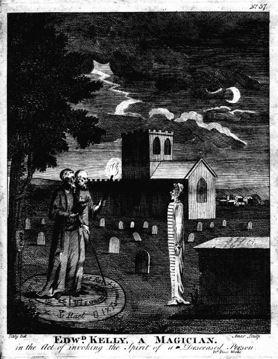
Last night I dreamed yet again. I felt myself drawn to a place where the mage stood, with another old man. They were huddled together, standing on a spot where strange devices had been scored upon the earth, as though the perimeter of the devices protected them from some evil or force beyond their control. I approached them as though through mist, or through the hall where I had first encountered the old man (though now it seemed plundered and ruined), all becoming clearer as I came close to them. At last I stood before them, a hand’s reach away, but outside their magic circle. The old man spoke to his companion.

“Strike with your staff upon the point of the heptogram, Master Kelley, and make it speak.”

At this, a look of annoyance passed the other’s face.

“I am known as Talbot now, and not by my old name. How many times do I have to say so before you remember!” He turned his eyes towards me, and drew himself up, rapping three times upon the ground with his stick.

“Speak, spirit,” he said. “Speak or be returned whence you came, and shut again in your arrow-chest. Speak, I command, in the name of an holy Power!”

“Whom do you command to speak?” I said. “I speak or do not speak at my own will, not yours. I say what is in my heart and mind, when it pleases me to open my lips. I am not bidden by anyone to speak or to stay silent, to come or to go.”

My old mage – I now thought of him as somehow mine – smiled a little, but the other became agitated, and struck again several times with his staff.

“I charge you to speak,” he barked. “Are you from Paradise or from eternal fire?”

“If you rap much harder on the ground,” said my mage. “You will find out first hand, as we shall fall through and into hell ourselves!”

“Paradise or flames?” I said. “A room in the Tower is not Paradise, though it is comfortable enough for a while; nor is it hell, for all its dreary solitude. Rather say it is purgatory, as it affords much opportunity for reflection and repentance!”

“Speak not in riddles!” cried the other. “But answer plainly, I charge you, by the angels!”

Patient now, my mage interjected, “Peace, Master Kelley; I know her, I know of her – she speaks what she thinks is true. She knows naught of heaven or hell, but lies where she lies, with her last memories, waiting for the graves to give forth their contents.”

“Master Dee, you may have traveled much, you may have been to Bohemia, and to Poland (where, I have heard, men have tails), but in these things you are ignorant. She is a spirit, and as such she has seen things you and I have not. And she is bound by the enchantment and invocation I have made, to tell us the truth. This fiddle-faddle she gives us is but her resisting my power, and it cannot last.”

“I know nothing of spirits,” I said. “Except that Saul was damned for causing one to be conjured up. I am none such. I am a queen, albeit one cast down. And Master Kelley or Talbot or whoever-you-may-be, you would be well advised to address me with more deference, and indeed to desist from your imagined conjuring.”

At this moment, my old mage turned eyes on me that held more pity and kindness than I had ever seen in him. There was such sorrow in his voice, when he spoke again.

“Master Talbot, it is clear to me that she is telling you the truth, though you cannot see it. Madam… Mistress… Your Majesty… “

His voice faltered, as though he had something difficult to say.

“Can you tell me where your favourite French headdress is at this moment?”

“Certainly, sir,” I replied. “I have it in my hand.”

“Madam, you have more than your headdress in your hand.”

At that moment, in my dream, I saw his meaning clearly –though I knew not with what eyes I saw that which I saw, for my own eyes looked up at me – and I screamed. My scream was choked by my awakening. Dreams are beyond fathoming, the pictures they paint are strange, their meaning is deep and often unholy…  and it is now today.

There is my gown, and my headdress; there also is my little book of psalms in French, undesecrated. I will wear my gown and my headdress today, and carry my psalms with me when I walk outside. I already have in mind what I will say:

Good Christian people, I am come hither to die, for according to the law, and by the law I am judged to die, and therefore I will speak nothing against it. I am come hither to accuse no man, nor to speak anything of that, whereof I am accused and condemned to die, but I pray God save the king and send him long to reign over you, for a gentler nor a more merciful prince was there never: and to me he was ever a good, a gentle and sovereign lord. And if any person will meddle of my cause, I require them to judge the best. And thus I take my leave of the world and of you all, and I heartily desire you all to pray for me. O Lord have mercy on me, to God I commend my soul.

But as I kneel, and before the swordsman scythes my head from my body, I shall think of my old magus. Then I shall breathe a short, Plantagenet prayer, and hope that my daughter, who has my eyes and my hair, will never be a queen, but will live her life a country lass, safe at home. For the burden of queenship is too heavy.

One Day in High Park, Toronto


Flash fiction – One Day in High Park, Toronto.

I was sitting on a bench, reading – hardly noticed the man, hand-in-hand with a boy. Both were dressed in black pants and white shirts, and the man had a black hat of woven straw. “Old Order Mennonite – what are they doing in town?” I mused momentarily.

They had been talking quietly, but suddenly the man raised his voice, still gentle in tone.

“No, Karl, that’s not true. You’re lying to me. I can’t allow that. You’ll have to take your punishment.”

“Yes, Dad.”

“Shall we get it over with now, rather than later?”

“Yes Dad.” The boy reached and rolled up the legs of his pants as far as they would go. The man bent down behind him and slapped him on the back of each calf, then slapped him again.

“Hey! Hey!” A guy in t-shirt and jeans, came from behind where I was sitting, vaulted over the end of my bench, and barged the man away from the boy.

“Pick on someone your own damn size!” he said, swinging a punch which caught the man on the right cheek. Down he went, and sat on the ground, hat awry, face bleeding. The t-shirt guy stood over him, fists balled.

After about fifteen seconds he got up, dusted himself off, straightened his hat, and looked at the t-shirt guy. He said nothing, but seemed to angle his left cheek a little, as though inviting another punch. Then he turned to the boy.

“Punishment over, Karl.” He said. The boy rolled his pants legs down, and came over to hold his father’s hand. “Shall we get some ice-cream?”

The boy grinned. “Yes please, Dad.”

They walked away, and the t-shirt guy stood, hands on hips. “Well… I… should… fuck… a… pig!”

I said nothing – I had a good book.

Axe

All the girls call me ‘Axe’. Tough name, but nah need fe aks me why, coz of me accent, ell-oh-ell!

They’re like to me – We were gonnay give you a kicking. Two days I’ve been in Glasgow, two days! I go out to a club, and these girls come over and they’re looking mean like they mean business, right. But the music is loud and the girl who’s doing all the talking has this accent, this Scottish accent, and she’s shouting over the music, and I’m like – What? What? And she’s back to me like – What? What? And then the music stops and all you can hear is her shouting what and me shouting what, and suddenly everyone’s laughing.

So the girl who’s doing all the talking, this is her to me – Come over to our table. And I’m like – Okay, cool. So we all get to be mates, and we’re laughing, and I can’t understand half of what they’re saying. I can now, though, later. I’m used to their accent, they’re used to mine though this is one of them to me back then – Oh. My. God. Your accent is weird!

Afterwards some of them are hammered and throwing up in the street, and we’re helping them. And she, this girl who was doing all the talking, she’s like – My name’s Marie, what’s yours? Only the way she says Marie is all Scottish like MAH-ri. And I’m like – I’m Shayla. And she’s like – you wernay scared when we came up to you, Shayla, we were gonnay give you a kicking, you didn’t back down. So I’m like – Why was you going to give me a kicking anyway? And she’s like – It was the way you were looking, looking at the lads in here, looking at us, just the way you were looking.

And she slips her arm through mine and we walk off down the street, and she’s like – Woot! That’s when we’re dodging round one of the other girls who’s not walking straight coz she’s hammered.

Then this is Marie to me when we’re walking down the street – Can you fight? Wannay be in the krew? This is me back to her – Yeah, all right.

So we’re The Gherls. The Gherls, right? They explain it to me once, it’s coz the krew started with, like, Celtic supporters’ girlfriends, and Celtic are called The Bhoys, yeah? But we’re not strictly Celtic supporters or Celtic supporters’ girlfriends any more, not Catholics. Well, Rosary is Catholic. We call her Rosary coz she gets her beads out before a fight, and like counts them with her thumb, then she puts them away and crosses herself. But Shireen is in our krew, and she’s a Muslim and Asian, and she wears a hijab thing and doesn’t drink, and it doesn’t matter even when we’re fighting Asian girls, so just the same it doesn’t matter to me if we’re fighting black girls. It’s the fighting that matters.

There’s ten of us hardcore, and there’s the also-rans, like girls who sometimes are there or girls we can call on, and some of those girls have mates who are okay and will help out. But like most of the time we don’t need them. The hardcore krew got loyalty.

And one day Marie’s like to me – How old are you? And I’m like – Why you aks me that? And she’s like – Axe? Axe? Ell-em-ay-oh, that’s what we’ll call you, your name is Axe. And I’m like – Laughing. My. Effing. Arse. Off.

When you’re fighting, like when I’m fighting, everything is so clear. Lights get really bright and white, and everything like stands out with this hard, black outline, and I feel really alive. I mean really alive, like my whole body is tingling and I can feel everything, and even when I get hurt it’s like the feeling takes over. It’s not like getting hurt normally. It’s different, better. I know that sounds weird, but I know what I mean.

There’s this girl, this Gherl, called Paysh, that’s like short for Patience which is her name, right. She’s cool, really quiet, never says nothing, never says nothing much. When she fights it’s like her fists go really tiny, and when they hit someone they must really hurt. I saw her once, and she’s really fast, and she’s fighting this other girl, and this other girl’s going down coz Paysh punches her in the face three times. Just like that, it took half a second. Bang bang bang. And these big red marks come on the girls face, and the rest of her face is pure white, and she looks like she’s going to cry. So all her mates are coming over like they want to kill Paysh, so we go and stand round Paysh and dare them, and they all back off.

And I’m like – that was sick, Paysh, really sick!

And the rest of The Gherls are like – yeah that was totally sick! And they’re all grinning.

And Paysh is suddenly all excited, and she’s like – Yeah it was sick, fuck yeah, did you see her face? And she’s making those tiny little fists. So anyway one day we’re in this bar, and I’m like – Where’s Paysh? And the others are like – She’s got her finals tomorrow, so she’s studying. And I’m like – What, no, Paysh is a fucking student?

And then the week after that I’m with Paysh shopping, and we go to Marks and Spencer’s café for a coffee, and this is me to her – Paysh, you’re really clever, so why’re you in a krew? Why’re you not, like, at the student union or something?

And she’s very quiet for a while, like she always is. She’s sitting there and I’m thinking how slim she is, and how she looks tall even when she’s sitting down, and how she always wears green but not bright green, not Celtic green, but sort of faded green, and how her hair is somewhere between blonde and red.

And then this is her to me – I don’t know, Axe. It’s as though when I’m at uni I’m on an island, or I’m behind bars, or I’m in a room with no windows full of mirrors. No one can see out. No one takes any notice of anything except what’s going on inside. No one sees that there’s a whole city outside of the uni. Yeah, it’s like I’m on an island and I want to see fish, but I can’t see fish unless I jump into the ocean, unless I make a conscious decision to jump into the ocean and swim and look for fish. So let’s take something simple: if I want a drink and a dance I go into the city, and there’s a club. If I want mates I go into the city, and there’s my krew. Some students if they want to do something dangerous and exciting they climb the big uni spire. When I want to do something and dangerous I get into fights with my krew. Do you understand, Axe?

And I nod, like I kind of understand. Then this is me to her – Yeah, I think so, it’s like when I’m at work it’s all brown and green, but when I’m out with The Gherls its bright yellow and bright blue, and when we’re fighting it’s brilliant white and there’s like wind-chimes going off in me head.

And she’s like – Synaesthesia. And I’m like – What? Whatever. Then we’re smiling at each other.

So one time I’m in our usual club and I’m fixing me makeup in the ladies, and Marie is standing next to me washing her hands. I’m sort of looking at her sideways and comparing her to Paysh coz they both have the same colour hair. But she’s shorter and like wider across the shoulders and hips, and she’s a little bit butch maybe, though not really stone just a little bit. And she’s taking a long time just washing her hands, and she looks over to me.

And she’s like – I really like you, Axe.

And I’m like – I really like you too, MAH-ri.

So then she leans over and kisses me right on the mouth, and her mouth is sort of nice so I kiss her back. Then we stop, and she’s like – Sick, or what? She’s grinning and I’m grinning too, and I’m like – Yeah, sick! And then we go back into the club to our mates.

Then there’s the time I see Rosary in the distance and I follow her, and she goes down streets I don’t know, where I’ve never been, and there’s this big Catholic church all brick and concrete, and she goes in. So I follow her, and there she is sitting in one of those long seats they have, and I go and sit next to her. She’s praying or something coz her eyes are closed and her hands are together and those beads of hers are between her hands. Her lips are moving but she’s not saying nothing. Then it’s like she realises I’m there or she finishes praying, coz she opens her eyes and crosses herself.

And I’m like – Hi! And she’s like – Hi. What are you doing here? And I’m like – I followed you. What are you doing? It’s not Sunday or nothing. And she’s like – I’m going to confession. And I’m like – What’s that? Coz I don’t know nothing about being Catholic.

And she’s like – I go into that box there, and there’s a priest in the other box, the one right next to it, and we cannay see each other but we can hear each other, and I tell him all the bad things I’ve done since the last time I was here. And he makes me promise no to do them again, and he forgives me like in God’s name, and tells me to go and say a bunchay Hail Marys or something as a penance.

So I think for a while, and then I’m like – Do you tell him about the krew and all the fights? And she’s like – Yeah of course.

So then there’s a creak and the door of the box opens and an old woman comes out and walks back through the church. Then Rosary gets up and goes into the box and closes the door behind her, and I suppose she’s telling the priest all about the things she’s done, and it makes me feel a bit weird because I’m sitting there and I’ve been part of the things she’s telling him. And I wonder what I would tell a priest if I was Catholic.

Then there’s this one big fight. There’s been another krew hanging out in the places we like to hang out, the mates of the girl Paysh punched. They’re like to everybody – we like it here, we’re gonnay keep coming here. So we’ve put the word round, Marie’s put the word round, that if they’re there on Friday then they are gonnay get a kicking. So on Friday there they are, and there’s more of them than before, and they’re really loud, they think they are so cool and tough. And Marie goes over to them and she’s like – Outside, round the back, ten minutes. And they’re like – Fuck you Missis Woman, but yeah.

So ten minutes later we’re all in the wynd and we’re thinking like – Where are they? Then we see them coming in at both ends of the wynd, and they’re grinning because they think they’ve got us trapped. And some of them are picking up stuff from the wynd, like sticks and stuff, and someone’s like – Watch out, that blonde hoor’s got a malky.

And Marie’s like – It makes me MAD when someone pulls a malky on me! Then we’re fighting our way out and they can’t keep us in, and Rosary’s up against some girl with a piece of wood, and I’m up against the girl with the malky, it’s a Stanley knife or a box-cutter or something and she cuts me across the face with it. And everything is brilliant white like camera flashes and ringing like bells in me head, and it’s like everyone is dancing and I’m breathing really fast. And I’m hitting the malky girl and she’s running and they’re all running, and we’re like – Woot!

Except Rosary is bent over with her hand on her knees and then she falls over, and someone’s like – She got hit over the head, someone with a piece of wood or something. And I’m like – Look, everyone, get out of here and I’ll stay with her. I’ll call an ambulance on me mobile, it’ll be all right, I’ll say we was mugged or something. Move! Get out of here! Before someone gets the coppers. Move!

So the ambulance comes and takes us to hospital, and Rosary is lying there with a blanket over her and a mask on her face, and I’m like – Rosary! Rosary! And the paramedics are seeing to me because of me cut face and they’re like – Look, keep still, you’re arm’s cut too. And me sleeve’s all wet and dark as they cut it away.

Then we’re at the hospital and there’s a woman doctor puts stitches in me face and me arm, and she’s like – We’ll keep you in overnight. And I’m like – Okay Miss, whatever, but can I have a bed next to me mate? And she’s like – I’ll see what I can do.

And the police are there and they want to talk to me, but I don’t tell them nothing, and I’m just like – We was mugged. We was jumped on. No I didn’t see who it was. It was dark. And they’re like – All right but we might want to talk to you again. And I can see they’re thinking, like – Black girl, black girl, blacks always equals trouble.

So then I’m sitting on this bed and Rosary is on the bed next to me with one of those drip things in her arm and bandages on her head where she got hit, and we’re talking to each other really quiet, and I’m like – You did really good, Rosary, at the fight, and you’ll be all right now the doctor’s seen you. And she’s like – You did really good too, Axe, and I’m glad you’re here. And then her voice goes even quieter, and she’s like – Hail Mary, full of grace. And it’s like she’s counting with her thumb but there’s nothing there, and suddenly her eyes roll and she starts to shake, and I’m like – Nurse! Miss! Miss!

Then there’s people running and pulling the curtains round her bed, and that’s Rosary dying, and I’m crying and I’m like – Rosary! Rosary! And there’s two nurses trying to make me be quiet, but I’m crying and I’m like – Rosary! Rosary!

So that’s when things go brown and green for me again, and the stitches in my arm and my face began to hurt, and Rosary dies and I never get to talk to her again, never get to tell her how great she is.

So we’re all standing round Rosary’s grave, The Gherls are here, and Rosary’s family that I’ve never met before, and there’s a priest and he’s like – And if the Spirit of him who raised Jesus from the dead is living in you, he who raised Christ from the dead will also give life to your mortal bodies through his Spirit, who lives in you. And he calls Rosary Christine McCluskey, because that was her name and I never knew it. I never heard it before. And Shireen isn’t there, she’s standing over by the path coz she can’t be at a Christian burial. So I walk over to her and I put my arm through hers, and Marie turns round and frowns, but I give her a sort of secret wave to let her know it’s all right, and she turns back again.

And this is Shireen to me – I really liked Rosary, I really liked her. And this is me back to Shireen – I really liked her too, we all did. And Shireen doesn’t know what else to say, so she’s like – La ilaha illallah, Muhammad rasulu-llah. And I don’t know what else to say either, so I’m like – Amen.

I’m standing there thinking the priest at Rosary’s church isn’t going to hear any more about us, about me. Now I won’t be in nobody’s confession.

And afterwards when Rosary’s parents have all gone, Marie’s like – No time to waste, we’re dressed in our best all in black, we are gonnay go and find the wee skank with the plank and we’re gonnay do to her what she did to Rosary, and we’re gonnay find the wee hoor who cut Axe with the malky, and we’re gonnay … we’re gonnay… something… like if they can pick up sticks we can pick up bricks.

And we’re all like – Yeah let’s fucking do it.

So we’re walking along in our best all in black, and inside me head there’s this rhyme, and inside I’m like – One two I love you, three four out the door, five six pick up bricks. And I’m looking at Marie and she’s looking back at me, and she’s like – This one’s for Rosary! And it’s cold and me teeth are chattering, and there’s bells in me head, and I’m angry but I’m smiling, and it’s all brilliant white, shining light, and I’m really alive again. Really, really alive.