Marie Marshall

Author. Poet. Editor.

Tag: Short story

It stops here!

President Harry S Truman looked around the Oval Office. His eye took in the rich, red drapes, the deep carpet in the same shade, the mahogany of the furniture. He glanced over each shoulder – right, left – to take in the Stars-and-Stripes and his own Presidential standard, and reflected that the room was still very much to the taste of Roosevelt his predecessor. How could it not be? FDR was such a dominating personality. He asked himself whether he had the courage (or the energy, or the time…) to redecorate.

Perhaps at this moment he doubted himself a little, but Truman was indeed a man of character. He looked down at his desk. Yes, here was the new Truman Presidency, ordered, workmanlike, symmetrical – that’s how he would be. A place for his pen, a place for his presidential blotter, a place for everything, yes everything was in order, so why was he frowning?

“Something is missing,” he thought.

His frown deepened when he caught sight of something he had been trying to avoid looking at. A tarpaulin had been laid on the carpet, and on that was the carcass of a freshly-killed white-tailed deer, a fine male with a single bullet hole. It was a gift from an eager, young White House aide who had heard that the President liked hunting. In that the aide had miscalculated – Truman shot grouse, not deer.

The President got up and walked round to the front of his desk. The carcass would not go away of its own accord, it had to be dealt with, a decision had to be made and it was the Commander-in-Chief who had to make it. No one else would make it for him.

“What the hell use would there be in a President who knew how to skin a damn deer?” he asked aloud. The walls of the Oval Office echoed his rhetorical question. He looked down at the white-tailed buck, then to the empty space on his desk. His frown melted. An idea formed in his mind and he made a decision. He lifted the Presidential phone and spoke to his secretary Matthew Connelly.

“Matt,” he said. “Get me the Presidential Butcher. And while you’re at it, get me the Presidential Carpenter and the Presidential Signwriter too…”

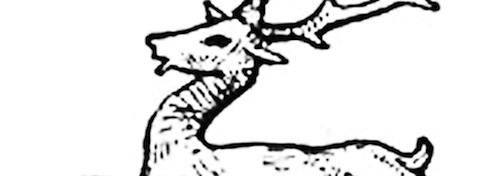
The Stag – a fable*

Deep in the heart of the realm of Angria there was a forest. In that forest lived a stag, perhaps the finest stag anyone had ever seen, his antlers spreading like the winter branches of an old beech tree, his flanks red as the ire of winter dawn. In a house just outside the forest there lived a hunter who had vowed to trap and kill the stag, to wear the antlers as his headdress and the russet hide as his cloak. But the stag was many years in age and full strength, wily, swift. He valued his freedom and would bound away while the hunter was still fitting a quarrel to his crossbow. Season upon season, year upon year, the hunter stalked the stag. Prey and predator knew every inch of the forest, every tree, every thicket, every faint sentier, every clearing, every pool, every shadow. At the beginning of one year the stag lifted his head to a new sound, the steady fall of an axe against a tree trunk. He thought little of it as such things are not the concern of deer, but nevertheless he moved through the forest to a place where the noise did not crowd as badly upon such things as did concern him. The sound continued throughout the year, but still the stag thought little of it. Then one day when he approached the edge of the forest he found that his kingdom was much smaller than he remembered, and his way out into the open fields beyond the forest was blocked. There was a high, wooden fence. The hunter had chopped down many trees to make it, and it was cammed in cruel, sharp points. The stag ran to the other side of the forest and found the way blocked there also. He ran along every path he knew and everywhere his was way barred by the fence. He plunged through thickets and briar patches through which he had never gone before, but the fence always thwarted and confounded him. Wherever he could get a run he tried to jump the fence but always, from outside, came the hunter’s mocking laugh or a warning bolt from the crossbow. At last the stag could endure this no more and risked everything on one last, desperate leap. The fence was higher than anything he had ever cleared before, but he gathered all his strength and courage, fixed his eye upon the blue sky above the cruel, sharpened points, and ran. He left the ground, he flew, he soared, wondering if this is what it felt like to be a bird. In mid-leap he could see the open farmland and the hills beyond. It was at that moment that the hunter, who had been waiting for him, loosed his quarrel. It went deep into the stag’s body, right to his heart, checked his leap, and brought him crashing down onto the sharp points. The stag’s eye was still fixed upon the sky and the far hills but now it saw nothing. When he saw what he had done, the hunter dropped his crossbow and his quiver and walked away. He was never seen again, and his house became a cold and empty ruin.
__________
* (c) from ‘Branwell’, a work-in-progress.

The Haunting of James Abbott McNeill Whistler

It is late on a rainy winter’s afternoon in the Hunterian art gallery in Glasgow. Little daylight finds its way into to the interconnecting rooms and the artificial light is yellow and diffuse, or seems so to the gallery-goer who is standing in front of a pair of paintings. They are behind one of the last few partitions at the back of the gallery, almost hidden from view unless one knows they are there or have happened on them in a spirit of exploration. The gallery-goer has to look slightly downwards to see them, as there are two other paintings above. These other paintings have only held her interest for a moment or two, but the lower pair seem to have transfixed her. She shifts her stance slightly as if to alter the angle of her gaze and lose some unwanted glare or reflection from the literal surfaces, and thrusts her hands in the pockets of her coat to quell an urge to reach out and feel the texture of the paint. She reads the laminated plaques at the side of each painting and confirms that they are by James Abbott McNeill Whistler and are part of the bequest of his sister-in-law Rosalind Phillip.

Whistler has never been her favourite painter – she prefers German Expressionism if anything – but at this moment she feels a compulsion to stand and let her emotional and intellectual reactions overlay each other, confuse her, vie for strength like two equidistant radio stations fighting for the capture effect. Arranging her thoughts like clothes on a washing-maiden to dry, the gallery-goer builds the following analysis.

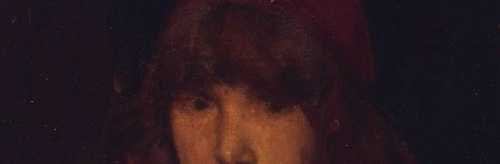
The composition of each painting is simply the figure of a seated girl from the waist up. She has long, full, auburn hair with an untidy fringe touching her eyebrows, and tresses which rest on her shoulders. She wears a purple beret or small cap on the top of her head, pushed back. She is dressed in shapeless, dark clothes, maybe brown, or black seen with a reddish sheen by a dim lantern or firelight. In one painting her body is angled slightly away from the artist and she has turned her head towards her left shoulder to look directly at him. Her hands rest on her lap but the delineation is imprecise, they are pale and doll-like, or like hands on a photograph from Belsen. In the other painting she is slightly more squarely-on, her hands are out of sight. At first it seems that her gaze is straight towards the painter again, but perhaps she is looking to his right and slightly down. The second painting seems to have been executed with a darker palette, but in both cases it looks like paint has been applied and then has been scraped thin. The texture of paint and canvas are one. The modeling is uncertain, the girl’s pale face seems to be the only source of light. The picture space has almost no depth, as though she is sitting directly in front of a dark wall with her back pressed against it. The tone in the first painting is stark in its contrast between light and dark even though the background colour is a warm brown; the white of the girl’s hands and face are almost shocking, and although her gaze engages the artist and the viewer there is a remoteness, we are at arm’s length from her. The second painting is darker overall, but the tone of the girl’s skin is softer, there is more colour to her cheeks. She seems to be closer to us, and although her gaze is slightly averted the whole effect is more intimate. In both cases her face dominates the picture, drawing the eye into an uncertain virtual space full of ‘as though… as though’.

The gallery-goer does not know how long she has stood looking at these paintings. She becomes aware that someone has come to stand at her left elbow, though she did notice this person arrive. The other person speaks to her, and in the exchange that follows tells her a story, or maybe more than one story.

*

Beautiful, isn’t she! You don’t think so? Well I’ll grant she isn’t conventionally pretty. Her nose is long, her mouth is canted slightly downwards to the left, her expression is mournful, her complexion seems pale and warmed only by external influence rather than by her own blush, and – look here – that could almost be a scar. No, I think it is more likely to be the violence of Whistler’s palette-knife as the mark is only there on one of the paintings. But her face holds you nonetheless. Am I right?

You are wondering why the title, why ‘Le Petit Cardinal’, why present the model as a male? There is something a little androgynous to her looks I agree, but it’s obviously because of that purple cap she is wearing. Whistler painted and drew her several times with that cap on her head. Her name is Lillie Pamington. Very little is known about her apart from her having been one of several street-girls who caught Whistler’s eye in London. One can imagine he was passing in a Hansom cab when suddenly saw her in her dark coat and purple cap, weaving her way in between the press of people on the pavement. He was captivated, just as you are, by that pale face in the gaslight, bobbing along like a jack-o-lantern amongst bushes, and he rapped the roof of the cab with his walking stick – Stop, cabbie, stop! – and jumped down onto the kerb.

Miss. I say there, Miss. Young lady with the purple cap! Picture her halting, looking over her shoulder to see who was calling. Maybe he gestured her to come. Maybe she placed one of those pale hands against her chest as if to ask Me? or as if she were trying to still a racing heartbeat, unsure in her mind whether she was to be the subject of a hue-and-cry as a thief. Picture him holding out a business card. Can you read? Come to this address then, I would like to paint your portrait. Did her face remain solemn and sullen or did she smile? Was she instantly trusting or did she rebuff him at first with a few choice words of cockney? We know that she did turn up at Whistler’s studio because we have the evidence right here in front of us, but for now picture her purple cap bobbing down the street, soon lost amongst the crowds. Oi guv’nor the cabbie would have called. You want this cab or not? I’m losin’ fares.

Imagine how, a day later, she arrived at his studio, that there was a knock at the door and that when he opened it Whistler was at first puzzled. Who could these two people? One would have been a child of about fourteen with a painted face and elaborately-curled hair, the other a woman, her hands resting lightly but proprietarily on the child’s shoulders. I made her look nice for you, sir – a proper little lady to ‘ave ‘er portrait painted. Whistler would have come to realisation, and would have been horrified. No, no, this wouldn’t do – where was the solemn waif with pale face and auburn tresses that had captivated him in the street? This was a sham, a travesty, a mockery of her beauty. Imagine how he controlled his emotions and explained to the woman, as her smile faded, that he wanted her daughter – was the woman actually the child’s mother? – just as he had first seen her, and turned them away from the door. How he would have fretted for the next few days, cancelling all the sittings he had scheduled in case the woman and child returned. Would they return? There had been no mention of payment. Should he patrol the street where he had first seen her, or would that risk his not being at the studio when the next knock came?

It might have been one evening ten days later that Whistler resolved that the next day he would stop waiting for Lillie Pamington to come, and would arrange other sittings again. Imagine a light step outside and the rap of a small fist upon his door. Imagine that he opened it and saw standing in the shadow… Lillie with the pale, solemn face, with the unruly waterfall of auburn hair, with the dark coat and purple cap. Standing alone, silent. Would he have let her in without a word, or would he have smiled and said, Delighted to see you, Miss Pamington – so glad you could come, please do step inside.

What was the obsession that drove him to paint and draw her over and over again, clothed and naked? We know that he was a womaniser, and that he sired many unacknowledged children by his mistresses. Did he see in Lillie some echo of Joanna Hiffernan, the lover whom he had lost to Gustave Courbet? We do not know, Whistler never told us and as for Lillie she suddenly disappeared from his life and became obscure once more.

But imagine this. Imagine Whistler, having used up all the obsession he could on painting her, throwing his paintbrush down one evening and taking her in his arms. A kiss for ‘Uncle James’, Lillie? A struggle would have happened – I’ll tell! I’ll tell! – and he would have silenced her, consigned her limp remains to secrecy and sworn to all inquirers that he had sent her home at the usual time. But the stress of keeping the secret as a matter between himself and his burdened conscience would have weighed upon Whistler, so much so that he might have spent hours gazing upon ‘Le Petit Cardinal’, at his study in ‘Grenat et Or’. One night he would have fallen asleep and awakened to see nothing but her pale and solemn face looking out from the portrait. It would have seemed that the face detached itself from the painting and approached, as though Lillie was walking towards him. Imagine that was the first of many such night-time visitations, and that eventually he could stand no more and, snatching up his palette-knife, slashed at the apparition. Imagine that in the daylight that eventually followed, the mark of the knife was to be seen on the painting. Imagine, perhaps, that years after Whistler’s death the skeleton of an unidentified girl was found in blitzed-out rubble somewhere in London.

No? You don’t like that story? Well then, imagine this alternative. Lillie came willingly to kiss ‘Uncle James’, and her kiss was sweet as pomegranate juice but sharp as broken glass, and that she came and went as she pleased at night until Whistler wasted away and died, his life entirely drained from him.

You’re right, of course. The official story is that he was ill, that he was broken-hearted after the death of his wife Beatrix, and I’m sure that is much more likely than either of these tales. How could they be true? But just look to your right, look at his last self-portrait. Gone is the confidence of the young man in the tilted, broad-brimmed hat, gone is the flash and dandyism. Originally he painted himself in a white coat, but something made him scrape off most of the paint and re-execute the work in black or dark brown. The stance and gestures are clearly in imitation of Velazquez; but the hands are indistinct as though fluttering and fretful, the right hand perhaps on the point of being raised to repel something, the left hand just holding his coat closed, a hesitative protection. His entire weight is on his back foot, as though he is leaning away from something. His expression – his eyes – he is looking down as if at the approach of someone a good deal shorter than himself, and he is staring with horror. What is he trying to tell us? What secret is he only just holding inside?

*

This is the point at which the gallery-goer realises that the other person has fallen silent and, moreover, that the gallery lights have all been shut off apart from the single, dimming lamp where she has been standing. The gallery is in complete silence, the only sounds are faint and come from outside. The most luminous object in her line of sight is the face of Lillie Pamington in the portrait.

The other person is still a presence at her elbow, just outside her peripheral vision.

Who are you? she asks. What are you?

I may not tell you, but I may show you, says the other. Come with me.

Bat, man, batman, batsman.

Crypto-anthropology is a word I thought I might have invented (like ‘polemophonic’ – pertinent to the sound of warfare, ‘polemophonics’ – the study of the sounds of warfare) but it seems not. A pity, considering my interest in the Moosh-Moosh. But then I didn’t invent ‘futilitarian’ or ‘eukelele’ either, although the latter is only a pre-existing, alternative spelling. Here is my butterfly mind flitting from flower to thoughtflower for the brief summer of its life, digressing from the off. Here’s what I mean to say:

Cities grow. Ours did. Track outwards from the centre and you will see where the margins were, how they advanced and were filled in, how they swallowed neighbouring villages and towns, how there are rural names for roads and faubourgs mixed in with the newer names that commemorate royalty, trees, Scottish islands. Between the city and me there is woodland and parkland, but in that woodland there is a golf course. Golf courses are things of the Scottish ‘edge’ as farmers diversify in hard times. Also there is a water tower for the nearest of the city’s housing schemes that lie on the other side of the wood. The parkland, once the estate of a conquering admiral, is now a pleasure park for the citizens, complete with zoo and funfair. Only on the edge could such things be.

Is my village itself still a village? Its dormitory status makes it almost a suburb, yet it has or had a number of edge-features – a caravan park, and at one time an indoor play-area for children with a ball-pool and such like. Oh flit, flitter, flutter, fritillary. Anyhow, here’s what I mean to say… no really…

Attached to our Millennium Hall are a bowling green and playing fields. There is fitba of course, but also a cricket pitch. Cricket is not unknown in Scotland, of course, and much further north in the land too, but it is nevertheless a curiosity to many, something you would have to turn your head to gawk at if you were passing on a bus. It isn’t entirely a haven for expatriate English and third-generation South Asian Scots either, but it is an edgy place where crypto-anthropology has recently taken a strange turn. I think so. I had to think so when someone told me that the cricket team had a member who was half-man and half-bat.

I remember thinking that they were making a play on the word ‘bat’, but no, they meant it literally. There is a man nominally on their playing strength who has the arms and wings of a bat. He goes by the name of Doug Millar. He can fly, though he hardly ever does, and only once has done so on the field of play. He was fielding at silly-point when a farmer’s son from Forfar let fly a square cut with his full strength. Doug dived out of the way to avoid harm – there was no way he could have stopped the ball, let alone caught it, without risk of injury – and in diving he spread his wings. He only flapped them once but that was enough to allow him to glide over the outfield towards the Third Man boundary where he banked sharply, caught a thermal, and soared. Thankfully the umpire was about to call a drinks break anyway and Doug wasn’t even off the field long enough to warrant substitution by Twelfth Man. He returned red-faced and apologetic for his lapse.

Doug is not of this world. He is a Thogrian, which many folk mistakenly write as ‘Thorgian’, a unique marooneer on our planet and a castadrift from the world of Goldilocks 4. The cricket club doesn’t shout about him, they’re cagey blokes. If he could handle the willow or the cork-and-leather a wee bit better, or if ever he flew from Fine Leg to take a catch at Gully, it might cause questions amongst the rules committee of the league in which our village team plays. But he’s a plodder with both ball and blade and an average though conscientious fielder, driven less by skill than by his love for the game.

I have always wanted to talk to him but have never succeeded. I heard that he was due to be at the last home game so I went there and hung about the pavilion, searching amongst the whited players on the field or waiting their innings on deck chairs. I couldn’t see him. Then someone told me he was in the scorers’ hut for that match and couldn’t be disturbed. And that’s when I caught sight of him, very briefly, walking back to the hut with a tray of teacups and a teapot, his wings folded across his back. For some reason he had affected a Mohawk haircut.

I am told that if he excels in any respect it is as a scorer. His entries in the score book are precise, instant, and accurate. He uses an ancient Parker fountain pen but never makes a blot, and indeed there is a little Gothic flourish every time he records a ‘W’ for wicket. I think that he’ll be in that hut whenever I make an appearance at the cricket pitch. I think I have missed my chance. The hut is sacrosanct.

You see… I want to tell him that I can fly too, even though I only have conventional arms. I can’t soar as he does, though I have tried it once or twice when leaping from the King’s Seat, beyond Abernyte. Each time I could feel the wind under my arms, but my descent was too rapid and I had to resort to flapping hard to maintain any height and to land safely. I want to share with him that sweet, intimate knowledge of the upper air and of seeing the land turn beneath me. I have to speak this truth to someone who will not say I have been dreaming.

Thirty years before, behind, and either side of the mast*

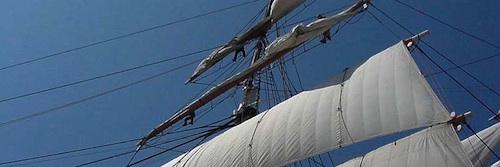
Ha! ‘Tis many a long year since I strode the deck of a tall ship. Well I remember how I bound my breasts and put on boys’ clothing, signed articles as a deck-hand on a cat-boat. I worked my way up by hard tack and little sleep, on luggers, cutters, coasters, trawlers, whalers, schooners, and square-riggers (in fact everything that showed a sail, apart from scows and dhows), till at last I became a deck-hand on the good ship Fancy out of Liverpool. Thirty years before the mast!

The Fancy? She was a floating purgatory, I can tell you. The captain was a bully, the mate was a bully, the bosun was a bully, and the ship’s salt-beef was a little too al dente for my taste too. But that bully captain – Dan Thirkell was his name – could drive her to make eleven knots, and that close-hauled! For all that the life on board her was hard, she was the trimmest tops’l schooner you could ever wish to see. Holystoned from keel to topmast she was.

Many’s the long voyage she saw, and many’s the time we beat around the Horn, Valparaiso-bound, half-seas-over. Aye, and many’s the good shipmate was washed overboard and never will be found until the sea shall give up its dead. Scurvy and yellowjack we endured, lateen-rigged pirate sloops we outsailed, monsoon and hurricano we withstood; sometimes Dan Thirkell would drive her until scarcely a piece of sailcloth remained aloft, while the mate and the bosun drove us fo’c’sle hands just as hard! (‘Twas thus on the very worst voyage; we saw St Elmo’s Fire on the topmast, mermaids off the port beam, and the mate shot an albatross. As all good sailors do know, ‘tis bad joss to bring golf clubs on board a ship!) But she was a fine sight with new canvas and new rigging, sailing goose-winged with a following trade wind.

But all things pass, shipmates. I mind the time that meself and me old mucker Bill Bracey from Boston (Lincs) were on the foredeck. We were a-skylarkin’, a-spinnin’ yarns, a-tellin’ tall tales, and a-spittin’ over the t’gallant rail the way that old salts do, when up comes Bigton Bill Buchan the bully bosun.

“Lay aft!” says he.

“Watch below, bosun,” says I. “Watch below until eight bells.”

“Damn ‘ee for a sea-lawyer!” says he, and starts a-lambastin’ me with his Malacca knout.

Later, in the fo’c’sle the ship’s cook (who was the nearest we had to a chirurgeon or a sawbones, being handy at jointing) tended to my wounds, stripping the shirt from my back and the breeks from my shanks to rub on tar-oil and goose-grease. Well that was the dismasting of me, because all of the hands could now see how I was rigged fore and aft!

“Why, Markie boy, you be a-sailin’ under false colours!” exclaimed Bristol Bob Bannerman, the sailmaker and ship’s carpenter. “For I see you be a judy!”

I was taken before the captain, and I expected the worst. To my surprise he was most civil when he saw what quarter the wind blew from. He cleared the mate out of his cabin and gave it over to me, gave me crinolines and petticoats to put on, even allowed me to wash. The rest of the voyage passed in pleasantness. I would stroll the deck, my parasol in my gloved hand, listening to the sea shanties and the orders from below to aloft borne on the wind, and they would seem exotic to me, sounds from another world. The crew would knuckle their foreheads as I passed and call me “Ma’am”; and the captain would stroll along half a pace behind me, hands clasped behind his broad back, head bowed, brows knitted, always as though about to speak of something.

Only later did it occur to me to wonder why he kept such an extensive female wardrobe aboard. I did notice that the dresses were a size or two large for me.

Y’know… even now, when the wind is set fair from the sou’ sou’ west, I have a longing to go to sea again. But this old peg leg of mine does warp so in the wet, and breaks my rolling gait.

Sorry – all this nautical reminiscing comes about by a circuitous route. An old Cheyenne woman knocked at the flap of my teepee this morning asking whether I still had the frying pan I borrowed from her village lo these many years. While Consuela (my Tejana maid) was rummaging in one of the yet-to-be-emptied tea-chests downstairs, she found my old pea-jacket and brought it to me.

Ah that old pea-jacket… still smelling of the salt wind and the spray… that old pea-jacket. I found something in the starboard pocket. It was a pea.

______________

* This story originally appeared in a series of humorous writings on an earlier blog

The Happiness Machine*

This will be the last entry I make in my journal. I may not die today but nevertheless I shall write no more. I have written and read and studied all my life and, yes, I have painted. I have painted faithfully as Master Leonardo da Vinci taught me, because there could be no other possible response to his selfless and incandescent love. I have no more to do and must set my house in order – praecipe domui tuae morieris enim et non vives, says the scripture. I have made my will and have left all Master Leonardo’s works, designs, and notes, and indeed all scraps and chits with his signature upon them or in his hand, to my son Orazio. They are to remain here in Vaprio d’Adda, safe in the hands of our family, for ever. They are now our birthright – or, no, we are their custodians.

There is an exception. I make this confession now. It is not a sin so I do not need to make it to a priest. It is a work of Christian charity, I see this now in my old age, in my final days. While I was young I might, I might, have dared to challenge or to stir things up, but now I seem to hear to echoes of a great hall of judgment, I know that all my deeds are being weighed, I will be judged. The exception is one bundle of papers that I have burned. It was the design for a machine and notes on its construction and use. I wept as I burned them for the simple reason that Master Leonardo had entrusted them to me on his deathbed. I was with him in France when he died, and it was I and not the King of France – disbelieve the legends! – who cradled his head as he died. I returned the Master’s love with a pupil’s devotion and its incandescence is within me still. He put his trust in me to seek a time and place where the knowledge in those papers would be accepted and I betrayed that trust. God above, will that weigh against me?

Leonardo’s designs were, the master himself told me, refinements and improvements of some earlier patterns for a machine that had actually been built by Verrochio, his own teacher. You all think of Verrochio as a painter, but just like Master Leonardo he was a natural philosopher skilled in geometry, architecture, medicine, and alchemy. Hearing that Verrocchio was dying, Master Leonardo journeyed from Milan to Venice to be with him, and he received the first draft of the designs he later gave to me, and he heard from Verrocchio’s own lips the story of the building and demonstration of the machine. He told it to me and whether he put flesh on the skeleton in his telling I do not know, but as he recounted it to me it was as though I heard the voices, saw the scene, witnessed the workings of the machine for myself.

It all happened in the time of His Holiness Pope Paul the Second. His Holiness was, in a way, a natural philosopher too, inasmuch as he loved machines. They delighted him, he understood them, appreciated the beauty of the mathematical principles behind their processes. It was said that he built his own Archimedes’ screw in the Vatican in order to demonstrate its properties to his cardinals. He authorized the setting up of printing presses throughout the Holy See and all Christendom, but immediately he had done so he realised their power, their potential for independence, as though they had minds of their own and could decide whether to lie or speak the truth. He imposed strict control on their construction and use. It was said that he had a small army of clerks who drew up an index of every press in existence and every printed work they produced. All natural philosophers who were concerned with the building of machines brought the plans or working models before the Holy Father who, if he approved of them, would affix his seal to the plan and grant a license for their construction.

Master Verrocchio was one such maker of machines, and one day he gained an audience with His Holiness for the purpose of demonstrating a machine of his devising. It consisted of a fixed chair over which two hoops were suspended in such a way that they could each spin freely. Each hoop had, on the outside of what I might call its northern, western, southern, and eastern points, a counterweight of lodestone, placed so that there was a tendency for the hoops to return from any eccentric alignment to one of ninety degrees relative to each other. The inside of each hoop was lined with reflecting plates like those described in the writings of Ibn al-Haytham. As a description that is the bare bones of it. There was much more to it, great delicacy and precision in its construction (oh, much more so in the drawings of Master Leronardo, believe me), but I shall leave all that dark.

Master Verrocchio explained to the Holy Father that it was an engine for generating happiness and that he had devised, it out of a sense of caritas, for the benefit of mankind. He hoped that the Pontiff, as the Vicar of Christ who wished nothing but good for all His children, would be the first to try its efficacy.

The Holy Father agreed, and seated himself in the central chair. Master Verrochio made adjustments to ensure that the machine was at a certain orientation relative to the sun, the moon, and the known bearings of divers points on the earth, and set it in motion. Slowly at first and then faster, faster, faster until they were a blur, the hoops spun around the Holy Father, who sat gripping the arms of the chair. The facets of the reflecting plates on the inside of the hoops merged, and it seemed to onlookers as though the Holy Father’s face was magnified in them, round and shining. To the amazement of those onlookers that face began to smile, to beam, to grin, and then its eyes closed and great guffaws of delighted laughter could be heard over the mechanical whirring. The Holy Father was laughing as merrily as a child at a fair.

Master Verrochio let this continue for some minutes and then applied some careful friction to the moving parts of the machine, one by one, causing the spinning to slow. More and more slowly spun the hoops, until at last they stopped.

Wiping a tear from his eye with the sleeve of his vestment, the Holy Father stepped, still smiling, from the machine. He was still smiling, but with a smile that was at once beatific and confident, when he turned not to Master Verrochio to congratulate him but to an attendant. He ordered bell, book, and candle to be brought. He ordered firewood and faggots. He ordered pitch, oil, and torches. He ordered all these things to be fetched without a moment’s delay, while Master Verrochio stood mutely by, half bewildered and half afraid for his life and his immortal soul.

Once everything for which the Holy Father had called was assembled, he solemnly excommunicated and burned… the happiness machine.

When it had been reduced to ashes, he turned to Master Verrochio, thanked him for the demonstration, blessed him with the sign of the cross in nomine patris et filii et spiritus sancti, and held out his hand so that Master Verrochio could kiss the ring on his finger. There was no further exchange between them and Master Verrochio left the papal presence never to return.

He had realised perhaps (though it is more likely he was now afraid to defy the Holy Father openly by continuing with his machine) what I came to realise once the sobriety of age had overtaken the rashness of youth, and what I realise more than ever now that proof of my mortality is stark before me. What was once supposedly evident to me in my confident and humanistic youth has faded and faded to be replaced by a simple and blessed faith – oh such a thing as never happened in the case of my own beloved Master Leonardo! – and my eyes are opened. If man could, by his own contrivance, build some machine, distil some elixir, devise some physical or mental exercise to ensure his happiness, what need would there be for the guiding presence of Mother Church? What need would there be for the salvation of his immortal soul. What need would there be – dare I breathe this even now? – for Christ Jesus? When I ask these questions I know that the act of destroying the last record of the happiness machine, although it was in defiance of my earthly Master whom I loved without reservation, it was in obedience to my Heavenly Master to whom all love, all reverence, all obedience are due. I will go to my eternal rest with peace in my heart. Peace, indeed, but not happiness. That is not my lot, nor anyone’s – homo ad laborem nascitur et avis ad volatum. The book is now closed.

Written on the 31st day of January, anno domini MDLXX, at Vaprio d’Adda, by me, Fancesco Melzi.

__________

* This story is inspired by, but not based on, the story of the same name by Ray Bradbury

‘A Woman on the Edge’ – workshop project of prose and poetry, part 3

The moosh-moosh

In the marginal lands between city and countryside there lives a type of rare hominid known as the ‘moosh-moosh’. The name appears to be of Romany origin and until recently these shy creatures would only reveal themselves to travelling folk. In fact so secretive and shy are they that most settled folk continue to deny their existence.

Their natural habitat is, or was according to anthropological speculation, the cave. However since intensive agriculture has decimated the wild places of Britain in the south, and deforestation and sheep-farming has done the same in the north, the moosh-moosh have moved into the new wilderness that humans have created, the wilderness that is neither urban nor rural but which is found on the margin between the two.

In build they resemble humans almost exactly, except for their apparent superior muscle tone. They are stocky but not fat. Their skin is pale but is hardly visible except on the face, the rest of their heads and bodies being covered in a light, reddish-brown fur. Their faces are large and broad but not un-handsome. Some observers believe them to be descended from the last remnants of the Neanderthalers, but this is mere speculation. They go naked but appear to be totally without any sense of shame. Deprived of their natural habitat, they have occupied such spaces as unwanted cargo containers. A small group was discovered living in an old Nissen hut on what was a WW2 airfield but upon which a new housing estate was encroaching, and it was this extended family that became the first moosh-moosh to encounter its homo sapiens cousins, or at least the settled and civilised branch of our species, with more regularity than before, gaining a certain controversial fame in academic circles and becoming a minor tourist attraction, especially for a few savvy if brash Americans.

Communicating with moosh-moosh is problematical. Folklore tells us that they and the Romany people once made themselves understood by a system of mutual hand-signs and by a few syllables of human speech, but if that folklore is based on truth it is a tenuous truth and the faculty has long-since evaporated. The interface between us and the moosh-moosh is akin to that between an adult and an autistic child, except that they will meet our eye with a steady gaze. There is no hint of comprehension in that gaze, with the exception that if you hurt one of them their expression hints at puzzlement and sadness. They seem to be asking silently “Why?” Violence is alien to them.

Their own speech sounds like a cross between the cooing of doves and a human whistle. It is quiet speech and they use it sparingly, spending long periods in communal silence. I have tried to imitate their sounds whenever I have been amongst the ‘Nissen Family’, as this particular group has come to be known, and whenever I have done so they have turned a softened gaze upon me as if to say that they appreciate my attempts. The only time I have ever seen a definite communication between moosh-moosh and homo sapiens was when I arrived at the same time as a knot of transatlantic tourists. The moosh-moosh were about to eat, which they do communally, and a female came behind us making insistent, shepherding gestures, urging us to sit down with them.

Moosh-moosh food is simple, consisting of a kind of cake made from the seeds of wild grasses sweetened with honey or with whatever berries are in season, or flavoured with hedgerow herbs. They share their food evenly between all who are present, even with homo sapiens, although the latter sometimes find it hard to digest. I am always conscious that they have scarcely enough to spare. In winter they are, if anything, less semi-visible than they are at other times of the year; it was thought that they hibernate – the Romany always said so – but in fact they spend most of this time when little sustenance is available huddled together for warmth in foraged straw and under salvaged tarpaulins.

Their groups and extended families are without hierarchy and are highly co-operative. If two or more discrete groups should meet there is no competition, but rather all direct themselves towards mutual benefit. Their delight is in each other, and it is a full and complete delight.

They make no art, no music, and of course no literature, but their appreciation of the natural world appears to be total. It is an appreciation apparently not born of awe or of anything mystical but rather seems to be one of immersion, joy, participation. It is a happy state free of the twin mental yokes of religion and science, a state which proves that mutuality rather than competition is the highest law of evolution.

The last time I sat down with the ‘Nissen Family’ of moosh-moosh I felt their hands gently resting on my shoulders and arms. Their gaze had softened and seemed to express some kind of sympathy. I realised that I had been crying. I tried to smile, and indeed their caresses were comforting, but this display of empathy, this acceptance of myself almost as one of them was so poignant that my tears continued. There was so much I wanted to say to them.

Oh, my dear Nissen Family, as dear to me as my own family! My dear, precious, innocent moosh-moosh! If only you knew my true nature and the nature of all of my brothers and sisters, the homo sapiens. If only you knew the depth and height of our jealousy, our insecurity, our vainglory. If only you knew how cruel we are. You, I know, are no children except inasmuch as you have preserved the innocence of childhood. You are no distant cousin, no Neanderthal throwback. You are of the same root and stock as we are, you are people, but you are people who took the decision long ago to follow the path of pure wisdom, to seek nothing but that which was good, nothing but what you actually needed. You are wise beyond our capacity to be wise. Yet in that wisdom you are as foolish as saints. What are fences and hedges to you? What are the divisions and boundaries that we set up in the face of nature to you? What are the frowns on the faces of farmers and householders to you when you forage their barley and their chives? What is our folly to you, the folly that points to something and says “Mine”?

If only I could convey this to you before it is too late, before you become nothing more than a dwindling number of anthropological or zoological specimens, a theme park, ‘Moosh-Moosh-Land’, an insignificant detail of history, a small entry in Wikipedia, a cuddly toy. If only you would realise this before we come for you, before we take you away, before we make you our playthings, before we study, catalogue, abuse, dissect, and destroy you, before we turn upon its head your evolutionary success and make a lie out of it. We are monsters, my dear family, monsters. We are ugly in our complexity, ogres, madmen!

You sit here in utter patience, lambs of the God you do not know, every one. Why do you not start up, why do you not run? Why do you not find all your tribes and families and hide in what remains of the forest? Why do you not go deep into our abandoned mines and conceal yourselves? Why do you not remove yourselves from our sight and memory before we remove you entirely from the world? Why do you sit so patiently, witnesses to all that is good, a light that will soon be put out? Are you somehow driven to prove to us what brutes we are?

We are your brothers and sisters but we are also your executioners. We hold your death warrant in our hands.