Marie Marshall

Author. Poet. Editor.

Tag: story

‘On The Platform’ at Fearie Tales

Helen Logan reading ‘On The Platform’, 1st Feb 2013. Image © Bookseeker Agency

Helen Logan reading ‘On The Platform’, 1st Feb 2013. Image © Bookseeker Agency

As previously reported, my short story On The Platform was one of the winners of this year’s ‘Fearie Tales’ competition at Pitlochry’s Winter Words Literary Festival. Winter Words kickstarts the literary year for Scotland, and features a list of writers and other people in the public eye. ‘Fearie Tales’ is its annual competition for stories of a ghostly, macabre, or supernatural nature, and this year actress Helen Logan gave my story a highly atmospheric reading…

… a young woman is waiting on a lonely station platform late at night… she meets a strange, dark man who starts to talk to her about supernatural matters… is one of them a ghost, and if so, which one?

The audience, which included broadcaster James Naughtie, was rapt throughout the reading and appreciative afterwards. Already I have ideas buzzing for my entry to the competition next year!

Dee and Boleyn

I have sought solace in reading psalms and in prayer, but nothing avails, except perhaps my dreams; and so I seek sleep, and hasten each day with pacing to and fro, as though I could not wait for the end. My mother called such behaviour wishing my life away, but would not laugh if she could see me here.

Each night I hurry to my bed, earlier and earlier, eager to enter a world of shadows and strange colours, and to find the answers to questions which perplex me, and any other whom I may ask, during the dubious hours of waking. Yet some nights are vague, and I may startle awake with a cock-crow or a bursting-in of sunlight, to remember nothing. Or again, I may lie upon my back all night, sleepless, and with my fists balled; the days that follow are drowsy and tedious, but the little sleeps between the visits of those who attend me are sans dreaming. I could read; I have many of my beloved books around me, but am without inclination these days, except for the psalms, with their illuminations – the blood of the whiplash fish, weathered green copper, gold-leaf. My constant prayer has been let me read the book of my dreams.

I recall the third night I was ever in this room. It seemed as though I was snatched from making out the shadows on the ceiling into another world. I was a child again, in a gown of green velvet, the hue of the under-side of leaves in high summer, and a gable-hood of the same. I was upon the London River, in a barge that slipped silently against the stream with the aid of neither sail nor oars; I was attended by silent servants in tabards that matched my gown. I enquired where we were bound for, and none would lift his head, save one who eyed me and looked away, and spoke in French.

Au Lac de la Mort, Maitresse.”

To the Lake of Death – and this puzzled me, for I knew of no such place on the Thames, but only of a hamlet that had grown around a stream filled with silver salmon, for that was the place where the barge glided to the shore, and where I stepped out onto the bank. And it seemed that at the moment my toes touched the land, I was in a great hall. Everything was tall – the people in it, the tables and the chairs, for I was an infant in this dream, to whom the walls of a chamber are as great as an oak or the flank of a galleon. And this hall was filled with books, shelved against every wall. Not one window was there here, but light was given by candles, some upon tables, some on the floor, some even upon a pile of books. Between the furred skirts of the gowns of the men who gathered in the hall, I could see only a little of the tables around which they clustered. From some, charts and scrolls spilled; upon others I saw browned skulls and thighbones, bottles of dark liquids, a still but evil-faced raven which winked at me, and other objects nameless and beyond description. As I walked by them, some of the men turned their heads to look at me, and I felt my face burn in their gaze; others conversed with each other in whispers and mutters, and two or three stretched their hands over some object and intoned in a language I did not recognise. One I saw exchange gold coins for a leather pouch that seemed to move, as though it contained a frog or a mouse.

At the far end of the room, upon a sort of dais, an old man sat, as though enthroned, and it was towards him that I walked. If I looked away for a moment he seemed, from the corner of my eye, to be a boy of twelve or thirteen; but always when I looked directly at him he was venerable, white-bearded.

There was an impatience in his face, as he leant forward and beckoned me, as though he had news of great import, or some secret to tell me. But in the moment that he drew breath to speak I awoke, and was here in my prison again.

“Where is a Joseph or a Daniel who will riddle me this?” I thought.

That was the first time I met the old mage in my dreams, for indeed he seemed to be a philosopher or magician of some sort; but since that night I have met him often, walked with him through the strangely silent streets of London or the garden of Hampton Court, where we stopped to look at the great clock. I swear I saw the hands whisk through the hours and the moon-phases faster than the wheels of Phaeton’s chariot. Sometimes in my dreams he was struck dumb, sometimes I; at other times he spoke to me only in a language I could not understand, and grew angry because I did not answer. At other times we conversed.

“Do you know me, Lady?” he asked once.

“Certainly,” I replied. “You are the old magus whom I meet here in my dreams.”

“But do you know my name, Madam?”

“No, I do not.”

“I shall write it for you,” he said, and stooped to trace it in the dust with his finger. At this I shuddered, for it seemed blasphemous to imitate a gesture of the Saviour thus – hoc autem dicebant tenantes eum, ut possent accusare eum, Iesus autem inclinans se deorsum, digito scribat in terra. Even more so did what the old man wrote upon the ground, for it was more a picture or a sign than a name. A circle, which could have been his face or the sun’s, with a single eye in the centre; crescent horns surmounted the face, and could have been the moon; from a stick-like body, two arms protruded, in mockery of our Lord upon the cross; the whole figure squatted upon the ground, it’s knees drawn up, and its legs bowed.

“This is all-in-all,” he said to me, and seemed to be pleased with what he said, and to ignore my look of horror.

Three nights ago I looked for him once more, but in my dream I stepped into my husband’s closet, seeking my book of psalms. My lord was there, and I spoke to him, simply saying his name once.

“Henry?”

I reached out my hand, but did not dare touch him. He seemed to hear me, and inclined his head, with a look of sudden irritation on his face. He said nothing, but continued what he had been doing when I entered – picking up books and leafing hastily through them as though searching for something.

Upon his table I saw my own book of psalms, and picked it up. But it was false – the cover of my book held pages of crabbed writing, little of which I could make out, except for the names of sundry angels. Then I came upon a page which had the symbol drawn by the mage in the dust, and I knew that this book was his. I put it down quickly, and my hand moved to another book, mutilated and coverless. That was mine, my poor little book of psalms in French, which I now opened to read, for solace. Quand je marche dans la vallée de l’ombre de la mort, Je ne crains aucun mal, car tu es avec moi… My eye was drawn from the holy words to the bright images upon the facing pages, which were unfamiliar, and bore such names as La Reine de Deniers, and La Reine d’Epées, as though the songs of King David had become a game, or a medium for scrying. I can recall no more of that dream.

Two nights ago I met the mage again, and he showed me the court of a great queen whom all feared and loved. She was enthroned, and clothed in a white gown on which pearls had been sewn with golden thread. She had my hair, and my eyes; but those eyes were full of loneliness past bearing.

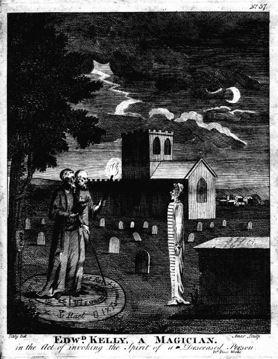
Last night I dreamed yet again. I felt myself drawn to a place where the mage stood, with another old man. They were huddled together, standing on a spot where strange devices had been scored upon the earth, as though the perimeter of the devices protected them from some evil or force beyond their control. I approached them as though through mist, or through the hall where I had first encountered the old man (though now it seemed plundered and ruined), all becoming clearer as I came close to them. At last I stood before them, a hand’s reach away, but outside their magic circle. The old man spoke to his companion.

“Strike with your staff upon the point of the heptogram, Master Kelley, and make it speak.”

At this, a look of annoyance passed the other’s face.

“I am known as Talbot now, and not by my old name. How many times do I have to say so before you remember!” He turned his eyes towards me, and drew himself up, rapping three times upon the ground with his stick.

“Speak, spirit,” he said. “Speak or be returned whence you came, and shut again in your arrow-chest. Speak, I command, in the name of an holy Power!”

“Whom do you command to speak?” I said. “I speak or do not speak at my own will, not yours. I say what is in my heart and mind, when it pleases me to open my lips. I am not bidden by anyone to speak or to stay silent, to come or to go.”

My old mage – I now thought of him as somehow mine – smiled a little, but the other became agitated, and struck again several times with his staff.

“I charge you to speak,” he barked. “Are you from Paradise or from eternal fire?”

“If you rap much harder on the ground,” said my mage. “You will find out first hand, as we shall fall through and into hell ourselves!”

“Paradise or flames?” I said. “A room in the Tower is not Paradise, though it is comfortable enough for a while; nor is it hell, for all its dreary solitude. Rather say it is purgatory, as it affords much opportunity for reflection and repentance!”

“Speak not in riddles!” cried the other. “But answer plainly, I charge you, by the angels!”

Patient now, my mage interjected, “Peace, Master Kelley; I know her, I know of her – she speaks what she thinks is true. She knows naught of heaven or hell, but lies where she lies, with her last memories, waiting for the graves to give forth their contents.”

“Master Dee, you may have traveled much, you may have been to Bohemia, and to Poland (where, I have heard, men have tails), but in these things you are ignorant. She is a spirit, and as such she has seen things you and I have not. And she is bound by the enchantment and invocation I have made, to tell us the truth. This fiddle-faddle she gives us is but her resisting my power, and it cannot last.”

“I know nothing of spirits,” I said. “Except that Saul was damned for causing one to be conjured up. I am none such. I am a queen, albeit one cast down. And Master Kelley or Talbot or whoever-you-may-be, you would be well advised to address me with more deference, and indeed to desist from your imagined conjuring.”

At this moment, my old mage turned eyes on me that held more pity and kindness than I had ever seen in him. There was such sorrow in his voice, when he spoke again.

“Master Talbot, it is clear to me that she is telling you the truth, though you cannot see it. Madam… Mistress… Your Majesty… “

His voice faltered, as though he had something difficult to say.

“Can you tell me where your favourite French headdress is at this moment?”

“Certainly, sir,” I replied. “I have it in my hand.”

“Madam, you have more than your headdress in your hand.”

At that moment, in my dream, I saw his meaning clearly –though I knew not with what eyes I saw that which I saw, for my own eyes looked up at me – and I screamed. My scream was choked by my awakening. Dreams are beyond fathoming, the pictures they paint are strange, their meaning is deep and often unholy…  and it is now today.

There is my gown, and my headdress; there also is my little book of psalms in French, undesecrated. I will wear my gown and my headdress today, and carry my psalms with me when I walk outside. I already have in mind what I will say:

Good Christian people, I am come hither to die, for according to the law, and by the law I am judged to die, and therefore I will speak nothing against it. I am come hither to accuse no man, nor to speak anything of that, whereof I am accused and condemned to die, but I pray God save the king and send him long to reign over you, for a gentler nor a more merciful prince was there never: and to me he was ever a good, a gentle and sovereign lord. And if any person will meddle of my cause, I require them to judge the best. And thus I take my leave of the world and of you all, and I heartily desire you all to pray for me. O Lord have mercy on me, to God I commend my soul.

But as I kneel, and before the swordsman scythes my head from my body, I shall think of my old magus. Then I shall breathe a short, Plantagenet prayer, and hope that my daughter, who has my eyes and my hair, will never be a queen, but will live her life a country lass, safe at home. For the burden of queenship is too heavy.

One Day in High Park, Toronto


Flash fiction – One Day in High Park, Toronto.

I was sitting on a bench, reading – hardly noticed the man, hand-in-hand with a boy. Both were dressed in black pants and white shirts, and the man had a black hat of woven straw. “Old Order Mennonite – what are they doing in town?” I mused momentarily.

They had been talking quietly, but suddenly the man raised his voice, still gentle in tone.

“No, Karl, that’s not true. You’re lying to me. I can’t allow that. You’ll have to take your punishment.”

“Yes, Dad.”

“Shall we get it over with now, rather than later?”

“Yes Dad.” The boy reached and rolled up the legs of his pants as far as they would go. The man bent down behind him and slapped him on the back of each calf, then slapped him again.

“Hey! Hey!” A guy in t-shirt and jeans, came from behind where I was sitting, vaulted over the end of my bench, and barged the man away from the boy.

“Pick on someone your own damn size!” he said, swinging a punch which caught the man on the right cheek. Down he went, and sat on the ground, hat awry, face bleeding. The t-shirt guy stood over him, fists balled.

After about fifteen seconds he got up, dusted himself off, straightened his hat, and looked at the t-shirt guy. He said nothing, but seemed to angle his left cheek a little, as though inviting another punch. Then he turned to the boy.

“Punishment over, Karl.” He said. The boy rolled his pants legs down, and came over to hold his father’s hand. “Shall we get some ice-cream?”

The boy grinned. “Yes please, Dad.”

They walked away, and the t-shirt guy stood, hands on hips. “Well… I… should… fuck… a… pig!”

I said nothing – I had a good book.

Axe

All the girls call me ‘Axe’. Tough name, but nah need fe aks me why, coz of me accent, ell-oh-ell!

They’re like to me – We were gonnay give you a kicking. Two days I’ve been in Glasgow, two days! I go out to a club, and these girls come over and they’re looking mean like they mean business, right. But the music is loud and the girl who’s doing all the talking has this accent, this Scottish accent, and she’s shouting over the music, and I’m like – What? What? And she’s back to me like – What? What? And then the music stops and all you can hear is her shouting what and me shouting what, and suddenly everyone’s laughing.

So the girl who’s doing all the talking, this is her to me – Come over to our table. And I’m like – Okay, cool. So we all get to be mates, and we’re laughing, and I can’t understand half of what they’re saying. I can now, though, later. I’m used to their accent, they’re used to mine though this is one of them to me back then – Oh. My. God. Your accent is weird!

Afterwards some of them are hammered and throwing up in the street, and we’re helping them. And she, this girl who was doing all the talking, she’s like – My name’s Marie, what’s yours? Only the way she says Marie is all Scottish like MAH-ri. And I’m like – I’m Shayla. And she’s like – you wernay scared when we came up to you, Shayla, we were gonnay give you a kicking, you didn’t back down. So I’m like – Why was you going to give me a kicking anyway? And she’s like – It was the way you were looking, looking at the lads in here, looking at us, just the way you were looking.

And she slips her arm through mine and we walk off down the street, and she’s like – Woot! That’s when we’re dodging round one of the other girls who’s not walking straight coz she’s hammered.

Then this is Marie to me when we’re walking down the street – Can you fight? Wannay be in the krew? This is me back to her – Yeah, all right.

So we’re The Gherls. The Gherls, right? They explain it to me once, it’s coz the krew started with, like, Celtic supporters’ girlfriends, and Celtic are called The Bhoys, yeah? But we’re not strictly Celtic supporters or Celtic supporters’ girlfriends any more, not Catholics. Well, Rosary is Catholic. We call her Rosary coz she gets her beads out before a fight, and like counts them with her thumb, then she puts them away and crosses herself. But Shireen is in our krew, and she’s a Muslim and Asian, and she wears a hijab thing and doesn’t drink, and it doesn’t matter even when we’re fighting Asian girls, so just the same it doesn’t matter to me if we’re fighting black girls. It’s the fighting that matters.

There’s ten of us hardcore, and there’s the also-rans, like girls who sometimes are there or girls we can call on, and some of those girls have mates who are okay and will help out. But like most of the time we don’t need them. The hardcore krew got loyalty.

And one day Marie’s like to me – How old are you? And I’m like – Why you aks me that? And she’s like – Axe? Axe? Ell-em-ay-oh, that’s what we’ll call you, your name is Axe. And I’m like – Laughing. My. Effing. Arse. Off.

When you’re fighting, like when I’m fighting, everything is so clear. Lights get really bright and white, and everything like stands out with this hard, black outline, and I feel really alive. I mean really alive, like my whole body is tingling and I can feel everything, and even when I get hurt it’s like the feeling takes over. It’s not like getting hurt normally. It’s different, better. I know that sounds weird, but I know what I mean.

There’s this girl, this Gherl, called Paysh, that’s like short for Patience which is her name, right. She’s cool, really quiet, never says nothing, never says nothing much. When she fights it’s like her fists go really tiny, and when they hit someone they must really hurt. I saw her once, and she’s really fast, and she’s fighting this other girl, and this other girl’s going down coz Paysh punches her in the face three times. Just like that, it took half a second. Bang bang bang. And these big red marks come on the girls face, and the rest of her face is pure white, and she looks like she’s going to cry. So all her mates are coming over like they want to kill Paysh, so we go and stand round Paysh and dare them, and they all back off.

And I’m like – that was sick, Paysh, really sick!

And the rest of The Gherls are like – yeah that was totally sick! And they’re all grinning.

And Paysh is suddenly all excited, and she’s like – Yeah it was sick, fuck yeah, did you see her face? And she’s making those tiny little fists. So anyway one day we’re in this bar, and I’m like – Where’s Paysh? And the others are like – She’s got her finals tomorrow, so she’s studying. And I’m like – What, no, Paysh is a fucking student?

And then the week after that I’m with Paysh shopping, and we go to Marks and Spencer’s café for a coffee, and this is me to her – Paysh, you’re really clever, so why’re you in a krew? Why’re you not, like, at the student union or something?

And she’s very quiet for a while, like she always is. She’s sitting there and I’m thinking how slim she is, and how she looks tall even when she’s sitting down, and how she always wears green but not bright green, not Celtic green, but sort of faded green, and how her hair is somewhere between blonde and red.

And then this is her to me – I don’t know, Axe. It’s as though when I’m at uni I’m on an island, or I’m behind bars, or I’m in a room with no windows full of mirrors. No one can see out. No one takes any notice of anything except what’s going on inside. No one sees that there’s a whole city outside of the uni. Yeah, it’s like I’m on an island and I want to see fish, but I can’t see fish unless I jump into the ocean, unless I make a conscious decision to jump into the ocean and swim and look for fish. So let’s take something simple: if I want a drink and a dance I go into the city, and there’s a club. If I want mates I go into the city, and there’s my krew. Some students if they want to do something dangerous and exciting they climb the big uni spire. When I want to do something and dangerous I get into fights with my krew. Do you understand, Axe?

And I nod, like I kind of understand. Then this is me to her – Yeah, I think so, it’s like when I’m at work it’s all brown and green, but when I’m out with The Gherls its bright yellow and bright blue, and when we’re fighting it’s brilliant white and there’s like wind-chimes going off in me head.

And she’s like – Synaesthesia. And I’m like – What? Whatever. Then we’re smiling at each other.

So one time I’m in our usual club and I’m fixing me makeup in the ladies, and Marie is standing next to me washing her hands. I’m sort of looking at her sideways and comparing her to Paysh coz they both have the same colour hair. But she’s shorter and like wider across the shoulders and hips, and she’s a little bit butch maybe, though not really stone just a little bit. And she’s taking a long time just washing her hands, and she looks over to me.

And she’s like – I really like you, Axe.

And I’m like – I really like you too, MAH-ri.

So then she leans over and kisses me right on the mouth, and her mouth is sort of nice so I kiss her back. Then we stop, and she’s like – Sick, or what? She’s grinning and I’m grinning too, and I’m like – Yeah, sick! And then we go back into the club to our mates.

Then there’s the time I see Rosary in the distance and I follow her, and she goes down streets I don’t know, where I’ve never been, and there’s this big Catholic church all brick and concrete, and she goes in. So I follow her, and there she is sitting in one of those long seats they have, and I go and sit next to her. She’s praying or something coz her eyes are closed and her hands are together and those beads of hers are between her hands. Her lips are moving but she’s not saying nothing. Then it’s like she realises I’m there or she finishes praying, coz she opens her eyes and crosses herself.

And I’m like – Hi! And she’s like – Hi. What are you doing here? And I’m like – I followed you. What are you doing? It’s not Sunday or nothing. And she’s like – I’m going to confession. And I’m like – What’s that? Coz I don’t know nothing about being Catholic.

And she’s like – I go into that box there, and there’s a priest in the other box, the one right next to it, and we cannay see each other but we can hear each other, and I tell him all the bad things I’ve done since the last time I was here. And he makes me promise no to do them again, and he forgives me like in God’s name, and tells me to go and say a bunchay Hail Marys or something as a penance.

So I think for a while, and then I’m like – Do you tell him about the krew and all the fights? And she’s like – Yeah of course.

So then there’s a creak and the door of the box opens and an old woman comes out and walks back through the church. Then Rosary gets up and goes into the box and closes the door behind her, and I suppose she’s telling the priest all about the things she’s done, and it makes me feel a bit weird because I’m sitting there and I’ve been part of the things she’s telling him. And I wonder what I would tell a priest if I was Catholic.

Then there’s this one big fight. There’s been another krew hanging out in the places we like to hang out, the mates of the girl Paysh punched. They’re like to everybody – we like it here, we’re gonnay keep coming here. So we’ve put the word round, Marie’s put the word round, that if they’re there on Friday then they are gonnay get a kicking. So on Friday there they are, and there’s more of them than before, and they’re really loud, they think they are so cool and tough. And Marie goes over to them and she’s like – Outside, round the back, ten minutes. And they’re like – Fuck you Missis Woman, but yeah.

So ten minutes later we’re all in the wynd and we’re thinking like – Where are they? Then we see them coming in at both ends of the wynd, and they’re grinning because they think they’ve got us trapped. And some of them are picking up stuff from the wynd, like sticks and stuff, and someone’s like – Watch out, that blonde hoor’s got a malky.

And Marie’s like – It makes me MAD when someone pulls a malky on me! Then we’re fighting our way out and they can’t keep us in, and Rosary’s up against some girl with a piece of wood, and I’m up against the girl with the malky, it’s a Stanley knife or a box-cutter or something and she cuts me across the face with it. And everything is brilliant white like camera flashes and ringing like bells in me head, and it’s like everyone is dancing and I’m breathing really fast. And I’m hitting the malky girl and she’s running and they’re all running, and we’re like – Woot!

Except Rosary is bent over with her hand on her knees and then she falls over, and someone’s like – She got hit over the head, someone with a piece of wood or something. And I’m like – Look, everyone, get out of here and I’ll stay with her. I’ll call an ambulance on me mobile, it’ll be all right, I’ll say we was mugged or something. Move! Get out of here! Before someone gets the coppers. Move!

So the ambulance comes and takes us to hospital, and Rosary is lying there with a blanket over her and a mask on her face, and I’m like – Rosary! Rosary! And the paramedics are seeing to me because of me cut face and they’re like – Look, keep still, you’re arm’s cut too. And me sleeve’s all wet and dark as they cut it away.

Then we’re at the hospital and there’s a woman doctor puts stitches in me face and me arm, and she’s like – We’ll keep you in overnight. And I’m like – Okay Miss, whatever, but can I have a bed next to me mate? And she’s like – I’ll see what I can do.

And the police are there and they want to talk to me, but I don’t tell them nothing, and I’m just like – We was mugged. We was jumped on. No I didn’t see who it was. It was dark. And they’re like – All right but we might want to talk to you again. And I can see they’re thinking, like – Black girl, black girl, blacks always equals trouble.

So then I’m sitting on this bed and Rosary is on the bed next to me with one of those drip things in her arm and bandages on her head where she got hit, and we’re talking to each other really quiet, and I’m like – You did really good, Rosary, at the fight, and you’ll be all right now the doctor’s seen you. And she’s like – You did really good too, Axe, and I’m glad you’re here. And then her voice goes even quieter, and she’s like – Hail Mary, full of grace. And it’s like she’s counting with her thumb but there’s nothing there, and suddenly her eyes roll and she starts to shake, and I’m like – Nurse! Miss! Miss!

Then there’s people running and pulling the curtains round her bed, and that’s Rosary dying, and I’m crying and I’m like – Rosary! Rosary! And there’s two nurses trying to make me be quiet, but I’m crying and I’m like – Rosary! Rosary!

So that’s when things go brown and green for me again, and the stitches in my arm and my face began to hurt, and Rosary dies and I never get to talk to her again, never get to tell her how great she is.

So we’re all standing round Rosary’s grave, The Gherls are here, and Rosary’s family that I’ve never met before, and there’s a priest and he’s like – And if the Spirit of him who raised Jesus from the dead is living in you, he who raised Christ from the dead will also give life to your mortal bodies through his Spirit, who lives in you. And he calls Rosary Christine McCluskey, because that was her name and I never knew it. I never heard it before. And Shireen isn’t there, she’s standing over by the path coz she can’t be at a Christian burial. So I walk over to her and I put my arm through hers, and Marie turns round and frowns, but I give her a sort of secret wave to let her know it’s all right, and she turns back again.

And this is Shireen to me – I really liked Rosary, I really liked her. And this is me back to Shireen – I really liked her too, we all did. And Shireen doesn’t know what else to say, so she’s like – La ilaha illallah, Muhammad rasulu-llah. And I don’t know what else to say either, so I’m like – Amen.

I’m standing there thinking the priest at Rosary’s church isn’t going to hear any more about us, about me. Now I won’t be in nobody’s confession.

And afterwards when Rosary’s parents have all gone, Marie’s like – No time to waste, we’re dressed in our best all in black, we are gonnay go and find the wee skank with the plank and we’re gonnay do to her what she did to Rosary, and we’re gonnay find the wee hoor who cut Axe with the malky, and we’re gonnay … we’re gonnay… something… like if they can pick up sticks we can pick up bricks.

And we’re all like – Yeah let’s fucking do it.

So we’re walking along in our best all in black, and inside me head there’s this rhyme, and inside I’m like – One two I love you, three four out the door, five six pick up bricks. And I’m looking at Marie and she’s looking back at me, and she’s like – This one’s for Rosary! And it’s cold and me teeth are chattering, and there’s bells in me head, and I’m angry but I’m smiling, and it’s all brilliant white, shining light, and I’m really alive again. Really, really alive.


It stops here!

President Harry S Truman looked around the Oval Office. His eye took in the rich, red drapes, the deep carpet in the same shade, the mahogany of the furniture. He glanced over each shoulder – right, left – to take in the Stars-and-Stripes and his own Presidential standard, and reflected that the room was still very much to the taste of Roosevelt his predecessor. How could it not be? FDR was such a dominating personality. He asked himself whether he had the courage (or the energy, or the time…) to redecorate.

Perhaps at this moment he doubted himself a little, but Truman was indeed a man of character. He looked down at his desk. Yes, here was the new Truman Presidency, ordered, workmanlike, symmetrical – that’s how he would be. A place for his pen, a place for his presidential blotter, a place for everything, yes everything was in order, so why was he frowning?

“Something is missing,” he thought.

His frown deepened when he caught sight of something he had been trying to avoid looking at. A tarpaulin had been laid on the carpet, and on that was the carcass of a freshly-killed white-tailed deer, a fine male with a single bullet hole. It was a gift from an eager, young White House aide who had heard that the President liked hunting. In that the aide had miscalculated – Truman shot grouse, not deer.

The President got up and walked round to the front of his desk. The carcass would not go away of its own accord, it had to be dealt with, a decision had to be made and it was the Commander-in-Chief who had to make it. No one else would make it for him.

“What the hell use would there be in a President who knew how to skin a damn deer?” he asked aloud. The walls of the Oval Office echoed his rhetorical question. He looked down at the white-tailed buck, then to the empty space on his desk. His frown melted. An idea formed in his mind and he made a decision. He lifted the Presidential phone and spoke to his secretary Matthew Connelly.

“Matt,” he said. “Get me the Presidential Butcher. And while you’re at it, get me the Presidential Carpenter and the Presidential Signwriter too…”

The Stag – a fable*

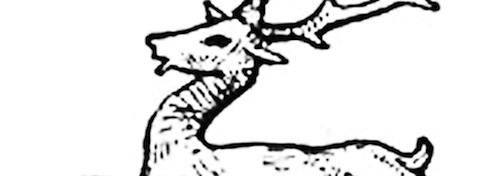
Deep in the heart of the realm of Angria there was a forest. In that forest lived a stag, perhaps the finest stag anyone had ever seen, his antlers spreading like the winter branches of an old beech tree, his flanks red as the ire of winter dawn. In a house just outside the forest there lived a hunter who had vowed to trap and kill the stag, to wear the antlers as his headdress and the russet hide as his cloak. But the stag was many years in age and full strength, wily, swift. He valued his freedom and would bound away while the hunter was still fitting a quarrel to his crossbow. Season upon season, year upon year, the hunter stalked the stag. Prey and predator knew every inch of the forest, every tree, every thicket, every faint sentier, every clearing, every pool, every shadow. At the beginning of one year the stag lifted his head to a new sound, the steady fall of an axe against a tree trunk. He thought little of it as such things are not the concern of deer, but nevertheless he moved through the forest to a place where the noise did not crowd as badly upon such things as did concern him. The sound continued throughout the year, but still the stag thought little of it. Then one day when he approached the edge of the forest he found that his kingdom was much smaller than he remembered, and his way out into the open fields beyond the forest was blocked. There was a high, wooden fence. The hunter had chopped down many trees to make it, and it was cammed in cruel, sharp points. The stag ran to the other side of the forest and found the way blocked there also. He ran along every path he knew and everywhere his was way barred by the fence. He plunged through thickets and briar patches through which he had never gone before, but the fence always thwarted and confounded him. Wherever he could get a run he tried to jump the fence but always, from outside, came the hunter’s mocking laugh or a warning bolt from the crossbow. At last the stag could endure this no more and risked everything on one last, desperate leap. The fence was higher than anything he had ever cleared before, but he gathered all his strength and courage, fixed his eye upon the blue sky above the cruel, sharpened points, and ran. He left the ground, he flew, he soared, wondering if this is what it felt like to be a bird. In mid-leap he could see the open farmland and the hills beyond. It was at that moment that the hunter, who had been waiting for him, loosed his quarrel. It went deep into the stag’s body, right to his heart, checked his leap, and brought him crashing down onto the sharp points. The stag’s eye was still fixed upon the sky and the far hills but now it saw nothing. When he saw what he had done, the hunter dropped his crossbow and his quiver and walked away. He was never seen again, and his house became a cold and empty ruin.
__________
* (c) from ‘Branwell’, a work-in-progress.

The Haunting of James Abbott McNeill Whistler

It is late on a rainy winter’s afternoon in the Hunterian art gallery in Glasgow. Little daylight finds its way into to the interconnecting rooms and the artificial light is yellow and diffuse, or seems so to the gallery-goer who is standing in front of a pair of paintings. They are behind one of the last few partitions at the back of the gallery, almost hidden from view unless one knows they are there or have happened on them in a spirit of exploration. The gallery-goer has to look slightly downwards to see them, as there are two other paintings above. These other paintings have only held her interest for a moment or two, but the lower pair seem to have transfixed her. She shifts her stance slightly as if to alter the angle of her gaze and lose some unwanted glare or reflection from the literal surfaces, and thrusts her hands in the pockets of her coat to quell an urge to reach out and feel the texture of the paint. She reads the laminated plaques at the side of each painting and confirms that they are by James Abbott McNeill Whistler and are part of the bequest of his sister-in-law Rosalind Phillip.

Whistler has never been her favourite painter – she prefers German Expressionism if anything – but at this moment she feels a compulsion to stand and let her emotional and intellectual reactions overlay each other, confuse her, vie for strength like two equidistant radio stations fighting for the capture effect. Arranging her thoughts like clothes on a washing-maiden to dry, the gallery-goer builds the following analysis.

The composition of each painting is simply the figure of a seated girl from the waist up. She has long, full, auburn hair with an untidy fringe touching her eyebrows, and tresses which rest on her shoulders. She wears a purple beret or small cap on the top of her head, pushed back. She is dressed in shapeless, dark clothes, maybe brown, or black seen with a reddish sheen by a dim lantern or firelight. In one painting her body is angled slightly away from the artist and she has turned her head towards her left shoulder to look directly at him. Her hands rest on her lap but the delineation is imprecise, they are pale and doll-like, or like hands on a photograph from Belsen. In the other painting she is slightly more squarely-on, her hands are out of sight. At first it seems that her gaze is straight towards the painter again, but perhaps she is looking to his right and slightly down. The second painting seems to have been executed with a darker palette, but in both cases it looks like paint has been applied and then has been scraped thin. The texture of paint and canvas are one. The modeling is uncertain, the girl’s pale face seems to be the only source of light. The picture space has almost no depth, as though she is sitting directly in front of a dark wall with her back pressed against it. The tone in the first painting is stark in its contrast between light and dark even though the background colour is a warm brown; the white of the girl’s hands and face are almost shocking, and although her gaze engages the artist and the viewer there is a remoteness, we are at arm’s length from her. The second painting is darker overall, but the tone of the girl’s skin is softer, there is more colour to her cheeks. She seems to be closer to us, and although her gaze is slightly averted the whole effect is more intimate. In both cases her face dominates the picture, drawing the eye into an uncertain virtual space full of ‘as though… as though’.

The gallery-goer does not know how long she has stood looking at these paintings. She becomes aware that someone has come to stand at her left elbow, though she did notice this person arrive. The other person speaks to her, and in the exchange that follows tells her a story, or maybe more than one story.

*

Beautiful, isn’t she! You don’t think so? Well I’ll grant she isn’t conventionally pretty. Her nose is long, her mouth is canted slightly downwards to the left, her expression is mournful, her complexion seems pale and warmed only by external influence rather than by her own blush, and – look here – that could almost be a scar. No, I think it is more likely to be the violence of Whistler’s palette-knife as the mark is only there on one of the paintings. But her face holds you nonetheless. Am I right?

You are wondering why the title, why ‘Le Petit Cardinal’, why present the model as a male? There is something a little androgynous to her looks I agree, but it’s obviously because of that purple cap she is wearing. Whistler painted and drew her several times with that cap on her head. Her name is Lillie Pamington. Very little is known about her apart from her having been one of several street-girls who caught Whistler’s eye in London. One can imagine he was passing in a Hansom cab when suddenly saw her in her dark coat and purple cap, weaving her way in between the press of people on the pavement. He was captivated, just as you are, by that pale face in the gaslight, bobbing along like a jack-o-lantern amongst bushes, and he rapped the roof of the cab with his walking stick – Stop, cabbie, stop! – and jumped down onto the kerb.

Miss. I say there, Miss. Young lady with the purple cap! Picture her halting, looking over her shoulder to see who was calling. Maybe he gestured her to come. Maybe she placed one of those pale hands against her chest as if to ask Me? or as if she were trying to still a racing heartbeat, unsure in her mind whether she was to be the subject of a hue-and-cry as a thief. Picture him holding out a business card. Can you read? Come to this address then, I would like to paint your portrait. Did her face remain solemn and sullen or did she smile? Was she instantly trusting or did she rebuff him at first with a few choice words of cockney? We know that she did turn up at Whistler’s studio because we have the evidence right here in front of us, but for now picture her purple cap bobbing down the street, soon lost amongst the crowds. Oi guv’nor the cabbie would have called. You want this cab or not? I’m losin’ fares.

Imagine how, a day later, she arrived at his studio, that there was a knock at the door and that when he opened it Whistler was at first puzzled. Who could these two people? One would have been a child of about fourteen with a painted face and elaborately-curled hair, the other a woman, her hands resting lightly but proprietarily on the child’s shoulders. I made her look nice for you, sir – a proper little lady to ‘ave ‘er portrait painted. Whistler would have come to realisation, and would have been horrified. No, no, this wouldn’t do – where was the solemn waif with pale face and auburn tresses that had captivated him in the street? This was a sham, a travesty, a mockery of her beauty. Imagine how he controlled his emotions and explained to the woman, as her smile faded, that he wanted her daughter – was the woman actually the child’s mother? – just as he had first seen her, and turned them away from the door. How he would have fretted for the next few days, cancelling all the sittings he had scheduled in case the woman and child returned. Would they return? There had been no mention of payment. Should he patrol the street where he had first seen her, or would that risk his not being at the studio when the next knock came?

It might have been one evening ten days later that Whistler resolved that the next day he would stop waiting for Lillie Pamington to come, and would arrange other sittings again. Imagine a light step outside and the rap of a small fist upon his door. Imagine that he opened it and saw standing in the shadow… Lillie with the pale, solemn face, with the unruly waterfall of auburn hair, with the dark coat and purple cap. Standing alone, silent. Would he have let her in without a word, or would he have smiled and said, Delighted to see you, Miss Pamington – so glad you could come, please do step inside.

What was the obsession that drove him to paint and draw her over and over again, clothed and naked? We know that he was a womaniser, and that he sired many unacknowledged children by his mistresses. Did he see in Lillie some echo of Joanna Hiffernan, the lover whom he had lost to Gustave Courbet? We do not know, Whistler never told us and as for Lillie she suddenly disappeared from his life and became obscure once more.

But imagine this. Imagine Whistler, having used up all the obsession he could on painting her, throwing his paintbrush down one evening and taking her in his arms. A kiss for ‘Uncle James’, Lillie? A struggle would have happened – I’ll tell! I’ll tell! – and he would have silenced her, consigned her limp remains to secrecy and sworn to all inquirers that he had sent her home at the usual time. But the stress of keeping the secret as a matter between himself and his burdened conscience would have weighed upon Whistler, so much so that he might have spent hours gazing upon ‘Le Petit Cardinal’, at his study in ‘Grenat et Or’. One night he would have fallen asleep and awakened to see nothing but her pale and solemn face looking out from the portrait. It would have seemed that the face detached itself from the painting and approached, as though Lillie was walking towards him. Imagine that was the first of many such night-time visitations, and that eventually he could stand no more and, snatching up his palette-knife, slashed at the apparition. Imagine that in the daylight that eventually followed, the mark of the knife was to be seen on the painting. Imagine, perhaps, that years after Whistler’s death the skeleton of an unidentified girl was found in blitzed-out rubble somewhere in London.

No? You don’t like that story? Well then, imagine this alternative. Lillie came willingly to kiss ‘Uncle James’, and her kiss was sweet as pomegranate juice but sharp as broken glass, and that she came and went as she pleased at night until Whistler wasted away and died, his life entirely drained from him.

You’re right, of course. The official story is that he was ill, that he was broken-hearted after the death of his wife Beatrix, and I’m sure that is much more likely than either of these tales. How could they be true? But just look to your right, look at his last self-portrait. Gone is the confidence of the young man in the tilted, broad-brimmed hat, gone is the flash and dandyism. Originally he painted himself in a white coat, but something made him scrape off most of the paint and re-execute the work in black or dark brown. The stance and gestures are clearly in imitation of Velazquez; but the hands are indistinct as though fluttering and fretful, the right hand perhaps on the point of being raised to repel something, the left hand just holding his coat closed, a hesitative protection. His entire weight is on his back foot, as though he is leaning away from something. His expression – his eyes – he is looking down as if at the approach of someone a good deal shorter than himself, and he is staring with horror. What is he trying to tell us? What secret is he only just holding inside?

*

This is the point at which the gallery-goer realises that the other person has fallen silent and, moreover, that the gallery lights have all been shut off apart from the single, dimming lamp where she has been standing. The gallery is in complete silence, the only sounds are faint and come from outside. The most luminous object in her line of sight is the face of Lillie Pamington in the portrait.

The other person is still a presence at her elbow, just outside her peripheral vision.

Who are you? she asks. What are you?

I may not tell you, but I may show you, says the other. Come with me.

Bat, man, batman, batsman.

Crypto-anthropology is a word I thought I might have invented (like ‘polemophonic’ – pertinent to the sound of warfare, ‘polemophonics’ – the study of the sounds of warfare) but it seems not. A pity, considering my interest in the Moosh-Moosh. But then I didn’t invent ‘futilitarian’ or ‘eukelele’ either, although the latter is only a pre-existing, alternative spelling. Here is my butterfly mind flitting from flower to thoughtflower for the brief summer of its life, digressing from the off. Here’s what I mean to say:

Cities grow. Ours did. Track outwards from the centre and you will see where the margins were, how they advanced and were filled in, how they swallowed neighbouring villages and towns, how there are rural names for roads and faubourgs mixed in with the newer names that commemorate royalty, trees, Scottish islands. Between the city and me there is woodland and parkland, but in that woodland there is a golf course. Golf courses are things of the Scottish ‘edge’ as farmers diversify in hard times. Also there is a water tower for the nearest of the city’s housing schemes that lie on the other side of the wood. The parkland, once the estate of a conquering admiral, is now a pleasure park for the citizens, complete with zoo and funfair. Only on the edge could such things be.

Is my village itself still a village? Its dormitory status makes it almost a suburb, yet it has or had a number of edge-features – a caravan park, and at one time an indoor play-area for children with a ball-pool and such like. Oh flit, flitter, flutter, fritillary. Anyhow, here’s what I mean to say… no really…

Attached to our Millennium Hall are a bowling green and playing fields. There is fitba of course, but also a cricket pitch. Cricket is not unknown in Scotland, of course, and much further north in the land too, but it is nevertheless a curiosity to many, something you would have to turn your head to gawk at if you were passing on a bus. It isn’t entirely a haven for expatriate English and third-generation South Asian Scots either, but it is an edgy place where crypto-anthropology has recently taken a strange turn. I think so. I had to think so when someone told me that the cricket team had a member who was half-man and half-bat.

I remember thinking that they were making a play on the word ‘bat’, but no, they meant it literally. There is a man nominally on their playing strength who has the arms and wings of a bat. He goes by the name of Doug Millar. He can fly, though he hardly ever does, and only once has done so on the field of play. He was fielding at silly-point when a farmer’s son from Forfar let fly a square cut with his full strength. Doug dived out of the way to avoid harm – there was no way he could have stopped the ball, let alone caught it, without risk of injury – and in diving he spread his wings. He only flapped them once but that was enough to allow him to glide over the outfield towards the Third Man boundary where he banked sharply, caught a thermal, and soared. Thankfully the umpire was about to call a drinks break anyway and Doug wasn’t even off the field long enough to warrant substitution by Twelfth Man. He returned red-faced and apologetic for his lapse.

Doug is not of this world. He is a Thogrian, which many folk mistakenly write as ‘Thorgian’, a unique marooneer on our planet and a castadrift from the world of Goldilocks 4. The cricket club doesn’t shout about him, they’re cagey blokes. If he could handle the willow or the cork-and-leather a wee bit better, or if ever he flew from Fine Leg to take a catch at Gully, it might cause questions amongst the rules committee of the league in which our village team plays. But he’s a plodder with both ball and blade and an average though conscientious fielder, driven less by skill than by his love for the game.

I have always wanted to talk to him but have never succeeded. I heard that he was due to be at the last home game so I went there and hung about the pavilion, searching amongst the whited players on the field or waiting their innings on deck chairs. I couldn’t see him. Then someone told me he was in the scorers’ hut for that match and couldn’t be disturbed. And that’s when I caught sight of him, very briefly, walking back to the hut with a tray of teacups and a teapot, his wings folded across his back. For some reason he had affected a Mohawk haircut.

I am told that if he excels in any respect it is as a scorer. His entries in the score book are precise, instant, and accurate. He uses an ancient Parker fountain pen but never makes a blot, and indeed there is a little Gothic flourish every time he records a ‘W’ for wicket. I think that he’ll be in that hut whenever I make an appearance at the cricket pitch. I think I have missed my chance. The hut is sacrosanct.

You see… I want to tell him that I can fly too, even though I only have conventional arms. I can’t soar as he does, though I have tried it once or twice when leaping from the King’s Seat, beyond Abernyte. Each time I could feel the wind under my arms, but my descent was too rapid and I had to resort to flapping hard to maintain any height and to land safely. I want to share with him that sweet, intimate knowledge of the upper air and of seeing the land turn beneath me. I have to speak this truth to someone who will not say I have been dreaming.

‘A Woman on the Edge’ – Railway poetry

Railway footbridge, Perth.

My careful paces, three to the second, carry me
across the worn, regular plates of the footbridge; a slight give,
spring, a dull noise that dies, and if I pause to look
over the rail into the slack, dark backwater,
the black-to-silver flash of heron-bait fry
flickers against the turvy tree and the negative sky.

I know that by the hedges at the far side of the bridge,
where an old gate leans, black flies will be haze-hanging,
trailing their lazy legs in the air, and that I might be taken
by the sudden ambiguity of a butterfly, resting
on a stoical stone, all red-gold-in-shadow.

Yet to come, but first a one-boy riot of slapping trainers
in a terrified sprint to win the far side before a train comes,
oh the clangour of drowned bells his feet make; be quick, be quick!
Who knows what cracks may open and
what worlds may be tumbled into if the monster should arrive;
would the boy be left senseless, eyes a-distance,
or a wicked, smiling changeling, or a pair of empty shoes?
Is there such magic, such old, unwritten wizardry in the everyday places?
I have no idea, but he has me running fit-to-win as well!

The view from a train

Travelling by rail gives me views I am not supposed to have. Human activity and urban sensibility demand that I approach by road, on foot or by car, and see the face that places want to project – the front of a house, the shop façade, the planned vista. The railway, on the other hand, ignores convention and ducks around the side and back, and for all that impoliteness it barges through in a straight line or at best in a gentle and graceful curve as though ignoring the things it passes. But surely things were built this way? Surely the railway was here before the majority of the landmarks of the townscape?  Maybe. Nevertheless even the Georgian villas present the reverse of their wooden fences to me, the obverse being a quiet component of a garden. It is not the train that sees things at all, it doesn’t care a jot for the intrusion, its progress is a linear dance to the tune of its diesel motor and the rhythms of the track. It is I who am the voyeur, keeking at the dirty underwear of the town. The town doesn’t care. It was built this way, showing its bent and ugly back to the travelers, showing us contempt. “I shall show hoi polloi my arse! Folk of quality roll up to my front door by carriage, knock, present a gilt-edged card. Only the ragged are shuttled behind me. If they demand respect, let them come by foot and see my porticos, my pediments, my railings of wrought iron.”

Not that we notice, of course. Newspaper, book, and now laptop, iPod, iPhone, iPad, tablet, gamer… only the indolent (me) technophobe (me) lexophobe (me) looks out of the window,

and

sometimes the town shuts with a bang. Someone has built a new housing estate that just out into the countryside. Its edge is as sharp as a kitchen-knife, and the green field full of sheep with dirty wool and patches of reddle leaps up at me immediately the instant I pass in the train. Whose idea was this insanity? Who decreed that there should be no debatable area but instead of that an ugly, stark interface?

There is a pick-up-sticks of broken doors,
poles, planks, grey and shadowed in angularity;
my head turns in direct proportion
to the speed of the train, and the sight is lost…

unless of course… the weather turns against us…

… rain making scars
across the face of a window.

In summer the rose bay willow herb is dense. Or is it loosestrife? The former I think. Someone I knew called it railway weed, or parson’s prick because it pops up everywhere – episcopalis vulgaris erectens or some such. I wrote a story once about being asked by an elderly Japanese couple what the tall, pink weeds at the side of the track were, and how I watched them mouth each word carefully. Rose. Bay. Willow. Herb. I can’t find it now. This tall, waving plant is the hair on the back of the town’s neck. It blushes and is beautiful from a distance, ugly close-to. It sighs and bows to the train’s bow-wave. It has its own eyes and watches back, pink-lidded and dusty with sleep. Left to its own devices it would colonise no further. It seems not to need to. It seems to know the limit of its domain. No flower defines the edge more than rose bay willow herb.

The Happiness Machine*

This will be the last entry I make in my journal. I may not die today but nevertheless I shall write no more. I have written and read and studied all my life and, yes, I have painted. I have painted faithfully as Master Leonardo da Vinci taught me, because there could be no other possible response to his selfless and incandescent love. I have no more to do and must set my house in order – praecipe domui tuae morieris enim et non vives, says the scripture. I have made my will and have left all Master Leonardo’s works, designs, and notes, and indeed all scraps and chits with his signature upon them or in his hand, to my son Orazio. They are to remain here in Vaprio d’Adda, safe in the hands of our family, for ever. They are now our birthright – or, no, we are their custodians.

There is an exception. I make this confession now. It is not a sin so I do not need to make it to a priest. It is a work of Christian charity, I see this now in my old age, in my final days. While I was young I might, I might, have dared to challenge or to stir things up, but now I seem to hear to echoes of a great hall of judgment, I know that all my deeds are being weighed, I will be judged. The exception is one bundle of papers that I have burned. It was the design for a machine and notes on its construction and use. I wept as I burned them for the simple reason that Master Leonardo had entrusted them to me on his deathbed. I was with him in France when he died, and it was I and not the King of France – disbelieve the legends! – who cradled his head as he died. I returned the Master’s love with a pupil’s devotion and its incandescence is within me still. He put his trust in me to seek a time and place where the knowledge in those papers would be accepted and I betrayed that trust. God above, will that weigh against me?

Leonardo’s designs were, the master himself told me, refinements and improvements of some earlier patterns for a machine that had actually been built by Verrochio, his own teacher. You all think of Verrochio as a painter, but just like Master Leonardo he was a natural philosopher skilled in geometry, architecture, medicine, and alchemy. Hearing that Verrocchio was dying, Master Leonardo journeyed from Milan to Venice to be with him, and he received the first draft of the designs he later gave to me, and he heard from Verrocchio’s own lips the story of the building and demonstration of the machine. He told it to me and whether he put flesh on the skeleton in his telling I do not know, but as he recounted it to me it was as though I heard the voices, saw the scene, witnessed the workings of the machine for myself.

It all happened in the time of His Holiness Pope Paul the Second. His Holiness was, in a way, a natural philosopher too, inasmuch as he loved machines. They delighted him, he understood them, appreciated the beauty of the mathematical principles behind their processes. It was said that he built his own Archimedes’ screw in the Vatican in order to demonstrate its properties to his cardinals. He authorized the setting up of printing presses throughout the Holy See and all Christendom, but immediately he had done so he realised their power, their potential for independence, as though they had minds of their own and could decide whether to lie or speak the truth. He imposed strict control on their construction and use. It was said that he had a small army of clerks who drew up an index of every press in existence and every printed work they produced. All natural philosophers who were concerned with the building of machines brought the plans or working models before the Holy Father who, if he approved of them, would affix his seal to the plan and grant a license for their construction.

Master Verrocchio was one such maker of machines, and one day he gained an audience with His Holiness for the purpose of demonstrating a machine of his devising. It consisted of a fixed chair over which two hoops were suspended in such a way that they could each spin freely. Each hoop had, on the outside of what I might call its northern, western, southern, and eastern points, a counterweight of lodestone, placed so that there was a tendency for the hoops to return from any eccentric alignment to one of ninety degrees relative to each other. The inside of each hoop was lined with reflecting plates like those described in the writings of Ibn al-Haytham. As a description that is the bare bones of it. There was much more to it, great delicacy and precision in its construction (oh, much more so in the drawings of Master Leronardo, believe me), but I shall leave all that dark.

Master Verrocchio explained to the Holy Father that it was an engine for generating happiness and that he had devised, it out of a sense of caritas, for the benefit of mankind. He hoped that the Pontiff, as the Vicar of Christ who wished nothing but good for all His children, would be the first to try its efficacy.

The Holy Father agreed, and seated himself in the central chair. Master Verrochio made adjustments to ensure that the machine was at a certain orientation relative to the sun, the moon, and the known bearings of divers points on the earth, and set it in motion. Slowly at first and then faster, faster, faster until they were a blur, the hoops spun around the Holy Father, who sat gripping the arms of the chair. The facets of the reflecting plates on the inside of the hoops merged, and it seemed to onlookers as though the Holy Father’s face was magnified in them, round and shining. To the amazement of those onlookers that face began to smile, to beam, to grin, and then its eyes closed and great guffaws of delighted laughter could be heard over the mechanical whirring. The Holy Father was laughing as merrily as a child at a fair.

Master Verrochio let this continue for some minutes and then applied some careful friction to the moving parts of the machine, one by one, causing the spinning to slow. More and more slowly spun the hoops, until at last they stopped.

Wiping a tear from his eye with the sleeve of his vestment, the Holy Father stepped, still smiling, from the machine. He was still smiling, but with a smile that was at once beatific and confident, when he turned not to Master Verrochio to congratulate him but to an attendant. He ordered bell, book, and candle to be brought. He ordered firewood and faggots. He ordered pitch, oil, and torches. He ordered all these things to be fetched without a moment’s delay, while Master Verrochio stood mutely by, half bewildered and half afraid for his life and his immortal soul.

Once everything for which the Holy Father had called was assembled, he solemnly excommunicated and burned… the happiness machine.

When it had been reduced to ashes, he turned to Master Verrochio, thanked him for the demonstration, blessed him with the sign of the cross in nomine patris et filii et spiritus sancti, and held out his hand so that Master Verrochio could kiss the ring on his finger. There was no further exchange between them and Master Verrochio left the papal presence never to return.

He had realised perhaps (though it is more likely he was now afraid to defy the Holy Father openly by continuing with his machine) what I came to realise once the sobriety of age had overtaken the rashness of youth, and what I realise more than ever now that proof of my mortality is stark before me. What was once supposedly evident to me in my confident and humanistic youth has faded and faded to be replaced by a simple and blessed faith – oh such a thing as never happened in the case of my own beloved Master Leonardo! – and my eyes are opened. If man could, by his own contrivance, build some machine, distil some elixir, devise some physical or mental exercise to ensure his happiness, what need would there be for the guiding presence of Mother Church? What need would there be for the salvation of his immortal soul. What need would there be – dare I breathe this even now? – for Christ Jesus? When I ask these questions I know that the act of destroying the last record of the happiness machine, although it was in defiance of my earthly Master whom I loved without reservation, it was in obedience to my Heavenly Master to whom all love, all reverence, all obedience are due. I will go to my eternal rest with peace in my heart. Peace, indeed, but not happiness. That is not my lot, nor anyone’s – homo ad laborem nascitur et avis ad volatum. The book is now closed.

Written on the 31st day of January, anno domini MDLXX, at Vaprio d’Adda, by me, Fancesco Melzi.

__________

* This story is inspired by, but not based on, the story of the same name by Ray Bradbury