Marie Marshall

Author. Poet. Editor.

Tag: writing

‘Milk of Female Kindness’ launched in Australia

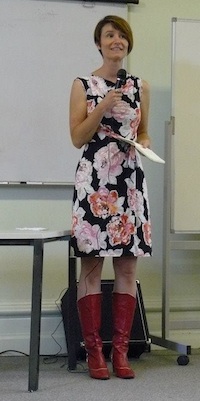
Kasia James addressing visitors to the launch.

Kasia James addressing visitors to the launch.

Lovely pictures from the other side of the world (as I look at it) from the Australian launch of the anthology The Milk of Female Kindness. You may recall this collection is the brainchild of Kasia James (pictured opposite); Kasia was kind enough to include some poetry that I wrote especially for the collection, and to ask me for some editorial consultancy. The theme of the anthology is Motherhood – the title is a quotation from Virginia Woolf’s Orlando, by the way – and it contains the prose and poetry of contemporary women writers from round the world.

The launch was held at Abbotsford Convent, Melbourne, Australia. This is an important cultural centre, hosting all kinds of events. The launch took place on 24th March – it seems strange, from my point of view, typing ‘took’ because that day is only just dawning here; of course in the Antipodes, as I write this, the day is coming to an end. Or is it? I get confused!

Anyhow, here are some pictures from the launch (c) Kasia James – there was food too, and a colouring table for kids. You’ll also see the table showing other works by contributors. If you want to read a quick review of the anthology, go here. I might have mentioned this before, but I am very pleased and proud to be associated with this venture, and I’m glad it is becoming successful.

A table full of milk...

A table full of milk…

An early visitor. Apparently attendance reached three figures.

An early visitor. Apparently attendance reached three figures.

Interest in the 'Other Work by Contributors' table.

Interest in the ‘Other works by Contributors’ table.

Amongst the material on this table you can spot my book 'I am not a fish', plus fliers fro 'Lupa' and 'The Everywhen Angels'.

Amongst the material on this table you can spot my book ‘I am not a fish’, plus fliers for ‘Lupa’ and ‘The Everywhen Angels’.

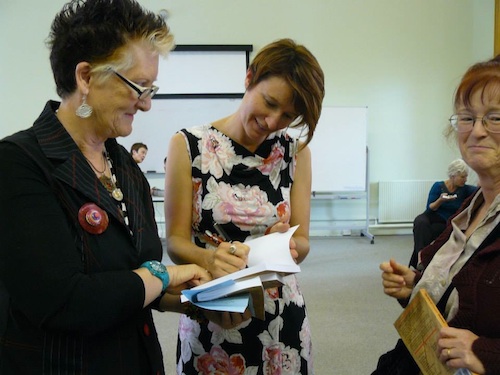
Book-signing.

Book-signing.


Mongolian Limericks

Mongolia

Five years or so ago, the late Vera Rich, poet and translator, let slip some ‘Mongolian’ Limericks just for fun. I replied in kind and tickled her. Here’s an exchange or two between us.

Vera:

A Mongolian dealer in koumiss
Told his daughter: “I’m angry with you, Miss!
Last night’s supper was spoiled,
For the tea was not boiled,
And the dumplings were sticky as glue, Miss!”

Me:

His daughter’s voice came from the yurt:
“To say the least, you’re very curt!
No need to be cocky –
Those dumplings were gnocchi,
Green tea is drunk tepid – I’m hurt!”

Apparently Vera wrote a whole series of these as a divertissement at a Mongolian Studies Conference in the 1980s – a far cry from her serious work translating Ukrainian and Belorussian poetry. Here’s some more.

Vera:

Said a PR man in Ulan Bataar,
“I really don’t know what’s the mataar!
But that cursed foreign press
Writes of us less and less,
Saying it has too much else on its plataar!”

Me:

The cleaner (whilst shoving her Huva)
Said, “No Mongol is the prime muva
Of things international.
Anonymity’s rational…
It could be worse – this could be Tuva!”

It does you good to let your hair down once in a while. Vera is very much missed by those of us who knew her and worked with her.

Baal, Yamm, and Anath

Embedded in The Everywhen Angels is this tale, handed down from ancient Canaan; it is told by a Romany patriarch to a gorjo boy, as his wife paints a henna tattoo on the boy’s arm.
__________

BaalFar away in the land of Canaan, many years ago, beyond the city of Ugarit, where they sang psalms to the creator El long before the Children of Israel came and stole not only their land but their psalms too, there stood a mountain. The mountain’s name was Zaphon, and it was the home of the great god Baal, son of Dagon, called ‘Lord of Thunder’, ‘Almighty’, ‘Rider of the Clouds’, ‘Lord over the Earth’. Some folk called Baal by the name of Hadad. Baal was never still – he could never rest – and thunder could be heard daily from Mount Zaphon, and flashes of lightning played around its summit.

From the summit of Mount Zaphon, where he ceaselessly paced to and fro, Baal could see the Mediterranean ocean, home of the god Yamm. Baal became angry. His kingdom now felt small, because he could see its boundaries. And in his anger he called out to Yamm, insulting him continually in his loud voice, hurling thunderbolts and making great winds, so that Yamm’s kingdom was constantly in turmoil, tossing this way and that in the storms and winds that Baal sent.

“Come out and fight me, Yamm, you coward!” shouted Baal, in a voice that echoed in a peal of thunder so loud it was heard beyond the southern border of Canaan. “Stop skulking in your slimy kingdom. Show yourself!”

And at last Yamm came up from the sea, his dark face rising like a tidal wave, and he set his great, green foot upon the shore, upon Baal’s kingdom. And he shouted back to Baal in a voice like the crashing of breakers against the cliffs.

“Here I stand, you blustering bully! Are you nothing but noise? I challenge you! Who’s the coward now?”

Baal saw that Yamm was indeed mighty, a great enemy, strong and fearsome. Baal himself was no coward, but he was very cunning, and so he went to Kothar, the blacksmith god, skilled in making any object a god could need. He asked Kothar to make him mighty weapons with which to fight Yamm. Kothar took all the metal that lay under the ground between Mount Zaphon in the West, and the Indus river in the East, and he worked it into a great, bronze sword. And he scooped up a huge piece of the Earth and made it into a stout shield; and the hole it left became the Sea of Galilee.

Armed with the sword and shield, Baal charged at Yamm. The battle between these two gods lasted twelve whole years, during which time there were such thunderstorms and tides as had never been seen in the Mediterranean*. Baal pushed at Yamm with his shield, and battered at him with his sword; and with every push of the shield and stroke of the sword there was a huge peal of thunder and flash of lightning. Yamm whipped Baal with waterspouts and showers of stinging rain and hail.

In the city of Ugarit, and throughout Canaan, the poor people cowered in their houses, only coming out when the two rival gods paused between rounds.

Eventually Yamm began to gain the upper hand, and roared with delight, beating Baal further and further back inland. One lash with a mighty waterspout was enough to send Baal’s shield spinning from his hand, to land on its edge in the sea, where it became the island of Cyprus.

By this time even the gods themselves had come to watch the battle, betting upon the outcome. The sun goddess, Shapash, was the only one to bet on Baal, and secretly warmed and dried him with her rays. Baal, who as you know was cunning, devised a plan to escape defeat. He waited until the sun goddess’s kindly gaze was on him and then angled his mighty, bronze sword so that it reflected the sunlight right into Yamm’s eyes. Yamm was dazzled and blinded, and Baal started to belabour him with the flat of his sword, raining blow after blow down upon the sea god, until he was beaten, and the sea became calm and still.

Now Baal had a wife who was also his sister. Do not ask me how this can be, but such things were possible with the gods of Canaan. Not only was Anath his sister and his wife, but she was forever a virgin. She was greatly loved by all the gods, and she took Baal by the hand and led him to see El, the creator, to whom all psalms were sung. There she told him that the reason Baal paced to and fro on Mount Zaphon was that he had no house to live in. If El would give permission for Baal to have a house built, then all Canaan would be a place of peace. El readily gave his permission.

Anath asked Kothar for help, calling to him sweetly, using the pet name she had for him. “O Hasis the Skilful, Hasis the Wise, make a house for my brother-husband Baal and me, in which we can live peacefully.”

Kothar built a house for Baal on top of Mount Zaphon, and Baal was pleased. For a while all Canaan was at peace, the sun shone, and the gods dozed. Even Yamm forgot his quarrel with Baal, and visited him in his house. At such times the summit of Mount Zaphon was wreathed in mist.

One day Baal invited all the gods to a great feast. Yamm was there, and El the creator as the guest of honour. Shapash and Kothar sat together, and even Yutpan the deceitful had a place. The only god not to be invited was Mot, the god of death. When he heard about the feast, he strode up Mount Zaphon in a rage, and pounded so hard on the door of Baal’s house that the food and drink was shaken off the tables.

Mot burst into the house and cursed and ranted at Baal for the insult of not inviting him. Baal was so enraged at this that he forgot he was supposed to be living a peaceful life. He sprang to his feet, seized the sword that he had used to defeat Yamm, and rushed at Mot.

Their duel was a terrible sight. Even the mighty gods fled from Mount Zaphon, as Baal and Mot reduced the lovely house to rubble in their raging. But even the mighty Baal could not defeat Death, and Mot eventually swallowed up Baal, and spat him out on the mountain top, dead and cold.

While the gods debated amongst themselves who could take Baal’s place, Anath mourned for him. Not only did she mourn as a sister and a wife, but also as a mother and a daughter would, for she was all things to Baal. She wandered through Canaan looking for Baal’s body, and when she found it, she buried it and wept over his grave. But her tears, at first cool and sorrowful, turned to drops of fire, and became a rage such as creation had never seen. She turned and ran and ran until she came to Mot, flinging herself upon him in a murderous frenzy. Struggle as he might, Mot found he was no match for Anath, because as she had mourned Baal as a sister, a wife, a mother, and a daughter, she had become four goddesses in one. In her wrath she killed Mot, ground his body to powder, and scattered it over land and sea.

Then she took the place of Baal on top of Mount Zaphon, where she ruled for many years, no longer as Anath the gentle and beloved of the gods, but as the goddess of slaughter, whom some called Ashtoreth, with a hideous aspect.

Many lives of men and women passed. One night El, the creator, dreamed a dream, in which Baal and Mot were alive and stood before him. What El dreams always comes to pass, and so when he awoke, there before him stood Baal and Mot, restored to life. He charged them solemnly each to keep to his own kingdom, and not to fight any more. They bowed low to him and gave him their promise.

When Anath saw Baal coming again to Mount Zaphon, her heart was softened, and her face became beautiful once more. She painted herself with a dye made from her sacred plant, which she called Mehendi, making  the beautiful patterns on her face and limbs, which brides do to this very day in India, and in Mesopotamia, and in all parts of Arabia.

And Baal and Anath lived in peace and happiness ever after. Some say that when the One God came they faded away. Others say they still live on top of Mount Zaphon, but now as an old man and an old woman, and have retired from being gods.

But one thing I know is this: Anath’s sacred plant, Mehendi, which we call Henna, still grows.
__________

* Yes, I know, I know!

Fearie Tales 2014

© Bookseeker Agency

© Bookseeker Agency

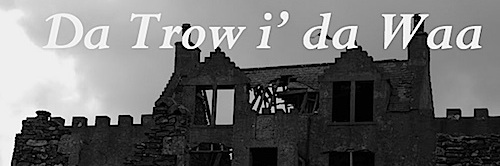
Last night, battling my agoraphobia, I made it for the first time to the final event of the 2014 Winter Words literary festival at Pitlochry Festival Theatre. This festival is the first in Scotland’s literary calendar, and each of five weekend evenings is rounded off with a couple of macabre short stories –  winners of their annual ‘Fearie Tales’ competition. I made a point of being there because my short story Da Trow i’ da Waa – a chiller set in Shetland – was the climax of the evening, sending festival-goers away until next year with a shiver in their spines.

The regular readers are actors (man-in-black) Dougal Lee and (woman-in-grey) Helen Logan. Dougal is a big guy, and sometimes at a tense moment he seems to hunch over his lectern, and glower at the audience over his specs. Helen, who read my story, has eyes that glitter, and a grin of delight at every ghoulish detail.

Although I say it myself, I’ve had a pretty good run at ‘Fearie Tales’, and I’m not about to stop, either. I dare say I’ll submit entries as long as they run the contest. Here’s a run-down of my successful entires so far – might as well blow my trumpet a bit!

2008 – Chagrin – and old man remembering a demon lover.
2009 – Vae Victis – horror at Rome’s northernmost outpost.
2010 – The Place of Safety – a tale of love, magic, and insanity.
2013 – On the Platform – a haunted railway station.
2014 – Da Trow i’ da Waa – old stones possessed.

The festival has some marvellous speakers and events, judging by the programme. Both the competition and the festival as a whole are well worth supporting and visiting if you can.

… a little touch of Branwell in the night…

I write in manic fits and starts. Not for me the discipline of a clock-timed hour set aside in the day, so don’t even suggest it. You will be familiar with my writing technique which is to ‘have an idea and throw words at it’ to see whether they stick. Often what results is a fragment that is laid aside. Sometimes I pick it up again and finish it (‘Lupa’ was written like that, as was ‘The Everywhen Angels’), at other times it lies unfinished. I throw none of them away, and I have several such works-under-scaffold that I’m concerned with right now, to a greater or lesser extent. The other day I found something I had started, fictionalising the life of Branwell Brontë, the under-sung brother of famous sisters. Here is an extract from it.
__________

Branwell Bronte self-portrait 2“Would you forgive me if I loved anyone else?” I said as I lay with my head on Emily’s lap, she stroking my hair as though to straighten my curls. She laughed. I remember this well, I remember this with extraordinary clarity, better than I remember last night’s company or this morning’s desultory breakfast.
“I would be delighted if the Grand Prince of Angria found and married his one true love.”

“Say rather the Pretender! Say rather the Desdichado, the dark Prince disinherited and lost who has come back to fight for his kingdom, to take it back, to wrest it from the usurper. Say rather the revolutionary leader who will seize power in the name of the Commoner and rule justly and grant freedom.”

Oui mon brave Napoléon, mon Empéreur!” That would have scandalized Papa.

“We should have been twins, thou and I,” I said, turning to look at her, making her pause in her stroking and poise her hand in mid-air – oh how I wished to paint her at that moment. We thou’d and thee’d each other often, like Yorkshire folk, like Walloons, like Quakers more. “Thou, my secret twin, Princess of Gondal in white satin embroidered with golden thread; for I am thee and thou art I.”

“We are one person, but one.” Our catechism, our sacred liturgy. Emily’s response was accompanied by a laugh. At that moment Bounce came into the room. We never called Charlotte ‘Bounce’ to her face, but often referred to her by that soubriquet in secret.

“Idling again?” This from Bounce, her hands upon her hips; but she wasn’t angry. She was the Grand Marshall of Angria, and even though she was not of the Blood Royal she governed as a Vizier might, directing our policy at home and our imperial adventures. She and I used to write together, but that stopped. Then I wrote with Emily, but that stopped. It all seems to have passed in the space of a week. All my life. Everything.

I am an Englishman and a Yorkshireman by birth and by breeding-up, yet on the stage I am always Michael Murphy, a broth of a boy bejabers, showing all the flash and dash of my Celtic blood and heritage, Cornish-Irish. I longed to see a dagger before me, to read words, words, words, to see a light from yonder window; I would have hunted the badger by owl light, or, if levity was wanted, I would have taken a part of Sheridan’s or Goldsmith’s. My best was – once – Shakespeare’s MacMorris and – once – indeed Sheridan’s Sir Lucius O’Trigger, and I was even banished from those roles when the Producer saw me silently mouthing the Principals’ lines. My rest was low pantomime, low comedia, come-soon-and-forgot-soon nonsense in which I was obliged to grey my whiskers, knuckle my forehead and give out, “Good luck to Your Honour, and will Your Honour be after wanting ‘tay’?” and very little else. The shambling servant or the bully with his Wicklow blackthorn. Thank God that Papa never saw me in such roles. It was his voice that I took and exaggerated, the voice in which he preached his sermons and, once a year, asked for a collection to be made for the poor of Ireland…

 
… Papa was never proud of me, even on the day when I rode into battle for him, as it were. I pushed my way through the crowd of people to get to him. He was elevated above them, at the hustings, speaking, his usual Tory nonsense. No matter, he was sincere and deserved respect, and that was what he was not getting from the crowd. There were interruptions, insults. I mounted behind him and then pushed my way to the front. I told them he was an honourable man. I told them they knew him to be honest and honourable, and that they should hear him. Even if they disagreed they should hear him out and let him speak the truth as he perceived it.

“Oho. We’ve had Patrick O’Brunty and now we’re to have Branty Fitzpatrick… What a fine dish of potatoes… Get dahn, tha Irish puppy!”

I told them I was born and bred and Englishman, a Yorkshireman like them.

“Mim, mim, mim! Harken ter thasen! Airs and graces nah, is it… Sure and begob Oi’m after bein’ an Englishman at all… Being born in an oven does not make you a biscuit… I owe thee fer a blow or two at the boxin’!”

Someone threw a stone which hit my left cheek and stung like a wasp. I began to feel cold, my mouth was shut fast, my fists were clenched and I was about to leap amongst them and do murder. Hands, probably Papa’s, maybe someone else’s as well, pulled me down, back. Later Papa was ungracious: “I acknowledge your intentions, Branwell, but I fear you made the situation worse, much worse than it already was,” were his words. That night a bonfire was lit in Haworth, and a Guido placed upon it, a potato in one hand and a herring in the other, a piece of card around its neck saying ‘Branwell O’Prunty, the Fighting Irishman’. Murder. Revenge. Shame, hot tears in my pillow more like, as I murdered the pillow – “Englishman!” with a punch, “Yorkshireman!” with a punch. Emily’s hand on my shoulder quieted me. Emily’s, not Charlotte’s. I remember. I remember her scent, her voice…
__________

© Marie Marshall

Something ghostly from Shetland…

Da Trow i' da Waa

… is coming to Pitlochry on 22nd February, in the shape of my short story Da Trow i’ da Waa. It will be rounding off the prizewinning stories of this year’s ‘Fearie Tales’ competition at the Winter Words literary festival – the first of Scotland’s literary season – at the Pitlochry Festival Theatre. ‘Trow’ is a word which has survived from Shetland’s Nordic past into its modern tongue (which is maybe less than a language, maybe more than a dialect, not unlike Lowland Scots), and it is roughly equivalent to the Scandinavian ‘troll’. My story is all about what happens to an author with writer’s block, who takes a cottage on the remote island of Yell, in Scotland’s most northerly archipelago.

The story will be read to an audience by Scottish actor Helen Logan. Just checking out the events for the rest of the Festival week, you could say I was on the same bill as Sir Chris Bonington, Mike McCartney, Sally Magnusson, and Neil Oliver! Here you can watch a short video about the festival and the venue.

Comic books, cultural catastrophes, and juggled balls.

All images shown under ‘fair use’ provisions.
__________

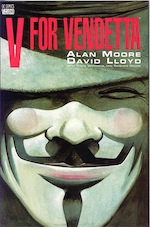
V for vendettaI own only one graphic novel, Alan Moore’s V For Vendetta. Of course I do – why wouldn’t I own a book in which an anarchist superhero goes mano a mano with a fascist government in Britain? I notice that Alan Moore distanced himself from the film version, exciting though that was (and it starred the wonderful Hugo Weaving!), saying that it had been ‘turned into a Bush-era parable by people too timid to set a political satire in their own country’. Having read the script, he said,

It’s a thwarted and frustrated and largely impotent American liberal fantasy of someone with American liberal values standing up against a state run by neoconservatives – which is not what the comic V for Vendetta was about. It was about fascism, it was about anarchy, it was about England.

If this does nothing else, it points up the difficulty in adapting a work of art in one medium for another. Perhaps the greatest irony about both the graphic novel and the film of V For Vendetta, is that whilst the Guy Fawkes mask of the protagonist has become instantly recognized worldwide as a symbol of radical protest, it must be making a pretty good profit for someone.

I own three DVDs that are adaptations of graphic novels or comics (if you don’t count assorted Batman flicks in the back of the drawer). These are 300, based on Frank Miller’s and Lynn Varley’s fictionalization of the Battle of Thermopylae, and Kick Ass and Kick Ass 2, based on the comics of Mark Millar and John Romita Jr.

Kick AssKick Ass is fun. It came in for a lot of abuse on account of the bad language, less for the violence – with the exception of one teenager, no bad guy is left alive by the end of the film. Its killing-spree violence is in the tradition of Peckinpah and Tarantino, subverting the bloodless wrong-righting of The Lone Ranger and Batman. I think people missed the point that it is highly satirical of the superhero genre, and simply spares no effort to de-bunk its ‘zap’ and ‘pow’ fisticuffs. It is, as the cover of the comic book says ‘Sickening violence, just the way you like it’, signaling that it does not take itself seriously and shouldn’t be taken too seriously by readers and movie-goers. The satire of the film is taken further by the character Big Daddy (Nicolas Cage) adopting the phrasing of Adam West, one of the film’s Batman references along with the parting Jack Nicholson quote from Chris D’Amico (Christopher Mintz-Plasse) “Wait till they get a load of me”, and Hit-Girl’s (Chloë Grace Moretz) “Just contact the mayor’s office. He’s got this giant light he shines in the sky. It’s in the shape of a giant cock” (the bird! the bird! Omnia munda mundis!).

Alan Moore is, I guess, entitled to take pot shots at the genre from his position as an insider. If anyone knows the genre he does. In his latest diatribe, possibly his public farewell, he not only curses the modern craze for superheroes, but also tackles such issues as the depiction of rape, and the right of an author to use characters of a different race, class, or gender from his or her own. Specifically on superheroes he says:

To my mind, this embracing of what were unambiguously children’s characters at their mid-20th century inception seems to indicate a retreat from the admittedly overwhelming complexities of modern existence. It looks to me very much like a significant section of the public, having given up on attempting to understand the reality they are actually living in, have instead reasoned that they might at least be able to comprehend the sprawling, meaningless, but at-least-still-finite ‘universes’ presented by DC or Marvel Comics. I would also observe that it is, potentially, culturally catastrophic to have the ephemera of a previous century squatting possessively on the cultural stage and refusing to allow this surely unprecedented era to develop a culture of its own, relevant and sufficient to its times.

Angels Amazon coverHaving fallen almost by accident into writing for young adults, I find myself skirting superhero territory. The teenagers in my novel The Everywhen Angels have powers that they don’t quite understand, and the protagonist in my recently-completed teen-vampire novella, From My Cold, Undead Hand, is a girl who has been trained to hunt and destroy vampires. Consciously or unconsciously, however, I seem to have made these characters break a mould, or break out of a strait-jacket. Unlike traditional heroes, they don’t necessarily win, they don’t necessarily triumph over a force bigger than they are, their tales do not have a clear resolution where all is explained in a neat and tidy way. Good does not necessarily triumph over evil, and where it does it may well be by accident rather than design. Why?

I guess it is because so many action adventures in any medium, where makers justify their violence in terms of the triumph of good over evil, are little more than morality plays and wish-fulfillment fantasies. If I’m to get readers close to the characters, and the characters close to the danger, everyone is going to have to realise that kids don’t get to be kings and queens of Narnia, and they do get to screw up. I mention all this because one of the balls I’m currently juggling is scripting From My Cold, Undead Hand for adaptation into a graphic novel. It isn’t all that easy. As I was writing it I never had anything in my mind apart from painting pictures with text. In order to script it, I have to take a huge step back, almost throw out the entire manuscript, and re-tell the story a totally different way. I have to imagine how it might look on the page. Take the following note I have made about the initial image:

Exceptionally, this should be a full-page picture, opening on the right-hand page. Chevonne is striding towards us, sword strapped to her back, carbon-pistol in her hand. Her face is rather grim and determined. The angle is fairly low – we’re slightly looking up at her. She’s striding between the stacks of a library. Text in a rectangular box, or maybe two, says something like: ‘The time is a little way into the future. This is Chevonne Kustnetsov – by day a student at PS#401, New York, by night a vampire hunter. Here she is, pursuing a vampire through the University Club Library, tracking it down to destroy it…’ Perhaps change that to 1st person speech, as the text novel is in 1st. Maybe not. We can take that final decision later.

Compare that with the opening paragraph of the novella:

There’s an art to this. When a vamp de-korps I only have a split second to guess where it’s going to re-korp. This one’s tricky, clever, powerful. As I just beaded my carbon-gat at it, it blew into a thousand-thousand little bits in front of me. Thought it could fool me, but that de-korp happened too quick to be the result of my bullet.

In that opening there is no detail of who the character is, where she is, or when the story is set. Such detail is revealed within the text when it needs to be – her school, for example, is not referred to until the second chapter, and the time in which the story is set is implied by things such as the technology depicted. You can easily see that this is a total departure for me. It’s quite a challenge and I think I’ll have to put other projects on hold while I tackle it. But you know me – I’m liable to pick up and put down my writing projects in a rather haphazard way. Wish me luck.

My YA novel ‘The Everywhen Angels’ – more news

41aYN0pMq2L._SY344_BO1,204,203,200_My novel aimed at young adults and older children – The Everywhen Angels – is now available internationally atAmazon, in paperback and Kindle formats. Will you be the first to review it, I wonder? I’m looking for reviews for Amazon and Goodreads.

Song

Janus

Spring in the meadow
primrose in the grass
life is too new
to let it pass

Summer in the forest
laughter in the trees
lies and deceit
on every breeze

So the old man tells a riddle
and the girl plays tambourine
And it’s all for the pleasure
of a foolish king and queen
While the moments turning over
say it’s like they’ve never been
and we move on

Fall of the harvest
riches on the floor
colour of blood
in every store

Winter in the city
sleep is on your breath
life was a dream
but so is death

So the old man tells a riddle
and the girl plays tambourine
And it’s all for the pleasure
of a foolish king and queen
While the moments turning over
say it’s like they’ve never been
and we move on

Moon follows daylight
morning follows stars
silence dogs romance
of guitars

Janus follows Jesus
crosses follow birth
That’s just the spinning
of the earth

So the old man tells a riddle
and the girl plays tambourine
And it’s all for the pleasure
of a foolish king and queen
While the moments turning over
say it’s like they’ve never been
and we move on

‘The Everywhen Angels’ reviewed.

angel eyes

The Everywhen Angels reviewed by Nikki Mason in the YA section at BestChickLit.com. Click here.