Marie Marshall

Author. Poet. Editor.

Tag: writing

On the centenary of Brian O’Nolan
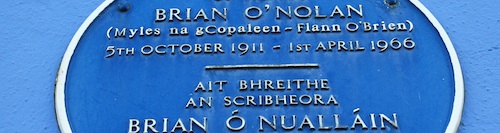
It is the centenary, give-or-take, of the birth of the Irish scriever Brian O’Nolan, famous nowadays for comic-fantastic novels such as ‘At Swim-Two-Birds’, ‘The Third Policeman’, and ‘An Béal Bocht’ (the latter written in his native Irish). He wrote under many names, the best known of which is Flann O’Brien, and for years under the cognomen of Myles na gCopaleen (Myles of the little horse) he wrote the humorous column ‘Cruiskeen Lawn’ in the Irish Times. What follows is a small selection of my tributes to him, originally published, shall we say, elsewhere; a small number of my contributions to the canon of adventures of those two pals – yer man Keats and yer man Chapman.

_______________

Keats and Chapman were once obliged to make a journey across the city by public transport. They boarded a bus and it set off. The vehicle was quite ancient and close to obsolescence, and its progress was erratic. This was made worse by the fact that it was a very windy day, and every time the bus passed a side-street or a gap in the buildings, it was struck by violent side-winds and caused to lurch terribly, as if about to capsize. Also the window-catches were defective, the windows would not close, and great draughts of air made it impossible for Chapman to continue to hold his copy of The Thunderer before himself to read. Chapman, being able to stand no more, paradoxically stood. He seized the conductor and began to make loud protestations about the fitness-for-purpose of the bus. The conductor took him on, arguing strongly that no one but Chapman was complaining. The exchanges between them became (in best cliché fashion) heated, and Chapman was within moments of being put off at the next stop. Keats, however, rose and put a placatory hand on the shoulder of each one of them.

“Gentlemen,” he said. “De gusty bus non disputandum est.”

_______________________

Keats and Chapman were at home, each at peace reading a newspaper. Chapman looked up from the cartoon page, and remarked on the genius of the American artist Charles M Schultz in the way that he made the little bird Woodstock talk to his pal Snoopy in a series of minuscule, vertical penstrokes.

“Talk is cheep,” observed Keats.

________________________

Keats was trying to listen to the Test Match on the radio one day, but was disturbed by Chapman, who was roaming from room to room in their shared apartment, overturning stuff, opening drawers, and cursing loudly. It became too much to bear when Chapman burst into the lounge where Keats was sitting and started to ransack the place. Keats sighed, switched off the radio, and asked Chapman what the divvil he thought he was playing at.

Chapman said, “I’ve been looking for my copy of Homer. It’s nowhere to be found. A mystery! In my opinion it’s been stolen!”

“I’ll look into it,” said Keats.

_______________________

Keats was a gracious man, and would never turn down an invitation to this meeting or that soiree or the other book-signing. Chapman wondered at his goodwill as much as at his stamina. One day Keats received a polite letter from a literary society based in a small town in the West of Ireland.

“I know these people well,” said Chapman to him. “I’ve given a talk there once, as have many of my friends – and yours I think.”

“I don’t know them,” said Keats. “What like are they?”

“They’re decent folk,” replied Chapman. “And they’ll be delighted to see you. But there’s one thing I ought to warn you about. There is one surname that is so common in that area that almost everyone bears it. They consider themselves to be a clan as much as a town. It seems that anyone who isn’t a Murphy there is an O’Murphy or as MacMurphy; even the local Punjabi shopkeeper named his eldest “Murphy” in their honour. What you have to watch out for is this: they have heard every possible joke about the name, every bon mot about potatoes, every quip about one chap called Murphy two hundred years ago who must have travelled round on a bike and, as Dryden put it, scattered his Maker’s image through the land. Say what you want, but just don’t mention that name!”

“I’ll mind that,” said Keats.

The pair travelled to the West of Ireland, to the little town, and were put up in the temperance hotel where the literary society were to hold the reception in his honour. Came the evening and they went down to the function suite where they were greeted with applause. Chapman, who was of course already known to them, introduced Keats as they circulated, and many a hand was shaken.

The formalities of the evening went ahead. Keats of course gave a reading of some of his own poetry, which was received with a reverent hush and a standing ovation at the end of it all. The rest of the evening was taken up by several items, which included:

“A tale or two of Finn MacCool” presented by the society’s shanachee Mr Eamon Murphy,

A solo upon the uilleann pipes by Mr James Murphy,

A recitation “On the visit to us of Mr John Keats” by the society’s Bard Mr Brian Murphy,

A song by Miss Kathleen Murphy, accompanied on the piano by her sister Miss Niamh Murphy,

A slide-show on the delights of Murphyville, Georgia USA, presented by Mr Hiram J Murphy III,

A blessing upon the gathering given by Father Liam Murphy,

A vote of thanks to Keats and to everyone involved proposed by the society’s Hon Sec Mr Brendan Murphy, and seconded by the society’s Hon Treas Mrs Deridre Murphy, and

A closing address given by the society’s Chairman Mr Arthur Wellesly Murphy.

That was not, however, the end of proceedings, as there was one final item on the agenda – the presentation to Keats of a cut-glass Waterford decanter, specially engraved to mark the occasion, paid for out of society funds. This was handed to Keats, with the thanks of all present, by the society’s President-for-Life Mr Aloysius Murphy.

Keats appeared overwhelmed, lost for words, and responded in his poor French.

“Murphy beaucoup!”

Chapman tore at his beard.

‘A Woman on the Edge’ – workshop project of prose and poetry, part 3

The moosh-moosh

In the marginal lands between city and countryside there lives a type of rare hominid known as the ‘moosh-moosh’. The name appears to be of Romany origin and until recently these shy creatures would only reveal themselves to travelling folk. In fact so secretive and shy are they that most settled folk continue to deny their existence.

Their natural habitat is, or was according to anthropological speculation, the cave. However since intensive agriculture has decimated the wild places of Britain in the south, and deforestation and sheep-farming has done the same in the north, the moosh-moosh have moved into the new wilderness that humans have created, the wilderness that is neither urban nor rural but which is found on the margin between the two.

In build they resemble humans almost exactly, except for their apparent superior muscle tone. They are stocky but not fat. Their skin is pale but is hardly visible except on the face, the rest of their heads and bodies being covered in a light, reddish-brown fur. Their faces are large and broad but not un-handsome. Some observers believe them to be descended from the last remnants of the Neanderthalers, but this is mere speculation. They go naked but appear to be totally without any sense of shame. Deprived of their natural habitat, they have occupied such spaces as unwanted cargo containers. A small group was discovered living in an old Nissen hut on what was a WW2 airfield but upon which a new housing estate was encroaching, and it was this extended family that became the first moosh-moosh to encounter its homo sapiens cousins, or at least the settled and civilised branch of our species, with more regularity than before, gaining a certain controversial fame in academic circles and becoming a minor tourist attraction, especially for a few savvy if brash Americans.

Communicating with moosh-moosh is problematical. Folklore tells us that they and the Romany people once made themselves understood by a system of mutual hand-signs and by a few syllables of human speech, but if that folklore is based on truth it is a tenuous truth and the faculty has long-since evaporated. The interface between us and the moosh-moosh is akin to that between an adult and an autistic child, except that they will meet our eye with a steady gaze. There is no hint of comprehension in that gaze, with the exception that if you hurt one of them their expression hints at puzzlement and sadness. They seem to be asking silently “Why?” Violence is alien to them.

Their own speech sounds like a cross between the cooing of doves and a human whistle. It is quiet speech and they use it sparingly, spending long periods in communal silence. I have tried to imitate their sounds whenever I have been amongst the ‘Nissen Family’, as this particular group has come to be known, and whenever I have done so they have turned a softened gaze upon me as if to say that they appreciate my attempts. The only time I have ever seen a definite communication between moosh-moosh and homo sapiens was when I arrived at the same time as a knot of transatlantic tourists. The moosh-moosh were about to eat, which they do communally, and a female came behind us making insistent, shepherding gestures, urging us to sit down with them.

Moosh-moosh food is simple, consisting of a kind of cake made from the seeds of wild grasses sweetened with honey or with whatever berries are in season, or flavoured with hedgerow herbs. They share their food evenly between all who are present, even with homo sapiens, although the latter sometimes find it hard to digest. I am always conscious that they have scarcely enough to spare. In winter they are, if anything, less semi-visible than they are at other times of the year; it was thought that they hibernate – the Romany always said so – but in fact they spend most of this time when little sustenance is available huddled together for warmth in foraged straw and under salvaged tarpaulins.

Their groups and extended families are without hierarchy and are highly co-operative. If two or more discrete groups should meet there is no competition, but rather all direct themselves towards mutual benefit. Their delight is in each other, and it is a full and complete delight.

They make no art, no music, and of course no literature, but their appreciation of the natural world appears to be total. It is an appreciation apparently not born of awe or of anything mystical but rather seems to be one of immersion, joy, participation. It is a happy state free of the twin mental yokes of religion and science, a state which proves that mutuality rather than competition is the highest law of evolution.

The last time I sat down with the ‘Nissen Family’ of moosh-moosh I felt their hands gently resting on my shoulders and arms. Their gaze had softened and seemed to express some kind of sympathy. I realised that I had been crying. I tried to smile, and indeed their caresses were comforting, but this display of empathy, this acceptance of myself almost as one of them was so poignant that my tears continued. There was so much I wanted to say to them.

Oh, my dear Nissen Family, as dear to me as my own family! My dear, precious, innocent moosh-moosh! If only you knew my true nature and the nature of all of my brothers and sisters, the homo sapiens. If only you knew the depth and height of our jealousy, our insecurity, our vainglory. If only you knew how cruel we are. You, I know, are no children except inasmuch as you have preserved the innocence of childhood. You are no distant cousin, no Neanderthal throwback. You are of the same root and stock as we are, you are people, but you are people who took the decision long ago to follow the path of pure wisdom, to seek nothing but that which was good, nothing but what you actually needed. You are wise beyond our capacity to be wise. Yet in that wisdom you are as foolish as saints. What are fences and hedges to you? What are the divisions and boundaries that we set up in the face of nature to you? What are the frowns on the faces of farmers and householders to you when you forage their barley and their chives? What is our folly to you, the folly that points to something and says “Mine”?

If only I could convey this to you before it is too late, before you become nothing more than a dwindling number of anthropological or zoological specimens, a theme park, ‘Moosh-Moosh-Land’, an insignificant detail of history, a small entry in Wikipedia, a cuddly toy. If only you would realise this before we come for you, before we take you away, before we make you our playthings, before we study, catalogue, abuse, dissect, and destroy you, before we turn upon its head your evolutionary success and make a lie out of it. We are monsters, my dear family, monsters. We are ugly in our complexity, ogres, madmen!

You sit here in utter patience, lambs of the God you do not know, every one. Why do you not start up, why do you not run? Why do you not find all your tribes and families and hide in what remains of the forest? Why do you not go deep into our abandoned mines and conceal yourselves? Why do you not remove yourselves from our sight and memory before we remove you entirely from the world? Why do you sit so patiently, witnesses to all that is good, a light that will soon be put out? Are you somehow driven to prove to us what brutes we are?

We are your brothers and sisters but we are also your executioners. We hold your death warrant in our hands.

a handful of stones

My ‘small stone’ entitled Craobh nan Ubhal (Apple Tree) is today’s featured poem on the ‘a handful of stones‘ web site.

‘A Woman on the Edge’ – workshop project of prose and poetry, part 2

image (c) James Allan

Caravan Storage 

There is a lane behind my house. It runs straight,
all along the backs of our gardens, a hedge to one side
of dense beech and hawthorn, garden fences to the other.
Today there is a litter of pace-egg shells; kids,
despairing of a slope, have hurled their treasures
at the high, thick, brown wood, and they have fallen
amongst a rash of tiny mauve flowers. The flowers dare me,
taunt me as a ‘nature-poet’, challenge me to name them,
and I can’t; the flowers win, and nod slightly to themselves.
I am no Janus. I confess I look outwards from the town,
never inwards; I can be found pent by the first barbed wire
when it is winter, clutching numbly with my fingers,
beside the prayer-flagging shreds of polythene,
gibbeted rags riven from their scavenged corpses,
making the only music above the wind in my ears,
harsh, a relentless clatter like the tearing of paper.
Now, spring, I strain to mark the place where dunnock,
finch, and wren give way to jay and woodpecker,
and that corsair southerner the magpie – curse her! –
where lawnmower is drowned in a sea of new leaf-rustle.
And yet at the end of the lane I am always surprised
by acres of caravans, so I turn right, looking to lose myself
in the wood, where one is always north of the road,
west of the golf course, south of the water tower,
east of the houses and one field of grass-keep,
and where in autumn I come across lost golf balls
as often as fly agaric. Today, perverse, I turn left
instead of right and wander where the phalanx of caravans sits,
silent, almost terminally silent; I expect a dog to bark
or a man to shout, but it is as though life is waiting,
as dormant as each caravan, as flat as the pale sheet of their sides,
the sky, the clouds, angled towards me in each window,
blind girls’ eyes, colours that can see no colours.
Behind me, diagonally across a field, it is playtime
at the school, the yard sharp and joyful with children –
here amongst these sleepers the kids’ cries are yips
and yaps that vie with the conversation of sparrows.
At the end of the very last row I could push through
a thin screen of trees to contemplate the brown furrows,
but why not, for once, sit with my back to a post
or perch on a metal step to look back? Find a vantage, Marie,
from which to gaze at this oblong promontory,
the imposition of order certainly, but left
to weather the seasons, tarmac pebbling at the edges,
grass high, dandelions asserting themselves,
crows wheeling awkwardly above, panels of pea green,
aquamarine, sunburst yellow baking to fade
in the Scottish sun. Along with caws from the tattered,
fragmented flight, the sound of the breeze
whipping a loose washing line, the clink of a tool
on an engine block, a hint of raucous diesel
from the mini-coach headquarters. The sight of roofs,
grey, grey, and pale pantile-red, slipping away to my right;
the insect-crawl of a tractor along the plumbline road.
I could sit here until night, when the dark is drilled
by streetlights, stars, and the red beacon atop the TV mast,
by the wing-tips of an old Fokker 50 in steady climb;
I could wait for owls; I could come back in autumn
and spy bats out of the corner of my eye, after days
spent brambling, the corners of my mouth hurting,
pie-hungry, my fingers bloodied and pricking;
I could mark the turns and twists of the year not so much
by the cold or by the rain but by the depth of the furrows,
the voices of the sheep, the ins and outs of the caravans,
the headlights on the tractors, the saltired contrails
on the blue flag of a Scottish sky. I could take root,
become a laminate print of myself, still as a Madonna,
and lean one-quarter-starwards as the caravan windows do.
I could become part of the debate that is this corner of my county.
Listen – is that the distant whip and pock of golf club against ball,
or a thrush anviling a snail? Is that a Romany terrier barking
or the cut-short cry of a gull, a child, the creak of a wind-driven hinge?
Eventually, of course, I will simply leave, go home;
but on the way I will pass a couple who have been
hand-in-handing it along the lane and, as always,
I will notice the young woman’s hair, conclude that it is
a cross between Baltic amber and that drift of old beech leaves
piled against the padlocked door of the shed I have never seen opened,
and I will rush to box myself in my house to write poems
to the Icon of the Angel with Golden Locks, striving
obsessively for the perfection that is never there in the world,
but without which we could not write, or paint, or sing.
The things which go on at this edge will go on without me,
as ignorant of me as I will be of them, because that is in our natures,
tenacious, just like cuckoo-spit on reed-grasses, oil patches on concrete,
the green of dock-stain on nettled thumbs; unlike my words
which stick in the mind less than the letters on an old, flattened can,
the painted number on that shed door, the half-buried
number plate of the old Vauxhall, and which, if read aloud,
are somehow less musical than the rattle of gravel under
slow van-wheels, the drone of a motor in low gear.
This box – home – is the inside of my head; out there
amongst the ranks and rows of trailer-homes is dreaming,
dream-time, another place entirely, conflicted with
the coming and going of images, unsafe, ambiguous,
flirting with the bizarre rather than fighting the familiar,
as though each was mildly irritated by the other
but neither could ignore the attraction, opposite poles
pulled together, magnetic lines compressed, penetrating,
alloyed, brazed at the edges, bitumen spilled onto grass,
grass spearing asphalt, weight and counter-weight,
blade and counter-blade, kiss and counter-kiss.
If there is a centre of the world, a true axis,
then the world will spin on an imaginary line
between two such places. The centre of everything
must be just that – the centre of everything, the bisection,
even the meeting of dreams and reality. And yet…

haiku on silk

Today I received a note from David Cobb. David was a founder member, past secretary, and past president of the British Haiku Society. He is a renowned poet, haijin, editor of many books including Haiku (British Museum Press), and is probably the UK’s most respected authority on haiku. The note was to tell me that British-resident Japanese haijin and artist Yoshiko Torii had translated one of my haiku into Japanese. The note ran:

The person who was supervising the ‘Silks and Haiku’ exhibition at the St Pancras Crypt Gallery had the rather sweet idea of translating your haiku into Japanese and making a haiga* of it. I can’t vouch for the accuracy of her translation, but I hope it will please you… The two scarves, on one of which your haiku appears, are now in the BHS possession and will be displayed at the upcoming AGM Day in Conway Hall, London…

I have to say that this was both unexpected and gratifying. It adds another language to the list of those into which pieces of mine have been translated (the list already includes Russian, Welsh, and Gaelic), and another location and medium to the list of those in which pieces of mine have been displayed (that list already includes the walls of a cafe in Wales and an art gallery on the isle of Mull, and etched into an African drum at the New Orleans Museum of Art).

__________

* Haiga is a form of expression which combines the use of words and calligraphy which go to make up haiku with visual art. Often the drawing would be done with the same brush and ink as was used for the words, and even if the drawing seemed obviously unrelated to the words the two would form a single work of art. I’m aware that this definition is an oversimplification but so many words are spent in discussing these simple forms – many more words and effort than are spent in executing them.  M.

‘A Woman on the Edge’ – workshop project of prose and poetry

Otto Mueller, Mädchen am Ufer

I know why I’m alive, why I want to be! Life is a blind headsman with a dull axe who tries to kill you many times, and though there are so many things ringing in my head, their peals and counter-peals, their changes and counter-changes, their plain bob majors, until my mind is a hellish jangle of wedding-Saturdays and a choir of imps telling me why I should not be, why I should die. However, if I can find a hill and punish myself up its grey, green sides, not stopping even if my own breath stabs me deep to the heart, pressing my aching feet on to a drumbeat only I can hear, and if I can reach the top or sometimes if I turn my head and am taken mid-pace by a burst of horizon through the trees, I say – I live here! I live here! That’s why I live. Anyone who can look down from a hill to a city, or look up from a town to a hill, may wonder what lies between.

I do. I lie between.

I have lain and lied between ever since I was small; I still lie between England and Scotland (with a scarlet splash of France, daring, incongruous, bof, zut!) somehow, yes I do, but when I was little and the hot summer came when stag beetles crissed and crossed the concrete flags and penny-piece raindrops hammered making great nail-head shapes and sounds, lapping and overlapping until the whole pavement was brown and shining, then, then, those were the days when I could walk and walk. I could walk and walk way beyond the cricket club, way up along Corkscrew Hill, past woods which hinted at Old England, past playing fields which were the flat, green temples to William Webb Ellis, past another copse through which I could see new houses (I pretended they were the angles of a castle), past a park and a convent, and down a lane which went on for ever to the downs. And I could turn and come back!

In those days the margin was harder, clearer; but still you could get on a Green Line bus or take the tube to the end of the line and at that terminus you could find the start of a footpath. That footpath would make a few angles around the back of shops and lock-ups, a straight alongside a playing field, and then maybe meander alongside a stream, pass a copse, skirt meadows sweet with the breath of cows, to a place where the soughing of leaves and grasses and the trickling of water obliterated the mechanical sounds of humanity. It was always a place of questions for me – I mean banal questions like should I wear a skirt and sandals to go there or jeans and hiking boots, or should I take sandwiches, stuff like that. My fictional character Ashe Sobiecki knew this:

“There’s a place where you notice our suburb begin to thin out. It’s a bit further now, because I think the car-park for the new garden centre reaches there. It’s not exactly the countryside, not yet, but it’s like the town isn’t holding on to its place any more, it’s beginning to lose its grip. There are buildings that aren’t quite farms, but might have a few sheep and ponies. There are stands of trees which aren’t quite woods, and there are tracks which aren’t quite lanes. You mustn’t be surprised to see ducks turning a flood-puddle into a pond as if by magic, or rabbits here and there; and once, one cold day when there was still snow on the ground, I saw a stoat in its winter ermine. I have even seen a sparrowhawk take a pigeon. When I was younger, I always liked to think that this area had a magic to it, because it was where something became something else. I used to notice things, I had my own little landmarks which told me whereabouts on a scale I had in my head, between town and country, the exact spot was. When we did percentages in school I used them in the scale. I graded the places by smell too. There’s a place where it smells of sheep droppings, and that’s about eighty percent countryside, and another where I can smell some sort of lubricating oil, and that’s seventy-five percent town. And sounds too. You never quite lose the noise of the traffic in the background, but it’s definitely louder the closer you get to the main road – well it would be – and in the opposite direction there’s the place where you can sometimes hear curlews in spring. That is so cool, that sound. Well, I like it round there. It’s not just the landscape, not just the smells and sounds, and the birds and stuff like that. It’s a feeling I get. I have always had it. It’s being right on the edge of something. I know it is only the countryside it is on the edge of, but it’s the edge that counts. It’s like one of those graphs that go along in a kind of gradual slope and then shoot up suddenly. It’s like that only upside down, so that the slope wants to pull you. I like being right where the pull is strong. It feels dangerous. But it’s a dangerous idea, not a real danger, if you see what I mean.”

Yes yes, Ashe, I felt that way too! I felt that if I kept walking up Layhams Road and into the Downs I was somehow walking on an overlay which had been placed upon history, and that if I pushed hard enough something miraculous and perilous would happen. Or I would keep walking until I reached Biggin Hill, one or the other.

This now is the twenty-first century, and places on this edge have changed again since I walked through them as a youngster. To Paul Farley and Michael Symmons Roberts, authors of Edgelands*, this fluid, shifting, abandoned and re-occupied, marginal zone is the place of power stations, scrap yards, water treatment plants, container depots, incongruously just-out-of-town shopping centres. Yet still they have a glamour that is hard to put your finger on. A new housing estate can grow up just where you remember a deserted holiday camp having been once. A farm, a seaside park, a railway station can decay and disappear as completely as a Highland Clearance village; a mead full of cowslips can become a wedge between a factory and a bypass, and then can be transformed into a car-breakers’ yard, and then bulldozed into annihilation, flattened, grasses and wild flowers re-establishing themselves. It is as though we watch a tide, or the breathing of a great animal.

__________

* Michael Symmons Roberts & Paul Farley, 2011, Edgelands, London, Jonathan Cape.

texting, tweeting, and the Poet Laureate

People who are familiar with my old (and defunct) literary blog will remember that occasionally I used to ‘go off on one’ on a literary subject. I’m doing that again today, simply because something got up my nose.

I am most critical of myself first of all, then of other writers, especially those who speak fluent rubbish but have an audience because of their position. The Poet Laureate Carol Ann Duffy, for whom I have a certain amount of respect as a poet, ought to guard her tongue or she will be seen as ridiculous. Recently she has, laudably, launched a competition in which secondary school students are encouraged to produce poetry anthologies. So far so good, a bloody brilliant idea! However she should know better than to try to ice the cake by attempting to sound ‘cool’. Here’s Carol Ann ‘getting down with the kids’:

The poem is a form of texting … it’s the original text. It’s a perfecting of a feeling in language – it’s a way of saying more with less, just as texting is. We’ve got to realise that the Facebook generation is the future – and, oddly enough, poetry is the perfect form for them. It’s a kind of time capsule – it allows feelings and ideas to travel big distances in a very condensed form… The poem is the literary form of the 21st century. It’s able to connect young people in a deep way to language … it’s language as play… I think it’s most obvious in music. If you look at rapping, for example, a band like Arctic Monkeys uses lyrics in a poetic way. And using words in an inventive way is at the heart of youth culture in every way.

This is straight out of Patronise 101, it is how people of older generations always talk down to youngsters. I remember it from my school days and it embarrasses me to hear someone of my own generation still doing it. “The Facebook generation” for heaven’s sake, as if there is no one over the age of fifteen on social media. That old chestnut of “Rock lyrics are poetry” has been debated since the early days of Bob Dylan, and it has been done to death. Carol Ann does no service to herself by rehashing it. Then she stumbles into another obvious pitfall – ignorance of her subject – by relating rap to the Arctic Monkeys, who are definitely not rap. All of this is before we even get to the notion of text equaling poetry. Here’s how a friend of mine expressed his opinion to me of Carol Ann’s statement:

Look, poetry can be written on a post-it-note, jotted on the back of a beer mat, blogged, emailed, extemporised in a chat room, and – yes – texted. But so can a shopping list, a dirty joke, or a phone number. To be poetry it has to be… well… poetry.

Preaching to the choir, pal… preaching to the choir! I have used the language of texting and chat rooms in my own fiction, I have had a poem published the title of which is set out like an html command – that was probably a world first but so what? I don’t say this to prove how clever I am, it’s just that the language is there, and there to be observed and used. If you google the word ‘haiku’ and ‘tweet’ or ‘twitter’ you will get pages of hits detailing 17-syllable, 140-character haiku. This doesn’t mean that texting or tweeting is poetry but simply that it can be used for poetry. We can say with Karlheinz Stockhausen (yes, I can be pretentious with the best of ‘em) “New means change the method, new methods change the experience, new experience changes man”, but texts and tweets are not so much new means as new media. The means – language – remains basically the same except for a few specialised abbreviations and the natural, morphing flow of argot.

I want to remind my readers of two things. They are seemingly contradictory but nevertheless they illustrate two solid pillars of the house of poetry. Firstly ‘success’ in the world of poetry still means getting your poetry into print – not blogging it, not texting it, not tweeting it, no matter how many ‘followers’ you get. If my word is not enough then consider what is going to happen with the winning anthology from the competition that Carol Ann Duffy is promoting. Secondly, on the other hand, there is the artistic satisfaction of creating poetry, and that does not depend on getting into print. Probably the most wonderful poet I know, Lane A Smith, is virtually unknown outside a couple of collective web sites. To the best of my knowledge she has only ever had two poems published in magazines (Bard issue 80, Awen issue 69, and they were submitted by someone else on her behalf), yet when I read her poetry it is as though the beat generation lives on but on the warm, worn boards of a front stoop overlooking a Georgia beach, and in childhood memories of hot summers, dust, and women who were much taller and wiser than the little girl whose older head reverberates to the memories. However if you google ‘Lane A Smith poet’ you will be lucky to get a single hit. Nevertheless I consider her to be a ‘success’ in a way few of us can ever be.

I’ll close with a poem of my own from my 2008 collection 58 degrees North. It is dedicated to Lane:


Day after midnight
we packed them in
trading word for world
line for lines
vice for verse
     incredible
      streaking daylight in rods
like frozen trails of hard liquor
after body-shots
trading cheap dresses
with each other
like in-jokes
(we laughed)

people talked of perfection
and greatness
but they didn’t get it

the whole point
was
the cheap dresses

those gaudy
booze-soaked
shreds of poetry


Pearl 5

(c) Winter Words Festival

Welcome to the new web site

Welcome to my new web site and literary blog. I am in the process of winding down my old site and archiving the material there. Once that is done I may reproduce some of the best of it here, but principally this site will carry my literary news, thoughts, and the occasional piece of creativity for you…

It’s a calm, grey day here in Scotland. The leaves are hanging loosely by the trees’ flanks, the birds all seem to be in hiding, and the traffic is low-level white noise. The clock’s hands are relentless and the working day calls…

Was it always this way, or was there once an excuse for indolence? Who froze forever the auld pletties o’ Dundee?