A couple of nice things people said about me in 2013
“… an intellectual and creative juggernaut, with a rare combination of self-awareness and self-actualization…”
“… the Queen of Wow…”
(Just saying)
M.

“… an intellectual and creative juggernaut, with a rare combination of self-awareness and self-actualization…”
“… the Queen of Wow…”
(Just saying)
M.

© Millie Ho
Over on Millie Ho‘s site she shares a few insights into the process of creating the cover illustration for The Everywhen Angels. Please do visit and show your appreciation.
 How would you like the cover art of The Everywhen Angels as your computer desktop? Just click on the thumbnail to open the image in your browser, then right-click and save or drag it to your desktop. Then you can set it up as your desktop in the normal manner for your computer operating system. NB: The artwork is the intellectual property of Millie Ho, and no permission is given for its use, reproduction, adaptation, or storage other than as specified here.
My second novel, The Everywhen Angels, is now published!
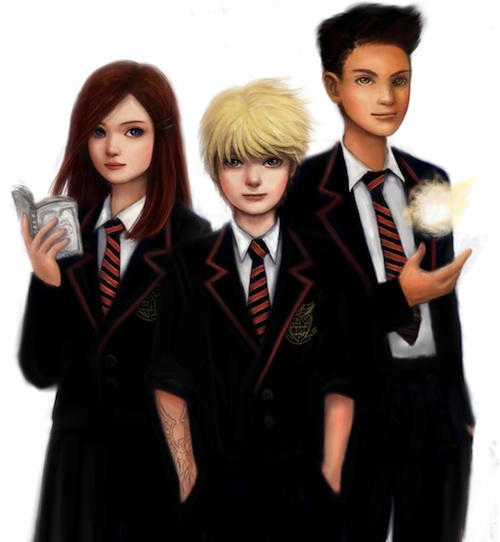
Image © Millie Ho
It has taken some time for me to realise this particular ambition, but at last my second novel – my first specifically written for younger readers – is now published. It’s available in eBook format direct from the publisher at present, but as soon as it becomes available elsewhere I’ll let you all know. The timing is pretty good, as you can buy it to top up someone’s electronic stocking this Christmas.
A few years ago I was having a lively discussion with a bunch of on-line friends who were all devoted fans of a certain Scottish author and her growing series of books about a boy-wizard. I have to confess that I was being less than charitable, and the argument was getting circular (They’re not well-written – That’s because they’re for kids – But you’re reading them and you’re adults – That’s because they’re great! – But they’re not well-written…). Eventually they told me that as I styled myself an author, I should either write a fantasy set in a school and make it at least as good as one of my compatriot’s novels, or I should shut up. Well you know me, I don’t shut up that easily, so I buckled down and wrote the book. It was tried out on the thirteen-year-old daughter of a friend; the deal was that the daughter would do her homework and tidy her room, and the mum would read one chapter aloud to her every evening. Well, never has homework been so assiduously completed and never has a room been tidier. I realised I had a hit on my hands. The next task would be to convince a publisher.
The manuscript did the rounds. Head of Zeus showed interest in it but eventually declined it, at which point it was snapped up by P’kaboo, who had already published my first novel Lupa. Although P’kaboo is a comparatively small publisher, the feeling one gets from having a novel published commercially – twice! – is very pleasant. I’m not knocking successful self-publishing – that’s now an established thing with its own degree of satisfaction – but to be taken on by a publisher because they have faith in your writing does feel very special indeed. As regular readers here will know, the cover illustration was provided by Millie Ho. I’m hoping that this will mark the first of several collaborations with Millie, who is very gifted at putting ideas into images.
So what next for The Everywhen Angels? Well, of course we – P’kaboo and I – are hoping for sales. And of course I’m looking forward to reviews and to readers’ comments, from which I will quote here.
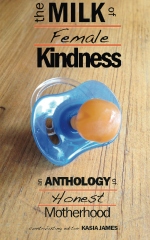 Some more publication news came my way today. The Milk of Female Kindness is subtitled ‘An Anthology of Honest Motherhood’. Edited and published by Kasia James, it is a collection of prose and poetry on the subject of motherhood. The title is a quotation from Woolf’s Orlando. I’m pleased to say that I provided three poems for the anthology and also contributed a little ‘editorial consultancy’ work towards it. I have therefore had the opportunity to read through it already, and I have to say it is an exceptional collection. Some of the writers are known to me, most are not, and all have views on motherhood which do not necessarily reflect the image at first conjured up by the word. It is available on Createspace and I recommend it highly.
 Also today I was paying a visit to the excellent blog of San Snoek-Brown, and I found his list of recommended books for the coming holiday season. Sam has amassed a big haul of books by writers he knows, one way or another, and whose work he seems only too happy to draw to readers’ attention. My poetry collection from earlier this year, I am not a fish, is included in his list. Thank you, Sam!
It is no heavy obligation for me to reciprocate. As regular readers here will know, I’ve been raving about Sam’s fiction ever since I first came across it. So please accept my recommendation of his chapbook of short fiction Boxcutters, available from Sunnyoutside.

Because this started out as an idea for a poem, and is prose-poetry rather than straight fiction, I’ve posted it on my poetry blog.

© Millie Ho
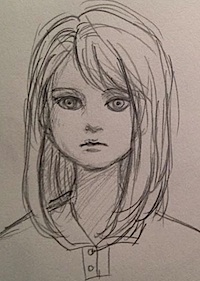
The first ‘Angela’ © Millie Ho
Recently it began to seem like a good idea to find cover art for The Everywhen Angels, my soon-to-be-published novel for older children, in a bit of a hurry. The idea was to publish well in time for Christmas, in order to advertise it for the seasonal market. Well, that might not happen, but in any case the perceived urgency gave me the chance to ask Canadian artist Millie Ho if she could come up with something post-haste. I sent her a copy of the draft manuscript, we discussed an idea I had in mind, and Millie set about constructing it.
Almost every day a sketch would come of one or all of the main characters – Angela, Charlie, and Ashe.
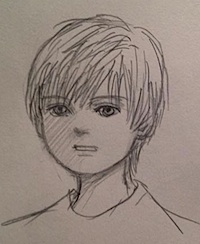
The first ‘Ashe’ © Millie Ho
I watched their characters take shape. In the book, we read the same story three times, each version as seen by one of this trio. With each version we get more of the back-story, and maybe more revelations about the underlying mystery. All of it? Hmmm, wait and see. I ask a lot of the young readership; for example, Charlie’s story is told backwards, and one of the first things that happens is that he emphatically contradicts one of the major events of Angela’s story. I touch on ‘difficult’ philosophical matters but, as I learned from my literary hero in the genre of fiction for young readers, Alan Garner, an author should never underestimate the intelligence of his or her readership.

The first ‘Charlie’ © Millie Ho
The book came about as a result of a heated but amicable argument between myself and some friends. They are all Harry Potter fans, and I was tearing JKR’s literary style to shreds*. They said I should either write a fantasy set in a school and make it as good as one of hers, or shut up. So I wrote one! It doesn’t quite qualify as a ‘fantasy’, but it does feature a group of teenagers with weird powers. An early draft was tried out on the twelve-going-thirteen-year-old daughter of one of these friends. It was read to her one chapter at a time, at bed time, in return for tidying her room and doing her homework. Never had her room been so tidy, and never had her homework been so promptly completed! I think I more than won the challenge. So does my publisher, P’kaboo, who has been enthusiastic about securing and publishing the book. I did try it with Head of Zeus first of all, who asked to see the full manuscript and were impressed by it, but decided it didn’t fit with the portfolio they were building up. P’kaboo then practically tore my hand off to get it.
You will soon be able to read the book, and you will soon be able to see more of Millie Ho’s artwork on the cover. There is a teaser of the final cover illustration at the top of this article. From the sketches here you will be able to see how Angela and Ashe developed from waif-like individuals to young people with great presence. Charlie’s sardonic streak was visible right from the word go.

The Angels take shape. © Millie Ho
My publisher was as enthusiastic as I was about Millie’s finished illustration. Millie and I are now talking about further collaboration. There is a possibility of some high-action teen-vampire fiction of mine being turned into graphic novels by Millie’s ink and brush. Millie has already added the word ‘fangirling’ to my vocabulary – it’s what we do with regard to each other’s work. Seems like a good basis on which to continue. I’ll keep you informed.
__________
* Fair’s fair – at the end of the day, JKR can ignore my opinion all the way to the bank, and good luck to her!

Glenshee – Winter, © Kirstie Behrens
Are you planning to go to Pittenweem Arts festival (3rd to 11th August)? If so, be sure to visit Venue 33, 7 Calman’s Wynd, where you will find the art of Reinhard Behrens, Margaret L Smyth, Kirstie Behrens, and David Behrens. This family group of artists grows in strength year by year, as the younger members hone their skills.

© Reinhard Behrens
Reinhard Behrens is the creator of Naboland, where thrown-away objects find a new life, and a toy submarine voyages in and out of an almost-but-not-quite parallel world. One of Reinhard’s finds, the remains of a teddy bear, inspired me to write a prose poem – had the bear been dropped by a certain creation of Mary Shelley as he sped across the Arctic ice in search of his monstrous creation? I dared think so…

© Marie Marshall

© Reinhard Behrens

Little one, many folk tell the tale of the three blind men who, unaware of each other, came upon the same elephant.
The first blind man, putting out his hands to feel his way, touched the elephant’s mighty trunk, feeling it flex and move, as though it had a life independent. He took it for a great snake.
“Surely,” he thought, “This is the greatest, most magnificent snake ever!”
The second blind man bumped into one of the elephant’s legs and, putting out his arms to try and encompass it, was certain that he had found the bole of a tall tree.
“Surely,” he thought, “There is no tree in all the world like this!”
The third blind man felt the elephant’s tail brush his face, and when he caught it in his hand, he was convinced that it was part of a gigantic vine.
“Surely,” he thought, “A man could live in the shade of this vine and want for nothing.”
Now folk who tell this tale, little one, usually stop at that point, and say it proves that in matters of faith and belief, all men perceive a little bit of the truth, never all of it. But they are not wise, little one, for the tale does not stop there. It goes on…
The first blind man became devoted to his notion of a snake, and began to worship it, singing and chanting.
“O divine Serpent… O divine Serpent…”
The second blind man became devoted to his notion of a tree, and began also to worship it, singing and chanting.
“O ineffable Tree… O ineffable Tree…”
The third blind man became devoted to his notion of a vine, and began also to worship it, singing and chanting.
“O miraculous Vine… O miraculous Vine…”
Then they heard each other, and became angry.
“What fools these other two fellows are,” thought the first blind man. “This is neither a tree nor a vine, but the Holy Serpent!”
“What fools these other two fellows are,” thought the second blind man. “This is neither a snake nor a vine, but the Heavenly Tree!”
“What fools these other two fellows are,” thought the third blind man. “This is neither a snake nor a tree, but the… er… Divine… Vine!”
So they all began to sing and chant more loudly, in order to drown out each other’s voices; and soon there was cacophony.
“… ineffable Tree… divine Serpent… miraculous Vine…”
Then their anger blazed into fury, and they began to shout and scream at each other.
“Heretics!”
“Blasphemers!”
“Infidels!”
Now you are aware, little one, being the wisest of children yourself, that elephants are very patient animals. But even the patience of the most forbearing tusker wears very thin, when such a hullabaloo happens around his feet. For this elephant was perfectly certain in his own mind that he was neither snake, nor tree, nor vine, but an elephant. And indeed he was. Elephant through and through. Elephant right to the core of his being. He knew well enough that each of the blind men did not have some of the truth, part of the truth, or even a little bit of the truth. All three were totally, completely, utterly… wrong!
Eventually he could stand no more. He shook his trunk free of the first blind man’s hands, and trumpeted loudly in his ear.
“Ow!” said the first blind man, his head ringing. “No snake ever did that!”
Next the elephant lifted his leg, and trod on the toes of the second blind man.
“Ow!” yelled the second blind man. “No tree ever moved!”
Next the elephant – I’m afraid – evacuated on the third blind man, who was impudently tugging his tail.
“Ugh!” said the third blind man. “Those are neither grapes nor oranges!”
In that moment, when the elephant manifested himself to them, little one, all three were enlightened, and knew the true nature of what they had worshipped separately.
Little one, foolish though these blind men were, eventually they were enlightened. Not so, I fear, those story-tellers who stop short, and do not themselves wait for the elephant to manifest itself. You see, because our god or our gods are known to be greater than we are, it is often assumed that they are wider and more complicated than we can conceive.
But they might just be simpler, more straightforward.
Like an elephant, little one.
Now be patient. You might dream of an elephant.
Go to sleep.

It occurred to me a long time ago that there are only two important factors in art – our expectations and the artist’s intentions – all else is subordinate. The extent to which one governs the other has been fluid over history. It is worth remembering that Théophile Gautier’s expression of autotelicism, “L’art pour l’art”, was a manifestation of a 19c movement, and therefore is less than two hundred years old. It is a blink of an eye in the history of art. However, it was an important movement, because it liberated the artist, more than any previous shift of influence, from the demands of patronage.
When we look at the 14c depiction of the Paleologue Emperor Theodore Metochites on the wall of the Church of St. Saviour in Chora, we are not looking at the work of an inept artist, simply because the stylized mosaic is not realistic to our eyes. Here the artist has created exactly what his Imperial patron asked for, and the priorities of the work radiate to us. The Emperor, his orientalism expressed in his turban and brocade robe, his power expressed in his senatorial beard, kneels before an austere Christ. In the potentate’s hands is a building, rendered model-sized – it is the Church that he had restored, and in which he was to end his days as a monk – which he offers to Christ. In his turn, Christ looks out at us, two fingers half-raised as if about to bless. We are meant to see piety, to appreciate holiness, and to feel awe. These are the semiotics of this type of Byzantine art.
 The fact that the image is already eight hundred years old reinforces the knowledge that it comes from a culture which had a sense of eternity. By contrast, an image hastily rendered in dripping spray-paint is ephemeral. The grotesque graffito of a face on a wall in Dundee was never meant to last – it leers at us for a while and is gone. I think even the wall has gone now. It comes from a culture which acknowledges and appreciates the throw-away. A very brief scan of both works of art suggests that if we took both artists we could train each of them in the use of perspective etc. and produce two adepts of photo-neo-realism. But why should we? What business is it of ours to demand that either should subscribe to our idea of what art ‘is’?
In 1907 when Pablo Picasso was midway through a birds-eye view of a group of prostitutes lounging on a bed, he was suddenly seized with the notion of incorporating a distorted version of an African mask into the picture, and two of his Demoiselles D’Avignon have markedly less realistic faces than the others. Modernist engagement with ‘the primitive’ was an exciting development in Western art. The fact that  they got African culture(s) badly wrong, failing to see the sophistication of its art, is almost irrelevant to the dynamism of the movement. We do get it wrong when we look at things from outside our culture; by and large that can’t be helped.
Thus when we see a work of art that is eight ninths vandalism of public property, it is very likely we simply get it wrong. After all, the culture from which it comes is arcane to us, with our bourgeois standards of behaviour and taste, and our own semiotics. It could be instantaneous, yes, almost mindless. It could be a deliberate negation of the whole concept of ‘public property’ and therefore some kind of political manifesto. It could be a personal expression of angst, pain, or terror It could be part of an intricate sub-culture which we do not recognize and whose semiotics are beyond us. We may one day learn  what is going on, we may not. However, thanks to Gautier and his contemporaries, we are no longer able to impose our tastes and our expectations, beyond saying whether we like something.
Or are we? An aspect of post-modernism seems to throw the ball back into the court of the onlooker, the reader, the consumer of art. In 1968 Roland Barthes published an essay entitled ‘The Death of the Author’. Rather than restore supremacy to the tastes and patronage of a privileged class, however, Barthes’ emphasis was on the interpretation by those before whom art comes as part of the continuing creative process. Therefore the modernists’ hash of ‘primitive’ Africanism could benefit from a reprieve; moreover, our own appreciation for something splashed on a wall gives it wings – perhaps – beyond its artist’s hoped-for flight. I would say we are nevertheless no longer able to damn something as ‘not being art’, or to scorn it because of the demographic from which it springs or because we find it hard to fathom or unpleasant. Art has long since become something with fewer imposed limits, if it has any at all.
What I’m currently doing:
Judging the Aval-Ballan Poetry Competition, promoting my poetry collection I am not a fish, tweeting, listening to one Led Zeppelin track per day because I committed to that task, organising a handful of fellow-poets and one artist to make a small chapbook anthology, looking through someone else’s poetry collection with a view to giving editorial advice, working, doing household chores, eating, sleeping…
What I’m currently not doing:
My own writing…
Something needs fixed.
Can’t figure out what, though…
 Marie Marshall