Marie Marshall

Author. Poet. Editor.

Category: writing

Just how many kinds of vampire are there?

promo09a

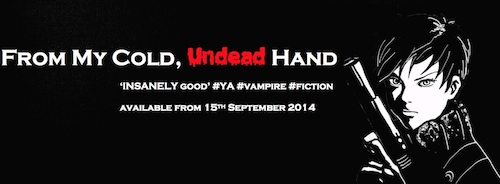
Big ones, little ones, new ones, centuries-old ones, perhaps ones that have had extensive orthodontic work, and perhaps even ones who have a secret that is kept until the sequel. Yes, there will be a sequel to From My Cold, Undead Hand! More about that later – much, much later – but right now all eyes are on the 15th of September, which is publication date! That’s when you’ll be able to get your teeth into it…

The book will first be available in e-book format direct from P’kaboo Publishers. Shortly after that it will be available via Amazon in both paperback and Kindle formats. However, if you want some bonus extras, in the form of extracts in text and audio of the ‘diary’ of one of the characters, then the e-book direct from the publishers is the way to go. You can even pre-order to make sure!

As you can imagine, I am very excited about having my third novel published. It is, in a way, also a ‘first’, being the first one I have written as a commission from a publisher, my first venture into the genre of teen-vampire fiction, and the first of a planned trilogy. If you would like to know about it, click here to find my answers to questions about it when I was interviewed recently.

If you have any questions about it yourself, please contact me and let me know.

MM

Jayhawkers, rougarous, and violent death: a review of Samuel Snoek-Brown’s ‘Hagridden’

(warning – this review contains plot spoilers)
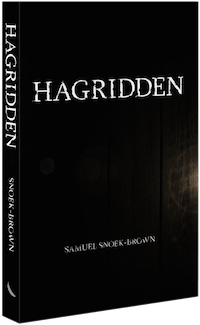
hagridden_book_coverHagridden
Samuel Snoek-Brown
Columbus Press, OH, pp.241

Samuel Snoek-Brown will possibly turn out to be one of the best storytellers of the 21c. There’s a modernist feel to his storytelling, very often his plots don’t resolve, but rather give the sense that a process – a life – is going on, and that we have witnessed a part of a greater whole. The psychology of his characters is seldom explained but always clearly displayed, as readers have already seen in Boxcutters, his slim book of short stories. Now we have his first published novel, Hagridden, to consider. According to Sam, Hagridden isn’t the first novel he has ever written, owning up to other attempts when he was much younger, saying “they were books I had to write in order to learn how to write this one”. Teethcutters, you might say!

Hagridden is the story of two women who eke out an existence in the Louisiana bayous towards the end of the American Civil War. One way they survive is to murder fleeing soldiers of both sides and sell their weapons and accoutrements to a corrupt storekeeper. When a neighbour, a comrade of the younger woman’s dead husband, returns to his hut having deserted from the Confederate army, their existence is thrown out of kilter. Aficionados of Japanese film will instantly recognise that Hagridden owes a huge debt to Kaneto Shindo’s movie Onibaba (1964). This debt has never been a secret, although it is not directly acknowledged in the book. However, this is not the first time that a tale from medieval Japan has been transferred to 19c America, and it is not simply an adaptation of Onibaba; not only has the tale moved in time and location, but it has also switched media. There are also differences in the plot beyond that, some subtle, some very obvious.

The Civil War is a very powerful element of the USA’s national myth as well as of that nation’s actual history. The stiffness of 1860s daguerreotypes from which uniformed, bearded men stare out was taken forward into film and TV – Gone with the Wind, North and South, Gettysburg – with gallant officers, plantation ladies, and stoical slaves. Largely forgotten in popular culture is the devastation to lives on the periphery. That is where Sam Snoek-Brown sets Hagridden. The two women have been brutalised by poverty, and their consequent violence is graphically described. Sam doesn’t pull any bayonet-thrusts in his descriptions, he doesn’t let the reader look away at any time, forcing a confrontation in which not every reader will feel comfortable. There were times as I read when I wanted to beg for mercy, not for myself and my own sensibilities, but for a character. In the end, it was almost a surprise to learn who did and who did not survive. Mercy, however, isn’t an option, as the book is driven along by the worst in humanity, in nature, and in superstition. There is only one act of kindness in the book, and that seems to be nothing more than a device to allow two of the central characters to survive a little longer.

Hagridden is almost an amoral book. In fact I would guess that this is deliberately so, making its amorality a moral stance in its own right. Characters are allowed their own morality, as when one of the women rationalises the sins of murder and lust:

I ain’t talking about killing nothing. They’s bad and then they’s bad. What we do we do to survive and they ain’t no sin in that. But lust? Whoo girl, you got to look out for that they lust. Worst sin they is. Sinners what lusted after the flesh in this world, they turn to animals in the next. Crawl round on all fours like dogs and the brimstone burning off they knees, the skin off they palms. Some say rougarous is lusters coughed up from Hell to walk the earth.

werewolfA ‘rougarou’ (Fr. loup garou, werewolf) is what gives Hagridden its superstitious, supernatural element, although there is a mundane explanation to this creature’s appearance in the story. However the appearance of the second (or is it third?) rougarou is almost too convenient, almost that of a deus ex machina, and not the novel’s most convincing episode.

From the quoted passage above, it can be seen that much of the dialogue is written with a distinct ‘eye-dialect’. There are also what I call ‘fixers’ – usages which establish a time and place in a story. In the case of Hagridden, the fixers are Cajun-isms, notably the way characters address each other casually as ‘sha’ (chère), ‘vieux’, ‘petites’, and ‘boo’ (beau). They don’t always work, as when ‘boo’, normally said to a man, is addressed to the older woman (p.14), or when the ungrammatical ‘ma petit fils’ is used(p.158). Such solecisms may exist in the vernacular of Louisiana – I speak a little Louisiana French but am no expert – yet they look wrong on the page. As a general point of style, direct speech is not marked by any form of quotation marks. This meant that I had to look consciously for where speech started and ended. But this wasn’t a chore, and in fact it concentrated my attention, making the text as a whole feel very taut. Some readers might find the use of the word ‘nigger’ unpalatable, but if it was there in the actual speech of that time and place then it has to be there in this novel.

Human-on-human is not the only brutality of the novel. Greater than the violence and murder done by the characters on each other, and than the supernatural terror of the werewolf stalking the bayou, is the force of nature. A hurricane and tidal surge threatens to wash away everyone and everything, including the story (pp.193-200). One of the most compelling passages of the book comes here, as two characters watch an oddly-juxtaposed procession of domestic objects, animals, and people float by them in the flood. It is surreal, almost nightmarish.

Sam Snoek-Brown has been praised for his meticulous research while writing this novel. Although I have queried some details, I could see as I read that he had indeed paid a great deal of attention to historical authenticity. This was obviously something he wanted to achieve, an integral part of the exercise of writing the novel. I don’t want to belittle that achievement, but to me it wasn’t over-ridingly important. What was more important was the novel’s plausibility, its power to make me suspend disbelief and follow the story to the end. He achieved that with an expertise that made it seem easy. That’s the mark of a craftsman-author. This novel may be read ignoring my quibbles, and on that basis I recommend it fully.

MM
__________

Hagridden official web site

Review of ‘Finis’ by Angélique Jamail

Finis cover 200Finis
Angélique Jamail
Amazon Kindle format
review by Marie Marshall

The best fantasies are the ones which have one foot in reality, in a world or society in which there is enough recognizable for a reader to be drawn in without having to have anything explained. A writer’s skill in doing so is necessary for the metaphor – the unreal, the less-than-recognisable that nonetheless stands for something in our own world – to take hold and be convincing, and Angélique Jamail’s skill is apparent from the very beginning of Finis.

We instantly enter a familiar world where work is tedious, landlords are mean, family is disapproving, neighbourhoods are patrolled by gangs, and where to be different is to be in danger. But in his corner office, the boss is a monster, quite literally a monster capable of goring any secretary who misses a staff meeting. In an environment where to be recognised as fully human one also has to be fully animal, one wonders just how bizarre the Minotaur of legend must have been if ‘Somewhere in Crete a maze is missing its pet’! Similar in feel to the way Philip Pullman’s characters develop a companion ‘dæmon’ as they mature, humans in Jamail’s story take on important aspects of members of the animal kingdom, until they are a fusion of the two. People who never develop this full nature are referred to as ‘plain’.

Elsa, Jamail’s protagonist is a ‘Plain One’, enduring reactions from her colleagues and superiors that range from pity, through discrimination, to bullying, and meeting little better from her immediate family. Even her cat wants to claw and bite her, and in fact is the only one who (spoiler alert! from now on they come thick and fast) actually understands her true nature from the beginning. Jamail’s portrayal of her nagging, unsympathetic father is convincing…

When Elsa doesn’t muster the same enthusiasm as the rest of the family, her father asks what her problem is.

   “Dad, you know I can’t swim – “

   “No, you won’t swim,” he grouses. “There’s a difference.”

This is technically true. Elsa chooses not to submerge herself in vats of acid too.

as is her mother’s fretful ‘Why doesn’t she ever go out? Why doesn’t she ever bring friends over at the holidays? Is she ever going to get married?’ The only member of Elsa’s family with whom she has any affinity is her cousin Gerard – “We both like seashells and hot chocolate”.

A tantalising ichthyological theme runs through the story like a bright thread – an aquarium, tuna sandwiches, references to water everywhere, even the punning title of the story and the last word on the page – loading the narrative with proleptic irony at every turn. Suddenly a clue comes, a newspaper story about the possible appearance of a Phoenix. Perhaps this is how Elsa will develop, with a rebirth in fire, and perhaps this explains her fear of water. But this is partly a red herring (!), although for Elsa it does suggest that maybe her own rebirth means surrendering to the very element that she fears. Eventually she becomes – what? A fish? A mermaid? Her transformation is left less than clear, but for her it is satisfying, it is an ending and a beginning. The conclusion is open-ended, and it almost leaves the reader with a feeling of unease. The problems of plain-ness have not gone away in Elsa’s world simply because she has escaped it, and the point of story has suddenly become her comfortable conformity.

Any niggles I have with the execution of this story are minor. For example, the process of change is referred to as ‘blossoming’, which to my mind is floral rather than faunal, and therefore less than appropriate. Overall it is a lesson in how to write from a point of ‘otherness’. It is short, but just the right length to carry readers and keep attention along a fairly simple narrative. Very worth reading, if my spoilers haven’t given the game away.

Read the first chapter of ‘From My Cold, Undead Hand’!

FMCUH cover final 500

Click on the illustration above to be taken to the publisher’s page for From My Cold, Undead Hand. Once you’re there, click on the cover illustration there and you can read the whole of the first chapter as a preview to the novel!

Download my free ‘From My Cold, Undead Hand’ wallpapers

FMCUH eyes

Make the most of your desktop with these cool, noir wallpapers, and help me celebrate the publication of my first teen-vampire novella. There is a lot of empty space so that your icons don’t appear as ‘clutter’. Choose glacier white or nightwalker black – just click on a thumbnail below and a full-size image will open…

The artwork is © Millie Ho; permission is not granted for use other than as a desktop wallpaper.

FMCUH white wallpaper     FMCUH black wallpaper

Pre-order ‘From My Cold, Undead Hand’!

News just in!

FMCUH pre-order

‘From My Cold, Undead Hand’ – Publication date!

twitterbanner 2 blog

I’m pleased to announce that From My Cold, Undead Hand, the first of a planned trilogy of teen-vampire novels, will be published in e-book form on 15th September! Don’t go looking for it just yet, as the plan also involves some free extras for pre-orders and/or early purchases – more news about that when I have it. I will also keep you informed as and when it becomes available at Amazon or elsewhere.

There are some preview opinions of From My Cold, Undead Hand here. If you’re on Twitter, you can keep up with the news by following @ColdUndeadHand.

Some of my old poems turned up…

product_thumbnail… in May Prism 2014, a collection of contemporary international poetry, a quarterly (or thereabouts) paperback edited and self-published by Australian poet Ron Wiseman. [Find it here, and my poems from p.157 onwards.] This was half-a-surprise to me, as I hadn’t visited the poets’ virtual hideaway that Ron and I frequent(ed) for a while until recently, so I was out-of-the-loop and didn’t even know he was engaged in this little publishing venture. As a result, the poems he selected (knowing that I would have given him permission anyway if I had been around) are all fairly old. Some of them have been published before, in Tower Journal for example, and many of them are formal, or show me tinkering with Celtic-mystic-medieval themes. The feature even quotes me as saying “I am best known as a neo-formalist poet…” Good grief! It’s a long while since I said that, and it is no longer strictly accurate, but never mind. I did cut my teeth on formal poetry, figuring that it was a good discipline to learn in order to give my writing in general some technical power.
May Prism is full of poetry by a whole range of poets from around the world, so I can thoroughly recommend it. Here is one of my poems from the selection of seven that Ron published. I have spared you the iambic pentameter – this one is written free.

Someone said you loved me

There are no ties to life; rather it’s like a hangnail
when it catches in my sweater – one tug and it’s free,
free to fall, free to take its end.

Few things make me catch my step, slow me,
have me gripping at the burning minutes as they are consumed,
very few things save, perhaps, you.

Gossip I can let tumble and roll among the leaves and papers –
except when someone said your eyes followed me
as I wandered through the room.

Now I will test the truth of this by walking slowly, as though on a wire,
savouring each second, seeing if my bare neck flames
in your gaze

Membranes of Marrakesh

words © Marie Marshall image © Membranes of Marrakesh

words © Marie Marshall
image © Membranes of Marrakesh

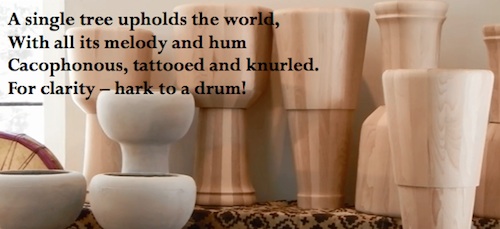
I often say that the strangest place I have ever ‘published’ a poem has to be the time one was etched into an African drum, which is now at the New Orleans Museum of Art. The poem was called ‘Djembe’; I wrote it several years ago, and that’s it above. The image I have used to accompany it shows the raw, waiting bodywork of drums made in the same workshop as ‘mine’ was. If you click on the image you will be taken to a fundraising site for the workshop’s new project. They hope to give away 100 drums at the Burning Man festival in Nevada this year. Have a read through their promotion and watch the video. If you can help this celebration of giving please do, even if it is only with good vibes and good wishes. Thank you.

By the way, if you happen to be in Nevada between August 25th and September 1st this year, then go and experience the Burning Man. If you visit the Membranes’ stall in the Souk, then the patter with which they address you may well have been written by… me! Find out how the young Berber woman, Yasmine, got the better of a mighty desert djinn!

M.

Dance the Carmagnole!

Traditional (anon.), tr. Marie Marshall

Young Missus Veto said to me
She’d slit the throat of all Paree.
Young Missus Veto said to me
She’d slit the throat of all Paree.
But see the plan she laid
Spoilt by our cannonade!

Let’s dance the Carmagnole
– hear ‘em roar, hear ‘em roar!
All dance the Carmagnole

– hear how loud the cannons roar!

Old Mister Veto said to me a-Sansculottes-1793-jacob 2
He’d give his realm fidelity.
Old Mister Veto said to me
He’d give his realm fidelity.
But this he failed to do,
We’ll give no quarter too!

Let’s dance the Carmagnole
– hear ‘em roar, hear ‘em roar!
All dance the Carmagnole
– hear how loud the cannons roar!

Antoinette said “Let it pass
The common crowd falls on its arse.”
Antoinette said “Let it pass
The common crowd falls on its arse.”
But in the market-place
She fell flat on her face!

Let’s dance the Carmagnole
– hear ‘em roar, hear ‘em roar!
All dance the Carmagnole
– hear how loud the cannons roar!

Louis the King thought he had won
But we’re the champions, every one.
Louis the King thought he had won
But we’re the champions, every one.
Cry-baby Louis – weep
From your palace to the keep!

Let’s dance the Carmagnole
– hear ‘em roar, hear ‘em roar!
All dance the Carmagnole
– hear how loud the cannons roar!  

When Antoinette was shown her cell
She began to weep as well.
When Antoinette was shown her cell
She began to weep as well.
She fainted and fell down,
All because she’d lost her crown!

Let’s dance the Carmagnole
– hear ‘em roar, hear ‘em roar!
All dance the Carmagnole
– hear how loud the cannons roar!

The bloody Switzers* made a vow
They’d gun down our comrades now.
The bloody Switzers made a vow
They’d gun down our comrades now.
But look at how they prance,
Our bullets make ‘em dance!

Let’s dance the Carmagnole
– hear ‘em roar, hear ‘em roar!
All dance the Carmagnole

– hear how loud the cannons roar!

sans-culottesComrades, forever we’ll unite
No matter who comes here to fight.
Comrades, forever we’ll unite
No matter who comes here to fight.
Attack us if they dare,
We’ll give ‘em such a scare!

Let’s dance the Carmagnole
– hear ‘em roar, hear ‘em roar!
All dance the Carmagnole

– hear how loud the cannons roar!

Comrades, remember their renown,
The Sans-Culottes from our town.
Comrades, remember their renown,
The Sans-Culottes from our town.
We’ll raise a glass and sing,
The bells of freedom ring!

Let’s dance the Carmagnole
– hear ‘em roar, hear ‘em roar!
All dance the Carmagnole

– hear how loud the cannons roar!

__________

* ‘Switzers’ here refers to Swiss mercenaries in the pay of the King of France.

There are several variants of this song. The words have been translated very freely and are possibly more ‘jokey’ than the original. As with all the better-known songs of the French Revolutionary period, this is actually a very rousing piece of music. If you would like to sing along, you will find the tune here.