Marie Marshall

Author. Poet. Editor.

Download my poster and wallpapers

Poster

Poster

Click on the thumbnail of the image you want to open it; right click and save or drag it to your desktop. All images are based on a poster idea used by the wonderful Scottish Poetry Library; they are under my copyright, but are released for use in unmodified form as posters or wallpapers. Enjoy.

M.

PC wallpaper

PC wallpaper

Mac wallpaper

Mac wallpaper

Sonnet in memory of Charles Bukowski

© 2008 Marie Marshall.  Twitter @MairibheagM

© 2008 Marie Marshall.
Twitter @MairibheagM

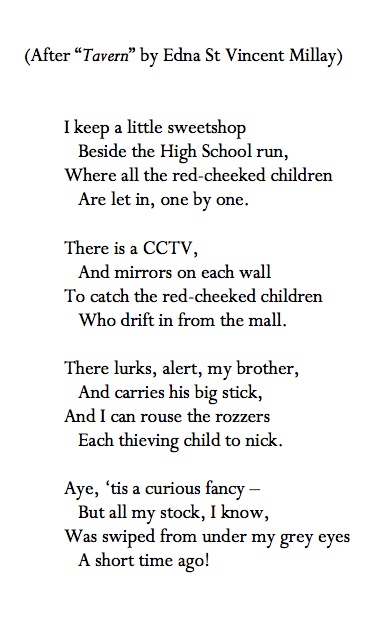
Sweetshop

© 2008 Marie Marshall.  Twitter @MairibheagM

© 2008 Marie Marshall.
Twitter @MairibheagM

TOADMEISTER!

Toadmeister

Ratty had been emailing me faster than I could reply, not that I’m all that savvy with electronic communications. Actually I spend most of my time down my hole engrossed in World of Warcraft, deep in the wizard-world of Azeroth – I’m a Night Elf from Outland – currently operating at the fourth level of Cataclysm and on the run from Hakkar the Soulflayer… not relevant, not relevant… but on the other hand not much need for emails either.

Ratty’s emails, they went along these lines… hang on, let me open one up and cut-and-paste it for you, here we go…

“Hey Mole, I’m due to fly out to Cyprus today and go on board the Wildwood Warrior. We’re going to sail for the Gaza strip in a couple of days time with a cargo of humanitarian aid to see if we can get past the blockade. There is still nothing, Moley, absolutely nothing half so much worth doing as simply messing about in boats! LOL. Follow me on twitter @riverbankratty.”

That was last week. I can’t look at his tweets, I fear for the dear fellow. The world out there is a big place and a dangerous place. ‘Messing about in boats’ is one thing, messing about in big boats in a sea full of bigger boats bristling with guns is another thing altogether. Oh well, at least he can swim, and he always was an adrenalin-junkie, Pan knows! Like I said, I get my adrenalin rush from virtual wargaming.

Talking of which I bumped into Badger the other day coming out of the Red Lion. Bumped literally. He had his head down and his nose in his Mac Book Air, which was open. As we collided he let it slip and it would have shattered into a thousand very expensive pieces on the cobbles of the pub courtyard if I hadn’t fielded it like Alastair Cook taking a slip catch. Of course I couldn’t help noticing what was on his screen – World of Warcraft! It was an irritated ol’ Badger who snatched the lappie out of my hands.

“Hey Badgie,” I said. “Didn’t realise you were into ‘the Craft’.”

“You make it sound like the confounded Freemasons,” he said with a frown. “Yes I do the odd bit of gaming.”

“Well maybe we have crossed swords at some stage,” I said. “I’m Dalforstin the Night-Elf. Who are you?”

He mumbled something I didn’t catch.

“What was that?”

“I said I’m Kolkhatana, Warrior Princess of the Dwarves. Satisfied?” he snapped, and stalked off in moderately high dudgeon. I was silent – gobsmacked actually – as his hunched figure hurried away. He was cutting quickly round the hedge at the end of the lane when a sudden thought struck me.

“Kolkhatana? Hey, didn’t we…” I called. But he had gone. And it didn’t bear thinking about.

I decided it was time to drop in on Toad Hall. Things had been quiet there for some time. I did know that the upkeep was rather steepish these days and that Toad, bless his silly heart, had been threatening to give it to the National Trust and move into the gamekeeper’s cottage. Presumably that would mean  that the gamekeeper would have to move out – Toad wouldn’t have thought of that, of course. Anyhow, I ambled along what had once been a leafy lane… well it was still a leafy lane for most of its length but the here at the village end of it there was a tightly-packed knot of new houses – Toadfields. His Toadfulness had sold a patch of the old estate off to a developer in order to settle a tax bill. So anyhow, like I said, there I was ambling along the lane which led eventually to Toad Hall, when I realised I wasn’t on my own. Stoats and Weasels, rucks of ‘em, were popping out of the trees and hurrying excitedly down the lane. I could see the increasing crowd three hundred yards away funnelling through the lodge-gates and on to Toad’s gravelled driveway*.

Momentarily I paused. I wondered whether it was another invasion such as the one we four – me, Ratty, Badgie, and Toady – had fought off back in the day. But these stoats and weasels seemed in good spirits, not belligerent, as though setting off to have a good time. They were all relatively young ‘uns too.

I accosted a ferret in a cap and shades (incongruous those, because the sun was about to set) and asked him what was afoot.

“Hey bruv,” he said. “It’s ‘im, innit. It’s da beats, bruv, da beats. It’s totally sick, sick as aids, bruv!”

I resisted the temptation to say “No hablo Chav” and let him go on his way. Still I stood and wondered what in Pan’s name my ol’ pal Bufo Bufo was up to this time. We’d been through the camp site, the theme park, the WW2 vehicle museum, the health spa… none of those had attracted a surge of young mustelidae like this and, crucially, none of them had made any money either. I straggled behind the crowd as evening fell.

Toad hall was in darkness, but by the light of the hundreds of glo-sticks the stoats and weasels were carrying, and the luminescent screens of hundreds more iPhones, I could make out some sort of bulky structure in front of it – a stage? A dais?

Suddenly a siren sounded and a great cheer went up from the crowd. Then the cheering itself was drowned by a deafening swell of electronic music at (I guess) one-hundred-and-thirty beats per second – the unmistakeable sound of Euro-Trance. Then fireworks exploded, lasers and strobe lights flashed, the stage was lit up by spotlights and there… there… there behind what could only be a set of decks bristling with controls, screens, sequencer keyboards, all the gubbins of Electro… there in a brilliant white T-shirt, cycling shades, and headphones was Toad! Toad grinning from ear to ear. Toad punching the air in time to the music, while the stoats and weasels danced and bounced and punched the air in response.

“TOADMEISTER! TOADMEISTER!” they yelled in unison.

You could have knocked me down with a wet piece of hedge-sorrel. But as I became swept up in the euphoria, began to bounce, began to dance, began to punch the air, I realised that at last, at last, Toad had got what he had always wanted.

Acclamation!

__________

* I would be grateful to know, by the way, why Americans park on a driveway and drive on a parkway.

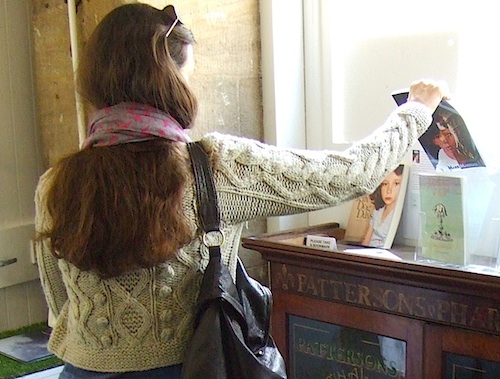
‘Reading Corner’ on Day Two.

©Bookseeker Agency / Balbirnie Collective

©Bookseeker Agency / Balbirnie Collective

Popped my head in briefly to see that everything was in full swing. Gratified for the exposure, the poetry-reading, and the interest shown in my books.

©Bookseeker Agency

©Bookseeker Agency

‘Reading Corner’ at Balbirnie.

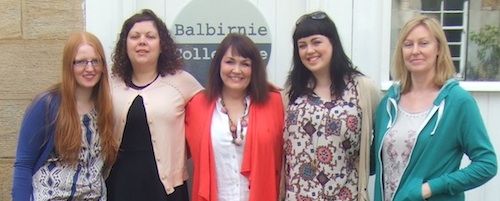
Members of the Balbirnie Collective, ©Bookseeker Agency

Members of the Balbirnie Collective, ©Bookseeker Agency

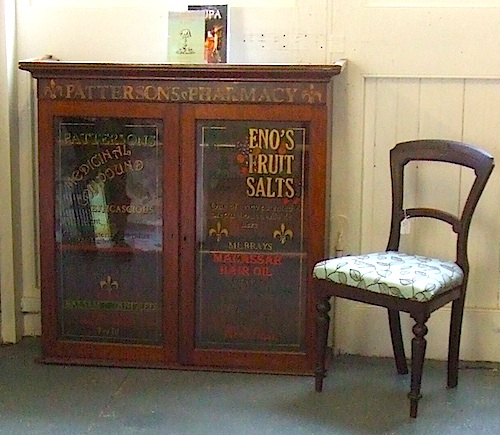
I was told that my books – my novel Lupa and my poetry collection I am not a fish – would occupy ‘a corner of a table somewhere’ at Balbirnie Craft Centre. In fact I was delighted to be informed by my agent that I had a whole bookshelf to myself when he arrived there today – see below. A pity I can’t fill it, but there will be more books there shortly…

'Reading Corner', ©Bookseeker Agency

‘Reading Corner’, ©Bookseeker Agency

The Ballad of the Loyalist

The old North Bridge, Concord MA.

The old North Bridge, Concord MA.

I’ve a couple of reasons for posting the poem below. Firstly I’m continuing to let today’s readers get to know my older writing. Secondly I’ve recently been discussing alternative views of history, in particular the imperative to strip away the gilding that patriotism has put on certain things. In 2008 I was invited to contribute a poem about the American Revolutionary War of the 1770s. I decided to use an old form – the ballad – and write from the point of view of what we used to call a Native American, before that term came to be used of the aboriginal people of that continent, that is to say a white farmer; this particular individual was amongst the large section of the population – getting on for half, I believe – whose political inclination was towards loyalty to the Crown. The poem became an exercise in imagination and a calling-into-question of war, as well as in the repetitive structure of the ballad and its metrical integrity. I hope you enjoy it and, if you’re American, I hope you don’t mind being asked to see things from another point of view. [Note on formatting: I find I’m unable to indent alternate lines, as originally typeset; this alters the visual impact of the poem a little, and for this I apologise.]

__________

                   The Ballad of the Loyalist

When the snow is on the ridge, and a rime upon the bridge
and the whippoorwill calls out in solemn tones,
Over wooden span and arch in my scarlet coat I march –
I’m the shade of British soldier William Jones.

I was raised upon this soil – a New England farm my toil –
and brought up a faithful subject of the Crown.
Though the rebels cussed and swore at the scarlet coat I wore,
I fought for King George, to put sedition down!
Though it gives some people pause, there’s a true and loyal cause,
there’s a greater good, a better song to sing;
In the tavern by the forge, a good health to German George
I would drink, and wish a long life to our King.

When the snow is on the ridge, and a rime upon the bridge
and the whippoorwill calls out in solemn tones,
Over wooden span and arch in my scarlet coat I march –
I’m the shade of British soldier William Jones.

Though the contrabandiers’ plaint seemed legitimate – it ain’t –
for the tea they dumped at Boston, it was cheap!
Contrabandiers hated tax, but our English laws were lax;
As the rebels sowed, as surely they would reap!
And the contrabaniers’ ploy – throwing snowballs at a boy –
there were stones inside them to provoke a fight…
Then a “massacre” they cried, and though many people died
now their propaganda hides the truth from sight.

When the snow is on the ridge, and a rime upon the bridge
and the whippoorwill calls out in solemn tones,
Over wooden span and arch in my scarlet coat I march –
I’m the shade of British soldier William Jones.

With a Hessian on my left, and my gun at shoulder-heft,
I marched bravely from my Massachusetts farm;
With a Mohawk at my side, I set off to stem the tide
of sedition, and protect the Law from harm.
Though the foe that I did face was like me, of native race,
it was he who marched to perpetrate a lie;
Though our culture was the same – why, I even knew his name –
we were mortal, and each one of us could die.

When the snow is on the ridge, and a rime upon the bridge
and the whippoorwill calls out in solemn tones,
Over wooden span and arch in my scarlet coat I march –
I’m the shade of British soldier William Jones.

Maybe things ain’t as they’re taught, maybe war is good for naught –
there were heroes, there were villains on each side;
If a monument you’d raise, or you’d sing a song of praise,
then kneel on the ground where we all fought and died,
Search among the mould and spall, till you find a musket ball,
and make that your icon, set it up on high –
Such a thing can stop your breath, save your life, or bring you death…
think upon it when you ask a man to die!

When the snow is on the ridge, and a rime upon the bridge
and the whippoorwill calls out in solemn tones,
Over wooden span and arch in my scarlet coat I march –
I’m the shade of British soldier William Jones.

So I fell, and now the bones of poor farmer William Jones
lie beneath his native clay in silent rest,
On a Massachusetts farm, far from trumpet’s shrill alarm,
I would seem to sleep the slumber of the blessed.
But my lonely ghost now walks with a thousand others, stalks
o’er the old North Bridge. The beauty of the scene
Belies all the pain and blood, all the marching and the mud –
we march into dark, as though we’d never been…

When the snow is on the ridge, and a rime upon the bridge
and the whippoorwill calls out in solemn tones,
Over wooden span and arch in my scarlet coat I march –
I’m the shade of British soldier William Jones –
Through the snowy winter night, in the deathly pale moonlight,
with my spectre-comrades, dressed in blue or red.
All you people of the town, safe beneath your eiderdown,
think not on us… no… for we are all long dead!


Before Fifty Shades: ‘The Dying Slave’.

Before Fifty Shades

It almost seems strange to be saying this, but there was life, and lifestyle, before Fifty Shades of Grey, and it made its way into literature. Sacher-Masoch’s Venus in Furs was published over 140 years ago. For some time before I became a ‘legit’ (what does that even mean?) author and poet I wrote about love, sex, domination, and the areas where they did and did not overlap. I wrote the vignette below in a deliberately-mannered and sentimental style, to reflect the formality that often exists within Dominant/submissive relationships; the era in which it is set is not mentioned, but it could belong to any time…

__________

“I have made her as comfortable as I can.” These had been the doctor’s parting words to Greta. Now Greta sat by Leonora’s bedside as the late afternoon sun struck aslant at the covers, through half-closed curtains. The room was almost silent. Outside, absurdly cheerful birds were twittering, oblivious to the sadness inside, where the only sound was the quiet rasping of Leonora’s breath.

“I do not have long,” said Leonora, very quietly. “I know this, Mistress.”

Greta reached out and took her hand, surprised by the strength of the grip she felt. Looking at Leonora’s face, her eyes met the dying woman’s, and held, and locked. She was surprised how bright they were, how much love and happiness they seemed to contain at this time. Leonora was smiling. Greta forced herself to smile in return, though she felt her heart was breaking.

“You will be fine, darling. Very soon you will be well and strong, and you will leave that bed. We’ll take our walks together again, and do all the things we love doing. And just call me Greta for now – there is no need for formality.” To herself she thought, “Why do we always say these absurd things to those whom we love, while life is slipping away? We know they are dying, they know they are dying, and yet we toss bright phrases about as if they are suffering from nothing worse than a slight migraine. Can we not bear the truth, even though we all know it?” She refocused on the sweet, submissive woman in the bed – the loving one who was slipping away from her – and fought hard to keep her composure. It did not break.

At the admonishment to drop her Mistress’s formal title, Leonora shook her head weakly, but with some vehemence. “Please, Mistress, I beg you not to deprive me of that – not now, please. I could not bear it, Mistress.”

There was something bold, almost forward in this petition. Greta’s thoughts rolled back through the decades to the time that Leonora had first come to her. By mutual consent Greta had offered her protection and command, and Leonora had offered herself. Her enthusiasm for being a submissive woman to Greta’s need to dominate had been tempered with a little hesitancy at first, but often the enthusiasm had got the better of her, and she had blundered into many a transgression, for which Greta had not been slow to chastise her pet. Now Greta sat, looking down at Leonora, wondering if she had been domineering rather than dominating, cruel rather than magnificent. But all she could see in Leonora’s eyes was love and devotion. If her slave had ever felt hard-done-by, she did not show it now. She showed only the faithful adoration that Greta had become so used to over the years. Leonora’s willingness to be led down any path of experience had surprised Greta, but to Leonora it had simply been a duty she had been resigned to – no, not resigned, one to which she had come singing with joy. Step by step her Mistress’s will had become second nature to her, as vital as food and drink, and as air, and she had learned to obey almost unbidden, knowing and anticipating Greta’s wishes, reading her needs, and submitting herself to them.

Now it was to end. That perfection of love was to wink out in an instant, a bare moment which seemed to be racing upon the two women as they faced each other now. Greta struggled to find the words she needed to say. In her mind, after all this time, were doubts about the life they had chosen. She asked herself, “What great things might Leonora have done, if she had been free?” And in an unspoken, inner dialogue she seemed to hear Leonora talking back to her, telling her how she had blossomed as a singer, as and artist, as a whole person, in Greta’s service, and how wonderful it had all been.

“Dear Leonora,” said Greta finally. “If I have never succeeded in telling you how grateful I am for your lifelong gift of yourself, please let the action I am about to take be an explanation. Darling, all those years ago you gave yourself to me unreservedly. Today, all debts are cancelled, all pledges redeemed. I give you the only gift I can – yourself. You are free.”

As Greta spoke, Leonora tugged urgently at her hand, in a way that she would hitherto not have dared.

“…And my parting gift is to return yours to you. I wish to die belonging to you, Mistress. It is all I have ever wanted – to serve you all the days of my life, right until my death. I am your slave for life, for my whole life.”

The grip on Greta’s hand was a little weaker now. The tugging seemed to have sapped Leonora of much of her strength.

“Very well, little one,” said Greta, using a term of endearment she had not used to Leonora in a long time. “It is my pleasure to grant your wish. I remain your Mistress to the end, and you my slave. But know this…”

Greta bent low, kissed her slave on the forehead, and the lips, feeling as she did so the barely-perceptible breath on her cheek.

“…in Paradise there is no slavery. In Paradise you will stand by my side as my eternal wife, and only as that. Even you cannot go against a law made in heaven. Be peaceful, my darling little one, be peaceful…” Greta’s commanding voice fell away, and she simply sat, holding Leonora’s hand, looking at the silent devotion and love in her eyes.

She sat and looked into those eyes until all the devotion and love had finally faded away, along with all other light and lustre, and all that was left was the eyes. Leonora’s breath had stilled to nothing, she was free, and her hand lay gently in that of her earthly Mistress.

That was the moment – when she was finally alone – that Greta surrendered her life-long dignity. She bowed her frame over her dead love and, as the birds sang with incessant merriness outside, she wept.

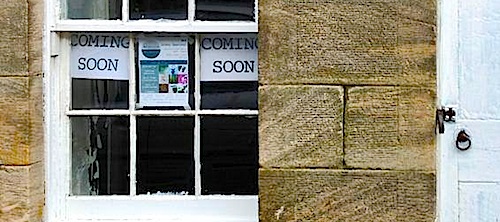
Coming soon

Balbirnie 3

Coming soon to Central Scotland – the opening weekend of Aval-Ballan’s new studio premises in Fife. Aval-Ballan is a creative arts partnership, based in Markinch, Fife. Their new premises will be at the Balbirnie Craft Centre, and they will be unveiled on the 1st and 2nd of June. If you’re in Scotland, do drop in. Their artwork, painting, new-old furniture, sea-glass and sea-pottery jewellery, etc. are wonderful; they run workshops for people who simply want to paint. Vist their web site for details and directions.

I am glad to say that they will be giving space to my books – Lupa and I am not a fish – probably on a permanent basis, so you will be able to get a signed copy at retail price!

Seulement dans le Vieux Carré

Decatur St., New Orleans, by Russell Lee.

Decatur St., New Orleans, by Russell Lee.

Seulement dans le Vieux Carré

Seulement dans le Vieux Carré
tombe mon coeur au trottoir,
là-bas où les maqueraux crient
  “Hé, chère!”.

Il me faut regarder de nouveau,
peut-être avec les yeux
d’un oiseau de printemps,
douces, à la teinte parme;
ou comme les Acadiennes
pendant la semaine sainte…

En cheminant à la Rue Bourbon
– en plein soleil
ou à la tombée bruyante de la nuit –
je le ramasserai, mon coeur,
qui nage sur
  un flot de jazz…

  et ça suffit pour vivre.


Only in the Quarter
does my heart fall to the sidewalk –
down there, where the pimps call out
“Hey, honey!”


I need to take another look,
maybe with the eyes of a spring bird,
soft, violet-hued;
Or like the Cajun girls
at Easter time…


Making my way along Bourbon Street
– in full sunlight,
or around clamorous nightfall –
I’ll pick it up, my heart
that’s floating on
a tide of jazz… 


and that’ll do to live on.