Marie Marshall

Author. Poet. Editor.

Poetry Book Society Choice

My collection, I am not a fish, is due to be published by Easter 2013. It will be entered for the Poetry Book Society Choice in the competition for the 2013 T S Eliot Prize. The Managing Editor of my publisher is eager to do this because she has faith in the work. Competition for the Prize is fierce, so there is absolutely no guarantee that the collection will even make the shortlist, but it is heartening to know that my publisher wants to hurry things along in order to meet the deadline for entries.

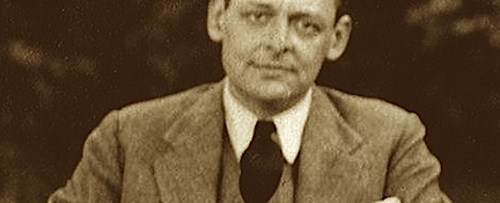
The Poetry Book Society was founded in 1923 by T S Eliot, hence the image above, in case you were wondering…

An Interview with Samuel Snoek-Brown

The difficulty with interviewing writer and teacher-of-writing Samuel Snoek-Brown is that his web site is so comprehensive that there is little left to ask. I’m reduced to quizzing him about the names of his cats. Sam is prolific, a non-stop writer, a daily blogger, a man of high, caffeine-driven energy. Amongst other things, aside from his writing, teaching, and speaking commitments, he is Production Editor of the amazing Jersey Devil Press, a small publishing outfit in the USA.

I caught up with Sam, by email, in between cups of coffee, and this is the result…

I guess you would say ‘Yes’ to this question without hesitation, but is it really possible to ‘teach writing’? Can you really take someone with – let’s be kind – no more than a modest talent, and, by instruction, make a successful writer out of them or at least someone who feels fulfilled in writing?

To the first part, yes, absolutely. But to the second part? That’s harder. I don’t think I can ‘make’ a successful writer out of anyone any more than I could ‘make’ any student successful in any field. I don’t view my role as teacher as a “maker” of students. I’m an usher; I collaborate in a student’s learning. There was a terrific article in Poets & Writers a couple of issues ago, in which Gregory Spatz tries not just to answer this question but to reframe it: he argues that the answer to the question is an obvious yes, and what we really ought to be asking is what happens when we do teach it. It’s a great article – people should track it down and read it.

But then there’s the last line of your question: can I help a student become ‘someone who feels fulfilled in writing?’ And yes, that I think I can do. And it’s not just about coddling or gladhanding writers. It’s about recognizing what they do well even if they don’t see it themselves, and then showing how to replicate that. That’s not easy to do – you have to make yourself into their sort of writer in order to know how to guide them in their writing – but I know it’s doable. When I was teaching in Wisconsin, I had a student who was an agriculture major in the most hard-core sense: the guy wore a uniform of heavy work boots and Carhartt jacket and John Deere cap; he proudly declared that his only reason for being in college in the first place was to learn how to take over his family farm from his father. He had no use for writing other than the credit it fulfilled in his degree. When I assigned the class to write about communities, he wrote about the farm, basic but beautifully pastoral essays about shovelling shit and harvesting beans. His essays weren’t perfect, but he worked hard and earned a solid B. And then he moved on, getting into the more important courses on agribusiness. But two years after he took my class, he surprised me in the hall outside my office. I smiled and shook his hand, thinking it was a passing hello, but he stopped me: he’d been looking for me. “I just wanted to tell you how much your class meant to me,” he said. “I ain’t gonna be a writer, but I never thought I could write. I’ve got some papers now in my other classes, and you gave me the confidence to write them. I’m doing okay – I even like my writing – and I wanted to thank you for that.”

In your opinion, what is the purpose of literature? How would you define ‘literature’ to start with? Does it have any obvious limits?

I used to be pretty snobby about the distinction between ‘literary’ and ‘non-literary’ fiction. In some respects, I still am: I just cannot give the same artistic weight to, say, Stephenie Meyer as I would to, say, Bram Stoker. But I’ve come to recognize ‘literary’ is just a genre tag, and that all fiction is literature.

So what is the purpose of any literature? I think it’s to entertain and to provoke – thought, emotion, or, ideally, both – to varying degrees. Some literature – what I like to call ‘airplane fiction’ – is almost purely entertaining and is designed to provoke the least possible amount of critical thought. Other literature is so intellectually demanding that it becomes exhausting and has almost no entertainment value at all. Both serve a purpose, but I think the ideal is a nice balance of the two.

Two of my favourite novels ever, Cormac McCarthy’s Blood Meridian and Ernest Hemingway’s For Whom the Bell Tolls, are richly complex works of literary fiction, full of demanding prose and opportunities for complicated critical investigation. Yet both are also essentially machoistic action novels full of sex and violence. And, for my money, that makes them two of the best novels ever written.

When you read, whether it is prose or poetry, what are you looking for? What qualities in others’ writings make you say, ‘Ah, yes!’?

I’m a big language guy. I love a good story or a clever conceit, but the work that makes me want to hug a book (and I literally do that – I press books right up against my heart) are the ones that use language beautifully. The cadences, the syntax, the images, the words…. The sentences of Cormac McCarthy or Barry Hannah or Alice Munro or Jac Jemc. The lines and images in Beth Ann Fennelly or Mark Doty or Czezlaw Milosz. The words. The words.

Beyond that, I want honesty. By which I mean beautiful ugliness, horrible love, brutal awe. I’m the kind of guy who thinks McCarthy’s The Road – in which the main character declares that “there is no God and we are his prophets” – is actually an uplifting novel. I’m the kind of guy who think Beth Ann Fennelly’s most beautiful poem is the one in which she describes breach-birthing her first child without drugs, how every capillary in her neck burst and her “asshole turned inside out like a rosebud.” One of my favourite love stories is Sarah Rose Etter’s Husband Feeding in which the wife lets herself be eaten alive by her spouse because it’s the only way to show how much she loves him.

What was your first published work? How did that first success feel?

I published a few things in my middle school magazine, the ink still purple from the mimeograph machine, the cardstock covers stapled on in the library. I fully expected classmates to throng me in the hallways and beg for my autograph, offer to buy my copies even though they were free to everyone. I was going to be the next Stephen King.

None of that happened, of course.

My first published story outside of school lit mags was ‘Coffee, Black,’ in Amarillo Bay. I knew and respected the editors, and I was over the damned moon. I shared that story everywhere. But by then, I knew enough not to expect fame a fortune. So it slightly less soul-crushing when fame and fortune kept ignoring me.

Recently you mentioned, amongst other anecdotes from your youth, a time when you were working as an office cleaner. By accident you came across a compartment in a wall, which contained some papers, money, and a lock-box for a hand-gun. You didn’t mention this to anyone – until recently of course – but did it occur to you to use this as the starting place for a piece of fiction? Has any other incident in your life been such a starting place?

At that point in my life, I was reading a lot of my dad’s old action novels, the Mac Bolan series, the Phoenix Force series, really campy ‘guy novels’ with lots of firearms and fists. This sort of thing – the panel in the wall, the cash and the handgun, the tiger head mounted on the wall – was straight out of one of those books, so if I had used it in a story, that’s what I would have done with it. But despite what I was reading, I was more interested in writing horror when I was a teenager, and I didn’t know what to do with that kind of incident.

But I’ve used a lot of incidents from my life in stories. Some of the events (I won’t say which) in my restaurant story ‘No Milk Would Come’ are based on my time cooking for a living. Some of the events in ‘A Few May Remember’ come from two different jobs I had working with senior citizens. The youth camp events in ‘Summerplace’ are practically autobiographical. The ending of ‘It Was the Only Way’ actually happened to me in Mexico.

I might have asked the above question also about coffee, but as it happens you have published ‘Coffee, Black’ back in 2001. How did your addiction start, and does it fuel your writing in any other way?

I grew up with coffee. My parents got addicted in college, and as soon as I was old reach the pot on the kitchen counter, I was making them coffee in the morning. But I didn’t take up coffee myself until I was in college. I was working at the restaurant, actually, exhausted from a full day of college classes and writing for the school newspaper and the long commute to the restaurant. I’d started popping caffeine pills, but one day I ran out, and the only caffeine we had at the restaurant was espresso. I brewed a double shot, slammed it back, and BAM – I was hooked. Fortunately, I had two English professors, one who hosted a monthly coffeehouse series where I read at the open mic and the other who was my mentor and a connoisseur of coffee, who helped nurture my addiction. (Thanks, Kathleen Hudson and David Breeden!)

Coffee absolutely fuels my writing. Some of it is pavlovian: I’ve just gotten so used to drinking coffee while writing that the flavor, even the aroma is enough to get the juices flowing. But a lot of it is scientific: caffeine stimulates creative centers in the brain. There’s a reason why artists and writers and musicians and philosophers all hung out together in the coffeehouses of Ottoman Istanbul and Enlightenment-era Europe. And still do, today.

I see that one of your principles is ‘Listen to comments on your writing. Do not react to negative criticism with anger or resentment.’ I have to ask – even when they’re plain, damn wrong?

Yes, absolutely. I believe in listening, and I believe and letting go of anger and resentment. But listening to comments doesn’t mean you have to obey or even accept the bad comments. And striving to avoid reacting with anger and resentment doesn’t mean you’re not allowed to feel anger and resentment – just that you should strive not to spread that anger or cling to resentment. Those are stifling emotions. If you hang onto those emotions – or, worse, if you get caught up in reacting from a position of those emotions – you’re only preventing yourself from getting back to work.

What drew you to an interest in religious motifs in literature? 

I got turned on by religion in college. I went to a church-affiliated college where I had the good fortune to study with a few really excellent professors in philosophy, religion, and mythology, and I was very interested very early in putting those fields together. When two of my professors – the campus minister and my myth-obsessed English professor – team-taught a course in religious motifs in literature, I leapt at the class. It remains one of the coolest classes I ever took.

My continued interest in the field of study stems from how I relate to religion and literature: I don’t really see the two as mutually exclusive. In fact, I think some of the best religious experiences necessarily come through the form of narrative or poetry, and some of the best written art is at least quasi-religious in tone. The earliest religious scripture was poetry and song, and then people began stringing those poems and songs together into narrative theater. The ancient stories we today call myths were narratives of religious experiences or stories we needed to understand our world. The Judaic-Christian-Islamic account of how God created the earth is given us in story, complete with dialogue (God speaks; Adam names things). And when I look at a story like, say, The Road or Beloved or Frankenstein, I see the echoes of religious narrative or images imprinted on those stories. That’s not the only thing I see – religious is just one tint of lenses through which I look at a text – but I can’t ignore it, either.

Do you think there will ever come a time when you will retire from writing?

God, I hope not. Sometimes I play those games with people – what superpower would you have? What would you do with three wishes? – and someone will ask which of my five senses I would least want to lose. And I don’t know, really, but somewhere in the discussion I try to imagine my life without touch or sight, and I immediately start making a list of people I could ask to write for me while I dictate, like Milton to his daughters. That’s how essential writing feels to my sense of self. I take breaks from writing all the time, but I don’t think I could ever quit for good. I wouldn’t know how.

As well as being an active writer, you are an avid reader. I have marooned you on a desert island with the Bible and the works of Shakespeare; you have room for one other book, what would it be? 

Shantideva’s The Bodhisattva Way of Life. Either that or Padmasambhava’s Enlightenment on Hearing in the Intermediate State. But if I could replace the Bible with one or both of those religious texts, and you required me to choose a work of fiction or poetry? I might say Alan Moore’s Watchmen. Not because it’s my favorite book or the best book ever printed, but because it’s the one I already reread once a year, every year.

I’m now going to ask you for a list of whos and whys. Who were the most fascinating literary and non-literary persons you have ever met, and what did you get from these encounters? Whom would you like the opportunity to meet, and why? Whom do you wish you could have met from the past, and why? 

I worked with a guy in the restaurant, a waiter named Sean Hutchinson. That dude was amazing. He once gave me a gift of a bird feather, a stone, and a Hopi sun drawing, just because. He left tiny gold buddhas as tips in diners. He dyed his hair a different color every month just so he wouldn’t get used to looking a certain way. He collected medieval tapestries. He worked at the restaurant only until he had enough money to move to Colorado, and then he worked at a ski lodge for a while, until he’d made enough money to move on to the next place, and the next. He was utterly unpredictable. I loved that about him.

I once met Frank McCourt. It was the year before his death. We were at a conference of the Association of Writers and Writing Programs, where McCourt and poet laureate Billy Collins had given back-to-back speeches. Afterward, they sat down at the same table to sign copies of their books. Everyone wanted autographs from both writers, but the conference organizers insisted on separate lines to keep things organized, and the lines were absurdly long, so people in one line weren’t going to have time to return to the end of the other line. After about thirty minutes, McCourt left the table and started walking back through the lines, shaking hands and signing books as he went, just so he could work his way up his own line and start coming back down the Billy Collins line. He had a smile for everyone, he listened to everyone, he told a different personal story to everyone. He personalized every autograph. I had him sign a copy of Teacher Man for my mother, who is a retired elementary school teacher. He told me to thank her for being a teacher – to thank her from him. He was an awesome human being, and I cried the day he died.

I would love some day to meet His Holiness the 14th Dalai Lama. Or the 15th Dalai Lama, if the 14th dies before I get a chance to meet him. In the past, I would love to have met Abraham Lincoln. I would love to have met the Prophet Mohammed, or to have been in the crowd while Jesus walked by, or to have attended even one teaching from Shakyamuni Buddha, or to have heard Socrates.

Is blogging really worth the trouble? 

Sometimes, no. It took me a long while to realize that and let it go when I get too busy to keep up with it. I love blogging, for what are probably pretty narcissistic reasons – I have something to say and everyone needs to read it! – but I’ve figured out that life is more important, and I’m not a slave to the blog the way I used to be. Still, one of the reasons I write is to participate in the larger discussion of the world, and I’ve come to see blogging as worthy part of that conversation, however little value my tiny voice might actually have.

What is on your ‘bucket list’? Not just as regards writing and reading, but other aspects of life.

I don’t know that I have a bucket list. Not in the literal sense that I have a list of stuff I want to do before I die. I could finish my list next week and then live to be 100. What would I do with the rest of that time? Or I could die in the next hour. If I haven’t done everything on my list, is that just an invitation to linger after death, wallowing in regrets and missed opportunities? This is just me being a Buddhist, but I think my time would be better served paying attention to this moment, not what I should be doing or haven’t done yet. Not that I actually do that – I’m constantly obsessing over things I haven’t done yet – but at least it’s stuff I didn’t do this week, or this year, and not this lifetime.

That said, I do have a list of places I’d love to visit, which is as close to a “bucket” list as I might get. Egypt, Japan, and India are on my personal short-list, but we’ve already decided our next overseas trip will be either to Germany or to England. I’d also love to take my wife to Turkey, and she’s long wanted to take me to San Miguel de Allende in Mexico. And we’d both love to return to Scotland, to Prince Edward Island in Canada, and to Thailand, three of our favorite places to visit. I guess you could say my whole ‘bucket list’, if I had one, is all travel.

Do you have any regrets about anything?

A friend of mine recently wrote a long blog post about how the whole ‘no regrets’ attitude is a lie. Of course we feel regrets. And then she launched into a litany of things she wishes hadn’t happened or that she’d done differently.

I don’t know that I buy that. There are plenty of things I wish I’d done differently or that had or hadn’t happened to me, but only in the most casual of ways. I’m a Buddhist, and I take the concept of karma pretty seriously, so I understand that whatever has happened to me, for better or worse, is mostly just karma arising. It’s stuff I’m burning through because of things set in motion in previous lives or in the lives of others. I constantly struggle to make better decisions in my life and to be more aware of how my life intersects with the lives of others, but what has already happened has happened, and I wouldn’t be at this point in my life otherwise. That’s not just Buddhism, that’s quantum science (though, more and more, it’s getting hard to tell the difference).

So do I have regrets in the sense that I actively wish things were different and that, given the magical opportunity, I’d change things in my past? Not really. I feel like I’d be pretty foolish to do so.

What the heck possessed you to call your cats ‘Ibsen’ and ‘Brontë’?

Actually, it was the other way around: they’re our cats because they already were Ibsen and Brontë. We adopted them from our local humane society when we lived in Texas, and we were first drawn to them because, of the cats listed on the society’s webpage, they were the only two with literary names. When we went to the shelter to fill out the adoption paperwork, we discovered they were siblings, and we knew we’d made the right decision, so we left their names as they are.

I like the literary name idea, so I keep threatening my wife that the next cat we adopt will be either Cormac, for a boy, or Austen, for a girl. So far she’s vetoed my choices, but we’re a two-cat family for now anyway, so it’s a moot issue. Our Ibsen and Brontë are plenty!

Thank you.

‘I am not a fish’

My collection of never-seen-before poems, I am not a fish, has been accepted for publication. I’ll give you more news as it occurs, but I thought I would share the initial buzz. Yes, it’s still a buzz when this kind of thing happens…

Visiting Angélique

Relaxing, letting the novel take care of itself for a few days…

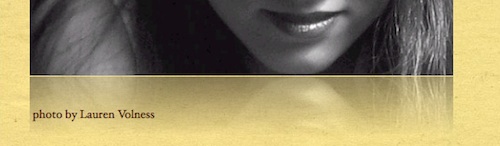
You might take some time to visit (as I did) the web site of writer Angélique Jamail, if for no other reason that to have your breath taken away by a smile and a frank stare as captured by the lens of Lauren Volness. I love black-and-white photography, I love its textures, I love its air of verité, and I love the way it makes me digress from the matter in hand.

I also love web sites that are clean but at the same time fill and delight the eye. There is something about dark red papyrus font on faded yellow, there is something about the empty, brown sidebars, there is something about the fussy, intrusive design of leaves that says ‘some is plenty’. The internal detail is personal and informal, yet to the point. It can sometimes be intriguing – “What’s the tab which says ‘RRFP’?” I asked myself. Apparently it has something to do with black and white, and a single accent of red, and if you want to know more, then visit. You will want to hear her poetry…

Gypsies, ‘… a loosely plot-driven collection of poems about jumping off from traditional toeholds and clinging to the air around you until you find a new niche.’

Barefoot on Marble, ‘orphan poetry, mermaid lit., and the poet’s impressions as more eras end.  These are lizards and prophets crawling up your house; these are lovers better left unmet; these are moments of great undoing; these are phoenixes, too.’

… and you will ache because none of it is there. But hurry, there is still time to buy a book!

There is a link to her blog, ‘Sappho’s Torque’, which is a different kettle of tuna altogether. It’s a blog, an honest-to-God blog, an it-does-exactly-what-it-says-on-the-tin blog, and that’s why I like it so much.

Have you ever come across poetry that you wish you had written, simply because it sits a camera on the sideboard of life, runs to the other side of the room, stands there, and grins? Have you ever come across poetry which, far from making you wish you had written it, makes you vividly almost painfully aware that you could not ever have had the precise experience of life to have written it? The following poem is one of the latter.

Recipe for My Daughter
Copyright © 2011 by Angélique Jamail

When the pita dough does not rise, throw it away,
remembering that yeast and flour are cheap,
and start over again on a day without rain.

When you become seven years old, you will be given
a new pair of tiny scissors, with which you will snip
the leaves from ten bunches of parsley, taking care

to keep the stems from the great silver bowl,
while your mother chops the tomatoes and onions.
When you manage this despite the nauseating

abundance of parsley, you will be allowed
to mix in the bourghoul. When you hollow out
the yellow squash, measure the tender rind so

your fingernail does not puncture the tiny gourd.
When you roll the grapeleaves, count twenty
per guest, and remember a pinky’s length of lamb
and rice is plenty. When you boil them

in the enormous pot, lay a dinner plate
on top so that the roiling does not unroll
your tightly wound creations.

When you learn to make bat’lawa, be careful
to paint the melted butter across every thin sheet
of filo separately. When you grind the pistachios,

try not to scrape your knuckles on the glass
each time you crank the lever around.

When the bread finally rises, you will sit upon
a wooden chair in front of the lower oven and announce
its brief inflation as if every puffed-up loaf were
the messiah. When it comes out of the upper oven,

flat again with a pocket, spread butter and grape jelly
on it and eat it so hot. When you are an adult,
you will remember this smell as joy.

When you have become good enough,
you will not have to measure anything ever again.

When you grind the lamb for kibbe, reserve some
to sautée with pine nuts for the hashwe, and run the rest
through the grinder twice more with onions and
bourghoul. When you have a craving for kibbe niya,

make it yourself and eat it the same day home from
the butcher, and bless the dish before you pour the olive oil,
because raw meat is not a thing to trust to just anyone.

When your son brings home an American girlfriend, admonish
his brothers for slopping it out in galoptious mounds
at her first dinner with the family.

When your daughter-in-law first opens her home to you,
bring her a great silver bowl, a new embroidered cloth,
a carton of sea salt, and a bulbous

witch doll to hang over her sink. When you take
the lemony, warm spinach pies to school for lunch,
you will not have to share them with the other children,

and one day you will appreciate having had them all to yourself.

A reader’s reaction to ‘Lupa’

Lupa is the story of two fearless fighters, two She-Wolves, perhaps the avatars of the same wandering spirit, whose destinies become aligned through the mirror of time and dream. The set of the two plots, none other than the Eternal City, casts its many shadows and symbols on both stories.

I came upon this book quite by accident, while perusing the poetry section of a blogging site. The author’s compelling poetry made me very curious about what her blog announced as her first novel and, indeed, I was not disappointed.

Marie Marshall’s sharp writing has a wolfish brutality to it that masterfully shape-shifts to raw emotion in Lupa‘s fighting scenes.

Unlike Hesse’s Harry Haller, the main characters not only accept but seek out the totemic wolf within.”

Dee and Boleyn

I have sought solace in reading psalms and in prayer, but nothing avails, except perhaps my dreams; and so I seek sleep, and hasten each day with pacing to and fro, as though I could not wait for the end. My mother called such behaviour wishing my life away, but would not laugh if she could see me here.

Each night I hurry to my bed, earlier and earlier, eager to enter a world of shadows and strange colours, and to find the answers to questions which perplex me, and any other whom I may ask, during the dubious hours of waking. Yet some nights are vague, and I may startle awake with a cock-crow or a bursting-in of sunlight, to remember nothing. Or again, I may lie upon my back all night, sleepless, and with my fists balled; the days that follow are drowsy and tedious, but the little sleeps between the visits of those who attend me are sans dreaming. I could read; I have many of my beloved books around me, but am without inclination these days, except for the psalms, with their illuminations – the blood of the whiplash fish, weathered green copper, gold-leaf. My constant prayer has been let me read the book of my dreams.

I recall the third night I was ever in this room. It seemed as though I was snatched from making out the shadows on the ceiling into another world. I was a child again, in a gown of green velvet, the hue of the under-side of leaves in high summer, and a gable-hood of the same. I was upon the London River, in a barge that slipped silently against the stream with the aid of neither sail nor oars; I was attended by silent servants in tabards that matched my gown. I enquired where we were bound for, and none would lift his head, save one who eyed me and looked away, and spoke in French.

Au Lac de la Mort, Maitresse.”

To the Lake of Death – and this puzzled me, for I knew of no such place on the Thames, but only of a hamlet that had grown around a stream filled with silver salmon, for that was the place where the barge glided to the shore, and where I stepped out onto the bank. And it seemed that at the moment my toes touched the land, I was in a great hall. Everything was tall – the people in it, the tables and the chairs, for I was an infant in this dream, to whom the walls of a chamber are as great as an oak or the flank of a galleon. And this hall was filled with books, shelved against every wall. Not one window was there here, but light was given by candles, some upon tables, some on the floor, some even upon a pile of books. Between the furred skirts of the gowns of the men who gathered in the hall, I could see only a little of the tables around which they clustered. From some, charts and scrolls spilled; upon others I saw browned skulls and thighbones, bottles of dark liquids, a still but evil-faced raven which winked at me, and other objects nameless and beyond description. As I walked by them, some of the men turned their heads to look at me, and I felt my face burn in their gaze; others conversed with each other in whispers and mutters, and two or three stretched their hands over some object and intoned in a language I did not recognise. One I saw exchange gold coins for a leather pouch that seemed to move, as though it contained a frog or a mouse.

At the far end of the room, upon a sort of dais, an old man sat, as though enthroned, and it was towards him that I walked. If I looked away for a moment he seemed, from the corner of my eye, to be a boy of twelve or thirteen; but always when I looked directly at him he was venerable, white-bearded.

There was an impatience in his face, as he leant forward and beckoned me, as though he had news of great import, or some secret to tell me. But in the moment that he drew breath to speak I awoke, and was here in my prison again.

“Where is a Joseph or a Daniel who will riddle me this?” I thought.

That was the first time I met the old mage in my dreams, for indeed he seemed to be a philosopher or magician of some sort; but since that night I have met him often, walked with him through the strangely silent streets of London or the garden of Hampton Court, where we stopped to look at the great clock. I swear I saw the hands whisk through the hours and the moon-phases faster than the wheels of Phaeton’s chariot. Sometimes in my dreams he was struck dumb, sometimes I; at other times he spoke to me only in a language I could not understand, and grew angry because I did not answer. At other times we conversed.

“Do you know me, Lady?” he asked once.

“Certainly,” I replied. “You are the old magus whom I meet here in my dreams.”

“But do you know my name, Madam?”

“No, I do not.”

“I shall write it for you,” he said, and stooped to trace it in the dust with his finger. At this I shuddered, for it seemed blasphemous to imitate a gesture of the Saviour thus – hoc autem dicebant tenantes eum, ut possent accusare eum, Iesus autem inclinans se deorsum, digito scribat in terra. Even more so did what the old man wrote upon the ground, for it was more a picture or a sign than a name. A circle, which could have been his face or the sun’s, with a single eye in the centre; crescent horns surmounted the face, and could have been the moon; from a stick-like body, two arms protruded, in mockery of our Lord upon the cross; the whole figure squatted upon the ground, it’s knees drawn up, and its legs bowed.

“This is all-in-all,” he said to me, and seemed to be pleased with what he said, and to ignore my look of horror.

Three nights ago I looked for him once more, but in my dream I stepped into my husband’s closet, seeking my book of psalms. My lord was there, and I spoke to him, simply saying his name once.

“Henry?”

I reached out my hand, but did not dare touch him. He seemed to hear me, and inclined his head, with a look of sudden irritation on his face. He said nothing, but continued what he had been doing when I entered – picking up books and leafing hastily through them as though searching for something.

Upon his table I saw my own book of psalms, and picked it up. But it was false – the cover of my book held pages of crabbed writing, little of which I could make out, except for the names of sundry angels. Then I came upon a page which had the symbol drawn by the mage in the dust, and I knew that this book was his. I put it down quickly, and my hand moved to another book, mutilated and coverless. That was mine, my poor little book of psalms in French, which I now opened to read, for solace. Quand je marche dans la vallée de l’ombre de la mort, Je ne crains aucun mal, car tu es avec moi… My eye was drawn from the holy words to the bright images upon the facing pages, which were unfamiliar, and bore such names as La Reine de Deniers, and La Reine d’Epées, as though the songs of King David had become a game, or a medium for scrying. I can recall no more of that dream.

Two nights ago I met the mage again, and he showed me the court of a great queen whom all feared and loved. She was enthroned, and clothed in a white gown on which pearls had been sewn with golden thread. She had my hair, and my eyes; but those eyes were full of loneliness past bearing.

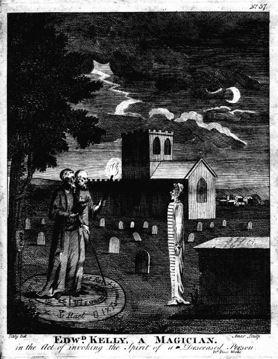
Last night I dreamed yet again. I felt myself drawn to a place where the mage stood, with another old man. They were huddled together, standing on a spot where strange devices had been scored upon the earth, as though the perimeter of the devices protected them from some evil or force beyond their control. I approached them as though through mist, or through the hall where I had first encountered the old man (though now it seemed plundered and ruined), all becoming clearer as I came close to them. At last I stood before them, a hand’s reach away, but outside their magic circle. The old man spoke to his companion.

“Strike with your staff upon the point of the heptogram, Master Kelley, and make it speak.”

At this, a look of annoyance passed the other’s face.

“I am known as Talbot now, and not by my old name. How many times do I have to say so before you remember!” He turned his eyes towards me, and drew himself up, rapping three times upon the ground with his stick.

“Speak, spirit,” he said. “Speak or be returned whence you came, and shut again in your arrow-chest. Speak, I command, in the name of an holy Power!”

“Whom do you command to speak?” I said. “I speak or do not speak at my own will, not yours. I say what is in my heart and mind, when it pleases me to open my lips. I am not bidden by anyone to speak or to stay silent, to come or to go.”

My old mage – I now thought of him as somehow mine – smiled a little, but the other became agitated, and struck again several times with his staff.

“I charge you to speak,” he barked. “Are you from Paradise or from eternal fire?”

“If you rap much harder on the ground,” said my mage. “You will find out first hand, as we shall fall through and into hell ourselves!”

“Paradise or flames?” I said. “A room in the Tower is not Paradise, though it is comfortable enough for a while; nor is it hell, for all its dreary solitude. Rather say it is purgatory, as it affords much opportunity for reflection and repentance!”

“Speak not in riddles!” cried the other. “But answer plainly, I charge you, by the angels!”

Patient now, my mage interjected, “Peace, Master Kelley; I know her, I know of her – she speaks what she thinks is true. She knows naught of heaven or hell, but lies where she lies, with her last memories, waiting for the graves to give forth their contents.”

“Master Dee, you may have traveled much, you may have been to Bohemia, and to Poland (where, I have heard, men have tails), but in these things you are ignorant. She is a spirit, and as such she has seen things you and I have not. And she is bound by the enchantment and invocation I have made, to tell us the truth. This fiddle-faddle she gives us is but her resisting my power, and it cannot last.”

“I know nothing of spirits,” I said. “Except that Saul was damned for causing one to be conjured up. I am none such. I am a queen, albeit one cast down. And Master Kelley or Talbot or whoever-you-may-be, you would be well advised to address me with more deference, and indeed to desist from your imagined conjuring.”

At this moment, my old mage turned eyes on me that held more pity and kindness than I had ever seen in him. There was such sorrow in his voice, when he spoke again.

“Master Talbot, it is clear to me that she is telling you the truth, though you cannot see it. Madam… Mistress… Your Majesty… “

His voice faltered, as though he had something difficult to say.

“Can you tell me where your favourite French headdress is at this moment?”

“Certainly, sir,” I replied. “I have it in my hand.”

“Madam, you have more than your headdress in your hand.”

At that moment, in my dream, I saw his meaning clearly –though I knew not with what eyes I saw that which I saw, for my own eyes looked up at me – and I screamed. My scream was choked by my awakening. Dreams are beyond fathoming, the pictures they paint are strange, their meaning is deep and often unholy…  and it is now today.

There is my gown, and my headdress; there also is my little book of psalms in French, undesecrated. I will wear my gown and my headdress today, and carry my psalms with me when I walk outside. I already have in mind what I will say:

Good Christian people, I am come hither to die, for according to the law, and by the law I am judged to die, and therefore I will speak nothing against it. I am come hither to accuse no man, nor to speak anything of that, whereof I am accused and condemned to die, but I pray God save the king and send him long to reign over you, for a gentler nor a more merciful prince was there never: and to me he was ever a good, a gentle and sovereign lord. And if any person will meddle of my cause, I require them to judge the best. And thus I take my leave of the world and of you all, and I heartily desire you all to pray for me. O Lord have mercy on me, to God I commend my soul.

But as I kneel, and before the swordsman scythes my head from my body, I shall think of my old magus. Then I shall breathe a short, Plantagenet prayer, and hope that my daughter, who has my eyes and my hair, will never be a queen, but will live her life a country lass, safe at home. For the burden of queenship is too heavy.

One Day in High Park, Toronto


Flash fiction – One Day in High Park, Toronto.

I was sitting on a bench, reading – hardly noticed the man, hand-in-hand with a boy. Both were dressed in black pants and white shirts, and the man had a black hat of woven straw. “Old Order Mennonite – what are they doing in town?” I mused momentarily.

They had been talking quietly, but suddenly the man raised his voice, still gentle in tone.

“No, Karl, that’s not true. You’re lying to me. I can’t allow that. You’ll have to take your punishment.”

“Yes, Dad.”

“Shall we get it over with now, rather than later?”

“Yes Dad.” The boy reached and rolled up the legs of his pants as far as they would go. The man bent down behind him and slapped him on the back of each calf, then slapped him again.

“Hey! Hey!” A guy in t-shirt and jeans, came from behind where I was sitting, vaulted over the end of my bench, and barged the man away from the boy.

“Pick on someone your own damn size!” he said, swinging a punch which caught the man on the right cheek. Down he went, and sat on the ground, hat awry, face bleeding. The t-shirt guy stood over him, fists balled.

After about fifteen seconds he got up, dusted himself off, straightened his hat, and looked at the t-shirt guy. He said nothing, but seemed to angle his left cheek a little, as though inviting another punch. Then he turned to the boy.

“Punishment over, Karl.” He said. The boy rolled his pants legs down, and came over to hold his father’s hand. “Shall we get some ice-cream?”

The boy grinned. “Yes please, Dad.”

They walked away, and the t-shirt guy stood, hands on hips. “Well… I… should… fuck… a… pig!”

I said nothing – I had a good book.

So, what’s it like to be an editor, Marie?

It’s interesting and demanding. The current task is the penultimate read-through of the first volume of The Phoenix Rising from the Ashes. The final selection process is complete, all the selected sonnets have been included, the Preface and the Introduction have been written. Now the time has arrived for us – the editorial team – to go through the final draft with a fine-toothed comb to see if we can spot any typographical errors. As we are an international panel, we have been warned not to correct British/American/Canadian English, so Associate Editor A has to do us the favor of leaving ‘neighbour’ as it stands, and Associate Editor B has to do us the favour of leaving ‘neighbor’ as it stands! Once we have completed this task (which we have to do by the middle of November) we will await the Master Copy, and we will proof-read that. We hope that the next copy we have to read after that will be the printed copy!

Being an editor or part of an editorial team does bring kudos with it, but let no one imagine it’s a sinecure

Words as ‘irreclaimable vagabonds’

On an old website of mine I had the following passage from an essay by Virginia Woolf. It is an extract from a talk she gave on BBC radio on 29th April 1937. Nothing remains of the talk except for this unique recording of her voice and the transcript below. I wasn’t the first person to do this and I won’t be the last. I’m not reproducing this because I accept VW’s argument, but simply because it is wonderful to read the words and hear the voice of such a writer…

…Words, English words, are full of echoes, of memories, of associations. They have been out and about, on people’s lips, in their houses, in the streets, in the fields, for so many centuries. And that is one of the chief difficulties in writing them today – that they are stored with other meanings, with other memories, and they have contracted so many famous marriages in the past. The splendid word “incarnadine,” for example – who can use that without remembering “multitudinous seas”? In the old days, of course, when English was a new language, writers could invent new words and use them. Nowadays it is easy enough to invent new words – they spring to the lips whenever we see a new sight or feel a new sensation – but we cannot use them because the English language is old. You cannot use a brand new word in an old language because of the very obvious yet always mysterious fact that a word is not a single and separate entity, but part of other words. Indeed it is not a word until it is part of a sentence. Words belong to each other, although, of course, only a great poet knows that the word “incarnadine” belongs to “multitudinous seas.” To combine new words with old words is fatal to the constitution of the sentence. In order to use new words properly you would have to invent a whole new language; and that, though no doubt we shall come to it, is not at the moment our business. Our business is to see what we can do with the old English language as it is. How can we combine the old words in new orders so that they survive, so that they create beauty, so that they tell the truth? That is the question.

And the person who could answer that question would deserve whatever crown of glory the world has to offer. Think what it would mean if you could teach, or if you could learn the art of writing. Why, every book, every newspaper you’d pick up, would tell the truth, or would create beauty. But there is, it would appear, some obstacle in the way, some hindrance to the teaching of words. For though at this moment at least a hundred professors are lecturing on the literature of the past, at least a thousand critics are reviewing the literature of the present, and hundreds upon hundreds of young men and women are passing examinations in English literature with the utmost credit, still – do we write better, do we read better than we read and wrote four hundred years ago when we were un-lectured, un-criticized, untaught? Is our modern Georgian literature a patch on the Elizabethan? Well, where are we to lay the blame? Not on our professors; not on our reviewers; not on our writers; but on words. It is words that are to blame. They are the wildest, freest, most irresponsible, most un-teachable of all things. Of course, you can catch them and sort them and place them in alphabetical order in dictionaries. But words do not live in dictionaries; they live in the mind. If you want proof of this, consider how often in moments of emotion when we most need words we find none. Yet there is the dictionary; there at our disposal are some half-a-million words all in alphabetical order. But can we use them? No, because words do not live in dictionaries, they live in the mind. Look once more at the dictionary. There beyond a doubt lie plays more splendid than Antony and Cleopatra; poems lovelier than the Ode to a Nightingale; novels beside which Pride and Prejudice or David Copperfield are the crude bunglings of amateurs. It is only a question of finding the right words and putting them in the right order. But we cannot do it because they do not live in dictionaries; they live in the mind. And how do they live in the mind? Variously and strangely, much as human beings live, ranging hither and thither, falling in love, and mating together. It is true that they are much less bound by ceremony and convention than we are. Royal words mate with commoners. English words marry French words, German words, Indian words, Negro words, if they have a fancy. Indeed, the less we enquire into the past of our dear Mother English the better it will be for that lady’s reputation. For she has gone a-roving, a-roving fair maid.

Thus to lay down any laws for such irreclaimable vagabonds is worse than useless. A few trifling rules of grammar and spelling is all the constraint we can put on them. All we can say about them, as we peer at them over the edge of that deep, dark and only fitfully illuminated cavern in which they live – the mind – all we can say about them is that they seem to like people to think before they use them, and to feel before they use them, but to think and feel not about them, but about something different. They are highly sensitive, easily made self-conscious. They do not like to have their purity or their impurity discussed. If you start a Society for Pure English, they will show their resentment by starting another for impure English – hence the unnatural violence of much modern speech; it is a protest against the puritans. They are highly democratic, too; they believe that one word is as good as another; uneducated words are as good as educated words, uncultivated words as good as cultivated words, there are no ranks or titles in their society. Nor do they like being lifted out on the point of a pen and examined separately. They hang together, in sentences, paragraphs, sometimes for whole pages at a time. They hate being useful; they hate making money; they hate being lectured about in public. In short, they hate anything that stamps them with one meaning or confines them to one attitude, for it is their nature to change.

Perhaps that is their most striking peculiarity – their need of change. It is because the truth they try to catch is many-sided, and they convey it by being many-sided, flashing first this way, then that. Thus they mean one thing to one person, another thing to another person; they are unintelligible to one generation, plain as a pikestaff to the next. And it is because of this complexity, this power to mean different things to different people, that they survive. Perhaps then one reason why we have no great poet, novelist or critic writing today is that we refuse to allow words their liberty. We pin them down to one meaning, their useful meaning, the meaning which makes us catch the train, the meaning which makes us pass the examination…

So interview me…

… and they did! A consequence of being published is that one becomes an object of interest and attention. In the past week I have given two interviews, one of which was to a magazine which has interviewed such writers as Minette Walters and Bernard Cornwell, so I’m in fine company. I’ll give you more news as it happens.