
It occurred to me a long time ago that there are only two important factors in art – our expectations and the artist’s intentions – all else is subordinate. The extent to which one governs the other has been fluid over history. It is worth remembering that Théophile Gautier’s expression of autotelicism, “L’art pour l’art”, was a manifestation of a 19c movement, and therefore is less than two hundred years old. It is a blink of an eye in the history of art. However, it was an important movement, because it liberated the artist, more than any previous shift of influence, from the demands of patronage.
When we look at the 14c depiction of the Paleologue Emperor Theodore Metochites on the wall of the Church of St. Saviour in Chora, we are not looking at the work of an inept artist, simply because the stylized mosaic is not realistic to our eyes. Here the artist has created exactly what his Imperial patron asked for, and the priorities of the work radiate to us. The Emperor, his orientalism expressed in his turban and brocade robe, his power expressed in his senatorial beard, kneels before an austere Christ. In the potentate’s hands is a building, rendered model-sized – it is the Church that he had restored, and in which he was to end his days as a monk – which he offers to Christ. In his turn, Christ looks out at us, two fingers half-raised as if about to bless. We are meant to see piety, to appreciate holiness, and to feel awe. These are the semiotics of this type of Byzantine art.
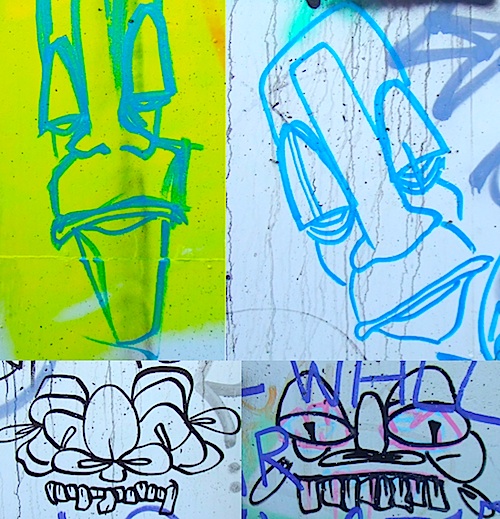
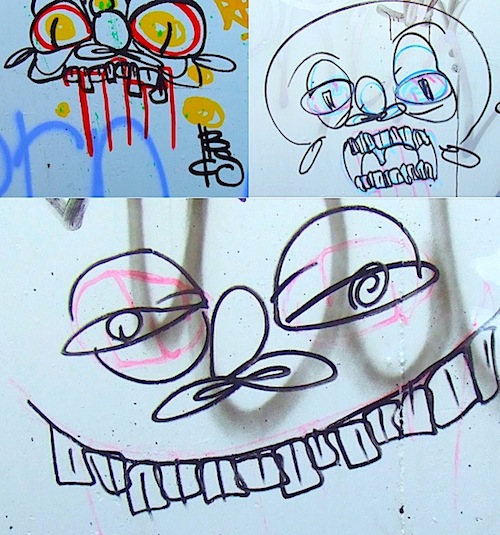
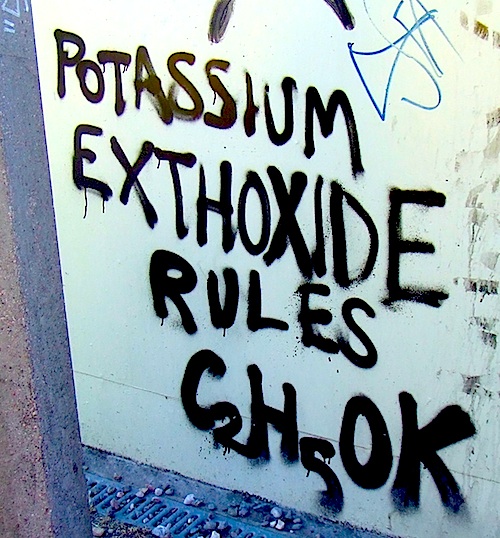
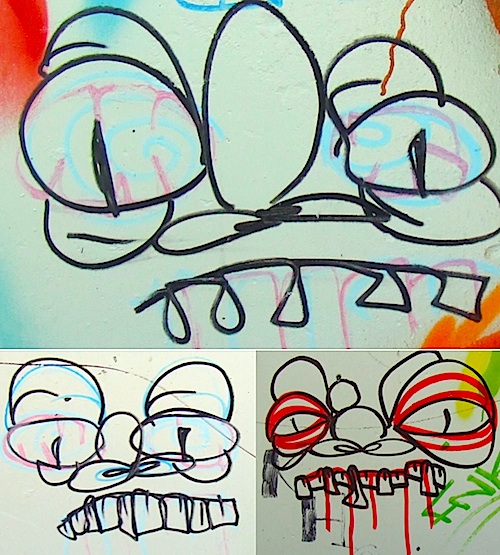
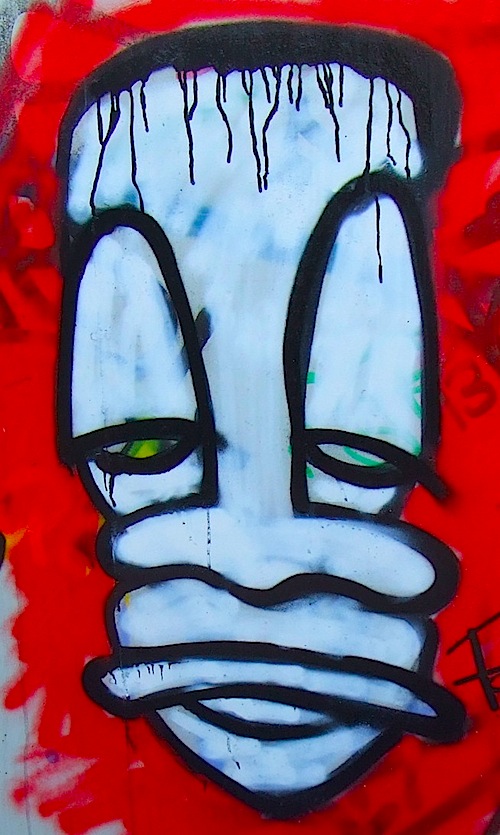
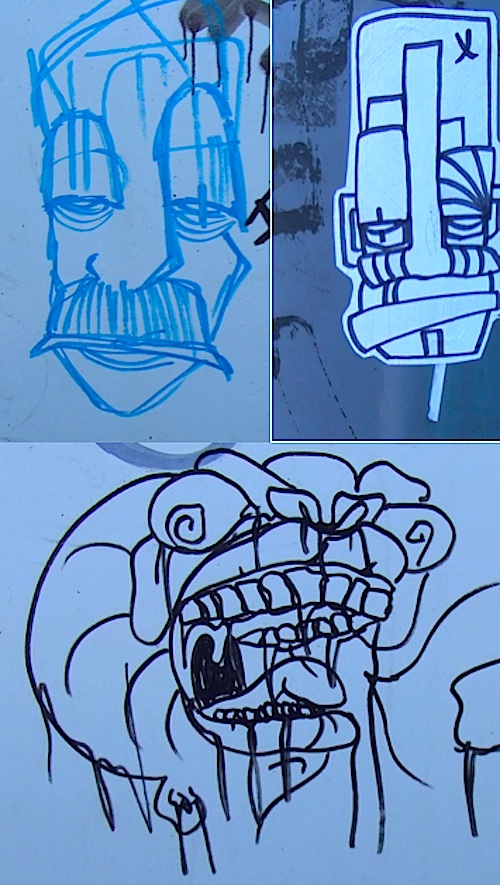
 The fact that the image is already eight hundred years old reinforces the knowledge that it comes from a culture which had a sense of eternity. By contrast, an image hastily rendered in dripping spray-paint is ephemeral. The grotesque graffito of a face on a wall in Dundee was never meant to last – it leers at us for a while and is gone. I think even the wall has gone now. It comes from a culture which acknowledges and appreciates the throw-away. A very brief scan of both works of art suggests that if we took both artists we could train each of them in the use of perspective etc. and produce two adepts of photo-neo-realism. But why should we? What business is it of ours to demand that either should subscribe to our idea of what art ‘is’?
In 1907 when Pablo Picasso was midway through a birds-eye view of a group of prostitutes lounging on a bed, he was suddenly seized with the notion of incorporating a distorted version of an African mask into the picture, and two of his Demoiselles D’Avignon have markedly less realistic faces than the others. Modernist engagement with ‘the primitive’ was an exciting development in Western art. The fact that  they got African culture(s) badly wrong, failing to see the sophistication of its art, is almost irrelevant to the dynamism of the movement. We do get it wrong when we look at things from outside our culture; by and large that can’t be helped.
Thus when we see a work of art that is eight ninths vandalism of public property, it is very likely we simply get it wrong. After all, the culture from which it comes is arcane to us, with our bourgeois standards of behaviour and taste, and our own semiotics. It could be instantaneous, yes, almost mindless. It could be a deliberate negation of the whole concept of ‘public property’ and therefore some kind of political manifesto. It could be a personal expression of angst, pain, or terror It could be part of an intricate sub-culture which we do not recognize and whose semiotics are beyond us. We may one day learn  what is going on, we may not. However, thanks to Gautier and his contemporaries, we are no longer able to impose our tastes and our expectations, beyond saying whether we like something.
Or are we? An aspect of post-modernism seems to throw the ball back into the court of the onlooker, the reader, the consumer of art. In 1968 Roland Barthes published an essay entitled ‘The Death of the Author’. Rather than restore supremacy to the tastes and patronage of a privileged class, however, Barthes’ emphasis was on the interpretation by those before whom art comes as part of the continuing creative process. Therefore the modernists’ hash of ‘primitive’ Africanism could benefit from a reprieve; moreover, our own appreciation for something splashed on a wall gives it wings – perhaps – beyond its artist’s hoped-for flight. I would say we are nevertheless no longer able to damn something as ‘not being art’, or to scorn it because of the demographic from which it springs or because we find it hard to fathom or unpleasant. Art has long since become something with fewer imposed limits, if it has any at all.


 Some of my other poetry from this book was featured at the ‘




 Marie Marshall