Marie Marshall

Author. Poet. Editor.

Tag: fiction

How Tam o’ Shanter came to be written – a tale for Burns Night

detail of Faed's Tam

Was it a year ago now, since last we piped in the great chieftain o’ the pudding race, that we raised an amber dram, that we all gave a hearty slainte mhath! There was one braw lad whose eyes were twinkling with glee and single malt, who rose and recited – without a prompt – the auld tale of Tam o’ Shanter, the skellum the blethering, blustering, drunken blellum. Aye, aye, and how we laughed, how we all chorused “Weel done, Cutty Sark!” And how we cheered on old Tam was he whipped Maggie his mare towards Doon Water and the Brig, held our breath at the last loup of Nannie the witch to grab the mare’s tale as Tam won to the key-stane o’ the brig, and yes, how we let it all out with a big gasp when he was hame and free. More, how we winked and smiled and nodded at each other when our impromptu Makar wagged his finger and said:

Noo, wha this tale o’ truth shall read.
Ilk man and mother’s son, take heed;
Whene’er to drink you are inclined,
Or cutty sarks run in your mind,
Think! Ye may buy joys o’er dear –
Remember Tam o’ Shanter’s mare.

Aye, aye, and we clapped and cheered of course, and shouted out, “More! More!” – and of course there is no more, for no one, least of all our national Bard, ever wrote The Further Adventures of Tam o’ Shanter. But of course the moment passed, and then someone got up and sang My Love Is Like A Red, Red Rose to which we all listened in silent transport, some of us with our eyes upturned in wistful sadness as we remembered the Joes and Jeannies of our youth. And at the end of the evening we all declared “A Man’s A Man For A’ That” as we shook each other by the hand.

That was a night, but then it always is, isn’t it.

Look, let me tell you something I heard. How Tam o’ Shanter came to be written. The tale may surprise you for many reasons. I heard the story from someone, and they heard it from someone in Ayr who heard it from someone in Mauchline who heard it from someone in Tarbolton. And that person from Tarbolton heard it from his grannie, and… well, you get the picture. Each one swears that it is a true story.

Firstly you must forget Alloway Kirk and the Brig o’ Doon. The story didn’t happen there. Imagine instead a man riding slowly along a country road, on his way to his farm at Mossgiel, his mare plodding hoof-after-hoof, he himself in a sober brown-study – aye, sober! No drunken blellum he, but a serious, sullen, frowning man, a young man who would have been handsome but for his scowl. He has come from a Lodge meeting in Mauchline where he had been passed over for advancement to one of the Craft’s arcane and worshipful positions, and passed over in favour of one more lately come to the brotherhood. However, remembering that concord should prevail amongst Brother Masons, he had transferred the resentment in his mind to other things. We may suppose his thoughts to have run somewhat along the following lines:

“Farming is a business for fools and dullards. Nothing good ever came out of a farm. Let my brother Gilbert work the farm to his heart’s content, let him whistle behind the plough, let him sow and harrow and reap and stack, let him break his back on the hard work – I have done my share of labouring since I was wee, and enough is enough! I am a poet, and I am a good one, and I should be kent as one; but no one will buy my verses. My curse on all publishers. How good it would be if there was some agency, natural or supernatural, by which poetry appeared in print on its merit alone, and did not depend on the whims and low tastes of publishers. Ah, and if I was mair kent then the lasses would look upon me and love me. Finding a love would be less of a trial and more of a sport.” And so on, and so on.

This resentment smoldered and kept hot in his mind, to the extent that he missed his way. He turned left before Tarbolton Kirk when he should have turned left at Tarbolton Kirk, but as the evening darkened he was well past the loanings to Hallrig and to Spittalside before he realized his mistake. He found himself approaching a meeting-of-ways that he did not recognize as the gloaming-light faded. He looked about him, and his frown did not improve. He was about to turn his mare round and ride back towards Tarbolton when the sound of some music reached his ears from across a field. He turned his head towards where he thought the sound came from, and for a while he could see nothing; but then there was a faint, greenish-yellow, bobbing light, as though a torchbearer was picking his way across a field. Then the light became two lights, the two became four, the four eight, and so they multiplied until it seemed as though a procession of torchbearers wound its way along the further edge of the field. All the while there was the wail of small-pipes playing a slow air in time to which the torchbearers marched.

Then their torches threw light upon some old walls and ruined towers, and upon a dour, square house of stone. The marchers passed in and out amongst the buildings, touching their torches to flambeaux in sconces, to braziers, and at last to a great bonfire, and against all this light the young man could see those walls now as squares of oblongs of shadows.

“Why this must be the old monastery ruins and castle of Fail,” he thought to himself. “But surely there have been no monks here since before the days of the Covenanters, and surely also no one has lived at the old castle – if you could call such a meager block a castle – for generations, not since the ill-reputed Laird died while old King James was still a bairn. That’s more than two centuries syne.”

Curiosity now overcame the young man’s former emotions. He looped the reins of his mare round the limb of a tree, climbed over a low stone fence, and made his way cautiously across the field towards the light and the music. The small-pipes were playing a jauntier tune now, and voices were joining in, not so much singing as chanting to the rhythm of the tune. He reached the outer wall of the monastery ruins and carefully peeked around them. What he saw made his jaw drop. His first thought was to take flight – aye and it would have been better for him if he had! There was only one word to describe the beings who had marched to that place by torchlight.

Witches!

I know, I know, that’s not a word we are supposed to use these days for fear of offending someone. Och there’s aye something to keep us from speaking the truth! Let me say then that these wights, these nighttime revelers, were as far away from the honest wiccans and pagans of today as it is possible to be. They were further still from the old storybook witches with their pointy hats and flying besoms. There is no better way to say what they were if not witches and warlocks, except perhaps that “the earth hath bubbles, as the water has, and these are of them.” So profound their evil, so eldritch their craft, so obscene their practices, so loathsome the object of their worship, so deep, so dark, so full of mortal danger…

As with all true evil, however, there was something fascinating and beguiling about them, a web of enchantment that even they wove without being conscious of it. The impulse to flee that had briefly come upon the young man died as quickly as it had appeared, and was replaced by a stronger curiosity than had first lured him to that spot. He stayed, he watched, enthralled even as disgust rose within him to battle with the thrall. The throng of this conventicle – it must have been a veritable synod of covens! – milled around a stone table, an altar dark-stained and cracked. Onto it they placed the burdens, offerings and sacrifices they had brought with them, or other foul objects wrenched from the freshly-breached tombs within those ruined walls. The young man made a ghastly catalogue of them in his mind:

A murders’s banes in gibbet-airns;
Twa span-lang, wee, unchristen’d bairns;
A thief, new-cutted frae a rape,
Wi’ his last gasp his gab did gape;
Five tomahawks, wi’ blude red-rusted;
Five scymitars, wi’ murder crusted;
A garter, which a babe had strangled;
A knife, a father’s throat had mangled…

… and so on, and so on, you know them all as well as I do, I have no doubt. When these had all been placed in a horrid tangle, the piper struck up another tune, a lively reel, and the company began to dance. The young man could just make out the piper sitting in an alcove, seven feet or more up a wall. He was a darker shadow in the dark, as though the light from the fires and torches could not reach him. Yet still the young man could tell that the piper’s fingers worked and worked at the chanter of his small-pipes, and the tune that came forth was lively, almost cheery, though there was mockery in its cheerfulness. As the witches and warlocks danced around the great table, the young man felt his own feet tapping to the tune. The reel gave way to a jig, rattling skirls and triplets rippled from the pipes, and the ghastly crowd flung themselves into their dancing, panting, sweating, shedding clothes as they whirled. Tongues lolled, eyes glazed with madness, spittle flew from their lips as the tune changed again to a wild slip-jig. One by one the witches and warlocks began to fall in exhausted stupors or trances until only a handful were left dancing, all hideous hags – except for one.

Louping higher than the rest, whirling and spinning with an uncanny vigour, her eyes bright, her face shining in ecstasy, was a young lass, stripped to her brief petticoat. The young man could not keep his eyes from her, nor his lascivious thoughts from her bare legs, or from what else might have been scarcely hidden.

“I ken her!” The sudden thought came to him. “Damn me but I ken her! That, unless I am mad, is the daughter of Brother McDowell from Mauchline. Aye, it is, it is. It’s young Nannie. Nannie whom I met at McDowell’s house on two, no, three occasions last year. Why, she must be no more than eighteen years old – and she’s here at a witch’s Sabbath?” Then he began to recall the looks that Nannie had given to him during those three visits. When he had looked at her directly she had lowered her eyes demurely, but once or twice he had caught her looking at him, just a swift, sideways glance. Now the awfulness of the scene began to lose its effect on him. Instead he looked at Nannie and saw not a witch cavorting round a horror-laden altar, but a wild thing, a beautiful thing, a filly or a young deer springing from crag to crag, an object of lust… no, of love!

All the remaining dancers except for Nannie dropped to the floor, and propelled by some new insanity the young man dashed out from behind the wall, louped into the middle of the blazing light, and seized Nannie by her hands. For a time which might have been an hour or a second, they danced and louped together in a frenzy, more a single being than two. Then –

“Weel done, Cutty-sark!” yelled the young man. “Weel done, Cutty-sark!”

Whatever spell had bound them momentarily was shattered by those words. The piping stopped. All was silence. Nannie crouched like a wild cat waiting to spring, her eyes no longer shining with the pleasure of the dance, but hard, dark, feral. All around him the exhausted witches and warlocks propped themselves on their elbows as though about to rise. Some eyes turned to the alcove where the piper sat. The young man stood, wishing he could cast a line around the seconds that had just past, haul them in, make it so they had never happened. In that moment of great peril, while all was yet still, he took hold of his chance, turned, and ran!

As he sped across the field it was only terror that made him turn his head to look behind. He caught glimpses. Witches and warlocks all in a guddle, tripping over each other in their haste, some grabbing knives and hatchets from the altar, some already running after him. At the head of the pursuit was Nannie, the hands that he had held in their dancing stretched before her like claws. No more tripping and stumbling now, they were all after him, Nannie in the van and the dark piper at the rear. The young man threw himself onto his mare’s back, whipped her and kicked her flanks with his heels, and she started away with less than a heartbeat to spare. Off she galloped, her hooves clattering on the road, the shrieking mob of witches and warlocks after her. Man, man could they run! Their devilish zeal, their anger at the disruption of their Sabbath giving them the strength and speed of a pack of hounds.

Wildly the young man rode towards Tarbolton, sometimes seeming to outdistance his pursuers, sometimes losing ground. At the outskirts of the little town, in a panic and instead of going straight on for the safety of the kirk, he slewed his mare sharply to the left and took the Mossgiel road. Och that was a mistake, as his pursuers simply louped over the hedges and fences and cut the corner. As he rode hard for the bridge over the Water of Fail they were almost upon him.

“Come on, Maggie, come on!” he yelled at his mare, and at last they won and barely passed over the key-stane o’ the brig!

Folk will tell you that neither witch nor warlock can pass over running water. It simply isn’t true. Witches and warlocks can pass over running water as well as you or I. Man and mare’s victory in this particular race was of no effect, for Nannie sprang and grabbed hold of the mare’s tail. The mare pulled up short, and the young man was thrown onto the hard ground, the wind knocked out of him. The next thing he knew was that he was surrounded by that horrid crew, and moreover Nannie was kneeling on his chest, her hands at his throat, her nails like talons digging into his flesh.

“Weel, weel, Rabbie ma doo,” she said, a grin twisting her beauty. “D’ye loo me?”

Oddly, even though he had never been so fearful for his life and for his immortal soul, the young man’s immediate thought was one of irritation. “Damn it,” he said to himself. “No one has called me by that diminutive since my late mother! Is this quine going to insult me before she kills me?”

Just at that moment the eldritch crowd parted, and the piper came and stood over him. The young man was expecting the Devil himself, and indeed that adversary might have seemed more comforting than the one who now looked down upon him. The fact that the piper was a lesser foe than Old McNiven, as we call the cloven-footed one, was not softened by the fact that he was as gruesome to look at. Let me say that he had the aspect of one who had lain a long time in his grave and who had been only lately and hastily disturbed. The young man looked at his grey skin stretched like old parchment over a wooden frame, at his eyeballs which were the colour of sour milk dribbled into ditchwater, at his lips which were eaten away to expose yellow-grey teeth, and he shuddered in total terror. The piper put his bony hands on his hips.

“Do I have the pleasure of addressing Master Robert Burns of Mossgiel, farmer?” he asked, his voice like rats’ claws on dead leaves, his breath stale and rank as the air of a disused charnel house.

“Aye sir, ye do,” answered the young man as bravely and politely as he could. “Do I have the honour of addressing Mister Walter Whiteford, late Laird of Fail?”

Very late,” said the piper, nodding.

“Would you be so kind as to entreat Miss McDowell here to leave go of me, or I fear I shall have no breath left to address you further.”

“Your having or not having breath is of purely academic interest,” said the piper, nevertheless motioning Nannie to get off the young man’s chest. “Tonight both your life and your immortal soul are forfeit, on account of the vanity and resentment I see in you, as well as for disrupting the business of our unholy Sabbath.”

“Wait, wait,” cried the young man, still prostrate on the ground. “Give me twenty years more life, only twenty, and I swear to you I shall turn this night into one of the best-kent legends. I shall write a poem that will make Nannie as weel-kent you are yourself, Laird of Fail. Give me another twenty years of life!”

The piper-laird laughed. “You are no Doctor Faustus to be asking such favours. I’ll give you seven for your effrontery!”

“Fifteen,” begged the young man. “Fifteen, for the love of God!”

“Twelve,” said the Laird of Fail. “For the love of Satan.”

“Done!” They spat on their palms, the trembling hand of the living shook the cold, desiccated hand of the dead, and there was a ghastly leer upon the face of the Warlock of Fail. The Laird looked around at his followers with something like a triumphant smirk on his face, and as they began to titter and to grab hold of Robert Burns’ arms and legs, the relief in the poet’s mind turned to fear and panic. “My God, my God,” he thought. “What have I done?”

The witches with a “One… two… THREE!” tossed him into the air, and he screamed!

The young man seemed to awake from a nightmare at that moment, for he found himself standing at Mossgiel in front of his own farm, holding the reins of Maggie the mare. Both were sweating. Both were shivering.

Well, he was as good as his word. It took some time but if he worked hard at nothing else he certainly put his soul into his poetry. He took his own folly out of the story, set it some miles away, and made the protagonist a drunkard, but apart from that the tale we know as Tam o’ Shanter became famous amongst all his famous poems. He had his treasure upon earth, and now he has statues and memorials, and pictures everywhere, and a special day set aside for us to celebrate him. But twelve years to the day after his mad ride from the old monastery and his bargain with the Laird of Fail, Robert Burns died. He was thirty-seven.

A reconstruction of the face of Robert Burns, from a skull cast made at the time of his death

A reconstruction of the face of Robert Burns, from a skull cast made at the time of his death

You want to know his fate? The fate of Scotland’s national bard is eternal fame, of course. The fate of Robert Burns the resentful brother, the philanderer, the father of illegitimate children, the falsifier of official records, the Freemason envious of those who should have been his brothers, good heavens the Excise Man? You want to know what happened to him? I can’t tell you. No, I won’t tell you. I shall however give you a hint. There was a tall, proud ship which bore the nickname by which he had called his young, unholy dancing partner. A few years ago – mark this well – it burned!

There’s a price to pay for everything, you see.

Sunset

sunset-ocean

In the days of the old British Empire, two colonial types were sitting on a Verandah somewhere in Malaya, sipping their pink gins and watching the day end.

The sun which during the afternoon had been a harsh and dazzling glare of white had consolidated to a disc of tangerine low in the sky. It rode on the horizon clouds, and its slanted rays turned the little breakers on the strand first to vanilla, then to lemon, then to copper. It kissed the far lip of the sea, sending a fan of reflections back across the miles of water. As that disc dulled to red and began to curtsey below the world’s edge, the sky faded from aquamarine to navy blue. Venus, in her peace and beauty, graced the sky by appearing at a wink, and, as if she were a herald, a million-million other stars were suddenly scattered onto the evening like diamonds onto an indigo velvet cape. Soon only a ribbon of red remained at the horizon. The sea’s lapping at the sand hushed to a repetitive whisper, the breeze captured the sudden scent of moon-seeking flowers, and the liquid notes of a bird’s call floated in from the plantation. Then the remains of sunlight evaporated with the last cloud, and a crescent moon was suspended away to the side of this heady panorama.

“Not bad, eh?” said one ex-pat to the other.

“There’s no need to rave about it like a ruddy poet, old man,” came the reply.

P’kaboo day at Glenstantia Library, Pretoria, SA.

(c) Lyz Russo

(c) Lyz Russo

The mini-launch in South Africa went off quite well. I was able to ‘join’ the proceedings by keyboard chat. The photo above shows the publicity table before the event began, with – yes! – Lupa on view there. My thanks go to Lyz Russo at P’kaboo for all the energy she has expended getting an event before Christmas. I’m told that there will be some more events in South Africa over the coming months, hopefully with Naked in the Sea and Mercury Silver featured also. Stay tuned.

If you happen to be in South Africa…

Lupa header temp

… on the 20th of December 2012, and you can get to Constantia Park Library, Pretoria, for 6pm, you will be able to attend a mini-launch of three books published by P’Kaboo Publishers. This will include my Lupa. Recommended – a book is always a good Christmas present, and a visit to a library is time well spent.

I mourn the passing of a blog today! Canadian poet Steve Myers – a totally unique voice – has left a farewell note on his now-empty blog. I am glad to see that he may still write, later, but sad to see that his future projects will not involve this medium, which even a technophobe such as myself acknowledges to be a remarkable tool for communication.

cartocom

Bang goes my next career move, then.

‘Mercury Silver’ and more interviews

(c) P'Kaboo Publishers

(c) P’Kaboo Publishers

There is a new anthology of short stories just released – especially for those of you with Kindle, and just in time for Christmas too. It’s called Mercury Silver, and you can get it from US or UK Amazon, or as a pdf direct from P’kaboo Publishers. It includes two of my stories, ‘Dragonslayers – a fable’ and ‘Memoirs of a Chief Replicator Technician’, the latter being a tribute to the late Gene Roddenberry. Other authors featured include Douglas Pearce, Emma L Briant, Leslie Hyla Winton Noble, Lois S Bassen, Lucy P Naylor, Lyz Russo, and Nick Legg. Check it out (as they say)!

I have been having fun answering some penetrating questions in an email conversation with Samuel Snoek-Brown. You may recall I interviewed him a while ago? Well, he repaid the compliment and the resulting interview is here. Also there’s a slightly lighter interview by Diane Tibert here. Enjoy both.

Lewis Grassic Gibbon’s ‘Sunset Song’ – a neglected classic.

I was recently loaned a copy of Sunset Song to read. The novel is the first part of a trilogy, collectively known as A Scots Quair, written by Lewis Grassic Gibbon. That is a pen-name, by the way, used by James Leslie Mitchell, an author who grew up in what was then Kincardineshire or ‘The Mearns’ in rural North-east Scotland, purely for this trilogy – he used his given name for his other work, his pen-name being a version of his mother’s maiden name. I was loaned it because (said the loaner) I would enjoy its literary qualities, its blending of Scots and English, and the anarcho-communist politics of its author, although the book does not wear those politics prominently on its sleeve.*

After I had read the book I applied the words above – ‘a neglected classic’ – to it. Not because it is neglected generally but because I had neglected it. in Scotland it is revered, it has been voted Scotland’s favourite novel and is in print at a host of publishing houses, as you can see from the handful of covers pictured here. Inasmuch as it documents vividly, truthfully, yet not without sentiment, the passing of the peasant class in rural Scotland, it is almost a work of social history as well as a novel. As we come closer to the centenary of the Great War of 1914-18, the event which, more than any, destroyed that class, the novel deserves reappraisal.

It is not necessarily an easy novel to get into. The register in which it is written is peculiar. A modern reviewer recently castigated it as being ‘badly written’ because of its overuse of conjunctions ‘and’ and ‘but’, its long sentences, and its peculiar syntax, dismissing the novel out-of-hand as boring and dull. Suffice it to say it’s neither boring nor dull, but its prologue is surprising. Before a reader is more than two or three sentences into it, he or she may become aware that this apparent mish-mash of folk-tale and history has the register of the Scots equivalent of a griot, the West African storyteller and reciter of genealogies. Where the ramble through the history of the Mearns community comes up-to-date, the register becomes gossipy, as though the doings of the inhabitants are being discussed over the garden fence. This was a departure from the expectations of novel-writing and narrations, and such departures were typical of the modernist period of literature**.

The four main chapters are given titles corresponding to stages in the agricultural cycle – ploughing, harvesting, and so on. Although the story is narrated, the central consciousness is that of Chris Guthrie, whom we see grow from childhood to young-widowhood. There are departures from her thoughts into the thoughts of others, often by Gibbon’s use of the confidential ‘you’ which places the narrator in the Mearns community and draws the reader into it also, but always and at the beginning and end of the chapters, it is Chris’s eyes we see through. Chris is a strong character, an intelligent young woman who could have broken out of her environment on account of her aptitude at school, but who chooses not to do so. Her staying gives an opportunity for the book’s point of view to be one of clear vision. Her insistence on being known as ‘Chris’, never ‘Chrissie’, gives her a toehold of independence in a society in which women are sexually and domestically subservient.

This is no rose-tinted novel. Life in the Mearns is shown to be harsh and hard. Sex is seen as a sociological driver. People are shown with brutal honesty as being mean-spirited and unwilling to speak well of anyone if they have a breath left to speak ill. The reader can sense that this is not a part of their character that Gibbon admires, but he is prepared to address it head-on, to describe all the small-mindedness and spite of the village gossips, all the brutality of the men without holding back. The prominence of Chris’s viewpoint, however, gives the novel an empathic gynocentricity which had critics at the time wondering about the gender of the author. However, Gibbon admires the way that, when the occasion demands it, these folk form and function as a community without giving it a moment’s thought.

There is another object of admiration. Chris’s father, John Guthrie, is portrayed as Calvinistic, tyrranical, brutal, and a prisoner of his sexual needs. Yet when he dies and is being buried, and the reader is heaving a sigh of relief, this moving passage occurs:

Someone chaved at her hand then, it was the gravedigger, he was gentle and strangely kind, and she looked down and couldn’t see, for now she was crying, she hadn’t thought she would ever cry for her father, but she hadn’t known, she hadn’t known this thing that was happening to him! She found herself praying then, blind with tears in the rain, lowering the cord with the hand of the gravedigger over hers, the coffin dirling below the spears of the rain. Father, father, I didn’t know, Oh Father, I didn’t KNOW. She hadn’t known, she’d been dazed and daft with her planning, her days could never be aught without father; and she minded then, wildly, in a long, broken flash of remembrance, all of the fine things of him and his justice, and the fight unwearying he’d fought with the land and its masters to have them all clad and fed and respectable, he’d never rested working and chaving for them, only God had beaten him in the end. And she minded the long roads he’d tramped to the kirk with her when she was young, how he’d smiled at her and called her his lass in days before the world’s fight and the fight of his own flesh grew over-bitter, and poisoned his love to hate…

I should point out that direct speech is rare in the novel, and where it occurs it is shown by italics. Here indeed we have those long sentences, rushing on, broken by conjunctions, but in this case it adds to the incoherence of the sudden realization of grief as suppressed memories of her father’s honesty and tirelessness, and even of a forgotten moment of affection between them, burst upon her. The gravedigger, his hand over hers, serves as a reminder of the good in her father – he is a silent almost-surrogate for her father in this scene. Chris’s anguished cry is almost a liturgical response to Christ’s petition for forgiveness on the cross. It is indeed the crux of the novel, and Gibbon’s bringing us to realise that not a monster but merely a man is being buried. The passage borders on sentimentality, but it is not maudlin. It is not the man John Guthrie that Gibbon admires, it is the qualities which are picked out in him in this and other passages. Here he stands for all the men of the Mearns – he works tirelessly, is rigorously honest, is rigorously egalitarian.

The passage is also interesting for its use of Scots words and hints of Scots grammar. This is typical of the book as a whole, and is evidence of Gibbon’s deliberate linguistic enterprise. His intent was to write in a way accessible to readers whose first language was English, but to enrich that English not only with the cadences of Scots but with a certain amount of Scots lexicon too. He did this with deliberation, out of the love of both languages and in the knowledge that one was effectively dying while the other was developing and strengthening. It isn’t an easy marriage. Scots is exclusively a demotic language, and the Scots of the Mearns is a dialect of it; Scots never had an official status even within the borders of its own land, was never the second language even of the Gaelic-speaking Westerners. This makes it difficult (not impossible) to use outside its historical and geographical context. However, Gibbon does make successful use of a selection of Scots words, the meaning of which is, to varying degrees, decipherable from the context. Gibbon did not want to include a glossary with his novels, but some editions do have one, which is of assistance. Less comfortable and to my mind a flaw in Gibbon’s execution of his scheme is his adaptation of some words into a faux-English equivalent. These stick out like a sore thumb for their etymological ineptness. I cite the following. ‘Brave’ for the Scots ‘braw’, the former being of Latinate origin and the latter Nordic, both having divergent meanings***. ‘Childe’ for ‘chiel’ meaning a fellow. ‘Quean’ for ‘quine’ meaning a young woman. ‘Blither’ for ‘blether’ meaning to speak or to converse, the former being an English word with connotations of delirious raving. Heaven alone knows why he made those particular lexical choices.

Despite this, the novel remains the preeminent evocation of the passing of the crofting way of life in the rural North-East. The final scene – the dedication of a war memorial at an old stone circle – records the names of the young men who would not be coming back to farm their smallholdings, and laments that their place has been taken by business-oriented farmers with an eye on profit at the expense of community.

I am currently reading through the sequels, Cloud Howe set in a large village or small burgh, and Grey Granite set in an industrial, coastal town. They are good books in their own right, but perhaps not as satisfying as Sunset Song. There is a sense of unfinishedness about them. Gibbon died at the early age of thirty-three. He did not live to see the Spanish Civil War, the Second World War, the establishment of the post-war Labour government with its National Health Service and other socialist projects, the fall of Stalin, the Iron Curtain, and the Cold War. Sunset Song has a resolution and closure that the other novels of the trilogy seem to lack, because it marks the passing of an old world; the others do not mark the beginning of a new. Nevertheless the trilogy is a landmark of the twentieth-century ‘Scottish Renaissance’, and Sunset Song itself a minor masterpiece. I would recommend it for anyone interested in Scotland, or in the history and literature of this country.

__________

* I am grateful to my agent – he is studying for a university degree in English Literature, and I get the backwash of his learning!

** It has to be said of modernism that it is not a unified nor easily defined movement, and that the writings of, say, James Joyce, Katherine Mansfield, Gibbon, and Virginia Woolf, to give a mere handful of examples, differ from each other greatly. One could more easily speak of ‘modernisms’ rather than ‘modernism’.

*** Here in Dundee we pronounce it ‘brah’, which is pure Swedish!

An Interview with Samuel Snoek-Brown

The difficulty with interviewing writer and teacher-of-writing Samuel Snoek-Brown is that his web site is so comprehensive that there is little left to ask. I’m reduced to quizzing him about the names of his cats. Sam is prolific, a non-stop writer, a daily blogger, a man of high, caffeine-driven energy. Amongst other things, aside from his writing, teaching, and speaking commitments, he is Production Editor of the amazing Jersey Devil Press, a small publishing outfit in the USA.

I caught up with Sam, by email, in between cups of coffee, and this is the result…

I guess you would say ‘Yes’ to this question without hesitation, but is it really possible to ‘teach writing’? Can you really take someone with – let’s be kind – no more than a modest talent, and, by instruction, make a successful writer out of them or at least someone who feels fulfilled in writing?

To the first part, yes, absolutely. But to the second part? That’s harder. I don’t think I can ‘make’ a successful writer out of anyone any more than I could ‘make’ any student successful in any field. I don’t view my role as teacher as a “maker” of students. I’m an usher; I collaborate in a student’s learning. There was a terrific article in Poets & Writers a couple of issues ago, in which Gregory Spatz tries not just to answer this question but to reframe it: he argues that the answer to the question is an obvious yes, and what we really ought to be asking is what happens when we do teach it. It’s a great article – people should track it down and read it.

But then there’s the last line of your question: can I help a student become ‘someone who feels fulfilled in writing?’ And yes, that I think I can do. And it’s not just about coddling or gladhanding writers. It’s about recognizing what they do well even if they don’t see it themselves, and then showing how to replicate that. That’s not easy to do – you have to make yourself into their sort of writer in order to know how to guide them in their writing – but I know it’s doable. When I was teaching in Wisconsin, I had a student who was an agriculture major in the most hard-core sense: the guy wore a uniform of heavy work boots and Carhartt jacket and John Deere cap; he proudly declared that his only reason for being in college in the first place was to learn how to take over his family farm from his father. He had no use for writing other than the credit it fulfilled in his degree. When I assigned the class to write about communities, he wrote about the farm, basic but beautifully pastoral essays about shovelling shit and harvesting beans. His essays weren’t perfect, but he worked hard and earned a solid B. And then he moved on, getting into the more important courses on agribusiness. But two years after he took my class, he surprised me in the hall outside my office. I smiled and shook his hand, thinking it was a passing hello, but he stopped me: he’d been looking for me. “I just wanted to tell you how much your class meant to me,” he said. “I ain’t gonna be a writer, but I never thought I could write. I’ve got some papers now in my other classes, and you gave me the confidence to write them. I’m doing okay – I even like my writing – and I wanted to thank you for that.”

In your opinion, what is the purpose of literature? How would you define ‘literature’ to start with? Does it have any obvious limits?

I used to be pretty snobby about the distinction between ‘literary’ and ‘non-literary’ fiction. In some respects, I still am: I just cannot give the same artistic weight to, say, Stephenie Meyer as I would to, say, Bram Stoker. But I’ve come to recognize ‘literary’ is just a genre tag, and that all fiction is literature.

So what is the purpose of any literature? I think it’s to entertain and to provoke – thought, emotion, or, ideally, both – to varying degrees. Some literature – what I like to call ‘airplane fiction’ – is almost purely entertaining and is designed to provoke the least possible amount of critical thought. Other literature is so intellectually demanding that it becomes exhausting and has almost no entertainment value at all. Both serve a purpose, but I think the ideal is a nice balance of the two.

Two of my favourite novels ever, Cormac McCarthy’s Blood Meridian and Ernest Hemingway’s For Whom the Bell Tolls, are richly complex works of literary fiction, full of demanding prose and opportunities for complicated critical investigation. Yet both are also essentially machoistic action novels full of sex and violence. And, for my money, that makes them two of the best novels ever written.

When you read, whether it is prose or poetry, what are you looking for? What qualities in others’ writings make you say, ‘Ah, yes!’?

I’m a big language guy. I love a good story or a clever conceit, but the work that makes me want to hug a book (and I literally do that – I press books right up against my heart) are the ones that use language beautifully. The cadences, the syntax, the images, the words…. The sentences of Cormac McCarthy or Barry Hannah or Alice Munro or Jac Jemc. The lines and images in Beth Ann Fennelly or Mark Doty or Czezlaw Milosz. The words. The words.

Beyond that, I want honesty. By which I mean beautiful ugliness, horrible love, brutal awe. I’m the kind of guy who thinks McCarthy’s The Road – in which the main character declares that “there is no God and we are his prophets” – is actually an uplifting novel. I’m the kind of guy who think Beth Ann Fennelly’s most beautiful poem is the one in which she describes breach-birthing her first child without drugs, how every capillary in her neck burst and her “asshole turned inside out like a rosebud.” One of my favourite love stories is Sarah Rose Etter’s Husband Feeding in which the wife lets herself be eaten alive by her spouse because it’s the only way to show how much she loves him.

What was your first published work? How did that first success feel?

I published a few things in my middle school magazine, the ink still purple from the mimeograph machine, the cardstock covers stapled on in the library. I fully expected classmates to throng me in the hallways and beg for my autograph, offer to buy my copies even though they were free to everyone. I was going to be the next Stephen King.

None of that happened, of course.

My first published story outside of school lit mags was ‘Coffee, Black,’ in Amarillo Bay. I knew and respected the editors, and I was over the damned moon. I shared that story everywhere. But by then, I knew enough not to expect fame a fortune. So it slightly less soul-crushing when fame and fortune kept ignoring me.

Recently you mentioned, amongst other anecdotes from your youth, a time when you were working as an office cleaner. By accident you came across a compartment in a wall, which contained some papers, money, and a lock-box for a hand-gun. You didn’t mention this to anyone – until recently of course – but did it occur to you to use this as the starting place for a piece of fiction? Has any other incident in your life been such a starting place?

At that point in my life, I was reading a lot of my dad’s old action novels, the Mac Bolan series, the Phoenix Force series, really campy ‘guy novels’ with lots of firearms and fists. This sort of thing – the panel in the wall, the cash and the handgun, the tiger head mounted on the wall – was straight out of one of those books, so if I had used it in a story, that’s what I would have done with it. But despite what I was reading, I was more interested in writing horror when I was a teenager, and I didn’t know what to do with that kind of incident.

But I’ve used a lot of incidents from my life in stories. Some of the events (I won’t say which) in my restaurant story ‘No Milk Would Come’ are based on my time cooking for a living. Some of the events in ‘A Few May Remember’ come from two different jobs I had working with senior citizens. The youth camp events in ‘Summerplace’ are practically autobiographical. The ending of ‘It Was the Only Way’ actually happened to me in Mexico.

I might have asked the above question also about coffee, but as it happens you have published ‘Coffee, Black’ back in 2001. How did your addiction start, and does it fuel your writing in any other way?

I grew up with coffee. My parents got addicted in college, and as soon as I was old reach the pot on the kitchen counter, I was making them coffee in the morning. But I didn’t take up coffee myself until I was in college. I was working at the restaurant, actually, exhausted from a full day of college classes and writing for the school newspaper and the long commute to the restaurant. I’d started popping caffeine pills, but one day I ran out, and the only caffeine we had at the restaurant was espresso. I brewed a double shot, slammed it back, and BAM – I was hooked. Fortunately, I had two English professors, one who hosted a monthly coffeehouse series where I read at the open mic and the other who was my mentor and a connoisseur of coffee, who helped nurture my addiction. (Thanks, Kathleen Hudson and David Breeden!)

Coffee absolutely fuels my writing. Some of it is pavlovian: I’ve just gotten so used to drinking coffee while writing that the flavor, even the aroma is enough to get the juices flowing. But a lot of it is scientific: caffeine stimulates creative centers in the brain. There’s a reason why artists and writers and musicians and philosophers all hung out together in the coffeehouses of Ottoman Istanbul and Enlightenment-era Europe. And still do, today.

I see that one of your principles is ‘Listen to comments on your writing. Do not react to negative criticism with anger or resentment.’ I have to ask – even when they’re plain, damn wrong?

Yes, absolutely. I believe in listening, and I believe and letting go of anger and resentment. But listening to comments doesn’t mean you have to obey or even accept the bad comments. And striving to avoid reacting with anger and resentment doesn’t mean you’re not allowed to feel anger and resentment – just that you should strive not to spread that anger or cling to resentment. Those are stifling emotions. If you hang onto those emotions – or, worse, if you get caught up in reacting from a position of those emotions – you’re only preventing yourself from getting back to work.

What drew you to an interest in religious motifs in literature? 

I got turned on by religion in college. I went to a church-affiliated college where I had the good fortune to study with a few really excellent professors in philosophy, religion, and mythology, and I was very interested very early in putting those fields together. When two of my professors – the campus minister and my myth-obsessed English professor – team-taught a course in religious motifs in literature, I leapt at the class. It remains one of the coolest classes I ever took.

My continued interest in the field of study stems from how I relate to religion and literature: I don’t really see the two as mutually exclusive. In fact, I think some of the best religious experiences necessarily come through the form of narrative or poetry, and some of the best written art is at least quasi-religious in tone. The earliest religious scripture was poetry and song, and then people began stringing those poems and songs together into narrative theater. The ancient stories we today call myths were narratives of religious experiences or stories we needed to understand our world. The Judaic-Christian-Islamic account of how God created the earth is given us in story, complete with dialogue (God speaks; Adam names things). And when I look at a story like, say, The Road or Beloved or Frankenstein, I see the echoes of religious narrative or images imprinted on those stories. That’s not the only thing I see – religious is just one tint of lenses through which I look at a text – but I can’t ignore it, either.

Do you think there will ever come a time when you will retire from writing?

God, I hope not. Sometimes I play those games with people – what superpower would you have? What would you do with three wishes? – and someone will ask which of my five senses I would least want to lose. And I don’t know, really, but somewhere in the discussion I try to imagine my life without touch or sight, and I immediately start making a list of people I could ask to write for me while I dictate, like Milton to his daughters. That’s how essential writing feels to my sense of self. I take breaks from writing all the time, but I don’t think I could ever quit for good. I wouldn’t know how.

As well as being an active writer, you are an avid reader. I have marooned you on a desert island with the Bible and the works of Shakespeare; you have room for one other book, what would it be? 

Shantideva’s The Bodhisattva Way of Life. Either that or Padmasambhava’s Enlightenment on Hearing in the Intermediate State. But if I could replace the Bible with one or both of those religious texts, and you required me to choose a work of fiction or poetry? I might say Alan Moore’s Watchmen. Not because it’s my favorite book or the best book ever printed, but because it’s the one I already reread once a year, every year.

I’m now going to ask you for a list of whos and whys. Who were the most fascinating literary and non-literary persons you have ever met, and what did you get from these encounters? Whom would you like the opportunity to meet, and why? Whom do you wish you could have met from the past, and why? 

I worked with a guy in the restaurant, a waiter named Sean Hutchinson. That dude was amazing. He once gave me a gift of a bird feather, a stone, and a Hopi sun drawing, just because. He left tiny gold buddhas as tips in diners. He dyed his hair a different color every month just so he wouldn’t get used to looking a certain way. He collected medieval tapestries. He worked at the restaurant only until he had enough money to move to Colorado, and then he worked at a ski lodge for a while, until he’d made enough money to move on to the next place, and the next. He was utterly unpredictable. I loved that about him.

I once met Frank McCourt. It was the year before his death. We were at a conference of the Association of Writers and Writing Programs, where McCourt and poet laureate Billy Collins had given back-to-back speeches. Afterward, they sat down at the same table to sign copies of their books. Everyone wanted autographs from both writers, but the conference organizers insisted on separate lines to keep things organized, and the lines were absurdly long, so people in one line weren’t going to have time to return to the end of the other line. After about thirty minutes, McCourt left the table and started walking back through the lines, shaking hands and signing books as he went, just so he could work his way up his own line and start coming back down the Billy Collins line. He had a smile for everyone, he listened to everyone, he told a different personal story to everyone. He personalized every autograph. I had him sign a copy of Teacher Man for my mother, who is a retired elementary school teacher. He told me to thank her for being a teacher – to thank her from him. He was an awesome human being, and I cried the day he died.

I would love some day to meet His Holiness the 14th Dalai Lama. Or the 15th Dalai Lama, if the 14th dies before I get a chance to meet him. In the past, I would love to have met Abraham Lincoln. I would love to have met the Prophet Mohammed, or to have been in the crowd while Jesus walked by, or to have attended even one teaching from Shakyamuni Buddha, or to have heard Socrates.

Is blogging really worth the trouble? 

Sometimes, no. It took me a long while to realize that and let it go when I get too busy to keep up with it. I love blogging, for what are probably pretty narcissistic reasons – I have something to say and everyone needs to read it! – but I’ve figured out that life is more important, and I’m not a slave to the blog the way I used to be. Still, one of the reasons I write is to participate in the larger discussion of the world, and I’ve come to see blogging as worthy part of that conversation, however little value my tiny voice might actually have.

What is on your ‘bucket list’? Not just as regards writing and reading, but other aspects of life.

I don’t know that I have a bucket list. Not in the literal sense that I have a list of stuff I want to do before I die. I could finish my list next week and then live to be 100. What would I do with the rest of that time? Or I could die in the next hour. If I haven’t done everything on my list, is that just an invitation to linger after death, wallowing in regrets and missed opportunities? This is just me being a Buddhist, but I think my time would be better served paying attention to this moment, not what I should be doing or haven’t done yet. Not that I actually do that – I’m constantly obsessing over things I haven’t done yet – but at least it’s stuff I didn’t do this week, or this year, and not this lifetime.

That said, I do have a list of places I’d love to visit, which is as close to a “bucket” list as I might get. Egypt, Japan, and India are on my personal short-list, but we’ve already decided our next overseas trip will be either to Germany or to England. I’d also love to take my wife to Turkey, and she’s long wanted to take me to San Miguel de Allende in Mexico. And we’d both love to return to Scotland, to Prince Edward Island in Canada, and to Thailand, three of our favorite places to visit. I guess you could say my whole ‘bucket list’, if I had one, is all travel.

Do you have any regrets about anything?

A friend of mine recently wrote a long blog post about how the whole ‘no regrets’ attitude is a lie. Of course we feel regrets. And then she launched into a litany of things she wishes hadn’t happened or that she’d done differently.

I don’t know that I buy that. There are plenty of things I wish I’d done differently or that had or hadn’t happened to me, but only in the most casual of ways. I’m a Buddhist, and I take the concept of karma pretty seriously, so I understand that whatever has happened to me, for better or worse, is mostly just karma arising. It’s stuff I’m burning through because of things set in motion in previous lives or in the lives of others. I constantly struggle to make better decisions in my life and to be more aware of how my life intersects with the lives of others, but what has already happened has happened, and I wouldn’t be at this point in my life otherwise. That’s not just Buddhism, that’s quantum science (though, more and more, it’s getting hard to tell the difference).

So do I have regrets in the sense that I actively wish things were different and that, given the magical opportunity, I’d change things in my past? Not really. I feel like I’d be pretty foolish to do so.

What the heck possessed you to call your cats ‘Ibsen’ and ‘Brontë’?

Actually, it was the other way around: they’re our cats because they already were Ibsen and Brontë. We adopted them from our local humane society when we lived in Texas, and we were first drawn to them because, of the cats listed on the society’s webpage, they were the only two with literary names. When we went to the shelter to fill out the adoption paperwork, we discovered they were siblings, and we knew we’d made the right decision, so we left their names as they are.

I like the literary name idea, so I keep threatening my wife that the next cat we adopt will be either Cormac, for a boy, or Austen, for a girl. So far she’s vetoed my choices, but we’re a two-cat family for now anyway, so it’s a moot issue. Our Ibsen and Brontë are plenty!

Thank you.

A reader’s reaction to ‘Lupa’

Lupa is the story of two fearless fighters, two She-Wolves, perhaps the avatars of the same wandering spirit, whose destinies become aligned through the mirror of time and dream. The set of the two plots, none other than the Eternal City, casts its many shadows and symbols on both stories.

I came upon this book quite by accident, while perusing the poetry section of a blogging site. The author’s compelling poetry made me very curious about what her blog announced as her first novel and, indeed, I was not disappointed.

Marie Marshall’s sharp writing has a wolfish brutality to it that masterfully shape-shifts to raw emotion in Lupa‘s fighting scenes.

Unlike Hesse’s Harry Haller, the main characters not only accept but seek out the totemic wolf within.”

Dee and Boleyn

I have sought solace in reading psalms and in prayer, but nothing avails, except perhaps my dreams; and so I seek sleep, and hasten each day with pacing to and fro, as though I could not wait for the end. My mother called such behaviour wishing my life away, but would not laugh if she could see me here.

Each night I hurry to my bed, earlier and earlier, eager to enter a world of shadows and strange colours, and to find the answers to questions which perplex me, and any other whom I may ask, during the dubious hours of waking. Yet some nights are vague, and I may startle awake with a cock-crow or a bursting-in of sunlight, to remember nothing. Or again, I may lie upon my back all night, sleepless, and with my fists balled; the days that follow are drowsy and tedious, but the little sleeps between the visits of those who attend me are sans dreaming. I could read; I have many of my beloved books around me, but am without inclination these days, except for the psalms, with their illuminations – the blood of the whiplash fish, weathered green copper, gold-leaf. My constant prayer has been let me read the book of my dreams.

I recall the third night I was ever in this room. It seemed as though I was snatched from making out the shadows on the ceiling into another world. I was a child again, in a gown of green velvet, the hue of the under-side of leaves in high summer, and a gable-hood of the same. I was upon the London River, in a barge that slipped silently against the stream with the aid of neither sail nor oars; I was attended by silent servants in tabards that matched my gown. I enquired where we were bound for, and none would lift his head, save one who eyed me and looked away, and spoke in French.

Au Lac de la Mort, Maitresse.”

To the Lake of Death – and this puzzled me, for I knew of no such place on the Thames, but only of a hamlet that had grown around a stream filled with silver salmon, for that was the place where the barge glided to the shore, and where I stepped out onto the bank. And it seemed that at the moment my toes touched the land, I was in a great hall. Everything was tall – the people in it, the tables and the chairs, for I was an infant in this dream, to whom the walls of a chamber are as great as an oak or the flank of a galleon. And this hall was filled with books, shelved against every wall. Not one window was there here, but light was given by candles, some upon tables, some on the floor, some even upon a pile of books. Between the furred skirts of the gowns of the men who gathered in the hall, I could see only a little of the tables around which they clustered. From some, charts and scrolls spilled; upon others I saw browned skulls and thighbones, bottles of dark liquids, a still but evil-faced raven which winked at me, and other objects nameless and beyond description. As I walked by them, some of the men turned their heads to look at me, and I felt my face burn in their gaze; others conversed with each other in whispers and mutters, and two or three stretched their hands over some object and intoned in a language I did not recognise. One I saw exchange gold coins for a leather pouch that seemed to move, as though it contained a frog or a mouse.

At the far end of the room, upon a sort of dais, an old man sat, as though enthroned, and it was towards him that I walked. If I looked away for a moment he seemed, from the corner of my eye, to be a boy of twelve or thirteen; but always when I looked directly at him he was venerable, white-bearded.

There was an impatience in his face, as he leant forward and beckoned me, as though he had news of great import, or some secret to tell me. But in the moment that he drew breath to speak I awoke, and was here in my prison again.

“Where is a Joseph or a Daniel who will riddle me this?” I thought.

That was the first time I met the old mage in my dreams, for indeed he seemed to be a philosopher or magician of some sort; but since that night I have met him often, walked with him through the strangely silent streets of London or the garden of Hampton Court, where we stopped to look at the great clock. I swear I saw the hands whisk through the hours and the moon-phases faster than the wheels of Phaeton’s chariot. Sometimes in my dreams he was struck dumb, sometimes I; at other times he spoke to me only in a language I could not understand, and grew angry because I did not answer. At other times we conversed.

“Do you know me, Lady?” he asked once.

“Certainly,” I replied. “You are the old magus whom I meet here in my dreams.”

“But do you know my name, Madam?”

“No, I do not.”

“I shall write it for you,” he said, and stooped to trace it in the dust with his finger. At this I shuddered, for it seemed blasphemous to imitate a gesture of the Saviour thus – hoc autem dicebant tenantes eum, ut possent accusare eum, Iesus autem inclinans se deorsum, digito scribat in terra. Even more so did what the old man wrote upon the ground, for it was more a picture or a sign than a name. A circle, which could have been his face or the sun’s, with a single eye in the centre; crescent horns surmounted the face, and could have been the moon; from a stick-like body, two arms protruded, in mockery of our Lord upon the cross; the whole figure squatted upon the ground, it’s knees drawn up, and its legs bowed.

“This is all-in-all,” he said to me, and seemed to be pleased with what he said, and to ignore my look of horror.

Three nights ago I looked for him once more, but in my dream I stepped into my husband’s closet, seeking my book of psalms. My lord was there, and I spoke to him, simply saying his name once.

“Henry?”

I reached out my hand, but did not dare touch him. He seemed to hear me, and inclined his head, with a look of sudden irritation on his face. He said nothing, but continued what he had been doing when I entered – picking up books and leafing hastily through them as though searching for something.

Upon his table I saw my own book of psalms, and picked it up. But it was false – the cover of my book held pages of crabbed writing, little of which I could make out, except for the names of sundry angels. Then I came upon a page which had the symbol drawn by the mage in the dust, and I knew that this book was his. I put it down quickly, and my hand moved to another book, mutilated and coverless. That was mine, my poor little book of psalms in French, which I now opened to read, for solace. Quand je marche dans la vallée de l’ombre de la mort, Je ne crains aucun mal, car tu es avec moi… My eye was drawn from the holy words to the bright images upon the facing pages, which were unfamiliar, and bore such names as La Reine de Deniers, and La Reine d’Epées, as though the songs of King David had become a game, or a medium for scrying. I can recall no more of that dream.

Two nights ago I met the mage again, and he showed me the court of a great queen whom all feared and loved. She was enthroned, and clothed in a white gown on which pearls had been sewn with golden thread. She had my hair, and my eyes; but those eyes were full of loneliness past bearing.

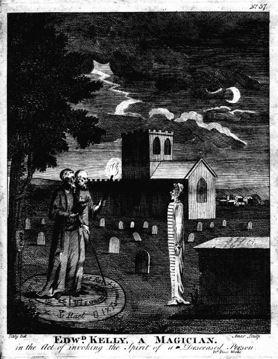
Last night I dreamed yet again. I felt myself drawn to a place where the mage stood, with another old man. They were huddled together, standing on a spot where strange devices had been scored upon the earth, as though the perimeter of the devices protected them from some evil or force beyond their control. I approached them as though through mist, or through the hall where I had first encountered the old man (though now it seemed plundered and ruined), all becoming clearer as I came close to them. At last I stood before them, a hand’s reach away, but outside their magic circle. The old man spoke to his companion.

“Strike with your staff upon the point of the heptogram, Master Kelley, and make it speak.”

At this, a look of annoyance passed the other’s face.

“I am known as Talbot now, and not by my old name. How many times do I have to say so before you remember!” He turned his eyes towards me, and drew himself up, rapping three times upon the ground with his stick.

“Speak, spirit,” he said. “Speak or be returned whence you came, and shut again in your arrow-chest. Speak, I command, in the name of an holy Power!”

“Whom do you command to speak?” I said. “I speak or do not speak at my own will, not yours. I say what is in my heart and mind, when it pleases me to open my lips. I am not bidden by anyone to speak or to stay silent, to come or to go.”

My old mage – I now thought of him as somehow mine – smiled a little, but the other became agitated, and struck again several times with his staff.

“I charge you to speak,” he barked. “Are you from Paradise or from eternal fire?”

“If you rap much harder on the ground,” said my mage. “You will find out first hand, as we shall fall through and into hell ourselves!”

“Paradise or flames?” I said. “A room in the Tower is not Paradise, though it is comfortable enough for a while; nor is it hell, for all its dreary solitude. Rather say it is purgatory, as it affords much opportunity for reflection and repentance!”

“Speak not in riddles!” cried the other. “But answer plainly, I charge you, by the angels!”

Patient now, my mage interjected, “Peace, Master Kelley; I know her, I know of her – she speaks what she thinks is true. She knows naught of heaven or hell, but lies where she lies, with her last memories, waiting for the graves to give forth their contents.”

“Master Dee, you may have traveled much, you may have been to Bohemia, and to Poland (where, I have heard, men have tails), but in these things you are ignorant. She is a spirit, and as such she has seen things you and I have not. And she is bound by the enchantment and invocation I have made, to tell us the truth. This fiddle-faddle she gives us is but her resisting my power, and it cannot last.”

“I know nothing of spirits,” I said. “Except that Saul was damned for causing one to be conjured up. I am none such. I am a queen, albeit one cast down. And Master Kelley or Talbot or whoever-you-may-be, you would be well advised to address me with more deference, and indeed to desist from your imagined conjuring.”

At this moment, my old mage turned eyes on me that held more pity and kindness than I had ever seen in him. There was such sorrow in his voice, when he spoke again.

“Master Talbot, it is clear to me that she is telling you the truth, though you cannot see it. Madam… Mistress… Your Majesty… “

His voice faltered, as though he had something difficult to say.

“Can you tell me where your favourite French headdress is at this moment?”

“Certainly, sir,” I replied. “I have it in my hand.”

“Madam, you have more than your headdress in your hand.”

At that moment, in my dream, I saw his meaning clearly –though I knew not with what eyes I saw that which I saw, for my own eyes looked up at me – and I screamed. My scream was choked by my awakening. Dreams are beyond fathoming, the pictures they paint are strange, their meaning is deep and often unholy…  and it is now today.

There is my gown, and my headdress; there also is my little book of psalms in French, undesecrated. I will wear my gown and my headdress today, and carry my psalms with me when I walk outside. I already have in mind what I will say:

Good Christian people, I am come hither to die, for according to the law, and by the law I am judged to die, and therefore I will speak nothing against it. I am come hither to accuse no man, nor to speak anything of that, whereof I am accused and condemned to die, but I pray God save the king and send him long to reign over you, for a gentler nor a more merciful prince was there never: and to me he was ever a good, a gentle and sovereign lord. And if any person will meddle of my cause, I require them to judge the best. And thus I take my leave of the world and of you all, and I heartily desire you all to pray for me. O Lord have mercy on me, to God I commend my soul.

But as I kneel, and before the swordsman scythes my head from my body, I shall think of my old magus. Then I shall breathe a short, Plantagenet prayer, and hope that my daughter, who has my eyes and my hair, will never be a queen, but will live her life a country lass, safe at home. For the burden of queenship is too heavy.