Marie Marshall

Author. Poet. Editor.

Tag: haiku

A call for submissions for the Summer 2015 Showcase at ‘the zen space’

Fukuda_Suiko-No_Series-Peony_and_Bee-00034592-030708-F12a bee passes by
weighed with the gold of flowers
this buzzing morning

The Summer 2015 Showcase at the zen space is due to be published on the 1st of July. I’m opening it to submissions this time, rather than sending out invitations, and I’m looking for ‘buzz poetry’ – that’s my name for any haiku or short form of words that is in-the-moment, of-the-moment, expressive, thought-provoking, emotion-evoking, or just zen-cool.

I would like to hear from new contributors, though old friends are welcome too. Just visit the site, click on the ‘Submission’ tab, find the editorial email address, and send me something. It doesn’t have to be on any particular theme, so surprise me with your brilliance…

MM.

‘the zen space’ Spring 2015 Showcase

Click on the mandala below to be taken to the Spring 2015 Showcase at the zen space, the e-zine where much imagery and a little wisdom is put into as few words as possible. Editor – yours truly.

violet

Have a Cold, Undead Christmas! :)

cover 200 disposalI was very pleased to see a copy of From My Cold, Undead Hand on the YA fiction shelves at my local branch of Waterstones the other day. There is still time, if you want to buy a copy as a Christmas gift for the bloodthirsty teen or vampire fanatic in your family – just pop along and order it at the counter. You can, of course, buy it on line in print form or as an ebook/Kindle download. Hurry!

I am currently doing minor tweaks and polishes to KWIREBOY vs VAMPIRE. I have sent copies to my ‘beta readers’ to get some initial comments, before I finally give it to my publisher. I’m hoping for a publication date later in 2015, but that has to remain a hope for now. Be assured I’ll let you know.
__________

The next Showcase at the zen space is due out on the first of next month, by the way, and I am looking for new blood (Oh – how appropriate!). Are there any poets out there who can use imagism or the haiku form to say something wonderful in very few words? If so, please get in touch.

M.

Imagine a wall… the answer

Last week I set a conundrum and asked if any of you could guess the answer my friend gave. Her answer illustrates two things, firstly lateral thinking, and secondly paying attention to the question. Here’s the question again:

Imagine a wall made of hard, smooth blocks of stone. It’s so high you can’t see the top. It’s so wide that no matter how far back you step you can’t see where it ends, if indeed it ends at all. A wall so mighty must have foundations almost as deep as it is tall, so it can’t be undermined. It is, as near as makes no difference, a wall of infinite dimensions! How do you get to the other side?

I think the most interesting answer came from someone who suggested walking away from the wall, all round the earth’s circumference, until you came to its further side. Hmm, that would be all very well if the wall didn’t itself circle the globe – you would be half way on your trek and suddenly would come up against the same side of the wall.

Look at the wording of the question again. My friend answered in three words. Here they are:

“Imagine a door…”

__________

While I have your attention, may I mention that the Autumn 2014 Showcase at the zen space, the on-line repository of haiku and other short poetry, is now published. Guest editor this time is the wonderful Sam Snoek-Brown. Read it here.

Spring 2014 showcase at ‘the zen space’

moon-face-smilingThe Spring 2014 showcase at the zen space is now published, and can be seen here. the zen space is my little e-zine for haiku and related in-the-moment poetry. I’ve been editing publishing it since 2011, honing my editorial skills. If you have never visited before, please feel free. There are now eleven showcases to browse through.


Angels, Mothers, Vampires, and Others.

Michael

This morning I finished my final read-through of The Everywhen Angels, my forthcoming novel, and gave a small list of unresolved typographical issues to my publisher. I think that’s the job done. I’m still awaiting the cover artwork, but that’s for the ‘house’ artist.

Having done that, I turned my attention to The Milk of Female Kindness, an anthology of prose, artwork, and poetry on the subject of motherhood. Contributors are drawn from as far afield as Australia, North America, and Britain. The Australian editor is Kasia James, and I am privileged to be doing a little editorial consultancy for her. The contents are marvelous – poetry ranges from Alison Bartlett’s ‘Reasons to Breastfeed’ to my own ‘The Maclaren’, about someone who can’t breastfeed – and I would especially recommend Maureen Bowden’s short story ‘Hiding the Knives’. I don’t have any information as to when the book will appear, but I’ll let you know as soon as I do.

I have also heard that the international anthology of modern sonnets The Phoenix Rising from its Ashes, for which I am Deputy Editor, is now ready to go to print. Publication is a little behind schedule, but it has a bit of a struggle to get this far. Being a deputy means you don’t get final say. I have often thought that it would have looked a lot different had I been at the helm, but it wasn’t my baby, and so all the recognizable facial features will be those of its very loving father, Editor-in-Chief Richard Vallance. Richard has sunk considerable energy and personal resources into this collection, and deserves to see it thrive. Again, more news as I get it.

Having work edited – the most chastening part of publication for an author – is damn good schooling for doing editorial work oneself. It sharpens up one’s initial presentation, for a start. Shortly, I hope, I shall be in a position to hand over the first draft of my teen-vampire novel. I’m winging it. I didn’t want to write a romance, where another Bella falls for another Edward*, so I launched straight into an action scene without even pausing to dream up a plot. I figured that my protagonist would suggest to me how the story would go and so she did! Imagine a tomboyish, even ‘boi-ish’, version of Buffy in a New York setting, a generation into the future, when energy resources are running thin and vampires are finding their way into positions of influence in the world. Imagine her reading a book about a nineteenth-century vampire hunter and finding connections. Imagine that despite her heroism she makes fatal mistakes. Imagine vampires with whom any person-to-person understanding is next-to-impossible (hence no cheesy romance). Imagine, most of all, the feeling that as a teenager one is marginalized and kept in the dark. That’s the way the novel is shaping up at present. The question of teenage alienation and lack of understanding is not a new theme for me. I deal with it a lot in The Everywhen Angels, for example. In my teen-vampire novel it is going to be dealt with a little more simply and superficially, amongst the episodic, crash-bang plot. I have to say it feels a little as though I’m writing a pot-boiler, but we’ll see how it comes out…

It’s a while until the next Showcase at the zen space is due out. Nevertheless I’m currently thinking about it. My aim this time will be to feature, strictly, writers whose work has not yet been seen in a Showcase. This means I will have to start sending out invitations and calling for contributions soon. I’m taking a little rest from writing poetry myself, but will be back at it shortly, I’m sure.

Finally, have you picked up your free ebook copy of my novel Lupa? If not, go here to do so – and also think about writing a review for me.

__________
*That’s a Twilight reference, for those of you who don’t instantly get it.

The Summer 2013 Showcase at ‘the zen space’ is now published.

dreesenbanner

the zen space is ‘my’ on-line-facility/e-zine/whatever for presenting haiku and related writing. I publish it once every three months, marking the four, Northern-hemisphere seasons. On this occasion I gave over the editorial seat to Angie Werren, a haijin of no little repute. To visit, click here or on the picture above. Enjoy.

Marking a century of haiku

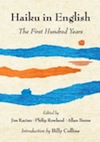
516Ba8RUQfL._SY300_Haiku in English: The First Hundred Years
Jim Kacian, Philip Rowland, Allan Burns (editors)
2013, New York, W W Norton & Company, pp.439
ISBN 978-0-393-23947-8
Hardcover $23.95US

Reviewed by Marie Marshall

As an anthologist I know when something ought to be done, and this had to be done. The centenary of Ezra Pound’s

The apparition of these faces in the crowd;
Petals on a wet, black bough.

in the infancy of imagism was impossible to miss. This book does not commemorate a birthday, however – it’s not just for this year, 2013. It stands as a record, and ought to stand as a book of reference.

The last time I reviewed a collection of haiku I made plain my objection to much time and energy being spent on writing about this word-form. I haven’t changed my opinion, but I will say that an editors’ foreword can’t be escaped in a book of this length. There simply has to be an explanation of what the editors had been trying to do. Their exercise was one of importance, marking a numerical milestone in the writing of haiku in English, their stated purpose not necessarily to present to us the ‘best’ haiku in our own language (stating that could be seen as cannily preempting criticism of their selection) but perhaps haiku which illustrated best its stages of development over the past hundred years.

That is what we are supposed to spot as we read. The stages are not flagged-up for us. Thus when I read, say, Ezra Pound’s orientalist

The petals fall in the fountain,
the orange-coloured rose-leaves,
Their ochre clings to the stone.

and the final poem of the book, Rebecca Lilly’s

Snow at dawn…
dead singers in their prime
on the radio

I am supposed to see a word-form which has changed, developed, moved. As it turns out, with these two examples I don’t. I see what I will have expected to see throughout the book – a continuum. Every newcomer to haiku has certain ‘rules’ drummed into him/her, notably the syllable-count, the reference to nature or season, the cutting point at the end of the second line, the need to omit definite and indefinite articles, and so on. That last ‘rule’, by the way, is one of the silliest and most stultifying, and one which (I am glad to say) most good writers of haiku ignore totally. Each of the poems above use an observation of nature to point to a season, each expresses the transient moment, neither dispenses with articles and therefore each flows naturally. This is precisely what I mean by ‘continuum’; I believe that the first and last poets to appear in this collection would have understood precisely what each other was trying to do.

By the way, neither poem adheres to a strict syllable count. Billy Collins in his guest introduction to the anthology makes the point that ‘a “syllable” does not have the same meaning or weight in Japanese as it does in English’. True, but the next time I read this I swear I’ll scream. It is the prime example of a ‘non-rule’ to counter balance all the ‘rules’.

Back on track. Would I be right to conclude that if I pick someone from the middle of the period, I will find the same recognizable ‘continuum’? Here are two from Jack Kerouac:

In my medicine cabinet
the winter fly
Has died of old age

The bottoms of my shoes
are clean
From walking in the rain

Yes. No. maybe. They’re brilliant anyway. But then someone else jumps in and kicks me in the head. Larry Gates:

Gateshaiku

This is where people sit bolt upright in their chairs and say, “But… but… this isn’t haiku!’ It appears between two other poems which quite clearly do fit comfortably in the continuum, but it sticks out like a mustard-plaster on a coal-scuttle. However, in the couple of seconds your eye first takes in this piece, you see the moment that the poet has captured. You think you see the exclamation ‘Great Snakes!’; you hear the ‘SSSSSSS’ of the snake’s hiss; you experience the aphasic ‘GGGGGGG’ of shock, the ‘RRRRRR’ of anger; you do see the word ‘SNAKE’ in there, and also, if you’re paying attention, the word ‘RAKE’. The poet in his garden is surprised by a snake and lashes out with the first thing that comes to hand. The first and last poet in the collection might have scratched their heads, but I think they’d have got it!

There are more than two hundred and twenty poets represented in this anthology. They are presented in order, that order being by the date of publication of their first identifiable haiku. Given the editors’ aim of showing the development of the form, this was a logical decision. Included are poets I know well – David Cobb*, Alexis Rotella, and Johannes S H Bjerg, for example. Also, if you are attracted by ‘names’, you will find Langston Hughes, e e cummings, Allen Ginsberg, Seamus Heaney, Paul Muldoon, and Billy Collins. I spotted Dag Hammarskjöld in there too, which surprised me – in my ignorance I only knew him as a statesman. In the collection are pieces that both reinforce and challenge our perceptions of what haiku is; in the continuum, bright and jagged shapes sometimes swim to the surface.

Pages 321 to 392 of the book are taken up with a dissertation by Jim Kacian, ‘An Overview of Haiku in English’. I really wish it wasn’t necessary, given my prejudice, but I guess it is. There is not a single volume of collected works or wisdom in the libraries of the world that another editor, myself included, would not have done differently. That goes as much for Haiku in English: The First Hundred Years as much as it does for The Faber Book of Beasts or The Oxford Dictionary of Quotations. We others have to let it go. The book under review here is absolutely essential, whether I’m comfortable with it or not, and my comfort is irrelevant. If you are at all interested in haiku, then it needs to be on your bookshelf and in easy reach.

Let me leave you with one of the most poignant pieces. It’s by Frank K Robinson, and it marks a point where the form is used to draw the mind from a simple natural observation to a dynamic and terrible time in 20c history:

anzio beach…
another wave gathers
and breaks

rated ★★★★☆

__________

*David Cobb, possibly the most renowned haijin in the UK, was kind enough to contribute to the first ever issue of ‘my’ e-zine the zen space.

Review of ‘A New Resonance 8’

resonance8

A New Resonance 8
Jim Kacian & Dee Evetts (editors)
2013, Winchester VA, Red Moon Press, pp.175
ISBN 978-1-946848 -22-5
$17US

Reviewed by Marie Marshall *

It’s a personal prejudice of mine that as little should be written as possible about haiku, and the same goes for writing about people who write it. You’ll forgive me, therefore, if I deal with the presentation of this anthology before I touch on the contents.

This latest in the New Resonance series is actually beautiful to look at, its covers using the reds and purples of an Emil Nolde painting, setting off yellow lettering – ‘Resonance’ being prominent. In place of a rear-cover blurb are the words

Seventeen poets
whose names you will hear often
in the coming years

and it doesn’t take a genius to spot the arrangement of syllables. Inside, the distraction starts. The business of a book – the title page and publication details – can’t be avoided. The busy-ness of a blank flyleaf, a foreword, a further title page, a list of contributors, an editorial review of the first haijin, and the publication details of her haiku – all before the first poem – arguably can. For the ninth in the series, I would like to see the editor consider what may or may not be superfluous. The first poem is ‘about’ beginning; ironically it’s on page 9. It’s a simple, enigmatic monostich

spring rain backwards until the beginning

and it is the intriguing (proper) start of the book. The nature referent is almost intrusive, interrupting an apparent grammatical flow, making the initial word ‘spring’ wonderfully ambiguous. ‘Time is not to be relied on’ runs the editorial commentary, and the poem ‘invite[s] us to read [it] over and over’. Does it? Should it? Would the shade of Basho gnash his teeth at the thought of our oohs and ahs as we fixate on the eternal plop of a frog into an eternal pool? Whatever – Melissa Allen’s one-liner is a great way to open the show. The rest of her selections are full of strength, surprising, compulsive stuff; the book leads with an ace.

Then comes another moment of superfluity. The next poet – each poet – is introduced not only by an editorial comment and publication details, but by a repeated list of all the poets, with the featured poet’s name in bold. Arguably it’s like two bars’ rest in music with the conductor still waving his baton, but please expect that at least fifty-one of your one hundred and seventy-five pages will not contain haiku. You’re looking at a stack of sandwiches, so expect a lot of bread.

But the filling!

The featured poets include many I know, such as Johannes S H Bjerg, Aubrie Cox, and Christina Nguyen, and many I don’t know. Again I’m uncomfortable writing too much about their creations. I can say that much of the poetry in A New Resonance 8 shows that there’s a happy coincidence in the Japanese words mono no aware and the English word ‘aware’. I’m going to extract a couple that stand out for me, and leave the rest for you to come across when you read the book for yourself. First Lucas Strensland’s

sleepless night
where else does she have
owl tattoos

and secondly John Hawk’s monostich

how should I put this broken window

yet another lovely monkeying-around with grammar and ambiguity. Perhaps the weakest poem is David Caruso’s

holy war
death
by ancient literature

– I feel like saying yes, you’ve made your point, but should you be even making a ‘point’ with haiku? Let me say anyhow that if that’s the weakest poem in the book – and it’s not that bad! – that says a lot for the quality of the book as a whole. After a while I even got used to the intrusive ‘bread’ pages. It’s a book to approach in may ways. I like to pick it up, flip open a random page (flip over a couple more if I land on the bread!) and read what I find there. If I occasionally land on the same poem, then that’s a serendipitous plop in the pool. This book is full of high quality modern haiku, stuff of a much higher standard than you’d even find in most specialist magazines.

Rated ★★★★☆

__________

* I’m grateful to Johannes S H Bjerg for the review copy. I would have done a shorter review for the zen space, but for the fact that the next issue is in the hands of a guest editor.

Spring 2013 Showcase at ‘the zen space’.

detail from 'The Graden of Allah' © Marie Taylor

detail from ‘The Garden of Allah’ © Marie Taylor

All Fools Day seems as good a time as any to publish an e-zine. This year’s Spring Showcase at the zen space is now on line, with a peaceful feel to it, and contributions from many new writers. Please visit.