Marie Marshall

Author. Poet. Editor.

Tag: story

Robin Hood and the Bishop of Hereford

Robin Hood and the Bishop of Hereford

Robin Hood and the Bishop of Hereford,

A story for May Day *


It happened that on the first day of May the Lord Bishop of Hereford was riding through the Great Greenwood that once covered most of England, on his way from the Abbey of St Hilda in Whitby to his own city of Hereford. Against the advice of the Abbot of Whitby, he was riding alone, for the Bishop was a man of great stature and courage and feared no man. “Besides,” he had said to the abbot, “who would waylay a man of the Church?”

As the Lord Bishop rode through the forest, looking around at the fresh, spring leaves on the oaks, the ashes, and the bonny rowans, and listening to the chaffinches giving their celebratory spring call and the jays laughing at them from deep in the trees, he too was filled with joy, and broke into a chant, in the manner of St Gregory.

Te Deum laudamus,” he sang, in his great baritone. “Te Dominum confitemur…” and the birds seemed to increase their trilling and laughing in friendly rivalry with him. Here, where the forest was at its deepest and greenest, and the track wound in between the oak boles, he felt was a place of goodness, where no harm could come to anyone, and if anywhere was a remnant of the blessed Garden of Eden, then this corner of England was it.

“Hold!” cried a voice, of a sudden. The Bishop broke off his song, looked down, and saw that he was surrounded by men in Lincoln Green, one of whom – a bold, smiling villain in a feathered cap – held fast his palfrey’s bridle. All brandished stout longbows with arrows nocked, some of which were pointed at him.

“Who are you men who roughly and rudely interrupt my praises to the Almighty, prevent my travel, and disturb this blessed Spring day?” cried the Bishop. “And especially, who art thou, grinning in thy beard? Yes, thou, the knave with the pheasant’s tail in his bonnet, who hast laid hands on my horse.”

This man, who appeared to be the leader of the troop, let go of the bridle, showed the palm of his hand to be clear of it.

“Upon your parole, then, my Lord Bishop,” he said. Then, sweeping his cap from his head, he bowed low and made a respectful leg to the prelate. “I am known in these parts as Robin Hood, and these honest churls, on whose behalf I beg your pardon for the interruption to your journey, are my friends and fellow Foresters. We collect the toll from travellers who pass this way.”

“Never let it be said that I refused to render unto Caesar that which is Caesar’s,” said the Bishop. “How much is the toll?”

“Half of all you carry,” said Robin, “and an hour or so of your time to dine with us.”

The Bishop’s eyes opened wide. “I am a humble priest!” he protested, “but even half of what I carry is too much to ask, surely?”

“Your fine garments, your riding-horse, the ring on your finger, and the heavy pouch at your belt would all say that you are far from humble, My Lord Bishop. Besides, it is much less of an impost than some of my men here have had to pay, having lost all they ever possessed.”

Now the Bishop, large and fearless though he was and capable of standing a round of buffets with any man, was kindly at heart. He had heard of how the outlaws of Sherwood, once they had sufficient to keep themselves fed, would distribute the bulk of their pelf to the poor, and he himself was cognizant of the virtue of St Martin. He recalled the story of how the saint, while still a soldier and a worldly man, had freely cut his paenula in two and given half to a shivering beggar who – as it was revealed to him in a dream – was Christ in disguise. Well, the man with the feathered cap was no Christ, any more than the others of the green-clad band were Apostles, so the Bishop was of a mind to have some sport with them.

“I doubt me, Sirrah, that thou art truly Robin Hood,” he said. “And if thou art not, what is to prevent another band of robbers stopping me a mile hence with their own claim to be the Merry Men of Sherwood, then another band a mile further, then another and another, each taking half, until I am left with a groat, half a cassock, half a cloak, and one shoe? I hear that Robin Hood and his followers are great archers. Lend me for one minute one of your longbows – let it be the worst you have – and I shall loose an arrow, shooting it as far as I can. If you can shoot further, and thou, Feathered-Cap Esquire, furthest, then I shall acknowledge that I am indeed in the presence of Robin Hood and his men, and I shall pay the forest-toll.”

With these words the Bishop leapt down from his horse and took hold of the bow of Much the Miller’s son, nocked an arrow to it, drew it, and let fly. The arrow’s flight was long, and it landed in a field beyond the trees. The Bishop handed the bow back to Much, who nocked a second arrow, drew back the bowstring, and with a grunt of effort shot it into the same field, but a little further than the Bishop’s. The Bishop clapped his hands.

“Excellent bowmanship for such a young lad!” he exclaimed, and then pointed at Will Scatlock. “Now this fellow!”

Will drew back his bowstring and shot an arrow into the next field, to the Bishop’s delight. Each of the band had his turn, each shooting further and further, until it was the turn of the tall, powerful John Little. With his mighty arms he drew back his bow and loosed an arrow that went two fields further than the last man’s.

“Thou giant!” cried the Bishop, even though he was of a height with John Little. “I’ll wager no one can best that!”

Robin Hood stepped forward. He was no match for his great lieutenant in height and strength, but his skill was such that he knew well how to make the most of a longbow. He took his bow, nocked an arrow, drew, elevated the bow with exactness and, having waited for the wind to die a little, let fly. The arrow went a prodigious distance and landed one field further than John Little’s. The Bishop clapped and cheered, and then bowed to Robin, addressing him politely.

“You are indeed Robin Hood!” he said. “That I freely acknowledge.”

“Then pay the toll, my Lord Bishop,” said Robin. “That was the wager.” But the Bishop mounted his horse again and raised an eyebrow in a pretence of haughtiness.

“Who is to stop me? All your arrows are spent!”

Robin saw that the Bishop had bettered him, and he threw back his head and laughed. Then he bowed again.

“Well won, Well won! The freedom of the forest track is yours. Pass onwards free of toll, for you have taught us all a lesson today, and that is worth more than any toll.”

But the Bishop did not spur his horse. “I am determined to be magnanimous in victory,” he said. “These lands hereabouts are mine, and the field where the lad’s arrow landed I shall give to him, and it shall be known as ‘Miller’s Field’. The next, where Scatlock’s arrow landed, shall be his and shall be called ‘Will Scatlock’s Field’. And there shall be ‘John Little’s Field’, and ‘Robin’s Field’, and a field for all of you.” And this offer was a true one, because the Bishop was not only a priest but also a great holder of land in his own right, being of the line of one of the Conqueror’s barons.

“Alas,” said Robin, shaking his head, “ this cannot be, for we are outlaws and forbidden to hold land.”

“Some say, however, that you are heir to the Manor of Locksley.”

“Aye, and others that I am the son of the Earl of Huntingdon, and others still that I am a Knight of the Cross of St John. But the law is the law, and we are outside it,” said Robin.

The Bishop dismounted again and clasped Robin’s hand.

“Then your lineage,” he said, smiling, “matters nothing to me. We shall halve the contents of my purse. Now, I believe there was some mention of dining – dare I expect venison?”

Thus the Bishop of Hereford came to feast in Sherwood, and a merry May Day was had by all. The Bishop counted over half of the coins in his purse, as he had promised, and made sure he had at least his fair share of venison. He conversed in Latin with the good Friar Tuck, in French with Demoiselle Marianne who was Norman, and even in Arabic and Greek with ibn Hassan, Robin’s hostage-become-friend. At the end of the feast he went on his way with many a wave and a Pax Vobiscum.

From that day, in all the diocese of Hereford, no church from the Cathedral itself to the lowliest chapel would refuse sanctuary to any man dressed in Lincoln Green; and every May Day was a holiday amongst the outlaws, and in their feasting they never forgot to toast the Bishop of Hereford, the only man ever to get the better of bold Robin Hood.

__________

* In most of the Robin Hood folk-tales, the Bishop of Hereford is portrayed as an enemy of Robin and the outlaws. In this particular tale, which is based on a story I heard from a teacher when I was a little girl, the Bishop is a good character. This tale is retold just for fun, without any pretended literary merit – whoever heard of a folk tale having literary merit, for heaven’s sake!

Baal, Yamm, and Anath

Embedded in The Everywhen Angels is this tale, handed down from ancient Canaan; it is told by a Romany patriarch to a gorjo boy, as his wife paints a henna tattoo on the boy’s arm.
__________

BaalFar away in the land of Canaan, many years ago, beyond the city of Ugarit, where they sang psalms to the creator El long before the Children of Israel came and stole not only their land but their psalms too, there stood a mountain. The mountain’s name was Zaphon, and it was the home of the great god Baal, son of Dagon, called ‘Lord of Thunder’, ‘Almighty’, ‘Rider of the Clouds’, ‘Lord over the Earth’. Some folk called Baal by the name of Hadad. Baal was never still – he could never rest – and thunder could be heard daily from Mount Zaphon, and flashes of lightning played around its summit.

From the summit of Mount Zaphon, where he ceaselessly paced to and fro, Baal could see the Mediterranean ocean, home of the god Yamm. Baal became angry. His kingdom now felt small, because he could see its boundaries. And in his anger he called out to Yamm, insulting him continually in his loud voice, hurling thunderbolts and making great winds, so that Yamm’s kingdom was constantly in turmoil, tossing this way and that in the storms and winds that Baal sent.

“Come out and fight me, Yamm, you coward!” shouted Baal, in a voice that echoed in a peal of thunder so loud it was heard beyond the southern border of Canaan. “Stop skulking in your slimy kingdom. Show yourself!”

And at last Yamm came up from the sea, his dark face rising like a tidal wave, and he set his great, green foot upon the shore, upon Baal’s kingdom. And he shouted back to Baal in a voice like the crashing of breakers against the cliffs.

“Here I stand, you blustering bully! Are you nothing but noise? I challenge you! Who’s the coward now?”

Baal saw that Yamm was indeed mighty, a great enemy, strong and fearsome. Baal himself was no coward, but he was very cunning, and so he went to Kothar, the blacksmith god, skilled in making any object a god could need. He asked Kothar to make him mighty weapons with which to fight Yamm. Kothar took all the metal that lay under the ground between Mount Zaphon in the West, and the Indus river in the East, and he worked it into a great, bronze sword. And he scooped up a huge piece of the Earth and made it into a stout shield; and the hole it left became the Sea of Galilee.

Armed with the sword and shield, Baal charged at Yamm. The battle between these two gods lasted twelve whole years, during which time there were such thunderstorms and tides as had never been seen in the Mediterranean*. Baal pushed at Yamm with his shield, and battered at him with his sword; and with every push of the shield and stroke of the sword there was a huge peal of thunder and flash of lightning. Yamm whipped Baal with waterspouts and showers of stinging rain and hail.

In the city of Ugarit, and throughout Canaan, the poor people cowered in their houses, only coming out when the two rival gods paused between rounds.

Eventually Yamm began to gain the upper hand, and roared with delight, beating Baal further and further back inland. One lash with a mighty waterspout was enough to send Baal’s shield spinning from his hand, to land on its edge in the sea, where it became the island of Cyprus.

By this time even the gods themselves had come to watch the battle, betting upon the outcome. The sun goddess, Shapash, was the only one to bet on Baal, and secretly warmed and dried him with her rays. Baal, who as you know was cunning, devised a plan to escape defeat. He waited until the sun goddess’s kindly gaze was on him and then angled his mighty, bronze sword so that it reflected the sunlight right into Yamm’s eyes. Yamm was dazzled and blinded, and Baal started to belabour him with the flat of his sword, raining blow after blow down upon the sea god, until he was beaten, and the sea became calm and still.

Now Baal had a wife who was also his sister. Do not ask me how this can be, but such things were possible with the gods of Canaan. Not only was Anath his sister and his wife, but she was forever a virgin. She was greatly loved by all the gods, and she took Baal by the hand and led him to see El, the creator, to whom all psalms were sung. There she told him that the reason Baal paced to and fro on Mount Zaphon was that he had no house to live in. If El would give permission for Baal to have a house built, then all Canaan would be a place of peace. El readily gave his permission.

Anath asked Kothar for help, calling to him sweetly, using the pet name she had for him. “O Hasis the Skilful, Hasis the Wise, make a house for my brother-husband Baal and me, in which we can live peacefully.”

Kothar built a house for Baal on top of Mount Zaphon, and Baal was pleased. For a while all Canaan was at peace, the sun shone, and the gods dozed. Even Yamm forgot his quarrel with Baal, and visited him in his house. At such times the summit of Mount Zaphon was wreathed in mist.

One day Baal invited all the gods to a great feast. Yamm was there, and El the creator as the guest of honour. Shapash and Kothar sat together, and even Yutpan the deceitful had a place. The only god not to be invited was Mot, the god of death. When he heard about the feast, he strode up Mount Zaphon in a rage, and pounded so hard on the door of Baal’s house that the food and drink was shaken off the tables.

Mot burst into the house and cursed and ranted at Baal for the insult of not inviting him. Baal was so enraged at this that he forgot he was supposed to be living a peaceful life. He sprang to his feet, seized the sword that he had used to defeat Yamm, and rushed at Mot.

Their duel was a terrible sight. Even the mighty gods fled from Mount Zaphon, as Baal and Mot reduced the lovely house to rubble in their raging. But even the mighty Baal could not defeat Death, and Mot eventually swallowed up Baal, and spat him out on the mountain top, dead and cold.

While the gods debated amongst themselves who could take Baal’s place, Anath mourned for him. Not only did she mourn as a sister and a wife, but also as a mother and a daughter would, for she was all things to Baal. She wandered through Canaan looking for Baal’s body, and when she found it, she buried it and wept over his grave. But her tears, at first cool and sorrowful, turned to drops of fire, and became a rage such as creation had never seen. She turned and ran and ran until she came to Mot, flinging herself upon him in a murderous frenzy. Struggle as he might, Mot found he was no match for Anath, because as she had mourned Baal as a sister, a wife, a mother, and a daughter, she had become four goddesses in one. In her wrath she killed Mot, ground his body to powder, and scattered it over land and sea.

Then she took the place of Baal on top of Mount Zaphon, where she ruled for many years, no longer as Anath the gentle and beloved of the gods, but as the goddess of slaughter, whom some called Ashtoreth, with a hideous aspect.

Many lives of men and women passed. One night El, the creator, dreamed a dream, in which Baal and Mot were alive and stood before him. What El dreams always comes to pass, and so when he awoke, there before him stood Baal and Mot, restored to life. He charged them solemnly each to keep to his own kingdom, and not to fight any more. They bowed low to him and gave him their promise.

When Anath saw Baal coming again to Mount Zaphon, her heart was softened, and her face became beautiful once more. She painted herself with a dye made from her sacred plant, which she called Mehendi, making  the beautiful patterns on her face and limbs, which brides do to this very day in India, and in Mesopotamia, and in all parts of Arabia.

And Baal and Anath lived in peace and happiness ever after. Some say that when the One God came they faded away. Others say they still live on top of Mount Zaphon, but now as an old man and an old woman, and have retired from being gods.

But one thing I know is this: Anath’s sacred plant, Mehendi, which we call Henna, still grows.
__________

* Yes, I know, I know!

Something ghostly from Shetland…

Da Trow i' da Waa

… is coming to Pitlochry on 22nd February, in the shape of my short story Da Trow i’ da Waa. It will be rounding off the prizewinning stories of this year’s ‘Fearie Tales’ competition at the Winter Words literary festival – the first of Scotland’s literary season – at the Pitlochry Festival Theatre. ‘Trow’ is a word which has survived from Shetland’s Nordic past into its modern tongue (which is maybe less than a language, maybe more than a dialect, not unlike Lowland Scots), and it is roughly equivalent to the Scandinavian ‘troll’. My story is all about what happens to an author with writer’s block, who takes a cottage on the remote island of Yell, in Scotland’s most northerly archipelago.

The story will be read to an audience by Scottish actor Helen Logan. Just checking out the events for the rest of the Festival week, you could say I was on the same bill as Sir Chris Bonington, Mike McCartney, Sally Magnusson, and Neil Oliver! Here you can watch a short video about the festival and the venue.

Comic books, cultural catastrophes, and juggled balls.

All images shown under ‘fair use’ provisions.
__________

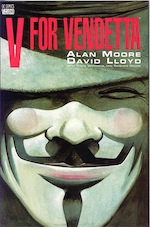
V for vendettaI own only one graphic novel, Alan Moore’s V For Vendetta. Of course I do – why wouldn’t I own a book in which an anarchist superhero goes mano a mano with a fascist government in Britain? I notice that Alan Moore distanced himself from the film version, exciting though that was (and it starred the wonderful Hugo Weaving!), saying that it had been ‘turned into a Bush-era parable by people too timid to set a political satire in their own country’. Having read the script, he said,

It’s a thwarted and frustrated and largely impotent American liberal fantasy of someone with American liberal values standing up against a state run by neoconservatives – which is not what the comic V for Vendetta was about. It was about fascism, it was about anarchy, it was about England.

If this does nothing else, it points up the difficulty in adapting a work of art in one medium for another. Perhaps the greatest irony about both the graphic novel and the film of V For Vendetta, is that whilst the Guy Fawkes mask of the protagonist has become instantly recognized worldwide as a symbol of radical protest, it must be making a pretty good profit for someone.

I own three DVDs that are adaptations of graphic novels or comics (if you don’t count assorted Batman flicks in the back of the drawer). These are 300, based on Frank Miller’s and Lynn Varley’s fictionalization of the Battle of Thermopylae, and Kick Ass and Kick Ass 2, based on the comics of Mark Millar and John Romita Jr.

Kick AssKick Ass is fun. It came in for a lot of abuse on account of the bad language, less for the violence – with the exception of one teenager, no bad guy is left alive by the end of the film. Its killing-spree violence is in the tradition of Peckinpah and Tarantino, subverting the bloodless wrong-righting of The Lone Ranger and Batman. I think people missed the point that it is highly satirical of the superhero genre, and simply spares no effort to de-bunk its ‘zap’ and ‘pow’ fisticuffs. It is, as the cover of the comic book says ‘Sickening violence, just the way you like it’, signaling that it does not take itself seriously and shouldn’t be taken too seriously by readers and movie-goers. The satire of the film is taken further by the character Big Daddy (Nicolas Cage) adopting the phrasing of Adam West, one of the film’s Batman references along with the parting Jack Nicholson quote from Chris D’Amico (Christopher Mintz-Plasse) “Wait till they get a load of me”, and Hit-Girl’s (Chloë Grace Moretz) “Just contact the mayor’s office. He’s got this giant light he shines in the sky. It’s in the shape of a giant cock” (the bird! the bird! Omnia munda mundis!).

Alan Moore is, I guess, entitled to take pot shots at the genre from his position as an insider. If anyone knows the genre he does. In his latest diatribe, possibly his public farewell, he not only curses the modern craze for superheroes, but also tackles such issues as the depiction of rape, and the right of an author to use characters of a different race, class, or gender from his or her own. Specifically on superheroes he says:

To my mind, this embracing of what were unambiguously children’s characters at their mid-20th century inception seems to indicate a retreat from the admittedly overwhelming complexities of modern existence. It looks to me very much like a significant section of the public, having given up on attempting to understand the reality they are actually living in, have instead reasoned that they might at least be able to comprehend the sprawling, meaningless, but at-least-still-finite ‘universes’ presented by DC or Marvel Comics. I would also observe that it is, potentially, culturally catastrophic to have the ephemera of a previous century squatting possessively on the cultural stage and refusing to allow this surely unprecedented era to develop a culture of its own, relevant and sufficient to its times.

Angels Amazon coverHaving fallen almost by accident into writing for young adults, I find myself skirting superhero territory. The teenagers in my novel The Everywhen Angels have powers that they don’t quite understand, and the protagonist in my recently-completed teen-vampire novella, From My Cold, Undead Hand, is a girl who has been trained to hunt and destroy vampires. Consciously or unconsciously, however, I seem to have made these characters break a mould, or break out of a strait-jacket. Unlike traditional heroes, they don’t necessarily win, they don’t necessarily triumph over a force bigger than they are, their tales do not have a clear resolution where all is explained in a neat and tidy way. Good does not necessarily triumph over evil, and where it does it may well be by accident rather than design. Why?

I guess it is because so many action adventures in any medium, where makers justify their violence in terms of the triumph of good over evil, are little more than morality plays and wish-fulfillment fantasies. If I’m to get readers close to the characters, and the characters close to the danger, everyone is going to have to realise that kids don’t get to be kings and queens of Narnia, and they do get to screw up. I mention all this because one of the balls I’m currently juggling is scripting From My Cold, Undead Hand for adaptation into a graphic novel. It isn’t all that easy. As I was writing it I never had anything in my mind apart from painting pictures with text. In order to script it, I have to take a huge step back, almost throw out the entire manuscript, and re-tell the story a totally different way. I have to imagine how it might look on the page. Take the following note I have made about the initial image:

Exceptionally, this should be a full-page picture, opening on the right-hand page. Chevonne is striding towards us, sword strapped to her back, carbon-pistol in her hand. Her face is rather grim and determined. The angle is fairly low – we’re slightly looking up at her. She’s striding between the stacks of a library. Text in a rectangular box, or maybe two, says something like: ‘The time is a little way into the future. This is Chevonne Kustnetsov – by day a student at PS#401, New York, by night a vampire hunter. Here she is, pursuing a vampire through the University Club Library, tracking it down to destroy it…’ Perhaps change that to 1st person speech, as the text novel is in 1st. Maybe not. We can take that final decision later.

Compare that with the opening paragraph of the novella:

There’s an art to this. When a vamp de-korps I only have a split second to guess where it’s going to re-korp. This one’s tricky, clever, powerful. As I just beaded my carbon-gat at it, it blew into a thousand-thousand little bits in front of me. Thought it could fool me, but that de-korp happened too quick to be the result of my bullet.

In that opening there is no detail of who the character is, where she is, or when the story is set. Such detail is revealed within the text when it needs to be – her school, for example, is not referred to until the second chapter, and the time in which the story is set is implied by things such as the technology depicted. You can easily see that this is a total departure for me. It’s quite a challenge and I think I’ll have to put other projects on hold while I tackle it. But you know me – I’m liable to pick up and put down my writing projects in a rather haphazard way. Wish me luck.

Introducing Evangeline*

Detail from 'The Derby Day' by William Powell Frith

Detail from ‘The Derby Day’ by William Powell Frith

Imagine Epsom a huge tray of type rolling, popping, reversing at it is shaken, and there you have this field of hats and heads, toppers, skimmers, brimmers, bowlers, billycocks, and caps, all peppered with ladies’ bonnets, twirlers, birders, and fascinators as though someone had tossed cloured comfits into the jiggling type. The men of course are the blacks and greys of the inky letters, apart from a handful of jays and mandrakes. In all this steps Evangeline, as though she is treading from tussock to tussock in a wind-disturbed swamp or from boat to boat in a bobbing harbour, although her paces have all the precision of a prima ballerina’s. She only appears to be pushing through the press, which in fact parts, imperceptibly, for her. She sees all, sees the punters, tic-tac men, bookies, buzzers, down-and-outs, up-and-comings, lordings out on the slum like so many drunken second-sons. Evangeline’s back is straight, the face she shows to each person she slides by is what they want to see; she is their equal whether they expect a whore or a lady, oh my, oh my, she can counterfeit all, especially that which she genuinely is.

“I have the skin of a fish,” she thinks, says under her breath, an arcane choice of phrase by which she takes pride in her ability to sense the movement of the crowd and isolate the ripples and disturbifications that are just a little foreign to it. As now she does, finding the zig-zag of a dipper whom she knows, searching for his titfer amongst the thousand, spotting it with a smile. It’s Ganzy Gil Degarry, called ‘Old Cawhang’ by his pals for his Channel Island cant and patois, though more than half he puts on, having left Guernsey as a young’un, and indeed he’s not that old. She sees him making a mark, lifting his hat in apology to a man whose weskit he has just relieved of a deaner or two, a drackmer, or maybe of his best jerry, or maybe of a long-tailed note. Ganzy Gil’s quite the mobsman, quite the tooler.

“What’s this?” she thinks, says under her breath, as a new counter-eddy makes itself known, paralleling the pick-pocket. Her eyes rake the stylish tiles, settling on a couple of bowlers circulating on the periphery. Two Miltonians (she’ll be bound!), one whose gait she recognizes as he whom she calls ‘my grasshopper’, the other no doubt his sergeant. No doubt either that their courses spiral in towards the progress of Ganzy Gil, whom they have spotted at his business. So she herself cuts a curlicue process towards the thief, prettily, carefully, lifting the skirts of her coat. Despite the deliberate ease with which she penetrates the jostling press, she knows they will have him before she gets to them. From her pocket she slips a small bottle of gin, swigging from it to perfume her breath and to give her an excuse to stagger a little.

Ganzy Gil’s skillful monkey-fingers are about to harvest a pocket-book from a portly cove when the sergeant’s hand rests lightly but obviously on his shoulder. He halts, looking for a way out, but is confronted by the grasshopper who stands before him like Dover cliffs. And so Ganzy Gil is voided of his energy – inevitability has seen to that – and his swagger sags. Inevitability, however, suffers a little reverse, when Evangeline takes a small, tipsy stumble backwards, and the heel of her shoe presses down hard on the grasshopper’s foot. He yells in pain, his colleague is distracted for long enough for the pick-pocket to swing away from under his grasp and dodge into the crowd. The sergeant springs to pursue, but Evangeline staggers in front of him and is knocked to the ground.

“Here! What’s your game?” she cries, not in the least winded. “Stop him! Stop him someone! That brute attacked me!”

A dozen or more bodies bar the sergeant’s way, and if Evangeline had been on her feet more quickly, she would seen a cheeky, over-the-shoulder grin from Degarry serving as his a la perchoine to the peelers. As it is, Evangeline is returned to her feet firmly by the grasshopper, whose grip lingers on her slender arm, strongly enough to be a restraint, gently enough to leave no trace of a bruise. “Blind me and bless me,” she thinks, “but he’s done this before, held a woman suspect immobile.”

“Miss, I think you are well aware that I am an Inspector of the Metropolitan Police,” he says, loudly enough so that the eagerly watching crowd does not turn nasty and instead knows him for the jack he is. “Furthermore I think you were well aware that my colleague whom you impeded so excellently is a sergeant of the same force. I also think you know the criminal whom we had arrested and who escaped thanks to your intervention. To put it simply, Miss, you’re nibbed.”

“Sir,” says Evangeline, brushing mud off her coat with her free hand, “you think a deal to much. And since you are a policeman you will know that your thoughts to not amount to evidence. Are we to miss the races because of your thoughts?”

“I see you are not as tipsy as you first appeared,” says the grasshopper. “That goes a little way towards being evidence. It is at least a suspicion in my mind, and as such is enough to oblige you to come with me and be questioned.”

“Then allow me a little dignity,” says Evangeline. “Allow me to take your arm as fits a lady. Your bulldog can walk behind and make sure I don’t cut and run.”

So Evangeline and ‘her’ jack swap their who-holds-whom, at her insistence and without his resistance. Together, and with the sergeant stalking behind like a zealous duenna, they walk through the once-again parting press as lady and escort. When a gaze meets hers she smiles, slightly inclining her head, and the gazer can’t help but touch the brim of his hat respectfully.

________

*My previous post was a teaser about ‘Agent Delta’, a fragment of an unwritten novel. Here is one which introduces ‘Evangeline’ – Victorian orphan, sometime mountebank but with true psychic talent, well-born friend of criminals and prostitutes, and destined to be a ‘Woman Searcher’ with the Metropolitan Police – and her ‘Grasshopper’, an unnamed Police Inspector, loosely based on the real-life Jack Whicher (though what an officer of ‘the Met’ is doing at a racecourse in Surrey is in itself a mystery).

I am fascinated by the thought of ‘lost slang’. I know that things I recall from my own lifetime have come and gone, leaving gaps in social history. Nothing appears on the mighty internet about them. They might never have been. For that reason, along with London’s Victorian argot that I have researched, my intention has always been to drop expressions into the mouths of my characters for which there is absolutely no evidence.

One other thing I ought to mention is an additional way that these fragments have been constructed to ‘tease’. All the original text fragments of both my ‘Agent Delta’ and ‘Evangeline’ works-in-progress are written in the first person, the protagonist narrating; however the two pieces I have composed and posted here are written in the third person, though focalized on the protagonist. I like to play. This is all helping me get back into the discipline of writing…

Millie and Marie meet some Angels

© Millie Ho

© Millie Ho

The first 'Angela' © Millie Ho

The first ‘Angela’ © Millie Ho

Recently it began to seem like a good idea to find cover art for The Everywhen Angels, my soon-to-be-published novel for older children, in a bit of a hurry. The idea was to publish well in time for Christmas, in order to advertise it for the seasonal market. Well, that might not happen, but in any case the perceived urgency gave me the chance to ask Canadian artist Millie Ho if she could come up with something post-haste. I sent her a copy of the draft manuscript, we discussed an idea I had in mind, and Millie set about constructing it.

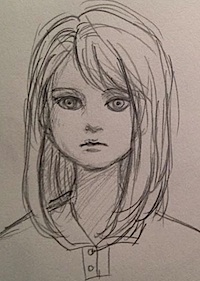
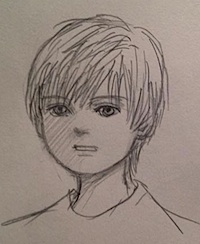
Almost every day a sketch would come of one or all of the main characters – Angela, Charlie, and Ashe.

The first 'Ashe' © Millie Ho

The first ‘Ashe’ © Millie Ho

I watched their characters take shape. In the book, we read the same story three times, each version as seen by one of this trio. With each version we get more of the back-story, and maybe more revelations about the underlying mystery. All of it? Hmmm, wait and see. I ask a lot of the young readership; for example, Charlie’s story is told backwards, and one of the first things that happens is that he emphatically contradicts one of the major events of Angela’s story. I touch on ‘difficult’ philosophical matters but, as I learned from my literary hero in the genre of fiction for young readers, Alan Garner, an author should never underestimate the intelligence of his or her readership.

The first 'Charlie' © Millie Ho

The first ‘Charlie’ © Millie Ho

The book came about as a result of a heated but amicable argument between myself and some friends. They are all Harry Potter fans, and I was tearing JKR’s literary style to shreds*. They said I should either write a fantasy set in a school and make it as good as one of hers, or shut up. So I wrote one! It doesn’t quite qualify as a ‘fantasy’, but it does feature a group of teenagers with weird powers. An early draft was tried out on the twelve-going-thirteen-year-old daughter of one of these friends. It was read to her one chapter at a time, at bed time, in return for tidying her room and doing her homework. Never had her room been so tidy, and never had her homework been so promptly completed! I think I more than won the challenge. So does my publisher, P’kaboo, who has been enthusiastic about securing and publishing the book. I did try it with Head of Zeus first of all, who asked to see the full manuscript and were impressed by it, but decided it didn’t fit with the portfolio they were building up. P’kaboo then practically tore my hand off to get it.

You will soon be able to read the book, and you will soon be able to see more of Millie Ho’s artwork on the cover. There is a teaser of the final cover illustration at the top of this article. From the sketches here you will be able to see how Angela and Ashe developed from waif-like individuals to young people with great presence. Charlie’s sardonic streak was visible right from the word go.

The Angels take shape. © Millie Ho

The Angels take shape. © Millie Ho

My publisher  was as enthusiastic as I was about Millie’s finished illustration. Millie and I are now talking about further collaboration. There is a possibility of some high-action teen-vampire fiction of mine being turned into graphic novels by Millie’s ink and brush. Millie has already added the word ‘fangirling’ to my vocabulary – it’s what we do with regard to each other’s work. Seems like a good basis on which to continue. I’ll keep you informed.

__________

* Fair’s fair – at the end of the day, JKR can ignore my opinion all the way to the bank, and good luck to her!

‘Dryad’ (with Joanne Harris)

People often ask me how I started writing. The answer is I started writing because I found I could. I entered a competition where participants had to complete a short story started by Joanne Harris. It doesn’t matter now how successful or unsuccessful my entry was; what does matter is that a quirk in my mind was turned towards writing, and I am glad of that. I thought you would like to read the story, partly © Joanne Harris, partly © me, to see the way my mind suddenly started to work back then.

Dryad

In a quiet little corner of the Botanical Gardens, between a stand of old trees and a thick holly hedge, there is a small green metal bench. Almost invisible against the greenery, few people use it, for it catches no sun and offers only a partial view of the lawns. A plaque  in the centre reads: In Memory of Josephine Morgan Clarke, 1912-1989. I should know – I put it there – and yet I hardly knew her, hardly noticed her, except for that one rainy Spring day when our paths crossed and we almost became friends.

I was twenty-five, pregnant and on the brink of divorce. Five years earlier, life had seemed an endless passage of open doors; now I could hear them clanging shut, one by one; marriage; job; dreams. My one pleasure was the Botanical Gardens; its mossy paths; its tangled walkways, its quiet avenues of oaks and lindens. It became my refuge, and when David was at work (which was almost all the time) I walked there, enjoying the scent of cut grass and the play of light through the tree branches. It was surprisingly quiet; I noticed few other visitors, and was glad of it. There was one exception, however; an elderly lady in a dark coat who always sat on the same bench under the trees, sketching. In rainy weather, she brought an umbrella: on sunny days, a hat. That was Josephine Clarke; and twenty-five years later, with one daughter married and the other still at school, I have never forgotten her, or the story she told me of her first and only love.

It had been a bad morning. David had left on a quarrel (again), drinking his coffee without a word before leaving for the office in the rain. I was tired and lumpish in my pregnancy clothes; the kitchen needed cleaning; there was nothing on TV and everything in the world seemed to have gone yellow around the edges, like the pages of a newspaper that has been read and re-read until there’s nothing new left inside. By midday I’d had enough; the rain had stopped, and I set off for the Gardens; but I’d hardly gone in through the big wrought-iron gate when it began again – great billowing sheets of it – so that I ran for the shelter of the nearest tree, under which Mrs Clarke was already sitting.

We sat on the bench side-by-side, she calmly busy with her sketchbook, I watching the tiresome rain with the slight embarrassment that enforced proximity to a stranger often brings. I could not help but glance at the sketchbook – furtively, like reading someone else’s newspaper on the Tube – and I saw that the page was covered with studies of trees. One tree, in fact, as I looked more closely; our tree – a beech – its young leaves shivering in the rain. She had drawn it in soft, chalky green pencil, and her hand was sure and delicate, managing to convey the texture of the bark as well as the strength of the tall, straight trunk and the movement of the leaves. She caught me looking, and I apologised.

“That’s all right, dear,” said Mrs Clarke. “You take a look, if you’d like to.” And she handed me the book.

Politely, I took it. I didn’t really want to; I wanted to be alone; I wanted the rain to stop; I didn’t want a conversation with an old lady about her drawings. And yet they were wonderful drawings – even I could see that, and I’m no expert – graceful, textured, economical. She had devoted one page to leaves; one to bark; one to the tender cleft where branch meets trunk and the grain of the bark coarsens before smoothing out again as the limb performs its graceful arabesque into the leaf canopy. There were winter branches; summer foliage; shoots and roots and windshaken leaves. There must have been fifty pages of studies; all beautiful, and all, I saw, of the same tree.

I looked up to see her watching me. She had very bright eyes, bright and brown and curious; and there was a curious smile on her small, vivid face as she took back her sketchbook and said: “Piece of work, isn’t he?”

It took me some moments to understand that she was referring to the tree.

“I’ve always had a soft spot for the beeches,” continued Mrs Clarke, “ever since I was a little girl. Not all trees are so friendly; and some of them – the oaks and the cedars especially – can be quite antagonistic to human beings. It’s not really their fault; after all, if you’d been persecuted for as long as they have, I imagine you’d be entitled to feel some racial hostility, wouldn’t you?” And she smiled at me, poor old dear, and I looked nervously at the rain and wondered whether I should risk making a dash for the bus shelter. But she seemed quite harmless, so I smiled back and nodded, hoping that was enough.

“That’s why I don’t like this kind of thing,” said Mrs Clarke, indicating the bench on which we were sitting. “This wooden bench under this living tree – all our history of chopping and burning. My husband was a carpenter. He never did understand about trees. To him, it was all about product – floorboards and furniture. They don’t feel, he used to say. I mean, how could anyone live with stupidity like that?”

She laughed and ran her fingertips tenderly along the edge of her sketchbook. “Of course I was young; in those days a girl left home; got married; had children; it was expected. If you didn’t, there was something wrong with you. And that’s how I found myself up the duff at twenty-two, married – to Stan Clarke, of all people – and living in a two-up, two-down off the Station Road and wondering; is this it? Is this all?”

That was when I should have left. To hell with politeness; to hell with the rain. But she was telling my story as well as her own, and I could feel the echo down the lonely passages of my heart. I nodded without knowing it, and her bright brown eyes flicked to mine with sympathy and unexpected humour.

“Well, we all find our little comforts where we can,” she said, shrugging. “Stan didn’t know it, and what you don’t know doesn’t hurt, right? But Stanley never had much of an imagination. Besides, you’d never have thought it to look at me. I kept house; I worked hard; I raised my boy – and nobody guessed about my fella next door, and the hours we spent together.”

She looked at me again, and her vivid face broke into a smile of a thousand wrinkles. “Oh yes, I had my fella,” she said. “And he was everything a man should be. Tall; silent; certain; strong. Sexy – and how! Sometimes when he was naked I could hardly bear to look at him, he was so beautiful. The only thing was – he wasn’t a man at all.”

Mrs Clarke sighed, and ran her hands once more across the pages of her sketchbook. “By rights,” she went on, “he wasn’t even a he. Trees have no gender – not in English, anyway – but they do have identity. Oaks are masculine, with their deep roots and resentful natures. Birches are flighty and feminine; so are hawthorns and cherry trees. But my fella was a beech, a copper beech; red-headed in autumn, veering to the most astonishing shades of purple-green in spring. His skin was pale and smooth; his limbs a dancer’s; his body straight and slim and powerful. Dull weather made him sombre, but in sunlight he shone like a Tiffany lampshade, all harlequin bronze and sun-dappled rose, and if you stood underneath his branches you could hear the ocean in the leaves. He stood at the bottom of our little bit of garden, so that he was the last thing I saw when I went to bed, and the first thing I saw when I got up in the morning; and on some days I swear the only reason I got up at all was the knowledge that he’d be there waiting for me, outlined and strutting against the peacock sky.

Year by year, I learned his ways. Trees live slowly, and long. A year of mine was only a day to him; and I taught myself to be patient, to converse over months rather than minutes, years rather than days. I’d always been good at drawing – although Stan always said it was a waste of time – and now I drew the beech (or The Beech, as he had become to me) again and again, winter into summer and back again, with a lover’s devotion to detail. Gradually I became obsessed – with his form; his intoxicating beauty; the long and complex language of leaf and shoot. In summer he spoke to me with his branches; in winter I whispered my secrets to his sleeping roots.

You know, trees are the most restful and contemplative of living things. We ourselves were never meant to live at this frantic speed; scurrying about in endless pursuit of the next thing, and the next; running like laboratory rats down a series of mazes towards the inevitable; snapping up our bitter treats as we go. The trees are different. Among trees I find that my breathing slows; I am conscious of my heart beating; of the world around me moving in harmony; of oceans that I have never seen; never will see. The Beech was never anxious; never in a rage, never too busy to watch or listen. Others might be petty; deceitful; cruel, unfair – but not The Beech.

The Beech was always there, always himself. And as the years passed and I began to depend more and more on the calm serenity his presence gave me, I became increasingly repelled by the sweaty pink lab rats with their nasty ways, and I was drawn, slowly and inevitably, to the trees.

Even so, it took me a long time to understand the intensity of those feelings. In those days it was hard enough to admit to loving a black man – or worse still, a woman – but this aberration of mine – there wasn’t even anything about it in the Bible, which suggested to me that perhaps I was unique in my perversity, and that even Deuteronomy had overlooked the possibility of non-mammalian, inter-species romance.

And so for more than ten years I pretended to myself that it wasn’t love. But as time passed my obsession grew; I spent most of my time outdoors, sketching; my boy Daniel took his first steps in the shadow of The Beech; and on warm summer nights I would creep outside, barefoot and in my nightdress, while upstairs Stan snored fit to wake the dead, and I would put my arms around the hard, living body of my beloved and hold him close beneath the cavorting stars.

It wasn’t always easy, keeping it secret. Stan wasn’t what you’d call imaginative, but he was suspicious, and he must have sensed some kind of deception. He had never really liked my drawing, and now he seemed almost resentful of my little hobby, as if he saw something in my studies of trees that made him uncomfortable. The years had not improved Stan. He had been a shy young man in the days of our courtship; not bright; and awkward in the manner of one who has always been happiest working with his hands. Now he was sour – old before his time. It was only in his workshop that he really came to life. He was an excellent craftsman, and he was generous with his work, but my years alongside The Beech had given me a different perspective on carpentry, and I accepted Stan’s offerings – fruitwood bowls, coffee- tables, little cabinets, all highly polished and beautifully-made – with concealed impatience and growing distaste.

And now, worse still, he was talking about moving house; of getting a nice little semi, he said, with a garden, not just a big old tree and a patch of lawn. We could afford it; there’d be space for Dan to play; and though I shook my head and refused to discuss it, it was then that the first brochures began to appear around the house, silently, like spring crocuses, promising en-suite bathrooms and inglenook fireplaces and integral garages and gas fired central heating. I had to admit, it sounded quite nice. But to leave The Beech was unthinkable. I had become dependent on him. I knew him; and I had come to believe that he knew me, needed and cared for me in a way as yet unknown among his proud and ancient kind.

Perhaps it was my anxiety that gave me away. Perhaps I under-estimated Stan, who had always been so practical, and who always snored so loudly as I crept out into the garden. All I know is that one night when I returned, exhilarated by the dark and the stars and the wind in the branches, my hair wild and my feet scuffed with green moss, he was waiting.

“You’ve got a fella, haven’t you?”

I made no attempt to deny it; in fact, it was almost a relief to admit it to myself. To those of our generation, divorce was a shameful thing; an admission of failure. There would be a court case; Stanley would fight; Daniel would be dragged into the mess and all our friends would take Stanley’s side and speculate vainly on the identity of my mysterious lover. And yet I faced it; accepted it; and in my heart a bird was singing so hard that it was all I could do not to burst out laughing.

“You have, haven’t you?” Stan’s face looked like a rotten apple; his eyes shone through with pinhead intensity.

“Who is it?”

I kept laughing. And then I stopped. We stood looking at each other, there in our front room, and I couldn’t find anything to say. My eyes wandered over to the table, where I had left my sketchbooks, and Stan’s gaze followed mine; then we looked at each other again, and I fancied I could see more in Stan’s eyes at that moment than I would have thought possible in such an unimaginative man. There was a sort of realisation, without understanding. There was anger, and there was pain.

I was terrified. I thought he might hit me. Then I thought he might do something to my sketchbooks. But at last he turned and went back upstairs, coming down a few minutes later in his working clothes. At the foot of the stairs he pulled his boots on, took the key to his lock-up workshop from the stand by the door, and went out of the house without saying a word or looking at me.

There was nothing for me to do, I felt, but to go back into the garden, and put my head against the trunk of The Beech.

People tell me that there was a terrible squall that night, and I am sure that the wind did get up awfully. But that can’t account for the way The Beech behaved to me. He seemed even angrier than Stan, now that our secret was out, and there was nothing slow about how he showed it. His trunk swayed, as he lashed his branches by my face, making me flinch. A falling branch glanced off my shoulder; a hail of leaves whipped my face. “Go!” he was saying to me. “Go! Go!”

Feelings of rejection and betrayal battled inside me with the sudden realisation that I had put The Beech in danger. I dashed back into the house, pulled on coat and shoes, and then I was out of the front door – leaving Daniel alone upstairs – running down towards Stan’s workshop. To Stan, a tree was nothing more than raw material, and the workshop held tools for dealing with that raw material. I knew what he wanted to do, but God knows what I could have done to stop him.

When I got to the workshop, Stan was sitting at a workbench. He was gripping the handle of a saw tightly in his right hand, but he was just sitting there, not moving. When I got closer to him, I could see that his eyes were glassy, and there was spittle running down his chin.”

Mrs Clarke sighed, and looked at me.

“That was his first stroke – the first of three. It put paid to his business, and to his dreams of a new house in the suburbs. It put paid to his power of speech, and suddenly I lived in an almost silent world, as The Beech no longer spoke to me either. We had to move after all, but into a downstairs flat at the other end of the borough. Stan couldn’t manage stairs, and in those days you looked after a sick husband, no question. He lived through the war, right into the mid fifties. I’m on my own now – Dan’s in Australia. I still draw. From memory……”

It had stopped raining, and I stood up, conscious that she had run out of steam.

“That’s quite a story,” I said. “Look, I’ll come back soon. I’ll see you again. But please excuse me, there’s something I must……..”

Not finishing sentences was catching! I looked back at her, as I hurried off towards the gate of the Botanic gardens. She smiled briefly, and then turned back to her sketchbook, and to her pictures – the pictures of our tree!

I walked home too fast for a pregnant woman. I hurried past the supermarket which stood, as I recalled, where the old lock-ups had been. I turned left into Station Road, and by the time I got to Mafeking Avenue, a street of refurbished terrace-houses, I was breathing hard. At number thirty-eight – my house – I fumbled in my pockets for the key, and opened the front door impatiently. I walked straight through the front room, through the dining room, through the nineteen-seventies’ extension, and out into the York-stone-paved back yard, with its terracotta pots and planters. I went straight down to the semicircle of earth at the far end, stopped, and looked up at The Beech. It had seemed familiar in Mrs Clarke’s drawings, but now I knew it beyond doubt. It was older, but it was the same tree.

I stretched out my hand gently, and laid it on the trunk – and began to understand! I turned, and rested my back against it, tilting my head round so that my cheek was against it too. I raised one hand to caress it, heard a sighing from the branches, and felt a few drops of rain, shaken from the leaves onto my face.

That’s where I was when my contractions started.

Twenty-five years have passed, during which time I have patiently learned the lesson which she did not: a secret has to be kept. The patience which I have learned from The Beech has spread outward into the rest of my life. The doors which had been clanging shut before, began to ease themselves gently open. My whole existence has seemed calmer, slower, more fruitful. My marriage went on, and produced a second daughter; oh sure, David left eventually, but men do that anyhow. I always meant to go and confide in Mrs Clarke, but I never saw her in the Botanic Gardens again, and eventually I found her in the municipal cemetery. The seat was a gesture to her, nothing more.

My life with The Beech has not been one of conversation, but of communion; not sex, but the meeting and merging of our essences. Oh there is passion, but it does not rage out of control. I sit with my back to him, to all intents simply a woman resting against a tree at the bottom of her garden, and I learn how to see and to feel with his slow consciousness, as it overtakes mine.

Soon – as a tree understands soon – my younger daughter Alice may well leave for college, or get married herself. But I shall never be alone. I shall be here, patiently waiting for answers. Do I carry a seed inside me? When I am dead and buried, will a new tree spring from the ground, and will its new thoughts be mine, or yours, or his own? This is the destiny of the dryad.

__________

© Joanne Harris/BBC/Marie Marshall

TOADMEISTER!

Toadmeister

Ratty had been emailing me faster than I could reply, not that I’m all that savvy with electronic communications. Actually I spend most of my time down my hole engrossed in World of Warcraft, deep in the wizard-world of Azeroth – I’m a Night Elf from Outland – currently operating at the fourth level of Cataclysm and on the run from Hakkar the Soulflayer… not relevant, not relevant… but on the other hand not much need for emails either.

Ratty’s emails, they went along these lines… hang on, let me open one up and cut-and-paste it for you, here we go…

“Hey Mole, I’m due to fly out to Cyprus today and go on board the Wildwood Warrior. We’re going to sail for the Gaza strip in a couple of days time with a cargo of humanitarian aid to see if we can get past the blockade. There is still nothing, Moley, absolutely nothing half so much worth doing as simply messing about in boats! LOL. Follow me on twitter @riverbankratty.”

That was last week. I can’t look at his tweets, I fear for the dear fellow. The world out there is a big place and a dangerous place. ‘Messing about in boats’ is one thing, messing about in big boats in a sea full of bigger boats bristling with guns is another thing altogether. Oh well, at least he can swim, and he always was an adrenalin-junkie, Pan knows! Like I said, I get my adrenalin rush from virtual wargaming.

Talking of which I bumped into Badger the other day coming out of the Red Lion. Bumped literally. He had his head down and his nose in his Mac Book Air, which was open. As we collided he let it slip and it would have shattered into a thousand very expensive pieces on the cobbles of the pub courtyard if I hadn’t fielded it like Alastair Cook taking a slip catch. Of course I couldn’t help noticing what was on his screen – World of Warcraft! It was an irritated ol’ Badger who snatched the lappie out of my hands.

“Hey Badgie,” I said. “Didn’t realise you were into ‘the Craft’.”

“You make it sound like the confounded Freemasons,” he said with a frown. “Yes I do the odd bit of gaming.”

“Well maybe we have crossed swords at some stage,” I said. “I’m Dalforstin the Night-Elf. Who are you?”

He mumbled something I didn’t catch.

“What was that?”

“I said I’m Kolkhatana, Warrior Princess of the Dwarves. Satisfied?” he snapped, and stalked off in moderately high dudgeon. I was silent – gobsmacked actually – as his hunched figure hurried away. He was cutting quickly round the hedge at the end of the lane when a sudden thought struck me.

“Kolkhatana? Hey, didn’t we…” I called. But he had gone. And it didn’t bear thinking about.

I decided it was time to drop in on Toad Hall. Things had been quiet there for some time. I did know that the upkeep was rather steepish these days and that Toad, bless his silly heart, had been threatening to give it to the National Trust and move into the gamekeeper’s cottage. Presumably that would mean  that the gamekeeper would have to move out – Toad wouldn’t have thought of that, of course. Anyhow, I ambled along what had once been a leafy lane… well it was still a leafy lane for most of its length but the here at the village end of it there was a tightly-packed knot of new houses – Toadfields. His Toadfulness had sold a patch of the old estate off to a developer in order to settle a tax bill. So anyhow, like I said, there I was ambling along the lane which led eventually to Toad Hall, when I realised I wasn’t on my own. Stoats and Weasels, rucks of ‘em, were popping out of the trees and hurrying excitedly down the lane. I could see the increasing crowd three hundred yards away funnelling through the lodge-gates and on to Toad’s gravelled driveway*.

Momentarily I paused. I wondered whether it was another invasion such as the one we four – me, Ratty, Badgie, and Toady – had fought off back in the day. But these stoats and weasels seemed in good spirits, not belligerent, as though setting off to have a good time. They were all relatively young ‘uns too.

I accosted a ferret in a cap and shades (incongruous those, because the sun was about to set) and asked him what was afoot.

“Hey bruv,” he said. “It’s ‘im, innit. It’s da beats, bruv, da beats. It’s totally sick, sick as aids, bruv!”

I resisted the temptation to say “No hablo Chav” and let him go on his way. Still I stood and wondered what in Pan’s name my ol’ pal Bufo Bufo was up to this time. We’d been through the camp site, the theme park, the WW2 vehicle museum, the health spa… none of those had attracted a surge of young mustelidae like this and, crucially, none of them had made any money either. I straggled behind the crowd as evening fell.

Toad hall was in darkness, but by the light of the hundreds of glo-sticks the stoats and weasels were carrying, and the luminescent screens of hundreds more iPhones, I could make out some sort of bulky structure in front of it – a stage? A dais?

Suddenly a siren sounded and a great cheer went up from the crowd. Then the cheering itself was drowned by a deafening swell of electronic music at (I guess) one-hundred-and-thirty beats per second – the unmistakeable sound of Euro-Trance. Then fireworks exploded, lasers and strobe lights flashed, the stage was lit up by spotlights and there… there… there behind what could only be a set of decks bristling with controls, screens, sequencer keyboards, all the gubbins of Electro… there in a brilliant white T-shirt, cycling shades, and headphones was Toad! Toad grinning from ear to ear. Toad punching the air in time to the music, while the stoats and weasels danced and bounced and punched the air in response.

“TOADMEISTER! TOADMEISTER!” they yelled in unison.

You could have knocked me down with a wet piece of hedge-sorrel. But as I became swept up in the euphoria, began to bounce, began to dance, began to punch the air, I realised that at last, at last, Toad had got what he had always wanted.

Acclamation!

__________

* I would be grateful to know, by the way, why Americans park on a driveway and drive on a parkway.

Cool

Cool

I hate strange cities. I avoid travelling unless I have to for work, and even then I wriggle out if it if I can. I pretend I’m nowhere at all, hurrying back from my appointments to hide away in my hotel room and flick through the television channels, settling on the least dreadful show. Sometimes I do get sick of this, and resolve to go out, leaving a mental trail of elastic thread back to my hotel, like an umbilical cord that attenuates and attenuates as I go. Long before it snaps, I let it reel me in, and I retrace my steps exactly no matter what temptation tugs me sideways.

Occasionally what seems to me like a wild spirit of adventure makes me disobey and kick against my agoraphobia. These are no big deal – I might go ten paces down a side street, or into a late-opening store for a few minutes, until the frisson of defiance is threatened again by a panic attack coming on and the feeling that I’m going to be sick. I know, I know! To you for whom it’s no adventure at all to roam the phoney souks and bazaars of the world’s far-flung towns, it must be laughable to hear someone so timid in her home country. But to tell the truth, beyond my own patria chica of a few streets and byways, everything is alien to me. Maybe I understand other women – who knows? – but beyond that everything animal, vegetable, or mineral, all that is natural or artificial, seems kind of inert and soulless to me. I guess that is why I’ve always been on my own. Sometimes I’ve provoked interest in other people, but it has always been short-lived when they don’t find that vital point of contact with me. I watch it happening. I can see it, but I can’t do anything about it.

What magic was around that one day, during that last professional mini-exile a few months ago? Normally there’s a voice in my head nagging me to forget the evening sunshine and go back to my hotel, but on this occasion something cemented me to the spot, by the door of a small bar. Easily answered. The magic was in the siren voice of a tenor saxophone, that’s what.

Precisely, I caught a snatch of a run of notes, repeated, repeated again and toyed with. Over the hum of conversation and the clink of glasses beyond the dark, open doorway, this simple playfulness, all within a single chord, I heard as suddenly thrown aside by the saxophonist, caught briefly by the right hand of the pianist, before the latter began to comp and the sax took up the melody of a standard. “Why, that’s…” I began to say out loud, and took a step towards the door.

I can’t say I actually remember walking into the bar. It was dark, half full, mercifully free of smoke – that I do remember. I must have ordered an apple cider with ice. I must have paid for it. I must have found my way to a small, unoccupied table, because that’s what I do recall. The table’s surface was slightly tacky against my bare elbows, the chair hard and almost uncomfortable, the cider was sweet on my lips and sharp on my taste-buds, the ice painful to my teeth, the jazz quartet…

Say what you like, black and white musicians come to jazz from totally different directions. Never mind what pressures homogenize them, there are still times when the racial mix of a band is as strange as a dog in a dress. The most liberal person – and people of my generation always are consciously and conscientiously liberal – listens out for tell-tale jarrings, slight… I don’t know what… I’m not a musician. Really. But I listen; music is lodged in my idiotikos and it’s something I escape into, burrowing down into melody and rhythm, resting there hearing and feeling things which may or may not be in it. So there I was, my umbilical cord somehow detached or forgotten for the evening, my lips sipping zinging apple from a glass, my elbows sticking to a table, my ears taking in sound which my mind was trying to filter unwanted ambient noise out of, my eyes making a composition from the oblong backdrop of the small stage on which were three black men and one white woman.

One man was at the piano – a grand, wedged tight into stage right, my left – and I could see him, head and shoulders only, looking down and sometimes flicking his gaze upwards to check out the saxophonist, as though looking re-established or reinforced a mental link. Another man was at the drums, taking in the rest of down-stage, loose, relaxed, smiling, chopping a syncopated be-bop as loose as himself with sticks or brushes, a swinging dynamo behind the flow of the music. A third, intense, brooding, brow lined with concentration, eyes shut, head nodding on the off-beat, hunched himself over the double-bass. All three were dark-suited, the drummer’s and bass-player’s neckties were loose, and I felt with them because I too, in my own way, was making a little gesture of non-conformity, defiance, simply by being here and conspiring with them to make or to hear music. I was engaged. They were not background noise. They were not wallpaper. Not to me.

In front of the three men was the saxophonist. Between numbers there was very little chat between her and the others, or amongst them generally, and no patter at all to the audience. Could we have been called an audience? Hardly anyone else apart from me was engaged; there was always a pitter-pattering of applause, like a brief rain-shower, at the end of each number, and maybe a couple of other people applauded solos along with me. The band hardly breathed between numbers, hardly waited for the brief applause to die down, seeming to regard it as a minor distraction along with the conversation, and the cross-currents of tinkling glass and the cash drawer opening and closing. Captained tenuously by the saxophonist, they cruised through standards and easy-winners, giving them an edge, a swing. I heard Cole Porter, I heard Gershwin, and then even Lennon and McCartney, Bricusse and Newley, Lionel Bart. Applause was a little louder the more people recognised a tune.

They had just eased their way through “Have You Met Miss Jones”, and the saxophonist put down her tenor and picked up a soprano for the first time since I’d come in. The sling her tenor had hung from was now lying loosely between her breasts, emphasising them slightly, making a sharp V, bisected by the fly-front of her white shirt. The shirt itself was picked up by one of the few spotlights almost randomly lighting the small stage. The shoulders inside the shirt were broad but spare; the arms, though I couldn’t see them, gave the impression of muscle tone, the wrists were slender, the fingers long. I caught myself thinking with a lot of “the”, sub-consciously de-personalising her, trying to ignore the fact that she was attractive. And she was. I saw a sister, about ten years my junior, and simultaneously an object of desire, an equal. Beneath my involvement with the music was an admiration for the roundness of her hips, which her formal slacks emphasised. She was tall, her hair short, feathered, spiky, and black. Her face was pale, slender, and seemed to hang from high cheekbones. Her playing… her playing was instinctive, intelligent, understanding, restrained enough for this time and place where experimentation was neither needed nor wanted, but still probing, flirting with a kind of effrontery.

Now, with the soprano to her lips, she led the combo effortlessly into “Every Time I Say Goodbye”. I recognised it immediately, right in the first bar, and I heard in it a distinct echo of John Coltrane’s Paris concert. It was no carbon copy, but the way she handled the melody said, “I’ve heard it, I know it, I understand it, and here’s my reply, my ‘take’”. She took the melody, and her improvisation made it fly like the loops, swoops, and sudden turns of a lapwing’s flight, and culminated her solo with a series of skylark trills, making my mind come up with all these silly bird-images – but wow! My applause for the solo, and at the end of the number, was louder than before, and she glanced over. Then she had a longer-than-usual word with the pianist, who nodded and mouthed something to the bass-player who nodded too.

As the saxophonist put down the soprano, and re-attached the tenor to its sling, the bass was already sounding out a few preliminary notes, making his instrument enter into a conversation of sorts with the piano. Then he picked up a familiar riff, and my heart jumped. It was Miles Davis’ “So What?” – the sextet version. It was like he was asking a question over and over, and the piano and sax started to answer with a flip comeback, “So… what? So… what?” Then suddenly they were off; the drummer swung on the hiss-cymbal, set the high-hat chapping the off-beat, clipping rim-shots across the swing; the bass player making large steps, four-square up and down the neck of the big fiddle; the pianist, watchful, comping. And oh that woman on the sax!

She didn’t exactly ignore the audience, didn’t turn her back on us, but she did turn sideways and drop her head, holding her horn close. Without imitating a muted trumpet, she was suddenly introspective, centring the music on herself, and I heard and understood the tribute to, the imitation of… no, the emulation of… Miles Davis’s initial solo. She took me with her. Her playing wasn’t Davis’ total self-absorbance – not to me, anyhow – but rather it left a way in, a window through which she showed the inner workings of her mind. Again it said, “I heard this, I understood, now here is what I have to say.” The fact that she took a trumpet part and moulded it to suit her tenor sax made me take notice of what she had to say.

Suddenly she abandoned the introspection, turned to face us full on, and relaxed out of her hunch. With eyes wide open she began to paint with brash, primary colours, launching into a second full-length solo. This was a tribute to Julian Adderley, Miles’ second soloist. It was loud, straight-ahead, bluesy, confident, adult yet playful. It was a joy, and I found my foot tapping and my head nodding as I listened.

As that second solo seemed to be coming to an end, I made to clap. But she took a breath, and turned the music round again. Her blowing became more concrete, more like sound for its own sake. She took runs and chords and tested them, searched them, used them to search other ideas and feelings. The music was less bluesy, hanging less and less upon the driving swing of her rhythm section, cutting more and more across it, probing, looking for something that was always beyond the reach of her fingertips. No, I was wrong about that, because I am sure she was holding back. But again, her playing said to me, “I have heard John Coltrane!” I held my breath and listened. No one plays like Coltrane did, but she played like someone who had known him and loved him and understood him. She played like someone on the same pilgrimage. And just when I thought she could pull out nothing more, she started to overblow, to make sounds that were fuzzy with harmonics and overtones as she made the reed in the tenor’s mouthpiece protest. The bass-player was still hunched and intense, but the pianist and drummer were playing freely and without inhibition, the former hitting loud chords, the latter syncopating wristy blows on the crash-cymbal and grinning broadly as he did so. The whole began to compete with conversations, and people bent towards their companions and put their hands alongside their mouths, looking over in annoyance. The music was beginning to be too risky for the environment.

But that was ok, because as suddenly as it had all happened the triple-solo of the sax faded, the music regained subtlety and composure, and the pianist took a short, tinkling solo.

As the sax-player took a step back and a breath, I couldn’t hold back a whoop as I applauded her solo. And I gave the whole piece a standing ovation at the end. The band stood too, to take a brief and final bow. It was the end of their set. The sax-player looked briefly in my direction, winked, cocked an index finger, and mouthed something which might have been “Thanks”.

The world was suddenly very empty simply because the stage was empty. I struggled to bring back the sensation of listening to that triple solo, but although I felt as though I could sing every note of it in my mind, its immediacy was gone. I felt like asking, “Did the earth move for you?” but there was no one to ask. The ambient noise of the bar was total now, even though it was no louder than before. There was nothing to draw my attention from it. As my teeth clattered against my glass, the conversations around me engulfed me without becoming any clearer in themselves. I was drowning, and realised that it was death to breathe. I recognised this panic and wondered if I shut my eyes and counted to ten, would I be transported back to my hotel room.

I have no idea what would have happened next if someone had not slipped into the seat opposite mine, and pushed across another iced apple cider.

“Hey!” said the saxophonist, smiling.

She was wearing jeans and a sweater now, and she had bought me a drink. I felt somehow that was the wrong way round.

“That was… I mean… hi, hello… that was just so amazing.”

“Thank you. I noticed you liked it. Not many people who come in here could care less about the jazz. I’ll get my ass kicked by the owner – he likes me to stick to standards. But I saw you dug the Cole Porter, so I asked the guys if they would mind playing something for you. They were ok about it.”

“You played it for me?”

“Uh huh.”

“Wow… I don’t think anyone has ever played anything for me before. But thanks. I mean it really was great. You got into something there – I could hear something of Davis, and Cannonball, and Coltrane of course, but it was all you at the same time. You were creating, not just being a copycat.”

She grinned again. “That’s nice of you to say, and it’s great to get someone in here who’s really into jazz. You know Sonny Rollins said – If Charlie Parker had been a gunslinger, there’d be a lot of dead copycats!”

“You’re too cool to shoot,” I said, and then thought to myself, “God, how lame!” But she was still smiling. There was a couple of bars rest. I sipped the drink she’d bought me and thought of what to say next.

“How long have you been?” I said. “I mean… into jazz?”

“My dad brought me up on Duke Ellington. Then I heard stuff like Brubek and the MJQ, and then I got into Trane, and Ornette, and Sonny, and Roland Kirk, and Pharaoh, and listened to everything I could on a jazz station. I took up sax in junior high, but there’s only so much you can do in a school band. I went for about four years in my late teens deliberately not listening to any jazz at all, so that I would play stuff that was all my own. Then I started listening again, and realised I could hear what was really going on. Trane and Sonny had been talking to me before, but now it was like I spoke the same language. Maybe with an accent, but I could talk back to them.”

“And now you’re fronting a quartet of your own.”

“Yeah, kinda. They’re some guys I know. Been playing on and off with them for about a year now. It works.”

“It certainly does. You read each other, you’re on the same wavelength. I don’t know what else to say.” I really didn’t. My isolation makes me gauche. I converse mostly with myself, and find little to say to anyone else. I was drowning again, but I wouldn’t reach out for her, I wouldn’t let her pull me out of the water. There was a pause, and I looked away as I felt her eyes searching my face.

“You look flushed – are you ok?” she said.

“I guess… maybe I’d better…”

“Look, give me a minute to get my jacket and I’ll meet you outside.” She got up before I could answer, and I was alone at the table again. Then, seemingly without any period of transience or mode of transit, I was back in front of the doorway, outside. It had gone dark, and a breeze played with a Styrofoam cup in the gutter, making it skitter. God knows how long I’d been in the bar, now I felt the umbilical tug; I knew which way to walk to get to my hotel – it was only five minutes away at most – but everywhere seemed different, and the breeze made me feel chilly.

Then there she was, coming out of the doorway pulling on a leather jacket.

“Hey!” she said again.

“Your horn?” I asked.

“The guys took it for me,” she said, and then stood there smiling, while I treated her to another silence.

“Look… “ I said. “I would really like to see you some more. I mean I don’t live around here, but we could… Do you want some coffee? I have a coffee-maker in my hotel room? Oh my God – sorry – that sounds so crass!”

But she was still smiling, and it was open, unaffected by my crassness.

“Hmm, coffee,” she mused.

The  she leant forward, and that embouchure that had kissed Davis and Adderley and Coltrane kissed me!

“Cool!” she said.

And it was. Very. As was the whole of the rest of that summer.

__________

‘Cool’ © 2007-2013 Marie Marshall

A Tale from the Hill Country

Curl Up and Burn
short story by Samuel Snoek-Brown
http://eunoiareview.wordpress.com/2013/02/03/curl-up-and-burn/ 
review by Marie Marshall

Kendall County Courthouse, Texas.

Kendall County Courthouse, Texas.

I would not normally review a short story, but this particular one by Sam Snoek-Brown is ten-thousand-or-so words long, and if the narrative were expanded it would start to knock on the door of novella. However, a short story it is, lean of excessive development and sharply focused. That leanness pulls us along and makes sure our attention is not diverted.

The subject matter is a ‘statutory rape’ case in Texas, its effects on the community and the persons involved, and its aftermath. The story’s style of presentation is one of reportage. It is written as if it is a magazine article. The narrator is as detached and non-judgmental as an investigative reporter, but his presence ‘interviewing’ and interacting with the personae of the story allows their character to be drawn out. The cut-and-paste nature of the narrative allows it to be episodic, which accentuates that drawing-out – for example, the meeting between the narrator and the convicted man’s father, the latter’s pickup blocking the road, a shotgun pointedly on display on the gun-rack, is loaded with tension and menace.

Another thing that this episodic treatment enables is a presentation of the ‘facts’ in a non-linear way. The fact that a man has been convicted of statutory rape and has served twelve years in a tough prison is made known very early in the story. The details of the case are revealed, but not necessarily in chronological sequence. Rather they are cut with historical detail, sections of modern supposed interviews with townsfolk, and with descriptions of the protagonist’s drives around his home town, where he and the crime of which he has been convicted are well-known, and of his obsession with building and maintaining a model of the town in which things he observes in everyday life modify the layout. Essentially there is no final resolution to the story, but we do realise that a story has been told. The protagonist’s final statement is terse, almost threatening in tone, but remains enigmatic.

Adding to the air of reportage is the research, including historical research, that the author has pasted into the story. The story is set in a real town in Texas – the author himself was brought up in Texas and can therefore be relied upon to give the setting an air of authenticity. Of course his storytelling style does take over from the journalistic style in places, notably in the descriptions of the protagonist’s run-in with his Nemesis, a local Deputy, and the title is a storyteller’s title, not a journalist’s.

I have a couple of niggles – no story is perfect, let’s face it. Firstly there is much made of a teenage girl’s ‘chatting on the internet’; I don’t know whether Texas was a long way ahead of us (I’m writing this from the point of view of a British reader), but in the early 1990s, when this was supposed to have taken place, chatrooms and emails were not as common as they now are, and most households, if they had a computer, were on a dial-up system for the internet, which took up phone time and therefore parents’ money. I could be out-of-touch, but this detail momentarily halted my ride through the story. Secondly, the girl in question is Chinese-American, and whilst her father has the English given name John, her full name appears to be wholly Cantonese. When a Chinese character appears in a work be a non-Chinese writer, I often wonder – maybe unfairly, I’ll grant you – whether her name has been plucked out of the air. I put the name of this character into an image search engine and came up with pictures of a male boxer. Like I said, these are only niggles, and could be my own reading quirks.

When it comes down to it, this is a compelling story, excellently written and insightful, moral but not moralistic. Sam Snoek-Brown is a tireless craftsman of the short story, and Curl Up and Burn shows that he has been working out.