Marie Marshall

Author. Poet. Editor.

Tag: writing

“Can you write a teen-vampire novel for us?”

03

If you scroll down through this blog section of my web site, clicking on the older posts as you go (a worthwhile exercise, by the way, as there is some interesting reading there), you’ll come across occasional news updates of whatever my ‘latest project’ happens to be. So what happens to them? Where are the finished products? In most cases they simply aren’t. Finished, I mean. Many of them are little better than ‘good ideas’. Other things get in the way – editorial work, judging a competition, work, food, sleep, and so on. Mainly they run out of steam, or I run out of commitment, and I know that is a personal flaw – ‘successful authors’ don’t have this flaw, if you believe their soundbites. But I feel every project was worth starting, just to see if it would work, just to see if it would carry me along.

Anyhow, now that my second novel, The Everywhen Angels, is about to be published, I have been wondering why it has been so hard to complete a third. And then I was asked “Can you write a teen-vampire novel for us?” That’s as near as damn-it a commission! My instant answer was “Yes. No. Maybe.”

To tackle this I would need to re-think my daily schedule. I have been lazy when it comes to writing. I don’t do what good writers are ‘supposed’ to do, which is to spend a fixed time each day writing. I would have to re-commit to that. I would have to shelve the two novels-in-progress that I have. That wouldn’t be shelving much, I have to confess, because they are in the doldrums anyway; but as I shelved one to write the other and now would be shelving both, well that wouldn’t do much for my confidence in finishing the third. I would have to start turning down requests for my editorial expertise; I wouldn’t be able to start any other projects, I would simply have to focus on this. Then the teen-vampire genre has been flogged as near to death as the undead can be, and is lying there waiting for a stake to be driven through its heart. Stephenie Meyer has seen to that. Is there anything left to say? Is there an unused plot? Is there an unexplored twist, an unusual angle? You can see why I said “Yes. No. Maybe.”

However, it just so happens that I have a pottle of notes, fragments, poems, and short stories about a vampire hunter. Could something be reconstructed from these shards? Let’s see if I can bang a stake in without hitting my thumb, or anyone else’s…


‘My life as a coble’, and other things

poetry life & times2

Poetry Life & Times has published a poem of mine, ‘My life as a coble’. You can read it here. A coble, by the way, is a clinker-built boat common to the east coast of the UK, particularly Yorkshire; its construction is thought to come down directly from the techniques used to build Viking longships.

Meanwhile, P’kaboo Publishers have taken on my second novel, The Everywhen Angels. More news later, including some possible promotional events.

StAnza Poetry Festival: I’m on the ‘Digital Slam’ shortlist!

stanza_tw_header

The podcast of my poem ‘O great maritime bears’ (actually written in imitation of Lisa Jarnot’s ‘Ye white antarctic birds’ and originally featured in qarrtsiluni e-zine) has made it through to the shortlist of the ‘Digital Slam’ competition at StAnza. StAnza is Scotland’s premier poetry festival, and is held in the ancient burgh of St Andrews. The winner is decided by votes cast by visitors to the StAnza blog. For me, it’s gratifying to get as far as the shortlist; of course I have to say that there’s some fine entries by other shortlisted poets, some of whom have submitted YouTube clips and so on, but if you would like cast a vote for me, that would be greatly appreciated.

Vote

Naboland and Pittenweem

Glenshee - Winter, © Kirstie Behrens

Glenshee – Winter, © Kirstie Behrens

Are you planning to go to Pittenweem Arts festival (3rd to 11th August)? If so, be sure to visit Venue 33, 7 Calman’s Wynd, where you will find the art of Reinhard Behrens, Margaret L Smyth, Kirstie Behrens, and David Behrens. This family group of artists grows in strength year by year, as the younger members hone their skills.

© Reinhard Behrens

© Reinhard Behrens

Reinhard Behrens is the creator of Naboland, where thrown-away objects find a new life, and a toy submarine voyages in and out of an almost-but-not-quite parallel world. One of Reinhard’s finds, the remains of a teddy bear, inspired me to write a prose poem – had the bear been dropped by a certain creation of Mary Shelley as he sped across the Arctic ice in search of his monstrous creation? I dared think so…

© Marie Marshall

© Marie Marshall

(c) Reinhard Behrens

© Reinhard Behrens


Aval-Ballan Poetry Competition and other news

Just letting you all know that the results of the Aval-Ballan Poetry Competition are now published. You can see them here.

I don’t know if any of you out there has been involved in judging a poetry competition. It’s not as easy as it sounds, even for a poetry editor like myself. Differentiating between the poems in a long list of about one hundred with a view to making them into a shortlist of thirty is hard enough. Whittling that shortlist to twelve winners is damn tough, particularly as it involves negotiating with other judges. Picking a winner from that short-shortlist is almost impossible, particularly when, as I said when asked, “I can’t get a ciggie paper between the first five or so”.

Having made a decision I then sat back and began to feel like a poet. I have had a lot of poetry published, and even more poetry rejected by publishers – that’s the way it goes. Nothing is going to stop the unsuccessful entrants from being disappointed. Nevertheless I wouldn’t have missed this opportunity for the world.

__________

Atlantean Publishing were kind enough to carry a notice in the  July issue of their newsletter, The Supplement, advertising my 2013 collection I am not a fish. The notice also included one of the shorter poems in the collection…

Mr Coelacanth’s nightmare

Mr Coelacanth’s recurring nightmare
is that he is before a committee of hungry cats
who ask him the question, Are you now,
or have you ever been, a fish?

Never, he replies,
trying not to speak in bubbles,
trying hard not to let words
like gill and dorsal enter his mind

simon-williams-150x150Some of my other poetry from this book was featured at the ‘Oversteps Day‘,  Saturday 13th July, at Dartington Ways With Words Festival, read by Simon Williams, as part of the ‘A toast to absent friends’ event. Thanks, Simon, for ‘charming’ the audience on my behalf – much appreciated.

Mabel’s Fables: ‘The Three Blind Men and the Elephant’

elephant fable

Little one, many folk tell the tale of the three blind men who, unaware of each other, came upon the same elephant.

The first blind man, putting out his hands to feel his way, touched the elephant’s mighty trunk, feeling it flex and move, as though it had a life independent. He took it for a great snake.

“Surely,” he thought, “This is the greatest, most magnificent snake ever!”

The second blind man bumped into one of the elephant’s legs and, putting out his arms to try and encompass it, was certain that he had found the bole of a tall tree.

“Surely,” he thought, “There is no tree in all the world like this!”

The third blind man felt the elephant’s tail brush his face, and when he caught it in his hand, he was convinced that it was part of a gigantic vine.

“Surely,” he thought, “A man could live in the shade of this vine and want for nothing.”

Now folk who tell this tale, little one, usually stop at that point, and say it proves that in matters of faith and belief, all men perceive a little bit of the truth, never all of it. But they are not wise, little one, for the tale does not stop there. It goes on…

The first blind man became devoted to his notion of a snake, and began to worship it, singing and chanting.

“O divine Serpent… O divine Serpent…”

The second blind man became devoted to his notion of a tree, and began also to worship it, singing and chanting.

“O ineffable Tree… O ineffable Tree…”

The third blind man became devoted to his notion of a vine, and began also to worship it, singing and chanting.

“O miraculous Vine… O miraculous Vine…”

Then they heard each other, and became angry.

“What fools these other two fellows are,” thought the first blind man. “This is neither a tree nor a vine, but the Holy Serpent!”

“What fools these other two fellows are,” thought the second blind man. “This is neither a snake nor a vine, but the Heavenly Tree!”

“What fools these other two fellows are,” thought the third blind man. “This is neither a snake nor a tree, but the… er… Divine… Vine!”

So they all began to sing and chant more loudly, in order to drown out each other’s voices; and soon there was cacophony.

“… ineffable Tree… divine Serpent… miraculous Vine…”

Then their anger blazed into fury, and they began to shout and scream at each other.

“Heretics!”

“Blasphemers!”

“Infidels!”

Now you are aware, little one, being the wisest of children yourself, that elephants are very patient animals. But even the patience of the most forbearing tusker wears very thin, when such a hullabaloo happens around his feet. For this elephant was perfectly certain in his own mind that he was neither snake, nor tree, nor vine, but an elephant. And indeed he was. Elephant through and through. Elephant right to the core of his being. He knew well enough that each of the blind men did not have some of the truth, part of the truth, or even a little bit of the truth. All three were totally, completely, utterly… wrong!

Eventually he could stand no more. He shook his trunk free of the first blind man’s hands, and trumpeted loudly in his ear.

“Ow!” said the first blind man, his head ringing. “No snake ever did that!”

Next the elephant lifted his leg, and trod on the toes of the second blind man.

“Ow!” yelled the second blind man. “No tree ever moved!”

Next the elephant – I’m afraid – evacuated on the third blind man, who was impudently tugging his tail.

“Ugh!” said the third blind man. “Those are neither grapes nor oranges!”

In that moment, when the elephant manifested himself to them, little one, all three were enlightened, and knew the true nature of what they had worshipped separately.

Little one, foolish though these blind men were, eventually they were enlightened. Not so, I fear, those story-tellers who stop short, and do not themselves wait for the elephant to manifest itself. You see, because our god or our gods are known to be greater than we are, it is often assumed that they are wider and more complicated than we can conceive.

But they might just be simpler, more straightforward.

Like an elephant, little one.

Now be patient. You might dream of an elephant.

Go to sleep.

Lady Clare

clare

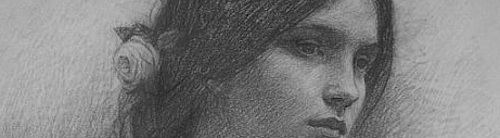
In 2006 I was experimenting with the sonnet and wrote many that deviated from iambic pentameter (yes, I know that I’m by no means the first poet to do that, and believe me when I say I won’t be the last!). One of these was inspired by J W Waterhouse’s sketch for ‘Lady Clare’, and featured lines of nine syllables in length, with an unstressed syllable at the end of each. Having had so many poems published that I have totally lost track, it was a great pleasure to receive the 10th Anniversary Issue of Rubies in the Darkness, the magazine of traditional, romantic, lyrical, and spiritually-inspired poetry, and find that my ‘Study for the Lady Clare’ is featured in it. The magazine may be obtained from Precious Pearl Press, 115 Green Lane, St Albans, Hertfordshire, AL3 6HG. Subscriptions cost £10 per annum.

‘Naked in the Sea’

nitsbanner

Image (c) Marcello Minnia

I’m very grateful to Angélique Jamail for publishing this review of my 2010 poetry collection Naked in the Sea.

The Summer 2013 Showcase at ‘the zen space’ is now published.

dreesenbanner

the zen space is ‘my’ on-line-facility/e-zine/whatever for presenting haiku and related writing. I publish it once every three months, marking the four, Northern-hemisphere seasons. On this occasion I gave over the editorial seat to Angie Werren, a haijin of no little repute. To visit, click here or on the picture above. Enjoy.

Art: a statement of priorities

Theodore Metochites

It occurred to me a long time ago that there are only two important factors in art – our expectations and the artist’s intentions – all else is subordinate. The extent to which one governs the other has been fluid over history. It is worth remembering that Théophile Gautier’s expression of autotelicism, “L’art pour l’art”, was a manifestation of a 19c movement, and therefore is less than two hundred years old. It is a blink of an eye in the history of art. However, it was an important movement, because it liberated the artist, more than any previous shift of influence, from the demands of patronage.

When we look at the 14c depiction of the Paleologue Emperor Theodore Metochites on the wall of the Church of St. Saviour in Chora, we are not looking at the work of an inept artist, simply because the stylized mosaic is not realistic to our eyes. Here the artist has created exactly what his Imperial patron asked for, and the priorities of the work radiate to us. The Emperor, his orientalism expressed in his turban and brocade robe, his power expressed in his senatorial beard, kneels before an austere Christ. In the potentate’s hands is a building, rendered model-sized – it is the Church that he had restored, and in which he was to end his days as a monk – which he offers to Christ. In his turn, Christ looks out at us, two fingers half-raised as if about to bless. We are meant to see piety, to appreciate holiness, and to feel awe. These are the semiotics of this type of Byzantine art.

face 09aThe fact that the image is already eight hundred years old reinforces the knowledge that it comes from a culture which had a sense of eternity. By contrast, an image hastily rendered in dripping spray-paint is ephemeral. The grotesque graffito of a face on a wall in Dundee was never meant to last – it leers at us for a while and is gone. I think even the wall has gone now. It comes from a culture which acknowledges and appreciates the throw-away. A very brief scan of both works of art suggests that if we took both artists we could train each of them in the use of perspective etc. and produce two adepts of photo-neo-realism. But why should we? What business is it of ours to demand that either should subscribe to our idea of what art ‘is’?

In 1907 when Pablo Picasso was midway through a birds-eye view of a group of prostitutes lounging on a bed, he was suddenly seized with the notion of incorporating a distorted version of an African mask into the picture, and two of his Demoiselles D’Avignon have markedly less realistic faces than the others. Modernist engagement with ‘the primitive’ was an exciting development in Western art. The fact that une demoisellethey got African culture(s) badly wrong, failing to see the sophistication of its art, is almost irrelevant to the dynamism of the movement. We do get it wrong when we look at things from outside our culture; by and large that can’t be helped.

Thus when we see a work of art that is eight ninths vandalism of public property, it is very likely we simply get it wrong. After all, the culture from which it comes is arcane to us, with our bourgeois standards of behaviour and taste, and our own semiotics. It could be instantaneous, yes, almost mindless. It could be a deliberate negation of the whole concept of ‘public property’ and therefore some kind of political manifesto. It could be a personal expression of angst, pain, or terror It could be part of an intricate sub-culture which we do not recognize and whose semiotics are beyond us. We may one day learn face 17awhat is going on, we may not. However, thanks to Gautier and his contemporaries, we are no longer able to impose our tastes and our expectations, beyond saying whether we like something.

Or are we? An aspect of post-modernism seems to throw the ball back into the court of the onlooker, the reader, the consumer of art. In 1968 Roland Barthes published an essay entitled ‘The Death of the Author’. Rather than restore supremacy to the tastes and patronage of a privileged class, however, Barthes’ emphasis was on the interpretation by those before whom art comes as part of the continuing creative process. Therefore the modernists’ hash of ‘primitive’ Africanism could benefit from a reprieve; moreover, our own appreciation for something splashed on a wall gives it wings – perhaps – beyond its artist’s hoped-for flight. I would say we are nevertheless no longer able to damn something as ‘not being art’, or to scorn it because of the demographic from which it springs or because we find it hard to fathom or unpleasant. Art has long since become something with fewer imposed limits, if it has any at all.