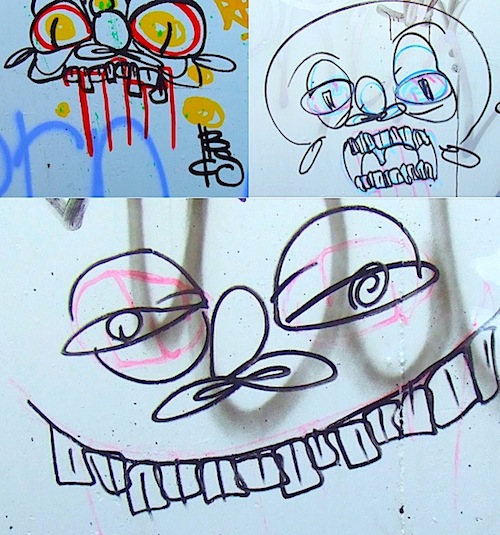
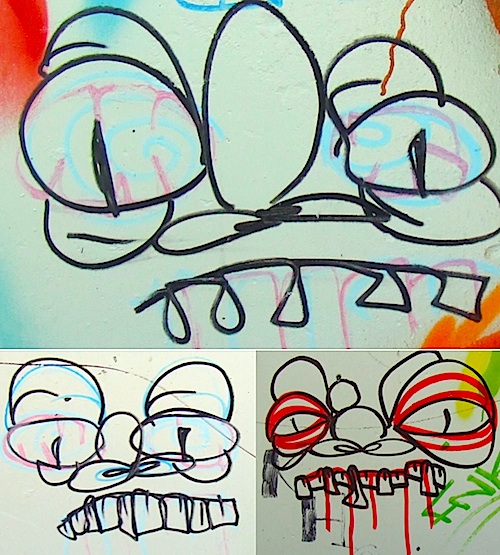
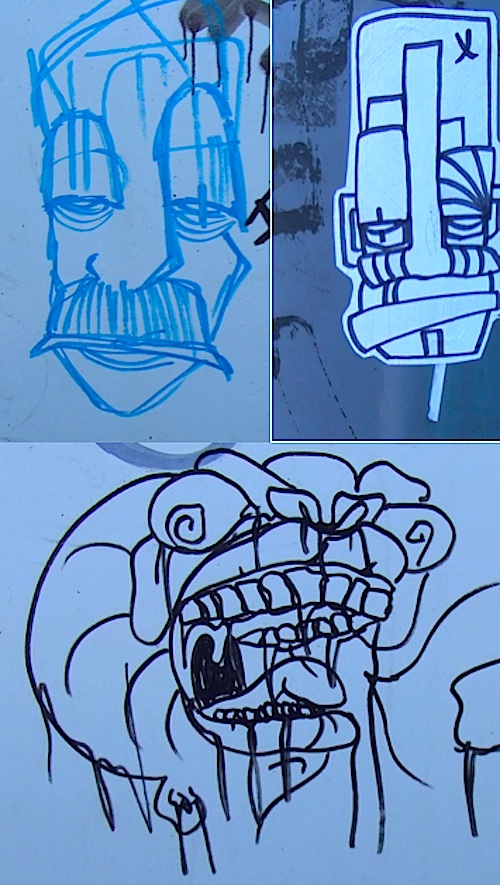
Faces of Dundee





What I’m currently doing:
Judging the Aval-Ballan Poetry Competition, promoting my poetry collection I am not a fish, tweeting, listening to one Led Zeppelin track per day because I committed to that task, organising a handful of fellow-poets and one artist to make a small chapbook anthology, looking through someone else’s poetry collection with a view to giving editorial advice, working, doing household chores, eating, sleeping…
What I’m currently not doing:
My own writing…
Something needs fixed.
Can’t figure out what, though…
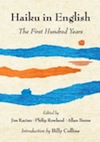 Haiku in English: The First Hundred Years
Jim Kacian, Philip Rowland, Allan Burns (editors)
2013, New York, W W Norton & Company, pp.439
ISBN 978-0-393-23947-8
Hardcover $23.95US
Reviewed by Marie Marshall
As an anthologist I know when something ought to be done, and this had to be done. The centenary of Ezra Pound’s
The apparition of these faces in the crowd;
Petals on a wet, black bough.
in the infancy of imagism was impossible to miss. This book does not commemorate a birthday, however – it’s not just for this year, 2013. It stands as a record, and ought to stand as a book of reference.
The last time I reviewed a collection of haiku I made plain my objection to much time and energy being spent on writing about this word-form. I haven’t changed my opinion, but I will say that an editors’ foreword can’t be escaped in a book of this length. There simply has to be an explanation of what the editors had been trying to do. Their exercise was one of importance, marking a numerical milestone in the writing of haiku in English, their stated purpose not necessarily to present to us the ‘best’ haiku in our own language (stating that could be seen as cannily preempting criticism of their selection) but perhaps haiku which illustrated best its stages of development over the past hundred years.
That is what we are supposed to spot as we read. The stages are not flagged-up for us. Thus when I read, say, Ezra Pound’s orientalist
The petals fall in the fountain,
the orange-coloured rose-leaves,
Their ochre clings to the stone.
and the final poem of the book, Rebecca Lilly’s
Snow at dawn…
dead singers in their prime
on the radio
I am supposed to see a word-form which has changed, developed, moved. As it turns out, with these two examples I don’t. I see what I will have expected to see throughout the book – a continuum. Every newcomer to haiku has certain ‘rules’ drummed into him/her, notably the syllable-count, the reference to nature or season, the cutting point at the end of the second line, the need to omit definite and indefinite articles, and so on. That last ‘rule’, by the way, is one of the silliest and most stultifying, and one which (I am glad to say) most good writers of haiku ignore totally. Each of the poems above use an observation of nature to point to a season, each expresses the transient moment, neither dispenses with articles and therefore each flows naturally. This is precisely what I mean by ‘continuum’; I believe that the first and last poets to appear in this collection would have understood precisely what each other was trying to do.
By the way, neither poem adheres to a strict syllable count. Billy Collins in his guest introduction to the anthology makes the point that ‘a “syllable” does not have the same meaning or weight in Japanese as it does in English’. True, but the next time I read this I swear I’ll scream. It is the prime example of a ‘non-rule’ to counter balance all the ‘rules’.
Back on track. Would I be right to conclude that if I pick someone from the middle of the period, I will find the same recognizable ‘continuum’? Here are two from Jack Kerouac:
In my medicine cabinet
the winter fly
Has died of old age
The bottoms of my shoes
are clean
From walking in the rain
Yes. No. maybe. They’re brilliant anyway. But then someone else jumps in and kicks me in the head. Larry Gates:

This is where people sit bolt upright in their chairs and say, “But… but… this isn’t haiku!’ It appears between two other poems which quite clearly do fit comfortably in the continuum, but it sticks out like a mustard-plaster on a coal-scuttle. However, in the couple of seconds your eye first takes in this piece, you see the moment that the poet has captured. You think you see the exclamation ‘Great Snakes!’; you hear the ‘SSSSSSS’ of the snake’s hiss; you experience the aphasic ‘GGGGGGG’ of shock, the ‘RRRRRR’ of anger; you do see the word ‘SNAKE’ in there, and also, if you’re paying attention, the word ‘RAKE’. The poet in his garden is surprised by a snake and lashes out with the first thing that comes to hand. The first and last poet in the collection might have scratched their heads, but I think they’d have got it!
There are more than two hundred and twenty poets represented in this anthology. They are presented in order, that order being by the date of publication of their first identifiable haiku. Given the editors’ aim of showing the development of the form, this was a logical decision. Included are poets I know well – David Cobb*, Alexis Rotella, and Johannes S H Bjerg, for example. Also, if you are attracted by ‘names’, you will find Langston Hughes, e e cummings, Allen Ginsberg, Seamus Heaney, Paul Muldoon, and Billy Collins. I spotted Dag Hammarskjöld in there too, which surprised me – in my ignorance I only knew him as a statesman. In the collection are pieces that both reinforce and challenge our perceptions of what haiku is; in the continuum, bright and jagged shapes sometimes swim to the surface.
Pages 321 to 392 of the book are taken up with a dissertation by Jim Kacian, ‘An Overview of Haiku in English’. I really wish it wasn’t necessary, given my prejudice, but I guess it is. There is not a single volume of collected works or wisdom in the libraries of the world that another editor, myself included, would not have done differently. That goes as much for Haiku in English: The First Hundred Years as much as it does for The Faber Book of Beasts or The Oxford Dictionary of Quotations. We others have to let it go. The book under review here is absolutely essential, whether I’m comfortable with it or not, and my comfort is irrelevant. If you are at all interested in haiku, then it needs to be on your bookshelf and in easy reach.
Let me leave you with one of the most poignant pieces. It’s by Frank K Robinson, and it marks a point where the form is used to draw the mind from a simple natural observation to a dynamic and terrible time in 20c history:
anzio beach…
another wave gathers
and breaks
rated ★★★★☆
__________
*David Cobb, possibly the most renowned haijin in the UK, was kind enough to contribute to the first ever issue of ‘my’ e-zine the zen space.

A New Resonance 8
Jim Kacian & Dee Evetts (editors)
2013, Winchester VA, Red Moon Press, pp.175
ISBN 978-1-946848 -22-5
$17US
Reviewed by Marie Marshall *
It’s a personal prejudice of mine that as little should be written as possible about haiku, and the same goes for writing about people who write it. You’ll forgive me, therefore, if I deal with the presentation of this anthology before I touch on the contents.
This latest in the New Resonance series is actually beautiful to look at, its covers using the reds and purples of an Emil Nolde painting, setting off yellow lettering – ‘Resonance’ being prominent. In place of a rear-cover blurb are the words
Seventeen poets
whose names you will hear often
in the coming years
and it doesn’t take a genius to spot the arrangement of syllables. Inside, the distraction starts. The business of a book – the title page and publication details – can’t be avoided. The busy-ness of a blank flyleaf, a foreword, a further title page, a list of contributors, an editorial review of the first haijin, and the publication details of her haiku – all before the first poem – arguably can. For the ninth in the series, I would like to see the editor consider what may or may not be superfluous. The first poem is ‘about’ beginning; ironically it’s on page 9. It’s a simple, enigmatic monostich
spring rain backwards until the beginning
and it is the intriguing (proper) start of the book. The nature referent is almost intrusive, interrupting an apparent grammatical flow, making the initial word ‘spring’ wonderfully ambiguous. ‘Time is not to be relied on’ runs the editorial commentary, and the poem ‘invite[s] us to read [it] over and over’. Does it? Should it? Would the shade of Basho gnash his teeth at the thought of our oohs and ahs as we fixate on the eternal plop of a frog into an eternal pool? Whatever – Melissa Allen’s one-liner is a great way to open the show. The rest of her selections are full of strength, surprising, compulsive stuff; the book leads with an ace.
Then comes another moment of superfluity. The next poet – each poet – is introduced not only by an editorial comment and publication details, but by a repeated list of all the poets, with the featured poet’s name in bold. Arguably it’s like two bars’ rest in music with the conductor still waving his baton, but please expect that at least fifty-one of your one hundred and seventy-five pages will not contain haiku. You’re looking at a stack of sandwiches, so expect a lot of bread.
But the filling!
The featured poets include many I know, such as Johannes S H Bjerg, Aubrie Cox, and Christina Nguyen, and many I don’t know. Again I’m uncomfortable writing too much about their creations. I can say that much of the poetry in A New Resonance 8 shows that there’s a happy coincidence in the Japanese words mono no aware and the English word ‘aware’. I’m going to extract a couple that stand out for me, and leave the rest for you to come across when you read the book for yourself. First Lucas Strensland’s
sleepless night
where else does she have
owl tattoos
and secondly John Hawk’s monostich
how should I put this broken window
yet another lovely monkeying-around with grammar and ambiguity. Perhaps the weakest poem is David Caruso’s
holy war
death
by ancient literature
– I feel like saying yes, you’ve made your point, but should you be even making a ‘point’ with haiku? Let me say anyhow that if that’s the weakest poem in the book – and it’s not that bad! – that says a lot for the quality of the book as a whole. After a while I even got used to the intrusive ‘bread’ pages. It’s a book to approach in may ways. I like to pick it up, flip open a random page (flip over a couple more if I land on the bread!) and read what I find there. If I occasionally land on the same poem, then that’s a serendipitous plop in the pool. This book is full of high quality modern haiku, stuff of a much higher standard than you’d even find in most specialist magazines.
Rated ★★★★☆
__________
* I’m grateful to Johannes S H Bjerg for the review copy. I would have done a shorter review for the zen space, but for the fact that the next issue is in the hands of a guest editor.
I seem to recall, from James A Michener’s Centennial, that twentieth century ranchers with sizeable flocks of sheep deliberately kept a few head of cattle, so that they could legitimately call themselves ‘cattlemen’, in order to benefit from the cachet of that name. Well, I’m an author. The fact that I also cook, clean, and have a paid job – all of which takes up most of my waking day – is neither here nor there. This means that in order to keep the content of this web site fresh, however, I have to manufacture news on a slow news day.
So, what is actually happening in my non-quotidian world? Am I currently authoring? ‘Yes and no’ is the answer to that. My second novel, The Everywhen Angels, is currently with three publishers, two of which actively expressed interest in having the manuscript; I have recently tweaked the content slightly, to reflect how the world has moved on in the handful of years since I completed it. I have plot outlines and chapters-in-progress of two other novels, neither of which has progressed for some time, I have to admit. There are many genuine reasons. However, the more these reasons accumulate the more they seem like a list of excuses – the household chores, the paid work, the fact that for much of 2012 I was working on a new collection of poetry (I am not a fish) for a publisher, the promotion of that published collection and of my first novel Lupa, the editorial work on The Phoenix Rising from the Ashes, the quarterly editorial work on the zen space…
Something had to give, and it has been work on my next novel(s). So what else of note is there? Well, since 2011 I have not been submitting much in the way of poetry to magazines. The exception being that recently I dropped a handful of haiku to Bones Journal and to Blithe Spirit (the poetry magazine of the British Haiku Society) and had one accepted at each, bringing my total of poems published since 2005 to two hundred and thirty-two. I need hardly add that this does not include poems blogged etc., which would take the number into the thousands. Nor does it include an extempore poem recently tweeted to the Scottish Poetry Library, which they instantly re-tweeted to all their followers. Nor, for that matter, does it include the poems that were published but which I’ve forgotten.*
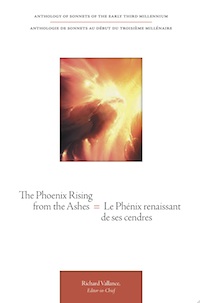 Work on The Phoenix Rising from the Ashes has reached galley proof stage. I shall be engaged in that over this weekend. Publication is late, but the anthology should be out in July. I am looking forward to that greatly, as is the whole of the editorial team. With all the work mentioned above going on, I rather foolishly proposed to five fellow-poets a small chapbook anthology – I’ll do it, I’ll do it, I promise! Thankfully the next issue of the zen space has a guest editor…
All this makes me realise that what I do not have, and should have, is a schedule detailing what I have to do. It should list tasks as ‘urgent’, ‘important’, and ‘routine’; attention to serious writing should never drop into the ‘routine’ category, even if it is to be tackled routinely, if you see what I mean.
It is 8:15 on Saturday morning. I have been up since 4:15 and have spent most of that time here at the keyboard. Have I written much? No, I’m ashamed to say that I haven’t, but I will admit that it’s a wonderful time of day for it. I really must put ‘making a schedule’ on the list of urgent tasks for today.
__________
*A lot of my records went missing in 2007.

©Bookseeker Agency

Poster
Click on the thumbnail of the image you want to open it; right click and save or drag it to your desktop. All images are based on a poster idea used by the wonderful Scottish Poetry Library; they are under my copyright, but are released for use in unmodified form as posters or wallpapers. Enjoy.
M.

PC wallpaper

Mac wallpaper

© 2008 Marie Marshall.
Twitter @MairibheagM
© 2008 Marie Marshall.
Twitter @MairibheagM

Ratty had been emailing me faster than I could reply, not that I’m all that savvy with electronic communications. Actually I spend most of my time down my hole engrossed in World of Warcraft, deep in the wizard-world of Azeroth – I’m a Night Elf from Outland – currently operating at the fourth level of Cataclysm and on the run from Hakkar the Soulflayer… not relevant, not relevant… but on the other hand not much need for emails either.
Ratty’s emails, they went along these lines… hang on, let me open one up and cut-and-paste it for you, here we go…
“Hey Mole, I’m due to fly out to Cyprus today and go on board the Wildwood Warrior. We’re going to sail for the Gaza strip in a couple of days time with a cargo of humanitarian aid to see if we can get past the blockade. There is still nothing, Moley, absolutely nothing half so much worth doing as simply messing about in boats! LOL. Follow me on twitter @riverbankratty.”
That was last week. I can’t look at his tweets, I fear for the dear fellow. The world out there is a big place and a dangerous place. ‘Messing about in boats’ is one thing, messing about in big boats in a sea full of bigger boats bristling with guns is another thing altogether. Oh well, at least he can swim, and he always was an adrenalin-junkie, Pan knows! Like I said, I get my adrenalin rush from virtual wargaming.
Talking of which I bumped into Badger the other day coming out of the Red Lion. Bumped literally. He had his head down and his nose in his Mac Book Air, which was open. As we collided he let it slip and it would have shattered into a thousand very expensive pieces on the cobbles of the pub courtyard if I hadn’t fielded it like Alastair Cook taking a slip catch. Of course I couldn’t help noticing what was on his screen – World of Warcraft! It was an irritated ol’ Badger who snatched the lappie out of my hands.
“Hey Badgie,” I said. “Didn’t realise you were into ‘the Craft’.”
“You make it sound like the confounded Freemasons,” he said with a frown. “Yes I do the odd bit of gaming.”
“Well maybe we have crossed swords at some stage,” I said. “I’m Dalforstin the Night-Elf. Who are you?”
He mumbled something I didn’t catch.
“What was that?”
“I said I’m Kolkhatana, Warrior Princess of the Dwarves. Satisfied?” he snapped, and stalked off in moderately high dudgeon. I was silent – gobsmacked actually – as his hunched figure hurried away. He was cutting quickly round the hedge at the end of the lane when a sudden thought struck me.
“Kolkhatana? Hey, didn’t we…” I called. But he had gone. And it didn’t bear thinking about.
I decided it was time to drop in on Toad Hall. Things had been quiet there for some time. I did know that the upkeep was rather steepish these days and that Toad, bless his silly heart, had been threatening to give it to the National Trust and move into the gamekeeper’s cottage. Presumably that would mean that the gamekeeper would have to move out – Toad wouldn’t have thought of that, of course. Anyhow, I ambled along what had once been a leafy lane… well it was still a leafy lane for most of its length but the here at the village end of it there was a tightly-packed knot of new houses – Toadfields. His Toadfulness had sold a patch of the old estate off to a developer in order to settle a tax bill. So anyhow, like I said, there I was ambling along the lane which led eventually to Toad Hall, when I realised I wasn’t on my own. Stoats and Weasels, rucks of ‘em, were popping out of the trees and hurrying excitedly down the lane. I could see the increasing crowd three hundred yards away funnelling through the lodge-gates and on to Toad’s gravelled driveway*.
Momentarily I paused. I wondered whether it was another invasion such as the one we four – me, Ratty, Badgie, and Toady – had fought off back in the day. But these stoats and weasels seemed in good spirits, not belligerent, as though setting off to have a good time. They were all relatively young ‘uns too.
I accosted a ferret in a cap and shades (incongruous those, because the sun was about to set) and asked him what was afoot.
“Hey bruv,” he said. “It’s ‘im, innit. It’s da beats, bruv, da beats. It’s totally sick, sick as aids, bruv!”
I resisted the temptation to say “No hablo Chav” and let him go on his way. Still I stood and wondered what in Pan’s name my ol’ pal Bufo Bufo was up to this time. We’d been through the camp site, the theme park, the WW2 vehicle museum, the health spa… none of those had attracted a surge of young mustelidae like this and, crucially, none of them had made any money either. I straggled behind the crowd as evening fell.
Toad hall was in darkness, but by the light of the hundreds of glo-sticks the stoats and weasels were carrying, and the luminescent screens of hundreds more iPhones, I could make out some sort of bulky structure in front of it – a stage? A dais?
Suddenly a siren sounded and a great cheer went up from the crowd. Then the cheering itself was drowned by a deafening swell of electronic music at (I guess) one-hundred-and-thirty beats per second – the unmistakeable sound of Euro-Trance. Then fireworks exploded, lasers and strobe lights flashed, the stage was lit up by spotlights and there… there… there behind what could only be a set of decks bristling with controls, screens, sequencer keyboards, all the gubbins of Electro… there in a brilliant white T-shirt, cycling shades, and headphones was Toad! Toad grinning from ear to ear. Toad punching the air in time to the music, while the stoats and weasels danced and bounced and punched the air in response.
“TOADMEISTER! TOADMEISTER!” they yelled in unison.
You could have knocked me down with a wet piece of hedge-sorrel. But as I became swept up in the euphoria, began to bounce, began to dance, began to punch the air, I realised that at last, at last, Toad had got what he had always wanted.
Acclamation!
__________
* I would be grateful to know, by the way, why Americans park on a driveway and drive on a parkway.
 Marie Marshall