Marie Marshall

Author. Poet. Editor.

Tag: writing

Sunset

sunset-ocean

In the days of the old British Empire, two colonial types were sitting on a Verandah somewhere in Malaya, sipping their pink gins and watching the day end.

The sun which during the afternoon had been a harsh and dazzling glare of white had consolidated to a disc of tangerine low in the sky. It rode on the horizon clouds, and its slanted rays turned the little breakers on the strand first to vanilla, then to lemon, then to copper. It kissed the far lip of the sea, sending a fan of reflections back across the miles of water. As that disc dulled to red and began to curtsey below the world’s edge, the sky faded from aquamarine to navy blue. Venus, in her peace and beauty, graced the sky by appearing at a wink, and, as if she were a herald, a million-million other stars were suddenly scattered onto the evening like diamonds onto an indigo velvet cape. Soon only a ribbon of red remained at the horizon. The sea’s lapping at the sand hushed to a repetitive whisper, the breeze captured the sudden scent of moon-seeking flowers, and the liquid notes of a bird’s call floated in from the plantation. Then the remains of sunlight evaporated with the last cloud, and a crescent moon was suspended away to the side of this heady panorama.

“Not bad, eh?” said one ex-pat to the other.

“There’s no need to rave about it like a ruddy poet, old man,” came the reply.

Keep an eye on the poetry page

whiskey

Don’t forget to keep an eye on my poetry page. The contents there change roughly once a month. (I am now waiting for the first smart aleck to ask me how come they change roughly.)

Review – ‘The Hobbit: An Unexpected Journey’

The Hobbit: An Unexpected Journey, 2012, dir. Peter Jackson, New Line / Wingnut / MGM.
Reviewed by Marie Marshall

Film poster presumed (c) MGM, reproduced under 'fair use'.

Film poster presumed (c) MGM, reproduced under ‘fair use’.

The Hobbit: An Unexpected Journey – or, as I have been calling it lately, Lord of the Rings: The Phantom Menace. Those of you familiar with prequels will appreciate what I’m driving at. There are problems with making prequels, and this film suffers from them all. Let me say straight away that it is nonetheless watchable. There are some good reasons for going to see it.

Good reason No.1 – you have a crush on Cate Blanchett or Hugo Weaver (and who could possibly blame you!).

Good reason No.2 – you are a Tolkie (Tolkeenie?) and a Middle-Earth completist, and I mean the kind of person who has even downloaded a hooky copy of the Air New Zealand in-flight safety video. In which case how could you miss this film!

Good reason No.3 – you are a fan of British and British-based actors in general, in which case this film is an absolute feast for you. You will sit there saying things like, “Hey – isn’t that Mitchell out of Being Human? Isn’t that the bloke who played Rebus?” Although if you can actually spot Benedict Cumberbatch and Barry Humphries you deserve a prize.

And that’s about it. On that last point, it does fare better than the Harry Potter canon in which the cream of British acting hammed their way to the bank, and who could blame them*. The acting quality is much better. Martin Freeman plays Bilbo Baggins almost exactly as he played Watson to Benedict Cumberbatch’s Sherlock Holmes, but he is believable as a young Ian Holm**. Sylvester McCoy is a thoroughly eccentric Radagast, and again fans will recall his equally eccentric tour of duty as the eponymous Dr Who, so it’s lovely to see him at his craft again.

However, The Hobbit: An Unexpected Journey does suffer all the ills of a prequel. There is no surprise, no delight in discovering the Shire, Rivendell, and the rest of Middle Earth. We are already familiar with it in the wonderful, broad sweep of the LOTR trilogy, with the musical tropes, and so they appear tired rather than fresh. There is no shock in seeing an orc or a troll for the first time, and in fact there is something tame about the trolls, which takes me on to the next problem.

The Hobbit, the novel on which this film is based, is very different in tone, in target readership, in almost every way from Lord of the Rings. It is very brief, shorter than any one of the three parts of Lord of the Rings, and written with young readers in mind. The three trolls that Bilbo encounters in the book are much less like the hulking, mindless monsters in the film trilogy, more bucolic, calling each other Tom, Bill, and Bert. The new film tries to bridge that gap, and damn near fails. The task is like binding two metal strips together, each of which expands with heat at a different rate, and holding them over a flame. This shows up very clearly in the scene with the trolls round their camp fire. They look sufficiently like the mindless trolls from the trilogy, but smaller, more like a trio of obese skinheads. This is a symptom of trying to marry very different books into a single experience – it doesn’t quite work.

The brevity of the book suggests to me that it could easily have been made into a single film, maybe even a stand-alone film. Stretching it out into two feature-length films is a mistake. As a result, and to provide extra action and spectacle, the film-makers have added elements which were not in the book. Unfortunately that complicates and obscures the plot. There is, for example, a back-story and sub-plot concerning Thorin and a one-handed, albino orc-warrior. It’s padding. Galadriel, Radagast, and Saruman do not appear in the book, but they do make appearances in the film. Sylvester McCoy’s cameo is, as I have said, eccentric, charmingly silly. Christopher Lee, on the other hand, plays Saruman entirely seated; he seems, as he is, much older than he did playing the same part supposedly many years into the future. The book glosses over the conflict between the shadowy ‘Necromancer’ (‘Sauron’ in Lord of the Rings) and implies that Gandalf’s order of wizards, including Radagast and Saruman we must assume, fought as one against this menace. However, the film-makers couldn’t resist giving us a disingenuously proleptic glimpse of ‘Saruman the Bad’. Again, padding, and I’m afraid the stuffing is falling out of it.

Another cameo appearance that simply doesn’t work: Elijah Wood, in real life, looks a good ten years older than he did when he first appeared as Frodo. Then he was cute, now no amount of soft focus can hide the fact that his face has matured. The result is that we are treated to seeing Frodo supposedly several years younger but obviously not. No, doesn’t work, bad padding again.

Maybe it is because I am more used to seeing Lord of the Rings in home DVD format, but I also felt that there was something lacking in the film quality, some lack of definition or clarity. It seems murkier than the trilogy. The film ends at a half-way point in the novel, leaving room for the next film to bridge the gap to Lord of the Rings. I do not know what elements of the story will be left out of No.2 (maybe the part played by Beorn the Skin-changer) nor what will be grafted in (presumably the conflict with the Necromancer and a resolution of Thorin’s feud with the pale orc), but I have my worries.

There are a few good moments of comedy in the film, however, mainly surrounding Thorin’s band of dwarves, who draw as much from Terry Pratchett as they do from Tolkien. I won’t spoil it for you, but watch out for the line, “That could have been worse.” Also it is available in 3D at the cinema, which is still a sufficiently new technology to be enjoyable, so it is worth seeing before you become jaded with the effect.

Overall I think it’s worth paying for a cinema ticket nevertheless (go for a cheap matinee), and worth buying the DVD after it has been out for a few months and the price has come down a little. You could iron to it. If I were to give the Lord of the Rings trilogy five stars, I would award this three. Not bad, Mr Jackson, but you could do much better.

__________

*There were some golden moments in the Harry Potter films too, though if you haven’t seen any of them, take my advice and only see the ones in which Jason Isaacs appears – he is the only cast member who doesn’t ham it up, and as a result he is utterly, chillingly convincing – and the one in which Hermione decks Draco Malfoy with a right hook. Shout ‘Expelliarmus’ all you like, that was the most magical moment in all that series of films.

**Except maybe to those of us old enough to remember the young Ian Holm.

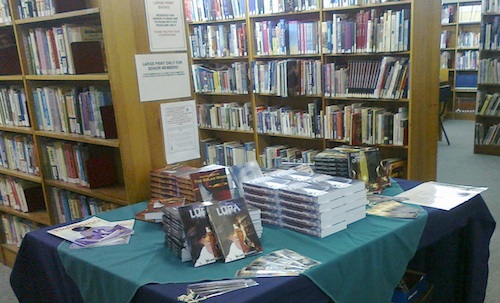
P’kaboo day at Glenstantia Library, Pretoria, SA.

(c) Lyz Russo

(c) Lyz Russo

The mini-launch in South Africa went off quite well. I was able to ‘join’ the proceedings by keyboard chat. The photo above shows the publicity table before the event began, with – yes! – Lupa on view there. My thanks go to Lyz Russo at P’kaboo for all the energy she has expended getting an event before Christmas. I’m told that there will be some more events in South Africa over the coming months, hopefully with Naked in the Sea and Mercury Silver featured also. Stay tuned.

If you happen to be in South Africa…

Lupa header temp

… on the 20th of December 2012, and you can get to Constantia Park Library, Pretoria, for 6pm, you will be able to attend a mini-launch of three books published by P’Kaboo Publishers. This will include my Lupa. Recommended – a book is always a good Christmas present, and a visit to a library is time well spent.

I mourn the passing of a blog today! Canadian poet Steve Myers – a totally unique voice – has left a farewell note on his now-empty blog. I am glad to see that he may still write, later, but sad to see that his future projects will not involve this medium, which even a technophobe such as myself acknowledges to be a remarkable tool for communication.

cartocom

Bang goes my next career move, then.

‘Mercury Silver’ and more interviews

(c) P'Kaboo Publishers

(c) P’Kaboo Publishers

There is a new anthology of short stories just released – especially for those of you with Kindle, and just in time for Christmas too. It’s called Mercury Silver, and you can get it from US or UK Amazon, or as a pdf direct from P’kaboo Publishers. It includes two of my stories, ‘Dragonslayers – a fable’ and ‘Memoirs of a Chief Replicator Technician’, the latter being a tribute to the late Gene Roddenberry. Other authors featured include Douglas Pearce, Emma L Briant, Leslie Hyla Winton Noble, Lois S Bassen, Lucy P Naylor, Lyz Russo, and Nick Legg. Check it out (as they say)!

I have been having fun answering some penetrating questions in an email conversation with Samuel Snoek-Brown. You may recall I interviewed him a while ago? Well, he repaid the compliment and the resulting interview is here. Also there’s a slightly lighter interview by Diane Tibert here. Enjoy both.

Playing solitaire till dawn with a deck of fifty-one

queen

I used to play patience (solitaire) a lot, with real cards, back in the day when it wasn’t a standard feature of Windows. Back in the day when there were no PCs, for heaven’s sake – aye, when a jug of ale cost a ha’penny, and they used to hang you for stealing a loaf of bread, and the wheel was thought to be a thing of magic!

I used to notice that people had slightly different “rules” for how the game was played. When a stack became empty, I would wait for a king to come up and place that in the empty space. A friend of mine would fill the empty space with the exposed cards of the nearest stack. Either way had its advantages and disadvantages; one might wait a longer time to turn up a king, but a lower card had less scope for adding cards below it. Another friend of mine would deal cards hand-to-hand, so that the order of the three selected cards was reversed, I would just take three of the top of the deck so that the order stayed the same; yet another friend would take the last cards at the bottom of the deck, whether they were three, two, or one, whereas if I had two or one left I would place them at the top of the deck, so that the cards would rotate by threes. Again, each of these differences had its disadvantage and its advantage, by swings and roundabouts.

I was playing one day (in the common room at school), using my spare-cards-to-the-top-of-the-deck method, and a friend was watching me idly. Suddenly she said –

“You can’t do that. That’s cheating!”

I pointed out that it was one of the many variants of the game. She said –

“Yeah… but… well… you can’t do that. That’s cheating!”

Funny thing, people’s perceptions. I found this “You-can’t-do-that-that’s-cheating” attitude turned up time and time again. I’ll give you another example. I once had a red queen at the top of an exposed stack, there were no hidden cards underneath her, so if she moved there would have been an empty space left. On another stack there was a black king. To save time I picked up the black king and simply slipped him underneath the queen, so he was now at the top of the stack where the queen was. I lifted my hand to make the next move, when…

“You can’t do that. That’s cheating!”

“I beg your pardon?”

“What you just did. You can’t do that. That’s cheating!”

I explained to the observer that I had seen that the queen would have gone on the king, and that the king would then have gone into the empty space, so I had simply saved time by slipping the king where he was going to go anyway.

“Yeah… but… well… you can’t do that. That’s cheating!”

So I said. “Tell you what – how about I put the cards back as they were? Now I put the red queen onto the black king, like this, Okay? Now I put the black king in this space here. How about that?”

“Yeah, that’s okay. You can do that. But that other way that you did it – you can’t do that. That’s cheating!”

I am sure she is now a mother, or a high-ranking executive in a company.

All I know is that my current games are governed not by a friend looking over my shoulder, telling me what I can and can’t put where, but by an algorithm. I can still choose whether to move a card, or to wait for a more favourable one to turn up, so I still have some choice in the matter. And the algorithm will allow me to undo a move. I am still waiting for someone to look over my shoulder and say, “You can’t do that. That’s cheating!” – I’ll tell them to address their remarks to Microsoft.

‘Panthera tigris altaica’

Tigris

‘Panthera tigris altaica’ is the title of a poem I wrote in 2008. It has recently been published in Rubies in the Darkness, the poetry magazine of the Red Lantern Retreat. Rubies in the Darkness describes itself as the ‘… prime specialist poetry journal of Spiritual Romanticism Worldwide’, and is one of these wonderful shoestring, small-press products that punches above its weight. It was a surprise arrival by post today.

At the same time I also received a signed copy of Peter Butler’s collection of haibun entitled A Piece of Shrapnel. Many thanks, Peter.

M.

‘A Scottish Autumn’

A couple of books were put into my hands yesterday. The first was a hot-off-the-presses copy of Lupa, one of the launch batch. It’s an interesting feeling holding the first pukka copy of a published novel. I’ve held the proof copy, but this is a different sensation. The second was a copy of the Realms of Gold anthology which I mentioned before, in which I have five poems. It was nice to find that I had won the Vera Rich Memorial Prize with my poem ‘A Scottish Autumn’. This isn’t a big prize, as the range of contributors to the anthology is limited, so I’m not about to exaggerate its importance, but it is named after a poet for whom I had enormous respect.

I wrote ‘A Scottish Autumn’ several years ago basing it on three paintings by Scottish landscape artist Tom Barron. The committee said of it: ‘The judgment here, with respect to this poem, is that it stood out for its local colour, imagistic clarity, and its intelligence.’ I have reproduced it below.


A Scottish Autumn

i.

when I was wee I used to buy
tiny drums of ice cream
wrapped round with a paper label

the melt ran down my fingers
and scented them vanilla

on train journeys banked above
where the Earn meanders
I would see bales

fallen chessmen on
an abandoned board

and a sudden trove of tastes
and smells would open up
I would find my fingers on
the carriage-window

as though to pick up
a melting memory

ii.

lassie – pit a bunnet awn

the farmer took pity on my reddening face
and the way my hair shone with sweat
we children swarmed upon the stubble field
it was our holiday to help heave the big
brick-bales of straw onto the flat-bed trailer

as the mountain grew the farmboys took them
out of our hands belt-buckle-high for the boys
but where our faces were a glow of heat
and hefted them into the hard-blue of the sky
our reward was some Tizer from the tractor-cab

now look at these –  an overturned colonnade
awaiting the fork-lift like a bull awaits an axe

iii.

close-to there is grey
and there is green

and the must
like old clothes
in the Sally Army shop

not the spitting dust
of summer

the icy water from
a seasons-old furrow
overtops one shoe

and these lone
old-men-of-the-fields

stand

mute as blocks
haphazard

lumbered ghosts
of a past
harvest