Marie Marshall

Author. Poet. Editor.

Tag: writing

Dee and Boleyn

I have sought solace in reading psalms and in prayer, but nothing avails, except perhaps my dreams; and so I seek sleep, and hasten each day with pacing to and fro, as though I could not wait for the end. My mother called such behaviour wishing my life away, but would not laugh if she could see me here.

Each night I hurry to my bed, earlier and earlier, eager to enter a world of shadows and strange colours, and to find the answers to questions which perplex me, and any other whom I may ask, during the dubious hours of waking. Yet some nights are vague, and I may startle awake with a cock-crow or a bursting-in of sunlight, to remember nothing. Or again, I may lie upon my back all night, sleepless, and with my fists balled; the days that follow are drowsy and tedious, but the little sleeps between the visits of those who attend me are sans dreaming. I could read; I have many of my beloved books around me, but am without inclination these days, except for the psalms, with their illuminations – the blood of the whiplash fish, weathered green copper, gold-leaf. My constant prayer has been let me read the book of my dreams.

I recall the third night I was ever in this room. It seemed as though I was snatched from making out the shadows on the ceiling into another world. I was a child again, in a gown of green velvet, the hue of the under-side of leaves in high summer, and a gable-hood of the same. I was upon the London River, in a barge that slipped silently against the stream with the aid of neither sail nor oars; I was attended by silent servants in tabards that matched my gown. I enquired where we were bound for, and none would lift his head, save one who eyed me and looked away, and spoke in French.

Au Lac de la Mort, Maitresse.”

To the Lake of Death – and this puzzled me, for I knew of no such place on the Thames, but only of a hamlet that had grown around a stream filled with silver salmon, for that was the place where the barge glided to the shore, and where I stepped out onto the bank. And it seemed that at the moment my toes touched the land, I was in a great hall. Everything was tall – the people in it, the tables and the chairs, for I was an infant in this dream, to whom the walls of a chamber are as great as an oak or the flank of a galleon. And this hall was filled with books, shelved against every wall. Not one window was there here, but light was given by candles, some upon tables, some on the floor, some even upon a pile of books. Between the furred skirts of the gowns of the men who gathered in the hall, I could see only a little of the tables around which they clustered. From some, charts and scrolls spilled; upon others I saw browned skulls and thighbones, bottles of dark liquids, a still but evil-faced raven which winked at me, and other objects nameless and beyond description. As I walked by them, some of the men turned their heads to look at me, and I felt my face burn in their gaze; others conversed with each other in whispers and mutters, and two or three stretched their hands over some object and intoned in a language I did not recognise. One I saw exchange gold coins for a leather pouch that seemed to move, as though it contained a frog or a mouse.

At the far end of the room, upon a sort of dais, an old man sat, as though enthroned, and it was towards him that I walked. If I looked away for a moment he seemed, from the corner of my eye, to be a boy of twelve or thirteen; but always when I looked directly at him he was venerable, white-bearded.

There was an impatience in his face, as he leant forward and beckoned me, as though he had news of great import, or some secret to tell me. But in the moment that he drew breath to speak I awoke, and was here in my prison again.

“Where is a Joseph or a Daniel who will riddle me this?” I thought.

That was the first time I met the old mage in my dreams, for indeed he seemed to be a philosopher or magician of some sort; but since that night I have met him often, walked with him through the strangely silent streets of London or the garden of Hampton Court, where we stopped to look at the great clock. I swear I saw the hands whisk through the hours and the moon-phases faster than the wheels of Phaeton’s chariot. Sometimes in my dreams he was struck dumb, sometimes I; at other times he spoke to me only in a language I could not understand, and grew angry because I did not answer. At other times we conversed.

“Do you know me, Lady?” he asked once.

“Certainly,” I replied. “You are the old magus whom I meet here in my dreams.”

“But do you know my name, Madam?”

“No, I do not.”

“I shall write it for you,” he said, and stooped to trace it in the dust with his finger. At this I shuddered, for it seemed blasphemous to imitate a gesture of the Saviour thus – hoc autem dicebant tenantes eum, ut possent accusare eum, Iesus autem inclinans se deorsum, digito scribat in terra. Even more so did what the old man wrote upon the ground, for it was more a picture or a sign than a name. A circle, which could have been his face or the sun’s, with a single eye in the centre; crescent horns surmounted the face, and could have been the moon; from a stick-like body, two arms protruded, in mockery of our Lord upon the cross; the whole figure squatted upon the ground, it’s knees drawn up, and its legs bowed.

“This is all-in-all,” he said to me, and seemed to be pleased with what he said, and to ignore my look of horror.

Three nights ago I looked for him once more, but in my dream I stepped into my husband’s closet, seeking my book of psalms. My lord was there, and I spoke to him, simply saying his name once.

“Henry?”

I reached out my hand, but did not dare touch him. He seemed to hear me, and inclined his head, with a look of sudden irritation on his face. He said nothing, but continued what he had been doing when I entered – picking up books and leafing hastily through them as though searching for something.

Upon his table I saw my own book of psalms, and picked it up. But it was false – the cover of my book held pages of crabbed writing, little of which I could make out, except for the names of sundry angels. Then I came upon a page which had the symbol drawn by the mage in the dust, and I knew that this book was his. I put it down quickly, and my hand moved to another book, mutilated and coverless. That was mine, my poor little book of psalms in French, which I now opened to read, for solace. Quand je marche dans la vallée de l’ombre de la mort, Je ne crains aucun mal, car tu es avec moi… My eye was drawn from the holy words to the bright images upon the facing pages, which were unfamiliar, and bore such names as La Reine de Deniers, and La Reine d’Epées, as though the songs of King David had become a game, or a medium for scrying. I can recall no more of that dream.

Two nights ago I met the mage again, and he showed me the court of a great queen whom all feared and loved. She was enthroned, and clothed in a white gown on which pearls had been sewn with golden thread. She had my hair, and my eyes; but those eyes were full of loneliness past bearing.

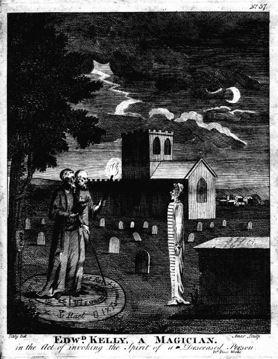
Last night I dreamed yet again. I felt myself drawn to a place where the mage stood, with another old man. They were huddled together, standing on a spot where strange devices had been scored upon the earth, as though the perimeter of the devices protected them from some evil or force beyond their control. I approached them as though through mist, or through the hall where I had first encountered the old man (though now it seemed plundered and ruined), all becoming clearer as I came close to them. At last I stood before them, a hand’s reach away, but outside their magic circle. The old man spoke to his companion.

“Strike with your staff upon the point of the heptogram, Master Kelley, and make it speak.”

At this, a look of annoyance passed the other’s face.

“I am known as Talbot now, and not by my old name. How many times do I have to say so before you remember!” He turned his eyes towards me, and drew himself up, rapping three times upon the ground with his stick.

“Speak, spirit,” he said. “Speak or be returned whence you came, and shut again in your arrow-chest. Speak, I command, in the name of an holy Power!”

“Whom do you command to speak?” I said. “I speak or do not speak at my own will, not yours. I say what is in my heart and mind, when it pleases me to open my lips. I am not bidden by anyone to speak or to stay silent, to come or to go.”

My old mage – I now thought of him as somehow mine – smiled a little, but the other became agitated, and struck again several times with his staff.

“I charge you to speak,” he barked. “Are you from Paradise or from eternal fire?”

“If you rap much harder on the ground,” said my mage. “You will find out first hand, as we shall fall through and into hell ourselves!”

“Paradise or flames?” I said. “A room in the Tower is not Paradise, though it is comfortable enough for a while; nor is it hell, for all its dreary solitude. Rather say it is purgatory, as it affords much opportunity for reflection and repentance!”

“Speak not in riddles!” cried the other. “But answer plainly, I charge you, by the angels!”

Patient now, my mage interjected, “Peace, Master Kelley; I know her, I know of her – she speaks what she thinks is true. She knows naught of heaven or hell, but lies where she lies, with her last memories, waiting for the graves to give forth their contents.”

“Master Dee, you may have traveled much, you may have been to Bohemia, and to Poland (where, I have heard, men have tails), but in these things you are ignorant. She is a spirit, and as such she has seen things you and I have not. And she is bound by the enchantment and invocation I have made, to tell us the truth. This fiddle-faddle she gives us is but her resisting my power, and it cannot last.”

“I know nothing of spirits,” I said. “Except that Saul was damned for causing one to be conjured up. I am none such. I am a queen, albeit one cast down. And Master Kelley or Talbot or whoever-you-may-be, you would be well advised to address me with more deference, and indeed to desist from your imagined conjuring.”

At this moment, my old mage turned eyes on me that held more pity and kindness than I had ever seen in him. There was such sorrow in his voice, when he spoke again.

“Master Talbot, it is clear to me that she is telling you the truth, though you cannot see it. Madam… Mistress… Your Majesty… “

His voice faltered, as though he had something difficult to say.

“Can you tell me where your favourite French headdress is at this moment?”

“Certainly, sir,” I replied. “I have it in my hand.”

“Madam, you have more than your headdress in your hand.”

At that moment, in my dream, I saw his meaning clearly –though I knew not with what eyes I saw that which I saw, for my own eyes looked up at me – and I screamed. My scream was choked by my awakening. Dreams are beyond fathoming, the pictures they paint are strange, their meaning is deep and often unholy…  and it is now today.

There is my gown, and my headdress; there also is my little book of psalms in French, undesecrated. I will wear my gown and my headdress today, and carry my psalms with me when I walk outside. I already have in mind what I will say:

Good Christian people, I am come hither to die, for according to the law, and by the law I am judged to die, and therefore I will speak nothing against it. I am come hither to accuse no man, nor to speak anything of that, whereof I am accused and condemned to die, but I pray God save the king and send him long to reign over you, for a gentler nor a more merciful prince was there never: and to me he was ever a good, a gentle and sovereign lord. And if any person will meddle of my cause, I require them to judge the best. And thus I take my leave of the world and of you all, and I heartily desire you all to pray for me. O Lord have mercy on me, to God I commend my soul.

But as I kneel, and before the swordsman scythes my head from my body, I shall think of my old magus. Then I shall breathe a short, Plantagenet prayer, and hope that my daughter, who has my eyes and my hair, will never be a queen, but will live her life a country lass, safe at home. For the burden of queenship is too heavy.


One Day in High Park, Toronto


Flash fiction – One Day in High Park, Toronto.

I was sitting on a bench, reading – hardly noticed the man, hand-in-hand with a boy. Both were dressed in black pants and white shirts, and the man had a black hat of woven straw. “Old Order Mennonite – what are they doing in town?” I mused momentarily.

They had been talking quietly, but suddenly the man raised his voice, still gentle in tone.

“No, Karl, that’s not true. You’re lying to me. I can’t allow that. You’ll have to take your punishment.”

“Yes, Dad.”

“Shall we get it over with now, rather than later?”

“Yes Dad.” The boy reached and rolled up the legs of his pants as far as they would go. The man bent down behind him and slapped him on the back of each calf, then slapped him again.

“Hey! Hey!” A guy in t-shirt and jeans, came from behind where I was sitting, vaulted over the end of my bench, and barged the man away from the boy.

“Pick on someone your own damn size!” he said, swinging a punch which caught the man on the right cheek. Down he went, and sat on the ground, hat awry, face bleeding. The t-shirt guy stood over him, fists balled.

After about fifteen seconds he got up, dusted himself off, straightened his hat, and looked at the t-shirt guy. He said nothing, but seemed to angle his left cheek a little, as though inviting another punch. Then he turned to the boy.

“Punishment over, Karl.” He said. The boy rolled his pants legs down, and came over to hold his father’s hand. “Shall we get some ice-cream?”

The boy grinned. “Yes please, Dad.”

They walked away, and the t-shirt guy stood, hands on hips. “Well… I… should… fuck… a… pig!”

I said nothing – I had a good book.

So, what’s it like to be an editor, Marie?

It’s interesting and demanding. The current task is the penultimate read-through of the first volume of The Phoenix Rising from the Ashes. The final selection process is complete, all the selected sonnets have been included, the Preface and the Introduction have been written. Now the time has arrived for us – the editorial team – to go through the final draft with a fine-toothed comb to see if we can spot any typographical errors. As we are an international panel, we have been warned not to correct British/American/Canadian English, so Associate Editor A has to do us the favor of leaving ‘neighbour’ as it stands, and Associate Editor B has to do us the favour of leaving ‘neighbor’ as it stands! Once we have completed this task (which we have to do by the middle of November) we will await the Master Copy, and we will proof-read that. We hope that the next copy we have to read after that will be the printed copy!

Being an editor or part of an editorial team does bring kudos with it, but let no one imagine it’s a sinecure

Words as ‘irreclaimable vagabonds’

On an old website of mine I had the following passage from an essay by Virginia Woolf. It is an extract from a talk she gave on BBC radio on 29th April 1937. Nothing remains of the talk except for this unique recording of her voice and the transcript below. I wasn’t the first person to do this and I won’t be the last. I’m not reproducing this because I accept VW’s argument, but simply because it is wonderful to read the words and hear the voice of such a writer…

…Words, English words, are full of echoes, of memories, of associations. They have been out and about, on people’s lips, in their houses, in the streets, in the fields, for so many centuries. And that is one of the chief difficulties in writing them today – that they are stored with other meanings, with other memories, and they have contracted so many famous marriages in the past. The splendid word “incarnadine,” for example – who can use that without remembering “multitudinous seas”? In the old days, of course, when English was a new language, writers could invent new words and use them. Nowadays it is easy enough to invent new words – they spring to the lips whenever we see a new sight or feel a new sensation – but we cannot use them because the English language is old. You cannot use a brand new word in an old language because of the very obvious yet always mysterious fact that a word is not a single and separate entity, but part of other words. Indeed it is not a word until it is part of a sentence. Words belong to each other, although, of course, only a great poet knows that the word “incarnadine” belongs to “multitudinous seas.” To combine new words with old words is fatal to the constitution of the sentence. In order to use new words properly you would have to invent a whole new language; and that, though no doubt we shall come to it, is not at the moment our business. Our business is to see what we can do with the old English language as it is. How can we combine the old words in new orders so that they survive, so that they create beauty, so that they tell the truth? That is the question.

And the person who could answer that question would deserve whatever crown of glory the world has to offer. Think what it would mean if you could teach, or if you could learn the art of writing. Why, every book, every newspaper you’d pick up, would tell the truth, or would create beauty. But there is, it would appear, some obstacle in the way, some hindrance to the teaching of words. For though at this moment at least a hundred professors are lecturing on the literature of the past, at least a thousand critics are reviewing the literature of the present, and hundreds upon hundreds of young men and women are passing examinations in English literature with the utmost credit, still – do we write better, do we read better than we read and wrote four hundred years ago when we were un-lectured, un-criticized, untaught? Is our modern Georgian literature a patch on the Elizabethan? Well, where are we to lay the blame? Not on our professors; not on our reviewers; not on our writers; but on words. It is words that are to blame. They are the wildest, freest, most irresponsible, most un-teachable of all things. Of course, you can catch them and sort them and place them in alphabetical order in dictionaries. But words do not live in dictionaries; they live in the mind. If you want proof of this, consider how often in moments of emotion when we most need words we find none. Yet there is the dictionary; there at our disposal are some half-a-million words all in alphabetical order. But can we use them? No, because words do not live in dictionaries, they live in the mind. Look once more at the dictionary. There beyond a doubt lie plays more splendid than Antony and Cleopatra; poems lovelier than the Ode to a Nightingale; novels beside which Pride and Prejudice or David Copperfield are the crude bunglings of amateurs. It is only a question of finding the right words and putting them in the right order. But we cannot do it because they do not live in dictionaries; they live in the mind. And how do they live in the mind? Variously and strangely, much as human beings live, ranging hither and thither, falling in love, and mating together. It is true that they are much less bound by ceremony and convention than we are. Royal words mate with commoners. English words marry French words, German words, Indian words, Negro words, if they have a fancy. Indeed, the less we enquire into the past of our dear Mother English the better it will be for that lady’s reputation. For she has gone a-roving, a-roving fair maid.

Thus to lay down any laws for such irreclaimable vagabonds is worse than useless. A few trifling rules of grammar and spelling is all the constraint we can put on them. All we can say about them, as we peer at them over the edge of that deep, dark and only fitfully illuminated cavern in which they live – the mind – all we can say about them is that they seem to like people to think before they use them, and to feel before they use them, but to think and feel not about them, but about something different. They are highly sensitive, easily made self-conscious. They do not like to have their purity or their impurity discussed. If you start a Society for Pure English, they will show their resentment by starting another for impure English – hence the unnatural violence of much modern speech; it is a protest against the puritans. They are highly democratic, too; they believe that one word is as good as another; uneducated words are as good as educated words, uncultivated words as good as cultivated words, there are no ranks or titles in their society. Nor do they like being lifted out on the point of a pen and examined separately. They hang together, in sentences, paragraphs, sometimes for whole pages at a time. They hate being useful; they hate making money; they hate being lectured about in public. In short, they hate anything that stamps them with one meaning or confines them to one attitude, for it is their nature to change.

Perhaps that is their most striking peculiarity – their need of change. It is because the truth they try to catch is many-sided, and they convey it by being many-sided, flashing first this way, then that. Thus they mean one thing to one person, another thing to another person; they are unintelligible to one generation, plain as a pikestaff to the next. And it is because of this complexity, this power to mean different things to different people, that they survive. Perhaps then one reason why we have no great poet, novelist or critic writing today is that we refuse to allow words their liberty. We pin them down to one meaning, their useful meaning, the meaning which makes us catch the train, the meaning which makes us pass the examination…

So interview me…

… and they did! A consequence of being published is that one becomes an object of interest and attention. In the past week I have given two interviews, one of which was to a magazine which has interviewed such writers as Minette Walters and Bernard Cornwell, so I’m in fine company. I’ll give you more news as it happens.

Apples and Ink Angels

© Lesley Haycock

Into my hands today popped a copy of Ink Angels. Edited by Kevin Watt and Elizabeth Neilson, it is an anthology of two hundred or so poems,  out of more than four million on the web site allpoetry.com, picked ‘as examples of having a profound perspective’. “Reading them,” says Kevin, “will take you to a lovely place.” I mention this because my poem Apples, written back in 2007 is included in the anthology. It’s among a wonderful collection… from my point of view it’s worth buying because it contains Don’t ask by L A Smith, who is one of my favourite poets of all time, yet so rarely is she published that she remains barely known outside a circle of friends. Put Ink Angels next on your wish list, after Lupa

How does it feel to have my first novel published?

At last my first novel Lupa is published. It was taken up by an independent publisher in South Africa who offered me a commercial contract. It feels as though the novel has had a long gestation period – it was my first work of full-length fiction and I completed it in 2004, and so it is in some senses a ‘young’ work. I have doggedly resisted the temptation to self-publish or even to accept an ‘author-subsidised’ deal. To my mind conventional publication does still confer legitimacy on a written work. This is not to say that there are not some excellent self-published works out there, nor that conventional publishing exclusively promotes works of great literary merit. We can all point to the exceptions. Nevertheless – I have to tell you – this feels good!

At present the book is available in print or in Kindle form via Amazon. My SA publisher is currently struggling with the problems of printing in both SA and the UK, so a bookshop launch in either country is not imminent. But as so much of the book trade is now on-line Lupa will actually be available internationally before it hits its domestic markets! Who knows – it may end up being printed in China.

Another aspect of being taken on by an ‘indie’ publisher is that such a lot of the publicity and marketing will have to be do-it-yourself. I am going to have to plug it via this site, via social networking, and so on, hoping that people who say they like my writing will actually prove it with a purchase, will recommend it to friends, will write favourable reviews, and so on. Over to you, I guess!

I would like to thank my agent, my publisher, my friends Lucy (who insisted that I wrote this book in the first place) and Joey (who gave it its first critical read-through back in 2004) and everyone who has made this possible for me.

A galley proof day.

(c) P’Kaboo Publishers

The moment you hold a galley proof of your book in your hands is a significant one. It is the moment that your mind-set shifts from ‘if this ever happens’ to ‘this is going to happen’. Of course there is still many a hurdle to jump on the way, but that’s how I felt when I held a preliminary copy of my novel Lupa today. I wonder if other authors feel the same way, and whether it applied as much to Harper Lee with her grand total of one novel – the wonderful To Kill a Mockingbird – as to Erle Stanley Gardner with his massive canon when they received a proof copy. My task today will be reading through the proof to see if anything has been missed during the editing stage.

Lupa is scheduled to be published by an independent publisher outside the UK; the publishers are trying to organise a separate print run in Britain, however, and it will also be available worldwide as an eBook. When I know the final arrangements and the launch date you’ll know too, but it may be in time for Literary Dundee in October.

Meanwhile a UK publisher has asked to see my second novel The Everywhen Angels. I merely mention this in passing because, as every author knows, that is only the very first step and one which might have to be retraced, having led nowhere. Even having a book accepted is part of a process in which each stage provokes a different reaction. There is the initial elation when the publisher says yes, the frustration and boredom when nothing seems to be happening, anger when a publisher’s editor insists on a change to the text – I recall how it felt to sacrifice a line of dialogue from Lupa, a line which I felt was the emotional climax of a key episode, at the insistence of the editor, but it had to be done and done with good grace on my part – anticipation as publication date moves nearer. As writers, authors, poets, we feel all these most keenly; it has to do with the urge to communicate, our art depending on language, the prime mode of human communication.

Ah well, time for a morning cup of tea. There’s a sunny day ahead today, and if I start my reading now I may get out into the fresh air later…

Is it too much to say ‘fallen comrades’?

Over the past couple of days we have lost Maeve Binchy and Gore Vidal. I don’t think I can add anything to obituaries and tributes published elsewhere, except to say that the loss of literary masters and mistresses reminds us very clearly that life is a loan and payback day comes around. Vidal’s Julian is on my to-read list and I mean to get to it soon.

Meanwhile work continues. The sonnet anthology The Phoenix Rising from its Ashes is moving ahead slowly. Due to unforeseen difficulties I have been asked to take over a task from the Editor-in-Chief. I’m sorry that progress seems to be glacial, but that’s the way of publication as I know from my own projects (about which more later, hopefully). Meanwhile the printed ice-cap continues to melt in the heat of E-publishing’s global warming. I feel like a polar bear.

__________
The image of Gore Vidal is from a photograph by David Shankbone.

“No matter how famous I become…”

“No matter how famous I become I will never ask for nor accept, from any publisher or magazine editor, more than the standard fee for any piece accepted. If that means accepting no payment for a particular piece then I’ll accept no payment, and that’s all there is to it!”

I had been in conversation and the subject of a famous poet came up, one who had been asked by a magazine of which I was part of the editorial team if we could reproduce one of her already-published poems. Yes, said her agent, and named a substantial fee. Having recounted this in the conversation I made the declaration above. I said that no poet is greater than her audience, and that everyone has the right to beautiful, radiant things (to quote Emma Goldman).

“Put that on your web site,” came the reply to my declaration. “Look at it again in ten years’ time, and see if you have stuck by your principles!”

Well, there it is. Of course in ten years’ time we won’t have web-sites, we’ll be manifesting ourselves in holographic displays, triggered by our audience’s thought-waves. Or some such…

*

You may be asking what has happened to the many writing projects I have talked about over the past couple of years. Well, most of them have been shelved for one reason or another. Admitting this may make me seem like a writer who can’t stay the course. Well that’s a possibility, I suppose, but on the other hand this year I have completed a new collection of themed poems for submission, by invitation from a particular publisher. The shelved projects may remain shelved, or they may re-emerge later, as they are or reworked. I don’t know.

Meanwhile I’m about to add another project to the list. As a radical departure for me I am hoping to adapt another novelist’s book as a radio drama. That may end up on the shelf as well, but I’m willing to have a go. I shall let you know in due course.