Marie Marshall

Author. Poet. Editor.

Tag: writing

Welshday: The inebriate Detective Inspector Rimbaud sings the praises of his love

I am old, too old for this bright love,
and yet I am dazzling in its ardency.
The slight snow greys my green body,
and my law-burns choke their weeping
in a jumble of scree and dirty ice.
As the citric sunlight of February afternoons

fades to madness-in-winter,
hopeless piping, desperate picayunes,

the gabble of the steep-in-age,
so you walk in, evening-cloaked,
a swirl of velvet, a silent falling,
a brief brush of lips against mine
and – O gods of my imagined tribe,
how such things burn hard on me!

I am demented for ever,
caught in the cold flow of eternity,

made cold, hot, cold, hot, cold
by your bright and coal-red lips,
the only fire, the sole light,
the lone sun in a black universe,
the one illumination of lost souls.
I should climb the ridge of your cheekbones,

the savannah of your hair,
the tearpaths of your face, jewelled rhones

and channels of soft weeping,
the bays and bights of your arms,
the long strand of your scapulae,
the bitter wind of your nape scouring
your shoulders’ mystery.
At times your kisses are baked bread,

the truth of straight-grown trees
with their cones fallen brown-red

and their honest, grey-and-green needles,
their brown cone-bells rustle-ringing;
the surprise of sea-scents, your kisses,
the gentle knock of a loosely-moored boat
against a grey-and-green wall
where the mad moonlight comes walking.

This is the alchemy of my love,
the whiskey talking.

__________

Welshday (you will need reminding) is a project I conceived in late 2008. It was to be some sort of verse-drama in which a fictionalised Irvine Welsh was conducted through a shadowy Edinburgh by an alcoholic policeman and a totally silent mime-artist, amongst others. Irvine Welsh himself gave me his permission (his actual words were “No worries – go ahead”), but since then I have only returned to work on it from time to time. It has been one of those many projects for which there are ideas but no handle to grip.

However, when I have returned to it, it has often given me a stand-alone poem. The one above is part of a planned section of the drama in which Irvine Welsh relates an ancient tale of Finn MacCool, Welsh and Rimbaud make punning variations upon the theme ‘mony a mickle maks a muckle’ using the names of sundry Scottish towns, Rimbaud rhymes endlessly using the words ‘Leith’, ‘Police’, and ‘fish’ to prove he is not drunk (whilst proving only that drink does not affect his ability to rhyme), and the Chorus reminds them where and who they are.

__________

Some small news of publications. My piece of flash fiction High Park, Toronto, can be read on-line at BoySlut. The Carnage Conservatory recently ran a three-liner of mine.

The Phoenix Rising from its Ashes

The Phoenix Rising from its Ashes is the title of the international anthology of sonnets for which I am one of the editorial team. The project has grown since its inception, to the extent that it will now be published in two volumes. The first will be the poems in English and French, the official non-Native languages of Canada, and is scheduled to be out by the end of 2012. The second volume will be of poems in other languages. That volume is expected to be on sale in spring 2013.

Working on this anthology has been a rewarding experience – a real labour of love. I have read hundreds of sonnets and have had to reject many which are remarkably strongly written. However, most of the kudos for this work should go and will go to Editor-in-Chief Richard Vallance and Co-Editor Jim Dunlap, whose continuing workloads far exceed those of the rest of the team.

I will post occasional news of The Phoenix here, along with news of other publications in which I might be involved either as author or editor. A propos that , I am now collecting work for the next online issue of the zen space. I am looking for original haiku and haiga, so please do feel free to get in touch. I recommend reading all the pages on the site before submitting.

Decanto, February 2012

The February issue of Decanto poetry magazine is now available from Masque Publishing. It is packed full of international poetry including a poem by myself. Featured poet in this issue is Jackie Fellaque.

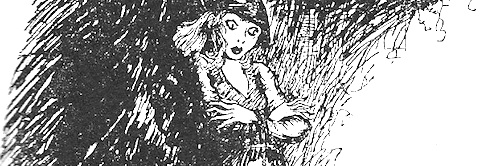
An excerpt from ‘The Chronicles of Anna Lund of Helsingfors, Vampire Hunter’

I can remember a cold evening, very cold, my toes numb in my boots, my fingers aching in my muff, so much so that I wanted to take them out and suck them to make them warm. I was huddled close to my father, his left arm was round my shoulder, and our feet crunched on the snow as the skirts of his coat flapped outwards at my thighs and legs. We were hurrying, and I felt that it was not so much because the winter snow was whipping at our faces, but because it was late. My father was in haste to get home, almost as though he was afraid. A few lights from windows and elsewhere threw patches of yellow glow on the snow, but though every flat surface was white and the wind was drifting it against walls, there were still shadows too dense for my half-shut eyes to see into, and pieces of black wall standing crazily upright like broken teeth or gravestones. Snowflakes clung to my eyelashes, and there was enough warmth in my face to melt some of them and make them run like tears. My legs propelled me almost to fast for me to stay upright, and had it not been for my father’s steadying arm, I believe I would have tripped over my numbed toes. My body and my breath were hot from effort, making my extremities feel even colder by contrast. If there was any sound apart from the crunch of our footfalls – which I seemed to feel rather than hear – it was lost in the wind that buffeted my ears. A winter night in Helsingfors can be cruel.

Then there was a moment when I came closest to falling; that was when my father suddenly stopped. Again I can’t be sure of sounds, but I think he gasped. He pulled me closer to him, pressing my face into his coat. It was rough and harsh against my skin, and I couldn’t breathe, so I slowly twisted my head so I could see out of the corner of my eye, between two of his long fingers as they barred across my face.

I thought I could make out that we were close to our home. If it had been bright daylight, I might have recognized the place where the street bent to the right, and to the left an alleyway led up narrow steps before making a right-angle and losing itself amongst the tenements and go-downs of the city. High on a wall a casement was flapping open in the wind, wrenching back against its own hinges. It was allowing a light to shine down upon the mouth of the alley and the steps. At the margin of the patch of light there seemed to be two vague shadows. One was like a crumpled shape on the ground, the other seemed to bend or loom over it; as the snowflakes dashed against my face, the two shadows seemed to merge into each other, separate, and merge again. Then suddenly, the lower shadow was alone, the looming shadow had disappeared; but instead there was a figure standing at the top of the steps, a man in dark clothes. The light from the casement shone directly onto his face – it was as though his face attracted it. To me it seemed as though his bright eyes were fixed upon me and only me, and he was looking at me, memorizing my half-hidden features. He was grinning, a nasty, fixed grin, and there was something about his teeth – I could not take my eyes away from his grin.

The wind blew my father’s coat across my face for a moment, and when it flapped back again the top of the steps was empty. The man had gone.

Once we reached our house, my father took me up to my bedroom and made me lie down for the night. I didn’t go to sleep immediately, and my father sat there beside my bed, his head bowed as though he was praying. When I did go to sleep – I seem to remember – my dreams took me back to the mouth of the alley. It was always deserted, not only free of snow but as though the steps had been swept by a broom. The casement was always tight shut and curtained. There always seemed to be the echo of running feet…

__________

‘Anna Lund’ is a casual, on-going project of mine. Something might come of it.

Of Sam, Miss Smith, and Justice!

When I was young I read a whimsical book by Beverley Nichols entitled The Tree That Sat Down. The story is set in a wood where four human characters – Judy and her grandmother Old Judy, and Sam and his grandfather Old Sam – run two rival shops. The Judys’ shop is set in the crook and hollow beneath an old willow tree, and there they sell all kinds of good and wholesome things to the talking animals of the wood. The Sams are newcomers and set up a rival shop in a ruined Model T Ford. Young Sam is a hoodlum and uses modern advertising techniques to sell worthless things to the animals, many of whom are nonetheless taken in. Sam recruits the help of Mr. Bruno, a bear who is basically decent but weak. In order to impress the woodland animals, Mr. Bruno has always pretended to come from ‘The Steppes of Russia’ and to be able to speak Russian, but Sam blackmails him, having recognized him from a visit to the circus from which Mr. Bruno had escaped. He becomes Sam’s bearspaw and bearsbody, doing nefarious errands for the young entrepreneur.

Into the wood comes a character who comes and goes through several of Beverley Nichols’ children’s books – the witch Miss Smith, with her attendant squad of toads. Though two or three centuries old, Miss Smith presents herself as a young lady of fashion. She is thoroughly evil, and Nichols describes this in a simple but succulent way:

“… all the evil things in the dark corners knew that she was passing… The snakes felt the poison tingling in their tails and made vows to sting something as soon as possible.  The ragged toadstools oozed with more of their deadly slime… In many dark caves, wicked old spiders, who had long given up hope of catching a fly, began to weave again with tattered pieces of web, muttering to themselves as they mended the knots…”

Sam accepts her help in his commercial war, but soon finds himself dominated by her. She suggests sending a poisoned gift, which she will make, to the Judys. Sam seems terrified at the implications of this, but mutely agrees, and Mr. Bruno is forced to deliver the deadly package. He sets off to do so, but at the last moment surrenders in tears to Constable Monkey and Mr. Justice Owl.

The animals put young Sam on trial for his life. Prosecuting counsel is the Judys’ best friend Mr. Tortoise. Mr. Justice Owl, despite his incompetence, conducts the trial, and Mr. Bruno, Miss Smith, and even the toads (“Swelpmesatan” they croak in chorus as they take the oath) give evidence against Sam. A storm is coming, the wind is rising; Judy looks at Sam cowering in the dock and feels nothing but pity for him. She shouts for mercy, but her cries are carried away in the wind. She looks up to the clouds and prays for some power to save Sam. The clouds roll back and she sees the stern face of the Clerk of the Weather – an angel who had once complained to God about the remorseless sunshine of heaven – who sends a tornado to blow Sam away to a new but hard life.

Mr. Tortoise transforms into a handsome prince – he had been turned into a tortoise until he had learned to better his ways – and marries Judy.

I can recall how incensed I was as a child by Sam’s trial. Certainly he was a wrong’un, a capitalist, and a racketeer, but how could it be fair? The judge was incompetent, the jury of animals was prejudiced against him after learning of the plot to kill Judy, and he had no defense counsel. Moreover he had been an almost-unwilling party to the plot, which had all been the suggestion of Miss Smith. She had made the poison. As far as I could tell Sam hadn’t even touched it, Miss Smith put it into the hands of Mr. Bruno, and now these two co-conspirators were giving evidence against him. I shouldn’t have had any sympathy for Sam, but my outrage was more practical than Judy’s pity. I imagined myself imposing my presence – a girl no older than Judy at the time – upon the court as counsel for the defense, showing how inadmissible the evidence was, how unreliable the witnesses were, how little a part Sam had actually had to play in the scheme, and dashing the prosecution’s case to pieces! How delicious it would have been to have had a battle of wits with Miss Smith as a hostile witness.

As I could not do that, I went through the book from the beginning, scoring out any bad thing that Sam did or said and writing in a virtuous alternative characterization. By the time I had finished the pages were thick with crossings out and were a palimpsest of redemptory fiction.

That was, I believe, the only time I had ever desecrated a book. I am rather glad I did, though, and if I ever get the time and inclination, I will search the second-hand book stalls and car-boot markets for Nichols’ other books that feature Miss Smith. It seems that she catalyses my creativity. I’ll put my pens well out of reach, though.

Tower Journal, Winter 2011-12

Poet and editor Mary Ann Sullivan has done me the honour of featuring eleven of my poems, alongside those of US Laureate (2008-2010) Kay Ryan and former Laureate Daniel Hoffmann, in the current issue of The Tower Journal. My featured poems are all from my 2011 output and include all four of the poems inspired by Veronica Franco (or perhaps five, as Calle dei Morte might be narrated by her or a ‘scene’ in her psyche – I wasn’t sure when I wrote it and I think I’ll leave it arcane). Mary Ann has been very complimentary about my poems and I was very pleased to be invited into an issue of Tower.

Winter 2012 showcase at ‘the zen space’

Happy New Year!

The Winter 2012 showcase at the zen space has now been published. It was hard but rewarding work sifting through the haiku and short-burst poetry, but I think the result is pleasing. Please do feel free to visit.

image (c) Marie Taylor

‘A Woman on the Edge’ – workshop project of prose and poetry: Omega.

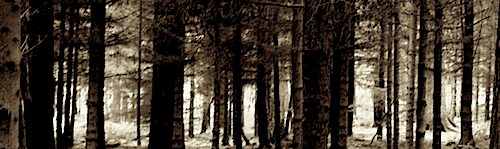
One day nature will declare my work-in-progress a canon, and there will be an omega stamped, sealed, upon my work. It will be as final as a horseshoe-print on my skull, a line drawn underneath the last word on the last page. The moment before that line is drawn and the Omega is spoken I know that I will be praying to write just one more line, one more metaphor. Perhaps it would have been as apt a metaphor as – life imitating art – was drawn by those foresters who lately cut down some trees in a piece of Perthshire woodland. No doubt in an act of supposed ‘management’ they culled those on which, a couple of months previously, hand-written poems of mine had been pinned, but more than management it seemed like retribution exacted by the landowners for their having participated in an act of revolution. Cruel landowner! Cruel foresters! The trees were innocent bystanders, or at most unwitting insurrectionists!

Still, it made me think.

It knocked clean out of my head my project of hidden poetry, buried under the earth and leaf-mold of the forest floor. In its place was panic at the thought that a day would come when I produced no new poetry, not simply poetry that would remain unseen. How awful a glimpse of mortality!

I shall seed amongst old books some scraps and notes, lines in my hand on the backs of old envelopes, hints of manuscripts completed but undiscovered, so that there will always be speculation as to whether any ‘canon’ is complete, whether there are poems out there new to the reader’s eye. I shall redecorate my house, writing in felt marker upon a wall before I apply paste and paper, so that – perhaps – when they blue-plaque the building with a reverent Marie Marshall, author and poet, lived here it may be treasure-trove. I shall give my man-of-law a box and specify that it is never to be opened.

Such you may consider to be sleight of hand, deception, half-lies, total falsehoods, and finite even if secretly so. I shall bequeath to other poets a phrase each, an idea, some few words, a sentence, a rhythm, a rhyme – something. Along with each bequest will be a plea for them to run with it, weave it in-and-out of the pommiers of their poetic orchard or of the bollards and signposts of their city streets, to mortar it as a reclaimed brick into their own wall. I will release my works to the world and say: If you have a mind to poetry, then lift these, re-mould them, extract text from them, expand the images and metaphors, or simplify them, encapsulate them in seventeen syllables, do anything you wish… but please be sure to acknowledge them!

Perhaps there is an Edgeland between life and death, and this is why we believe in ghosts; perhaps my own dreams – the ones where I can fly, rather as one treads water – are intimations of this state seen through a crack in time and space. If this is so, I might be watching as it all unfolds. I might be the goose that walks over the grave of the reluctant poet – the one who doesn’t pitch in – and makes him shiver. You have been warned.

‘A Woman on the Edge’ – workshop project of prose and poetry, part 6

Templeton Woods

Held in an irregular trapezoid between Dundee and one of its dormitory villages, bordered by a broken road, by the ordered twists and turns and straight-forwards of a golf course, by the rat-run to Coupar Angus, and crowned by a water-tower, is the wood where I walk. I prefer to pick days when I won’t meet anybody, so that in this patch, this scratch of trees on the map, this soledad, I can run and walk alone. I can lose myself, pretend I am in the depths of the antic Caledonian Forest; so I come midweek, maybe in the rain, deliberately to feel the breath knife my lungs and my heartbeat rise to meet it. I feel safe here, there is no denying. Sometimes I feel as though I could pull a blanket of fallen leaves over me and sleep, never to be found, although sometimes felt. I have run here in the dark, bobbing my torch to the fall of my trainers, veering crazily off the path and crashing into branches, and only the cold has held pace with me. I have deliberately stood here waiting for evening to overtake day, for the last sky-metal to turn edge-on to me and withdraw, for the blue-to-black sheath to take its blade, so that I could look up between the trees to see stars, shooting stars, tricks of the light that never came. All this so close to civilisation.

On the 20th of March 1979, eighteen-year-old Carol Lannen was witnessed getting into a man’s car in Dundee. Some time later her naked body lay here in Templeton Woods; she had been strangled, her clothes were never found but her handbag was discovered miles away in Aberdeenshire. A little short of a year later a shy young woman by the name of Elizabeth McCabe went missing. Rabbit hunters found what they thought was a discarded shop-window dummy lying very close to where Carol Lennan’s body had been found. Neither murder has ever been solved, each remains a cause célèbre, and a torment to those who knew and loved each victim.

And yet I still come here, willing myself to be lost, to be alone. Day after day I cross the trail of other walkers, I find litter, hear a dog barking. Woods like this one right here on the edge of things are debatable places. They ought to be wild yet so much of them is touched daily – we come for solitude, for exercise, maybe for sex, for thought, for stars. Twice, as recorded, to leave the aftershock of pain and terror. Oh God, there are edges and then there are edges.

The Haunting of James Abbott McNeill Whistler

It is late on a rainy winter’s afternoon in the Hunterian art gallery in Glasgow. Little daylight finds its way into to the interconnecting rooms and the artificial light is yellow and diffuse, or seems so to the gallery-goer who is standing in front of a pair of paintings. They are behind one of the last few partitions at the back of the gallery, almost hidden from view unless one knows they are there or have happened on them in a spirit of exploration. The gallery-goer has to look slightly downwards to see them, as there are two other paintings above. These other paintings have only held her interest for a moment or two, but the lower pair seem to have transfixed her. She shifts her stance slightly as if to alter the angle of her gaze and lose some unwanted glare or reflection from the literal surfaces, and thrusts her hands in the pockets of her coat to quell an urge to reach out and feel the texture of the paint. She reads the laminated plaques at the side of each painting and confirms that they are by James Abbott McNeill Whistler and are part of the bequest of his sister-in-law Rosalind Phillip.

Whistler has never been her favourite painter – she prefers German Expressionism if anything – but at this moment she feels a compulsion to stand and let her emotional and intellectual reactions overlay each other, confuse her, vie for strength like two equidistant radio stations fighting for the capture effect. Arranging her thoughts like clothes on a washing-maiden to dry, the gallery-goer builds the following analysis.

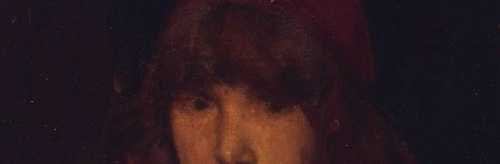
The composition of each painting is simply the figure of a seated girl from the waist up. She has long, full, auburn hair with an untidy fringe touching her eyebrows, and tresses which rest on her shoulders. She wears a purple beret or small cap on the top of her head, pushed back. She is dressed in shapeless, dark clothes, maybe brown, or black seen with a reddish sheen by a dim lantern or firelight. In one painting her body is angled slightly away from the artist and she has turned her head towards her left shoulder to look directly at him. Her hands rest on her lap but the delineation is imprecise, they are pale and doll-like, or like hands on a photograph from Belsen. In the other painting she is slightly more squarely-on, her hands are out of sight. At first it seems that her gaze is straight towards the painter again, but perhaps she is looking to his right and slightly down. The second painting seems to have been executed with a darker palette, but in both cases it looks like paint has been applied and then has been scraped thin. The texture of paint and canvas are one. The modeling is uncertain, the girl’s pale face seems to be the only source of light. The picture space has almost no depth, as though she is sitting directly in front of a dark wall with her back pressed against it. The tone in the first painting is stark in its contrast between light and dark even though the background colour is a warm brown; the white of the girl’s hands and face are almost shocking, and although her gaze engages the artist and the viewer there is a remoteness, we are at arm’s length from her. The second painting is darker overall, but the tone of the girl’s skin is softer, there is more colour to her cheeks. She seems to be closer to us, and although her gaze is slightly averted the whole effect is more intimate. In both cases her face dominates the picture, drawing the eye into an uncertain virtual space full of ‘as though… as though’.

The gallery-goer does not know how long she has stood looking at these paintings. She becomes aware that someone has come to stand at her left elbow, though she did notice this person arrive. The other person speaks to her, and in the exchange that follows tells her a story, or maybe more than one story.

*

Beautiful, isn’t she! You don’t think so? Well I’ll grant she isn’t conventionally pretty. Her nose is long, her mouth is canted slightly downwards to the left, her expression is mournful, her complexion seems pale and warmed only by external influence rather than by her own blush, and – look here – that could almost be a scar. No, I think it is more likely to be the violence of Whistler’s palette-knife as the mark is only there on one of the paintings. But her face holds you nonetheless. Am I right?

You are wondering why the title, why ‘Le Petit Cardinal’, why present the model as a male? There is something a little androgynous to her looks I agree, but it’s obviously because of that purple cap she is wearing. Whistler painted and drew her several times with that cap on her head. Her name is Lillie Pamington. Very little is known about her apart from her having been one of several street-girls who caught Whistler’s eye in London. One can imagine he was passing in a Hansom cab when suddenly saw her in her dark coat and purple cap, weaving her way in between the press of people on the pavement. He was captivated, just as you are, by that pale face in the gaslight, bobbing along like a jack-o-lantern amongst bushes, and he rapped the roof of the cab with his walking stick – Stop, cabbie, stop! – and jumped down onto the kerb.

Miss. I say there, Miss. Young lady with the purple cap! Picture her halting, looking over her shoulder to see who was calling. Maybe he gestured her to come. Maybe she placed one of those pale hands against her chest as if to ask Me? or as if she were trying to still a racing heartbeat, unsure in her mind whether she was to be the subject of a hue-and-cry as a thief. Picture him holding out a business card. Can you read? Come to this address then, I would like to paint your portrait. Did her face remain solemn and sullen or did she smile? Was she instantly trusting or did she rebuff him at first with a few choice words of cockney? We know that she did turn up at Whistler’s studio because we have the evidence right here in front of us, but for now picture her purple cap bobbing down the street, soon lost amongst the crowds. Oi guv’nor the cabbie would have called. You want this cab or not? I’m losin’ fares.

Imagine how, a day later, she arrived at his studio, that there was a knock at the door and that when he opened it Whistler was at first puzzled. Who could these two people? One would have been a child of about fourteen with a painted face and elaborately-curled hair, the other a woman, her hands resting lightly but proprietarily on the child’s shoulders. I made her look nice for you, sir – a proper little lady to ‘ave ‘er portrait painted. Whistler would have come to realisation, and would have been horrified. No, no, this wouldn’t do – where was the solemn waif with pale face and auburn tresses that had captivated him in the street? This was a sham, a travesty, a mockery of her beauty. Imagine how he controlled his emotions and explained to the woman, as her smile faded, that he wanted her daughter – was the woman actually the child’s mother? – just as he had first seen her, and turned them away from the door. How he would have fretted for the next few days, cancelling all the sittings he had scheduled in case the woman and child returned. Would they return? There had been no mention of payment. Should he patrol the street where he had first seen her, or would that risk his not being at the studio when the next knock came?

It might have been one evening ten days later that Whistler resolved that the next day he would stop waiting for Lillie Pamington to come, and would arrange other sittings again. Imagine a light step outside and the rap of a small fist upon his door. Imagine that he opened it and saw standing in the shadow… Lillie with the pale, solemn face, with the unruly waterfall of auburn hair, with the dark coat and purple cap. Standing alone, silent. Would he have let her in without a word, or would he have smiled and said, Delighted to see you, Miss Pamington – so glad you could come, please do step inside.

What was the obsession that drove him to paint and draw her over and over again, clothed and naked? We know that he was a womaniser, and that he sired many unacknowledged children by his mistresses. Did he see in Lillie some echo of Joanna Hiffernan, the lover whom he had lost to Gustave Courbet? We do not know, Whistler never told us and as for Lillie she suddenly disappeared from his life and became obscure once more.

But imagine this. Imagine Whistler, having used up all the obsession he could on painting her, throwing his paintbrush down one evening and taking her in his arms. A kiss for ‘Uncle James’, Lillie? A struggle would have happened – I’ll tell! I’ll tell! – and he would have silenced her, consigned her limp remains to secrecy and sworn to all inquirers that he had sent her home at the usual time. But the stress of keeping the secret as a matter between himself and his burdened conscience would have weighed upon Whistler, so much so that he might have spent hours gazing upon ‘Le Petit Cardinal’, at his study in ‘Grenat et Or’. One night he would have fallen asleep and awakened to see nothing but her pale and solemn face looking out from the portrait. It would have seemed that the face detached itself from the painting and approached, as though Lillie was walking towards him. Imagine that was the first of many such night-time visitations, and that eventually he could stand no more and, snatching up his palette-knife, slashed at the apparition. Imagine that in the daylight that eventually followed, the mark of the knife was to be seen on the painting. Imagine, perhaps, that years after Whistler’s death the skeleton of an unidentified girl was found in blitzed-out rubble somewhere in London.

No? You don’t like that story? Well then, imagine this alternative. Lillie came willingly to kiss ‘Uncle James’, and her kiss was sweet as pomegranate juice but sharp as broken glass, and that she came and went as she pleased at night until Whistler wasted away and died, his life entirely drained from him.

You’re right, of course. The official story is that he was ill, that he was broken-hearted after the death of his wife Beatrix, and I’m sure that is much more likely than either of these tales. How could they be true? But just look to your right, look at his last self-portrait. Gone is the confidence of the young man in the tilted, broad-brimmed hat, gone is the flash and dandyism. Originally he painted himself in a white coat, but something made him scrape off most of the paint and re-execute the work in black or dark brown. The stance and gestures are clearly in imitation of Velazquez; but the hands are indistinct as though fluttering and fretful, the right hand perhaps on the point of being raised to repel something, the left hand just holding his coat closed, a hesitative protection. His entire weight is on his back foot, as though he is leaning away from something. His expression – his eyes – he is looking down as if at the approach of someone a good deal shorter than himself, and he is staring with horror. What is he trying to tell us? What secret is he only just holding inside?

*

This is the point at which the gallery-goer realises that the other person has fallen silent and, moreover, that the gallery lights have all been shut off apart from the single, dimming lamp where she has been standing. The gallery is in complete silence, the only sounds are faint and come from outside. The most luminous object in her line of sight is the face of Lillie Pamington in the portrait.

The other person is still a presence at her elbow, just outside her peripheral vision.

Who are you? she asks. What are you?

I may not tell you, but I may show you, says the other. Come with me.