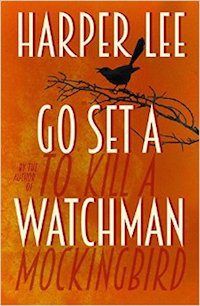
 Over six months ago several things came to a head seemingly all at once. Firstly the flying of the Confederate flag – or rather its lowering – became an issue all over the southern states of the USA. Secondly a prominent activist was outed as trans-racial. Thirdly, Harper Lee’s publishers released Go Set A Watchman.
The latter was significant to me. Harper Lee had always been a heroine of mine, for writing one of the monuments of American Literature – To Kill a Mockingbird – and then retiring. I wanted to do the Scottish equivalent, but as soon as I published my second novel that was out of the question anyway – that fact always makes me smile.
With the near-coincidence of these three things, it occurred to me to write a short story, set in 2015, in which a young female couple, one of whom is of mixed racial heritage, have a rendezvous in the Alabama town where one of them has her roots. Together they see how the town has coped with the realities of the twenty-first century. The central event in the story is the lowering of the Confederate flag at the town’s courthouse; but also the couple visit, in passing, an elderly lady who can remember her childhood in the town, during the Depression. My story remained unfinished. I had planned it as a tribute to Harper Lee, and it only really made sense if I could call the elderly woman ‘Jean Louise Finch’. This was, as I say, to be a serious story and a tribute, not ‘fanfic’. So I did the polite thing and got in touch with Ms Lee’s publishers to ask permission, leaving the story unfinished.
Well, seven months later, long after I had forgotten about the project, I got my answer. No. Not only could I not call the elderly character ‘Jean Louise Finch’, I could not use any character names out of To Kill A Mockingbird or Go Set A Watchman. That’s fair enough, I guess. Not only that, but I could not call the town ‘Maycomb’. Okay, I can see the logic in that, given the interdict on character names. But apparently I could call the town ‘Monroeville’ if I wanted. Well thanks, I know I could – any writer is free to set a story in a real place – but the point would be lost. In any case, seven months after the event(s), the moment for the story has passed. It remains unfinished.
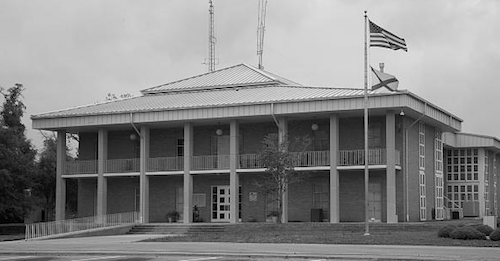
But I thought I would share a passage with you, just for the heck of it. Very little else of the story has been written, and now probably won’t be; so what you have here is a little insight. The accompanying pictures are of the old and new courthouses in Monroeville – and just to be clear, the new courthouse can be seen to be flying the Stars-and-Stripes and the Alabama State Flag, not the Confederate flag, which was another reason why fictionalisation was necessary. By the way, the story was to be called The Standard of the Camp, which is a reference to Numbers 1:52 and Numbers 2:2 in the Bible.
*

Judith parked the car a few blocks away, and we walked hand in hand, joining one of the little streams of people approaching from every direction to swell the small crowd in front of the building. It was indeed a small crowd as a proportion of the population – only a few hundred – but unless a person had a reason to wish to be there for what was, after all, only a minor piece of history when taken with the bigger picture, why make a fuss and stir yourself? To Judith and me, with our own union being also a small part of a bigger picture, there was a reason to come. There was to be no ceremony. Simply, at six o’clock, the Confederate flag was to be lowered from the flagpole outside the courthouse, never to be raised there again. It was to be an occurrence, that’s all.
“Has that flag always flown here?” I asked Judith.
“Not sure,” she said. “The way I heard it, it wasn’t raised anywhere at all until the nineteen-twenties. There’s a picture somewhere of the old courthouse during World War Two, and it had the Stars and Stripes on the flagpole, and another picture taken during the Cold War that shows the same. Someone told me that a group of local politicians pushed through some measure when Obama got elected President. But hell, I’ve hardly ever been down this part of town before, so I wouldn’t know.”
“I guess people didn’t really notice until it became an issue.”
“You got that right!” said someone near me.
I get that. When something is just part of the scenery you don’t notice it. Then one day it’s gone, maybe a tree is cut down or a building demolished or something new built, and the best you can do is wonder what’s wrong with this picture. The Stars and Bars on a biker’s jacket or tacked up in the back of a neighbor’s garage can just be scenery. Until someone decides to become a semiotician, and – bam! Just how important to us all was disposing of this symbol? Apparently it was important to APT and WSFA as they had cameras there, so it was potentially news.
The clock at the old courthouse began to strike the hour. A side door of the newer building opened, two uniformed court bailiffs came out and began to walk diagonally across the lawn towards the flagpole. The buzz in our little crowd died down. I could see that a reporter from one of the TV stations had stationed herself between the cameras and the flagpole and was talking into a microphone. There were no salutes, there was no fuss, one of the bailiffs untied the hoist from its cleat, and began to hand-over-hand it. The flag began to descend, slowly. As it did, a knot of men nearer the front began to chant.
“USA, USA, USA…”
I could see a veteran’s cap, I could see a biker’s bandana, I could see a couple of hand-held Stars and Bars being waved.
“God, they say we Americans have no sense of irony, and they’re right,” said Judith.
“Look at another way, honey,” I said. “The way these guys see it, the ideal of the United States is that the whole is not greater than its parts, there is no over-riding principle that can impose itself on a constituent state, and indeed upon the right of an individual’s expression. In some way that’s what they believe in. In their view of history, that’s what the Confederacy was fighting to establish and the Union was trying to crush.”
“That’s an extraordinary opinion to come from an African-American,” said a voice behind me. I looked over my shoulder at the woman who had spoken. I hadn’t heard any hostility in her voice and I couldn’t see any in her face.
“I guess I’m repeating something I heard from someone here in town,” I said. “Don’t get me wrong. To me that flag is just what they say it is – the symbol of white supremacy – and although I’m not from these parts myself, I’m glad to see it taken down. It’s just that the person who gave me that idea also told me that something like nine out of every ten Confederate soldiers had never seen a black person, let alone owned one. They didn’t decide what the flag meant. Somebody else did.”
“Hmm.”
Judith nudged me, and I turned back. People had their iPhones out, taking pictures of the lowering. Some were taking selfies.
“You want a picture?”
“Nuh-uh. No thanks.” For many reasons I did not.
The flag came to the end of its journey. The guys chanting fell silent. I stood on tiptoes to watch the two court bailiffs detach it from the hoist and fold it without any flourish. One of them tucked it under his arm and they began to walk back towards the courthouse. What would happen to it now? As long as it never flew again, did I actually care? Judith and I turned to go.
*
I recall a similar thing happened when I had an idea for a full-length adventure novel featuring a character created by a fellow-Scot. Her creation was not a pleasant character, he was in fact the arch-rival of her protagonist. But I saw in him the potential lead in a story about a cynical adult wizard. So I wrote to her publishers and asked for permission. And of course the answer came back in the negative. Now, I am all for authors protecting their intellectual copyright, given current social and commercial circumstances. I feel no rancor to either Harper Lee or to JKR because their people said no. Indeed, my cynical adult wizard – Agent Delta of the Chthonic Intelligence Agency© – still exists on my virtual drawing-board, is not named as anyone in any other work of fiction, inhabits a milieu nowhere near any boarding-school, and may come to life in a way that infringes no copyright.
 On the other hand, when I got in touch with Irvine Welsh and asked if I could use his name as the central character in an epic poem – Welshday – in which he journeys through the city of Edinburgh in the company of an inebriate detective and a living statue, in a tribute to James Joyce’s celebration of ‘Bloomsday’, he replied “Why not! Go for it!”. All of which leads me to the point of this post: it doesn’t hurt to ask. Countless authors have based novels and stories on pre-existing characters – the Flashman novels, James Bond novels by Kingsley Amis and William Boyd, and so on. Sometimes a living author will hand on the baton willingly to a successor, and the worst that can happen is that they’ll say no.
As it happens, Welshday was never finished either. I know the concept of unfinished writings seem strange, almost like the idea of failure. But I draw the analogy with a painter’s studio – no one finds it strange to find drawings, sketches, studies, and unfinished works there, so I have no qualms about admitting to countless novels, stories, and poems that never made it (yet!) to completion. In fact Welshday gave rise to some good stand-alone poems, so here’s one of them for you. Our journeying hero and his inebriate companion visit a bar in Leith, where they are accosted by a Russian seafarer who claims to be the only survivor from the sinking of the submarine Kursk. It’s a sestina:
Old Rimbaud said, “Let’s go and take a glass
of whiskey in a jostling pub I know.”
I, like a sodding numpty, dogged his steps,
And tracked him to a clapped-out, frowsy dive,
Where half the clientele were missing ears –
the other half were shouting to be heard!
We’d been there half an hour when I heard
a Russian sailor tap the falling glass;
he grabbed my sleeve, said “This is for your ears
alone, no other bugger has to know.
I heard my skipper calling dive-dive-dive,
as I slid down the conning-tower steps…”
Old Rimbaud, blootered, sunk down on the steps;
the Russian bellowed at me, to be heard.
“The air inside gets hotter when you dive,
the sea is slagged and dark as bottle-glass.
The ghost of every bugger that you know
floats by, and there’s a pounding in your ears!”
His sliding, slootered accent hurt my ears.
I thumbed my belt and slipped some salsa steps;
I said, “Now tell me something I don’t know,
no half-arsed, half-cocked tale already heard,
no shite enigma darkly in a glass,
no bonny buck-and-wing, no duck-and-dive!”
He scowled at me and, miming a crash-dive,
resumed the tale that battered at my ears,
while I, to ease my pain, sucked at my glass.
“Kolesnikov took all the proper steps,
and we went aft – perhaps you might have heard –
but when you’re frigging shark-bait, boy, you know!”
I shut him up, and said, “Here’s what I know –
no fucker made it home from that last dive –
They all asphyxiated, so I heard!”
He laughed, he jeered, I stopped my ringing ears,
and sat down with old Rimbaud on the steps,
to spit at all the demons in my glass.
When ghosts well from a glass you always know,
You’re sitting on the steps of some sad dive,
and though you stop your ears you’ll still have heard!


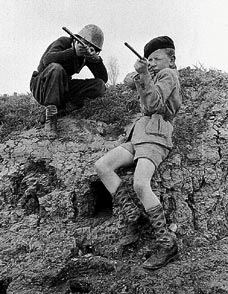 The boys put down their Commando comics, in which the heroes were square-jawed and wore their helmets at a jaunty angle, and the enemies’ eyes were always in shadow, and determined to play war in the woods. One or two were lucky enough to have their dads’ old berets, a helmet, or a toy gun, the others grabbed dry sticks of the right size, with which to extemporise a weapon. They picked sides and fanned out into the trees.
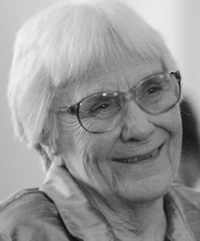 At the time I started writing seriously, Harper Lee had published one single work of fiction. However, that was the book that would come first to mind if ever one was asked to name a 21c American novel. Chances are that To Kill A Mockingbird would spring to one’s lips before anything by Hemingway, Sallinger, Fitzgerald, or even Steinbeck. Why? As a piece of literature it did not represent any great step forward, it offered no breakthrough in technique or genre. What it did do, however, was capture a 1960s Zeitgeist, and capture it early. Or did it? It was published five years after Rosa Parks had refused to give up her seat in the bus, and thirty years after the era it depicted. What was outstanding about it was that, notwithstanding its being written primarily for an adult readership, its narrative voice was that of a child; that child observed no great world events, but simply watched what happened in a small town in Alabama during the Depression, noting the attitudes of people of one race to those of another. Of course there’s much more to the book than that, and indeed if there is any change in racial attitudes by the end of the story it was the merest flicker of the needle on the dial! The tabula rasa of the child-narrator’s consciousness was a wonderful device for presenting truth without judgment, enabling the reader to see beyond the rights and wrongs that thirty years of hindsight reveal, to the ordinariness and humanity of the characters. To Kill A Mockingbird has never been out-of-print, is read by young and old, and is studied both by schoolchildren and academics.
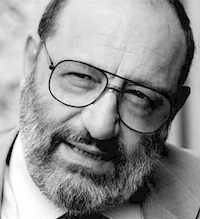 Here was another writer from whom I claim influence. As a semiotician, Eco had a mind that was adept at cracking the codes of language, literature, culture, and philosophy, and reassembling them to tell stories. He dreamed up scenarios, pulled contexts from the thin air of history, wove plots that bent logic round like a Möbius strip, built on unlikely premises his unexpected yet inevitable outcomes, filled his books with compelling characters, played hide-the-easter-egg with references (no, not that Baskerville, this Baskerville; no, not that Foucault, this Foucault). Where he influenced me in my writing was firstly in that genius for unexpectedness. Secondly, there was his realisation that language was merely a code for something else that was going on, for a reality beyond the words themselves. I don’t mind admitting took direct from his The Mysterious Flame of Queen Loana the idea of having a (supposedly) amnesiac protagonist and used it in my novel-in-progress The Deptford Bear.

 Reader
 Marie Marshall