Marie Marshall

Author. Poet. Editor.

Tag: writing

In case you’re wondering…

It must seem to my regular readers that nothing much happens in my literary life. I have no whistle-stop tours of signings and readings, no local radio appearances and so on to report. However, I’m far from inactive, and the notion that nothing happens couldn’t be further from the truth. So what is happening?
writing-clipart-1Well, firstly I am writing a new novel, or rather one that I had had some notes for a while ago but had shelved while I finished From My Cold, Undead Hand and the sequel KWIREBOY vs VAMPIRE. It would be difficult to say at this stage what it is ‘about’, because I am trying to walk a tightrope between experimenting with form and style and producing something that is readable. For a while now I have been taking part in discussions, notably with Millie Ho and her blog-followers, about… well… how to write. Millie has some brilliant ideas, and if I take issue with many of them it is merely because they stimulate thought. One topic in particular has been that of working towards an ending, and my concern is that literature has been stuck in a pattern that has lasted for centuries, if not at least a couple of millennia, going back to the concept of ‘catharsis’ in classical Greek drama. What this has meant for fiction is that it has largely resisted major innovation, and that it is alone as an art form in doing so. I have written on this subject before. Fiction, pretending to give us a narrative progression from a beginning to an end, more often than not is driven by that predetermined end in a way that life is not – ‘Destiny does not send us heralds,’ said Oscar Wilde in The Portrait of Dorian Gray, and neither should the writer of fiction be obliged to function as some kind of prescient, wiser than the rest of us. As readers we ought to be able to cope with fiction that hands us a slice of life to look at, and the knowledge that life continues after that slice is finished.

In our discussions we have been looking at the problem of how to give a novel ‘closure’ – giving the readers the sense of its completeness – without necessarily having a structural ‘resolution’ driven by the dictated need for catharsis.

For my current novel project (working title The Deptford Bear) therefore, I have a probable direction of narrative travel rather than a definite ending in view. I can see where the narrative may possibly lead, but I am open to the journey of exploration taking a turn and leading instead to somewhere unexpected. For this reason, and because it’s the way I actually enjoy writing, I haven’t been plodding, chapter-by-chapter, from the beginning. I have been writing ‘episodes’ in an almost random order, which I will sew together later. I have been writing from inside the head of the protagonist, hopping from happening to colourful happening in her life. An added challenge is that the whole of her story is being told to a third party – a Scotland Yard detective – and there is probably a lot she is holding back, even from the reader. The story has a strong element of ‘detective mystery’, though whether the mystery will be cleared up when the novel closes is another matter. It has elements of ‘steampunk’, being set in a Victorian London where nineteenth-century history is telescoped or concertinaed in on itself, ‘Montgolfier’ balloons traverse the city from mooring-tower to mooring-tower, and messages are passed between police stations by a vast, steam-driven network of ‘Lampson’ tubes. But how much of this is real, and how much is in the imagination of the protagonist is hard to say. She is, apparently, an amnesiac, and has a strange way of relating to the world, and of expressing herself, learned since she lost her memory as a child; she is a clairvoyant who admits to being a mountebank but who might be genuinely psychic; and she may be something much, much darker than that. Her London is peopled not only with thieves and murderers, toffs and paupers, but with hawkers and buskers, with carnival people and mummers, perhaps with monsters and changelings, and is haunted by one sinister, silent figure – the ‘Deptford Bear’ himself, a creature of deep ritual significance. Or is it she who is haunted rather than the city?

Regular readers of the blog section of this web site will know that I have other novel ideas on my shelf, for which I have written sketches. It’ll be The Deptford Bear I’ll be working on for the foreseeable future, and the others will remain on the shelf. I’m up to about 15,000 words so far.

Secondly, work continues on turning my short story Axe into a film or TV script. I have provided some extra narrative material, and a Scottish screenwriter is currently working on it. I have seen his summary of how he would like to tackle the dramatisation, and the first draft of the opening, and it is developing in quite an exciting way. To go back to the matter of how to end a piece of fiction, those of you who have read the short story will notice that it did not ‘resolve’ in any conventional way; the extra narrative material I have given, along with the creative input of the screenwriter himself, perhaps a little more of a conventional resolution. Nevertheless, this is an exciting project and something totally new for me.

Thirdly, other stuff. You will no doubt remember that my short story Voices was amongst the winners at the Winter Words festival a few months ago. Well, as often happens, that win gave me a boost, and I have already written two further macabre short stories, and sketched out a third, which will fit well as entries for next year’s competition, and the year after that… and the year after that. Also I’m preparing some new poetry for a forthcoming anthology.

So, although my blog section here isn’t full of a mad social whirl, inactive I am not. I’ll keep you all posted.

More Veronica Franco

Click here, or click the image below, to be taken to Sappho’s Torque, the blog of Angélique Jamail, who this month is featuring a different poet every day. This particular link will take you to a brand new poem of mine, not published anywhere else, from my ‘Veronica Franco’ series.

VeronicaFranco

Cultural appropriation: that ship has sailed!

The question of whether anyone from one community can or ought to take something, in whole or part, that is the practice of another community, and use it as his or her own, is an issue that emerges, submerges, and reemerges. We would all, it seems, like hard-and-fast rules to tell us what we can take and on what terms, and what we can’t. But surely that is unrealistic? Cultures and the communities that sustain them have always been porous, transferring ideas, bringing their influence to bear on each other, sometimes one giving way under the pressure of another, but never standing still.

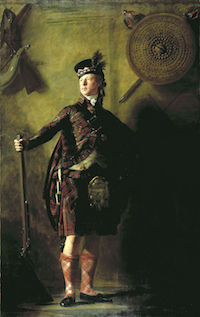
Henry Reaburn's 1812 portrait of Alexander Ranaldson MacDonnell of Glengarry, wearing a costume of almost total artificiality.

Henry Reaburn’s 1812 portrait of Alexander Ranaldson MacDonnell of Glengarry, wearing a costume of almost total artificiality.

In 1746, following the Battle of Culloden, the clans of the Scottish Gàidhealtachd, irrespective of which side they had fought on, were banned outright, by Act of Parliament, from wearing their native costume. This Act was repealed thirty-six years later, not at the protest of the dispossessed Gaels themselves, but at the instigation of The Highland Society of London, an organisation of English-speaking landed gentlemen and aristocrats of Scottish origin. By this time a generation of clanspeople had gone, and the habit of making and wearing their native dress had been all but lost – they were after all, only a peasant class and therefore insignificant. Soon great numbers of the people themselves would, as the eighteenth century gave way to the nineteenth, be forced out of their native glens and into coastal villages, or to the big cities of the central belt, or away to Canada. Meanwhile a commercial version of their tartan was being produced in the lowland town of Bannockburn, specifically for military use. In 1822, in order to stem popular radicalism in Scotland, novelist Sir Walter Scott and others arranged for King George IV to visit Edinburgh, and for him to be greeted by a pageant largely of their own invention. Highland dress was to be on display, worn by the Clan Chiefs – whose private life was now much less like that of their paternalistic forebears and more like that of English landowners – and by bands of such ‘clansmen’ as still could be mustered. The tartans they wore, specially designed by the company in Bannockburn, were largely the fanciful inventions of the Chiefs themselves. What we now think of as ‘Highland dress’ was a nineteenth-century invention.

However, its artificiality did not stop its being adopted, in due course and merrily, by high and low as the national costume of Scotland. At weddings from Stranraer to Lerwick, on high days and holidays, and whenever the Scotland Rugby team is hosting a match at Murrayfield, you will see kilts and tartans. At Carter Bar, high in the Cheviot Hills where no native ever wore a kilt in antiquity, you will find a piper in Highland dress entertaining the tourists who stop at the English-Scottish border. Go much further afield and you will find the Pipes and Drums of the Chicago Police Department resplendent in their tartan kilts; even the hatbands that Department uses are in the ‘Sillitoe Tartan’ – actually a checkerboard pattern rather than a true tartan, but first used as a police identifier exclusively in Scotland until 1961. Meanwhile, back in Scotland, you can now buy Star Wars sporrans in the image of a Wookie.

Now, I don’t say all this in a spirit of ‘me-too-ism’. I have simply picked it because it is close to home and readily researched, and more importantly, it illustrates a warp and weft of many complex systems. It is not a straightforward picture of a straightforward process. There are so many different attitudes on show, to what was once exclusive to the peasant culture of the Highlands – violent disruption, appropriation by a different class, misunderstandings and assumptions about its nature, gaps in knowledge filled in with invention, adoption as a national identifier, dissemination as a cultural export, re-importation with external influences, all these and probably more interwoven and difficult to unpick. I only know that I am no longer in a position to feel any direct resentment about this element of Scottish culture, if such a feeling in me could ever have been justified in the first place. I have both Scottish Lowland and Highland heritage, but I am who I am here and now. I am looking at a current situation which was not determined by a small number of great forces, but by billions of little ones; and history is a very fragile thing, within which we have no idea whatsoever what might have happened had one of those ‘little forces’ flipped.

I had managed to get as far as that last paragraph without mentioning ‘the A-word’. Well, it had to come at some time! The term current for the adoption of a cultural asset across a social boundary is ‘appropriation’. Often, sometimes fairly and sometimes unfairly, it is a code-word for outright theft; unfortunately that connotation colours its entire use and too often enables it to be employed as an accusatory bludgeon. Whilst I will grant without reservation that there are points of contact between social and cultural communities that are understandably very tense – I am thinking in particular of the racial dynamics of the USA, where the subject of cultural appropriation is probably most hotly debated today – it would take, in my estimation, a very blinkered outlook to ignore the fact that we now live in a world almost entirely without walls. From our corner of the world we are able to see into all the others, in a way without precedent in history. The porosity of cultures has never been more obvious. The kids of a family in Wales paint their faces in Dia de los Muertos masks, a Tibetan exile makes Hip Hop videos, the presence of economic migrants in Scotland means you can buy Eastern-European food in the corner shops, every indigenous, folkloric, or local music can be searched on YouTube – the walls are down, people, the walls are down! The mechanics whereby culture travels are now almost entirely on the surface, and are intensified!

Bobby Darin, one of the artists who recorded cover versions of Ray Charles's 'What'd I Say'.

Bobby Darin, one of the artists who recorded cover versions of black music.

Is it not high time, therefore, that we say of ‘cultural appropriation’ that that ship has definitely sailed? I am aware that there are still sore places on the cultural body, such as the way in which, in living memory, mainstream American music businesses took and repackaged African-American music, and sold versions of it performed by European-Americans; but to me that says at least as much about the American strain of aggressive capitalism, in which anything which can be commodified will be commodified, as it does about the actual purloining of culture. Moreover, it is a particular case, not a representative case or a test case. Again, complex systems at work, from which it is difficult to narrow our scrutiny to a single point of principle.

I am asking the question. I’m not seeking to close the debate, but to open it out, so please do not think that I am being heedlessly dismissive of your own particular concerns, whatever they may be. Maybe the proposition I have advanced will make you think again – or afresh – and find new reasons why this still seems an issue where we have to tread carefully. Maybe, on the other hand, your reappraisal will open the possibility that we can start to celebrate when our own culture rolls out beyond its former borders, no matter how that happened in the beginning. Let’s see.

__________

If you click here, you can read an interview with me, conducted by Robin Ouzman Hislop on behalf of Poetry Life and Times.

‘the zen space’ Spring 2015 Showcase

Click on the mandala below to be taken to the Spring 2015 Showcase at the zen space, the e-zine where much imagery and a little wisdom is put into as few words as possible. Editor – yours truly.

violet

Grammar precision: why hasn’t that boat sailed?

woman-writing-letters-by-charles-dana-gibsonOne of the most common memes on Facebook, at least in the circles I frequent, is the exasperated declaration about a point of grammar. Grammatical rules are a sticking point for so many people. Now, I know I’m writing from a position of privilege here (I checked – I often check my privilege, y’know!) inasmuch as my education was grounded in ‘correct’ grammar, and the mode of communication I was brought up with is Received Standard English. However, I am often driven to comment that these rules are arbitrary. They are. They were devised in the eighteenth and nineteenth century, by gentlemen with the benefit of classical education, who observed that the English language was changing.

Changing? Whoa! Who knew?

Languages change. The English language has changed radically in my lifetime and – know what? – by and large no one noticed. We simply went on speaking and writing English. The concerns of those erudite gentlemen in periwigs and britches have been echoed in every generation since then. They made a conscious choice to base their concept of English grammar on Latin grammar, even though the Latin language had had, until then, only a very limited influence on English. Hence, for example, their rule that one should never end a phrase with a preposition. Such a thing is actually impossible in Latin. However, it was current usage in 18c English and remains so, despite them, to this day. You probably noticed I broke their rule (deliberately) in the first paragraph above. Did that bother you? I doubt if it did too much damage to your sensibilities, any more than the many neologisms did that I use in this article.

There is a word for this insistence on the purity of grammatical rules. It is called ‘prescriptivism’. There can be times when its adherents will stick to something even against good advice. Not so long ago I posted a piece about the split infinitive, in which I quoted Fowler at length. Fowler, of course, is the grand-daddy of prescriptivism, the go-to guy, The Man, the settler of arguments on English usage. His advice on splitting infinitives? That people waste their time avoiding them, and in avoiding them produce ugly, unwieldy English. But – if I may begin a sentence with a conjunction – I am still getting feedback on that, from people who insist that to split an infinitive is plain damned wrong, and would go all round the houses to actually avoid doing so.

Let’s take another example – the ‘double negative’, as in ‘Ain’t Got No’ from Hair. The double negative as an intensifier has been around for centuries. It is there in French, which was arguably the single most important influence on the development of Middle and Early Modern English grammar. It is there in many vernaculars throughout the English-speaking world. When Geoffrey Chaucer wrote

He nevere yet no vileynye ne sayde
In al his lyf unto no maner wight

or Joe Tex sang

Ain’t gonna bump no mo’ with no big fat woman

is anyone unclear about what they meant? And yet because a double negative is impossible in Latin it becomes un-passable in English! (By the way, in the examples quoted, Joe Tex uses a triple-negative intensifier, and Chaucer – arguably – a quadruple.)

Of course this is the moment at which modern prescriptivists say, “We know how the English language developed, but that is irrelevant – it has these rules now.” Do they have a point?

Anyone schooled in linguistics will tell you that the proper study of language is into how people use it. From the time of the classically-educated prescriptivists, and in the generations since then during which the grammatical rules were taught by rote, right though to today when prescriptivists fight a keen rearguard action, the English language has gone through a very dynamic period. It has spread world-wide, it has given birth to scores of vernaculars, creoles, and contact-languages, it has lived a life full of action and incident, it has seen an efflorescence of creativity, it has been subjected to the innovations of information technology, it has changed and developed markedly, it has – and this is a very important point to remember – moved far beyond the confines of its traditional bases such as Britain, Britain’s white inheritor-countries (Canada, Australia, and New Zealand), and the United States. In moving away from these it has weakened any right people there have to consider themselves sources of normative power, gatekeepers of the supposed purity of the language.

Prescriptivism has, however, remained a recognisable influence upon the language. Students of linguistics realise this; prescriptivists, on the other hand, need to realise that it is only one influence among many. That’s how it has always been. The developments I cited above all happened despite, not because of prescriptivism. If prescriptivism in how one may use the language had been the be-all and end-all, then there would have been no Finnegans Wake with its stream-of-consciousness, no Catcher in the Rye with its colloquial register, no On The Road with its unedited spontaneity, no A Clockwork Orange with its exuberant conlang. There would have been virtually no poetry!

Prescriptivists also need to scrutinise themselves further, and ask themselves, honestly, whether their concerns are truly governed by matters of language. So often language campaigns, particularly by politicians, have been coded references to other social matters – youth behaviour, class, race, social order, national identity, for example. I’m not standing apart here and pointing a finger; each of us has his or her own cognitive biases, of which we are hardly ever aware. I am sure I do, as much as anyone else.

I’m going to reverse track on this argument and propose that there are ways in which a certain level of prescriptivism can be viewed as natural and beneficial. Whilst personally I don’t care where a preposition is, whether a negative is double, or whether an infinitive is split, I do care about clarity. If I were writing a notice for the benefit of the general public I would want to be sure that as many as possible took as its meaning that which I had intended; this level of consensus ad idem can only be reached if there is an agreed standard between myself and my readership. Narrowing it down further, if I am in a plane, I travel more easily if I can take it for granted that such a consensus exists between the pilot and the air-traffic-controller. Go anywhere and you will find that people like the assurance that what they say today in a conversation across their neighbour’s fence, will mean the same thing tomorrow. In countries where English is a force of new focus – the expanding economy of India, for example – there are prescriptivist movements growing which, though they might trace their origin to the English of the Raj, have their eyes on a particular issue of local or national concern. Even in a dynamic and changing context such as the slang of the young, wherever in the world they may be found, in New York, Singapore, or Bangalore, there are rules no matter how transient they may be. Rules, whether artificial and imposed, or natural and usage-driven, do exist in language in general, and in English in particular.

I believe it behoves us all to realise that the history of the English language is not over. No one could have predicted its state today, and no one can predict its state in the future. It is a beautiful language in which to create. It is a language which, out there in the world, enjoys the dynamism and tensions of a myriad of cultural encounters. It is at the same time a natural thing with a life of its own, which twists in our hands as we try to grasp it, and on the other hand a far-from-neutral political tool in the same hands. It is a child still, and children steadfastly refuse to grow up in our own image.

‘Abandon the Shadows’

jpegAbandon the Shadows is a slim but poetry-packed anthology by ‘Poets Collective’, a cooperative of versifiers. I was invited by Toni Christman, one of the coordinators of the book, to contribute, and I replied with a specially-written sonnet called ‘Haply Slappy’. The anthology, as you might gather from its title, and from the title of my poem, is about optimism – there’s not a lot of that around these days, so that’s one good reason to buy the book! You can get it at Amazon, or you can get in touch with Poets Collective direct. Here’s what coordinator  Mary Boren has to say about it:
Amazon search results numbering in the millions attest to the fact that new poetry abounds in the world today, if not on the shelves of bricks-and-mortar bookstores, certainly in the countless internet venues where poets congregate and the varied creative outlets that facilitate self publishing.

Cheerful poetry with substance, however, is not as readily found. In this collection twenty-six contemporary poets lend their voices to a rousing sunny side chorus – not in sugar-coated greeting card fashion, but in authentic acknowledgement, contemplation, and ultimate acceptance of the challenging circumstances we all witness and experience in life. In styles ranging from traditional formal to minimalism, the tone of underlying resolution rings clearly. We hope you are pleased with the sound.

You’ll find my ‘Haply Slappy’ on page 67. It isn’t going to be published anywhere else, by the way, so if you want to read it, buy the book, and you get all these other poets for free! 😉

In the dead of night, somewhere in the Highlands…

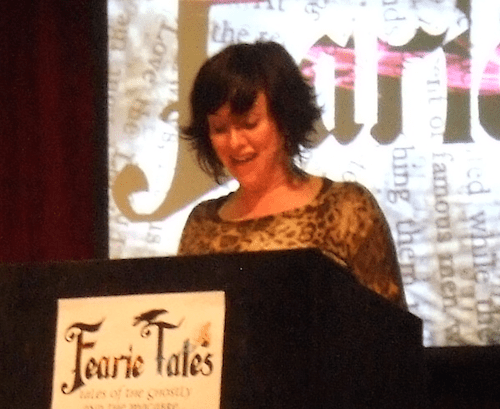
As I said in my last post, I have been amongst the winning entries in the ‘Fearie Tales’ Competition six times now, in eight years. They don’t rank the eight winners, but it’s a safe bet if you have been scheduled to round off a Saturday evening’s storytelling you can be pretty proud of yourself. I had that spot on Saturday 14th February, and pro actor Helen Logan read out, or rather performed, my story ‘Voices’.

The story concerns an Australian scientist – a woman with one foot in rationalism and the other foot in the ‘Dream Time’ of an old Aboriginal mentor – who camps at the summit of a remote Scottish mountain, intent on investigating ‘random voice phenomena’. What happens next defies explanation. Is it supernatural? Is it psychological? Whichever, the consequences are dire. It is all set out in the spoken commentary to her video diary.

Helen Logan, for whom I had specifically written the story having seen her deliver my previous story, threw herself into the role of the Queenslander, pitching the disintegration of the narrator’s mind at quite a high level of histrionics. It worked; at times it was comic, and at other times it was terrifying.

(c) Bookseeker Agency

(c) Bookseeker Agency

Despite this being my sixth win, it was only my second visit, thanks to the kindness of my ‘fan base’. I lurked at the back of a full room. ‘Fearie Tales’ is popular with festival-goers, and it was good to hear my work being applauded.

I now have quite a portfolio of short stories. A handful of them have been blogged, six of them have now been read aloud publicly, but many of them are simply set by in case they are needed. If collected together, they would make a decent-sized book. I shall have to think what to do with them. Maybe I should consult my agent (a good idea anyway) and discuss options.

__________

By the way, the folk at Indies Unlimited asked me to expand a comment I made on an article about self-publishing into an article in its own right. They asked me to set up an ‘author page’ at Amazon, which is one of the features they like anyone to have, if they are due to be featured on their site. So I have done just that. Just check out amazon.com/author/marie_marshall. The four books of mine which are available at Amazon (not counting the books I have had a hand in editing, or in which work of mine is featured) are listed there.

Parade throws and other lovely stuff

When they speak of ‘Mardi Gras’ in New Orleans they don’t just mean Shrove Tuesday, they mean a whole season when parades and all kinds of other high jinks can take place. It may surprise you to know that the parade season has already started there. Part and parcel of the parade procedure is the ‘throw’. Throws are gew-gaws and souvenirs that the marchers give away – literally throw into the crowd. This means that on Saturday all the throws containing my quick-fire poems about Doctor Who landing the TARDIS in New Orleans have… gone! Not one remains! Well, what does remain is the blog record of the assembly line – check it out here!

Ben Crystal

Ben Crystal

In other news, renowned Shakespearean actor Ben Crystal, who is the son of linguist David Crystal and the brains behind the project to present Wm Shakespeare’s plays in their original pronunciation, declared my ‘A sonnet to explain why Veronica Franco misses the first hint of spring‘ to be “Lovely stuff!” Let me explain something: Ben really understands iambic pentameter, and I’m honoured that he should have even read my little piece of not-so-serious sonnetry.

Anything else been happening this weekend? Well, I have been working on some extra material for the possible TV adaptation of ‘Axe’, and have picked up one of my shelved novel projects, The Deptford Bear, to see if I can get it moving again. So far it stands at a little over 11,000 words and I think it can work.

‘From My Cold, Undead Hand’ sold out at Waterstones

jpegI just heard that all copies of From My Cold, Undead Hand have gone from the shelves of the local branch of Waterstones. Don’t worry though, vampire-fiction fans – you can still order a copy at the counter. Just ask an assistant and they’ll get it for you.

‘Crocodilism’ – a dem⦁n’s definition

crocodilism, n.


  1. The political principle whereby a state claims or occupies smaller states, territories, or disputed regions; extended to any corporation, body, or individual who appropriates possessions by virtue of their proximity rather than by any recognised right.


  1. The practice of girls walking in a long column of twos whilst holding hands; extended to the progress of any slow-moving procession of objects close together.


  1. The practice of weeping or making any pretence of woe for the purpose of entrapment; extended to the general philosophy that such pretence and the gaining of an advantage by it is acceptable.


  1. The worship of Sobek.


  1. The deliberate eating of something considered by others to be unnatural or unacceptable.

    “Thes forsothe among polutid thinges shulen be holde, of hem that ben meued in erthe; a wesil, and a mouse, and a cokedril, eche after his kynde.” Leviticus 11:29 Wycliffe version (1395)


  1. The practice of a philosophy where captious or sophistical argument is used; extended to any deliberate use of trick questions.

    “A woman sitting by the side of Nilus, a Crocodile snatched away her child, promising to restore him, if she would answer truly to what he asked; which was, Whether he meant to restore him or not. She answered, Not to restore him, and challeng’d his promise, as having said the truth. He replyed, that if he should let her have him, she had not told true.” Thomas Stanley, The History of Philosophy vol. II, viii, 57 (1656)


  1. The affectation of flattery, clemency, or any other favourable behaviour by a person holding any power or influence over others.


  1. The habit of removing irritations from a person from whom one wishes to gain favour.


  1. The hoarding and bringing into use of things past their time of practical usefulness.


  1. The condition of being all mouth and no ears.

[I recently rediscovered this introduction to a poetry project. I thought it might be worth popping here. M.]