
Cultural appropriation: that ship has sailed!
The question of whether anyone from one community can or ought to take something, in whole or part, that is the practice of another community, and use it as his or her own, is an issue that emerges, submerges, and reemerges. We would all, it seems, like hard-and-fast rules to tell us what we can take and on what terms, and what we can’t. But surely that is unrealistic? Cultures and the communities that sustain them have always been porous, transferring ideas, bringing their influence to bear on each other, sometimes one giving way under the pressure of another, but never standing still.
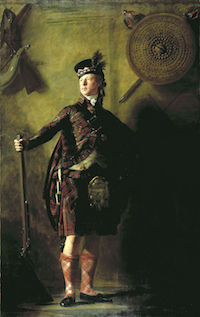
Henry Reaburn’s 1812 portrait of Alexander Ranaldson MacDonnell of Glengarry, wearing a costume of almost total artificiality.
In 1746, following the Battle of Culloden, the clans of the Scottish Gàidhealtachd, irrespective of which side they had fought on, were banned outright, by Act of Parliament, from wearing their native costume. This Act was repealed thirty-six years later, not at the protest of the dispossessed Gaels themselves, but at the instigation of The Highland Society of London, an organisation of English-speaking landed gentlemen and aristocrats of Scottish origin. By this time a generation of clanspeople had gone, and the habit of making and wearing their native dress had been all but lost – they were after all, only a peasant class and therefore insignificant. Soon great numbers of the people themselves would, as the eighteenth century gave way to the nineteenth, be forced out of their native glens and into coastal villages, or to the big cities of the central belt, or away to Canada. Meanwhile a commercial version of their tartan was being produced in the lowland town of Bannockburn, specifically for military use. In 1822, in order to stem popular radicalism in Scotland, novelist Sir Walter Scott and others arranged for King George IV to visit Edinburgh, and for him to be greeted by a pageant largely of their own invention. Highland dress was to be on display, worn by the Clan Chiefs – whose private life was now much less like that of their paternalistic forebears and more like that of English landowners – and by bands of such ‘clansmen’ as still could be mustered. The tartans they wore, specially designed by the company in Bannockburn, were largely the fanciful inventions of the Chiefs themselves. What we now think of as ‘Highland dress’ was a nineteenth-century invention.
However, its artificiality did not stop its being adopted, in due course and merrily, by high and low as the national costume of Scotland. At weddings from Stranraer to Lerwick, on high days and holidays, and whenever the Scotland Rugby team is hosting a match at Murrayfield, you will see kilts and tartans. At Carter Bar, high in the Cheviot Hills where no native ever wore a kilt in antiquity, you will find a piper in Highland dress entertaining the tourists who stop at the English-Scottish border. Go much further afield and you will find the Pipes and Drums of the Chicago Police Department resplendent in their tartan kilts; even the hatbands that Department uses are in the ‘Sillitoe Tartan’ – actually a checkerboard pattern rather than a true tartan, but first used as a police identifier exclusively in Scotland until 1961. Meanwhile, back in Scotland, you can now buy Star Wars sporrans in the image of a Wookie.
Now, I don’t say all this in a spirit of ‘me-too-ism’. I have simply picked it because it is close to home and readily researched, and more importantly, it illustrates a warp and weft of many complex systems. It is not a straightforward picture of a straightforward process. There are so many different attitudes on show, to what was once exclusive to the peasant culture of the Highlands – violent disruption, appropriation by a different class, misunderstandings and assumptions about its nature, gaps in knowledge filled in with invention, adoption as a national identifier, dissemination as a cultural export, re-importation with external influences, all these and probably more interwoven and difficult to unpick. I only know that I am no longer in a position to feel any direct resentment about this element of Scottish culture, if such a feeling in me could ever have been justified in the first place. I have both Scottish Lowland and Highland heritage, but I am who I am here and now. I am looking at a current situation which was not determined by a small number of great forces, but by billions of little ones; and history is a very fragile thing, within which we have no idea whatsoever what might have happened had one of those ‘little forces’ flipped.
I had managed to get as far as that last paragraph without mentioning ‘the A-word’. Well, it had to come at some time! The term current for the adoption of a cultural asset across a social boundary is ‘appropriation’. Often, sometimes fairly and sometimes unfairly, it is a code-word for outright theft; unfortunately that connotation colours its entire use and too often enables it to be employed as an accusatory bludgeon. Whilst I will grant without reservation that there are points of contact between social and cultural communities that are understandably very tense – I am thinking in particular of the racial dynamics of the USA, where the subject of cultural appropriation is probably most hotly debated today – it would take, in my estimation, a very blinkered outlook to ignore the fact that we now live in a world almost entirely without walls. From our corner of the world we are able to see into all the others, in a way without precedent in history. The porosity of cultures has never been more obvious. The kids of a family in Wales paint their faces in Dia de los Muertos masks, a Tibetan exile makes Hip Hop videos, the presence of economic migrants in Scotland means you can buy Eastern-European food in the corner shops, every indigenous, folkloric, or local music can be searched on YouTube – the walls are down, people, the walls are down! The mechanics whereby culture travels are now almost entirely on the surface, and are intensified!

Bobby Darin, one of the artists who recorded cover versions of black music.
Is it not high time, therefore, that we say of ‘cultural appropriation’ that that ship has definitely sailed? I am aware that there are still sore places on the cultural body, such as the way in which, in living memory, mainstream American music businesses took and repackaged African-American music, and sold versions of it performed by European-Americans; but to me that says at least as much about the American strain of aggressive capitalism, in which anything which can be commodified will be commodified, as it does about the actual purloining of culture. Moreover, it is a particular case, not a representative case or a test case. Again, complex systems at work, from which it is difficult to narrow our scrutiny to a single point of principle.
I am asking the question. I’m not seeking to close the debate, but to open it out, so please do not think that I am being heedlessly dismissive of your own particular concerns, whatever they may be. Maybe the proposition I have advanced will make you think again – or afresh – and find new reasons why this still seems an issue where we have to tread carefully. Maybe, on the other hand, your reappraisal will open the possibility that we can start to celebrate when our own culture rolls out beyond its former borders, no matter how that happened in the beginning. Let’s see.
__________
If you click here, you can read an interview with me, conducted by Robin Ouzman Hislop on behalf of Poetry Life and Times.

 Abandon the Shadows is a slim but poetry-packed anthology by ‘Poets Collective’, a cooperative of versifiers. I was invited by Toni Christman, one of the coordinators of the book, to contribute, and I replied with a specially-written sonnet called ‘Haply Slappy’. The anthology, as you might gather from its title, and from the title of my poem, is about optimism – there’s not a lot of that around these days, so that’s one good reason to buy the book! You can get it at Amazon, or you can get in touch with
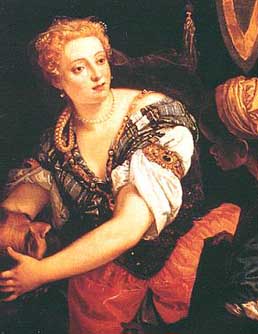 My obsession with Veronica Franco continues – I mean the 16c Venetian courtesan, not the 21c porn star, just in case anyone was in any doubt. Lately I have been adding to my canon of poetry dedicated to or written about her. These poems have been handed to the e-zine Poetry Life & Times for their use, along with the previously-published poems from that collection. In these poems, Veronica and I inhabit a shadowy world between life and death, in Venice and elsewhere, where the Renaissance has cell phones and tablets, Tintoretto flies in and out from Marco Polo Airport, and she and I meet for lunch dates irrespective of her being alive or dead. The first one has just appeared, and – guess what! – its setting is Marco Polo! Read it
  I’m taking a moment to review how things have gone in 2014. Sometimes, at the end of a year, I feel that I haven’t achieved anything; but when I stop and think about it, actually quite a lot has happened.
 Waterstones. Then in February my short story Da Trow I’ da Waa was read aloud to the audience at Pitlochry Festival Theatre. This was the fifth time in seven years that one of my stories has been featured at the Winter Words literary festival, and I consider that to be quite an achievement.
 Throughout the year both old and new poems of mine have been published in anthologies and magazines. Notable among the publications have been The Milk of Female Kindness (ed. Kasia James) in March, May Prism 2014 (ed. Ron Wiseman) in May, although I didn’t find out about that until August, and Rubies in the Darkness (ed. P G P Thompson) in December.
 In September, of course, my third novel was published – From My Cold, Undead Hand – and what more need I say about it! And a short time ago I put the final full-stop at the end of the sequel, KWIREBOY vs VAMPIRE. Since then I have placed it in the hands of a couple of beta readers, and have had first reactions from one of them. Amongst her comments were the words “… great job! … maelstrom of action and adventure…” and I am still basking in that rosy glow; however, a writer herself, she drew my attention to several things in the general readability of the novel about which I am going to have to think very seriously.
 Today’s big news is that I have finished writing KWIREBOY vs VAMPIRE, the sequel to From My Cold, Undead Hand. So now I plan a period of leisure – no more novel-writing until well into Spring 2015.

 Marie Marshall