
Bang goes my next career move, then.

Bang goes my next career move, then.

(c) P’Kaboo Publishers
There is a new anthology of short stories just released – especially for those of you with Kindle, and just in time for Christmas too. It’s called Mercury Silver, and you can get it from US or UK Amazon, or as a pdf direct from P’kaboo Publishers. It includes two of my stories, ‘Dragonslayers – a fable’ and ‘Memoirs of a Chief Replicator Technician’, the latter being a tribute to the late Gene Roddenberry. Other authors featured include Douglas Pearce, Emma L Briant, Leslie Hyla Winton Noble, Lois S Bassen, Lucy P Naylor, Lyz Russo, and Nick Legg. Check it out (as they say)!
I have been having fun answering some penetrating questions in an email conversation with Samuel Snoek-Brown. You may recall I interviewed him a while ago? Well, he repaid the compliment and the resulting interview is here. Also there’s a slightly lighter interview by Diane Tibert here. Enjoy both.

I used to play patience (solitaire) a lot, with real cards, back in the day when it wasn’t a standard feature of Windows. Back in the day when there were no PCs, for heaven’s sake – aye, when a jug of ale cost a ha’penny, and they used to hang you for stealing a loaf of bread, and the wheel was thought to be a thing of magic!
I used to notice that people had slightly different “rules” for how the game was played. When a stack became empty, I would wait for a king to come up and place that in the empty space. A friend of mine would fill the empty space with the exposed cards of the nearest stack. Either way had its advantages and disadvantages; one might wait a longer time to turn up a king, but a lower card had less scope for adding cards below it. Another friend of mine would deal cards hand-to-hand, so that the order of the three selected cards was reversed, I would just take three of the top of the deck so that the order stayed the same; yet another friend would take the last cards at the bottom of the deck, whether they were three, two, or one, whereas if I had two or one left I would place them at the top of the deck, so that the cards would rotate by threes. Again, each of these differences had its disadvantage and its advantage, by swings and roundabouts.
I was playing one day (in the common room at school), using my spare-cards-to-the-top-of-the-deck method, and a friend was watching me idly. Suddenly she said –
“You can’t do that. That’s cheating!”
I pointed out that it was one of the many variants of the game. She said –
“Yeah… but… well… you can’t do that. That’s cheating!”
Funny thing, people’s perceptions. I found this “You-can’t-do-that-that’s-cheating” attitude turned up time and time again. I’ll give you another example. I once had a red queen at the top of an exposed stack, there were no hidden cards underneath her, so if she moved there would have been an empty space left. On another stack there was a black king. To save time I picked up the black king and simply slipped him underneath the queen, so he was now at the top of the stack where the queen was. I lifted my hand to make the next move, when…
“You can’t do that. That’s cheating!”
“I beg your pardon?”
“What you just did. You can’t do that. That’s cheating!”
I explained to the observer that I had seen that the queen would have gone on the king, and that the king would then have gone into the empty space, so I had simply saved time by slipping the king where he was going to go anyway.
“Yeah… but… well… you can’t do that. That’s cheating!”
So I said. “Tell you what – how about I put the cards back as they were? Now I put the red queen onto the black king, like this, Okay? Now I put the black king in this space here. How about that?”
“Yeah, that’s okay. You can do that. But that other way that you did it – you can’t do that. That’s cheating!”
I am sure she is now a mother, or a high-ranking executive in a company.
All I know is that my current games are governed not by a friend looking over my shoulder, telling me what I can and can’t put where, but by an algorithm. I can still choose whether to move a card, or to wait for a more favourable one to turn up, so I still have some choice in the matter. And the algorithm will allow me to undo a move. I am still waiting for someone to look over my shoulder and say, “You can’t do that. That’s cheating!” – I’ll tell them to address their remarks to Microsoft.

‘Panthera tigris altaica’ is the title of a poem I wrote in 2008. It has recently been published in Rubies in the Darkness, the poetry magazine of the Red Lantern Retreat. Rubies in the Darkness describes itself as the ‘… prime specialist poetry journal of Spiritual Romanticism Worldwide’, and is one of these wonderful shoestring, small-press products that punches above its weight. It was a surprise arrival by post today.
At the same time I also received a signed copy of Peter Butler’s collection of haibun entitled A Piece of Shrapnel. Many thanks, Peter.
M.

A couple of books were put into my hands yesterday. The first was a hot-off-the-presses copy of Lupa, one of the launch batch. It’s an interesting feeling holding the first pukka copy of a published novel. I’ve held the proof copy, but this is a different sensation. The second was a copy of the Realms of Gold anthology which I mentioned before, in which I have five poems. It was nice to find that I had won the Vera Rich Memorial Prize with my poem ‘A Scottish Autumn’. This isn’t a big prize, as the range of contributors to the anthology is limited, so I’m not about to exaggerate its importance, but it is named after a poet for whom I had enormous respect.
I wrote ‘A Scottish Autumn’ several years ago basing it on three paintings by Scottish landscape artist Tom Barron. The committee said of it: ‘The judgment here, with respect to this poem, is that it stood out for its local colour, imagistic clarity, and its intelligence.’ I have reproduced it below.
A Scottish Autumn
i.
when I was wee I used to buy
tiny drums of ice cream
wrapped round with a paper label
the melt ran down my fingers
and scented them vanilla
on train journeys banked above
where the Earn meanders
I would see bales
fallen chessmen on
an abandoned board
and a sudden trove of tastes
and smells would open up
I would find my fingers on
the carriage-window
as though to pick up
a melting memory
ii.
‘lassie – pit a bunnet awn’
the farmer took pity on my reddening face
and the way my hair shone with sweat
we children swarmed upon the stubble field
it was our holiday to help heave the big
brick-bales of straw onto the flat-bed trailer
as the mountain grew the farmboys took them
out of our hands belt-buckle-high for the boys
but where our faces were a glow of heat
and hefted them into the hard-blue of the sky
our reward was some Tizer from the tractor-cab
now look at these – an overturned colonnade
awaiting the fork-lift like a bull awaits an axe
iii.
close-to there is grey
and there is green
and the must
like old clothes
in the Sally Army shop
not the spitting dust
of summer
the icy water from
a seasons-old furrow
overtops one shoe
and these lone
old-men-of-the-fields
stand
mute as blocks
haphazard
lumbered ghosts
of a past
harvest

… and when the chance comes I take it. A couple of months back I was interviewed for Gold Dust, the twice-yearly magazine of literature and the arts. The interview came out in their Winter 2012 issue. It has been overtaken by events a little, inasmuch as The Everywhen Angels is currently being considered by a UK publisher, and the new collection of poetry, I am not a fish, will be published early in 2013 (I know, I know, I keep telling you this).
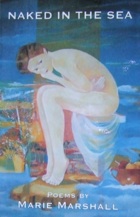 If you happen to want to order a copy of the original imprint of Naked in the Sea from your local Waterstones, they should be able to get it for you. Just give them the ISBN 978-0-9566041-0-1. It’s certainly on Waterstones’ on-line ordering system, and is still available direct from Masque Publishing. Meanwhile the second imprint, courtesy of P’Kaboo Publishing, is available as in Kindle format from Amazon UK, or Amazon USA, or as an eBook direct from P’Kaboo.
More news about Lupa when I have it.
 I’m remarkably out-of-touch about some projects. I was reminded yesterday about this do-it-yourself anthology, and it contains five of my old poems: ‘At Håkon’s Cove’ (2008), ‘Destiny’s Song’ (2008), ‘The Grey’ (2012), ‘We met Death one day, you and I’ (2011 – also published in The Tower Journal), and ‘A Scottish Autumn’ (2008 – part of a collection of poems I wrote to compliment the paintings of Scottish artist Tom Barron’. ‘At Håkon’s Cove’ and ‘Destiny’s Song’ show me flexing my ‘rhyme-and-metre’ muscles. The editor of the anthology is Ron Wiseman, an Australian poet and editor, and one-time seam bowler. I just had to get that cricket reference in, folks. Click on the cover picture for details of how to buy the book. It is full of poems by some wonderful poets, probably more of the formalist bent than many of my readers are used to, but a varied and interesting cooperative.
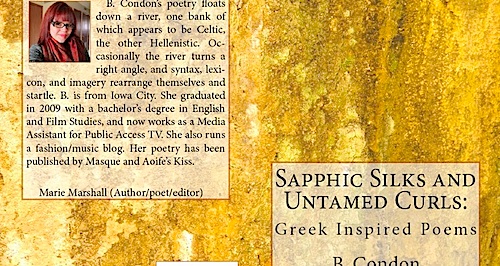
Just putting in a word for B Condon’s Sapphic Silks and Untamed Curls. I had the honour to be invited to write the back-cover blurb. I can’t help liking B’s poetry. It seems to be atavistic and proleptic all at the same time. Work that out…

It seems that this week I have done nothing but revise, review, and re-format my poetry. Firstly I have been trying to get the Kindle version of Naked in the Sea ready. It will be available on Amazon soon as a second imprint by P’Kaboo Publishers, ISBN 978-0-9921921-1-2. I’ll let you know when – ignore anything currently at Amazon, that was a trial run and there were problems. Secondly I have been reading through my new collection I am not a fish, which is due for publication in Spring 2013, published by Oversteps. Both these processes have had to result in slight and not-so-slight alterations in layout or order of the poems, but I’m hoping that the result will be satisfactory. All this has got severely in the way of actual ‘creative’ writing, but it has to be done!
Meanwhile, a light interview with myself was published at the web site of Diane Tibert, a writer from Nova Scotia. It includes the first three hundred words of Lupa. For those of you who haven’t got your copy of Lupa yet, why not ask for it as a Christmas gift from a family member, or buy it yourself as a present for someone else…

I was recently loaned a copy of Sunset Song to read. The novel is the first part of a trilogy, collectively known as A Scots Quair, written by Lewis Grassic Gibbon. That is a pen-name, by the way, used by James Leslie Mitchell, an author who grew up in what was then Kincardineshire or ‘The Mearns’ in rural North-east Scotland, purely for this trilogy – he used his given name for his other work, his pen-name being a version of his mother’s maiden name. I was loaned it because (said the loaner) I would enjoy its literary qualities, its blending of Scots and English, and the anarcho-communist politics of its author, although the book does not wear those politics prominently on its sleeve.*
After I had read the book I applied the words above – ‘a neglected classic’ – to it. Not because it is neglected generally but because I had neglected it. in Scotland it is revered, it has been voted Scotland’s favourite novel and is in print at a host of publishing houses, as you can see from the handful of covers pictured here. Inasmuch as it documents vividly, truthfully, yet not without sentiment, the passing of the peasant class in rural Scotland, it is almost a work of social history as well as a novel. As we come closer to the centenary of the Great War of 1914-18, the event which, more than any, destroyed that class, the novel deserves reappraisal.
 It is not necessarily an easy novel to get into. The register in which it is written is peculiar. A modern reviewer recently castigated it as being ‘badly written’ because of its overuse of conjunctions ‘and’ and ‘but’, its long sentences, and its peculiar syntax, dismissing the novel out-of-hand as boring and dull. Suffice it to say it’s neither boring nor dull, but its prologue is surprising. Before a reader is more than two or three sentences into it, he or she may become aware that this apparent mish-mash of folk-tale and history has the register of the Scots equivalent of a griot, the West African storyteller and reciter of genealogies. Where the ramble through the history of the Mearns community comes up-to-date, the register becomes gossipy, as though the doings of the inhabitants are being discussed over the garden fence. This was a departure from the expectations of novel-writing and narrations, and such departures were typical of the modernist period of literature**.
The four main chapters are given titles corresponding to stages in the agricultural cycle – ploughing, harvesting, and so on. Although the story is narrated, the central consciousness is that of Chris Guthrie, whom we see grow from childhood to young-widowhood. There are departures from her thoughts into the thoughts of others, often by Gibbon’s use of the confidential ‘you’ which places the narrator in the Mearns community and draws the reader into it also, but always and at the beginning and end of the chapters, it is Chris’s eyes we see through. Chris is a strong character, an intelligent young woman who could have broken out of her environment on account of her aptitude at school, but who chooses not to do so. Her staying gives an opportunity for the book’s point of view to be one of clear vision. Her insistence on being known as ‘Chris’, never ‘Chrissie’, gives her a toehold of independence in a society in which women are sexually and domestically subservient.
This is no rose-tinted novel. Life in the Mearns is shown to be harsh and hard. Sex is seen as a sociological driver. People are shown with brutal honesty as being mean-spirited and unwilling to speak well of anyone if they have a breath left to speak ill. The reader can sense that this is not a part of their character that Gibbon admires, but he is prepared to address it head-on, to describe all the small-mindedness and spite of the village gossips, all the brutality of the men without holding back. The prominence of Chris’s viewpoint, however, gives the novel an empathic gynocentricity which had critics at the time wondering about the gender of the author. However, Gibbon admires the way that, when the occasion demands it, these folk form and function as a community without giving it a moment’s thought.
There is another object of admiration. Chris’s father, John Guthrie, is portrayed as Calvinistic, tyrranical, brutal, and a prisoner of his sexual needs. Yet when he dies and is being buried, and the reader is heaving a sigh of relief, this moving passage occurs:
Someone chaved at her hand then, it was the gravedigger, he was gentle and strangely kind, and she looked down and couldn’t see, for now she was crying, she hadn’t thought she would ever cry for her father, but she hadn’t known, she hadn’t known this thing that was happening to him! She found herself praying then, blind with tears in the rain, lowering the cord with the hand of the gravedigger over hers, the coffin dirling below the spears of the rain. Father, father, I didn’t know, Oh Father, I didn’t KNOW. She hadn’t known, she’d been dazed and daft with her planning, her days could never be aught without father; and she minded then, wildly, in a long, broken flash of remembrance, all of the fine things of him and his justice, and the fight unwearying he’d fought with the land and its masters to have them all clad and fed and respectable, he’d never rested working and chaving for them, only God had beaten him in the end. And she minded the long roads he’d tramped to the kirk with her when she was young, how he’d smiled at her and called her his lass in days before the world’s fight and the fight of his own flesh grew over-bitter, and poisoned his love to hate…
I should point out that direct speech is rare in the novel, and where it occurs it is shown by italics. Here indeed we have those long sentences, rushing on, broken by conjunctions, but in this case it adds to the incoherence of the sudden realization of grief as suppressed memories of her father’s honesty and tirelessness, and even of a forgotten moment of affection between them, burst upon her. The gravedigger, his hand over hers, serves as a reminder of the good in her father – he is a silent almost-surrogate for her father in this scene. Chris’s anguished cry is almost a liturgical response to Christ’s petition for forgiveness on the cross. It is indeed the crux of the novel, and Gibbon’s bringing us to realise that not a monster but merely a man is being buried. The passage borders on sentimentality, but it is not maudlin. It is not the man John Guthrie that Gibbon admires, it is the qualities which are picked out in him in this and other passages. Here he stands for all the men of the Mearns – he works tirelessly, is rigorously honest, is rigorously egalitarian.
 The passage is also interesting for its use of Scots words and hints of Scots grammar. This is typical of the book as a whole, and is evidence of Gibbon’s deliberate linguistic enterprise. His intent was to write in a way accessible to readers whose first language was English, but to enrich that English not only with the cadences of Scots but with a certain amount of Scots lexicon too. He did this with deliberation, out of the love of both languages and in the knowledge that one was effectively dying while the other was developing and strengthening. It isn’t an easy marriage. Scots is exclusively a demotic language, and the Scots of the Mearns is a dialect of it; Scots never had an official status even within the borders of its own land, was never the second language even of the Gaelic-speaking Westerners. This makes it difficult (not impossible) to use outside its historical and geographical context. However, Gibbon does make successful use of a selection of Scots words, the meaning of which is, to varying degrees, decipherable from the context. Gibbon did not want to include a glossary with his novels, but some editions do have one, which is of assistance. Less comfortable and to my mind a flaw in Gibbon’s execution of his scheme is his adaptation of some words into a faux-English equivalent. These stick out like a sore thumb for their etymological ineptness. I cite the following. ‘Brave’ for the Scots ‘braw’, the former being of Latinate origin and the latter Nordic, both having divergent meanings***. ‘Childe’ for ‘chiel’ meaning a fellow. ‘Quean’ for ‘quine’ meaning a young woman. ‘Blither’ for ‘blether’ meaning to speak or to converse, the former being an English word with connotations of delirious raving. Heaven alone knows why he made those particular lexical choices.
Despite this, the novel remains the preeminent evocation of the passing of the crofting way of life in the rural North-East. The final scene – the dedication of a war memorial at an old stone circle – records the names of the young men who would not be coming back to farm their smallholdings, and laments that their place has been taken by business-oriented farmers with an eye on profit at the expense of community.
I am currently reading through the sequels, Cloud Howe set in a large village or small burgh, and Grey Granite set in an industrial, coastal town. They are good books in their own right, but perhaps not as satisfying as Sunset Song. There is a sense of unfinishedness about them. Gibbon died at the early age of thirty-three. He did not live to see the Spanish Civil War, the Second World War, the establishment of the post-war Labour government with its National Health Service and other socialist projects, the fall of Stalin, the Iron Curtain, and the Cold War. Sunset Song has a resolution and closure that the other novels of the trilogy seem to lack, because it marks the passing of an old world; the others do not mark the beginning of a new. Nevertheless the trilogy is a landmark of the twentieth-century ‘Scottish Renaissance’, and Sunset Song itself a minor masterpiece. I would recommend it for anyone interested in Scotland, or in the history and literature of this country.
__________
* I am grateful to my agent – he is studying for a university degree in English Literature, and I get the backwash of his learning!
** It has to be said of modernism that it is not a unified nor easily defined movement, and that the writings of, say, James Joyce, Katherine Mansfield, Gibbon, and Virginia Woolf, to give a mere handful of examples, differ from each other greatly. One could more easily speak of ‘modernisms’ rather than ‘modernism’.
*** Here in Dundee we pronounce it ‘brah’, which is pure Swedish!
 Marie Marshall