 By now we all know the story of how To Kill A Mockingbird came to be written, and how Go Set A Watchman came to be published fifty-five years later. That half-century-and-a-bit has seen a lot of changes in sensibilities about race, particularly in the USA, the country where both novels are set and where their major readership is. The thesis of To Kill A Mockingbird seems to be that, by and large, people are decent, or strive to be decent, or can be reminded of their decency despite their prejudices, not simply about race but about other fears as well; this decency does not always win out against a tragic result, when such prejudices are deeply ingrained in a community’s culture, but that is life. Man, as the Bible says, is born to suffering, as the sparks fly upward. Nevertheless, keeping an eye to that glint of decency leads, step-by-step, to some kind of progress.
To an extent, we readers found it easy to accept this naivety, given that the first-person voice of the book was that of a child, and that Harper Lee was relaying to us how the world seemed to her, that child, the novel being semi-autobiographical. We excused the ingenuous nature of its basic philosophy – indeed, it seemed ideologically neutral to us, because it expressed how we like to feel about ourselves, that there is hope, progress, and betterment. Most of its first readers came to it during the optimism of the 1960s Civil Rights movement.
Nowadays, in the era of ‘Check your privilege!’, it seems such an attitude won’t do. Racism is binary, it is either on or off, it is a thing without shade, hue, or nuance, it is a label hung as prominently around the neck of anyone who betrays a slight slip of attitude as it is round the neck of the most dyed-in-the-wool Klansman. I don’t say this is right or wrong. I do say it is as much cultural as was the liberal feelgood attitude that seems to be there in Mockingbird. Without the hardening of attitude since the date of writing and publication, perhaps a book like Mildred D Taylor’s Roll Of Thunder, Hear My Cry would not have been written fifteen years later. Certainly I could argue that her minor character Mr Jamison, the sympathetic white  lawyer, would not have been created without the pre-existence of Atticus Finch. But Taylor’s work is much harder-edged, plainly didactic, aiming to show that African-American people must be the prime movers of their own change in circumstance. Thus Mr Jamison is largely ineffectual; whilst a lynching in Mockingbird is prevented by the stoical Atticus and ultimately by the ingenuous Scout, in Roll Of Thunder Jamison can’t swim against the tide, and a lynching is only prevented by a covert act of arson on the part of one of the adult black characters, as a result of which all the characters, irrespective of ethnicity, have to collaborate to save their livelihood. Taylor’s attempt to seize the story of racism in the South and depict it from the point of view of those on the receiving end was understandable. Despite Roll Of Thunder receiving the 1977 Newbery medal, I have always felt it failed as a book, because it never quite managed to give the child characters’ actions any appreciable impact or effect, compared to that of Scout in front of the gaol, and as it was principally a book written for children, that was a not inconsiderable failing.
Go Set A Watchman is already suffering on many counts in the few days since it was published. I almost feel cheated myself – I always wanted to be a writer, and Harper Lee was my idol for the simple reason she had come along out of nowhere, written one book which turned out to be a literary landmark, and then had written nothing else. I would have loved to have written the twenty-first century’s Scottish equivalent and similarly retired. Therefore I had mixed feelings when the coming of Go Set A Watchman was announced. I had long since given up my ambition of being a second Harper Lee – after all, I had had three novels published, and although I am glad to say they are read, I can’t claim that they have achieved the status of Mockingbird. I wondered whether the appearance of Go Set A Watchman would tarnish Lee’s reputation, rather than enhance it. I knew I would buy it, but frankly I would have waited with greater anticipation the appearance of a new Anne Tyler novel, she being acknowledged as prolific and a good story-teller.
How, then, to read Go Set A Watchman? We know that it is a largely unaltered first-draft of a novel that, with substantial revisions consisting of taking a minor passage and expanding it to novel length on its own, became To Kill A Mockingbird. We know that it is set in the 1950s, closer to the time when it was written. We have to be prepared for some major differences. The first and most obvious one is that we do not have Scout’s direct voice. There is no ‘Scout’ as such, no immediate trace of the overall-clad tomboy, except in a handful of flashbacks. The protagonist is Jean Louise Finch, somewhat of a feisty New York sophisticate in slacks, coming back to her  Southern birthplace for a visit. The novel is written in ‘free indirect speech’, which means that although we do see things from Jean Louise’s viewpoint, the actual language is third-person. This holds us at a slight distance from the protagonist, it is not as easy to identify with her. The biggest surprise – well, by now it is, of course, no surprise at all – is to find Atticus Finch holding segregationist views. This troubles our binary view of racism. More to the point, it troubles our binary view of liberalism. Atticus Finch, as shown in Mockingbird and in the film adaptation of the novel, has inspired many people to take up the Law as a profession. He has a monument raised to him in Monroeville, Lee’s home town, which is fairly unusual for a fictional character. Good heavens, Gregory Peck, when I saw him in a TV re-run of the film, became my first and only guy-crush!
Yet, having read the book, I realised that his courtroom address in defense of wrongly-accused Tom Robinson, though thoroughly logical, read like a grocery list. It was flat and undramatic, lacking in rhetoric, as though the facts were enough to carry the day. He won the argument, sure, but lost the trial. He was not an advocate for any great social change, he was simply a man who demanded, plainly and without passion, that the law should be properly applied, and that you could not convict a black man contrary to the evidence. This is a major reason why later reviews of Mockingbird criticised both him and his creator for not being anti-racist enough, for not using the Tom Robinson case, Samson-like, to topple the Philistine edifice of Southern racism once and for all. But – for heaven’s sake! – did that happen in real life? Then why should it happen in fiction? Whilst no work of literature is ideologically neutral, Mockingbird is a realist novel, not a sermon.
 If it really shocks you to find that a character who in one novel was, as a matter of principle, sure that a black man ought not to be convicted of a crime he did not commit, is in another novel, sure that the black and white races should develop separately, then do as follows. Do not regard Go Set A Watchman as To Kill A Mockingbird Part Two. It was never conceived as such. Regard it as a stand-alone novel with stand-alone characters that just happen to have the same names as characters in another novel that you have already read. More properly, regard it as you would regard a first draft that turned up in the posthumous papers of a departed novelist, and cherish it as a record of her creative thought processes. I grant that this will be difficult, but judge it without reference to the literary merit of To Kill A Mockingbird. To have that previous merit in mind will mar your reading. This, however, you should bear in mind: Go Set A Watchman is not a twenty-first-century novel. It is a mid-twentieth-century novel. It is a product of its time and of the culture that Harper Lee lived in and took as normative. L P Hartley said that ‘the past is a foreign country; they do things differently there’, and this is something that I, as a person with very sharply defined political and literary principles, have had to learn to come to terms with as I read literature, and as I write creatively myself. I’ll not spoil the plot for you, but that is how to read Go Set A Watchman.

 I could say, I suppose, “I’m still writing my next novel,” but how many times can I repeat that before ‘no news is good news’ becomes simply ‘no news is no news’? As it happens, I am still writing that novel. What’s it about? Well, I’m playing my cards close to my chest on that one, for many reasons, not least of all that it is a dynamic project that has changed course several times already. That’s largely because the leading character has taken over – the novel is not only in her unique voice, but governed by the way her unique mind works – and she is defying the concept of an end-driven story. I can say that it is the novel, or if not the novel then one of the novels, I have always wanted to write. Also that it is set in Victorian London, or is set there as far as can be gauged, given that the leading character’s psychology has telescoped the entire Victorian era into her short life. There will be murders and detection, but also obfuscation and doubt. English folklore characters from the countryside will encroach onto the bustle of the metropolis, there will be both psychic fakery and psychic peril, and a strange, silent figure will stalk through the narrative.
 Assembling a chapbook-length selection of my poems inspired by the 16th century Venetian courtesan Veronica Franco, to present to a Scottish publishing house during their twice-yearly ‘window’.
 Meanwhile KWIREBOY vs VAMPIRE, the sequel to my novel From My Cold, Undead Hand, is now with P’kaboo, and is awaiting publication in due course.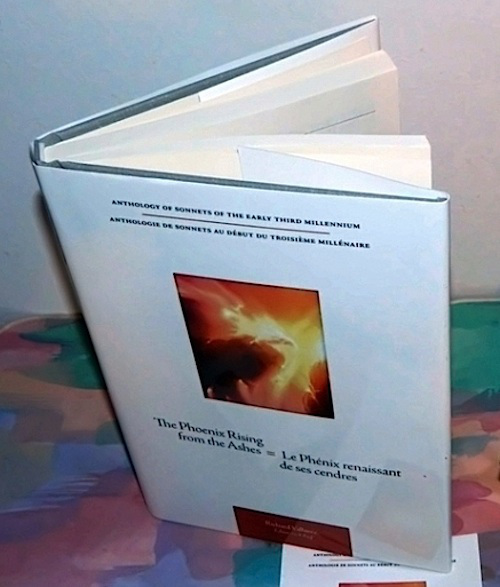

 Silver Threading is a web site that has as its theme ‘Authors Supporting Authors’. This support can take the form of interviews, book reviews, articles, and so on. Recently they featured me, in an article mainly drawn from my own words. You can read it

 Haiku, haiga, short bursts of poetry, startlingly immediate artwork – these are things I try to incorporate in the quarterly e-zine the zen space. How I come to be editing and publishing this e-zine is an old, old story, but it has something to do with a run-in I had with the editor of a similar enterprise. I, being an arrogant wee beggar, decided I could do better. Well, I don’t know if I’ve actually ‘done better’, but at least I’ve ‘done’.
 Marie Marshall