Marie Marshall

Author. Poet. Editor.

Tag: writing

Comments that have made me blush recently.

“Marie Marshall is a poet of substance. Relatively speaking, I would place her at the level of the late Sylvia Plath. I am an Australian poet/editor and for years, I’ve had the greatest respect for the depth of talent in poems by Marie. Do read her work again and again.”

Ron Wiseman, Sunshine Coast, Australia.

“An excellent writer whose style adjusts and flows with the genre and setting of her work. Her stories are deep and thought-provoking while never losing their swift forward motion; her poetry is poignant and of a rare beauty.”

Lyz Russo, South Africa.

A good review at BestChickLit.com

NewChickHeader

BestChickLit.com is a review site mainly dedicated to reviewing literature by and for women readers. It also has a thriving ‘Young Adult’ section, where it has featured my previous YA novel The Everywhen Angels, and has now featured From My Cold, Undead Hand. Reviewer Nikki Mason called it ‘a great adventure book’, and appreciated the fact that the vampires are ‘unequivocally the bad guys’. Drop in at the site and check out the review. Many thanks, Nikki.

By the way, this is what BestChickLit.com has to say about Nikki:

Nikki


I am interviewed by Janni Styles

Janni Styles is a Canadian writer and blogger, whose new collection of short stories, One Part Good, was published recently. She did me the courtesy and favour recently of interviewing me, asking me some rather interesting questions about From My Cold, Undead Hand, and about myself and my writing in general. You can read the interview here. In fact, please do…

‘From My Cold, Undead Hand’ now available at Amazon!

jpegYes! I’ve just been up-dating the page on this site for From My Cold, Undead Hand to take account of the availability of the novel worldwide in more formats. You can still get it in ePub format direct from the publisher from their site, and with it some extra text and an audio file. But now it’s additionally available from Amazon in both Kindle and paperback. So, if you’re choosy about  your format you are now spoilt for choice! I will give you more news about its availability via bookshops as and when I have it. Why not follow me on Twitter @MairibheagM and keep up with my news in brief!

A big thank-you from me to P’kaboo, my publisher, for all their effort and support, and also to my trusty agent.

Imagine a wall… the answer

Last week I set a conundrum and asked if any of you could guess the answer my friend gave. Her answer illustrates two things, firstly lateral thinking, and secondly paying attention to the question. Here’s the question again:

Imagine a wall made of hard, smooth blocks of stone. It’s so high you can’t see the top. It’s so wide that no matter how far back you step you can’t see where it ends, if indeed it ends at all. A wall so mighty must have foundations almost as deep as it is tall, so it can’t be undermined. It is, as near as makes no difference, a wall of infinite dimensions! How do you get to the other side?

I think the most interesting answer came from someone who suggested walking away from the wall, all round the earth’s circumference, until you came to its further side. Hmm, that would be all very well if the wall didn’t itself circle the globe – you would be half way on your trek and suddenly would come up against the same side of the wall.

Look at the wording of the question again. My friend answered in three words. Here they are:

“Imagine a door…”

__________

While I have your attention, may I mention that the Autumn 2014 Showcase at the zen space, the on-line repository of haiku and other short poetry, is now published. Guest editor this time is the wonderful Sam Snoek-Brown. Read it here.

Imagine a wall…

Today I was pondering the famous ‘three light switches’ conundrum when I remembered another one. It had been posed to me by a fellow writer – even so it wasn’t of her devising, it had been posed to her by someone else who had been amazed at how quickly she had come up with an answer. Instantly. I wondered what you would make of it. Shall we see?

Imagine a wall made of hard, smooth blocks of stone. It’s so high you can’t see the top. It’s so wide that no matter how far back you step you can’t see where it ends, if indeed it ends at all. A wall so mighty must have foundations almost as deep as it is tall, so it can’t be undermined. It is, as near as makes no difference, a wall of infinite dimensions! How do you get to the other side?

If you think you can guess the answer my friend gave, then tweet me @MairibheagM. Yes, her answer was so simple it can easily be contained in a tweet. If you don’t have a Twitter account, then you can get in touch via the email address on my ‘Contact’ page. I’ll publish the answer in a week’s time.

Publication tomorrow!

banner 500

“… The fog is still yellow and thick. I can see maybe twenty yards either way. The house across the street is a vague oblong, the parallel lines of the sidewalk fade into the general gloom. There’s a thickening, a kind of shift in the fog, like it’s swirling, like it’s trying to contain more than it actually can. And there’s a smell in the air I don’t like. Downhill there are man-size shapes forming in the fog, figures walking towards us – three, maybe four. I look back uphill – figures there too, and a couple across the road. The house door creaks, and there’s another figure standing in the doorway. Maybe a dozen of these figures are slowly closing in on us. I grip the broken chair leg as E.J. moves round me and we stand back-to-back…”

Just how excited can an author get about nearing publication? Do all the big ‘names’ feel as cool as they look? Do they think “Well, there goes another one”, and wait for the offers of interviews from the Times Literary Supplement and the BBC to roll in? Maybe, maybe not. All I know is that I am excited about getting novel No.3 published as I was about getting No.1 out there. I have only twenty-four hours to wait – tomorrow is the big day!

Just how many kinds of vampire are there?

promo09a

Big ones, little ones, new ones, centuries-old ones, perhaps ones that have had extensive orthodontic work, and perhaps even ones who have a secret that is kept until the sequel. Yes, there will be a sequel to From My Cold, Undead Hand! More about that later – much, much later – but right now all eyes are on the 15th of September, which is publication date! That’s when you’ll be able to get your teeth into it…

The book will first be available in e-book format direct from P’kaboo Publishers. Shortly after that it will be available via Amazon in both paperback and Kindle formats. However, if you want some bonus extras, in the form of extracts in text and audio of the ‘diary’ of one of the characters, then the e-book direct from the publishers is the way to go. You can even pre-order to make sure!

As you can imagine, I am very excited about having my third novel published. It is, in a way, also a ‘first’, being the first one I have written as a commission from a publisher, my first venture into the genre of teen-vampire fiction, and the first of a planned trilogy. If you would like to know about it, click here to find my answers to questions about it when I was interviewed recently.

If you have any questions about it yourself, please contact me and let me know.

MM

Jayhawkers, rougarous, and violent death: a review of Samuel Snoek-Brown’s ‘Hagridden’

(warning – this review contains plot spoilers)
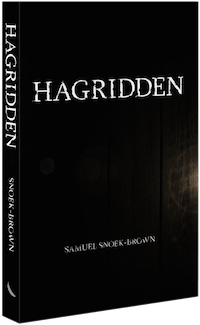
hagridden_book_coverHagridden
Samuel Snoek-Brown
Columbus Press, OH, pp.241

Samuel Snoek-Brown will possibly turn out to be one of the best storytellers of the 21c. There’s a modernist feel to his storytelling, very often his plots don’t resolve, but rather give the sense that a process – a life – is going on, and that we have witnessed a part of a greater whole. The psychology of his characters is seldom explained but always clearly displayed, as readers have already seen in Boxcutters, his slim book of short stories. Now we have his first published novel, Hagridden, to consider. According to Sam, Hagridden isn’t the first novel he has ever written, owning up to other attempts when he was much younger, saying “they were books I had to write in order to learn how to write this one”. Teethcutters, you might say!

Hagridden is the story of two women who eke out an existence in the Louisiana bayous towards the end of the American Civil War. One way they survive is to murder fleeing soldiers of both sides and sell their weapons and accoutrements to a corrupt storekeeper. When a neighbour, a comrade of the younger woman’s dead husband, returns to his hut having deserted from the Confederate army, their existence is thrown out of kilter. Aficionados of Japanese film will instantly recognise that Hagridden owes a huge debt to Kaneto Shindo’s movie Onibaba (1964). This debt has never been a secret, although it is not directly acknowledged in the book. However, this is not the first time that a tale from medieval Japan has been transferred to 19c America, and it is not simply an adaptation of Onibaba; not only has the tale moved in time and location, but it has also switched media. There are also differences in the plot beyond that, some subtle, some very obvious.

The Civil War is a very powerful element of the USA’s national myth as well as of that nation’s actual history. The stiffness of 1860s daguerreotypes from which uniformed, bearded men stare out was taken forward into film and TV – Gone with the Wind, North and South, Gettysburg – with gallant officers, plantation ladies, and stoical slaves. Largely forgotten in popular culture is the devastation to lives on the periphery. That is where Sam Snoek-Brown sets Hagridden. The two women have been brutalised by poverty, and their consequent violence is graphically described. Sam doesn’t pull any bayonet-thrusts in his descriptions, he doesn’t let the reader look away at any time, forcing a confrontation in which not every reader will feel comfortable. There were times as I read when I wanted to beg for mercy, not for myself and my own sensibilities, but for a character. In the end, it was almost a surprise to learn who did and who did not survive. Mercy, however, isn’t an option, as the book is driven along by the worst in humanity, in nature, and in superstition. There is only one act of kindness in the book, and that seems to be nothing more than a device to allow two of the central characters to survive a little longer.

Hagridden is almost an amoral book. In fact I would guess that this is deliberately so, making its amorality a moral stance in its own right. Characters are allowed their own morality, as when one of the women rationalises the sins of murder and lust:

I ain’t talking about killing nothing. They’s bad and then they’s bad. What we do we do to survive and they ain’t no sin in that. But lust? Whoo girl, you got to look out for that they lust. Worst sin they is. Sinners what lusted after the flesh in this world, they turn to animals in the next. Crawl round on all fours like dogs and the brimstone burning off they knees, the skin off they palms. Some say rougarous is lusters coughed up from Hell to walk the earth.

werewolfA ‘rougarou’ (Fr. loup garou, werewolf) is what gives Hagridden its superstitious, supernatural element, although there is a mundane explanation to this creature’s appearance in the story. However the appearance of the second (or is it third?) rougarou is almost too convenient, almost that of a deus ex machina, and not the novel’s most convincing episode.

From the quoted passage above, it can be seen that much of the dialogue is written with a distinct ‘eye-dialect’. There are also what I call ‘fixers’ – usages which establish a time and place in a story. In the case of Hagridden, the fixers are Cajun-isms, notably the way characters address each other casually as ‘sha’ (chère), ‘vieux’, ‘petites’, and ‘boo’ (beau). They don’t always work, as when ‘boo’, normally said to a man, is addressed to the older woman (p.14), or when the ungrammatical ‘ma petit fils’ is used(p.158). Such solecisms may exist in the vernacular of Louisiana – I speak a little Louisiana French but am no expert – yet they look wrong on the page. As a general point of style, direct speech is not marked by any form of quotation marks. This meant that I had to look consciously for where speech started and ended. But this wasn’t a chore, and in fact it concentrated my attention, making the text as a whole feel very taut. Some readers might find the use of the word ‘nigger’ unpalatable, but if it was there in the actual speech of that time and place then it has to be there in this novel.

Human-on-human is not the only brutality of the novel. Greater than the violence and murder done by the characters on each other, and than the supernatural terror of the werewolf stalking the bayou, is the force of nature. A hurricane and tidal surge threatens to wash away everyone and everything, including the story (pp.193-200). One of the most compelling passages of the book comes here, as two characters watch an oddly-juxtaposed procession of domestic objects, animals, and people float by them in the flood. It is surreal, almost nightmarish.

Sam Snoek-Brown has been praised for his meticulous research while writing this novel. Although I have queried some details, I could see as I read that he had indeed paid a great deal of attention to historical authenticity. This was obviously something he wanted to achieve, an integral part of the exercise of writing the novel. I don’t want to belittle that achievement, but to me it wasn’t over-ridingly important. What was more important was the novel’s plausibility, its power to make me suspend disbelief and follow the story to the end. He achieved that with an expertise that made it seem easy. That’s the mark of a craftsman-author. This novel may be read ignoring my quibbles, and on that basis I recommend it fully.

MM
__________

Hagridden official web site

Review of ‘Finis’ by Angélique Jamail

Finis cover 200Finis
Angélique Jamail
Amazon Kindle format
review by Marie Marshall

The best fantasies are the ones which have one foot in reality, in a world or society in which there is enough recognizable for a reader to be drawn in without having to have anything explained. A writer’s skill in doing so is necessary for the metaphor – the unreal, the less-than-recognisable that nonetheless stands for something in our own world – to take hold and be convincing, and Angélique Jamail’s skill is apparent from the very beginning of Finis.

We instantly enter a familiar world where work is tedious, landlords are mean, family is disapproving, neighbourhoods are patrolled by gangs, and where to be different is to be in danger. But in his corner office, the boss is a monster, quite literally a monster capable of goring any secretary who misses a staff meeting. In an environment where to be recognised as fully human one also has to be fully animal, one wonders just how bizarre the Minotaur of legend must have been if ‘Somewhere in Crete a maze is missing its pet’! Similar in feel to the way Philip Pullman’s characters develop a companion ‘dæmon’ as they mature, humans in Jamail’s story take on important aspects of members of the animal kingdom, until they are a fusion of the two. People who never develop this full nature are referred to as ‘plain’.

Elsa, Jamail’s protagonist is a ‘Plain One’, enduring reactions from her colleagues and superiors that range from pity, through discrimination, to bullying, and meeting little better from her immediate family. Even her cat wants to claw and bite her, and in fact is the only one who (spoiler alert! from now on they come thick and fast) actually understands her true nature from the beginning. Jamail’s portrayal of her nagging, unsympathetic father is convincing…

When Elsa doesn’t muster the same enthusiasm as the rest of the family, her father asks what her problem is.

   “Dad, you know I can’t swim – “

   “No, you won’t swim,” he grouses. “There’s a difference.”

This is technically true. Elsa chooses not to submerge herself in vats of acid too.

as is her mother’s fretful ‘Why doesn’t she ever go out? Why doesn’t she ever bring friends over at the holidays? Is she ever going to get married?’ The only member of Elsa’s family with whom she has any affinity is her cousin Gerard – “We both like seashells and hot chocolate”.

A tantalising ichthyological theme runs through the story like a bright thread – an aquarium, tuna sandwiches, references to water everywhere, even the punning title of the story and the last word on the page – loading the narrative with proleptic irony at every turn. Suddenly a clue comes, a newspaper story about the possible appearance of a Phoenix. Perhaps this is how Elsa will develop, with a rebirth in fire, and perhaps this explains her fear of water. But this is partly a red herring (!), although for Elsa it does suggest that maybe her own rebirth means surrendering to the very element that she fears. Eventually she becomes – what? A fish? A mermaid? Her transformation is left less than clear, but for her it is satisfying, it is an ending and a beginning. The conclusion is open-ended, and it almost leaves the reader with a feeling of unease. The problems of plain-ness have not gone away in Elsa’s world simply because she has escaped it, and the point of story has suddenly become her comfortable conformity.

Any niggles I have with the execution of this story are minor. For example, the process of change is referred to as ‘blossoming’, which to my mind is floral rather than faunal, and therefore less than appropriate. Overall it is a lesson in how to write from a point of ‘otherness’. It is short, but just the right length to carry readers and keep attention along a fairly simple narrative. Very worth reading, if my spoilers haven’t given the game away.