 I share a literary agent and a publisher with English novelist Carmen Capuano, whose YA novel Split Decision will be launched in a week’s time on the 4th of July. Our publisher – admittedly not one of the heavyweights – is utilising the ‘Thunderclap’ web application to promote the launch. If this promotion is successful, then they will use it for future book launches, including those of any book(s) of mine they may publish. This means I have a vested interest in seeing that their current campaign on behalf of Carmen is a success.
In order for it to work, we need one hundred people to support it. Yes – one hundred, and in less than a week! This means that we need to drum up people who are prepared to publicise it on Twitter, Facebook, and Tumblr. It only takes a click or two. Please go here and read about this campaign.
Thanks in advance for your support.
__________
In yesterday’s PM, BBC Radio 4’s late-afternoon current affairs programme, there was a light-hearted item about the use of the word ‘intertwangled’ by (I think) management consultant Peter York during a radio interview. According to a representative from the Oxford English Dictionary, the word isn’t in the current OED, but, she said, it is a word by virtue of someone’s having used it. There was even a possible earlier coining. PM’s presenter invited listeners to bring the word into currency, the first line of attack being Twitter #intertwangled.
I love new words, inventive language, and so on, so I have jumped on the band-wagon by using it, in a poetic context, in one of my series of dem●n’s diaries. All in good fun. So there’s another campaign you can get behind!
__________
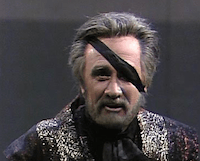 The other day I found, to my delight, that someone had loaded the whole of the Jahrhundertring onto YouTube. The Jahrhundertring was the production of Richard Wagner’s four-opera cycle, Der Ring des Nibelungen, that was staged to mark the centenary of the Bayreuth Festival. This production, staged between 1976 and 1980 was marked firstly by the conductor’s baton being in the hands of probably the greatest modernist composer of the 20c, Pierre Boulez, and secondly by the stage direction being by Patrice Chéreau. Together they managed to realise George Bernard Shaw’s socialist analysis of the cycle, lifting the story almost totally out of Nordic/Germanic mythology and placing it in the 18c and 19c development of the Industrial Revolution. This might seem a fanciful idea, but, if you have the patience to watch the four operas, collected from the 1979 and 1980 stagings, and to absorb the concept, it works, and in fact becomes difficult to fault.
The humanising of the characters reminds us that the supernatural beings of Germanic mythology were, in many ways, the personification of human traits and emotions – courage and cowardice, love and anger, honesty and deceit, triumph and tragedy – but magnified far beyond the human range. Sir Donald McIntyre’s Wotan is a magnificent, tragic figure; if gods are more powerful than mortals, and their traits greater, then equally the contracts that bind them are more constraining. Wotan is bound by the agreements he has made, and each attempt he makes to find a way round them is doomed.
 We first see Wotan amongst the other gods, gorgeously clad in 18c finery, in Das Rheingold. Valhalla having been secured and occupied, in Die Wallküre he has taken on the appearance of a bourgeois, 19c banker, frustrated in his scheming by his wife, the goddess Fricka (Hanna Schwarz) who is a picture of uxorial respectability. By the time of Siegfried, Wotan has become ‘Der Wanderer’, a rootless ranger of the world, limited by choice or by fate in how far he can intervene, and his clothes are a nondescript brown. He is still an imposing figure, but his clothes seem no longer to fit well, and he has already discarded the band that hid his empty eye-socket, reminding us that, for godlike power, paying a price is more than a mortal would endure. In my opinion, Richard Wagner would have considered McIntyre as the man he wrote the role for.
I said that the production was ‘difficult to fault’. In fact, one scene in Die Wallküre always fails to convince me, and that is at the beginning of Act III, where the Valkyries are lugging dead heroes’ bodies around like so many sacks of coal. However, the culmination of Act III also contains the farewell scene between Wotan and Brünnhilde (Gwyneth Jones), which is an almost unbearably emotional depiction of the irrevocable breaking of a father/daughter bond. It is the stuff of pure tragedy, and I love it.
 Other singers deserve recognition in their roles – in fact they all do, but I am going to single some out. Firstly Peter Hofmann and Jeannine Altmeyer as the incestuous lovers Siegmund and Sieglinde are not only brilliant singers, but bring physical beauty to the roles. They even manage to look like twins. Perfect casting.
Not least of all Heinz Zednik, who steals the show in Das Rheingold as the cynical demi-god Loge, his 18c costume, a modest black contrast to the shimmer of the gods’ adornment, covering a slightly deformed shoulder, the lace of his shirt-front and cuffs shabby and loose. He also took the role of the hapless, shambling Mime in Siegfried, and managed to wring pity from the viewer, under the bullying of the hero-tenor Siegfried (Manfred Jung).
 When, at the end of Götterdämmerung, the age of gods, giants, dragons, heroes, and dwarves perishes and Valhalla burns, the front of the stage is full of crouching figures, dressed in grey. They are cowering in awe, their backs to us. Suddenly, as the flames die and only smoke remains where once Valhalla stood, one figure – a young girl dressed in white – emerges from the middle of them, standing and turning to face us. Gradually, more and more of the nameless mortals stand and face us. It is a powerful moment, the culmination of the cycle, bringing the message that the age of ordinary humanity has come into being – no more meddling gods, scheming gnomes, doomed races of heroes – we are on our own, and had better face forward.
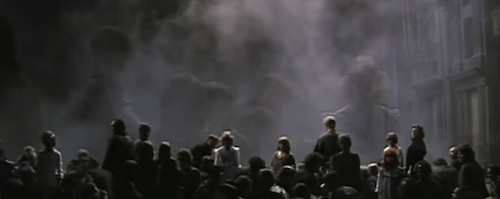
This is, of course, not the latest production of the Der Ring des Nibelungen. It is already thirty-five years old. But it is a milestone performance, and the fact that modern technology has made it accessible (whether legitimately or not) means an opportunity for the experience of a lifetime. Watching this cycle of four long operas, the shortest lasting two-and-a-half hours, can be an endurance test. But to my mind it is well worth it.
__________
By the way, it is often remarked upon that Wagner was the favourite composer of one A Hitler. So what? If Hitler ever truly ‘got’ Wagner, then I’m a flying Dutchwoman!

 There’s an excellent poetry enterprise, over in the USA, called PoCo Publications. It’s the child of poets Mary Boren and Toni Christman, and one of the projects it supports is the Poets Collective, having now published two anthologies of work by contributing poets. Mary and Toni were gracious enough to invite me to contribute to their most recent anthology – Collect the Day – in which we deal, metaphorically and literally, with the subjects at the head of this item, four times of day. Thirty-one poets have their work featured in the book, and I have eight poems in there, including four extracts from my A dem●n’s diary series, all unpublished elsewhere, all therefore entirely new to you!
 Haiku, haiga, short bursts of poetry, startlingly immediate artwork – these are things I try to incorporate in the quarterly e-zine the zen space. How I come to be editing and publishing this e-zine is an old, old story, but it has something to do with a run-in I had with the editor of a similar enterprise. I, being an arrogant wee beggar, decided I could do better. Well, I don’t know if I’ve actually ‘done better’, but at least I’ve ‘done’.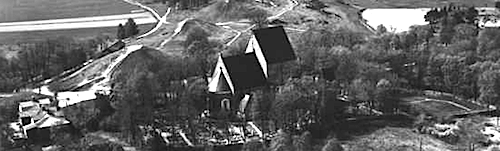


 a bee passes by



 Marie Marshall