Marie Marshall

Author. Poet. Editor.

Thunderclap, Intertwangle, and Wotan.

ccapuanowsdI share a literary agent and a publisher with English novelist Carmen Capuano, whose YA novel Split Decision will be launched in a week’s time on the 4th of July. Our publisher – admittedly not one of the heavyweights – is utilising the ‘Thunderclap’ web application to promote the launch. If this promotion is successful, then they will use it for future book launches, including those of any book(s) of mine they may publish. This means I have a vested interest in seeing that their current campaign on behalf of Carmen is a success.

In order for it to work, we need one hundred people to support it. Yes – one hundred, and in less than a week! This means that we need to drum up people who are prepared to publicise it on Twitter, Facebook, and Tumblr. It only takes a click or two. Please go here and read about this campaign.

Thanks in advance for your support.
__________

In yesterday’s PM, BBC Radio 4’s late-afternoon current affairs programme, there was a light-hearted item about the use of the word ‘intertwangled’ by (I think) management consultant Peter York during a radio interview. According to a representative from the Oxford English Dictionary, the word isn’t in the current OED, but, she said, it is a word by virtue of someone’s having used it. There was even a possible earlier coining. PM’s presenter invited listeners to bring the word into currency, the first line of attack being Twitter #intertwangled.

I love new words, inventive language, and so on, so I have jumped on the band-wagon by using it, in a poetic context, in one of my series of dem●n’s diaries. All in good fun. So there’s another campaign you can get behind!
__________
Wotan 1The other day I found, to my delight, that someone had loaded the whole of the Jahrhundertring onto YouTube. The Jahrhundertring was the production of Richard Wagner’s four-opera cycle, Der Ring des Nibelungen, that was staged to mark the centenary of the Bayreuth Festival. This production, staged between 1976 and 1980 was marked firstly by the conductor’s baton being in the hands of probably the greatest modernist composer of the 20c, Pierre Boulez, and secondly by the stage direction being by Patrice Chéreau. Together they managed to realise George Bernard Shaw’s socialist analysis of the cycle, lifting the story almost totally out of Nordic/Germanic mythology and placing it in the 18c and 19c development of the Industrial Revolution. This might seem a fanciful idea, but, if you have the patience to watch the four operas, collected from the 1979 and 1980 stagings, and to absorb the concept, it works, and in fact becomes difficult to fault.

The humanising of the characters reminds us that the supernatural beings of Germanic mythology were, in many ways, the personification of human traits and emotions – courage and cowardice, love and anger, honesty and deceit, triumph and tragedy – but magnified far beyond the human range. Sir Donald McIntyre’s Wotan is a magnificent, tragic figure; if gods are more powerful than mortals, and their traits greater, then equally the contracts that bind them are more constraining. Wotan is bound by the agreements he has made, and each attempt he makes to find a way round them is doomed.

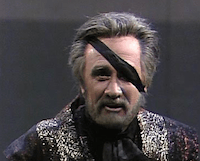
Wotan 2We first see Wotan amongst the other gods, gorgeously clad in 18c finery, in Das Rheingold. Valhalla having been secured and occupied, in Die Wallküre he has taken on the appearance of a bourgeois, 19c banker, frustrated in his scheming by his wife, the goddess Fricka (Hanna Schwarz) who is a picture of uxorial respectability. By the time of Siegfried, Wotan has become ‘Der Wanderer’, a rootless ranger of the world, limited by choice or by fate in how far he can intervene, and his clothes are a nondescript brown. He is still an imposing figure, but his clothes seem no longer to fit well, and he has already discarded the band that hid his empty eye-socket, reminding us that, for godlike power, paying a price is more than a mortal would endure. In my opinion, Richard Wagner would have considered McIntyre as the man he wrote the role for.

I said that the production was ‘difficult to fault’. In fact, one scene in Die Wallküre always fails to convince me, and that is at the beginning of Act III, where the Valkyries are lugging dead heroes’ bodies around like so many sacks of coal. However, the culmination of Act III also contains the farewell scene between Wotan and Brünnhilde (Gwyneth Jones), which is an almost unbearably emotional depiction of the irrevocable breaking of a father/daughter bond. It is the stuff of pure tragedy, and I love it.

Sieglinde SiegmundOther singers deserve recognition in their roles – in fact they all do, but I am going to single some out. Firstly Peter Hofmann and Jeannine Altmeyer as the incestuous lovers Siegmund and Sieglinde are not only brilliant singers, but bring physical beauty to the roles. They even manage to look like twins. Perfect casting.

Not least of all Heinz Zednik, who steals the show in Das Rheingold as the cynical demi-god Loge, his 18c costume, a modest black contrast to the shimmer of the gods’ adornment, covering a slightly deformed shoulder, the lace of his shirt-front and cuffs shabby and loose. He also took the role of the hapless, shambling Mime in Siegfried, and managed to wring pity from the viewer, under the bullying of the hero-tenor Siegfried (Manfred Jung).

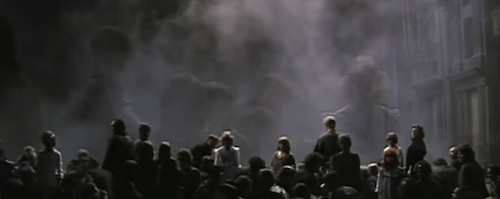
LogeWhen, at the end of Götterdämmerung, the age of gods, giants, dragons, heroes, and dwarves perishes and Valhalla burns, the front of the stage is full of crouching figures, dressed in grey. They are cowering in awe, their backs to us. Suddenly, as the flames die and only smoke remains where once Valhalla stood, one figure – a young girl dressed in white – emerges from the middle of them, standing and turning to face us. Gradually, more and more of the nameless mortals stand and face us. It is a powerful moment, the culmination of the cycle, bringing the message that the age of ordinary humanity has come into being – no more meddling gods, scheming gnomes, doomed races of heroes – we are on our own, and had better face forward.
end

This is, of course, not the latest production of the Der Ring des Nibelungen. It is already thirty-five years old. But it is a milestone performance, and the fact that modern technology has made it accessible (whether legitimately or not) means an opportunity for the experience of a lifetime. Watching this cycle of four long operas, the shortest lasting two-and-a-half hours, can be an endurance test. But to my mind it is well worth it.
__________

By the way, it is often remarked upon that Wagner was the favourite composer of one A Hitler. So what? If Hitler ever truly ‘got’ Wagner, then I’m a flying Dutchwoman!

Considering Racial Dysphoria

Rachel DolezalA couple of weeks ago, I drafted the short post below, but never got round to publishing it. Then, the other day, the controversy over Rachel Dolezal broke out. So I wondered whether this might give me the opportunity, in fact, to address the issue after all. Accordingly I have redrafted it in the light of recent events, and the result is below.
__________

Our current view of sexuality and, more especially, of gender identity is that it is fluid. For example, someone born with all the physical attributes of a girl might, at an early stage or much later in life, feel that a male identity was more in keeping with their psychological and emotional outlook. For some this can be a tenuous feeling, for others it is the strongest indication that they* should take radical steps to correct – as they see it – the mistake of their physical birth-gender. Their first step is often to ‘live as’ a person of the other gender, presenting themselves socially, in appearance and behaviour, as one would expect from a person of that gender, expecting those people-in-the-street who don’t know them, simply to accept what they see. Modern, Western society is increasingly accepting of this fluidity of identity, although the subject still does attract controversy.

I want to ask this question: if gender, then why not other fundamental birth-attributes? Why not race? I can see that you’re shaking your head already, just like we all would have done a few generations ago at the idea that someone could identify with another gender, let alone change theirs to it.

When I was at school in the 1970s, I had a friend who was a James Joyce completist, and if asked for her ethnicity she would say ‘Pseudo-Irish’. I realise that this is a simple question of cultural affinity, and that whether she was by heritage English or Irish she would always be regarded as ‘white’, but on the other hand in these islands the distinction between ‘Celtic’ and ‘Saxon’ was serious, deep, and fundamental. No Irish Nationalist at the time would have seen her as anything but a ‘Brit’. Heads would be shaken at any suggestion that she identify with an ethnicity other than she one she was born and brought up in.

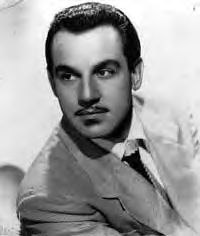
Johnny OtisIn 1921, in Vallejo, California, a son was born to Greek immigrant parents. His name was Ioannis Alexandres Veliotes. His father ran a grocery store in a predominantly African-American neighbourhood. Although his racial heritage was Mediterranean / Southern-European, he identified himself with the African-American community, and lived his life as one of them. He wrote, “As a kid I decided that if our society dictated that one had to be black or white, I would be black.”
No doubt his Mediterranean complexion and his dark hair helped to give the impression that his heritage genuinely included African, and his familiarity with black culture made it easy to fit in. Nevertheless it was a definite trans-racial identification. As ‘Johnny Otis’ he became a musician and bandleader, and was highly influential in R&B, an essentially African-American genre. As such, he was inducted into the Rock and Roll Hall of Fame and the Blues Hall of Fame in 1994.

Johnny Otis’s case was, until recently, exceptional. Incidences of trans-racial identification are far, far rarer than gender dysphoria – until the issues raised by Rachel Dolezal’s covert identification surfaced, the closest I could get was that of Johnny Clegg’s identification with Zulu culture in South Africa. However, when one considers that we are all one species, why should such a thing be a matter for head-shaking? I grant that this would be a problematic issue where there had been extremes of prejudice between the races concerned in someone’s identification – imagine an African-American who today identified as European-American, imagine the resistance to that idea amongst members of both race communities – but even in such scenarios, the overt action of Johnny Clegg and the covert action of Rachel Dolezal may be regarded as politically pioneering.

Seriously, if we ceased to regard matters such as race as fixed – exactly as we now do with gender – would race-hatred gradually lose its relevance in the world? Just think about that for a minute, consider it, ask yourself the question. At some time in the future, will all the opprobrium currently heaped on Rachel Dolezal change, in retrospect, to admiration?

__________

*I’m using the ‘singular they’ throughout; it’s a usage with a long pedigree, and if it’s good enough for Shakespeare it’s good enough for you.

Mr. Coelacanth considers Uppsala

Uppsala

Uppsala, broad-axed, bearded, Nordic kings
take thrones of state, mead and ale flow
from foamed hartshorns, suns sear a midnight sky,
or so it goes in my idle dreams.

Behind the harbour wall at Norrtalje, bobbing in ripples,
the finn-sold, fin-sailed, flying-fish galleys nod,
talk in the undertones of the halyards’ slap on masts,
of the Baltic swells they tacked and snake-hulled
a year ago as they rounded Åland lodestone-bound
for Riga, the amber city, and for the broad rivers of Rus
where their berserkers leapt ashore to found kingdoms
to the glory of Uppsala.

Here in Uppsala every fourth man is mailed,
every fourth woman is green-gowned,
gold-kirtled with runes, every corner rings
with the sound of lur, of stråkharpa, of fele, and of psaltery,
wheat-shirted children run the blond street
singing the Trettondagsmarchen, begging for bezants.
Here sits their solemn All-Thing, to decide the right
to barley and to wives, to monopolies in akkavit,
to axe and holm, to dour theology, to clinker-hulls,
to the wearing of fox-fur and elk-hide, to the franchise
of the Saami of Laponia, to red-gold, to weaving,
to patterns in knitted wool, to the bourns of charity,
to the meanings of stage-plays, to the enmity of peoples,
to the grey of suits and ties, to the served time of doctors.

Mr Coelacanth 1

And in the bleak, birched, lake-banded hinterland
dour detectives rake for bones, wooden houses
sting the air with pine-resin, the fishbone arrowheads
that hunters use are traded in the market-villages
for barter-goods to change for Uppsala silver –
the beaten silver of the holy plates hidden
in the reliquaries of sitka-spired churches.
Across the sea marshes and inlets comes the mist,
the breath of the great Dragon of the Baltic,
cold monster that tells of ice, migrating bears,
and the clangour of strange, brazen bells.
She reminds the burghers of Uppsala
that the balance of their simmer-dim is
the death-in-life of winter night, the sightless days
chased by old, lancing stars and northern lights.

The stride of beard-brave champions on pitching boards
or flagged thoroughfare, the ringing fall of boots,
the wending of men who measure time in leagues travelled,
all these come to Uppsala in the end; all the salt-fish
come here by net, by lure, or of their own seeking,
all the following, hungry glutton-seals and seagulls,
all the scuttling crabs too; every adventuring clan
of Lett, of Rus, of Tatar, and of Gael gravitate to kneel
by Queen Uppsala, each chieftain swearing by his pagan-ness
to be her man-at-weapons, each chieftain’s daughter
to be her maid-at-linen, each thrall to be hers
to use as she will. Each oarsman dedicates his blisters,
and the trip-trap of horses from the longship’s slender gangway,
to the quays and godowns on the Fyris-side,
over cobbles, to the smooth mountain-stone
of the chateau-courtyard, sounds for the Queen.

Mr Coelacanth 2

Ah, Uppsala, a Queen to whom bow lesser
and bend the knee – Osthammar, Hallstavik, Nacka,
Vaasa, Turku, Mariehamn, humble embassies –
your scepter and your bow, your altars to the Æsir
and to the Lutheran God, your awesome Majesty,
how happy must your burghers be in their guilds
and free assemblies, their crafts and churches,
their marching bands, their fire-watches,
their coteries and snug brains-trusts!

I am not a Finn, says Mr Coelacanth to himself.
Otherwise I would hale a dragon-boat through
the fogbanks of Dogger and trace the fractal fjords
to my heart’s content
. And he settles back, shutters his eyes,
and wanders the dreaming, cobbled, castled, long-halled,
long, hauled, old-strawed, old-strewn alleys of Uppsala,
his sense of geography untainted by the truth.

He is unaware of the halo-flight of bismuth beetles
japanning around his head – so many spies
looking for a landing-place.

__________

From I am not a fish

© 2013 Marie Marshall

And while we’re on about Jane Austen…

db1

Mr Collins is my name

Mr Collins is my name,
I’m a man of modest fame,
Just a member of the clergy – in the Anglican Liturgy –
And I’m really not to blame,
For enrichment’s not my aim,
And if Longbourn I inherit – ‘twill be Providence, not merit –
I’ll bow to it, all the same!

Lady Catherine de Bourgh,
How I always will defer –
Lady Catherine de Bourgh!

Oh my patroness is great
In her wealth and her estate,
And I’m grateful for her giving me a satisfactory living –
Though I feel the need, of late,
Of a helpmeet and a mate,
But you cannot say I cozen the fair daughters of my cousin
I would be a base ingrate!

Lady Catherine de Bourgh,
Ah, I owe it all to her –
Lady Catherine de Bourgh!

Sweet Elizabeth (or Jane*)
Can a clergyman attain
Such a pinnacle in marriage. Oh, a man of humble carriage
Might a celibate remain,
And renounce all thought of gain.
But such piety I’m shedding to pursue a modest wedding
(Better marry than abstain!)

Lady Catherine de Bourgh,
I, with admiration, purr –
Lady Catherine de Bourgh!

Now sweet Charlotte has my heart
(She’s the daughter of a ‘Bart’)**
And she thinks it is no larceny to wed a humble parson,
We will ride in my dogcart
From our nuptials, and start
Our conjugal bliss together – richer, poorer, blind to weather –
As the good Lord doth impart…

Lady Catherine de Bourgh,
I, a moon around thee, whirr –
Lady Catherine de Bourgh!

(*Yes, I know. I claim artistic license at that point. **And that one.)

If Jane Austen Got Feedback From Some Guy In A Writing Workshop

image: Dan Meth

image: Dan Meth

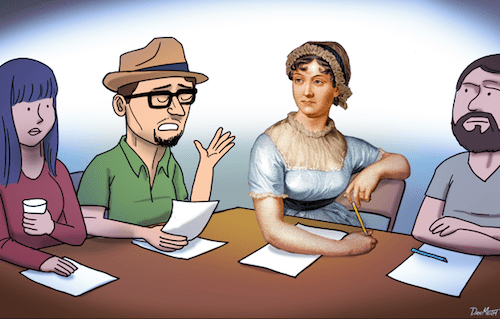
BuzzFeed contributor Shannon Reed came up with this wonderful piece, in which a bloke in a Writers’ Workshop commented on ‘Pride and Prejudice’. Any of you who are writers and are part of such a gathering will recognise his type instantly, sitting there in his hat, glasses, and beard, reading out his epistolarily-framed critique. I gave in to a whim and penned Jane Austen’s reply. So below you will find Shannon Reed’s original, and my rapid response in the persona of Jane Austen. Enjoy!

Dear Jane,

I don’t usually read chick lit, but I didn’t hate reading this draft of your novel, which you’re calling Pride and Prejudice. I really liked the part where Elizabeth and her aunt and uncle went on a road trip, which reminded me of Chaucer’s Canterbury Tales (also about a road trip — check it out!). Anyway, good job. I do have a couple of notes to share, in the spirit of constructive criticism.

So, a big question I have is “Why?” Why does Elizabeth do the things she does? Why does Mr. Darcy do the things he does? Why does Mrs. Bennet do the things she does? Have you read Hamlet? I feel like you could really learn something from how Shakespeare (the author) has Hamlet tell readers why he’s doing the things he does.

Another problem I noticed: Mr. Wickham (great name, by the way, evoking both a strong but flexible plant, and an earthly, bestial pig) is in the army, but you don’t make use of that. What if Mr. Wickham, instead of just being sort of a scoundrel (Again: why?), is a scoundrel because he’s suffering from his experiences in the war? (Which war, btw?) That way he could tell Elizabeth about it, and we would be able to see that she’s not just an independent young woman, but also a really good listener. He could tell some jokes, too, to liven up the mood, and show that Elizabeth has a good sense of humor. This could be the middle section of the book, like five or six chapters in there.

Also, why five sisters? How about just two? Combine Jane and Kitty. Or, better, make one of the sisters a brother (named “Jim,” maybe?), and then he could be the narrator who mentions his sisters from time to time! Like Hamlet!

While I’m on the sisters, is it just me, or does everyone treat Kitty really badly? Personally, I want to say “Huzzah!” to Kitty, and it’s annoying that everyone else — literally everyone else — wants to hold her back. Even you, I think— and, sorry, don’t mean to hit too close to home here, but… I’m just saying that I would totally court Kitty. She’s got a great sense of humor. But anyway, if you change her to Jim, problem solved!

A few other concerns: Mrs. Bennet is annoying, and you don’t have any people of color. Also, there aren’t a lot of men in this book. Only about the same number as there are women. I was thinking that what you could do is have Mrs. Bennet be dying, but give her a black best friend. Like Othello? (Have you read it? It’s also by Shakespeare, fwiw.) The Othello character could be her butler, maybe? There you go: three problems solved. You’re welcome!

I don’t know if you noticed this, but there’s a lot about hair ribbons here. Did you mean to do that? Maybe you could develop them into a kind of motif throughout, the way Shakespeare uses a skull in Hamlet? Maybe, when Mrs. Bennet is dying, she could ask to hold a hair ribbon? And Othello the butler could bring it to her, and tell her a story, or, better yet, get Wickham in there to tell her about the war. Oh! Perfect: just have Wickham, Jim and Othello talk about the war, while Mrs. Bennet lies unconscious in the background, holding a ribbon.

What do you think about Jim, Othello, and Wickham: Brothers in Arms as a title instead of Pride and Prejudice?

Anyway, while this isn’t something I would pick up on my own to read, I still enjoyed it more than I thought I would. Thanks for letting me take a look, and let me know if you need any more help with it.

Keep writing!

Tim

*

3630,Jane Austen,by Cassandra AustenMy dear Mr. Timothy, may I begin by saying I am obliged to you, sincerely, for the time and trouble you have taken over your critique. Also, sir, your kind offer of assistance with a re-draft is greatly appreciated, by one so recently arrived from Hampshire and yet to be fully sure of her place in society here (though surrounded by so much simple generosity of spirit). It is a truth universally acknowledged that a single lady in possession of a manuscript must be in want of a good beta reader, so I shall respond extempore to some of your salient points.

Your reputation, amongst our little circle of mutual acquaintances, for admirable frankness, is indisputable. I well recall your helpful comment to Mr. James, regarding one of his short stories – set in Norfolk, I believe. You challenged him thus: “What’s so scary about bedsheets, I mean, really?” Also your words to our Irish friend Mr. Joyce, when you opined that his novel fell “… somewhere between gonzo and mofo, and maybe too much of one and not enough of the other…” and also that you felt that his story arc lacked something by omitting the episode where the hero blinds the one-eyed giant.

By the way, I do notice that neither gentleman is here today, and that our feedback group, though quorate, is a little thin. I declare I have no idea why.

I do take to heart, Mr. Timothy, your suggestion regarding the Bennet siblings. I could, I suppose, recast my novel in a slightly more tragic mould, and have two of the sisters carried off by typhus. However, to my mind that would put at hazard the point of my essai, which is, after all, a douce satire on the station of women on the periphery of genteel English society – rather in the same vein as our colleague Ms. French’s work is of our station in American society. Yes? No? I believe this is something you may have missed, and although I am relieved that you did not hate my novel, I wonder if I could urge you to read it again. Persuasion is my forte, after all. It is not a work solely intended to be read by women, and although, again, I must thank you for the suggestion that I insert ‘Jim’ into the Bennet household, I have to say that such an amendment would mar the isolation of Mr. Bennet – an essential of the plot.

Ah – Shakespeare! Yes, modesty would normally forbid this, Mr. Timothy, but a friend of mine, who must remain nameless, actually likened the quality of my authorship to that of Shakespeare’s. I see the surprise in your expression, and I myself smile at the comparison, but suffice it to say that I am familiar with the writings of the bard. In fact I had already considered a sub-plot in which Mr. Darcy is the Colonel of Mr. Wickham’s regiment, and the latter being enraged by his commanding officer’s advancement of… of… of Mr. Bingley, provokes Mr. Darcy to a murderous jealousy by somehow placing one of Elizabeth Bennet’s hair-ribbons in Mr. Bingley’s possession. Much confusion, eventually resolved of course, but in fact I abandoned this as being a little too contrived. Oh, be assured however, Mr. Timothy, that I fully intend to continue my literary efforts.

I notice Ms. French is also absent today…

Well, would someone ring for tea?

A call for submissions for the Summer 2015 Showcase at ‘the zen space’

Fukuda_Suiko-No_Series-Peony_and_Bee-00034592-030708-F12a bee passes by
weighed with the gold of flowers
this buzzing morning

The Summer 2015 Showcase at the zen space is due to be published on the 1st of July. I’m opening it to submissions this time, rather than sending out invitations, and I’m looking for ‘buzz poetry’ – that’s my name for any haiku or short form of words that is in-the-moment, of-the-moment, expressive, thought-provoking, emotion-evoking, or just zen-cool.

I would like to hear from new contributors, though old friends are welcome too. Just visit the site, click on the ‘Submission’ tab, find the editorial email address, and send me something. It doesn’t have to be on any particular theme, so surprise me with your brilliance…

MM.

Claire Pellucida – a Fable

castleOnce there was a town. In the middle of the town stood a castle, and in the middle of the castle stood a high tower, and at the highest point of the tower was the chamber of a princess. Her name was Claire Pellucida, and the people of the town loved her, because she was pretty, and her eyes shone. They found her wise, because they would come to her and ask her what she could see from the window of her chamber, and she would tell them the most wonderful things. And the town itself was called Pellucida, in honour of its wise and pretty princess.

One day the people of the town assembled in the courtyard of the castle, and called up to the princess. “Princess Claire Pellucida, tell us what you can see to the north.”

The princess looked to the north, and said, “Far away I see mountains, with summits and pinnacles as sharp as needles. There are trees growing there, that are of solid silver, and on them hang fruits and berries that are pearls and hard diamonds. There is a river of clear crystal, like ice, that flows with such slowness. And in amongst the silver trees I see the glint of the eyes of ermines and foxes; and above the trees, on snowy wings, fly white birds like eagles, with silver beaks.”

The townspeople were amazed, and very happy that they had such a wise princess, who could see so far and tell them such wonderful things. But visitors from the north laughed at them.

“You Pellucidians are fools,” they said. “There are no such mountains to the north of here, no such trees, nor birds, nor animals, nor a crystal river!”

But the people of the town believed their princess, and one day, when Claire Pellucida had grown into a beautiful young woman, they assembled in the courtyard of the castle and called up to the princess. “Princess Claire Pellucida, tell us what you can see to the east.”

The princess looked to the east, and said, “Far away I see a forest, standing stark against the rising sun. The trees are an army of gigantic soldiers in a livery of black and dark green, and they roar in the wind, brandishing their long spears angrily, because they cannot march upon us.”

The townspeople were amazed, and very happy that they had such a wise princess, who could see so far and tell them such wonderful things. But visitors from the east laughed at them.

“You Pellucidians are fools,” they said. “There is no such forest of roaring giants to the east of here.”

But the people of the town believed their princess, and one day, when Claire Pellucida had grown into a handsome matron, they assembled in the courtyard of the castle and called up to the princess, “Princess Claire Pellucida, tell us what you can see to the south.

The princess looked to the south, and said, “Far away I see a land where the sands ripple as the sea does, and the mountains are like children’s bricks, stacked chequered – white limestone, red sandstone, pink granite. And the trees wave in the breeze, like many-fingered hands, and amongst them step lithe girls and boys in linen robes, gathering the amber fruits that hang on them.”

The townspeople were amazed, and very happy that they had such a wise princess, who could see so far and tell them such wonderful things. But visitors from the south laughed at them.

“You Pellucidians are fools,” they said. “There are no such mountains like children’s bricks to the south of here. Nor are there such waving trees with amber fruit.”

But the people of the town believed their princess, and one day, when Claire Pellucida had grown into a stately old woman, they assembled in the courtyard of the castle and called up to the princess. “Princess Claire Pellucida, tell us what you can see to the west.”

The princess looked to the west, and said, “Far away I see a peaceful sea of liquid silver, where the sun shines like copper. There is an island on that silver sea, and a great city on that island, with tall towers of yellow-veined marble, on which the copper sunlight glints, and shines, and dances. And upon that silver sea sail great golden dhows.”

The townspeople were amazed, and very happy that they had such a wise princess, who could see so far and tell them such wonderful things. But visitors from the west laughed at them.

“You Pellucidians are fools,” they said. “There is no such silver sea to the west of here. Nor is there such and island city, nor golden dhows.”

But the people of the town still believed their princess, as they had always done.

The night after she had looked to the west, and told the people of the town what she had seen there, Princess Claire Pellucida was wakened by a great glow outside the window of her chamber. She rose from her bed, and looked out of her window, to the west. There was the silver sea, the copper sunset, the island with its city of yellow-veined marble; and more marvellously, a silver river was running from the silver sea right to her castle. And on that silver river was a great, golden dhow. And on that great, golden dhow stood tall mariners and fine ladies, all dressed in saffron cloaks sewn with golden-thread. There were circlets on their heads of interwoven white gold and yellow gold, and torques of copper round their necks and wrists, and rings of gold upon their fingers. And they saluted and bowed, and called out to the princess.

“Princess Claire Pellucida, come down and sail with us to the island in the silver sea; for the island city with its towers of yellow-veined marble, has need of a queen to rule it.”

So Princess Claire Pellucida came down from her chamber in the highest point of the tower, in the centre of the castle; and she sailed away with the tall mariners and fine ladies, to the sunset, to the silver sea, to the island city with its towers of yellow-veined marble. And there she ruled as their Queen for ever.

But that is not the end of things.

The next morning, the people of the town of Pellucida gathered in the courtyard of the castle, and called up to their princess. But she did not answer. One brave townsman entered the castle, and climbed the tower, and from the window of the chamber at its highest point, he called sadly for five of his friends to join him.

In the chamber, the six men stood, and looked down at the bed, on which lay Princess Claire Pellucida. She lay smiling and peaceful, as though she slept, and in her face the six men could see the fleeting prettiness that had been there when she was a girl, the beauty that had been there when she was a grown woman, the loving gentleness that had been there when she was a matron, and still, still the stately splendour of their dear princess in old age lingered also. But they knew that she was not sleeping. She had left them, and was dead.

But even that is not the end of things.

The six men carried her, with great sadness and reverence, down to the townspeople, and they all processed solemnly out of the town, and laid the body of the princess – as was their custom – a mile away, in the great, open wilderness that surrounded the town for mile upon mile, for the wild beasts and the birds to devour.

But even that is not the end of things.

The townspeople continued to tell stories to their children, of all the wonderful things that the princess had seen from her chamber in the castle tower, and of all the things she had told them. The children believe the stories, and worshipped the tower where the princess had lived. They told the same stories to their own children. These children did not believe them, but still they told the same stories to the next generation. The children of that next generation believed nothing at all, except what travellers from the north, from the east, from the south, and from the west told them.

And who knows if that is the end of things!

golden 2

__________

I’m thinking of putting together a collection of my short stories – most of which you have not seen here on the web site, and presenting them for publication. What do you think? If you would like to read through the short stories that I have published so far on this web site, please click here.

M

A Wave of Scottish Monarchs

David I, King of Scots

I wrote this piece of nonsense doggerel in 2010 especially for Visit Scotland (formerly the Scottish Tourist Board). I have no idea whether they ever used it at all. I had a mind to do it when I recalled the famous old jingle that listed the Kings and Queens of England. It began in 1066 with

Willie, Willie, Harry, Ste,
Harry, Dick, John, Harry 3

and continued till the end of the 19c with

Willie and Mary, Anna Gloria,
Four Georges, Willie, and Victoria.

Well, we had nothing like it for the Kings and Queens of Scots, so I just piled in. It’s all in fun, so enjoy!

© 2010 Marie Marshall

© 2010 Marie Marshall

In case you’re wondering…

It must seem to my regular readers that nothing much happens in my literary life. I have no whistle-stop tours of signings and readings, no local radio appearances and so on to report. However, I’m far from inactive, and the notion that nothing happens couldn’t be further from the truth. So what is happening?

writing-clipart-1Well, firstly I am writing a new novel, or rather one that I had had some notes for a while ago but had shelved while I finished From My Cold, Undead Hand and the sequel KWIREBOY vs VAMPIRE. It would be difficult to say at this stage what it is ‘about’, because I am trying to walk a tightrope between experimenting with form and style and producing something that is readable. For a while now I have been taking part in discussions, notably with Millie Ho and her blog-followers, about… well… how to write. Millie has some brilliant ideas, and if I take issue with many of them it is merely because they stimulate thought. One topic in particular has been that of working towards an ending, and my concern is that literature has been stuck in a pattern that has lasted for centuries, if not at least a couple of millennia, going back to the concept of ‘catharsis’ in classical Greek drama. What this has meant for fiction is that it has largely resisted major innovation, and that it is alone as an art form in doing so. I have written on this subject before. Fiction, pretending to give us a narrative progression from a beginning to an end, more often than not is driven by that predetermined end in a way that life is not – ‘Destiny does not send us heralds,’ said Oscar Wilde in The Portrait of Dorian Gray, and neither should the writer of fiction be obliged to function as some kind of prescient, wiser than the rest of us. As readers we ought to be able to cope with fiction that hands us a slice of life to look at, and the knowledge that life continues after that slice is finished.

In our discussions we have been looking at the problem of how to give a novel ‘closure’ – giving the readers the sense of its completeness – without necessarily having a structural ‘resolution’ driven by the dictated need for catharsis.

For my current novel project (working title The Deptford Bear) therefore, I have a probable direction of narrative travel rather than a definite ending in view. I can see where the narrative may possibly lead, but I am open to the journey of exploration taking a turn and leading instead to somewhere unexpected. For this reason, and because it’s the way I actually enjoy writing, I haven’t been plodding, chapter-by-chapter, from the beginning. I have been writing ‘episodes’ in an almost random order, which I will sew together later. I have been writing from inside the head of the protagonist, hopping from happening to colourful happening in her life. An added challenge is that the whole of her story is being told to a third party – a Scotland Yard detective – and there is probably a lot she is holding back, even from the reader. The story has a strong element of ‘detective mystery’, though whether the mystery will be cleared up when the novel closes is another matter. It has elements of ‘steampunk’, being set in a Victorian London where nineteenth-century history is telescoped or concertinaed in on itself, ‘Montgolfier’ balloons traverse the city from mooring-tower to mooring-tower, and messages are passed between police stations by a vast, steam-driven network of ‘Lampson’ tubes. But how much of this is real, and how much is in the imagination of the protagonist is hard to say. She is, apparently, an amnesiac, and has a strange way of relating to the world, and of expressing herself, learned since she lost her memory as a child; she is a clairvoyant who admits to being a mountebank but who might be genuinely psychic; and she may be something much, much darker than that. Her London is peopled not only with thieves and murderers, toffs and paupers, but with hawkers and buskers, with carnival people and mummers, perhaps with monsters and changelings, and is haunted by one sinister, silent figure – the ‘Deptford Bear’ himself, a creature of deep ritual significance. Or is it she who is haunted rather than the city?

Regular readers of the blog section of this web site will know that I have other novel ideas on my shelf, for which I have written sketches. It’ll be The Deptford Bear I’ll be working on for the foreseeable future, and the others will remain on the shelf. I’m up to about 15,000 words so far.

Secondly, work continues on turning my short story Axe into a film or TV script. I have provided some extra narrative material, and a Scottish screenwriter is currently working on it. I have seen his summary of how he would like to tackle the dramatisation, and the first draft of the opening, and it is developing in quite an exciting way. To go back to the matter of how to end a piece of fiction, those of you who have read the short story will notice that it did not ‘resolve’ in any conventional way; the extra narrative material I have given, along with the creative input of the screenwriter himself, perhaps a little more of a conventional resolution. Nevertheless, this is an exciting project and something totally new for me.

Thirdly, other stuff. You will no doubt remember that my short story Voices was amongst the winners at the Winter Words festival a few months ago. Well, as often happens, that win gave me a boost, and I have already written two further macabre short stories, and sketched out a third, which will fit well as entries for next year’s competition, and the year after that… and the year after that. Also I’m preparing some new poetry for a forthcoming anthology.

So, although my blog section here isn’t full of a mad social whirl, inactive I am not. I’ll keep you all posted.

More Veronica Franco

Click here, or click the image below, to be taken to Sappho’s Torque, the blog of Angélique Jamail, who this month is featuring a different poet every day. This particular link will take you to a brand new poem of mine, not published anywhere else, from my ‘Veronica Franco’ series.

VeronicaFranco